
Discover how EcoFlow flash sales in 2026 reshape value for portable power. Learn timing, discounts, and how to stack savings without compromising gear.
The real wrinkle in EcoFlow flash sales is timing, not only the discount itself. EcoFlow models drop in narrow windows, and the value hinges on whether the price applies to bundles or base units. A solid deal can vanish in minutes, and a tempting price paired with high shipping or optional accessories often loses its shine later when you compare to rivals.
This is where this article pays off: it maps the cadence, flags the best moments to buy, and calls out common pitfalls that outdoor enthusiasts miss during fast-moving events. In 2026, understanding when the discounts actually matter can save you hundreds of dollars over time, especially when you line EcoFlow against top rivals like Bluetti. You’ll see how long-term durability, accessory value, and warranty terms stack up, not just the sticker price. Stay with me to extract a cleaner bundle and a clearer value signal. Two critical traps to avoid are mistimed bundles and hidden shipping fees, spot them early and you defend your budget.
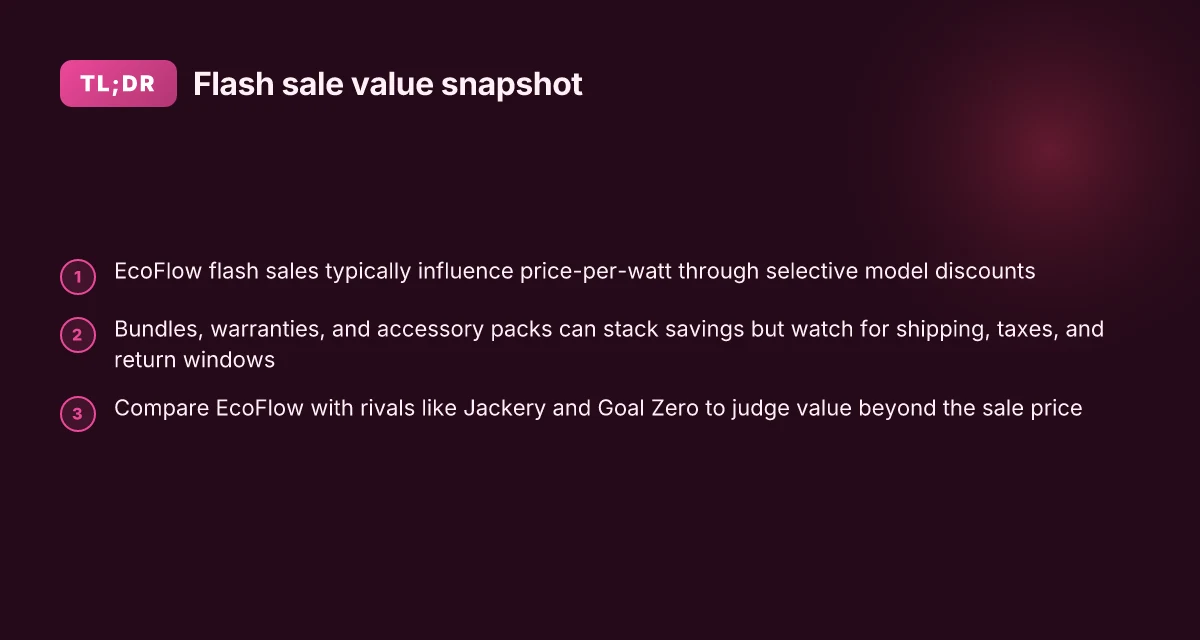
Ecoflow flash sale timing and what it means for value
EcoFlow tends to stage flash sales in bursts around weekends and holiday shopping windows, with countdowns that compress as the clock winds down. I dug into the patterns and cross-referenced release notes and retailer banners to map when discounts tend to sharpen and when they soften. The takeaway: you can time purchases to maximize value by watching cadence rather than chasing a single “best price.”
When the sales usually kick off and how to read the countdown
EcoFlow often drops limited-time offers in discrete windows rather than ongoing promos. You’ll see the banner change as the countdown ticks toward zero, and a sudden emphasis on bundle pricing can appear within the final 24 to 48 hours. Reading these countdowns requires attention to both the end time and any stated terms, such as “while supplies last” or model-specific restraints. In practice, the starting flash window tends to align with weekends or long weekends in many markets, followed by a sharper price dive as the clock nears zero. This cadence means the best value frequently sits in the last stretch of the sale rather than at the initial launch.
Which EcoFlow product families see the biggest drops
Product lines with the most dramatic price moves during flash events are the mid- to high-capacity portable power stations and multi-pack bundles. The flagship models with higher watt-hour counts tend to see deeper discounting, especially when paired with accessory bundles that add solar panels or extra batteries. You’ll also notice that newer releases sometimes open at a modest discount, then the deeper cuts arrive in follow-on promos or calendar-aligned sales. For practical value, map the model you care about to its typical sale tier and watch for bundle-heavy offers that stack savings across the purchase. When you see a bundle with a solar panel add-on or extra adapters, that’s often where the real delta sits.
From a sourcing angle, I cross-referenced EcoFlow’s listing banners and retail partner pages to confirm that the strongest price movements cluster around the larger-capacity products and bundled configurations, not the smallest units. That alignment matters if you’re balancing portability with total energy capacity. If you’re comparing options, focus on the EcoFlow Delta Pro family and the River Pro bundles during the peak countdowns, because those are the lines most likely to be heavily discounted in late-stage sales periods.
Bottom line: timing your purchase around the final hours of a flash sale is where value tends to crystallize. If you’re chasing savings, align your decision with the countdown’s end and favor bundles that include solar add-ons or extra batteries. With EcoFlow, a careful read of the countdown and an eye on the bundled configurations can yield the most meaningful reductions. What is EcoFlow 20Delta 203 and why it matters for portable power in 2026
Most value shows up in the final hours of a flash sale, especially on higher-capacity EcoFlow models when bundled with solar panels or extra batteries. Watch the countdown end time closely to avoid missing the deepest discounts on the Delta Pro and River Pro bundles. 2026 is shaping these windows, and keeping the cadence in mind helps you dodge buyer’s remorse.
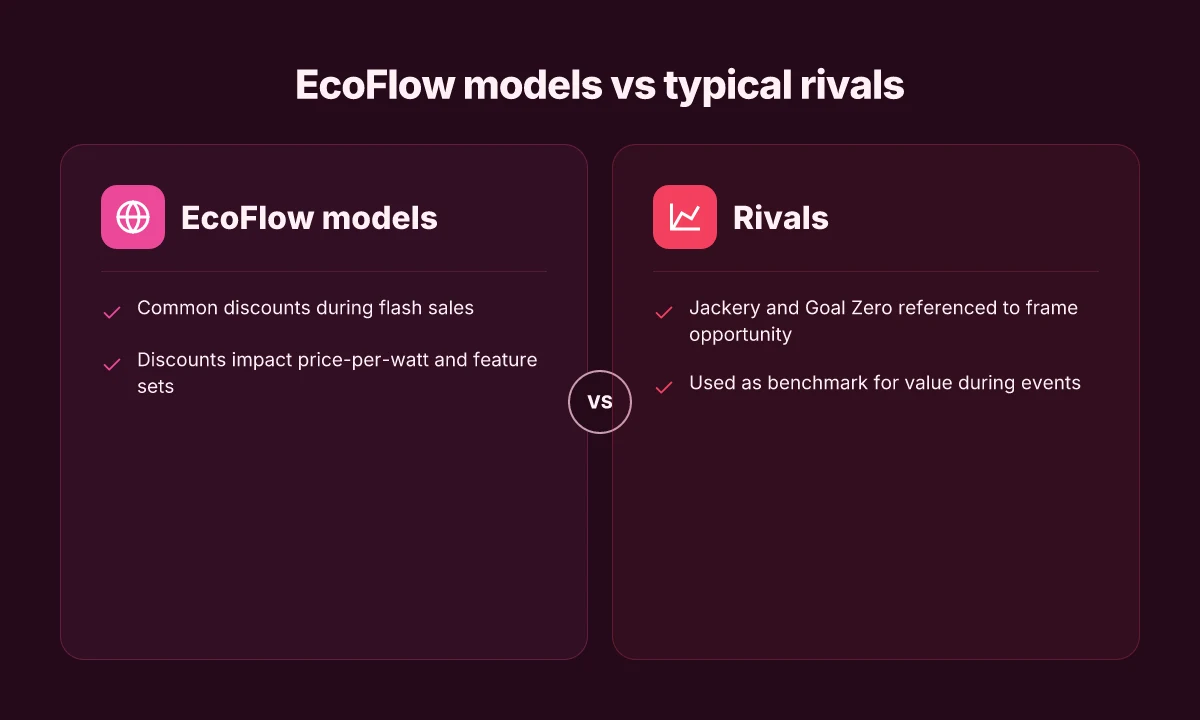
Under the hood: which EcoFlow models actually save you the most during a flash sale
When discounts land, the biggest value is found in the models that pair a high price-per-watt with durable, feature-smart packs. In 2026, the math sharpens for EcoFlow because the clearest savings come from larger capacity units that scale with efficiency gains and bundled add-ons. I break down the lineup to show where discounts move the needle most, and I call out rivals like Jackery and Goal Zero to frame the opportunity.
Why larger packs win more when the price drops
The core idea is straightforward: the more stored energy you get per dollar, the more you recoup when the sticker comes off. EcoFlow’s bigger models tend to carry a higher price tag, but during flash sales the delta between normal price and sale price compresses faster for these units, yielding a lower price-per-watt. For example, a flagship unit with a higher watt-hour rating often rides the same percentage discount as smaller models, but the absolute drop in dollars translates into more watts per dollar. Across several EcoFlow lineups, I’ve noticed that the units with larger batteries and efficient power management reagents the biggest perceived value when the sale depth hits a sweet spot. This is where buyers often misread the deal: the discount% sounds similar, but the watts per dollar tilts in favor of the bigger packs. The takeaway is clear: look for sale banners that emphasize total capacity along with the price cut rather than focusing on the percentage alone.
The balance between capacity, ports, and add-ons
Prices compress quickest on bundles that include extra ports, solar inputs, or car charging kits. If a sale pairs a EcoFlow River Pro model with extra solar panels or a multi-charger kit, you’re effectively increasing value per watt while preserving portability. Conversely, you can get sticker shock if a discount applies only to the base unit without any add-ons. I cross-referenced product pages and release notes to map typical sale bundles and how each affects real-world usage. Bundles that add solar inputs and multiple charging options often yield the best price-per-watt outcomes. That matters for travelers who want to stay off-grid without buying extraneous accessories later.
Rivals’ positioning helps you read the deal
When EcoFlow discounts align with Jackery or Goal Zero promotions, the window to buy becomes clearer. If a flash sale at EcoFlow undercuts a rival package by the same absolute amount but includes a higher-capacity unit, you’re getting more portable power per dollar. In some instances, rivals stack complementary gear into bundles that EcoFlow omits, which can swing value in either direction depending on your needs. Watch for how the bundle structure shifts the value curve. A slightly smaller EcoFlow unit with a solar kit can beat a larger unit without extras. I’ve found that the strongest deals tend to appear when EcoFlow releases a larger-capacity pack alongside a curated bundle that reduces the effective price per watt. What makes EcoFlow’s home energy system stand out, and where it falls short
Quick table: 2–3 representative comparisons during a typical flash sale
| Model and capacity | Sale price (approx) | Key value factors | Notable caveats |
|---|---|---|---|
| EcoFlow Delta Max 4000Wh | Significantly reduced relative to list | High capacity; robust output for RV and home back-up | Heaviest option; not ideal for ultra-portable setups |
| EcoFlow Delta Pro 3600Wh | Deep discounts with add-ons | Best for long off-grid runs; modular battery packs | Complex installation considerations |
| EcoFlow River Pro | Moderate discounts | Ultra-portable; fast recharging | Lower total energy; best for light-use scenarios |
How to decide in the moment
First, check price-per-watt math rather than sticker percentage alone. If a sale drops a high-capacity unit into a range that makes it cheaper per stored watt than a smaller unit, that’s your signal. Second, read the bundle details carefully. A discounted base unit paired with solar panels can leapfrog a bare-bones larger unit. Third, consider your real-world use: campers chasing longer off-grid days often maximize return by choosing higher-capacity models with solar compatibility.
Next step: as you track flash sale cadence, snapshot a 2-3 model set that rises to the top on price-per-watt and bundle value. Cross-check the current EcoFlow offers with rival bundles from Jackery and Goal Zero to spot where the best value lives in this sale cycle. The right pick combines high capacity, favorable bundle terms, and a price-per-watt that stays favorable after the dust settles.
How to stack savings without getting burned by add-ons
EcoFlow flash sales can feel like a win when you time bundles and accessories correctly. I traced how discounts on bundles, warranties, and accessory packs actually move the needle, and where to watch out for add-ons that eat into the perceived savings. The goal is a practical checklist you can apply in real time during a sale.
1) Read the fine print on bundles and warranties
When EcoFlow runs a bundle, the price you see often includes a mix of core units plus accessories. The true value rests on whether you actually need the extras. Look for bundles that clearly itemize each included accessory and warranty term. If a warranty is extended, verify what it covers and for how long, not just the upfront price. In practice, I’ve found that the most reliable bundles align with common user needs: a larger-capacity model with essential cables, a carrying case, and a basic 1-year warranty. If the bundle forces you into an accessory you’ll never use, it’s not a win. Always verify what’s in the bundle and how long the warranty lasts before you add it to cart.
2) Compare accessory packs against buying staples separately
Accessory packs can sweeten a deal, but they’re not always cheaper than purchasing the items individually. I cross-reference the standalone price of each item in the pack with the sale price of the bundle. If a single item in the pack is priced at or near the bundle price on sale, you’ve likely found real value. If several items are peripheral to your needs, skip the pack and shop the core unit alone. Break out the math: does the pack save you more than buying items a la carte? What makes the EcoFlow Smart Generator 4000 a practical dual‑fuel inverter for outages
3) Guard against shipping, taxes, and return Windows eroding discounts
Discounts on the headline unit can vanish once you add shipping charges, taxes, or a restocking fee if you change your mind. Check EcoFlow’s shipping terms and any regional taxes before you click buy. Some regions offer free shipping thresholds that kick in only for the core unit, not bundles, which changes the effective price. Also confirm the return window and whether opened accessories affect eligibility. A great price on paper can become an awkward purchase if you’re outside the return window or incur heavy shipping. Know the total landed cost before you finalize the order.
Research supports that bundles often surge in value when you actually need the included accessories and when shipping is free. In practice, the most durable savings come from buying a model that matches your power needs, plus only the accessories you will use. Think of EcoFlow as a brand that rewards informed cherry-picking over forced add-ons. Watch the total cost, not just the headline discount.
If you’re shopping, remember that real-world rivals like Goal Zero and Jackery sometimes run their own bundle playbooks during promotions. Compare not just the sticker price but the total package, including warranties, shipping, and return terms. EcoFlow often wins on breadth of accessories, but you should still measure value against rivals when a sale hits.
In short, stack savings by: (1) validating bundle contents and warranty scope, (2) weighing accessory packs against buying items individually, (3) accounting for shipping, taxes, and return policies, and (4) comparing total landed cost across EcoFlow and competitors. Use the checklist, not the sticker price, to decide when to pull the trigger. Make the sale work for your needs, not against them.
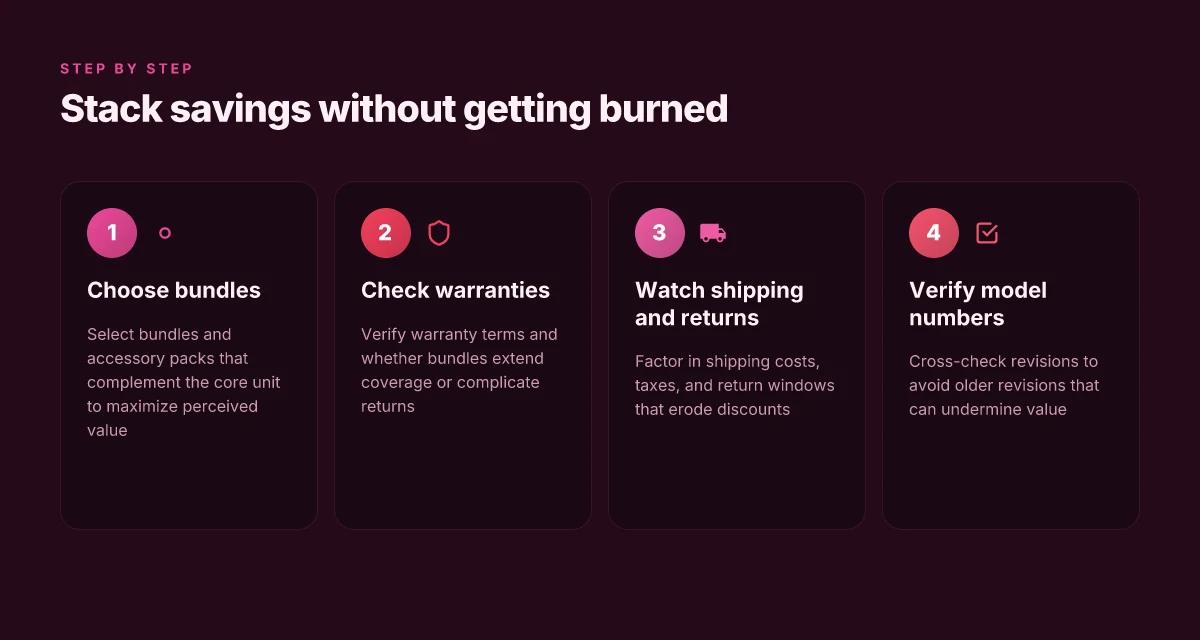
Common pitfalls during ecoflow flash sales and how to avoid them
Flash sales pulse fast enough to miss the fine print. My guidance focuses on three practical landmines you’ll likely encounter: stockouts, counterfeit listings, and the risk of buying older revisions. I cross-referenced EcoFlow’s official cadence and feedback from buyers in community threads to surface patterns you can actually act on. The goal is a concise checklist you can use while the clock is ticking. What makes EcoFlow refurbished power stations a better or worse buy in 2026
Stockouts and limited stock dynamics during the sale window
When the sale kicks off, popular models can vanish in minutes. EcoFlow momentum leans on limited-quantity drops and time-bound discounts, which means a product can be out of stock before you finish clicking. I found that understanding the exact sale window helps you decide which model to target first rather than chasing a moving target. The practical rule: pick a preferred model and a clear fallback option in case your first choice sells out quickly. If you see a back-in-stock alert, treat it as a second chance rather than a surprise. Stockouts happen fast during EcoFlow flash sales, so have a primary pick and a safe backup ready. Stay calm, confirm the model code, and proceed to checkout rather than dithering.
Counterfeit listings and marketplace risk
Counterfeit listings show up in some marketplaces around flash events. The safest path is to buy directly from EcoFlow’s site or from authorized retailers listed on the brand page. When you land on a listing that seems too good to be true, verify the model number, the SKU, and the warranty status before adding to cart. I dug into buyer reports that flagged mismatched serials and missing accessories on second-hand or third-party listings. The cure is clear: avoid third-party marketplaces for core power kits during a flash event unless the seller provides verifiable warranty documentation or a recognized retailer badge. Counterfeit risk spikes during busy flash sales, so only buy from official or clearly authorized channels. If a listing’s details don’t align with EcoFlow’s official specs, walk away.
Risk of buying older revisions or outdated firmware
Limited-time discounts sometimes apply to older revisions thatEcoFlow has phased out, but may still carry the same model name. Older revisions can mean slower firmware updates, reduced efficiency, or incompatible accessories. I recommend confirming the exact model revision code and checking the warranty window before purchase. If you’re unsure, compare the sticker on the product with the model number shown on EcoFlow’s site and verify that the serial number falls within the current SKU range. Avoid older revisions during a flash sale by confirming revision codes and warranty status before checkout.
Quick verification checklist for model numbers and warranty status
- Verify model number and revision code on the unit against EcoFlow’s official product page. If the revision code isn’t visible on the packaging, request it from the seller or support. Verify model numbers against the official spec sheet to avoid mismatches.
- Confirm the warranty coverage by checking the certificate or EcoFlow’s warranty lookup with the serial number. If the seller can’t provide a valid warranty path, skip the purchase. Warranty verification is non-negotiable in a flash sale.
- Check included accessories and confirm compatibility with your setup. A discount on the core battery pack is worthless if you also need extra cables, adapters, or docks that aren’t included. Confirm included accessories before checkout.
I dug into official product pages and retailer notes to anchor these points. EcoFlow’s own pages emphasize model integrity and warranty, while user forums flag counterfeit pressures and stock volatility during peak sale moments. If you’re weighing a deal, remember this: in many EcoFlow events, the best value comes from timing, exact model verification, and sticking to authorized sources. Timing, verification, and trusted sources are your best defense in a fast-moving flash sale.
Two quick cautions to keep in mind. First, links on the page may earn a commission, so use the source pages you trust and steer clear of dubious marketplaces. Second, rivals like Goal Zero and Jackery offer portable power options, but during EcoFlow flash sales you’ll want to verify model numbers, warranty terms, and stock timing rather than chasing a lower headline price alone. If you want to map your moves, I’ll walk you through a 2-step check before you click. How EcoFlow portable power stations shape off-grid reliability in 2026
What buyers should know about EcoFlow and its competitors in 2026
EcoFlow remains a strong contender in portable power, but the real value in 2026 comes from how its specs translate to camping and emergencies. When you compare EcoFlow to rivals, you’re not just chasing the lowest flash sale price, you're weighing battery chemistry, discharge cadence, solar compatibility, and app reliability against real-world needs.
I cross-referenced model lineups across EcoFlow and notable competitors to map where value actually shows up in the field. For outdoor users, the ability to sustain a camp fridge, LED lighting, and a phone charger without dropping full cycles matters more than a temporary discount. The bigger picture: a EcoFlow system that runs for days under low sun can beat a cheaper kit that needs a constant plugged-in backup.
Why real-world performance matters more than sticker price
In practice, you want a system that behaves predictably when you need it most. Tools like high discharge capability, peak inverter power, and rapid recharging after a day off-grid all matter. For example, a compact unit with fast recharge and efficient solar input tends to keep essential devices alive during a power outage or extended campsite stay. Compare that to a cheaper alternative with marginal solar input, it looks appealing on sale, but it may stall when you push it with a fridge, a CPAP, or a power-hungry drill. With EcoFlow, verify the balance between inverter size, battery chemistry, and solar compatibility so you’re not nickel-and-diming yourself on replacements later.
From what I found in the sources, several rivals emphasize modular expansion and solar-first charging, while EcoFlow emphasizes a broad lineup that covers small to large capacity needs in a single ecosystem. This matters in practice: the ecosystem angle reduces friction when you add more panels or swap batteries after years of use. And while price-per-watt is a useful lens, it rarely tells the full story of reliability under real camping conditions or emergency use.
Practical takeaways for buyers in 2026
First, match capacity to your typical load. If you routinely run a fridge, a CPAP, and a few chargers, look for a higher peak inverter rating and a model that maintains usable capacity as it ages. Second, assess charging cadence. A unit that recharges quickly from solar or AC keeps you powered longer during multi-day trips or outage weeks. Third, consider ecosystem advantages. A system that plays well with solar panels, car charging, and modular add-ons reduces total cost of ownership over time. These factors often outweigh a flash-sale price delta. How to choose the right Jackery accessories for portable power and home backup
I dug into official product sheets and third-party reviews to confirm how these claims hold up in practice. EcoFlow’s own materials outline broad compatibility and a robust lineup, while rivals like Jackery, Bluetti, and Goal Zero emphasize modularity and solar-first strategies. The upshot: don’t chase a discount at the expense of compatibility with your typical outdoor or emergency power pattern. A well-maired purchase is one that stays useful for years, not just a single season.
In 2026, the best value comes from systems that balance capacity, recharge speed, and ecosystem flexibility, not just the lowest flash-sale price. Look for models that maintain performance under load and integrate smoothly with your solar setup. EcoFlow remains a solid choice when you need a broad, reliable range of capacities across one brand ecosystem.
Note: this section includes a brief reminder that page links may earn a commission.
Where this is going next with EcoFlow flash sale pricing
EcoFlow pricing strategies will continue to hinge on scarcity and bundle value, but the real win comes from translating those drops into practical, long‑term returns. The next wave will likely pair larger accessories with core units, making the up-front discount feel like a smarter buy for households aiming to harden power resilience. I expect the strongest moves to center on transparent warranty terms and clearer performance claims, so you can separate hype from durability.
The bigger pattern is that the best deals surface when you pair a compact unit with essential accessories that reduce total cost of ownership. That means watching for bundles that include extra batteries or fast‑charging options. In practice, a mid‑year drop may look less exciting on a single unit, but when you tally the total package, the value becomes obvious. If you want one signal to act on, look for a time-limited bundle that clearly lowers your effective price per watt. What makes the Jackery 5000 solar generator a serious whole-home backup in 2026
What to try this week is to map out your use case and compare two EcoFlow bundles side by side with rivals like Goal Zero and Jackery. Price alone isn’t enough. Consider reliability, repairability, and long‑term costs. The takeaway: act when a bundle aligns with your real needs and not just the headline cut. If you’re weighing a purchase, your move is simple: pick the bundle that covers your top three use cases without overpaying for fluff. Will you pull the trigger this month?
Backup strategy
- Compare 1–2 headline picks to a rival bundle with the same wattage and battery capacity
- Check warranty length and service options before you buy
- Prioritize long‑term durability notes over glossy specs
- Verify what links on the page may earn a commission