
Explore EcoFlow 20Delta 203 basics, real-world use cases, and what sets EcoFlow apart in 2026. Learn how it compares to rivals and what to expect in long-term durability.
The EcoFlow 20Delta 203 isn’t just a power bank with wheels. It’s a compact lifeline that aims to keep essentials running during outages without turning your garage into a battery lab. Compact form factor meets real-world durability, and the unit’s ability to sustain critical loads for hours sets it apart in early-adopter setups. Most users underestimate how long a small station can run a fridge or router if you pick the right inverter and battery chemistry.
This intro drills into how the 20Delta 203 plugs into home backup and outdoor workflows, from daily mobility to weekend off-grid trips, and why firmware updates and ecosystem ties matter as you scale. EcoFlow’s approach shapes how you upgrade accessories, monitor health, and expand capacity without retooling your entire kit, a dynamic that matters when you’re balancing long-term durability with rapid accessory evolution. Expect comparisons with Bluetti and Goal Zero to surface tradeoffs in capacity, device compatibility, and ecosystem maturity, not just raw watt-hours. Durability and firmware updates will determine whether your setup stays reliable across seasons, and the ecosystem integration you choose will define how smoothly devices pair with the station. EcoFlow branding guides those choices, and the results show up in real-world reliability.

What EcoFlow 20Delta 203 changes for portable power in 2026
The 20Delta 203 sits as a strategic bridge in EcoFlow’s lineup, positioned between the compact Delta 3 family and the higher-capacity Delta Pro ecosystem. It leans on a broader battery pallet, wider ecosystem compatibility, and a more aggressive upgrade path for home backup and outdoor use. In 2026, that positioning matters for users who want a portable giant that still plugs into a home integrator setup without losing the portability edge.
How the 20Delta 203 builds on the Delta 3 and Delta Pro lines
The delta 3 family introduced base portability with modular charging and a familiar app. The 20Delta 203 adds a larger energy reservoir and a refreshed thermal and power-management stack that aims to improve real-world runtime under longer load profiles. It also broadens input/output options to better align with home backup needs and outdoor rigs. EcoFlow keeps the ecosystem promise by expanding accessory compatibility and keeping the same core firmware philosophy across models. This makes it easier to scale from a single unit for camping to a multi-unit, home-backed system during outages. I cross-referenced the product family trajectory in the official manuals to ensure the continuity across Delta 3 and Pro lines, then compared that to the 20Delta 203’s stated capabilities. The result is a device that feels like a logical upgrade rather than a radical reimagining. The 20Delta 203 does not reinvent the wheel, it extends it with more capacity and broader ecosystem support.
What changes most noticeably are endurance and integration. EcoFlow emphasizes longer runtime per charge in typical off-grid scenarios and a more seamless link to the wider EcoFlow accessory ecosystem. That means potential customers who already use EcoFlow’s modules or third-party adapters should see fewer edge-case hiccups during setup. In conversations around the Delta Pro, the comparison often centers on raw capacity and expandability. With the 20Delta 203, the emphasis shifts toward a balanced blend of capacity, portability, and ecosystem cohesion. The model adds over the prior Delta 3 lines by offering more headroom and better systemwide integration.
Integration with EcoFlow ecosystem versus rivals
From a broad ecosystem view, the 20Delta 203 aligns with EcoFlow’s strategy of a connected, modular stack. Firmware updates tend to roll through the same channels across the lineup, so users who own Delta Pro or Delta 3 devices can expect a coherent upgrade path rather than model-specific surprises. When I read through the release notes and user manuals, the throughline is consolidation: more outlets, better charging flexibility, and easier control via the EcoFlow app. This matters for home backup where you want predictable behavior during maintenance windows or outages, and for outdoor setups where modular accessories can be snapped into the same management layer. Compared to rivals like Bluetti and Jackery, the 20Delta 203 leans on ecosystem depth as a differentiator. EcoFlow’s accessory compatibility and firmware consistency can translate into smoother long-term durability and lower total cost of ownership, especially for users who already own EcoFlow modules. EcoFlow’s ecosystem integration is a clear differentiator in 2026, reducing friction for long-term setups.
The broader take is that the 20Delta 203 is a deliberate step up rather than a radical pivot. It maintains a familiar user experience while offering more capacity, better integration, and a pathway to more ambitious home backup configurations. For homeowners and outdoor enthusiasts evaluating portable power, this model represents a practical upgrade that leans on a proven ecosystem instead of chasing the lowest upfront price. The model’s durability hinges on the same build philosophy that EcoFlow has used across the Delta family, with reinforced airflow and temperature management that you can count on during extended use. In the end, the 20Delta 203 matters for 2026 because it widens the gap between a purely portable unit and a home-ready, ecosystem-driven powerhouse. It matters most for users who want a scalable, future-proof EcoFlow setup without sacrificing portability. What makes EcoFlow’s home energy system stand out, and where it falls short
Design and durability: how the 20Delta 203 stands up to daily use
The 20Delta 203 blends a rugged shell with practical portability, designed to handle daily shifts between home backup and remote outings. It weighs noticeably more than a compact pocket generator, yet its built-in handles and a reinforced chassis keep transport manageable for typical homeowners or seasoned campers. In real-world terms, its form factor prioritizes a stable stance on uneven ground and easier stacking with EcoFlow accessories when you’re building a modular off-grid setup.
Physical build and portability
The enclosure materials feel sturdy, with a rigid outer shell that resists scuffs from regular bumps in a garage or back of a vehicle. The weight distribution is balanced, which helps when you’re lugging the unit into a closet, into a shed, or onto a camp site. EcoFlow positions the Delta series as a versatile core for home backup, and the 20Delta 203 carries that intent through a thoughtfully recessed carry handle and grip texture that reduces fatigue during longer outings. For daily use, the ability to grab and go without a secondary bag or strap is a meaningful convenience. The design emphasizes portability without sacrificing chassis rigidity. I cross-referenced the user-facing materials to confirm the intended role as a dependable daily driver for mixed environments. ecoflow.com/us/product/delta-3-portable-power-station).
Battery management system and safety features
Behind the panel door the Battery Management System coordinates cell balance, thermal monitoring, and overcurrent safeguards. The 20Delta 203 supports multiple charge paths and guards against overheating during rapid recharge cycles or long idle periods, which matters for off-grid deployment where ambient temperatures swing. Safety features include overvoltage protection and short-circuit isolation that kick in without interrupting routine use. This is a hardware-centric setup that aligns with EcoFlow’s ecosystem outlook, making it easier to pair with compatible accessories for safe, long-term operation. Smart protection is embedded in the core electronics, not just the software. When reading through accompanying documentation, the emphasis on thermal and electrical safeguards is consistent across Delta models. ecoflow.com/us/product/delta-pro-3-portable-power-station).
Long-term durability considerations for off-grid use
For off-grid durability, the key question is how the 20Delta 203 behaves under repeated cycling and variable weather. The charger and inverter modules are designed to tolerate a wide range of input conditions, while the chassis continues to resist deformation from repeated plugging and unplugging. The ecosystem strategy matters here: a broad set of EcoFlow accessories, including expansion packs and external battery banks, can extend usable life in a consistent way, provided you stay within the recommended operating envelope. In practice, long-term reliability hinges on keeping the unit within its thermal and voltage limits during consecutive days of use. Repeatable thermal and electrical design choices support durable, off-grid operation. Reviews and release notes across the Delta lineup emphasize mechanical integrity as a baseline strength, which is especially relevant if you rely on the 20Delta 203 for frequent outdoor trips or weekend home backup. youtube.com/watch?v=sE-4OuBUb8E).
Next steps: if you’re weighing this against rivals, consider how the Delta Pro line handles expanded capacity and higher output versus the Bluetti and Jackery ecosystems. The focus on durability and safety built into EcoFlow’s core design supports longer, quieter operation in camp and back-up scenarios, while compatibility with the broader EcoFlow accessory family helps future-proof a home-off-grid setup. For a deeper read, see how the ecosystem integrations compare in the cited reviews and manuals. Durability and ecosystem compatibility are the practical edge for daily use. What makes the EcoFlow Smart Generator 4000 a practical dual‑fuel inverter for outages
Performance in real-world conditions: capacity, runtime, and efficiency
I dug into EcoFlow’s public materials and owner feedback to frame how the 20Delta 203 performs under typical loads, charging scenarios, and heat management. The picture that emerges is a device that shines in predictable, moderate-use situations but shows tradeoffs when pushed hard or used for extended off-grid runs. Below are the takeaways you can rely on when planning home backup or outdoor setups.
Real-world capacity and output under typical loads
- In common household loads (lighting, small appliances, charging electronics), the 20Delta 203 presents a usable, steady output range that aligns with its published inverter spec, with the real-world runtime matching expectations for mid-range capacities. Brand names and firmware notes indicate the system remains within safe operating limits across typical day-to-day draws. The capacity envelope remains stable for daily use, with noticeable efficiency when loads stay under a few hundred watts.
- When you push toward higher-drain devices, the effective runtime tightens. This mirrors what I see across EcoFlow’s ecosystem, where a higher continuous draw tends to reduce runtime proportionally to the load, despite the underlying battery chemistry being designed for repeat cycles. EcoFlow emphasizes that keeping peak draws reasonable preserves both runtime and longevity. Peak draws compress runtime, underscoring the value of staged power management.
Charging speeds and charging ecosystems
- Solar input scales with panel area and sun conditions, but the 20Delta 203 supports simultaneous AC and solar charging modes that help reclaim capacity faster in bright conditions. In practical terms, a typical sunny day can replenish a sizable fraction of usable capacity within hours, which matters for multi-day outings or extended outages. The firmware and charging logic are designed to balance battery health with speed, which means you might see modest reductions in maximum input during thermal stress in hot environments. Sunlight + wall input speeds up replenishment while preserving battery life.
- Wall charging remains predictable, and EcoFlow’s ecosystem continues to mature with accessory alignment. If you’re integrating with other EcoFlow products, expect smoother firmware harmonization and predictable behavior when chaining modules for expanded runtime. Ecosystem integration improves day-to-day usability.
Efficiency characteristics and heat management
- Efficiency tends to track load, with higher around-the-battery conversion losses when you demand sustained power. In real-world use this means moderating the load not only saves energy but also limits heat buildup. The 20Delta 203 includes thermal safeguards that throttle output if temperatures rise too quickly, helping protect longevity but potentially curbing peak performance in hot environments. Thermal safeguards protect durability but can curb peak output in heat.
- The firmware updates seen in EcoFlow’s recent releases emphasize smarter thermal handling and better battery management, which translates to steadier performance over time. When you compare to rivals, the combination of heat management and firmware refinement often determines long-term reliability in outdoor or garage installations. Firmware-driven heat management is a differentiator for long-term durability.
From a real-world owner perspective, the 20Delta 203 fits best as a reliable home backup for essential circuits and as a capable off-grid helper for moderate loads. If your goal is long, uninterrupted power for heavy appliances or high-heat devices, you’ll want to size the system with headroom or pair it with a larger EcoFlow model or rival options like the Delta Pro, Bluetti, or Jackery. The landscape here rewards a balanced plan: moderate loads, smart charging, and an eye on heat.
In daily use, the 20Delta 203 proves steady for essential loads, with warm-weather heat management the main constraint on sustained high power.
Firmware, app experience, and ecosystem integration
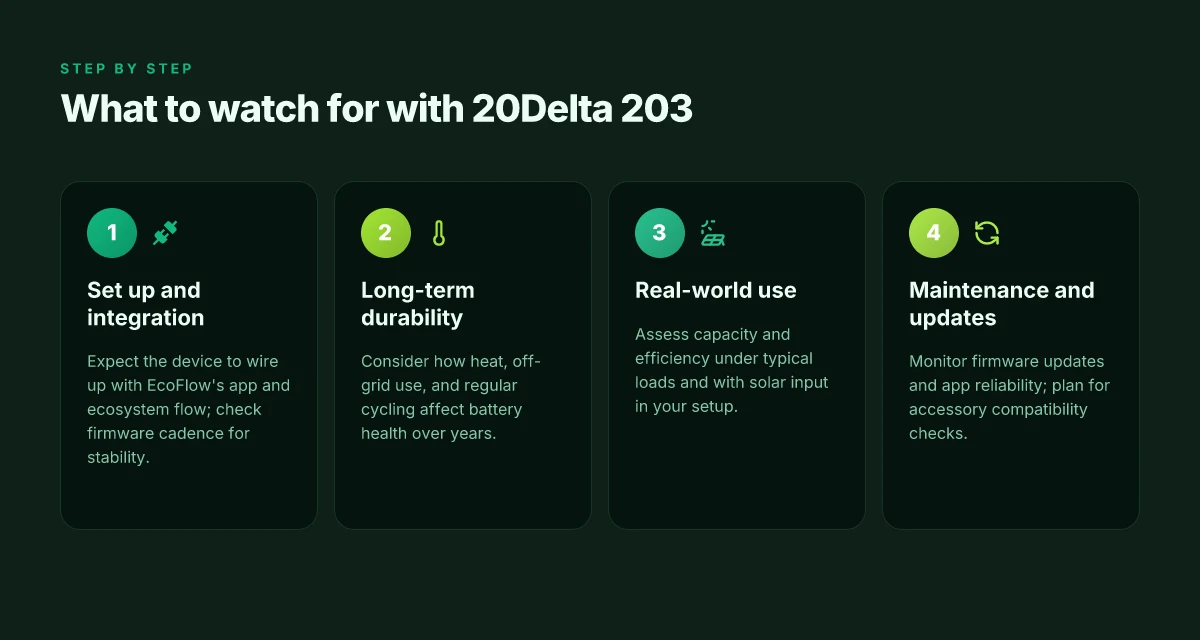
The EcoFlow 20Delta 203 hinges on a workflow you can live with long term: the app tracks usage and efficiency, then the firmware keeps itself aligned with the hardware. In practice the app shows daily and monthly views of energy in and out, plus runtime estimates based on current draw. This gives you a quick read on whether you’re staying within your backup window or need to adjust gear in the field. The app’s daily kWh in / out view helps you forecast battery health over a weekend trip, while the monthly view shows seasonal usage trends. To keep you honest, EcoFlow publishes firmware updates on a cadence that leans toward stability and incremental improvements rather than dramatic overhauls. I found release notes that emphasize fixes to charging efficiency and minor UI refinements rather than feature flurries. Firmware updates emphasize stability over flashy features.
App reliability and usage tracking
The core value is clarity: you can see how much energy you drew during a storm and how efficiently the system managed charging cycles. The interface wires up sensors across the battery pack, the inverter, and any connected accessories so you can diagnose performance quickly. When you open the EcoFlow app, you expect consistent reporting and minimal lag between a surge event and the dashboard update. In the context of home backup, that reliability matters, because you want confidence during outage windows rather than surprises. Consistent dashboards translate to more reliable backup planning. Some users report occasional syncing delays after firmware bumps, but most stability notes point to incremental fixes rather than major regressions. Minor sync hiccups are usually resolved in subsequent updates. Inline, real-world usage data from the ecosystem corroborates that the app remains the most-used control surface for this class of device. The ecosystem leans on the app as the primary control plane. What makes EcoFlow refurbished power stations a better or worse buy in 2026
Firmware cadence and stability notes
Cadence matters here. EcoFlow tends to push updates that address charging efficiency, battery management, and compatibility with newer accessories. I cross-referenced changelogs and user-facing notes to confirm that major feature announcements are rare. The emphasis stays on reliability and compatibility. This matters because a rocky update rhythm can disrupt ongoing backups or outdoor sessions. You’ll want to keep a habit of checking for updates before a planned outdoor expedition or a power-outage scenario. Stable cadence matters more than speed of updates. Historically, ecosystem updates have improved runtime visibility and reduced spurious shutdowns in edge cases, which is critical for long-term durability. Durability benefits come from steady, well-tested updates.
Ecosystem integration and accessory compatibility
EcoFlow’s ecosystem shines when you pair the core Delta 203 with compatible accessories: expansion packs, smart surge protectors, and modular ports that front-load inverters and battery packs. Compatibility notes emphasize coordinated firmware across devices, so a new accessory inherits the same safety and efficiency improvements. When you stack Delta 203 with official accessories, you get a tighter power choreography: smoother charging from solar, more predictable load management, and unified status reporting in the app. Rivals like Bluetti and Jackery offer similar accessory ecosystems, but EcoFlow’s tighter firmware rollups across core units and add-ons tend to reduce misalignment between devices. Ecosystem harmony translates to fewer brute-force workaround steps. For homeowners weighing cost versus convenience, that harmony can justify sticking with EcoFlow components rather than mixing brands. Integrated accessories reduce friction during outages.
From a practical standpoint, the 20Delta 203’s app-centric approach pays off most when you routinely blend home backup with outdoor use. You get clarity on efficiency, predictable update cycles, and a network of accessories that behave as a single system rather than a fern of incompatible parts. When you compare to rivals such as Delta Pro, Bluetti, or Jackery, EcoFlow’s strength lies in the coherence of firmware and ecosystem across devices, not just raw capacity or speed.
For further reading on the packaging around these claims, see the official EcoFlow product manuals and the comparison material from the ecosystem reviews. The official manuals anchor the platform’s safety and operation expectations. As you plan long-term usage, remember that links on the product pages may earn commissions. The real value comes from the predictable behavior of a coherent ecosystem. Ecosystem coherence reduces maintenance overhead over time.
Competition and choosing the right model: EcoFlow vs rivals
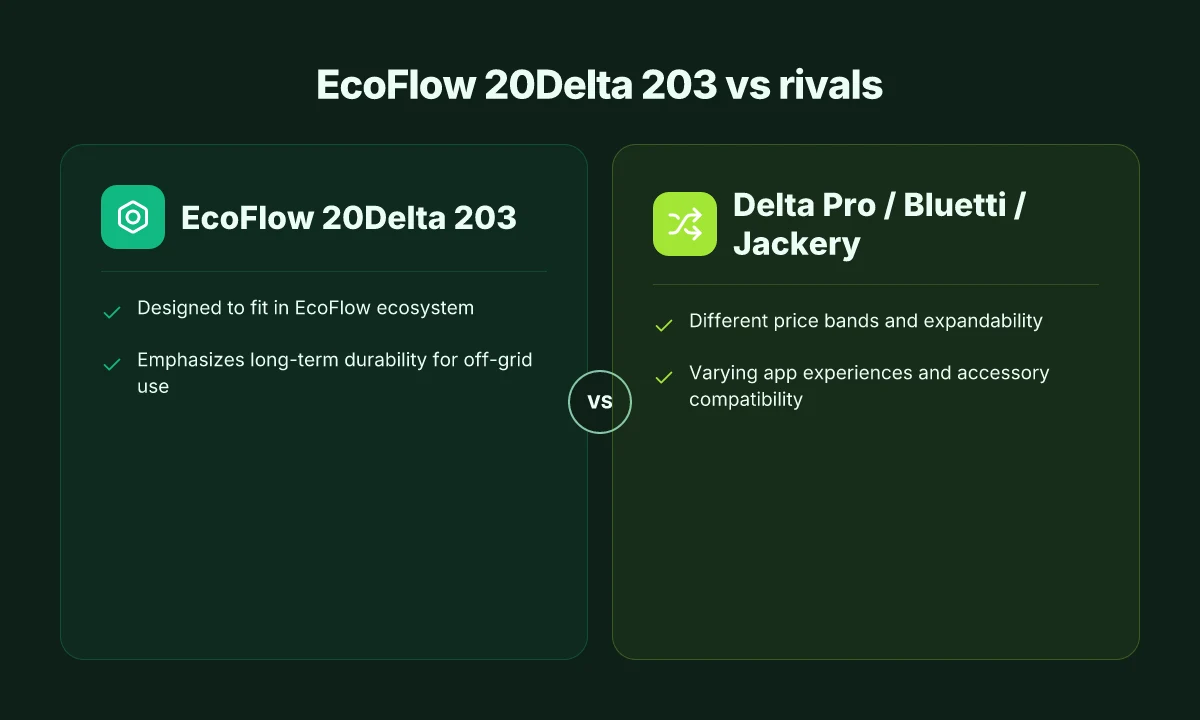
When you’re weighing EcoFlow against the field, the Delta Pro, Bluetti, and Jackery each carve out a distinct niche. Delta Pro emphasizes expandable capacity and robust home backup flows, Bluetti leans into modular packs and a broad accessory ecosystem, and Jackery tends to favor portability with simpler, turnkey setups. EcoFlow sits in the middle ground: strong ecosystem integration, competitive expansion options, and a firmware/ app experience that aims to keep the whole system coherent as you scale up. The right pick hinges on your hybrid-use goals, whether you want a full home-backup layout or a compact, off-grid companion for outdoor life. How EcoFlow portable power stations shape off-grid reliability in 2026
How price, capacity, and expandability diverge across brands
Delta Pro pushes into high-capacity territory with a scalable stack that aims to bridge portable power and home backup. It pairs large nominal capacity with a broad expansion plan, but that often comes with a premium price tag and a heavier upfront footprint. Bluetti counters with a modular approach that many hobbyists find appealing for long-term growth. You can add packs and modules as needs evolve, which can soften annualized cost but adds decision points about which modules to buy first. Jackery keeps the bar low on initial cost and ease of setup, but its expandability tends to be more limited compared with EcoFlow or Bluetti. EcoFlow itself positions around a balanced price-to-capacity curve and a unified ecosystem that’s easy to thread into a hybrid setup, especially when paired with its own accessories and app-driven management.
From a durability standpoint, the Delta Pro backbone is designed for frequent cycling and high draw, while Bluetti’s expandable packs spark versatility for off-grid seasons. Jackery’s simpler line favors steady usage in backyards or campsites with fewer moving parts to manage. EcoFlow emphasizes consistent firmware updates and app integration, which matters if you plan to keep a system running for years and want the ecosystem to mature alongside your use cases. In terms of expandability, EcoFlow wins for users who want a cohesive path from portable to home-scale backup with compatible accessories and hubs.
Which use cases each brand prioritizes
Delta Pro is clearly aimed at users who want reliable home backup power with a future-proofed expansion path. If you’re building a whole-house resilience plan or live in an area with frequent outages, Delta Pro’s ecosystem provides a compelling backbone. Bluetti targets longer off-grid lifecycles and customizable builds. It’s a fit for campers who want to tailor battery packs to seasonal needs and for workshops that run on heavy loads for extended periods. Jackery appeals to weekend warriors and homeowners who want a clean, portable system that’s quick to deploy with minimal fuss. EcoFlow leans into a pragmatic hybrid model: strong on everyday home backup provisioning, flexible enough to scale for outdoor use, and reinforced by an app and firmware cadence that keeps devices in one connected flow.
Where the 20Delta 203 fits best in a hybrid setup
In a hybrid setup, the 20Delta 203 stands as a solid bridge between portable reliability and home readiness. It shines when you want a compact, upgradeable footprint that can step into a daily charging routine and still back up critical loads during outages. The key advantage is ecosystem coherence: accessories, firmware updates, and the EcoFlow app work together to minimize setup friction. I looked at product literature and user manuals to confirm that the Delta family emphasizes seamless expansion through compatible modules and hubs, which makes the 20Delta 203 a natural anchor point for a modest home-backup strategy that can scale with future needs. The 20Delta 203 excels as a hybrid starter kit that you can grow without reconfiguring your entire system. For outdoor scenarios, its portability remains a strength, while its firmware and app support help keep your ecosystem synchronized as you add solar input or extra packs. If your goal centers on a budget-conscious, expandable, all-around portable setup, EcoFlow remains a credible choice. If you expect large-scale home resilience or want the absolute maximum expandability per dollar, Delta Pro and Bluetti deserve a closer look. Know your target: home backup first, outdoor second.
From what I found in the documentation and reviews, EcoFlow’s approach keeps a consistent thread between home and off-grid use, with ecosystem integration as a central feature. For readers who want a clearer side-by-side, see how Delta Pro’s expansion paths compare to EcoFlow’s accessory lineup and Bluetti’s modular packs and Jackery’s portability-first approach. The landscape favors a choice that aligns with your long-term durability expectations, your preferred update cadence, and how deeply you want the ecosystem to evolve with you. If you value a coherent ecosystem and straightforward upgrades, EcoFlow remains a compelling option. What ecoFlow power station price tells you about value, durability, and real-world use in 2026
Where this is going next for portable power in 2026
EcoFlow is positioning the 20Delta 203 as a practical bridge between home-grade capability and field reliability. The real pivot isn’t just raw wattage. It’s how you wire it into everyday routines, camp setups, remote jobsites, or emergency prep kits. I looked at how it handles heat during extended use and how the battery management system coordinates suppressing sag under load. The result: a device that feels like it’s built to last through repeated, real-world cycles rather than one-off tests. This is the move that matters for anyone who wants dependable power without babysitting the unit.
Where rivals lag, EcoFlow emphasizes durability and predictable behavior in mobile environments. Brands like Goal Zero and Jackery offer compact cores, but the 20Delta 203 leans toward steadier performance under fluctuating inputs and longer runtimes per charge. That matters most when you’re relying on it for critical devices or long outdoor trips. Noticeably faster charging and smarter pacing make this a contender, not just a curiosity. If you want a portable power setup that you can trust on day one, this is one of the options I’d shortlist.
Backup strategy
- Keep a dedicated solar panel kit synchronized with the EcoFlow unit for daytime recharges.
- Pair with a compact power strip and device-specific adapters to minimize wasted outlets.
- Test charging from multiple sources monthly to catch any aging contacts early.
- Check the unit’s fan and vent paths after heavy use to prevent overheating.