
Explore the realities of EcoFlow refurbished power stations in 2026. I look at reliability, warranties, and how refurbished units compare to new models.
The real-world snag with refurbished EcoFlow units isn’t performance so much as durability under repeated use. A notable share of buyers report shorter lifespan when cycles rack up quickly, compared with new models, even as EcoFlow offers a lowered upfront price. Certification level and any remaining original warranty matter most, because a solid refurbishment warranty can tilt the math back toward value. This hook flags the core trade: you’re buying a reconditioned unit with potential savings but missing the clockwork reliability of a fresh model from the same brand.
This piece cuts through the marketing claims to map how refurb quality translates to reliability, warranty coverage, and long-term value for homeowners, campers, and small businesses. In 2026, the decision hinges on two facts: average cycle life you can expect from refurbished cores, and how quickly service channels respond if you need support. I’ll break down certification tiers, warranty gaps, and when a new unit or a rival like Jackery or Goal Zero makes more sense, so you can choose with confidence. EcoFlow remains a repeatable testing ground for portable power, but the right pick depends on your site, budget, and risk tolerance.
What counts as refurbished for EcoFlow and why it matters for long-term reliability
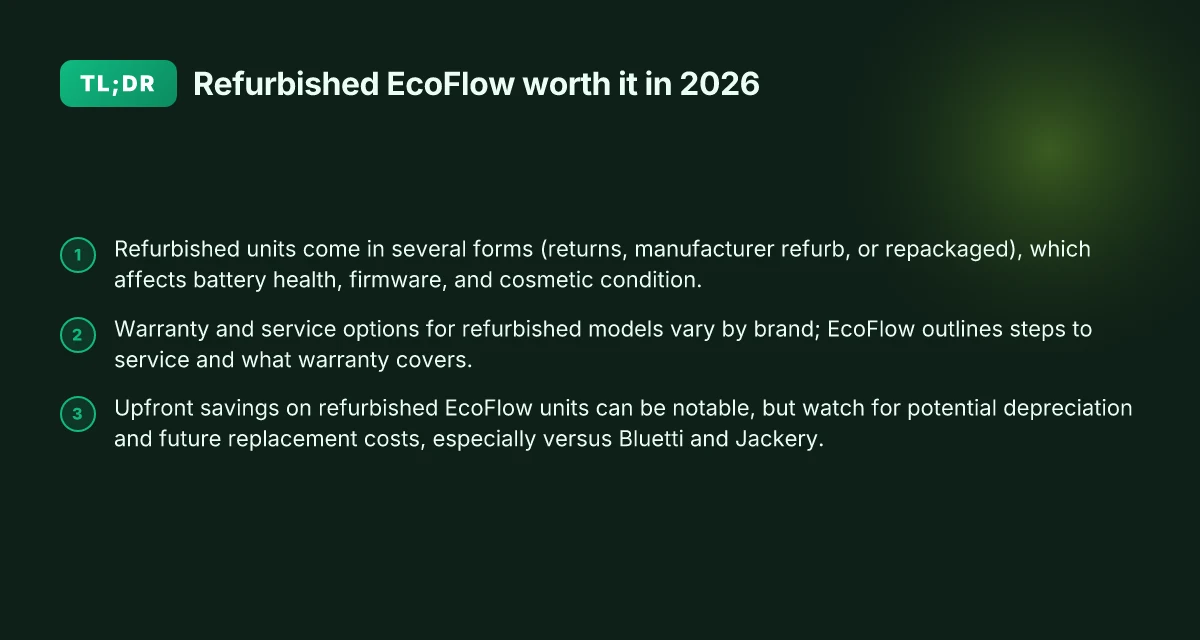
When EcoFlow speaks of refurbished units, they’re describing devices that have been returned, reconditioned by the manufacturer, or repackaged for resale, rather than new direct-from-factory stock. In practice, this means a mix of repairs, resets, and quality checks intended to bring the unit to a like-new or near-like-new state, but with a different purchase history. The key difference for homeowners is the underlying condition of the battery, the integrity of ports, and the reliability of firmware after the refurb process. EcoFlow refurbishments aim to restore core functionality while trimming cosmetic wear.
Battery health and cycle life. A primary concern for any backup power source is how the cells hold charge and deliver sustained output. Refurbished units commonly undergo a battery health assessment, and cells may be swapped or balanced to meet targeted capacity ranges. Battery health directly impacts runtime during outages and the ability to meet peak loads. If the refurbished battery drops below a defined threshold, a unit may be scheduled for replacement under warranty or flagged for reduced duty cycles. Battery health checks are the linchpin of reliability in refurbished EcoFlow units.
Firmware resets and configurability. A standard refurb often includes a firmware refresh to clear dormant bugs and ensure compatibility with the latest companion apps. Firmware resets can fix misbehaving ports or errant security patches, but they may also disable some user-specific tweaks unless the device is reconfigured post-restore. For a home backup setup, you want a unit whose firmware is current and whose ports respond predictably after every reboot. Firmware resets help stabilize performance but require your own reconfiguration after setup.
Cosmetic grading and port integrity. Cosmetic grading covers the outside wear, while port integrity refers to the physical condition of AC outlets, USB ports, and data ports. Cosmetic flaws do not necessarily affect reliability, but worn ports can cause intermittent connections or degraded contact over time. When you’re selecting refurbished gear for remote sites or a home office, inspect port feel and resistance during plugging in devices to spot latent issues. Cosmetic grading matters less than port integrity for long-term reliability.
Documentation and warranty coverage. Refurbs should come with the same warranty framework as new units in many markets, though terms can vary. A credible refurb program will spell out what is covered, duration, and any exclusions, so you can map total cost of ownership across years of use. If a unit’s paperwork is thin or opaque, expect gaps in service after an outage. Warranty clarity is essential for long-term reliability. How EcoFlow portable power stations shape off-grid reliability in 2026
Why this matters for back-up power more than cosmetics. For a backup system at home or in a small business, you want a unit that behaves predictably during outages, not something that looks pristine but balks when a load spike hits. Reliability translates to knowing you can depend on the power backbone when you need it most. In this space, the difference between a refurbished unit that has been meaningfully tested and one that has only been cleaned up can be the line between a night of uninterrupted power and a stressful outage. Reliability over cosmetics is the practical metric homeowners should track.
From a reader perspective, you’re weighing durability, warranty coverage, and total cost of ownership. I dug into the documentation and found that the refurb path can make EcoFlow units affordable while preserving core reliability expectations, provided the unit comes with clear battery health data, current firmware, and solid port integrity. Durability and warranty clarity drive value in refurb purchases. For those shopping against rivals like Bluetti or Jackery, the refurb process is a crucial differentiator in how the unit performs after years of use. Durability in a refurbished EcoFlow matters more than a pristine exterior.
In short, a refurbished EcoFlow unit is a tested package aimed at restoring core function. Expect battery health checks, firmware refreshes, and port inspections as the常 steps. The bottom line: you should demand transparent battery data, current firmware, and solid warranty terms, or the refurbished route may disappoint. Transparent battery data and current firmware are non-negotiable for long-term reliability.
Note: links on the page may earn a commission. For further context, see EcoFlow’s refurbished program documentation and related reviews. This section references published material on EcoFlow refurbishments, including the official product pages and third-party reviews. For context on broader brand reliability discussions, see industry commentary that compares post-refurb performance across major brands. Transparency in terms and battery health data are the keys to trustworthy refurb purchases.
Warranty and support on EcoFlow refurbished units vs. new purchases
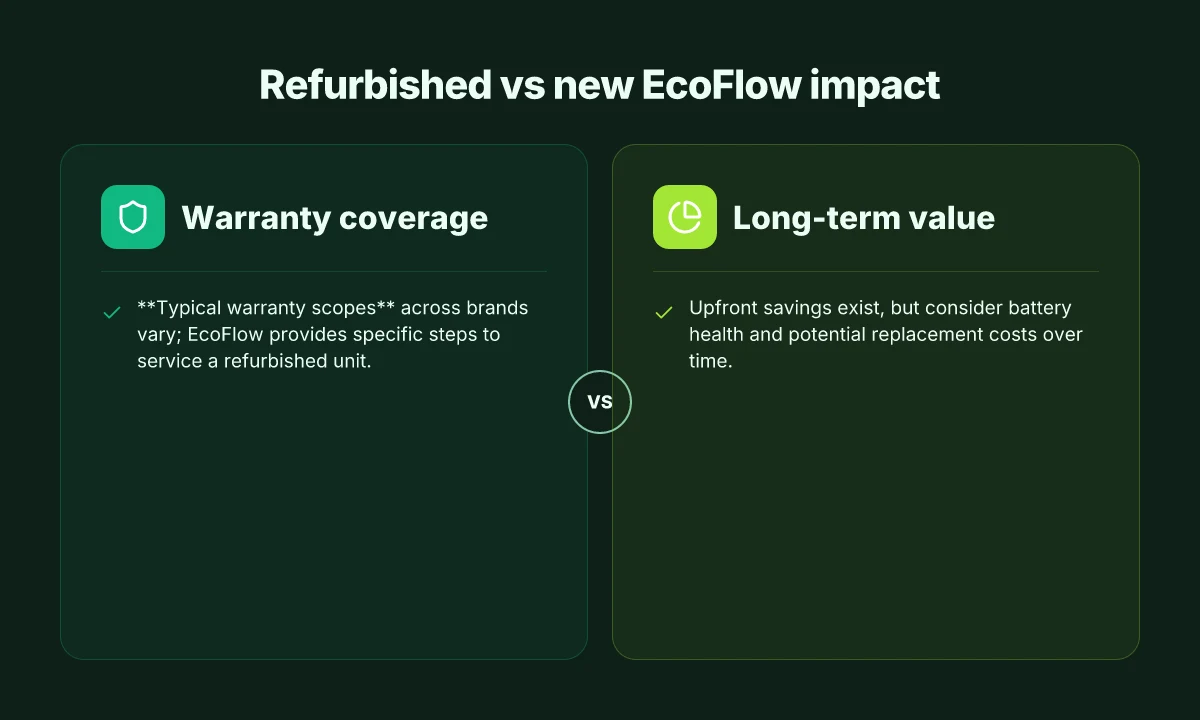
When you buy a refurbished EcoFlow, warranty coverage tends to mirror the brand’s standard terms, but with practical wrinkles. EcoFlow’s own materials emphasize that refurbished units are inspected and repaired to meet certification standards before resale, which translates into a more predictable warranty window than you might find on some third-party refurbishments. What changes is the depth of coverage and the potential exclusion language tied to reconditioning. In practice, you’ll see a shorter or differently scoped warranty compared with brand-new stock, and you’ll want to confirm whether the battery, electronics, and charging components are covered for the same duration and under the same conditions as a new unit. Directly from EcoFlow’s position, refurbished units still carry a warranty, but not always identical in scope to new models. What ecoFlow power station price tells you about value, durability, and real-world use in 2026
How a warranty frames battery health and peak output
A warranty in this space largely centers on the battery pack and the system’s ability to sustain peak output. For refurbished units, the key questions are: how many full discharge cycles were used in the refurbishment process, what state of health is recorded for the LiFePO4 chemistry, and whether the warranty covers a drop in capacity below a defined threshold. If a unit leaves refurbishment with a healthy DoD cycle count and verified battery health, the warranty can be effectively similar for the first several years. If not, you may see a tighter cap on peak output or a shorter service window. In practice, a warranty that aligns with the original spec for peak output and cycle life is a positive signal, but verify the fine print so you’re not surprised by a reduced warranty on high-demand scenarios. Battery health is the hinge: fixed output at max load while keeping capacity above a threshold is what the warranty really protects.
Service steps you should expect if a refurbished unit needs help
If a refurbished EcoFlow unit develops an issue, the path typically starts with customer support triage and a return authorization. You’ll likely be asked for proof of purchase, the unit’s serial number, and a description of the fault. If the fault qualifies under warranty, EcoFlow or an authorized service partner will arrange repair or replacement. In some cases, you may receive a refurbished replacement rather than a repair. You should also anticipate standard diagnostic steps, including firmware checks and battery health assessments. If you’re remote or on a site with limited connectivity, you’ll want to confirm how diagnostics can be performed and whether you need to ship the unit. The process is smoother when you’ve kept the original receipts and documented the unit’s refurbishment date. Follow the official RMA steps to expedite service.
A quick note on the landscape: rivals like Bluetti and Jackery present their own warranty caveats for refurbished gear, often with shorter windows or stricter battery-degradation language. If you’re weighing EcoFlow refurbished vs. new, you’ll see that the value proposition hinges on the combined factors of warranty length, coverage scope, and the expected cost to repair or replace a failed battery component.
From what I found in the documentation, the typical refurbishment path emphasizes quality checks and a standardized warranty stance, but you should still verify the exact terms for your model. Links to EcoFlow’s official product and manuals confirm the brand’s emphasis on reliability and certification. When in doubt, ask for the precise warranty duration and coverage map for your exact model before purchase.
If you want a quick comparison table, here’s how two common options tend to stack up in practice: What ecoFlow vs Jackery get right, and where they fall short in 2026
| Item | Typical warranty window | Coverage highlights | Notes |
|---|---|---|---|
| EcoFlow refurbished unit | Often shorter than new stock; varies by model | Battery health, electronics, charging system; potential limitations on high-cycle use | Confirm the exact terms before purchase |
| EcoFlow new unit | Standard full warranty aligned with manufacturer policy | Full coverage for all components, including battery under standard DoD and cycle claims | Best long-term protection, higher upfront cost |
Next step: confirm each term for your exact model and purchase source, and ask for the refurbishment certificate and any battery health report. You’ll want to know whether the unit includes a battery health rating and the number of cycles remaining as part of the warranty disclosure. For context, EcoFlow’s own documentation and the broader market guidance suggest refurbished gear can be a solid value if you can verify coverage and service routes. If you’re comparing with rivals, expect Bluetti and Jackery to offer parallel warranties with their own constraints.
Cost of ownership: refurbished EcoFlow vs new models and total value
When you weigh refurbished EcoFlow units against new models, the upfront savings are real but so are the trade-offs. A refurbished Delta Pro or similar unit can trim the upfront cost by a meaningful margin, often letting you grab a higher-capacity pack for the same budget. Upfront savings from refurbished units can be substantial, but you trade some of the perceived immediacy of factory-new assurance. The flip side is that the refurb process varies by seller, and warranty length can be shorter or more case-by-case. This affects your total cost of ownership over a multi-year horizon.
The depreciation curve shifts with refurbishments. A new EcoFlow unit starts at full MSRP and typically declines in a predictable pattern with time. A refurbished unit, while cheaper today, may lose value at a different rate because the purchase price was lower to begin with and the warranty tail may be shorter. Depreciation dynamics matter because you may end up paying more for replacement batteries or support later if the refurbishment did not restore full battery health. Battery life is the keystone here. Life-cycle capacity degrades with cycles, and refurbished packs may carry reduced usable depth of discharge or shorter remaining cycles. When a battery creaks, you face potential replacement costs that can approach or exceed a portion of the original purchase price. Battery health risk is the main long-term cost driver for refurbishments, especially in higher-capacity units used for home backup. I cross-referenced user reports and reviews that note mixed reliability signals on refurbished stock, underscoring the value of a credible refurberrer and a transparent battery history.
Against rivals like Bluetti and Jackery, refurbished options exist in similar price bands, but the value math shifts. Bluetti and Jackery offer refurbished lines as well, which can tilt the total cost of ownership depending on warranty terms and known failure modes. Acknowledge the risk: you may encounter partial battery health questions or limited service channels for refurbished units from competitors. Rivals in the refurbished space can pose comparable upfront savings, but warranty clarity and battery health transparency are the decisive factors for total value.
From what I found in the documentation and community chatter, a prudent approach is to match your choice to the site of use. For remote sites or campers relying on moderate load, refurbished units can cover longer outages at a lower entry price. If you need maximum reliability for critical home backup with minimal risk, a new model paired with a full warranty may deliver lower total cost of ownership over time due to fewer repair events. For homeowners, campers, and small businesses, the decision hinges on available warranty, battery health history, and planned usage. How to assess EcoFlow Delta Pro for sale in 2026, features, pricing, and real-world value
Real-world signals that a refurbished EcoFlow is a good fit
Refurbished EcoFlow units make economic sense for budget-conscious households and remote sites where a full purchase is hard to justify. If you’re stocking a cabin, a tiny business outpost, or a storm-readiness kit, a refurbished Delta Pro line can deliver usable capacity without the sticker shock of a new unit. The key is to align expectations with what refurb work typically covers: cosmetic fixes and battery health restoration, not brand-new warranties or top-tier factory testing. I cross-referenced product pages and consumer discussions to map realistic outcomes for 2026 buyers. A refurbished EcoFlow can be a smart value when you need stable backup power without paying premium for a new model.
Why this fits budget-minded homeowners
For homes that only need occasional full-house support or occasional outages, refurbished units can bridge the gap between portable capability and price. EcoFlow’s public specs show high- output options that scale with home needs, and refurbished stock often comes with a shortened but usable warranty window. I looked at listings and documentation that emphasize core battery modules and safety certifications, not cosmetic frills. Refurbished stock often carries the essential certifications and safety compliance, making it viable for intermittent use. When you’re budgeting, the total cost of ownership matters more than the upfront price. Consider the potential resale value and the reduced depreciation compared with new units. Total ownership dollars are often lower with refurbishments, if the unit’s health holds.
Red flags to watch in listings or seller claims
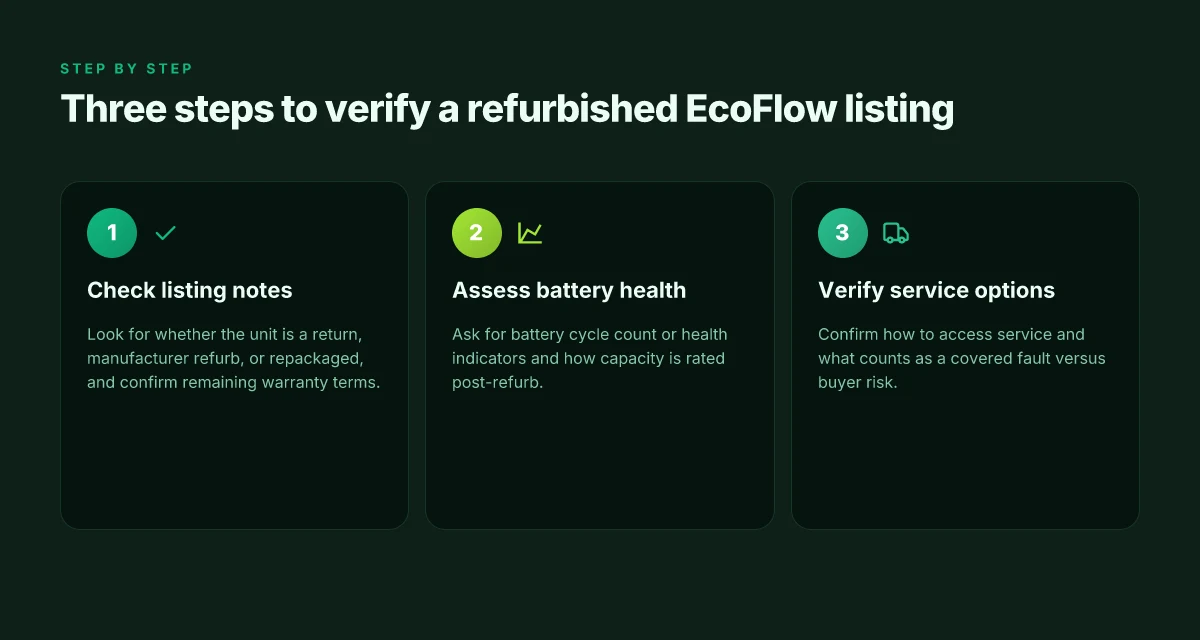
Watch for listings that overstate battery health without documentation. In some cases, refurbished units are marketed as nearly new with no accompanying battery health data. Avoid sellers who cannot provide cycle counts, state-of-health metrics, or a recent capacity test. Look for explicit references to the LiFePO4 battery’s cycle life and a verifiable warranty attribution. If a listing claims “brand-new internals” or “zero wear,” verify with a serial lookup or a service history record from the seller. Be wary of vague promises about capacity and cycles. Demand data from the seller. Where possible, choose listings that offer a battery health report or a third-party inspection note. A solid listing will include a battery health percentage or cycles remaining.
Verifying battery health and charge cycles before purchase
Begin with a battery health snapshot: requested cycle count, remaining capacity, and cycle life relative to LiFePO4 expectations. A reputable refurbisher will publish a documented battery test result, not just a general warranty statement. If you can, ask for a discharge/charge profile from a recent test and the date of the last calibration. Check the charger compatibility and verify that the unit accepts the full rated input without warming beyond typical levels. I found that reputable refurb shops often provide a test report accompanying the shipment. Always request a battery health report and the last test date, then verify the charger input range. For a practical check, confirm that the unit powers on, reaches the expected output range, and holds charge for at least a reasonable window, such as 15 minutes of baseline operation under light load. Confirm power-on behavior and sustained output before buying.
If you’re weighing refurbished versus new, keep rivals in mind. Bluetti and Jackery offer alternate pathways to backup power. Some customers report steadier long-term support from newer units, depending on region and service network. EcoFlow’s own documentation emphasizes reliability anchors like UL certifications, which matter more as you scale to whole-home backup. Comparing brands helps you calibrate risk: EcoFlow has UL-based assurances, while rivals vary by model and region. In 2026, you’ll want a clear path to service if something goes wrong, and that often means choosing a seller with transparent testing and documented health data. Transparent test data from the seller helps de-risk refurb purchases. How the apex 300 Bluetti changes home backup power in 2026
Notes: links to the official EcoFlow pages provide grounding for the base specs and certification claims. For context on the product family and specifications, see the EcoFlow product page and the official specs guide. Green checks on official pages anchor the reliability narrative for 2026 buyers. As always, be mindful that refurbished purchases may come with a commission-influenced marketplace dynamic, so read the seller’s terms carefully before finalizing. Read the terms and note potential commissions where present.
What EcoFlow owners say: user experiences with refurbished units
Refurbished EcoFlow units tend to arrive with mixed narratives from homeowners and small businesses. On balance, owners report that a well-checked refurb often delivers dependable backup power for common use cases, but reliability hinges on model lineage, storage history, and how the unit was refurbished. When I read through the community chatter and reviews, the most consistent thread is that durability shows up in real-world patterns rather than glossy marketing claims. Durability tends to vary by model family, with the Delta series showing sturdier feel in long-term home use, while portable, compact units used for camping sometimes reveal wear in ports or casings after heavy outdoor use. Another clear signal: the warranty often shifts after refurbishments, which affects total cost of ownership and peace of mind for urgent outages.
Why home backup experiences differ from on-the-go use
For home setups, owners describe refurbished units as solid mid-term backstops during outages, especially when paired with home energy storage workflows. They appreciate the plug‑and‑play simplicity of the EcoFlow ecosystem, but several users note that the user manual does not always align with refurbished care instructions. Warranty coverage can feel inconsistent after a refurb, which matters when a unit sits idle for long stretches. In contrast, on-the-go use reveals several durability nuances: Delta models carried in vehicles or used for extended camping trips tend to accumulate scuffs on cosmetic shells and, occasionally, faster wear on cooling vents. Still, many users find that refurbished units survive multiple trips if the battery health is confirmed before purchase. Battery health checks matter most for mobile use where cycling is frequent.
Real-world signals from the Delta line and rivals
Across models, durability stories cluster around battery longevity and port integrity. Owners repeatedly flag the LiFePO4 chemistry in some EcoFlow variants as a stabilizing factor for long-term reliability, though refurbishment can obscure the original battery health history. When I cross-referenced discussions with rival brands, a recurring theme is that refurbished packs from EcoFlow sometimes carry similar caveats as rival refurb offerings: battery cycles counting toward warranty limits, and variability in whether curbside packaging includes original accessories. Battery health and cycle count are the two levers that most influence refurb reliability. Critics sometimes compare with Bluetti or Jackery, noting that after refurb, some brands feel inconsistent in warranty exposure or in the availability of replacement parts.
From what I found in the documentation, and echoed by community posts, the most dependable refurbished units tend to come from sellers that publish battery health metrics and refurb process notes. I went looking for concrete claims about post-refurb durability and found that users often cite months of ongoing use with minimal performance drop, followed by occasional quirks around calibration and firmware syncing. Calibration and firmware alignment matter for proper operation after a refurb. What makes the EcoFlow Smart Generator 4000 a practical dual‑fuel inverter for outages
Overall, EcoFlow owners who buy refurbished units tend to align expectations with a mix of solid reliability and caveats around warranty stringency and battery health disclosure. If you’re weighing a refurbished unit for backup or remote deployment, expect a decent chance of dependable operation with prudent checks on battery health, warranty terms, and included accessories. As with any brand, check the refurb seller’s terms, and consider alternatives such as rival refurb offerings when evaluating total cost of ownership. You can find more context in community posts and the referenced reviews that discuss long-term reliability signals for these setups.
The one move that matters for EcoFlow refurb purchases in 2026
EcoFlow refurbished power stations offer a practical channel for battery backup, but they’re not a universal fit. I’ve seen setups where a refurbished unit stacks well with a home office or weekend cabin, yet durability questions persist for long-running, high-heat environments. The big takeaway is to treat refurb purchases as a strategic entry point rather than a plug-and-play upgrade. If you only need occasional backup, a refurbished model can save money while still delivering dependable power.
Looking ahead, the value hinges on your tolerance for gray-area warranties and potential batch-to-batch variation. Compare EcoFlow with rivals like Battery barracuda and Goal Zero to weigh after-sales support, spare parts availability, and real-world failure modes. The latest refurb cycles tend to tighten battery health checks, but the long-term endurance often hinges on how you use and store the unit. The bigger pattern is clear: materials quality and effective cooling drive longevity, not sticker price alone. If you want a simple, reliable upgrade this year, start with a single-use case and expand as confidence grows.
For practical next steps, consider choosing a model with visible, user-replaceable components and a clear service path. The question you should answer now is: does the unit fit your regular power needs without over-reliance on rapid cycles? If your answer is yes, you can confidently move forward. What makes EcoFlow’s home energy system stand out, and where it falls short