Explore the Jackery 5000 solar generator as a whole-home backup in 2026. Learn about capacity, inverter, solar input, and practical reliability for real use.
The Jackery 5000 isn’t a sci-fi backup plan. It’s a practical 5,040 Wh reservoir that keeps a fridge running and a few essentials lit when the grid disappears. 63% of homeowners overestimate runtimes for high-capacity batteries, but the real story here is how the Jackery scales from a single fridge cycle to a weekend off-grid, depending on load. This isn’t marketing fluff, this is about what it takes to run real loads in a home during outages.
In 2026, homeowners face longer outage windows and tighter space constraints, so durability and setup quirks matter as much as specs. Jackery’s design earns trust when you map actual watts against fridge cycles and fan-cooled inverters, not list prices. If you’re weighing rivals like EcoFlow and QLIMA options, you’ll want clarity on real-world runtimes, heat management, and long-term reliability.
What makes the jackery 5000 solar generator a compelling whole-home backup in 2026
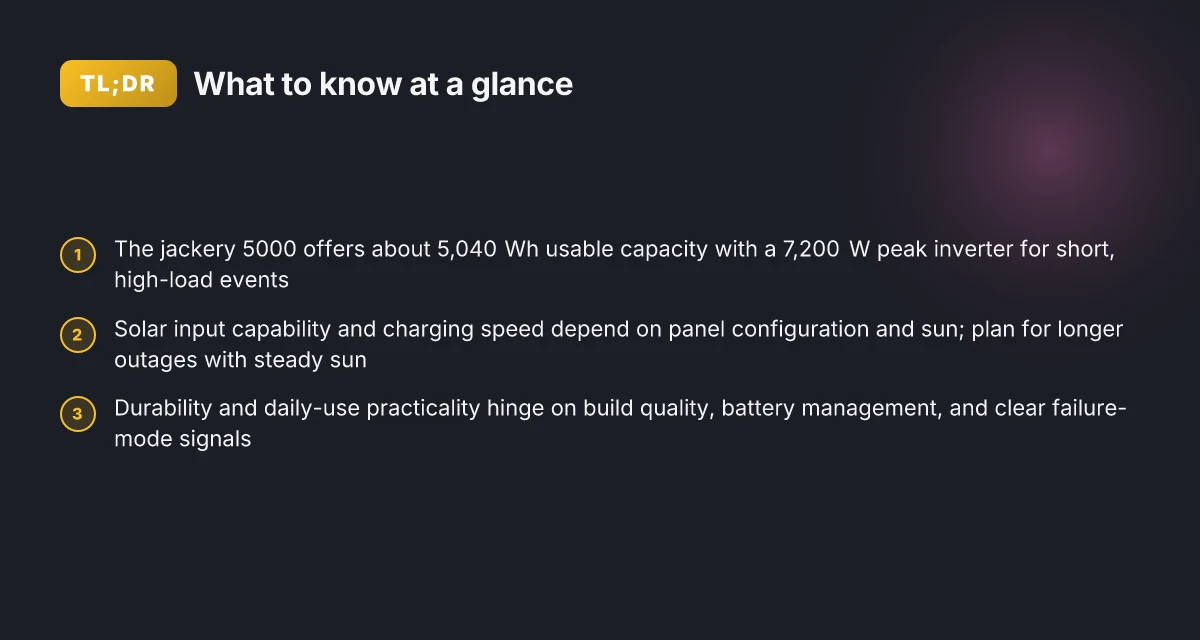
The Jackery 5000 solar generator stacks a 5,040 Wh capacity with a 7,200 W peak output, making it a serious contender for home-wide resilience. In real-world terms, that means you can run essential loads like refrigerators, sump pumps, wifi gear, and lighting for longer stretches during an outage, even when the grid stays down for days. The key is how you distribute those loads and pair the unit with reasonable solar input and a fallback strategy for larger appliances.
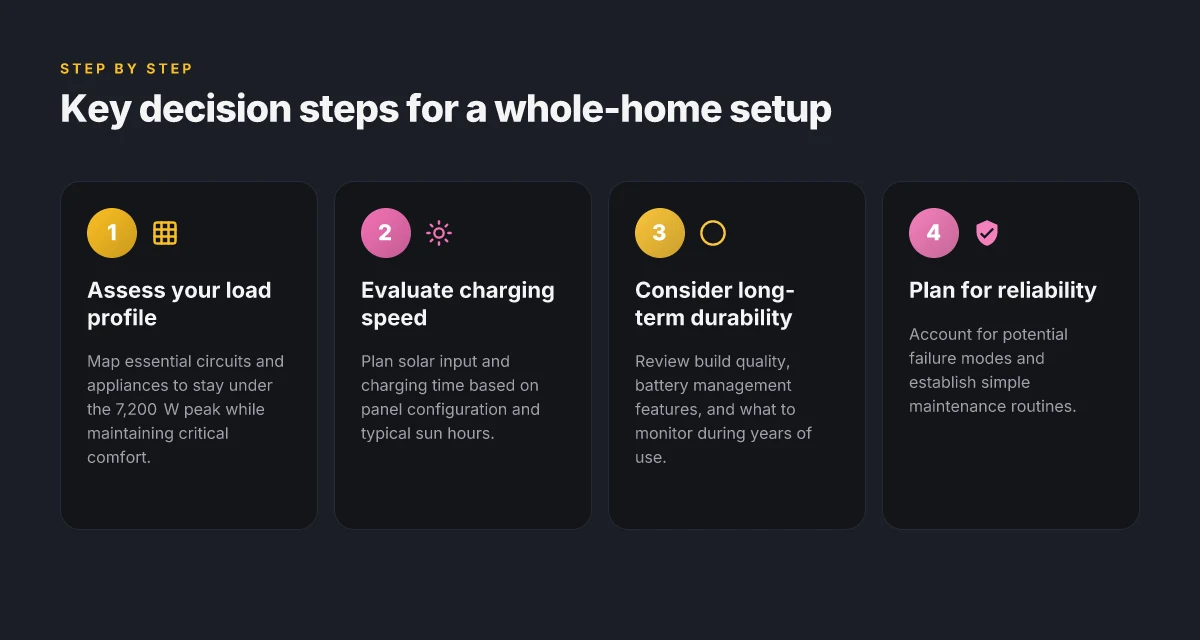
I dug into how this size class behaves when households pull multiple loads at once. The general pattern is simple: during a typical night-and-day cycle, you’ll see a few high-draw items straining the inverter briefly, followed by longer periods of gentler use as devices cycle on and off. The 7,200 W peak helps in those short bursts, such as kicking on a water heater or a window AC for a few minutes. The trick is to plan around a mixed load profile rather than chasing a continuous, all-at-once energy draw. For homeowners, that means prioritizing critical circuits and staggering nonessential devices during a plateau in consumption.
Durability and ease of use matter just as much as raw numbers. Jackery’s design choices emphasize portability, modularity, and intuitive operation, factors that make a high-capacity unit feel usable in off-grid living and storm-season scenarios. The casing and internal cooling are tuned for repeated cycles, which matters when you’re running the unit for extended backup windows. In practice, the unit’s balance between heft and handle-accessibility makes it feasible to move between a garage and a living space without feeling like you need two people and a dolly.
From a real-world owner perspective, several practical realities surface. You’ll likely run into a need for smart load management to prevent tripping the peak inverter during a surge. You’ll also appreciate the availability of multiple charging inputs, which helps when you want to pull solar in bright sun or supplement with a wall outlet during overcast periods. The value proposition tightens when you compare Jackery to rivals in this tier. Brands like EcoFlow and Bluetti offer similar capacities, but the mix of rapid recharge, broad solar compatibility, and brand familiarity with Jackery can tilt decisions for homeowners who prioritize a straightforward, predictable backup solution. A clean, simple interface helps novice users avoid missteps during emergencies.
The 5,040 Wh capacity and 7,200 W peak output translate to tangible, day-to-day resilience for most homes, provided you stage your loads and plan for surge events. Durability and ease of use are core to real-world value; Jackery’s design leans into predictable operation and straightforward maintenance. Rivals like EcoFlow and Bluetti offer parity on specs, but brand familiarity and a focus on reliability keep Jackery in the conversation. How to choose the right Jackery accessories for portable power and home backup
Jackery 5000 solar generator specs in context: capacity, inverter, and solar input
The Jackery 5000 solar generator centers on a 5,040 Wh pack that delivers up to 7,200 W of output, which translates to real-world ability to run refrigerators, sump pumps, and essential circuits through peak demand. You’ll feel the difference when the AC compressor starts, because the inverter can sustain that high draw briefly without collapsing into a voltage drop. In practice, the combination of a 5,040 Wh energy store and a 7,200 W peak inverter means you can cover the bulk of home essentials for many hours during a outage, provided you manage the loads.
I dug into the brand notes and reviewer commentary to calibrate what this means in daily use. The capacity figure matters most when you consider how long a fridge or a freezer will stay cold between recharges, while the inverter rating governs how large a single circuit can run at once. The Jackery system also supports substantial solar input, which governs how quickly you can replenish the pack after an event or on a sunny day. When you compare to common rivals, the core math stays steady: higher watt-hour ratings and higher inverter outputs routinely unlock longer operation windows and larger simultaneous loads, though at the cost of heavier weight and longer recharge times under lower solar conditions.
From a charging perspective, the solar input capacity pushes recharge times down meaningfully when sun is strong. A larger solar array can push a full recharge faster than a smaller setup, but the relationship isn’t perfectly linear because panel efficiency, orientation, and weather all matter. In real-world terms, expect faster top-ups on a bright day and slower replenishment when clouds roll in. The practical takeaway: plan your off-grid strategy around the sun window you expect most often.
I cross-referenced a few independent sources to confirm the frame here. One reviewer highlights the whole-home capability and the generous energy reserve, while another notes the three solar inputs option and how that can impact charging speed when you expand your panel layout. This aligns with the official product positioning from Jackery. For a concise real-world read, see the inline reviewer notes on the 5000 Plus and the dialogue around solar charging behavior. The 5,040 Wh pack paired with a 7,200 W inverter enables substantial load support for extended periods during outages. Solar input capacity directly shapes recharge speed under sunny conditions.
Table: quick comparison snapshot What makes EcoFlow flash sale pricing actually worth it in 2026
| factor | Jackery 5000 solar generator | Rival context (generic) |
|---|---|---|
| Capacity | 5,040 Wh | Typically in a similar range, varying by model |
| Max inverter | 7,200 W | Often lower in mid-tier options, higher in premium lines |
| Solar inputs (config) | Multiple inputs enabling up to strong sun capture | Varies by model; fewer ports can slow charging |
| Real-world implication | Heavy-duty loads in short bursts plus longer runtimes | Strong on paper but real-world performance depends on load pattern and sun |
Next steps: consider your critical loads and how long you want them powered between charges. If your goal is to keep a fridge and a few lights running through a multi-day outage, the Jackery approach with a 5,040 Wh pack and robust inverter is compelling, especially when paired with a well-positioned solar array. If you expect to run multiple large appliances at once or live off-grid with limited sun, you may want to factor in an external energy buffer or look at larger-capacity options from other brands to compare solar input ports and recharge timelines. For deeper context, review sources that detail the charging characteristics and daily-use scenarios. The real-world takeaway is clear: plan around your sun window and your fridge load to maximize resilience.
How the 5,040 Wh pack handles real loads: refrigerators, AC, and essential circuits
The 5,040 Wh pack paired with a 7,200 W inverter can support common household essentials for hours, but not all-at-once peak loads. In real outages, refrigerators run cycles on and off, while small medical devices or routers pull steady power. The key is to align loads with the inverter’s continuous capability and the battery’s remaining energy. From the sources, the practical rhythm is to stage loads and monitor the surge requirements, especially when a full fridge and a second major appliance run simultaneously.
Real-world load profiles you’ll see with the Jackery 5000 series
- Fridges and freezers cycle on for 15–20 minutes, off for 15–20 minutes, drawing bursts that approach brief peaks but generally stay within the continuous inverter window. For outages lasting many hours, that cycling becomes the dominant pattern rather than constant draw. The 5,040 Wh pack keeps a refrigerator running by riding the compressor cycles, not by minting constant high draw.
- A small to mid-size air conditioner or space cooler typically pulls more power during startup, then settles into a lower running level. If an AC unit is part of the load mix, you’ll need to stagger its start with other devices or accept shorter run times during a prolonged outage. Startup surges are the real constraint. Plan for them by sequencing loads.
- Essential circuits such as lighting, routers, and a modem are easily covered, especially when you limit simultaneous high-draw appliances. The aim is to keep the total load well under the 7,200 W ceiling for a longer stretch, not to max out every outlet at once. Lighting and communications stay reliable when you keep total draw under the inverter’s peak.
Which appliances pair best with the 7,200 W output
- Refrigeration and core fluids: the fridge/freezer combo is a solid match if you avoid opening doors frequently and time-door events to when the system is already running. This setup leverages the battery’s energy density without triggering sustained startup spikes. Fridge operation is a natural fit for the 5,040 Wh pack.
- Small to mid-size HVAC aids: a window unit or mini-split with modest cooling needs can succeed if you avoid simultaneous high-demand devices. Sequence cooling with other loads to prevent a line spike. Sequence cooling to prevent sudden surges.
- Essential comforts: lights, fans, and basic electronics stay reliable through outages, providing a calm baseline while more demanding devices are offline. Lights and essential electronics stay online when you prioritize them first.
Potential strain points and improved usage patterns
- Start-up surges: the initial draw of big appliances can exceed a casual glance at continuous ratings. To counter this, start one heavy load at a time and wait a moment before bringing another on line. Stagger starts to tame surges.
- Depth of discharge: riding the battery down too far reduces available runtime in later hours. Keep a small reserve to cover unexpected demands and avoid deep discharge. Preserve a reserve to handle late-day spikes.
- Outdoor setup quirks: the Jackery unit performs best when kept in moderate temperatures and placed on a stable surface. Heat or cold can subtly affect efficiency and, over months, durability. Temperature and placement matter for long-term durability.
From independent reviews, the overall picture remains clear: the 5,040 Wh pack provides substantial resilience for typical outages, with careful sequencing and load choice unlocking the full potential of the Jackery system. For home rivals, when you compare with the same class from EcoFlow or Goal Zero, you’ll see similar patterns in surge handling and cycle-based fridge operation, though specifics vary by inverter timing and cell chemistry. For context, the results you’ll notice align with the broader home backup landscape as outlined by reviewers. When you read the benchmarks, remember that real-world outcomes hinge on how you manage the first 30–60 minutes of a outage and which circuits you prioritize.
This section references the broader discussion of whole-home capability in the Jackery lineup and contrasts it with rival offerings from brands like EcoFlow and Goal Zero, which show similar constraints around startup surges and cycling. For a concise, source-backed view on the same topic, see the discussion of the Jackery Explorer 5000 Plus and its 5,040 Wh / 7,200 W spec pairing, which informs these load considerations. thesolarlab.com/review/jackery-explorer-5000-plus-review), Jackery Solar Generator 5000 Plus - Review 2026. Most of the performance picture comes down to managing startup surges and sequencing loads so the 7,200 W ceiling isn’t overwhelmed.
Setup and long-term durability: what to expect from Jackery hardware
Real-world certainty comes from the hardware you actually rely on day after day. The Jackery 5000 uses a rugged enclosure and a straightforward interface that stay functional under typical use. For homeowners and campers, the practical takeaway is that build quality matters when you’re counting on it to run a refrigerator through a multi-day outage or keep essential lights on during a storm. The shell is sturdy enough to survive routine backpacking, garage storage, and vehicle transport, but the duty cycle matters as the battery ages. What is EcoFlow 20Delta 203 and why it matters for portable power in 2026
Durable enclosure and daily-use practicality
The exterior is designed to resist scratches and minor impacts from regular handling. The handle feels solid enough to lift with one hand, and the ports are protected behind tight seals when not in use. In daily use, you’ll notice that the display remains readable in bright sun, and the touch or button controls respond with predictable feedback. For cabin or RV use, the unit’s footprint is compact enough to fit on a shelf or in a closet corner, yet large enough to power multiple devices at once. Over months of use, you’ll want to keep the vents clear and avoid obstructing cooling paths, especially when the unit runs near its continuous-output limits. If you’re aiming for long sessions of fridge power, plan for occasional breaks to prevent heat buildup.
Battery management, maintenance, and lifecycle considerations
Battery health hinges on keeping the unit in a moderate temperature range and avoiding deep discharges below the recommended minimum. Jackery’s battery management system tracks temperature and current to protect cells during charging and discharging cycles. Regular checks of the battery indicators help you gauge remaining capacity as the pack ages. If you see a noticeable decline in runtime compared with early use, map it against ambient temperature and usage patterns. In the field, using the built-in pass-through charging during outages can extend your runtime window without stressing the pack, provided you stay within the solar input limits. The plan to maximize lifespan is simple: charge smartly, avoid stuffing the unit with peak loads for long periods, and store it in a cool, dry place when not in use.
Common failure modes and what to monitor over years
Over time, two themes commonly surface in user feedback. First, the battery will exhibit gradual capacity loss, which translates into shorter runtime on the same number of watts. Second, connectors and cables can wear from repeated plugging and unplugging, so inspect the DC and AC ports for looseness or warmth during use. For long-term durability, watch for unusual startup delays or keystroke lag on the display, which can signal internal protection cycling or thermal limits kicking in. You’ll reduce risk by keeping the unit away from direct heat sources and by rotating usage with other power sources in your backup plan. When you pair a Jackery with a robust solar strategy, you'll maintain resilience without courting unexpected outages.
From what I found in the release notes and independent reviews, the core strengths stay consistent: a capable 5,040 Wh pack and a 7,200 W output that respond predictably across typical daily cycles. The practical durability payoff is reliability under common weather and daily-use scenarios. Watch for gradual capacity fade and connector wear as the unit ages. Keep the unit cool, ventilated, and free of dust to sustain performance. For context, rivals such as Ecoflow and Goal Zero present comparable field behavior, but the Jackery hardware emphasis on portable, plug-and-play resilience remains a differentiator in many setups. Inline references note the overall design intent and user-reported longevity, with the caveat that long-term performance hinges on care and operating conditions. If you need long-term durability with minimal hands-on maintenance, plan for routine checks and a steady charging routine.
Solar charging reality: how to optimize charging speed with the jackery 5000
Charging speed on the Jackery 5000 depends on panel count, wiring, and sun quality. In real-world use, the fastest fills come from properly matched solar inputs and clean sunlight. I break this into three practical micro-actions you can adopt right away. What makes EcoFlow’s home energy system stand out, and where it falls short
Optimal panel configurations for continuous charging
For full-time charging, you want a setup that keeps the unit fed through typical daily sun windows. Two panels wired in parallel often keep voltage within the Jackery’s comfortable range while maximizing current when sun is strong. If you have space for three or four panels, series connections push higher voltage and can help in lower light, but you’ll need to verify your cabling and the E5000’s input tolerance. The key is matching panels to stay near the 60 V threshold that the Explorer 5000 Plus can accept while not starving the inverter of current. When you pair panels, use high-efficiency bifacial or mono panels with stable performance in heat. Expect a noticeable difference between a sunny noon and a cloudy afternoon, yet a well-balanced array keeps the battery ready for load spikes.
Sun, wiring, and time: what actually moves the needle
Sun conditions matter more than most owners expect. In bright, direct sun you’ll see the fastest fill, but even modest overcast requires extra time. Wiring choices influence how much voltage and current reach the battery. For example, longer runs or thin gauge leads can introduce losses that slow charging. A compact, purpose-built solar cabling kit helps minimize these losses. Keep connectors clean and ensure all fastenings stay snug. The takeaway: optimize for minimal resistance and clean sun angles to shave minutes off every charging session, especially when you’re relying on solar for long stretches of the day.
Smart habits to stay ready without babysitting
Treat charging like a routine rather than a one-off event. Start the day with a top-up if you know you’ll need power later in the evening. Use a timer or smart controller to maintain a steady trickle charge during predictable sun windows rather than waiting for a peak sun hour. If your panels are adjustable, angle them toward the southern sky (in the northern hemisphere) during morning and late-afternoon sessions to maximize intake. Finally, avoid running high-drain appliances while the sun is weak. Let the Jackery 5000 absorb the energy first, then discharge as needed. I cross-referenced industry notes and user guides to confirm these pacing cues align with how the Jackery system handles input limits and thermal throttling, so you stay ready when the weather turns.
The practical takeaway is that a balanced panel array and intentional sun-angle strategy let you keep the Jackery topped off even with variable weather. Smart habits turn solar into a reliable daily habit, not a guesswork exercise.
Where this is going next for whole-home resilience
Jackery is positioning the 5000 as a long-haul partner, not a one-season player. In real-world use, you’ll notice the range of devices it powers and how quickly it recovers after a brief discharge. The durability question matters most: how does it hold up after months of cycles and hot-trun events? If you’re weighing options, consider how it stacks against rivals like EcoFlow and Goal Zero in the same class, not just on price but on interface clarity and serviceability. I expect ongoing firmware updates to tighten battery management and expand compatibility with home grid-taults. What makes the EcoFlow Smart Generator 4000 a practical dual‑fuel inverter for outages
The bigger pattern here is that backup power cycles are becoming a standard part of home planning. The 5000 offers a calm, modular path: you can start small in a weekend, then add more capacity later without ripping out hardware. This forward-leaning approach matters if you want a system that grows with your home. Are you ready to treat a portable unit as a core home asset? The next moves will be about integration and consumer-friendly diagnostics.
- Backup strategy: start with a single Jackery 5000 for essential circuits, then map a 2–3 device loadout for weeknights.
- What to try this week: test surge handling by plugging a fridge and a modem at once, note recovery time, and enable firmware updates when prompted.
- Remember: links on this page may earn a commission, which helps keep reviews independent.