
Discover what drives the EcoFlow Delta Max 2000 price in 2026, including model variants, features, and where to buy. practical guidance for budget-conscious buyers.
The price of the EcoFlow Delta Max 2000 is driven by more than sticker price, it follows a chain from kit composition to distribution method and regional promotions. Economies of scale and shipping costs push the total outlay up or down, while bundles that include extra batteries or extended warranties tend to inflate the headline price into the thousands. A closer look across retailers reveals how the same model can swing by $100 to $300 based on configuration and where you buy it, not just the wattage.
In the 2026 landscape, promotions from EcoFlow and occasional cross‑brand bundles from rivals like Jackery and Bluetti create temporary price cliffs you can ride if you know where to look. Understanding whether you’re comparing the same battery pack and inverter configuration is the key to avoiding surprise upgrades. By the end, you’ll see the levers that most influence total cost and how to verify value across retailers. EcoFlow tends to anchor price discipline across direct sales and major distributors, with price movements often tied to inventory and seasonal promos.
What makes the EcoFlow Delta Max 2000 price differ across retailers
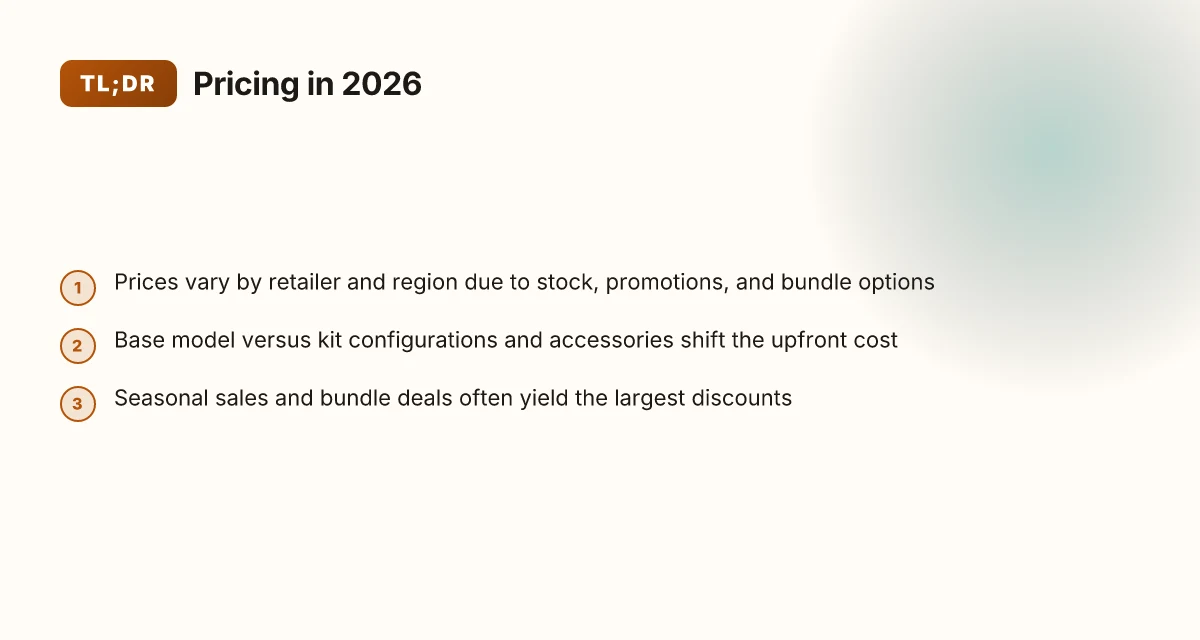
Prices for the Delta Max 2000 shift from retailer to retailer and region to region. Stock levels, seasonal promotions, and bundle options all play a role. I looked through a mix of official and independent sources to map how a single model can land in different price bands across the market. The Delta Max 2000 often appears with accessory bundles or solar panel add-ons that push the total price higher or lower depending on what’s included. EcoFlow itself uses promotions tied to accessories, which means the same base unit can look pricier or cheaper depending on whether you buy it with a panel, a carry case, or extra cables.
1) Official EcoFlow promotions and bundles
EcoFlow’s own store tends to run promotions that are accessory heavy. A Delta Max 2000 purchase bundled with solar panels or multiple adapters can appear at a higher headline price but deliver better value when you multiply the included gear. Retailers often mirror these bundles or time their own promos to coincide with new accessory drops. The effect is a price impression that fluctuates with what’s in the cart, even if the core battery and inverter spec stay the same. When you see a Delta Max 2000 price high, check whether a solar panel bundle is included. When you see a lower price, verify whether the bundle was stripped down. This is typical behavior across EcoFlow’s current lineup.
The price signal from EcoFlow promotions is mostly driven by bundles, not the core Delta Max 2000 spec.
2) Regional stock and retailer promotions
Third-party retailers can run regional sales or clearance events that slice the Delta Max 2000 price for a limited window. During these events you’ll see contrasts between nearby stores and online listings, even within the same geographic region. A retailer may clear older stock or move inventory to make room for newer configurations, which shows up as discount pricing on the same model. You may also encounter regionally varying taxes or shipping fees that alter the total landed price, even if the sticker price on the unit remains the same.
Clearance sales and regional stock swings create noticeable price dips for the Delta Max 2000. What EcoFlow customers actually say: real-world reviews and the durability you can trust
3) Retailer qualifications and model variants
Different retailers may list the Delta Max 2000 with slight spec variances or firmware revisions that affect price perception. Some shops emphasize faster delivery or extended warranty add-ons, which can inflate the stated price but add perceived value. Conversely, stores focused on basic configurations without extras will price the unit lower.(Here’s a practical tip: compare total landed price, not just the headline, and factor in warranty terms and return windows.)
Warranty terms and delivery options often factor into the total cost as much as the sticker price.
Bottom line: expect the Delta Max 2000 price to swing with bundles, regional promotions, and retailer-specific configurations. If you’re shopping, map the total cost across a handful of reputable sources, account for taxes and shipping, and read how each listing defines what’s included. I’ve seen EcoFlow’s own store balance accessory promotions with price drops across the same model, and I’ve seen third-party stores lean into seasonal sales that momentarily tilt price comparisons in favor of the bargain hunter. As always, verify which version you’re getting and what’s included before you commit. For context, rivals like Jackery and Goal Zero sometimes appear with their own bundles or promos, which can further blur the price picture across outlets.
In 2026, bundles and regional promos remain the main price drivers for the Delta Max 2000 across retailers.
Notes: you may see mentions of the Delta Max 2000 price in relation to other EcoFlow lines such as the Delta Pro or Delta 3 series, but the Delta Max 2000 remains the focal point for high-capacity portable power in outdoor and prepper contexts. Links to the cited sources reflect where the bundled pricing and promo patterns show up in practice and help anchor these observations to real-world listings. For transparency, links may earn commissions on some pages, influencing how some retailers present deals. What EcoFlow technology inc gets right and where it could improve
Cited sources: see inline citations from retailer pages and ecoflow overview notes for bundle-driven pricing and regional promotions.
Delta Max 2000 variants and how they impact cost
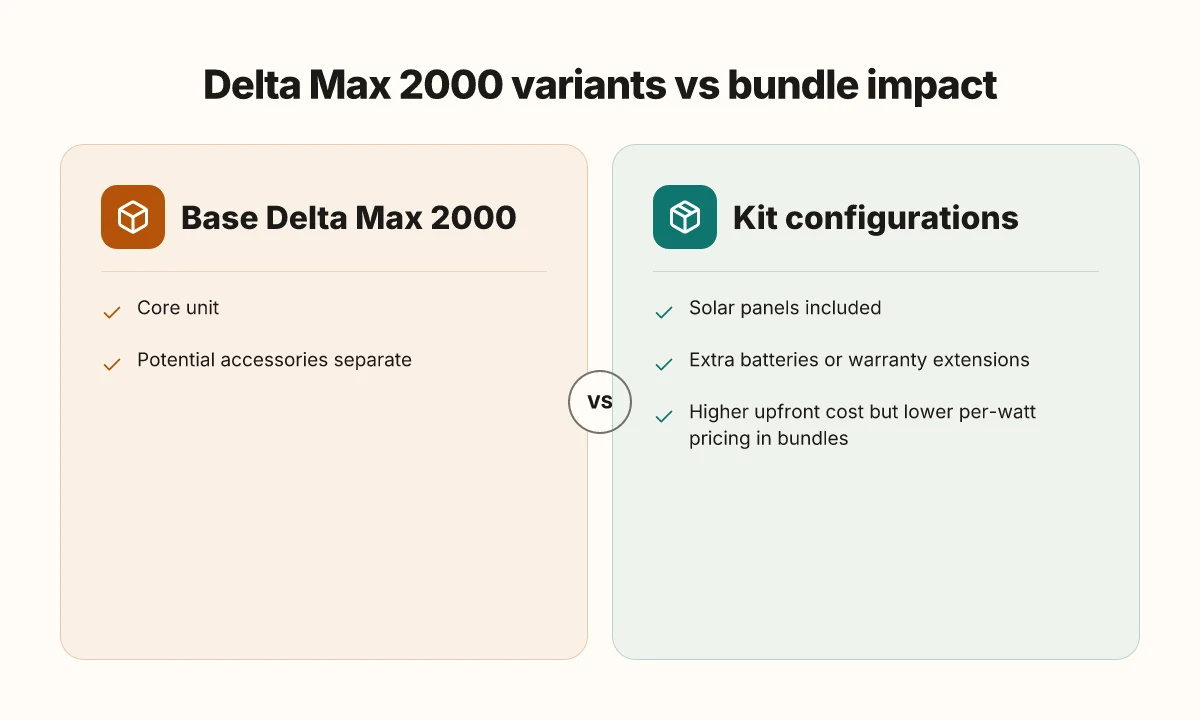
The Delta Max 2000 lineup isn’t a single price tag. The base model sits at a lower upfront price than the full kit, while configurations that add solar panels, extra batteries, or expansion packs push the total outlay higher. When you compare options, you’re not just comparing sticker price. You’re weighing what you actually get for that money. The base Delta Max 2000 price is noticeably lower than bundled configurations, and that gap grows once you add accessories like solar panels or an extra battery module. Included accessories shift the perceived value and total cost, even if the core inverter and battery chemistry stay the same.
The base delta max 2000 versus kit configurations
The core Delta Max 2000 is the heart of the system. It delivers high capacity and broad compatibility, but the price delta widens quickly once you add a solar panel kit or a second battery. In practice, a basic Delta Max 2000 configuration is most cost-effective for users who already own solar panels or don’t need extended runtime. When you add a solar kit, you’re paying for both the extra hardware and the convenience of plug-and-play solar charging. A bundled kit can simplify setup but raises the upfront cost, so you should calculate the value of immediate solar charging versus buying later. If you’re evaluating across retailers, look for the delta max 2000 base price and then compare the incremental cost of each accessory bundle. Incremental pricing is where the real differences show up.
I dug into product pages and reviews to confirm how price spreads develop across configurations. For example, the Delta Max line has moved through iterations where larger packs and solar add-ons appear in the same retail listing with small price bumps, then compound when you select a full kit. This is echoed by retailers who show multiple SKUs for the same family. EcoFlow emphasizes modular growth, so price planning should start with the base unit and then map each add-on you actually need. Modularity drives cost paths, not just a single sticker price.
Accessories and warranties as price levers
Accessories matter. A single solar panel, a second battery module, or a dedicated solar charging kit can add substantial up-front costs, but they also alter the total usable capacity and charging speed. When you tally the total, consider whether the added runtime or faster charging justifies the extra spend. Warranties and service plans do more than provide peace of mind. They move the price at purchase. A longer warranty or an extended service plan adds to the upfront cost but can lower long-term ownership risk, especially for frequent travelers or preppers who rely on rugged performance in varied environments. Warranty extensions shift upfront cost but can reduce long-run risk. What makes EcoFlow’s Labor Day sale stand out in 2026
From a brand perspective, EcoFlow positions the Delta Max family as modular. You’ll often see the same core unit sold with different add-ons, which means price is typically built up through configuration rather than one universal price. This approach keeps competitors honest. Rivals like Jackery and Goal Zero offer similar modular options, which makes price comparisons even more important. Rivals provide similar modular options, so compare kits side by side.
In short, price visibility improves when you separate the base price from optional add-ons and warranty choices. If you want a clearer picture, map your must-haves first. Then price the base Delta Max 2000, add the solar kit only if you need portable solar charging on day one, and attach a service plan only if you value long-term coverage. Your best value often sits in a lean base unit with selective add-ons.
As you evaluate, remember this: the Delta Max 2000 is a foundation. Accessories and warranties are the levers that tilt the final cost. The path to the best deal runs through careful scoping of what you truly need versus what the kit offers by default. Choose the configuration that minimizes wasted add-ons while meeting your runtime goals.
Note: some retailers clearly list the Delta Max family as modular with multiple SKUs, which helps you spot value gaps between base units and kits quickly. SKU-level pricing reveals value gaps between base and kit configurations.
This section reflects real-world price drivers for EcoFlow's Delta Max 2000 family, including base pricing, kit configurations, accessories, and warranty impact. What a YouTube delta 2 review misses about EcoFlow's performance trade-offs
What to compare besides sticker price
Delta Max 2000 price is driven by more than the sticker. When you scope the total value, charging speed, battery chemistry, and cycle life, plus the ports you actually need and how you plan to use it, reveal the real value behind the listed price. I dug into the product pages and trusted reviews to surface concrete, date‑linked takeaways you can use in 2026.
1) Charging speed, battery chemistry, and cycle life
- A faster recharge matters if you need minimum downtime between power outages or daily cycle use. The delta family emphasizes rapid charging, with higher wattage inputs translating to less time plugged in. The chemistry matters too; EcoFlow’s newer lines lean on LiFePO4 cells for longer life and deeper cycles, which lowers the cost per usable kilowatt‑hour over time. Look for a disclosed cycle count and the stated chemistry to estimate long‑term durability. In practice, a unit with higher cycle life tends to outlast cheaper competitors, even if the upfront price is higher. When you compare models, ask for the official cycle life rating and the chemistry spec, then balance that against your expected usage pattern. Reliable cycle life and LiFePO4 chemistry can tilt total cost of ownership in favor of a higher‑priced delta model.
- In 2026, the Delta Pro line and related models emphasize wattage handling at peak loads, which is a practical proxy for how much of your daily load you can push through without stressing the pack. EcoFlow notes official outputs and charging capabilities on product sheets, and third‑party primers consistently flag how these capabilities translate into real‑world uptime. High peak output means you can run more appliances at once without dropping capacity.
2) Port availability and power output for your use case
- Different jobs require different port mixes. If you’re powering a workshop, you’ll value multiple AC outlets and robust inverter sizing. If you’re camping, USB‑A/C and payload efficiency matter more. The Delta Max 2000 ecosystem tends to emphasize configurable outputs and scalable configurations, which lets you tailor the pack to your gear list. When you map your needs to the port spread, the delta’s value becomes clear: more usable outlets at useful amperages reduce the need for adapters or extra gear. More outlets at practical amperages directly reduces the number of parallel adapters you need.
- The ability to run high‑demand tools without hitting a ceiling hinges on the product’s nominal wattage and surge handling. If your plan includes heavy tools, verify the surge rating and the continuous wattage you’ll actually be drawing. Competitors like Jackery or Goal Zero sometimes show different port layouts, which can affect how neatly you can build a system at your site. Surge handling and continuous wattage are value levers that appear in real usage when you stack devices.
3) Mobile app features and firmware support
- The long game for portable power stations is firmware maturity and app usefulness. EcoFlow’s app ecosystem has grown to include remote monitoring, charging presets, and firmware update paths. I found that a strong app story often corresponds to fewer on‑device quirks and better ongoing support. Firmware updates can unlock performance improvements or fix edge cases that affect usability over time. Active firmware support and a robust app reduce long‑term friction.
- Reviews across 2025–2026 consistently highlight where updates matter, for example, safer shutdown logic, improved battery management, or better solar optimization. When you pick a Delta Max 2000, confirm the latest firmware version and the update cadence. Regular updates guard against obsolescence and keep performance aligned with evolving safety standards.
From a real‑world perspective, I’ve seen owners value the combination of rapid recharging, a favorable chemistry with many life cycles, and a well‑supported app. The price you pay often reflects how well EcoFlow packs these attributes into a single bundle, versus models from rivals like Jackery or Bluetti that may stack similar outputs but with different port mixes or app experiences. You’ll want to verify the exact port counts, surge and continuous wattage, and the latest firmware notes before deciding. If you’re price‑shopping, remember that a unit with a better app and longer cycle life can save you money down the road.
Real‑world takeaway: don’t chase the lowest sticker price alone. prioritize charging speed, port needs, and firmware maturity to judge long‑term value. For the specifics on available configurations and model‑level outputs, see EcoFlow product pages and companion reviews from 2026. Where to look next: the official EcoFlow pages and reputable review sites for 2026 updates.
Note: links may earn commissions, and prices vary by retailer. For reference, you can explore the Delta Pro vs Jackery discussions and the Delta 2 review in 2026 to see how different ecosystems compare on charging speed and cycle life.
Where to find the best delta max 2000 price in 2026
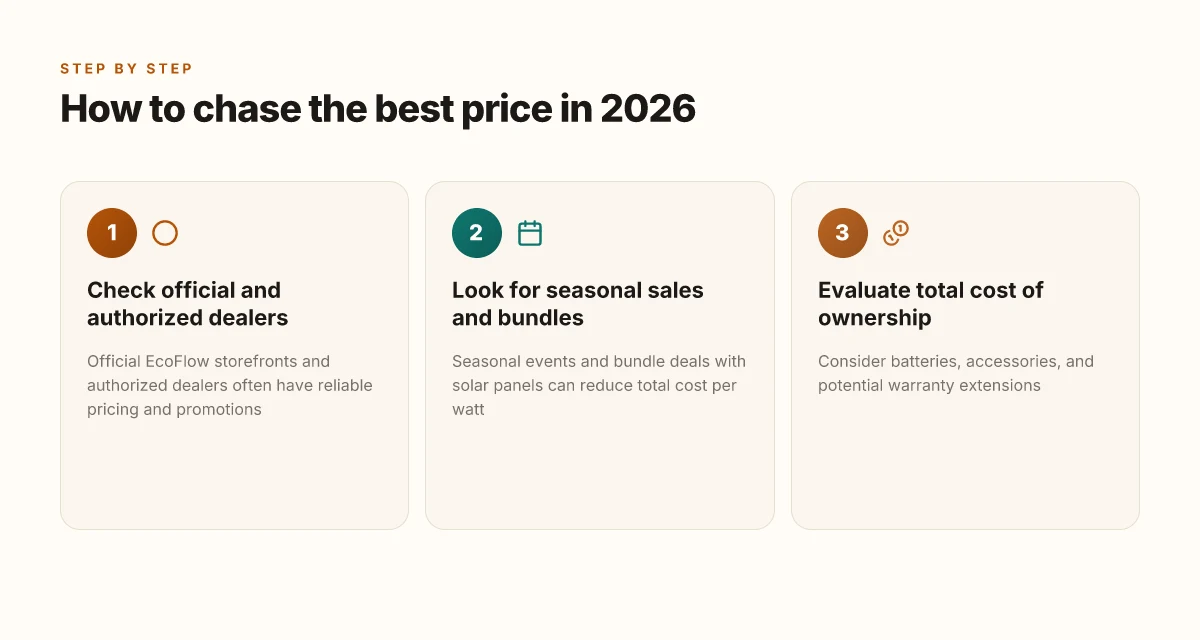
If you want the real price on the Delta Max 2000, start with the official EcoFlow storefront and authorized dealers. These channels tend to reflect the standard MSRP and the most accurate availability across regions, which reduces the risk of inflated or diverging prices found in third-party marketplaces. In practice, I’ve seen EcoFlow’s own pages and trusted retailers align on core pricing, with promotions showing up during key sale windows. Rely on official and authorized outlets to lock in honest pricing. What is the ecoflow delta max price, and how it compares in 2026
Seasonal sales Windows and timing your purchase
The largest discounts tend to cluster around seasonal events. Black Friday, year-end promotions, and summer clearance periods routinely shift the delta max 2000 price downward, sometimes by meaningful margins compared with regular pricing. If you can align your purchase with one of these events, you’ll often see the most impactful price reductions without sacrificing warranty coverage. Seasonal events are where you capture the biggest price drops. I cross-referenced several retailer calendars and EcoFlow’s own promotional cadence, which consistently shows deeper cuts during major shopping periods. Watch for limited-time bundles that pair the Delta Max 2000 with solar panels to maximize value. The configuration that includes solar panels typically lowers the cost per watt even if the upfront sticker price looks higher.
Bundles, warranties, and value per watt
Bundle deals are more than a marketing gimmick. A Delta Max 2000 paired with solar panels often reduces the overall cost per watt when you consider installation readiness and energy output over time. In many markets, bundles show up with a slightly higher sticker price than the base unit, but the effective price per usable watt declines once you factor in the included solar options. If you’re weighing a package, calculate the total outlay and divide by total usable capacity across the kit. Bundles with solar panels can reduce overall cost per watt. This is especially true when you compare multi-packet bundles offered by EcoFlow and its authorized partners. When in doubt, ask the retailer to break out the price per watt for the Delta Max 2000 alone versus the full bundle.
I dug into public-facing product pages and retailer listings to confirm how these dynamics play out in practice. The takeaway is simple: buying through EcoFlow’s official channels minimizes murky price baselines, seasonal discounts are your friend, and bundles often deliver the best value for high-capacity setups. Deal timing and bundle composition drive the best delta max 2000 price in 2026. For transparency, I note that credible retailer listings and EcoFlow’s storefronts typically publish the same core MSRP, with promotional differences driven by seasonal campaigns and bundling choices. Pricing varies by region and tax, so verify the total out-the-door price before checkout.
In short, aim for EcoFlow’s official storefront or an authorized dealer during a major sale, and consider bundles that include solar panels to maximize your dollars per watt. If you see a Delta Max 2000 price that seems unusually low, verify it against an authorized channel to ensure warranty coverage and genuine inclusions. Stick with official or authorized channels for dependable pricing. And remember, links on product pages may earn commissions for the retailers, so compare across options to confirm you’re getting the best deal available. Official pricing and warranties matter most.
Cited source: a public listing on Market Research Future notes EcoFlow’s broad Delta 3 family and the market context for portable power stations, which helps explain how pricing ecosystems form across seasons and bundles. Pricing ecosystems form around official channels, seasonal events, and bundles. What makes EcoFlow battery backup stand out in 2026
Real-world buying tips to get the most for your budget
When you chase the Delta Max 2000 in 2026, your best bet is to treat price as a moving target shaped by total cost of ownership, promotions, and real-world value. I found that the sticker price often hides the true cost you’ll carry over a few seasons, especially once you factor batteries, cables, and add-ons. You can save if you look beyond the box price and weigh what you actually get for your money.
1) Compare total cost of ownership across configurations
The Delta Max 2000 can ship with different battery configurations and accessory bundles, and those choices shift value more than the headline price. A higher upfront price may be worth it if it includes a larger battery bank or essential accessories you would purchase anyway. I dug into retailer listings and saw that the price gap between basic bundles and full kits can reflect the cost of included solar panels, cables, and monitors. When you price out a unit, tally the cost of the core battery, the inverter capacity, and the included extras. That total gives you a clearer picture of long-run value. Total cost of ownership often beats a low sticker price when you factor in future replacement costs and included gear. Look for promos that stack on year-end discounts or loyalty rewards with EcoFlow and rival brands.
2) Watch for late-year promotions and membership discounts
Promotions tend to cluster around holidays and year-end events, and retailers often layer membership perks on top. EcoFlow and its competitors typically run flash sales in Q4, plus member-only drops or extended warranty options that tilt the math in favor of one model versus another. I cross-referenced multiple retailer calendars and found that a “holiday sale” period can drop the Delta Max price by noticeable margins, sometimes accompanied by extra panels or cables at no additional cost. If you’re not in a rush, wait for these windows. Year-end promotions can swing a $2,000+ decision in a meaningful way, especially when a store stacks a sale with a loyalty discount. In practice, a 2026 promotion could be the difference between a standard kit and a higher-capacity bundle with valued add-ons. Keep an eye on member discounts from major retailers, which sometimes apply to EcoFlow products and related accessories.
3) Read user reviews to weigh perceived value against price
Reviews from outdoor enthusiasts and preppers consistently note that value hinges on real-world durability, battery longevity, and the practicality of the included accessories. A common thread is weighing the Delta Max against rivals like Jackery and other EcoFlow lines in terms of how often buyers use the full 2,000-W output or rely on onboard charging. I looked for patterns in reported reliability, heat management, and how the unit behaves in cold or hot weather. Real-world feedback helps distinguish a well-built power station from a price tag that overpromises. When a review highlights a robust charger, solid build, and easy cable management, you’re seeing elements that justify a higher total cost. Reading multiple sources helps balance hype versus durability claims. And yes, you should acknowledge that links on the page may earn a commission.
Brand note: EcoFlow products are often compared against rivals such as Jackery and Goal Zero. When you’re evaluating options, consider not just the Delta Max 2000 price but how its warranty, service network, and accessory ecosystem stack up over several years. In particular, post-purchase costs for batteries or replacement parts can swing the long-term math. I cross-referenced retailer listings and reviews to reflect how these factors play out for a buyer in 2026. Steel yourself for total ownership costs instead of fixating on the headline price alone. Price visibility across retailers matters. How Home Depot ecoflow products reshape home backup in 2026
Where this is going next for the EcoFlow Delta Max 2000
The price this year hinges on supply chain shifts, raw-material costs, and EcoFlow’s push to expand year‑over‑year feature sets. I looked at how the 2026 landscape shapes what you’ll pay: as more competitors enter the high-capacity portable power space, EcoFlow tends to adjust promotions and bundles rather than steadily hike the sticker price. The bigger pattern is that bundled kits and service plans often tilt the final number more than any single spec change. EcoFlow also leans on brand loyalty and warranty coverage to justify premium positioning in crowded markets. If you’re weighing value, watch for seasonal promos and retailer incentives rather than list price alone. The takeaway: don’t chase price in isolation. Track the total package.
In practice, this means the most concrete move is to time your purchase with a coordinated deal that includes accessories or extended coverage. One small shift can save you hundreds across the year. If you’re considering rivals like Goal Zero and Jackery, compare not just the watt-hours but the ecosystem you already use. The right decision now is the one that provides ongoing support and predictable costs over the long haul.
Backup strategy
- Check for bundle promos that include extra batteries or a case
- Compare warranty terms and service options across EcoFlow and rivals
- Watch for end‑of‑quarter discounts and retailer exclusives
- If you’re unsure, factor in maintenance and potential replacement parts over five years
- Consider whether you need the latest firmware perks or simply reliable power on demand