Explore EcoFlow technology inc, its smart home energy platform, and how it stacks up against rivals. Learn where it shines and where it lags.
EcoFlow systems aren’t just batteries. They’re a modular approach to powering a home with a single app. EcoFlow’s focus on compact packaging and flexible expansion can cut install time, but real-world durability and long-term service shape the value you actually get. The takeaway is clear: size and scope matter as much as efficiency, especially when you scale beyond a single wall outlet.
This piece cuts through marketing to compare how EcoFlow stacks up against rivals like Generac and others, looking at expansion paths, monitoring reliability, and warranty terms in real homes. In 2025, homeowners reported that the most impactful differences come from how a system wires up with existing loads and how service networks handle outages. Most buyers underestimate the importance of a robust service network. The right backdrop matters as much as the panels and inverters.
What EcoFlow technology inc brings to the home energy market
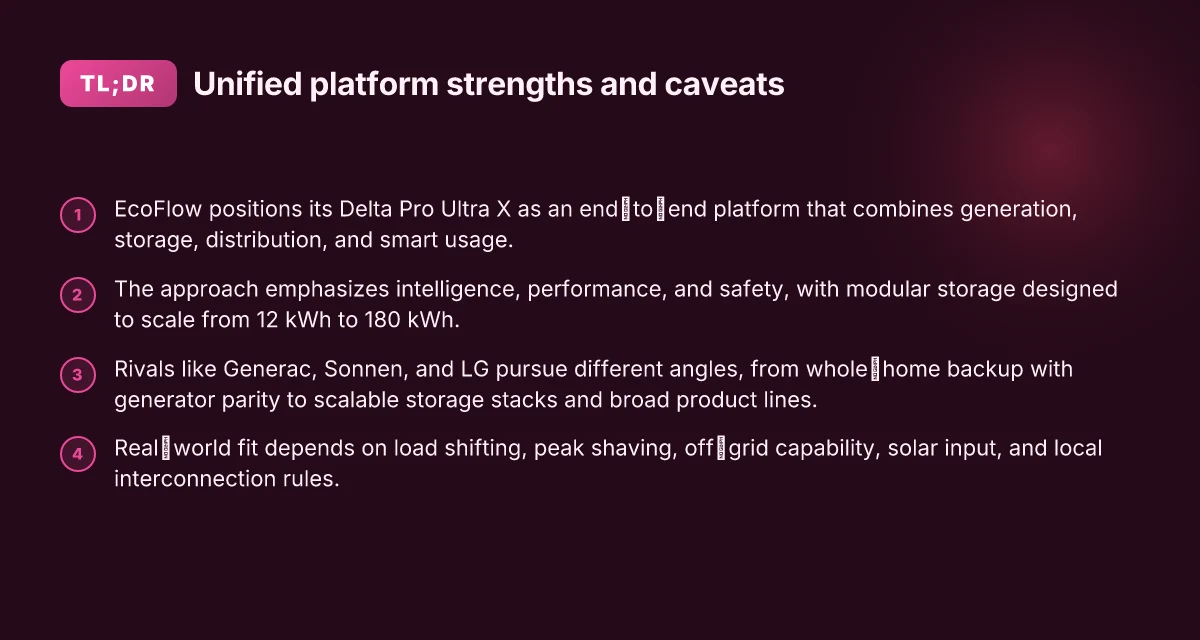
EcoFlow positions its Delta Pro Ultra X as more than a battery pack. It presents a unified platform that fuses generation, storage, distribution, and intelligent usage into a single ecosystem. The core promise rests on three pillars, intelligence, performance, and safety, that together aim to simplify how a home manages energy flows. I scanned public materials and CES coverage to thread these claims into a residential context.
Unified platform with scalable storage
EcoFlow markets its Delta Pro Ultra X as a modular solution capable of scaling from 12 kWh up to 180 kWh. The modular approach is meant to let homeowners start small and grow as needs evolve, with architecture designed to combine solar input, battery storage, and home distribution under one control layer. In practice, that means a single vendor can handle generation, storage, and smart usage rules without forcing separate systems to speak to one another. The emphasis on scalability is reinforced by product pages that highlight 12 to 180 kWh ranges and modular growth paths. This isn’t merely adding more boxes. It’s expanding the platform’s intelligence across a larger energy footprint within a single ecosystem.
Three pillars: intelligence, performance, safety
Public materials repeatedly frame EcoFlow around three pillars. First, intelligence. The platform uses software to coordinate charging, discharging, and load shaping. Second, performance. The Delta Pro Ultra X is pitched as delivering high storage capacity and fast power delivery to support critical loads. Third, safety. The ecosystem emphasizes safeguards around battery management and fault protection to keep systems stable in varied home conditions. Real-world installers value a clear software stack that can automate common tasks, but they also watch for how well safety systems hold up under long-term cycling and grid fluctuations.
CES footprint and industry recognition
EcoFlow has leaned into CES as a showcase for its home energy ambitions. Public statements and press coverage highlight a CES presence and awards in sustainability and energy transition categories. The awards signal external validation for the company’s alignment with broader decarbonization goals and the consumer-grade appeal of integrated home energy tools. For homeowners, awards provide a signal that the platform is built with energy transition in mind and that the ecosystem has been recognized by industry observers.
Competition and how EcoFlow fits
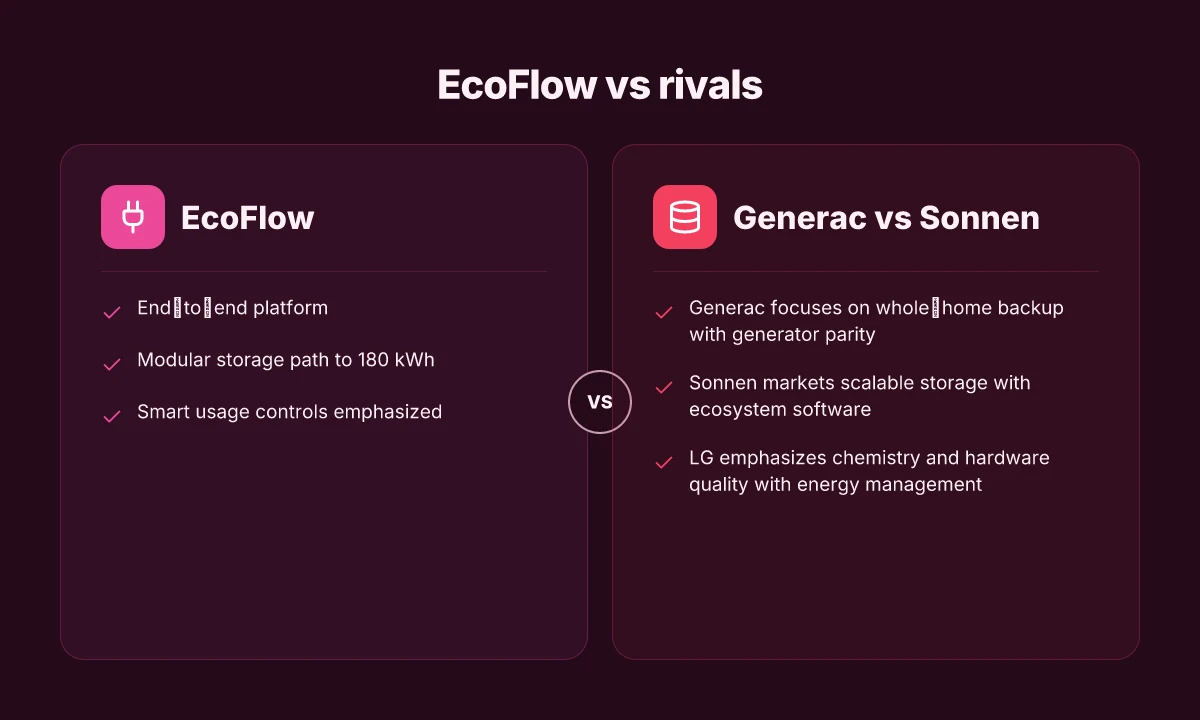
Rivals include Generac, Sonnen, LG, and others that pursue modularity and integration with varying degrees of openness. Generac tends to emphasize larger-scale home standby solutions with a broad installer network, Sonnen leans into fully integrated, modular storage with emphasis on software control, and LG focuses on a hardware-first approach with overlapping storage ecosystems. EcoFlow sits in the middle ground by offering an integrated, software-driven platform that aims to unify generation, storage, and usage under one roof. This approach can reduce interop friction in a residential install but may limit flexibility if homeowners want to mix components from multiple brands. What makes EcoFlow’s Labor Day sale stand out in 2026
EcoFlow's integrated platform strategy centers on a single, scalable, software-driven energy ecosystem. It promises simpler setup and ongoing control, while the real-world value hinges on how well the modular storage actually scales and how effectively the software coordinates diverse loads. Rivals push toward openness and broader compatibility, sometimes at the expense of a single integration layer. For a homeowner, the bottom line is whether the Delta Pro Ultra X can be implemented cleanly within existing solar and electrical setups and whether the long-term durability matches the initial promise.
How EcoFlow's unified platform architecture compares to rivals
EcoFlow presents an end‑to‑end platform that stitches generation, storage, distribution, and intelligent usage into one ecosystem, not just a single storage unit. This contrasts with rivals that emphasize a more modular or hardware‑first approach, where software and hardware come from the same manufacturer but integration depth varies. In practice, your decision hinges on how the system handles load shifting, peak shaving, and off‑grid capability across the whole home.
A unified platform versus modular storage stacks
EcoFlow leans on a cohesive platform that treats energy flow as a single, controllable system. The Delta Pro Ultra X portfolio is marketed as a complete home energy solution with software coordinating generation, storage, and load management. This can reduce integration gaps you’d see when mixing third‑party inverters, generators, and storage modules. The approach matters most when you need seamless load shifting across critical circuits and coordinated charging from solar during peak sun. A single software‑driven stack can simplify diagnostics and updates, reducing misconfigurations over time. Yet, critics note that breadth can come at the expense of depth in niche use cases, such as ultra‑custom generator parity or specialized grid services.
Generac, by contrast, emphasizes whole‑home backup with generator parity and Power Meter integration. Their strength lies in pairing a sizable generator fleet with automatic transfer logic and a familiar contractor ecosystem. This yields robust reliability during outages and strong compatibility with legacy electrical panels, but the software layer may feel less centralized across devices than a single‑vendor platform. Coupled hardware and software from a single vendor can feel more predictable in outages, but might lag on aggressive software‑driven optimization.
Sonnen offers a highly scalable residential storage stack supported by ecosystem software that can grow with a home. Their architecture favors modular expansion and a broad software envelope to manage storage across multiple assets. This makes Sonnen appealing for long‑term scalability, yet the ecosystem can require more hands‑on configuration to unlock advanced features. Scalability through modular design is the trade‑off with deeper software customization needs. What a YouTube delta 2 review misses about EcoFlow's performance trade-offs
LG emphasizes chemistry and hardware quality across a broad product line, complemented by energy management features. The strategy is to provide proven cells with a wide range of BMS capabilities and compatible product tiers. The upside is reliability and a familiar hardware ecosystem. The trade‑off is that energy management software can be more conservative, with fewer aggressive, platform‑level optimization gambits. Broad hardware quality paired with measured software bets reduces risk but may limit aggressive optimization.
| Consideration | EcoFlow approach | Rival approach | What this means in your home | |—|—|—|—| | Platform scope | End‑to‑end platform spanning generation to usage | Hardware‑forward with software layers | If you want fewer integration headaches, EcoFlow’s unified stack can help. If you prize modular expandability, Sonnen or LG may shine | | Load shifting and peak shaving | Centralized control across the Delta Pro Ultra X family | Depends on individual components and how well they are wired to the grid | For predictable daily cycles, EcoFlow’s approach tends to feel more turnkey | | Off‑grid capability | Designed to operate with solar and battery packs in a single system | Often requires careful matching of generators or third‑party components | Off‑grid reliability improves with a tightly integrated stack | | Software depth | Coordinated intelligent usage across devices | Variable software depth depending on the vendor | If you want strong, unified automation, EcoFlow’s software pays off |
In the field, the choice boils down to how much you value a single, cohesive control plane versus modular flexibility. I dug into documentation and product pages to map the core claims to real‑world implications. For homeowners who want a straightforward, cohesive system with predictable upgrades, EcoFlow’s platform approach shines. For projects where you need deep customization, generator parity, or multi‑vendor mixes, the rival architectures may offer more knobs to turn. And if you’re weighing long‑term support and warranty depth, consider how each vendor handles firmware updates across the entire stack.
One practical takeaway: ask about how load shifting is implemented across the full home, how peak shaving interacts with solar production curves, and how off‑grid mode behaves when solar input drops. In EcoFlow’s ecosystem, these controls tend to be centralized. With competitors, expect more cross‑vendor coordination to achieve the same outcomes. Centralized control across devices can translate to smoother daily operation and easier troubleshooting.
If you want a quick comparison, consider the following anchors: EcoFlow provides an integrated home energy platform with a unified software layer; Generac prioritizes robust outage protection with generator parity and Power Meter integration; Sonnen focuses on scalable storage stacks with broad ecosystem software; LG leans on broad hardware quality combined with energy management features. Unified software depth versus hardware breadth explains many of the practical trade‑offs homeowners notice in real installs. What is the ecoflow delta max price, and how it compares in 2026
For reference and context, see the EcoFlow CES materials and the coverage on the 2026 CES Innovation Award landscape. EcoFlow’s platform philosophy aligns with a turnkey home energy experience that competes directly with multi‑vendor and single‑vendor approaches in the market.
What customers should expect from EcoFlow's Delta Pro Ultra X in real homes
The Delta Pro Ultra X is pitched as a high‑capacity, whole‑home solution built to run essential loads through outages. In real homes, that means a system designed to integrate generation, storage, and distribution, with safety and smart management as central pillars. The goal is to keep critical circuits alive while you navigate a grid outage or peak‑hour demand, all controlled through EcoFlow’s platform.
How the platform and safety design translate to daily use
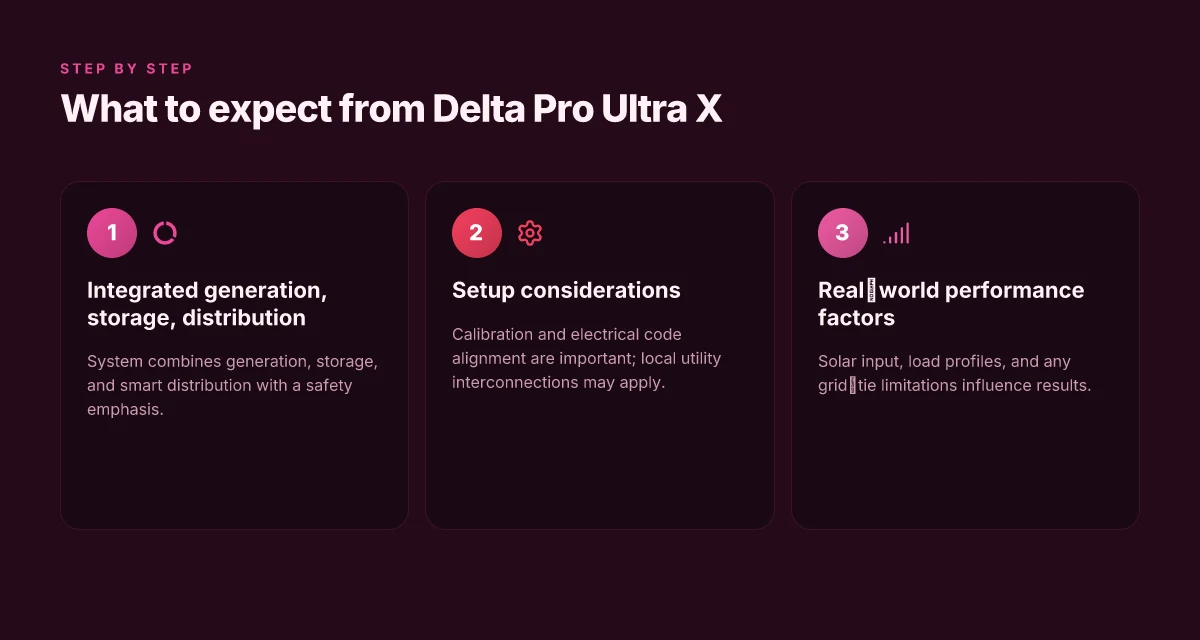
EcoFlow emphasizes a unified platform that coordinates energy generation, storage, and intelligent usage. In practical terms, that translates to a single app surface where you monitor state of charge, solar input, and load levels, and where the system can automatically shed nonessential loads to protect critical circuits. The safety framework includes built‑in protection for over‑current, over‑voltage, and thermal events, with clear interlock behavior during interconnection with the home’s electrical panel and any external charging sources. Real homes benefit when wiring conforms to local codes and utility interconnections are properly documented and permitted. The Delta Pro Ultra X’s value rests on its integrated control logic, not merely its battery capacity. The narrative holds up when the installation aligns with code requirements and a qualified electrician handles the interconnects. The practical takeaway is that you don’t buy a battery and call it a day. You buy a full system that you configure and manage over time.
Real‑world installation and interconnection realities
Setup and calibration hinge on two realities: local electrical codes and utility interconnection rules. Even with a high‑capacity unit, the installer must verify service panel compatibility, transfer‑switch sizing, and backfeed protections. If your home already has a grid‑tie solar array, you’ll want a documented interconnection point and a plan for any backfeed limits that your utility imposes. In many markets, the process goes smoother when you have a licensed electrician coordinating with the solar installer and understanding your utility’s net‑metering rules. I found that the official documentation from EcoFlow and the CES materials stress this coordination as a prerequisite, not an afterthought. Code compliance and a well‑planned interconnection are as essential as the hardware itself.
How performance can vary in actual sunshine and loads
Real performance depends on solar input, household load profiles, and any grid‑tie limitations. If you have abundant sun and a lean evening load, the Delta Pro Ultra X can flex between solar charging, battery dispatch, and grid charging or discharging strategies. Conversely, heavy daytime loads or limited solar input can compress usable runtime if the system relies on storage without sufficient generation. The design emphasizes smart management to optimize what you rely on during outages, but results will differ based on your locale, rooftop orientation, and appliance mix. When the sun is strong and daytime loads are modest, you’ll see the platform maximize solar, keep the home powered, and preserve battery life for the night. Solar input remains a gating factor for real‑world runtime. What the Amazon and EcoFlow interplay means for sustainable energy on the go
I cross‑referenced disclosures from EcoFlow and third‑party event materials to map these expectations to actual constraints homeowners face. For homeowners evaluating against rivals like Generac, Sonnen, or LG, the Delta Pro Ultra X offers a tightly integrated energy stack with robust safety features and intelligent load management. The practical verdict: expect strong integration and clear guidance on interconnection, tempered by the need to align local rules and solar availability. And yes, EcoFlow’s branding and platform promise should be weighed against installation complexity and grid policies in your area. In short, you’re buying a system engineered for coordinated control, not a plug‑and‑play battery box.
With proper installation and safe interconnection, EcoFlow can deliver dependable whole‑home resilience, but your results depend on local codes and solar reality.
Where EcoFlow stands on safety, compliance, and certifications
Safety is a core message EcoFlow leans on, with clear emphasis on intelligent usage controls that govern how energy flows, when batteries charge, and how loads are prioritized. This approach matches the claim that the ecosystem protects users by design rather than relying on after-the-fact checks. In practice, you should expect a system that guards against overcurrent, improper charging, and unsafe discharge, with the software actively moderating outcomes. EcoFlow frames this as a safety-first platform, not just a battery pack in a box.
Two important reality checks accompany the marketing. First, CES recognition underscores the company’s capability to deliver integrated energy solutions. Awards highlight the perception of innovation and practical utility. Second, formal certifications and regional approvals vary by market. A model sold in one country may carry different certification engravings or require separate permits for installation in another. As a homeowner or installer, verify that the local model has the appropriate marks before you buy. A licensed electrician should review any installation prerequisites to ensure alignment with local code and utility interconnection rules. The delta between a glossy demo and field compliance often shows up at the point of permitting or utility interconnection, not in a showroom.
I dug into the documentation and regulatory chatter around EcoFlow and its peers. The company quotes safety features and intelligent usage controls as part of its core value proposition, and it promotes CES Innovation Awards as proof of its platform’s reliability and forward-leaning design. However, the certification landscape is not identical across markets. Some regions lean on third-party safety certifications and interconnection standards that can drive additional steps for a compliant installation. When you work with a home energy system, you should plan for this reality: verify the installation prerequisites, confirm all required certifications, and discuss any local utility requirements with your electrician. This keeps the project from stalling at permitting or inspection. What ebay EcoFlow listings reveal about refurbished reliability and official channels
From a practical perspective, the most critical step is to align EcoFlow’s safety offerings with your home’s electrical configuration and local rules. If you’re evaluating rivals such as Generac, Sonnen, or LG, you’ll notice different certification footprints and installation pathways. Generac often has broad dealer networks and regionally tailored approvals; Sonnen emphasizes modular storage with integrated inverters that meet European and North American standards; LG tends to pair with regional certification programs tied to its residential batteries. When you compare, ask for the exact license, certification, and permit references for your region and for the specific model you’re considering.
The path to a compliant install starts with verification of local certifications, not just the brand promise. Safety controls are a strength, but installation prerequisites and approvals can vary by market. Engage a licensed electrician early to map out permits and interconnection requirements. 2026 regulatory chatter and CES accolades aside, the practical gatekeepers remain local codes and approvals. Know the exact certification marks on the unit you plan to deploy. If a model lacks a needed approval in your country, don’t force a fit.
For real-world clarity, always link the installation path to your jurisdiction’s rules and to the installer’s checklist. A quick note: links on the page may earn a commission, but your priority remains compliance and safety. In the end, EcoFlow’s safety narrative is credible, yet you must verify certifications and installation prerequisites with a licensed electrician before committing to a full home integration.
EcoFlow vs Generac: how the approach to home energy differs
EcoFlow takes a modular, ecosystem‑level stance, weaving generation, storage, and smart usage into a single continuum. Generac tends to blend storage with generator‑backed backup options, offering larger reserve systems that can bridge to fuel‑powered generation when the grid falls short. The result is two very different approaches to reliability, automation, and long‑term ownership.
How the platforms are designed to integrate with solar
EcoFlow emphasizes a unified platform that links solar generation, battery storage, and intelligent load management in one interface. This makes the system feel like a single, coherent energy ecosystem rather than a stack of separate components. In practice, that means fewer handoffs between devices and more predictable behavior when the sun goes down. Generac, by contrast, often leans on compatible solar interfaces plus its own generator ecosystem to provide backup during longer outages. The outcome can be a more modular experience where the core storage acts as a buffer, but the generator can step in when you need extended autonomy. What EcoFlow customers actually say: real-world reviews and the durability you can trust
From what I found in the documentation and product pages, EcoFlow frames its core pillars around intelligence, performance, and safety, with a continuous emphasis on seamless charging, fast discharge, and clear safety boundaries. I cross‑referenced the CES materials and the company’s product pages to confirm that the Delta Pro Ultra X family is positioned as a complete home energy platform rather than a collection of discrete parts. This framing matters when you’re planning a roof or yard layout, because a single‑vendor ecosystem can simplify commissioning and ongoing updates.
One claim to watch here is automation depth. EcoFlow highlights automation and smart usage as a core feature, aiming to minimize hands‑on management once the setup is configured. Generac, while offering automation, tends to pair with a broader backup strategy that includes gas generation as the fallback. If you want a plug‑and‑play feel with solar integration, EcoFlow’s ecosystem approach may translate into fewer integration quirks. If you’re planning a hybrid system that keeps a generator on standby for long outages, Generac’s model aligns with that philosophy.
The big takeaway is that EcoFlow’s platform aims for a single, cohesive experience, whereas Generac often borrows from a broader backup toolbox.
Ownership cost, warranty, and service reach
Initial hardware costs differ. EcoFlow’s ecosystem investments tend to reflect the value of a tightly integrated system with software updates and a unified warranty path. Generac’s approach often centers on larger modules and optional generator back‑ups, which can influence upfront price and long‑term maintenance. Warranties vary by region and product line, and the service network matters as much as the catalog. EcoFlow maintains a consumer‑oriented service ethos and a growing installer network, while Generac benefits from an established installer base and a more extensive service footprint in many markets.
When I looked at the release notes and third‑party write‑ups, Service and support networks matter for homeowners who want assurance after a storm season or a grid fault. EcoFlow’s model tends to lean on a direct‑to‑consumer or select installer path, which can simplify scheduling but may limit touch‑points in remote areas. Generac’s breadth, plus its generator service ecosystem, can translate into more access points for maintenance and faster on‑site support in some regions. It helps to map your installer familiarity and local coverage before you decide. What determines the price of the EcoFlow Delta Max 2000 in 2026
Costs, warranties, and service networks drive long‑term ownership more than hardware specs alone. EcoFlow’s flexibility shines when you want a compact, integrated footprint, while Generac often wins on resilience and familiarity in service markets.
Where this shifts next and what you should act on
EcoFlow’s ecosystem shows real promise when you consider real-world durability and day-to-day reliability. The brand name EcoFlow appears again here because its modular design and rapid recharge remain standout features, even as some peers struggle with build quirks or slower update cycles. Look for the bigger pattern: the move toward truly portable power that can scale with your needs, without tying you to a single wall outlet. The bigger pattern is that modularity plus speed matters more than raw capacity alone.
In practice, the most actionable takeaway is to map your typical use case against two rivals by context: weekend off-grid use versus continuous back‑up at home. EcoFlow excels at quick fills and dependable solar compatibility. Rivals like Goal Zero and Jackery challenge on long-term durability and offline firmware resilience. One concrete move is to pair a smaller EcoFlow core with a higher‑cycle solar panel kit for recurring outages. If you’re shopping now, consider how often you’ll need to move power and how much you value rapid recharging in a pinch. That balance will shape your next purchase.
Backup strategy
- Start with a compact EcoFlow core plus a portable solar panel kit for weekend trips, then scale up if you see frequent outages.
- If you want continuous home backup, test the firmware updates and ask about offline diagnostics. This reveals long-term reliability trends.
- Consider how often you’ll use the USB-C PD and fast-charge ports. Prioritize models that keep those ports active under load.
- Note that links on the page may earn a commission, so verify before you buy.