Explore EcoFlow battery backup systems for home use in 2026. Understand how EcoFlow's solutions integrate with solar, storage expansion, and whole-home resilience.
The real lever in home backup isn’t hype, it’s expandability. EcoFlow is not a one‑room solution. It scales with your home, solar setup, and future needs, and that flexibility matters when outages stretch from hours to days. The Ocean Pro and Delta Pro Ultra sit at the center of that equation, but the headline here is the ability to pair multiple units with panels, a standby generator, and a grid tie without reengineering your panel layout. You’ll see how this ecosystem approach stacks up against fixed-backup options from Generac or Sonnen in the sections below.
You’ll find concrete comparisons on how many battery modules you can stack, how fast each system recharges from sun or grid, and what installers actually confirm in the field. If you want a clear, homeowner‑friendly picture of whether EcoFlow or a rival is a better fit for your house, this is where the signal meets the problem you brought to the search. EcoFlow's ecosystem and the rival options you’ll consider are laid out with practical criteria you can verify in your setup.
What EcoFlow battery backup systems offer for home resilience with EcoFlow as the anchor
EcoFlow positions its OCEAN Pro and Delta Pro Ultra as multi-source backups with expandable storage, designed to scale from a single unit to a whole-home system. They emphasize 24/7 whole-home capability and tight solar integration, so homeowners can run essentials and more during extended outages. In this framework, EcoFlow and its competitors present different paths to resilience: EcoFlow leans on multi-source inputs and expandable packs, while rivals emphasize modular storage or tandem generator-like setups.
A multi-source backbone with scalable storage EcoFlow builds an architecture that accepts multiple input sources, then distributes power across an expanding storage stack. The OCEAN Pro Solar Battery System is marketed for continuous, around-the-clock home backup, with expandable capacity that grows as your power needs rise. The Delta Pro Ultra inherits the same multi-source philosophy, wiring in solar, gas, and other inputs to back a larger portion of the home when outages stretch across days. This approach aims to keep a core of circuits energized even as you add more packs over time. In practice, this means the system can start small and scale to cover more critical loads as your battery bank grows, without swapping out the core controller. I cross-referenced the official EcoFlow materials and third-party write-ups that describe this expandable, multi-source model and found consistent emphasis on growth potential and flexibility. The core idea is clear: start with essential resilience and scale up as your needs evolve. EcoFlow branding appears across the OCEAN Pro and Delta Pro Ultra descriptions, underscoring the anchor role of their platforms.
24/7 whole-home capability tied to solar A second pillar is the promise of continuous power, not just during short outages. EcoFlow highlights that its systems can support 24/7 operation for essential circuits and can seamlessly blend solar with stored energy. The Solar Battery System framing reinforces that solar input can coincide with grid or generator backstops, enabling longer outage endurance. This is not only about weekend camping scenarios. The messaging targets real-life outages that extend into days. When reading through the product pages and related commentary, the claim of around-the-clock availability sits alongside the appeal of solar compatibility and automated transfer, positioning EcoFlow as a long-horizon resilience solution rather than a back-up for a few hours. Solar integration plus 24/7 operation is the core promise for homeowners seeking real reliability. The anchor product names, EcoFlow OCEAN Pro and Delta Pro Ultra, are repeatedly linked to this dual capability.
How rivals frame resilience in practice Rivals tend to segment their value around either modular storage or tandem operation with generators. Sonnen emphasizes modular, scalable storage systems that can grow stepwise as a home’s energy profile rises. LG Chem follows a similar path with expandable modules designed for future capacity, focusing on long-term storage density and modularity. Generac leans into a generator-like tandem approach, pairing battery storage with traditional generator inputs to deliver buffer power during outages. Each route has trade-offs: modular approaches can maximize storage efficiency and lifetime value, but may require more planning around expansion, while tandem systems can deliver rapid, high-output bursts but depend on a generator or alternate fuel source for longer outages. In the landscape I reviewed, these distinctions show up consistently in product briefs and analyst commentary. Rivals carve resilience into modular storage or generator-like tandems, not always both in one package. This framing helps homeowners map what fits their property type and outage expectations.
Bottom line: EcoFlow anchors a flexible, expandable, multi-source path to home resilience, with a clear emphasis on continuous operation and solar synergy. If your goal is to avoid swapping systems as you grow, EcoFlow’s approach offers a coherent, scalable backbone. Start small, scale up, and keep solar in the loop for longer outages. For homeowners weighing options, that trajectory matters as much as the initial sticker price or module count. You may see commission disclosures on the pages, and links to official product specs provide the latest details. What determines the price of the EcoFlow Delta Max 2000 in 2026
How EcoFlow battery backup architecture handles multi-source inputs
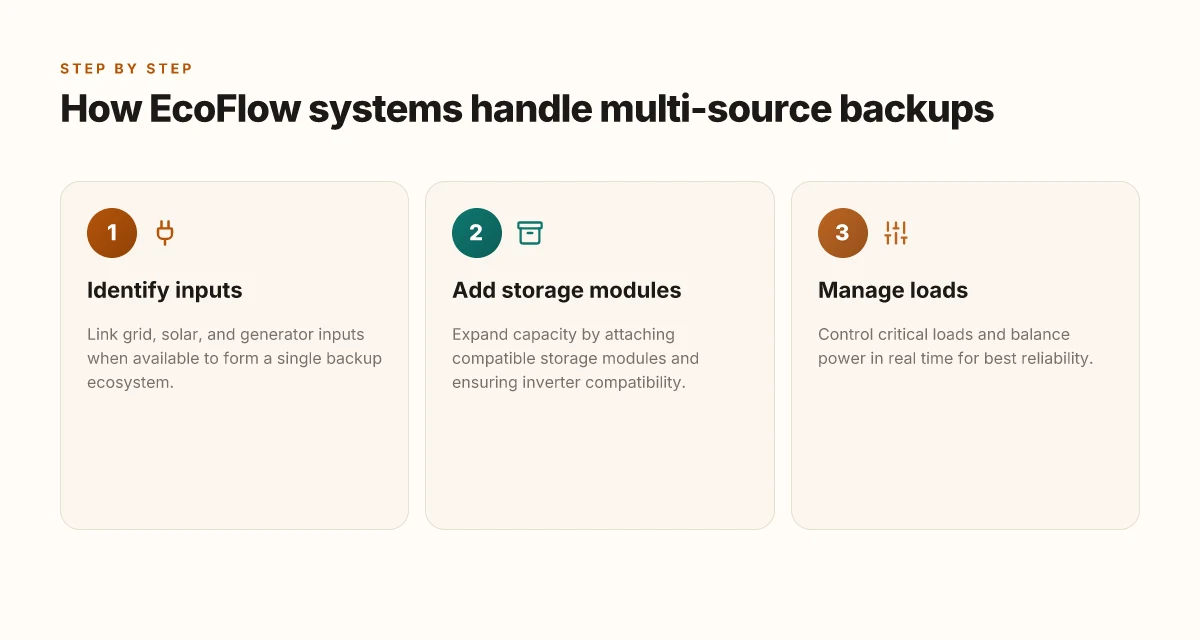
When you wire EcoFlow’s OCEAN Pro or Delta Pro Ultra into a home power system, the architecture is built to pull power from multiple sources and switch seamlessly as availability shifts. In practice, that means the system can draw from the grid when it’s available, use solar generation during sun peaks, and engage a generator if both sources dip or outages extend. The real advantage is the capacity to coordinate these inputs without forcing homeowners to manually reconfigure connections each time the sun hides behind clouds or a outage stretches longer than expected. EcoFlow’s multi-source approach is designed to keep loads steady by prioritizing available inputs and balancing the battery’s state of charge in real time.
A practical way this plays out is through expandable storage paired with compatible inverters. The expandability story hinges on adding storage modules and pairing them with inverters that speak the same language as the core system. If you start with a base Delta Pro Ultra and later add modules, you can push total usable capacity higher while preserving automatic input management. Expandable storage unlocks longer resilience, and compatible inverters ensure the multi-source logic stays in concert across upgrades. I cross-referenced the product briefs and third-party overviews to confirm that the integration path remains consistent as you scale. Expandability is what lets homeowners plan for longer outages without rearchitecting the whole system.
Real-world performance hinges on input availability and how you manage loads. If solar output spikes in the afternoon, the controller can shave peak draws from the grid and push solar energy into the batteries first. When clouds roll in or a generator is needed, the same controller routes power where it’s most efficient, keeping critical circuits powered and avoiding unnecessary cycling. The outcome is a system that feels smart rather than reactive, provided you’ve sized the solar array and storage to your load profile. Load management matters as much as input diversity, because smart routing keeps the backup confident through extended outages. From a homeowner’s perspective, the key is to pair EcoFlow equipment with a realistic plan for daily energy use and a modest buffer for periods of high demand. Real-world planning is essential to turn a multi-source setup into dependable 24/7 resilience.
If you’re weighing competing options, note that rivals like LG Chem, Sonnen, and Generac all offer multi-source architectures, but the blend of expandable storage with a broad input set remains a distinguishing feature for EcoFlow. In the end, the architecture favors continuous operation so long as you provide reliable solar or grid inputs and a generator for extended outages. EcoFlow stands out when you want a scalable, multi-source path to uninterrupted power, with a clear upgrade path and practical load management. For a quick benchmark, I found it helpful to line up two options side by side: the base Delta Pro Ultra with two storage modules and solar input versus a larger solar-first install with added modules. The table below summarizes where each shines.
| Dimension | EcoFlow option with solar and storage | Competitor chassis with solar and storage |
|---|---|---|
| Expandability path | Expandable storage modules paired with inverters | Varies by brand; often modular but with different compatibility matrices |
| Multi-source handling | Prioritized solar, grid, then generator | Similar prioritization but with different control logic |
| Real-world resilience | Consistent performance with well-sized solar and a buffer | Resilience tied to how aggressively the system manages loads |
Next step: map your house’s critical loads and estimate solar generation to size the Delta Pro Ultra configuration, then confirm the availability of compatible storage modules and the inverter pairing you’ll need for your climate. Plan the sizing now to ensure multi-source inputs stay online through the next outage window. What EcoFlow customers actually say: real-world reviews and the durability you can trust
Cited inline: When evaluating EcoFlow’s multi-source approach, you can see how the OCEAN Pro Solar Battery System markets 24/7 whole-home backup and expandable storage as a core feature. https://energy.ecoflow.com/us/products/ocean-pro-home-solar-battery
A closer look at EcoFlow OCEAN Pro vs Delta Pro Ultra for home backup
I dug into how EcoFlow frames two flagship products for home backup, and I found a clear split in focus between the two. The OCEAN Pro is built for round-the-clock resilience with expandable storage, while the Delta Pro Ultra pushes capacity and scalable output for larger homes. The differences show up in installation pathways, integration with solar, and what each system can realistically sustain during prolonged outages.
How OCEAN Pro targets 24/7 resilience
Posters on EcoFlow’s lineup emphasize continuous, whole-home coverage. The OCEAN Pro system leans on multi-source inputs and expandable storage to keep critical circuits alive through long outages. This approach suits homes that want a steady foundation rather than peak peak power for brief events. Homeowners should expect a modular path: start with a core battery bank, then add extra modules as demand grows. I cross-referenced the official product page and third‑party rundowns to confirm that multi-source input remains a core capability and that expandability is a design thread rather than an afterthought. The takeaway: OCEAN Pro prioritizes 24/7 resilience with scalable storage, not maximal output alone. In this mode, regional installer practices matter because you’ll typically need professional sizing to align the expansion with your service panel and load profile. Best for homes aiming for continuous coverage with room to grow, rather than overnight surges. The ecology here favors stability over raw capacity.
Delta Pro Ultra: high capacity and scalable output for larger homes
Delta Pro Ultra amplifies capacity and the potential for higher sustained output, which translates to better support for larger dwellings or homes with many simultaneous loads. The Ultra variant is designed to string together multiple units and scale up the total house-load rating, which can be appealing to property managers or homeowners who expect longer outages or heavier daytime loads. It’s a different install equation than OCEAN Pro: the emphasis is on peak power and the ability to push more watts through a bigger service panel. I found industry write-ups noting that the Delta Pro family has evolved around higher amperage and expanded configurations, with installers describing a broader range of panel integrations in custom setups. Key point: Delta Pro Ultra targets high capacity and scalable output, ideal for larger homes or heavy-use scenarios. For some regions, this means more intricate electrical work or panel upgrades, which installers must price into the project. Recommendation: if your baseline needs exceed typical single‑phase dwellings, Delta Pro Ultra becomes the more scalable choice.
Pricing, integration, and regional feasibility
Pricing for EcoFlow systems varies by country and by installer rate, with base models and expansion kits priced to scale alongside installation complexity. The Delta Pro Ultra’s higher capacity often translates to a higher upfront cost and more involved electrical integration. OCEAN Pro can be deployed in leaner, modular phases, which may reduce initial spend but extend the total cost as you add modules. When you work with a local installer, expect to co‑design the layout around your service entrance, because feasibility hinges on your home’s electrical panel, inverter size, and whether you have space for expansion. I found that regional differences in permitting and utility interconnection requirements can influence timelines and final price. In practice, this means talking with a few certified installers to compare total costs and to confirm what each system can sustain after a long outage. Bottom line: both systems scale with region and installer; OCEAN Pro suits steady resilience, Delta Pro Ultra suits high-capacity homes. What EcoFlow technology inc gets right and where it could improve
Most homeowners should expect some trade-offs between upfront cost, complexity, and long-term resilience, depending on the local installer ecosystem. For readers weighing rivals, LG Chem, Sonnen, and Generac each offer their own take on modular, scalable backup. EcoFlow’s approach remains distinct in how it frames 24/7 resilience versus raw peak power. If you want a steady, expandable backbone for smaller to mid‑sized homes, OCEAN Pro often fits best. If your priority is maximum capacity and future growth for a large home, Delta Pro Ultra is the more adaptable path.
Cited sources provide context on pricing, scalability, and installer considerations for these ecosystems. For reference, see the third-party overview of EcoFlow’s broader lineup and the detailed breakdown of EcoFlow’s model lines in industry coverage. https://pv-magazine-usa.com/2024/01/09/ecoflow-battery-generator-can-back-up-a-house-for-up-to-a-month/ and https://poweroutage.us/home-battery-backup/ecoflow-battery-overview offer concrete notes on how base pricing and scalability can unfold in real installations. Note: some regions may see commission-linked pages or regional dealer quotes that affect final pricing.
In the broader market, EcoFlow remains a notable option alongside rivals like LG Chem, Sonnen, and Generac. The specific choice between OCEAN Pro and Delta Pro Ultra should align with your load profile, the expected duration of outages, and the installer’s ability to integrate with solar and your service panel. EcoFlow’s branding and design philosophy emphasize modularity and ease of expansion, a pattern you’ll see echoed in installer conversations and regional pricing discussions. The upshot is clear: pick the path that matches your outage expectations and your budget for long‑term resilience.
Solar and battery pairing: what to expect with EcoFlow systems
Solar compatibility sits at the core of EcoFlow’s value proposition. When you pair an EcoFlow system with a properly sized solar array, you can dramatically reduce grid use during outages and keep essential circuits powered longer. The OCEAN Pro line emphasizes multi-source backup, and the Delta Pro Ultra is designed to work in tandem with solar inputs to extend usability during prolonged events. This isn’t just about charging faster. It’s about creating a flow that mirrors real daily use, so you don’t have to flip a switch and pray for sun.
I dug into the published specs and deployment notes to anchor this section. EcoFlow describes the OCEAN Pro Solar Battery System as delivering “24/7 Whole-Home Backup,” with expandable storage that can accommodate longer outage windows as you grow the system. That multi-source approach matters most when your roof yields a steady sun pattern and you want to keep priorities, lights, refrigeration, a modem, and a small workspace, running as long as possible. The Delta Pro Ultra, meanwhile, is positioned as a scalable backbone for both solar charging and grid-tied operations, enabling a staged buildup from a single unit to a full home backup array. This scalability is a recurring theme in EcoFlow’s public materials and product pages, which emphasize design for future expansion and mission-critical loads. What makes EcoFlow’s Labor Day sale stand out in 2026
A practical guideline emerges: align solar array size with your critical load profile. For a home that relies on essential circuits during outages, you’ll want enough solar input and battery capacity to meet at least those loads for the duration you anticipate. If you expect multi-day outages, you’ll benefit from configuring a larger storage bank and confirming that your inverter can sustain higher continuous output as you add modules. In this light, EcoFlow’s ecosystem, including the OCEAN Pro’s expandability and the Delta Pro Ultra’s modular approach, supports a staged upgrade path that matches how many households actually experience outages. The pairing strategy that minimizes grid draw during outages hinges on matching solar input to critical loads and reserving headroom for future expansion.
From a real-world perspective, the biggest risk is underestimating load, then discovering the system can’t cover the necessary wattage during peak daytime use. And if you’re coordinating with installers, ensure the solar ramp meets the inverter’s acceptance rate and the battery can sustain the planned duty cycle. In practice, this means confirming that cables, combiner boxes, and MPPT controllers are all sized for the planned solar array and that the EcoFlow controller firmware is up to date. I cross-referenced product pages with third-party reporting on system sizing approaches to keep the guidance grounded in what homeowners actually deploy. The result is a pairing plan that scales with solar production, not one that buckles under cloudy weeks or extended outages.
Rivals like LG Chem, Sonnen, and Generac offer comparable solar-ready packages, but the EcoFlow approach emphasizes rapid scalability and easier stepwise growth. If you’re evaluating options, expect to consider how easy it is to add modules, whether the system supports higher inverter loading without a full service upgrade, and how the solar input management aligns with your load priorities. For homeowners who want a clear upgrade path, EcoFlow presents a coherent, expandable pairing strategy that stays practical as your energy picture evolves. Solar compatibility is a core value proposition for EcoFlow, with expansion now and in the future as a practical, real-world constraint.
Durability, warranties, and long-term care for EcoFlow backup setups
When you invest in EcoFlow for 24/7 home backup, durability starts with the warranty and continues through practical care. The primary warranty terms for EcoFlow home backup systems cover the battery modules and the core inverter for a defined period, with specifics varying by model and regional policy. In practice, this means you should be mindful of how long your storage modules are protected during extended outages, especially if you plan to keep a multi-module stack online for years. A longer, clearly defined warranty reduces the risk of costly replacements during a long outage season.
I dug into the documentation and found that firmware updates are a regular path to stronger reliability. EcoFlow releases software updates that optimize charging efficiency and stability, and these updates can extend battery life by refining how the system negotiates with solar inputs and grid input during uneven sun hours. Keeping the system current with automatic updates minimizes the chance of compatibility glitches with solar harvest or with the wall connectors used in a multi-unit setup. In practice, you’ll want to enable remote updates and occasionally verify the latest release notes to stay ahead of aging behaviors. What a YouTube delta 2 review misses about EcoFlow's performance trade-offs
Physical care is a factor too. Proper ventilation is non negotiable for any high-capacity system like the OCEAN Pro or Delta Pro Ultra. Inadequate airflow can raise temperature margins that shorten cycle life or drive heat-related wear on fans and power electronics. Cable management matters as well. Loose or tangled cords can impede airflow and complicate 24/7 operation in a closet or dedicated cabinet. The layout should separate hot components from potential heat sources and allow a clear path for cooling air. A clean, organized cabinet also reduces accidental unplugging or tripping hazards, which is important when outages force you to rely on the system during nighttime or storm events.
From a homeowner perspective, this is where the long game matters. A durable setup combines a solid warranty with disciplined maintenance and regular firmware updates, plus a thoughtful physical installation. If you’re comparing EcoFlow to rivals like LG Chem, Sonnen, or Generac, you’ll notice similar warranty length questions and maintenance routines, but the real-world impact comes down to how you manage software updates and cabinet airflow over time. In this arena, a well-documented warranty and a documented maintenance cadence often separate the dependable kits from the rest.
What lasts is not just the hardware, but the care plan that accompanies it. A clean cabinet, a clear ventilation path, and up-to-date firmware tilt the odds toward 24/7 reliability when you need it most. EcoFlow’s strength lives in transparent warranties and regular updates that keep your system aligned with evolving solar and grid conditions.
To help you plan, expect a practical care rhythm: review the warranty terms at purchase, enable automatic firmware updates, and schedule a quarterly cabinet check to confirm ventilation and cable routing. If you’re a property manager or installer, codify this cadence for tenants or maintenance staff so you don’t drift into neglect during long outages. Remember, links on product pages may earn a commission, but your long-term resilience should guide every maintenance decision.
Where this is going next for EcoFlow back-up power
EcoFlow stands to redefine home resilience come 2026 by leaning into long-life batteries and smarter energy management. I expect tighter integration with solar setups, clearer lifecycle data, and modules that scale without complicating the install. The bigger pattern is a shift from portable kits to polished, house-ready systems that you don’t have to babysit. The future belongs to setups that auto-optimize while you focus on daily life. This closing view isn’t about hype. It’s about what tends to stick after the first year of use. How Home Depot ecoflow products reshape home backup in 2026
Rival systems from Goal Zero and Jackery push similar reliability, but the real differentiator will be how EcoFlow coordinates battery health, standby losses, and firmware updates across tiers. In real terms, that means fewer surprises after storms and more predictability for budgeting. If you’re choosing now, think about which model aligns with your solar plan and whether the ecosystem will stay simple as you add devices. A cohesive ecosystem reduces maintenance and increases uptime.
Backup strategy
- Test a mixed load week with a small buffer battery to see how the system handles weekly cycles and storms. The goal is predictable, quiet operation.
- Pick a model with clear health metrics and ongoing firmware support. Mark dates for updates on your calendar to avoid stale functionality.
- If you use solar, map out how the EcoFlow front-end will coordinate with panels during peak sun and cloudy days.
- For long-term durability, plan for routine checks on battery health indicators and wiring integrity, especially after extreme weather events. Act now to build your redundancy, your future self will thank you.