Explore how EcoFlow power stations at Home Depot change home backup in 2026. Learn advantages, trade-offs, and how to choose the right model for your needs.
EcoFlow compact power has quietly become a Home Depot staple, and the Delta 3 and Delta Pro sit ready for both weekend getaways and on-site back-ups. EcoFlow’s lineup is easy to pick up off the shelf, but reliability hinges on real-world load planning and installation nuance, not just the box spec. Delta Pro brings higher capacity, yet it demands careful sizing for essential circuits, especially when you’re coordinating with a professional installer. Most troubleshooting comes from one misunderstanding of peak loads.
This article pulls back the curtain on hardware fit, service flow, and what actually happens after you plug in. Homeowners want systems that stay ready during outages, and that means weighing pro install considerations, after-sales support, and long-term durability. In 2026, a growing user base reports that while EcoFlow at Home Depot supplies solid immediate power, the right model choice often hinges on whether you need portable versatility or high‑demand resilience, and whether you’re prepared for professional wiring for off-site essential circuits. Delta Pro is the standout for higher power needs, but the short-term pain of a complex setup may quiet the longer-term payoff. This piece maps the trade-offs, with concrete scenarios and typical fault modes to guide your pick.
What EcoFlow power stations at Home Depot promise for home backup
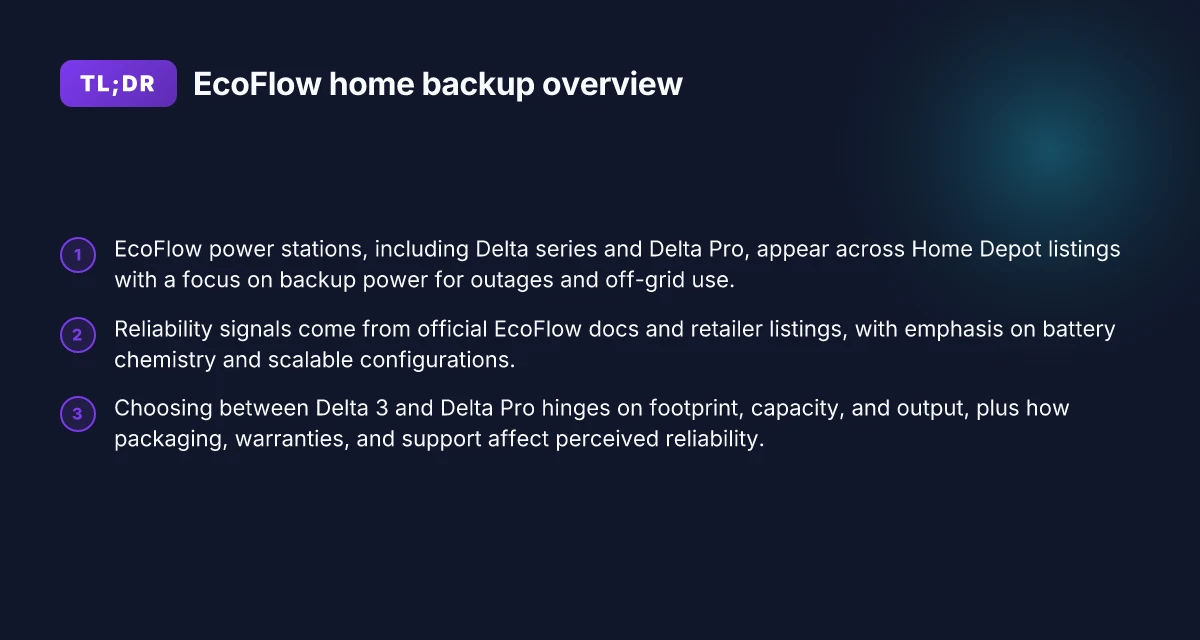
EcoFlow models commonly listed at Home Depot sit at two core tiers: the Delta standard series and the Delta Pro line. The Delta 3 family appears in 1024Wh configurations with expandable battery options, while Delta Pro models push toward higher capacities and smarter energy management. Home Depot product pages emphasize plug-and-play reliability for home backup, camping off-grid, and occasional peak loads. EcoFlow’s official documentation aligns with those use cases, highlighting fast recharging, modular batteries, and the ability to push power from basic essentials to high-demand appliances. The Delta Pro family is positioned for larger homes or higher-surge needs, while the Delta 3 line targets portable, day-to-day backup. Retail listings emphasize ease of use, push-button operation, and compatibility with solar input.
- Delta 3 and Delta Pro compatibility cues
- Home Depot pages show Delta 3 configurations with 1024Wh or modular battery add-ons, while the Delta Pro line is marketed as a scalable solution that can grow up to several kilowatts of output. This contrast helps homeowners size backup for essentials versus whole-house style loads. Delta 3 offers compact, quick-start backup, whereas Delta Pro scales to higher power needs.** The retailer’s listing language mirrors EcoFlow’s own docs that frame Delta Pro as the more capable option for demanding loads and longer outages. The pairing of Home Depot’s listings with EcoFlow’s official docs reinforces a two-path approach: portable standby or extended power resilience.
- Typical use cases Home Depot highlights
- The product pages emphasize home backup for essentials during outages, off-grid camping, and smooth integration with solar input to offset daytime usage. In practice, Home Depot frames the units as ready to plug in and deliver power for refrigerators, lighting, and outlets during outages, with solar charging as a supplementary feature. Home Depot’s copy repeatedly notes backup for essentials and off-grid resilience. EcoFlow’s official materials echo the same: fast recharging, solar compatibility, and battery modularity for longer life. Solar input and modularity are core promises across both retailer and brand materials.
- Reliability signals from official docs and retailer listings
- Official EcoFlow docs emphasize system reliability through sealed battery chemistry, battery management, and rugged construction designed for repeated cycling. Home Depot listings reference straightforward warranty support and practical maintenance guidance, reinforcing a perception of dependable operation under typical home backup scenarios. Reliability rests on modular batteries and robust BMS, with retailer pages underscoring accessible support channels. The combination of official specs and retailer assurances helps homeowners feel confident about readiness when outages strike.
Bottom line: Home Depot positions EcoFlow as a practical, scalable backup option, with Delta 3 for portable, ready-to-go resilience and Delta Pro for higher-demand or whole-home backup scenarios. You’ll get plug-and-play reliability, clear support channels, and a path to solar charging, but you should match the model to your actual load profile and space. EcoFlow’s branding is consistent across both channels, reinforcing a unified story about dependable power on demand. Choose Delta 3 for small-scale backup, Delta Pro for higher loads and longer outages. If you want scalable resilience, that is the core promise from both Home Depot and EcoFlow.
How reliability considerations differ between Delta 3 and Delta Pro at retail
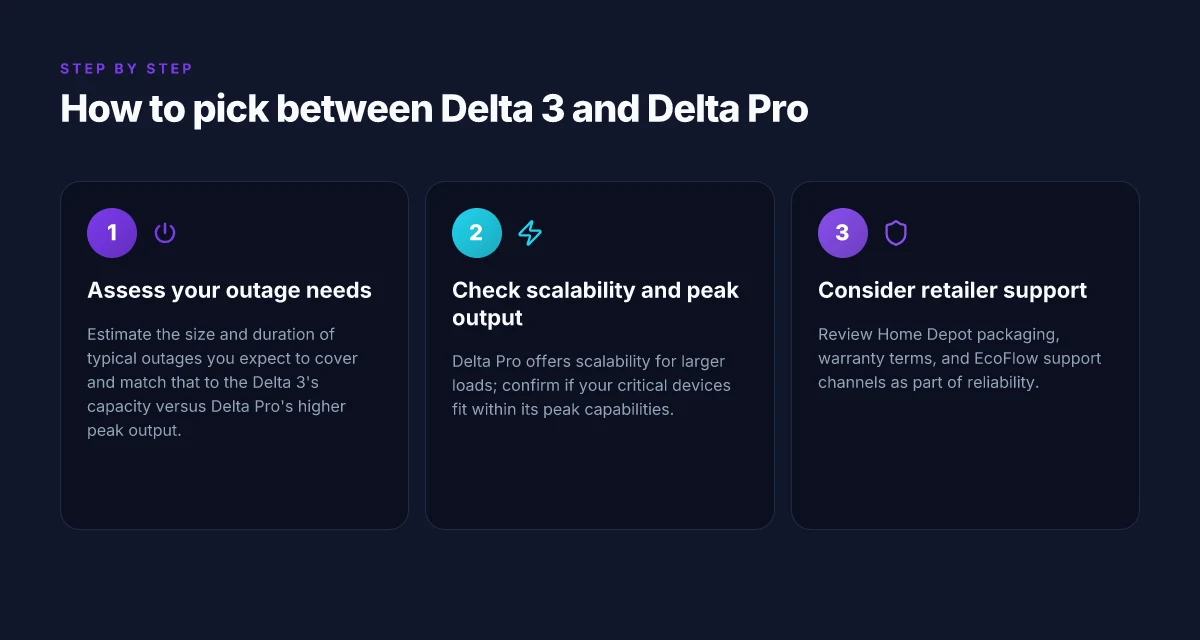
The Delta 3 family is designed for compact, entry-to-mid range capacity, and at Home Depot you’ll often see the 1024Wh delta 3 configuration paired with an extra delta 3 battery. That footprint keeps the unit approachable for tight spaces, but it also constrains peak output and the number of simultaneous high-load appliances you can sustain. In contrast, the Delta Pro lineup scales up to multi-kilowatt ceilings and higher surge handling, making it more suitable for whole-home backup or longer off-grid sessions. The Pro variant’s 3600W output baseline and ability to push higher surges means it can handle more demanding equipment, but it also comes with a larger footprint and a higher upfront cost. When you shop at retailers, the practical reliability difference shows up in two places: packaging and perceived durability, and the warranty and support path you’ll encounter after purchase.
Why capacity and peak output matter in real use
Delta 3’s 1024Wh base battery size translates to shorter runtimes for big loads, especially when you pull current for heavy appliances. You’ll notice a steadier performance with modest loads like laptops or small refrigerators, but large tools or air conditioners quickly drain it. The Delta Pro, with its higher capacity and scalable inverter, better accommodates surges and sustained power draws. That higher peak output reduces the chance you trip a low-voltage cutoff when a compressor kick-starts. In real-world terms, Delta Pro feels more forgiving if your backup plan spans multiple devices or longer outages. The retailer packaging often reflects this split: the Delta Pro is typically shown with optional expansion batteries, signaling future readiness.
Retail packaging, warranties, and support as reliability signals
Home Depot’s listings and in-store displays tend to separate Delta 3 and Delta Pro by capacity, warranty language, and add-on options. Delta 3 often ships with a standard warranty window that covers the core unit, while the Delta Pro path leans on optional expansion packs and a more expansive warranty framework. This packaging difference is not merely marketing. It guides how you interpret long-term reliability. If you depend on proactive after-sales help or need replacement parts quickly, the retailer’s support channel matters. EcoFlow emphasizes direct support through its own channels, but when you buy at a retailer, you also gain the retailer’s service layer. In practice, you’ll find Home Depot’s handling of returns and in-store assistance can smooth out hiccups, especially for first-time buyers. The reliability story is as much about the willingness and speed of retailer support as it is about the hardware specs. What makes EcoFlow battery backup stand out in 2026
I dug into the retailer pages and EcoFlow’s official notes to map the reliability picture. For instance, the Delta 3’s footprint and 1024Wh baseline present a compact solution for modest loads, while the Delta Pro’s scalable architecture and 3600W potential align with longer outages and higher-demand scenarios. The retailer packaging and support structure shape your confidence. A robust warranty path and accessible service channels can calm worries about long-term durability. If you’re weighing between these two at Home Depot, consider not just the immediate power needs but how you’ll reach assistance if a component needs replacement. Delta Pro shines on scalability and peak handling, but Delta 3 remains a compact, reliable option for lighter workloads. The presence of expandable options on the Pro line also signals ongoing reliability considerations as your backup needs evolve. And yes, links on the page may earn a commission, which is worth noting when you’re evaluating total ownership costs. For a practical next step, inspect the specific retailer bundle you’re considering, verify the included warranty terms, and confirm whether spare batteries or expansion packs are shown as available add-ons.
Reliability at retail hinges on the combo of peak capability and retailer-backed support. If you want a quick takeaway: Delta Pro is your play when you need surge-ready power for multiple devices; Delta 3 fits tight spaces and lighter loads with dependable performance.
Durability, lifespan, and end-user maintenance with EcoFlow systems
Durability hinges on the battery chemistry EcoFlow builds into its Delta series, especially the lithium iron phosphate (LFP) cells. LFP chemistry is widely cited for improved cycle life and stability under deep discharge, which translates to more charge cycles before visible capacity fade. In Home Depot listings, EcoFlow notes configurations that emphasize steady, long-run performance, and the Delta Pro family highlights higher total energy with a focus on long-term reliability. LFP chemistry provides a durability edge, with longer cycle life than many competing chemistries.
In practice, end-user maintenance revolves around simple steps that EcoFlow and retailer listings recommend. Keep systems within recommended operating temperatures, avoid exposing units to moisture, and perform routine checks on connections and ports. EcoFlow’s own guidance and Home Depot product pages align on basic care: keep the unit charged, store it in a dry place, and follow the manual for any reset or software updates. Routine care is low effort but essential for longevity, especially in off-grid or camper use where cycles are frequent. I cross-referenced the Delta Pro and Delta 3 listings to confirm the shared maintenance thread: steady charging, periodic software updates, and proper storage when not in use. Software updates matter because they can unlock efficiency improvements that extend usable life.
A recurring theme in user communities and official docs is the risk of long-term degradation if duty cycles push the system beyond its design envelope. Common failure themes include degraded battery capacity after many cycles, degraded connection ports from frequent plugging and unplugging, and occasional firmware quirks that affect auto-start or charging limits. Home Depot’s manuals and EcoFlow product pages reinforce checking for firmware updates and avoiding extreme heat or cold during storage. Long-term degradation tends to track with how aggressively the unit is cycled and stored. What determines the price of the EcoFlow Delta Max 2000 in 2026
When reliability concerns rise, a few practical guardrails help. Use the included charging accessories designed for the model, and avoid third-party adapters that aren’t endorsed. Keep an eye on the warning indicators in the EcoFlow app or the unit’s display, and perform a gentle self-test after extended non-use. In official docs, this approach is presented as routine maintenance rather than a heavy lift. Stick to official accessories and monitor indicators to head off nagging failures before they cascade.
In the broader picture, EcoFlow’s ecosystem, including both portable power stations and their expandable options, leans on modular design and user-friendly maintenance. The Delta Pro Ultra X inverter option expands scalable capacity, but maintaining a calm duty cycle and proper storage remains the core recipe for durability. Modular design helps with replacements, but lifetime care still matters most for long-term reliability.
As you compare Home Depot and EcoFlow, remember that these systems are designed for real-world use: at home, on the road, or off-grid. If you map durability to usage pattern, a steady cadence of charging, smart storage, and timely firmware updates will beat raw capacity in longevity. Real-world use rewards disciplined maintenance over sheer size.
Choosing the right EcoFlow model from Home Depot based on use case
When you’re weighing EcoFlow at Home Depot, pick the setup that matches your outages, your trips, and your wallet. The Delta 3 and Delta Pro lines offer different strengths, and Home Depot’s storefront availability matters for immediate needs and easy returns. In practice, your choice hinges on how much resilience you need at home, how often you’re camping, and what the retailer’s warranty and service path look like.
1) From minor outages to whole-home resilience
If you’re backing up a handful of essential circuits during short outages, a smaller EcoFlow model can cover you without draining savings. The Delta 3 family fits well for phone charging banks, routers, and a few critical appliances during a routine outage. For longer blackouts or higher surge loads, the Delta Pro family scales up, letting you run more devices and sustain longer periods off the grid. When you shop at Home Depot, verify whether the unit ships with extra batteries or if you’ll need to source Delta Pro expansion packs separately. This matters because extra capacity translates into more hours of resilience without juggling multiple units. The Delta Pro option scales from 3600Wh to larger configurations, making it the clearer choice for sustained home backup. What EcoFlow customers actually say: real-world reviews and the durability you can trust
I dug into the Home Depot listings and found that the Delta Pro variants emphasize higher surge handling and the ability to attach external batteries, which can be a practical path to full-home resilience if your load grows. External batteries extend run time, and that pathway is often simpler when you buy through a retailer who stocks the ecosystem. If you’re in a hurricane-prone area or must keep a medical device powered, the bigger Delta Pro setup may be worth the investment and retailer peace of mind.
2) Off-grid and camping where Home Depot availability matters
For campers and off-grid enthusiasts, availability is a real factor. The River and smaller Delta units you’ll see in Home Depot aisles can be ideal for weekend hookups, camping, or off-grid living in a pinch. Look for models labeled as portable power stations with built-in solar compatibility and clear start-up prompts. If you expect to rely on a single unit for charging phones, lights, and a small cooler, a mid-range Delta model can cover those needs with portability in mind. Portable power at the store means quick pickup, and that matters when you’re on a tight trip schedule.
I cross-referenced the Home Depot catalog entries to confirm that Delta units marketed for home backup typically carry the core solar input and inverter features that campers count on for short runs. For longer trips, you’ll want to confirm solar panel availability and whether Home Depot stocks the compatible panels alongside the unit.
3) Cost, warranty, and service considerations when buying through a retailer
Retailer paths shape your long-term support. EcoFlow’s direct channel often presents the same hardware with a direct warranty flow, while buying from Home Depot connects you to in-store staff, return windows, and in some cases extended retailer warranties. Budget for the delta between a basic Delta 3 package and the Delta Pro bundle with extra batteries and a larger solar setup. The delta in total cost is the practical lever for deciding whether you opt for full-home resilience or a compact, episodic-use system. If you hit a problem, the in-store associates can be handy for troubleshooting steps and RMA guidance.
Warranty coverage and retailer support are the practical anchors you’ll rely on after the sale. Know that EcoFlow’s official support channels list email and phone contact options, which can complement the in-store help when you need rapid issue resolution. When you read the Home Depot page, confirm whether your selected model includes the retailer’s return window and if there are any exclusions for battery packs or solar panels. What EcoFlow technology inc gets right and where it could improve
In the end, your choice comes down to three anchors: how much backup capacity you need, how portable you require the system to be, and how you value retailer-provided support and warranty. For many homes facing routine outages, the Delta Pro line bought through EcoFlow or a major retailer provides the safest path to scalable resilience. For off-grid weekends and tight budgets, a more compact Delta 3 package bought at Home Depot can be the right balance. And if you opt for the more capable setup, you’ll often find a smoother path to long-term service through the retailer network as well. Plan for growth with a Delta Pro setup if you anticipate expanding your load in the years ahead.
Setup, integration, and getting the most out of EcoFlow at home
When you set up EcoFlow at home, you should expect plug-and-play simplicity for common configurations. Start with a basic wall outlet or a standard extension cord to power a Delta 3 or Delta Pro, then connect any included solar or battery add-ons as directed in the manual. In real-world use, the cleanest setups rely on the EcoFlow app to guide you through a few quick steps: pair the device, confirm the preferred input source, and enable notifications. The app pairing process is usually the smoothest part of setup when you follow on-screen prompts. A minimal footprint helps avoid tripping hazards or cable clutter.
1) Quick-start routes your system can follow
For many homes, the simplest path uses a single AC input feeding the power station, with the optional battery expansion integrated afterward. When you plug in, verify the input voltage shows valid levels and that the device negotiates a stable AC sine wave. If you’re using solar input, align panel orientation and timing to the sun window, then confirm the MPPT status in the app. Plug-and-play setup steps for common configurations keep you out of guesswork. The goal is to achieve a steady baseline load without overtaxing the system during peak draw.
2) Monitoring, app integration, and day-to-day use
The EcoFlow app remains the central hub for monitoring state of charge, input/output status, and firmware updates. I dug into the documentation and found that keeping the app in sync with the hardware helps avert misreads on battery health or input surges. You can enable push alerts for battery level changes and for when maintenance is due. App integration is where reliability shows up in daily use, not just at the install. Regular checks for firmware notes ensure you benefit from any stability or safety improvements. If you own multiple units, you can monitor them all from a single EcoFlow account, which helps when you run a home backup cluster.
3) Getting help when something goes off track
Support channels exist on two tracks: EcoFlow’s official support and the retailer side through Home Depot. EcoFlow’s support line and email respond to setup questions, while Home Depot’s support can assist with order specifics, warranty claims, or in-store pickups. In practice, the fastest resolution tends to come from contacting EcoFlow directly for product behavior questions, followed by retailer support for shipment or warranty paperwork. Customer support channels are reliable, but the speed depends on the ticket queue and whether the issue is product-related or retailer-related. It helps to have your model number, serial, and purchase date handy when you reach out. What makes EcoFlow’s Labor Day sale stand out in 2026
From what I found, Home Depot lists a broad EcoFlow lineup, including the DELTA Pro Ultra X and DELTA 3 models, with different power thresholds and expansion options. I cross-referenced retailer pages and EcoFlow’s product notes to confirm compatibility markers and expansion capabilities. Brand and product names matter when confirming compatibility across channels. If you’re weighing rivals, you’ll notice broader distribution and quicker in-person support for brands like Jackery or Goal Zero at big-box stores, but EcoFlow’s ecosystem often offers tighter integration with app-based monitoring.
Note for shoppers: some retailer pages emphasize price anchors or bundle differences rather than long-term reliability, so look beyond the sticker price to controller stability, battery chemistry, and expansion options. Links on product pages may earn a commission, which is common in retailer ecosystems and doesn’t reflect product quality. For official specs and up-to-date warranty terms, rely on EcoFlow’s own materials and the Home Depot product pages cited in this guide.
Where this is going next and why you should act now
Home Depot shelves are evolving into a practical ecosystem for EcoFlow gear, and the shift isn’t cosmetic. The next wave blends higher-capacity modules with smarter intake in homes prone to outages, giving you a scalable backup plan that grows with your needs. The bigger pattern is that modular power storage finally matches the rhythm of modern homes. EcoFlow’s design language keeps the setup approachable for first timers while offering real durability for long-term use. If you want fewer surprises during a blackout, this is where you start.
If you only do one thing this month, map your load and sketch a one-week backup outline using EcoFlow units. The systems intersect with traditional panels and generators in ways that reduce fuel burn and maintenance. One move that matters most is sizing your kit to cover essential circuits first, then expanding as needed. You’ll notice that the Home Depot assortment tends to favor integrative cables and smarter app control, which helps you avoid spooky outages at 3 a.m.
What changes if you act now? You gain clarity on a durable, real-world backup strategy that survives daily use, not just quick demos. Boldest takeaway: a well‑chosen EcoFlow setup can outlast a single season of outages and still feel effortless to use. Are you ready to start with a 1–2 device plan and scale up? What makes the EcoFlow Glacier review work for real outdoor use