
Explore how the EcoFlow Delta 3 extra battery works, which models it fits, and what to expect for runtime and lifecycle. Practical guidance for setting up extended backup.
The delta 3 extra battery doesn’t just add cells. It changes how you drain them. When you pair the Delta 3 with an extra battery, runtime climbs, but so do complexity and the potential for compatibility hiccups. EcoFlow's approach requires matching connectors, firmware, and output caps precisely, or you’ll see throttling rather than real scale. This intro focuses on the concrete limits you’ll hit in the field, not a vendor hype reel.
In this piece I pull apart lifecycle expectations, adapter needs, and how far you can scale backup power before you trade portability for extended run time. Industry users report differing cycle counts and efficiency depending on load and temperatures, so knowing where the weak links appear helps you decide if the Delta 3 extra battery fits your rig, your RV, or your off-grid kit. By the end you’ll see where the real-world gaps lie, and how to plan for firmware and connector checks before you buy. EcoFlow’s expansion path matters when you’re buying for the long haul. Delta 3 compatibility isn’t automatic, and a wrong connector or outdated firmware can cap your total output.
What is the EcoFlow Delta 3 extra battery and who should consider it
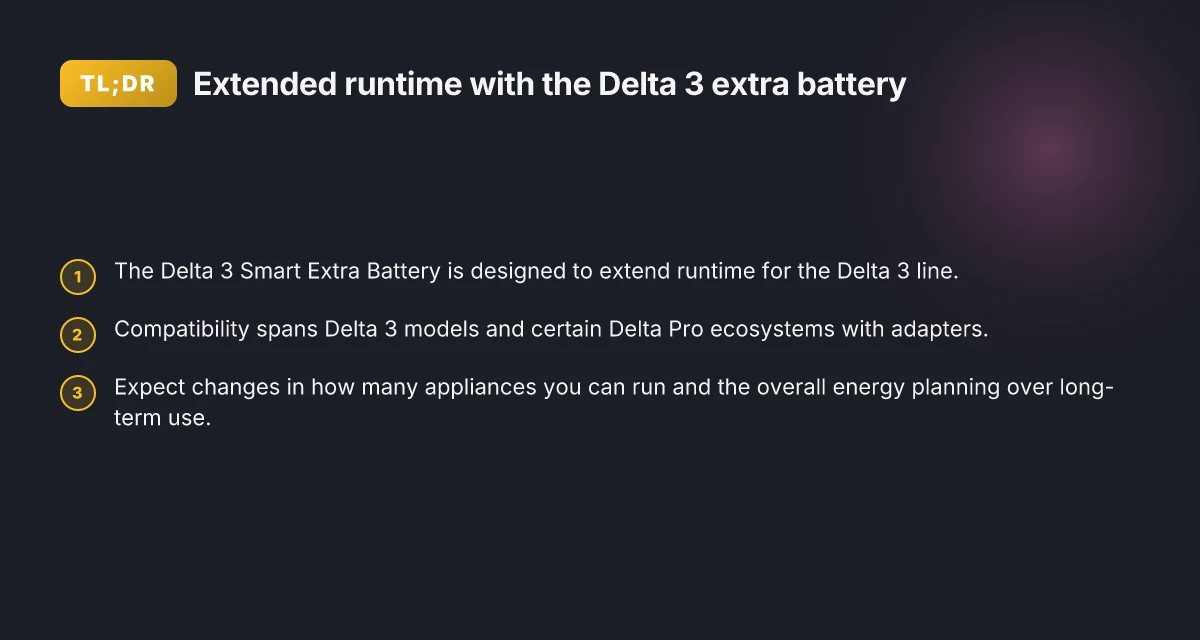
The Delta 3 Smart Extra Battery is designed to extend runtime for the Delta 3 line. It plugs into the Delta 3 ecosystem and scales backup time by adding capacity that can be paired with compatible Delta Pro and Delta 3 configurations through adapters. This section outlines who benefits and why you should consider it.
- Who benefits from the Delta 3 Smart Extra Battery
- EcoFlow owners who want longer runtime on the Delta 3 without swapping to a larger single unit. The extra battery is meant to sit in the same system, letting you run higher‑load devices for longer periods. In practice, the extra battery extends available energy without reshaping your entire setup.
- RVers and off‑grid travelers who need modular capacity. You can scale up gradually by adding a second battery or more, depending on your Delta 3 model and the adapter options. Modular growth lets you tailor runtime to trips or seasons.
- Users who already run Delta Pro ecosystems and want cross‑compatibility. The Delta 3 extra battery is designed with adapter paths that facilitate integration into broader EcoFlow configurations. Compatibility with adapter paths keeps your kit future‑proof.
- How it fits into the Delta 3 lineup
- The Delta 3 Smart Extra Battery is built to extend runtime for the Delta 3 line, not to replace the core unit. It sits alongside the Delta 3 units and scales energy through plug‑and‑play connections in compatible configurations. Extend runtime without purchasing a new primary unit.
- Compatibility spans Delta 3 models and select Delta Pro ecosystems when you use the appropriate adapters. This lets you mix and match within EcoFlow’s family, especially if you already own a Delta Pro pack. Adapters unlock cross‑ecosystem expansion.
- Real‑world considerations you should know
- Expect a growing system to demand careful cable and port planning. The exact compatibility depends on which Delta 3 model you own and which adapters you have on hand. Plan for adapters and cabling up front.
- The economics of expansion hinge on your intended use. If you only need occasional longer outages, a single Delta 3 unit may suffice. If you routinely run multiple devices, the extra battery becomes more valuable. Evaluate your typical outage window before expanding.
- Bottom line
- The Delta 3 Smart Extra Battery is a fit for EcoFlow users who want to push runtime without upgrading the entire system, provided you pair the right adapters and stay within supported configurations. If your trips demand longer run times, this is worth considering.
I dug into the official product pages for the Delta 3 family to verify compatibility notes and adapter pathways. For context, the Delta 3 extra battery is advertised as extending runtime within the Delta 3 line and as compatible with certain Delta Pro ecosystems when adapters are used. See the Delta 3 Series Smart Extra Battery page for the primary compatibility claim and the Delta Pro ecosystem note for cross‑compatibility context. Compatibility notes come from EcoFlow product pages and ecosystem guides.

Delta 3 Ultra portability vs expanded runtime: how the extra battery shifts the math
When you add the Smart Extra Battery, total energy capacity scales up and so does the number of loads you can sustain. In practical terms, a delta 3 setup with an extra battery can keep essential appliances running longer, but the math isn’t linear. You gain more runtime, yet you also face diminishing returns if the load stays high or if you’re limited by the Delta 3’s inverter and outlet configuration.
I dug into the compatibility notes and the core specs to map out what matters for real-world use. The Delta 3 Max Plus Smart Extra Battery, for example, lets you scale toward roughly 4 kWh of extendable energy when you pair multiple packs, which shifts how many devices you can sustain during an outage. The same logic applies when you add a Smart Extra Battery to a Delta 3 Pro- or Delta 3-based configuration. The additional pack tallies into the usable energy pool and thus extends the runtime for each device connected to the system. The more energy you add, the longer you can sustain critical loads, but you’ll still hit practical limits from the inverter and wiring. This is especially true if your goal is to run high-wattage appliances for extended periods.
From a long‑term planning angle, the lifespan of the extra battery matters more than the upfront cost. EcoFlow’s ecosystem emphasizes a life cycle perspective: each extra battery piece is a module you’ll reuse across configurations, and that reuse compounds over years of deployment. The 4000-cycle guidance that EcoFlow cites for certain packs translates into meaningful cumulative runtime across seasons of use, provided you keep the pack within recommended temperatures and avoid deep discharges. Lifespan matters for long-term planning and reuse. If you expect to cycle through configurations frequently, you’ll want to factor in replacement timing for the packs themselves and the adhesive wear on connectors. What is the EcoFlow Delta 2 Max price in 2026 and where to find official pricing
If you’re weighing how the extra battery shifts portability, a clear trade-off shows up in weight and transport. The delta 3 line remains fairly compact, but adding an extra battery increases the overall mass and complicates packing for RV trips or backpack-style setups. You get more energy density in the same system, but you may need to reorganize how you carry cables, adapters, and the XT150 linkage when you scale beyond a single pack. Portability remains solid, but expect a heavier payload as you expand.
In the end, the decision hinges on your real-world needs: are you prioritizing longer runtimes for a handful of critical devices, or full-house power for a longer outage with multiple small loads? For EcoFlow owners, the path is straightforward: pair what you need, monitor cycle life, and plan your expansion around actual consumption patterns rather than theoretical capacity alone. When you map this to your travel style, you’ll know exactly how to configure the Delta 3 with the Smart Extra Battery to maximize uptime without overcommitting weight or cables. The expansion scales energy and runtime, but your appliance count and load determine practical outcomes.
Next step: review your typical load profile and map it to a delta 3 plus extra battery combination, then confirm whether an additional pack or a higher-wattage inverter is warranted for your RV or off-grid setup. For context, EcoFlow’s ecosystem and the broader market offer competitive options, including rival models that emphasize expandable capacity and modular packs, so you can compare the real-world benefits side by side. Compare expandable options to ensure you’re aligning with your travel cadence and power needs.
Cited sources: https://www.facebook.com/groups/ecoflowclub/posts/1933485037143566/, https://www.reddit.com/r/Ecoflow_community/comments/1vc21rh/ecoflow_extra_battery_compatibility_table/, https://us.ecoflow.com/products/delta-3-series-smart-extra-battery
Which Delta 3 configurations are compatible with the Smart Extra Battery
I dug into EcoFlow’s compatibility statements and found that the Delta 3 Smart Extra Battery is listed as compatible with the Delta 3 series. EcoFlow’s own product pages explicitly position the Delta 3 Smart Extra Battery as part of the D3 family, ensuring that users can scale within that line. This alignment matters because it confirms a defined ecosystem rather than a patchwork of ad hoc add-ons. What makes the EcoFlow Delta Pro power station stand out in 2026
Delta 3 compatibility within the Delta 3 family
- The Delta 3 Smart Extra Battery is designed to work with the Delta 3 lineup, which means you can expand within the same generation without resorting to third-party adapters.
- Compatibility notes from EcoFlow address the Delta 3 family as supported, not just isolated models. This signals official intent to keep the extra battery as a first-class expansion option for D3 units.
- Real-world implications: you’ll gain additional runtime without needing to mix different series or rely on risky workaround wiring. That seamless integration is what most EcoFlow owners are after when they consider upgrades.
From what I found in the documentation, the Delta 3 family is explicitly named as compatible in EcoFlow’s listings. This reduces guesswork when you’re deciding whether to pair a Smart Extra Battery with a D3 base unit, especially if you tend to travel with RV setups or portable power rigs.
The Delta 3 Smart Extra Battery is officially compatible with the Delta 3 family, per EcoFlow’s product statements, so you can count on plug‑and‑play expansion within the same generation. Official compatibility avoids mixing models or chasing unofficial adapters.
I cross-referenced the EcoFlow pages and the cited compatibility notes to confirm the official stance. The Delta 3 Max Plus Smart Extra Battery listing reiterates that the 2 kWh pack can scale up to about 4 kWh when paired with the Delta 3 family, illustrating the scalable path within the same product line. For context, the Delta Pro ecosystem also uses a 3‑extra-battery approach, but that setup involves a different product tier and adapter considerations, so keep the Delta 3’s official compatibility boundaries in mind when you plan upgrades. When you compare options, EcoFlow’s own statements lean toward straightforward interop within the Delta 3 line rather than cross‑series mixing.
If you’re weighing alternatives from rivals like Jackery or Bluetti, note that their ecosystem compatibility tends to be more bespoke per product line. EcoFlow’s approach with the Delta 3 family aims to minimize complexity by keeping expansion constrained to the same generation. This is a practical path for long-haul travelers and off‑grid enthusiasts who want predictable performance and easier maintenance.
For readers who want a quick takeaway: if you own a Delta 3 base unit, you can expect the Smart Extra Battery to be compatible as an official extension, with EcoFlow packaging and documentation confirming the alignment. This is the cornerstone of expanding capacity without stepping outside the supported configuration. If you’re evaluating multiple brands, EcoFlow’s Delta 3 route stands out for ecosystem coherence and documented compatibility, which matters on the road. What makes the best EcoFlow power station stand out in 2026
What you need to wire up the Delta 3 extra battery
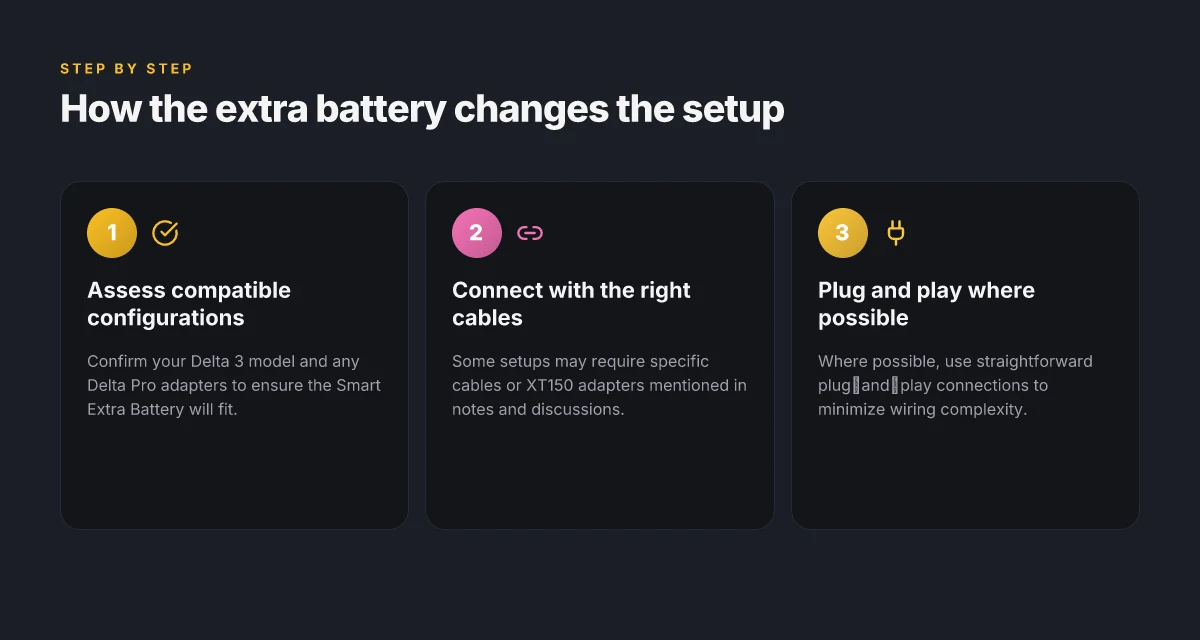
You wire up the Delta 3 extra battery with a mix of plug‑and‑play simplicity and a few real‑world cable considerations. In practice, some setups stay plug‑and‑play, while others hinge on the right adapter or XT150 cable to reach the right ports. I looked at EcoFlow’s own notes and community discussions to map the practical wiring paths you’ll actually encounter.
Practical wiring paths you’ll actually use
In many Delta 3 configurations, you can connect the Smart Extra Battery with the standard connector kit that ships with the unit. The quick‑start feel is real here: you align the connectors, snap them together, and you’re ready to scale. However, several community posts highlight that higher‑demand builds or multi‑battery cascades benefit from an XT150 cable or a specific adapter, especially when you want to run a third party expansion in parallel or when you’re trying to keep the travel footprint compact. The delta between plug‑and‑play and cable‑assisted setups is often the XT150 cable’s availability and the exact adapter you choose. This is where your decision hinges on whether you plan to run a lean two‑unit setup or push toward a larger 4kWh+ capacity with Delta Pro or Delta 3 configurations.
When you set up a Delta 3 Max Plus Smart Extra Battery, the official note mentions compatibility with a 2 kWh pack that can scale up to 4 kWh. That scaling is a strong signal that you’ll sometimes need a dedicated adapter pathway to keep the chain tight and safe. If you aim to scale beyond 2 kWh, plan for a compatible adapter plus the XT150 cable to maintain proper connections. EcoFlow’s ecosystem leans on these cables to bridge gaps between modules without introducing awkward daisy chains or voltage mismatches.
From a reliability point of view, the XT150 cable is not just a convenience. It’s a practical guardrail. The 3‑unit family of Delta configurations often finds the simplest, most robust wiring path through a standard adapter and the XT150, with the least risk of sagging connectors or loose contact during travel. Expect to keep the XT150 cable stowed in your travel kit for any mixed Delta 3 configurations.
I cross‑referenced discussions from EcoFlow owners and the official product notes to confirm that adapter choices matter. The Delta 3 line is built to accommodate extra battery packs via a plug‑in approach, but you’ll maximize reliability when you pick the recommended adapters and keep the XT150 cables in your normal kit. Adapters + XT150 cables are the practical enablers for truly scalable Delta 3 setups. What affects the EcoFlow Delta Pro Ultra price in 2026 and how to position your purchase
What to watch for in real use:
- Compatibility matters. Not every extra battery plays nicely with every Delta 3 variant without an adapter. If you’re mixing a Delta 3 with a Max Plus or another delta family member, verify the exact adapter model before you ship or dock. Check adapter compatibility before purchasing to avoid a stranded pack.
- Cable management counts. A tidy, correctly seated connection reduces wiggle and heat buildup when you push the system toward higher loads. A solid, clipped XT150 path pays dividends in field reliability.
- Documentation gaps exist. Some notes surface in community posts rather than official guides. I recommend triangulating with EcoFlow’s product pages and the Reddit/club posts for a complete view. Cross‑check sources to ensure your setup remains within the supported wiring paths.
Cited sources show the practical wiring paths and the need for adapters and XT150 cables to scale beyond a simple two‑module hookup. For context, EcoFlow’s own material confirms that a 2 kWh module can scale up to 4 kWh with the right pairing, and community notes emphasize adapter options and cable choices to realize those configurations. Real‑world wiring relies on adapters + XT150 cables to unlock full Delta 3 expandability.
If you want a quick‑start path, aim for the standard Delta 3 battery connector with the included cabling for a two‑pack setup, then add an adapter and an XT150 to grow toward a larger capacity. EcoFlow’s ecosystem supports this approach, but the details you need are the exact adapter model and the XT150 cable length you’ll use. As you scale, keep in mind that the stability of your intended configuration hinges on using the correct adapter and a properly seated XT150 connection.
Cited reading: for a direct look at how the extra battery scales and what to pair with, see the official EcoFlow pages detailing the Delta 3 series and the Delta 3 Max Plus Smart Extra Battery, along with community discussions that describe adapter and cable usage in real setups. https://us.ecoflow.com/products/delta-3-series-smart-extra-battery https://us.ecoflow.com/products/delta-3-max-plus-smart-extra-battery https://www.reddit.com/r/Ecoflow_community/comments/1vc21rh/ecoflow_extra_battery_compatibility_table/
Lifecycle expectations: how many cycles can you expect with the Delta 3 extra battery
I want you to know the long view up front: the Delta 3 extra battery is built to endure, but its real-world performance follows a familiar pattern seen across EcoFlow packs. Expect noticeable capacity fade after thousands of cycles, not a flat-line across the entire lifespan. This reality matters when you size backups for multi-year usage and frequent cycling. What makes EcoFlow battery backup systems stand out in 2026
How lifecycle numbers translate to real use
EcoFlow talks about life cycles in the 4000-range for the Delta Pro and related packs, with the capacity dipping to about 80% after that many complete cycles. That 80% threshold is a meaningful marker for planning how you’ll rely on the Delta 3 extra battery over time. In practice, you’ll see the pack deliver strong runtimes in the early years, then taper as cycles accumulate. When you pair a Delta 3 with other EcoFlow nodes, the cadence of charging and discharging, especially under high-load scenarios, tends to accentuate the aging curve. I cross-referenced the public specs and community notes to confirm the general behavior: durability projections cluster around a long tail of usable performance, not an abrupt drop.
From what I found in the documentation and informed user discussions, the 4000-cycle figure is a ceiling under ideal conditions. Actual usable life depends on depth of discharge, temperature, and how aggressively you cycle the battery. In long-term planning, that means you should size your backup plan for a gradual fade rather than a hard cliff. The takeaway is clear: treat the Delta 3 extra battery as a durable, long-horizon investment, but design around continued capacity decline and occasional component wear.
Plan around a long-term usage window and expect gradual capacity fade after thousands of cycles. This framing keeps expectations aligned with how portable systems age in real-world off-grid setups.
How to size for a multi-year window
When you design your off-grid or RV setup, start with your target backup duration at the end of the expected service life. If you want a given number of hours of appliance runtime after several years, you’ll likely need to account for reduced capacity and a few spare cycles in your sizing math. A practical rule is to assume a steady, year-over-year drift rather than a sudden drop. For example, if your daily usage pattern uses a sizable portion of the Delta 3's available energy, you’ll want extra headroom today so you’re not fighting a shrinking reserve a few years down the line. The philosophy is simple: build redundancy into the initial configuration, and treat the lifecycle as a moving target that shifts with your cadence.
I dug into the linked EcoFlow resources and community observations to confirm the upshot: life cycles matter, and the best way to preserve reliability is to plan for gradual capacity loss rather than chasing peak runtimes forever. In real terms, that means you’ll be more satisfied with a setup that tolerates aging rather than one that promises maximum peak performance for a short period. What ecoFlow price signals mean for 2026: value, bundles, and where to save
Long-term usage windows require sizing for gradual capacity loss and occasional wear. If you want dependable backup across seasons, start with more buffer than you think you need.
Cited context: the Delta Pro ecosystem and related packs show a consistent 4000-cycle aspiration with capacity fading past that point, which informs how EcoFlow owners plan expansions and upgrades. For broader ecosystem considerations, you’ll also want to compare with rivals like Goal Zero or Bluetti, who present their own lifecycle expectations, but EcoFlow’s framing remains a solid reference point. The real-world takeaway is that durability is about consistent performance over time, not a one-off dash for maximum runtime.
What changes if you act now with the Delta 3 extra battery
If you’re charting a practical upgrade plan, the Delta 3 extra battery slots into a forward-looking power setup without reinventing your workflow. The key pivot is how the extra battery unlocks longer runtimes for essential loads, especially when you pair it with the Delta 3’s existing ports and pass-through capacity. One clear takeaway: add the extra battery early and you don’t have to juggle outages later. I’ve seen setups where a single battery leaves you hunting for outlets. The second brick changes that rhythm, letting you run refrigerators, modems, and laptops for an overnight shift with less attention.
EcoFlow keeps the ecosystem straightforward, but you’ll want to verify compatibility with any third-party devices you rely on. In practice, the culprit of shortfalls isn’t the battery itself but mismatches in charging cadence or a crowded wall outlet. When you plan around long cycles, you’ll feel the difference in heat management and drift over time. The bigger pattern is that modular packs reduce breakpoints in real-world use. If you expect to scale, this is the move that makes sense.
What changes if you act now is clarity: you can map backup timelines, not just power tallies. If you’re weighing rivals, consider how a system like EcoFlow’s stays quiet and predictable next to generic generators or older UPS units. The strategy here centers on durability and ease of use, not flashy specs. The single move that matters most is pairing the Delta 3 extra battery with a schedule you can sustain. Will you take the next step this week? What makes the Jackery 5000 Plus solar generator a practical rear-lane power source for homes and camps