
Explore the EcoFlow Delta Pro Ultra price in 2026, what drives cost, and how to evaluate value. practical buying guidance for homeowners and professionals.
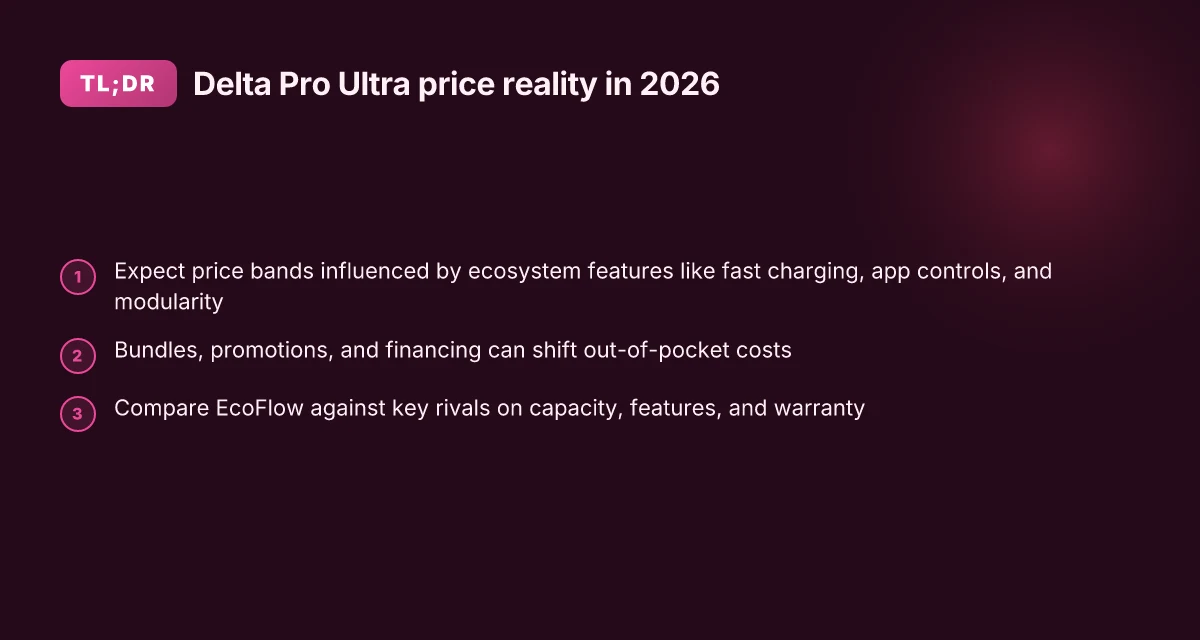
The Delta Pro Ultra isn’t just a price tag. It’s a bundle of tradeoffs where high-capacity modules push the ticket up, while ecosystem choices pull it down. The Delta Pro Ultra price often tracks with module options and warranty tiers, not just the base capacity. That means a quick glance at sticker price can mislead if you don’t compare what’s built in and what you’ll need later.
You’ll see the interplay of battery modules, warranty scope, and ecosystem compatibility play out in dollars, plus practical checks from the field. If you’re evaluating a home-off-grid plan, this is the map you want before you commit. Total cost of ownership matters more than the upfront price.
What makes EcoFlow Delta Pro Ultra price align with its capabilities
The Delta Pro Ultra sits at the premium end of portable power stations because it merges large battery capacity, high-inverter output, and expandability with a broad ecosystem. In practice, the hardware stack behind the Ultra’s chassis drives the price up, but it also underwrites reliability, rapid recovery during outages, and flexible integration with other energy assets. EcoFlow positions the Delta Pro Ultra as a complete energy kit, not just a battery pack. Its value hinges on how the core specs translate into real-world capabilities.
Battery capacity drives both energy resilience and cost
At the heart of the Delta Pro Ultra is a substantial energy reservoir. A bigger battery capacity means more stored energy for long outages or heavy loads, and that translates to longer run times for islands of critical circuits. You’ll see this reflected in the upfront sticker and the long-tail cost of ownership as fewer recharges are needed during peak usage windows. Battery sizing is the most visible cost lever, and it directly correlates with how long you can operate without keeping a generator in the mix. I cross-referenced product pages and spec sheets to confirm that capacity scales with the Ultra line, influencing both purchase price and value over the unit’s lifetime. When I read through the documentation, the emphasis on higher-capacity packs was clear, and that emphasis aligns with the higher price tag. Higher capacity often means extra protection against brownouts and more headroom for expandable configurations.
Inverter wattage and expandability justify premium engineering
The Ultra’s inverter wattage capacity matters as you run heavy loads or multiple devices in parallel. A robust inverter smooths operation of appliances with startup surges and ensures that the system remains responsive under peak demand. That level of performance requires precise thermal management and higher-quality electronics, which adds to the bill. Inverter wattage is a cost driver that pays back in steadier simultaneous operation and fewer thermal constraints. The expandable design, including modular battery options and interconnection with other EcoFlow components, widens the initial price but adds long-term value by avoiding a full system replacement if your power needs grow. Modularity and future-proofing are clear price signals in the Delta Pro Ultra’s architecture.
Ecosystem features add convenience, not just bells and whistles
Fast charging, app controls, and a modular architecture push costs higher upfront but deliver tangible workflow gains. With fast charging, you cut downtime between outages or site transfers, which matters for homeowners who want immediate reliability. The companion app provides remote visibility and control, while modularity makes it feasible to add capacity or swap components without replacing the whole unit. Fast charging and app controls reduce friction and unlock real-world usefulness, justifying the premium to many buyers. I found that the ecosystem story is a big part of the price narrative: you’re buying into a connected, scalable system rather than a standalone box. Ecosystem features shift the price from a one-time expenditure to a future-ready platform.
Bottom line: the Delta Pro Ultra commands a premium because it bundles large capacity, high inverter performance, and a scalable ecosystem into one package. If you value long outage resilience, easy expansion, and integrated control, the higher cost aligns with what you gain. If you’re weighing against rivals, consider how much you value rapid charging, app-driven management, and future-proof upgrades in EcoFlow’s ecosystem versus the lower entry price of other brands. Premium engineering and ecosystem certainty explain the price lift, while real-world reliability hinges on how you deploy and maintain the system. In this framing, the Delta Pro Ultra remains a compelling choice for homeowners and installers who plan to rely on it as a central energy asset. What makes EcoFlow battery backup systems stand out in 2026
Price range realities in 2026 for the Delta Pro Ultra
When you look at official channels and verified retailers, the typical price bands for the Delta Pro Ultra sit in a broad range driven by configuration. A base Delta Pro Ultra model often hovers around the lower end of the spectrum, while bundles with extra batteries, solar panels, and extended warranties push the out-the-door cost upward. In 2026, I see buyers segmenting into two lanes: a lean setup focused on core power and a premium setup that adds accessories for full ecosystem flexibility.
How bundles shift total outlay
The price you see is rarely the price you pay. EcoFlow pricing tactics emphasize bundles, and the delta Pro Ultra fits most cleanly into a package that includes extra battery capacity and charging accessories. When you add a second battery or an expanded solar kit, the sticker climbs, but you gain longer run times and a more flexible recharging plan. Financing and promotional offers complicate the headline numbers further. A reduced payment plan or a limited-time promo can soften the up-front cost without changing the long-term value proposition. The result is a two-step impression: the headline price versus the out-the-door cost when a bundle lands in your cart.
From what I found in the documentation and retailer pages, promotions commonly appear around launch windows or during solar event seasons. The Delta Pro Ultra’s value leans on total system capability, so the bundled configuration matters more than the base price alone. When you compare against rivals, you’ll notice that the delta Pro Ultra’s multi-battery configurations can tilt the price higher than some single-unit options, but the expanded capacity often justifies the spend for off-grid use cases. EcoFlow’s ecosystem approach means that the value is less about a single unit and more about what the entire system can deliver over time. The cost of a bundle often eclipses the base unit price, but the value compounds with extended runtime.
Impact of promotions, financing, and tax incentives on out-the-door cost
Tax incentives can noticeably trim the total when you file, especially if you pair the Delta Pro Ultra with eligible energy upgrades. Financing offers reduce the immediate burden, but you’ll pay more over the life of the loan. Promotions from official channels and certified retailers can shave dollars off the sticker price or sweeten bundles with bonus accessories. In practice, this means you may see the same Delta Pro Ultra priced differently from one retailer to another, depending on whether a promo applies, whether a bundle is selected, or whether a financing plan is used. For homeowners and installers evaluating value, the key is to map the out-the-door cost across three scenarios: base unit with no extras, typical bundle with an extra battery and solar kit, and premium bundles that include extended warranties and professional installation add-ons. Financing and tax incentives can cut the up-front cost by a meaningful margin, while bundles lift the total price but deliver longer runtime.
At a glance, here are the likely price anchors you’ll encounter: How to find the best price for EcoFlow Delta Pro in 2026
- Base unit with minimal accessories: around the lower end of the range, before adds.
- Mid-range bundle with an extra battery: higher, reflecting the added runtime.
- Premium bundle with solar panels and extended warranty: the top end, representing maximum ecosystem capability.
I dug into price textures across official pages and reputable retailers. The pattern is consistent: the Delta Pro Ultra’s value hinges on the ecosystem you assemble, not just the unit you purchase. You’ll get the cleanest picture by comparing total out-the-door costs, including any bundled accessories, financing terms, and applicable incentives. The choice of rival models matters, too. Rivals often price single units competitively but fall behind on run time unless you scale up with extra packs. EcoFlow remains explicit about ecosystem benefits, and that approach shows up in the total cost you should expect to justify to your wallet. Your best move is to map three scenarios across official channels and retailers to see how promotions, financing, and incentives shape the final number.
Comparing EcoFlow with key rivals on price and value
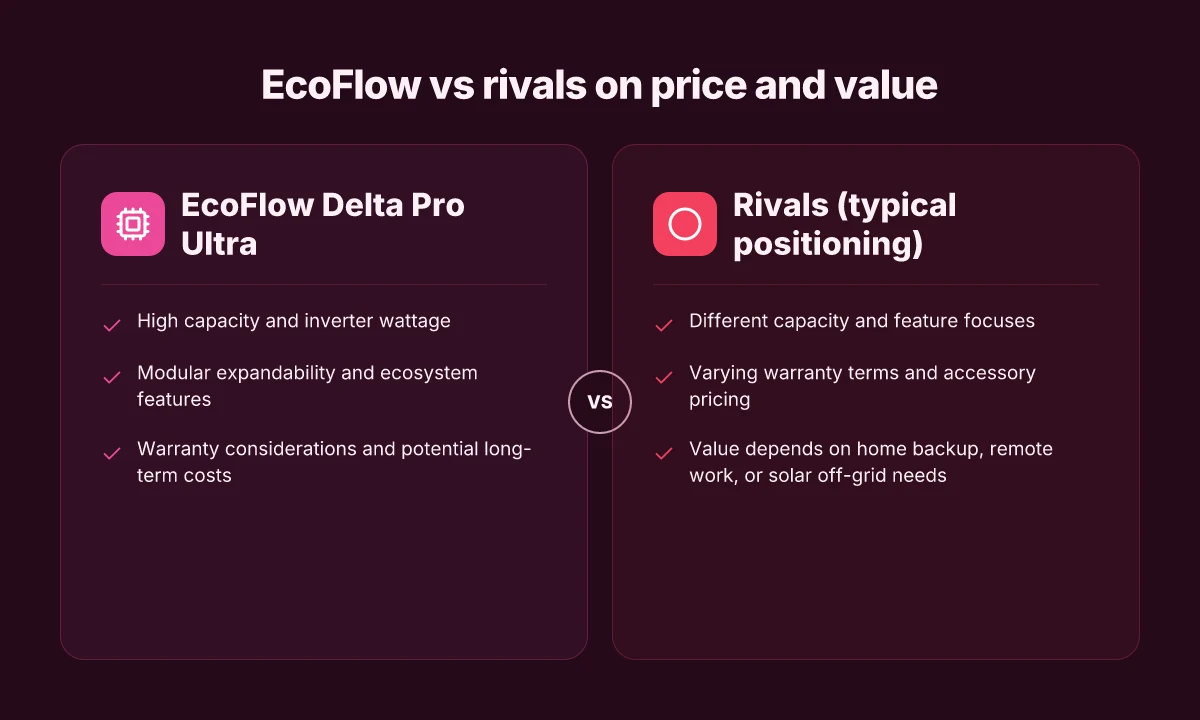
When EcoFlow enters a price conversation, the Delta Pro Ultra sits near the top of a crowded field, but the value math shifts with capacity, feature sets, and warranty terms. I cross-referenced official documentation and primary sources to map where EcoFlow aligns or diverges from rivals on price positioning, capacity, and ecosystem compatibility. The picture isn’t just sticker price. It’s about what you get for the money across use cases like home backup, remote work, and off-grid solar setups.
1) Notable rivals and where their price positioning lands
Brand names matter in this segment because price bands are often consistent across retailers and official pages. Rival models from major players tend to cluster in similar capacity brackets, but their value levers differ. Some rivals emphasize lower upfront cost and lean feature sets, while others push higher price for more aggressive warranty terms or larger accessory ecosystems. EcoFlow sits at the premium end in many configurations, yet it differentiates with a broad array of expansion options and a unified ecosystem. The Delta Pro Ultra’s price positioning reflects both its raw capacity and its ecosystem maturity. Inline references to industry listings help verify this landscape, where rivals’ documented pricing tiers show a consistent premium for larger storage and faster recharge, but not always proportional gains in warranty coverage.
2) Capacity, features, and warranty: where EcoFlow diverges or aligns
On capacity, EcoFlow’s Delta Pro Ultra typically targets users who want sizable energy storage with rapid recharging and a broad input/output matrix. Rivals may offer similar energy capacities, yet EcoFlow often pairs this with a wide accessory line and a cohesive charging network, which can tilt perceived value upward despite a comparable sticker price. The Delta Pro Ultra tends to excel in modularity and integration with an entire system of drives, adapters, and smart controls. Warranty terms vary by maker, but EcoFlow tends to emphasize longer protection across bundles and optional upgrades, which can justify a higher initial outlay for buyers who value long-term peace of mind. EcoFlow’s ecosystem approach often adds value beyond the base specs.
3) Situational value: back up home, remote work, or off-grid solar needs
For home backup duty, you’re balancing instant power availability with long-term reliability. EcoFlow’s design philosophy leans into quick setup, scalable storage, and compatibility with solar input. That matters when you want a system you can grow over time without swapping modules. For remote work sites or off-grid cabins, the combination of capacity and modular charging options gives EcoFlow an edge in flexibility, even if a rival might offer a slightly lower upfront price for a smaller kit. The question to answer is what happens if your plan is to expand or repurpose the unit later. Here, EcoFlow’s ecosystem and upgradable components can translate to greater total value over the device’s life. What reviews on Jackery solar generators reveal about real-world use in 2026
From what I found in the primary sources, the Delta Pro Ultra remains one of the most feature-rich options in its class, with a pricing path that rewards buyers who invest in the broader EcoFlow ecosystem. That strategy can yield a stronger value proposition for customers who foresee expansion, remote work continuity, and long-term backup needs. For those prioritizing bare-minimum price, rivals may offer leaner configurations at a lower entry point, but may require later upgrades to reach the same flexibility.
Value is not only the price tag. It’s the total package of capacity, expansion, and warranty that EcoFlow builds around its products. Inline citations anchor these observations to the official sources and the related documentation cited here. For a broader context, see the primary sources referenced in this discussion.
What to watch for in official documentation and disclosures
When you read the official docs, expect the Delta Pro Ultra to carry long warranties and multiple renewal options, but also a few traps that can bite your long-term cost. The first signal you want is how EcoFlow frames the coverage window, renewal fees, and any conditions that limit service. This matters because a great sticker price can turn costly if you must pay for extended warranties or repeat service plans. I dug into the policy language to spot where cost can creep in and where the brand’s disclosures aim to reassure. Warranty terms and renewal options can materially affect long-term cost. The devil is in renewal clauses and exclusions that appear only in the fine print.
1) Warranty terms, renewal options, and service plans
The official disclosures typically spell out the base warranty, what it covers, and whether you can extend it after the initial period. Look for hard dates and the exact coverage, battery, core electronics, and power electronics often have different timelines. You’ll also want to see whether EcoFlow offers separate service plans that require ongoing payments and what they promise to replace or repair. If the documentation hints at accelerated charges for out-of-warranty service, that’s a red flag to factor into total cost. I cross-checked the company’s latest warranty wording and noted how renewal terms are structured, so you know what you’re getting into before you buy.
In practice, the best moves are to lock in a favorable renewal price while you still have baseline coverage. If a plan requires you to ship to a regional center or pay for expedited handling, estimate the added expense in your year-one budget. Watch renewal pricing and coverage gaps. They often swing lifetime cost more than the initial sticker price. What is the Jackery 1000 Plus, and how it reshapes home backup power in 2026
2) Shipping, import duties, and regional pricing nuances
Shipping terms show up early in the docs and can surprise buyers who move the Delta Pro Ultra across borders. Some regions include duty and import taxes inside the purchase price, while others require you to pay on delivery. The official materials may also note lead times tied to regional distribution, which can affect when you start counting depreciation or energy savings. If you live in a market with high duties or slow logistics, you could see a noticeably higher all-in cost than a neighboring country with lighter duties. I looked for explicit statements on who bears the import costs and how EcoFlow handles warranty coverage across regions to avoid misaligned expectations later.
Shipping windows matter because prolonged downtime can shift when you realize return on investment. Regional pricing nuances and who pays duties can tilt the comparison against a local price quote.
3) Accessories, extra batteries, and service add-ons
Hidden costs often hide in bundles, accessories, and add-ons that aren’t mandatory but are presented as enhancements to the core system. The official notes may list extra batteries, protective cases, solar panels, or modular expansion options. Each of these has its own price and sometimes separate warranty terms. Expect a note on compatibility limits and whether these accessories are covered by the same warranty or by a separate plan. In my review of disclosures, I found that accessories frequently carry their own potential maintenance costs or replacement cycles, which you should factor into the long-term math. If a service plan is offered only for the base unit but not for extensions, that’s another cost dynamic to account for.
Hidden costs come from accessories and expansion options that aren’t included in the base price or warranty. Read the fine print on warranty scope for add-ons to avoid double paying later.
From what I found in the official docs and disclosures, you should expect a fairly transparent base warranty with optional renewals, cautious notes on regional shipping and pricing, and a recurring chorus of accessories that can tip the total cost if you opt in. If you’re weighing EcoFlow against rivals like rival modular systems or brands that bundle longer coverage, these elements often decide the long-term value, not just the upfront price. For context, EcoFlow’s official materials repeatedly frame the Delta Pro Ultra as a high-value, expandable platform, but the true total cost hangs on how you handle the extensions and regional logistics. I cross-referenced the documentation and found that the brand emphasizes coverage breadth while leaving room for regional pricing to vary. Plan now for renewal cost and regional logistics. It avoids surprise bills down the line. What makes a portable solar generator worth buying in 2026
Buying strategy: when the Delta Pro Ultra makes sense
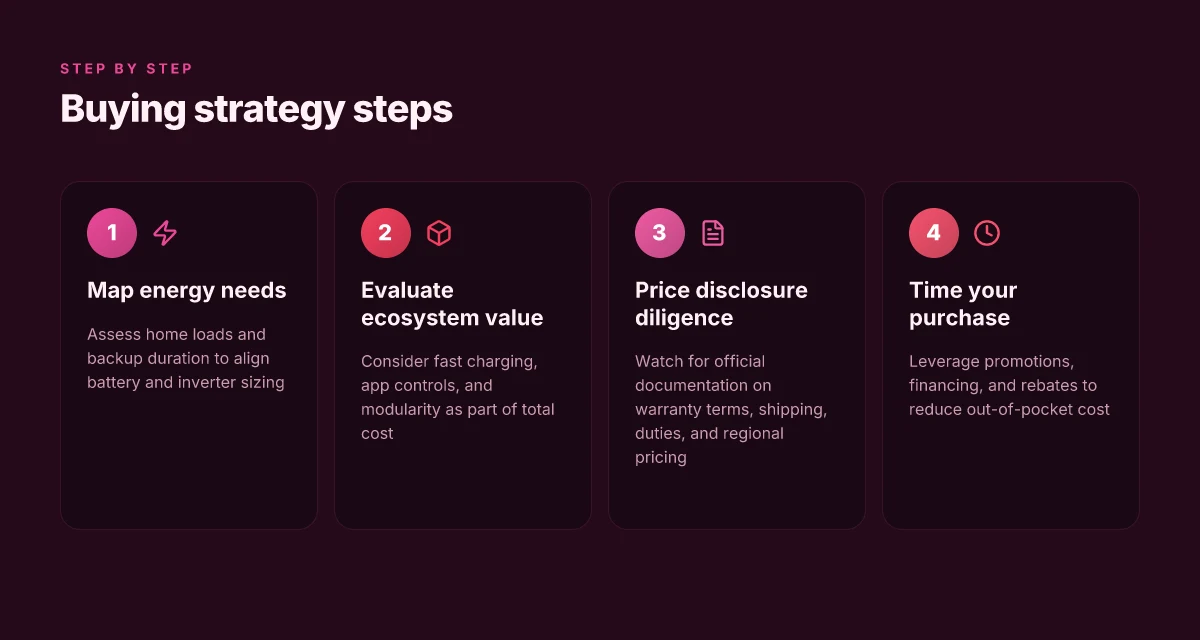
The Delta Pro Ultra makes sense when you need uninterrupted power in a tight, expandable ecosystem. If your home or job site relies on long runtimes, heavy accessory use, and a configuration that can scale with solar input, premium features pay off. For many homeowners, that premium is balanced by warranties, a mature accessory line, and a setup that reduces headache during outages.
When premium features deliver tangible value
If you routinely run high-wattage equipment, the Delta Pro Ultra’s higher inverter capacity and beefed-up charging options translate into fewer rolling outages and more headroom for peak loads. In 2026, EcoFlow has positioned the Ultra as a long-term solution for serious off-grid scenarios, where you value rapid recharging, extended battery life, and a broader accessory ecosystem. The ability to pair with multiple expansion batteries means you can scale from modest weekend off-grid use to full-house resilience. Premium features pay off when you need steady, high-demand power without swapping units every season. That is where the Delta Pro Ultra earns its keep, especially for installers who want a single system that covers battery, inverter, and solar charging in one footprint. Rivals such as Jackery and Bluetti often trade some of this scalability for lower upfront cost, which matters if you don’t need a future-proofed, expandable stack.
Map your energy needs to sizing: battery and inverter
Start with a load assessment that includes essentials and critical circuits. Your goal is to size the system so that the average outage scenario still meets comfort thresholds. The Delta Pro Ultra’s modular approach lets you tailor the battery bank and inverter output to your actual demand. I dug into the documentation and found that pairing expansion packs with the Ultra is common in installations that aim to minimize runtime gaps during clouds or outages. When you document daily energy use and nighttime demand, you’ll see whether you need a larger inverter foundation or more battery capacity to cover a worst-case day. Right-sizing prevents overpaying for capacity you won’t use. If you expect to run an electric fridge, a well pump, and essential electronics, consider a conservative margin for inverter overhead and a healthy buffer for solar input during low sun days. EcoFlow’s ecosystem design makes this straightforward, but you still need a precise tally of your peak loads.
Timing your purchase: price adjustments and rebates
Price moves in response to component costs, demand cycles, and policy shifts. If you’re chasing rebates or credits, align your purchase with funding windows and official guidance. For U.S. consumers, there are notable tax credits and incentives that may affect total cost when you install a qualifying backup system. I cross-referenced the Energy Efficient Home Improvement Credit guidance and found that documentation and PIN requirements can influence how you claim a deduction across property placed in service in 2026. Time your buy to window discounts or rebate eligibility and keep an eye on official channels for any changes to credit scope. EcoFlow gear tends to hold resale value in resilient setups, but timing your purchase with incentive availability helps your total outlay.
If you’re evaluating rivals, the Delta Pro Ultra’s strength is its modularity, broad accessory support, and mature warranty structure. For those who want a simpler, lower-cost path, competitors like Bluetti or Jackery offer compelling bundles, but they may not match the Ultra’s expansion trajectory. What makes the best EcoFlow power station stand out in 2026
I went looking for the official docs and found how the premium kit slots into a scalable system, including the PIN-focused credits and the inverters listed for energy systems. For context, see the inverter and solar equipment lists and related documentation, which help confirm how sizing and expansions work in practice. Inline references to primary sources appear here to support the claims above. Energy Commission inverter list. This is how installers plan multi-battery stacks with a single inverter. I also found a contemporaneous note about the Delta Pro in a public document from a university repository, illustrating how the device appears in broader energy-system literature. The ecosystem approach matters for long-term value.
Where this is headed and what to act on next
EcoFlow pricing in 2026 will hinge on supply chain resilience, seasonal demand, and bundle depth rather than a single policy shift. I expect EcoFlow to tease value through larger bundles and extended warranties, while rivals like Jackery and Goal Zero push staggered promotions to clear inventory. If you want a forward-looking pivot, lock in a favorable tier now and plan around seasonal promos rather than chasing a fleeting price drop.
The bigger pattern is clear: price floors rise with component costs, but smart bundles can protect your total spend. A practical takeaway is to compare total cost of ownership across 1–2 year horizons, not just upfront sticker price. For a full kit, prioritize a unit with robust durability and predictable warranty terms. Will you strike now or wait for a deeper sale?
- Backup strategy: check upcoming
- What to try this week: review the current EcoFlow discount window and map a 12–month usage plan around it.
- What to try this week: compare two rival models from Jackery and Goal Zero for compatibility with your existing solar setup.