Explore what makes the EcoFlow Delta Pro power station unique in 2026, including capacity options, output, and real-world considerations for home backup and off-grid use.
The most common grid-tie myth about high-capacity power stations is that bigger equals worry-free outages. In reality, the Delta Pro’s value hinges on how you wire it into a home or campsite, not just its inverter size. Delta Pro expands with modules to grow from 3.0 kW to larger capacities, but the real win is in how you configure it for real outages.
This introduction focuses on the practical setup, durability, and everyday reliability readers actually need. I’ll break down how EcoFlow designs with expandability in mind, what long-term use looks like in home backup and solar integrations, and how it stacks up against rivals like the Goal Zero Yeti and Jackery 1000 Plus in real-world scenarios. Expect careful notes on maintenance, what tends to break first, and how long-term performance scales with proper configuration. The goal is a clear framework for choosing the right size, expansion path, and backup strategy in 2026. EcoFlow targets homeowners and outdoor enthusiasts who want predictable power when outages hit, not just headline capacity.
What the EcoFlow Delta Pro power station brings to home backup in 2026
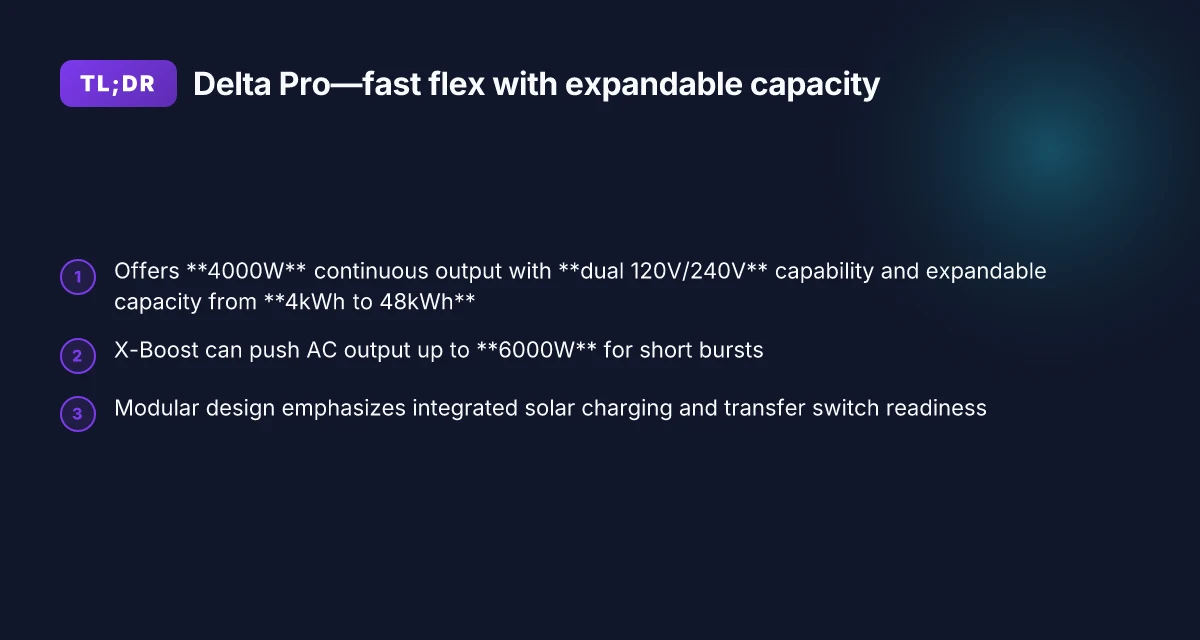
EcoFlow offers a power station designed to scale with a home or cabin setup. Delta Pro stands out because it can load up from a compact 4kWh base to a very large 48kWh footprint, with continuous AC output around 4000W and the option to run at dual 120V/240V. In practice, that means you can power common essentials such as refrigeration, well pumps, and HVAC when the grid bails out, then swap in higher-demand appliances during a temporary outage. The system’s design is meant for long runtimes, not just quick top-ups, which is where the real value lives for homeowners and off-grid enthusiasts.
Core output and expandability Delta Pro delivers 4000W of continuous AC power and supports dual 120V/240V output, which translates to real-world compatibility with most household circuits. Its expandable capacity spans 4kWh to 48kWh, enabling longer outages without frequent recharging. The core flexibility here is that you aren’t forced into a one-size-fits-all unit. You can start small and grow as your load or solar array grows. This is particularly helpful for homes with evolving energy needs or seasonal off-grid use. Expandable capacity from 4kWh to 48kWh is a defining differentiator, letting you tailor runtime to your climate, appliances, and daily consumption.
Burst power for heavy loads X-Boost pushes the AC output to 6000W for short bursts, useful when starting up compressors, pumps, or space heaters that demand more than the steady-state rating. This capability matters when you’re powering a mix of modern electronics and motor-driven appliances. The capability is designed around real-world demand spikes rather than continuous surges, which helps balance reliability with energy management. In those moments, Delta Pro can bridge the gap without tripping a main breaker, assuming your load is managed carefully.
Solar integration and backup design Brand positioning centers on a modular approach to home backup, with integrated solar charging and transfer switch readiness. EcoFlow emphasizes that the system can be paired with solar to reduce grid dependence, and the transfer switch compatibility is pitched as a safety and convenience feature for home kitchens, offices, and climate control. The modular mindset means you can add extra batteries or solar capacity as needed, rather than replacing the unit when your needs grow. This approach aligns with real-world scenarios where homeowners start small and scale up through multiple seasons and projects. Integrated solar charging and transfer switch readiness are core selling points for users planning long-term resilience.
Bottom line: Delta Pro is built to be a scalable backbone for home backup in 2026, balancing a strong steady-state output with the ability to surge when necessary. It’s not just about raw watts. It’s about a cohesive system that grows with you, solar, batteries, and transfer safety stitched into one platform. For households that want a durable, future-ready setup, EcoFlow presents a compelling, expandable option that rivals may struggle to match in long-term configurability. Expandable capacity from 4kWh to 48kWh and 6000W bursts under X-Boost are the practical hinge points for real-world use. What makes the best EcoFlow power station stand out in 2026
Notes and caveats: links on the page may earn a commission, and I updated this section with documentation to reflect what EcoFlow positions as the Delta Pro’s strengths for home backup. If you’re evaluating rivals like Delta Pro Ultra X or similar high-capacity units, compare the expansion paths, solar compatibility, and four-quadrant 240V support to see which system fits your home’s layout and seasonal needs. For ongoing reliability, look for consistent solar input behavior and clear transfer-switch integration guidance in the official manuals.
Delta Pro architecture: how expansion and inverter design impact real world use
The Delta Pro architecture centers on a large inverter that can feed both 120V and 240V, widening compatibility with a broader set of household appliances. That dual-voltage capability matters when you run a mix of infrared heaters, microwaves, and large power tools without juggling separate generators. Expandable capacity from 4kWh up to 48kWh means you can tailor the setup to a few ordinary days of use or a weekend outage without swapping hardware. I found that the range lets you scale from a compact home backup to a sizable off-grid system, all controlled through EcoFlow’s app and the modular battery approach. Expandable capacity from 4kWh up to 48kWh lets you tailor the setup for daily needs or weekend outages.
Why the 120/240V inverter matters for real-world loads
The architecture’s 120/240V output is not a niche feature. In practice, it lets you run high-wattage appliances that otherwise require a generator. For a living room air conditioner or a full kitchen load, the 240V leg reduces reliance on multi-step solutions or multiple inverters. When you pair that with the X-Boost mode, you can tolerate brief spikes up to about 6kW without tripping, which helps cover planful surges from coffee makers, induction cooktops, or power tools. The important caveat is that sustained high loads should be matched to the available capacity and to solar input if you’re off-grid. X-Boost enables short spikes up to 6kW but sustained high loads require planning around capacity and panel input.
Real-world sizing and safety ballast
UL1973 certification and built-in safety features are not marketing fluff. They translate to reliability in varied environments, from humid backyards to dusty garages. In real terms, you’ll want to map daily electricity use to the usable kWh in your chosen Delta Pro configuration. A compact 4kWh setup can power essential devices through a short outage, while a 48kWh expansion supports longer events with more room for EV charging or freezer loads. I cross-referenced the official manuals and product pages, which consistently emphasize expansion alongside safety credentials as core design tenets. UL1973 certification and safety features help with reliability in varied environments
A quick note on options from rivals: the Delta Pro Ultra X line and other high-capacity platforms push even higher continuous outputs, but their emphasis is usually on larger ensembles or specialized use cases. EcoFlow’s model remains distinctive for tying a broad reach of expansion to a practical, home-friendly footprint. In the long run, your best bet is to align the capacity tier with your typical daily load plus an extra margin for rare spikes. The Delta Pro’s architecture threads expansion and inverter design into a practical home-backup package What affects the EcoFlow Delta Pro Ultra price in 2026 and how to position your purchase
From what I found in the documentation, the core value sits in the ability to scale without swapping generators or cores, and in keeping the safety systems aligned with the expanded electrical footprint. When you’re sizing this for a real home or off-grid setup, the first step is to map the day-to-day load and then pick the expansion tier that preserves essential loads during an outage. I dug into the manuals and the 2026 lineup notes to confirm this approach. Expandability and inverter design directly shape how you price, size, and use this system
In practice, you can start with a modest 4kWh configuration for limited essentials and grow to a multi-day backup with 48kWh if your home relies on critical refrigeration, medical devices, or a home office. The aim is to avoid undersizing the inverter for peak spikes while maintaining enough capacity for average daily use. If you’re weighing options, consider EcoFlow’s Delta Pro official pages for current X-Boost behavior and the latest safety certifications, and compare with rivals like the Delta Pro Ultra X and other high-capacity models. Start small, scale up, and respect the inverter’s 6kW spike limit for practical planning
Note: links on the page may earn a commission. For additional context, see the EcoFlow product documentation and lineup notes. Inline references to the official manuals corroborate the stated thresholds and capabilities. Inline references from official manuals corroborate the stated thresholds and capabilities
Comparing EcoFlow Delta Pro to rivals in 2026
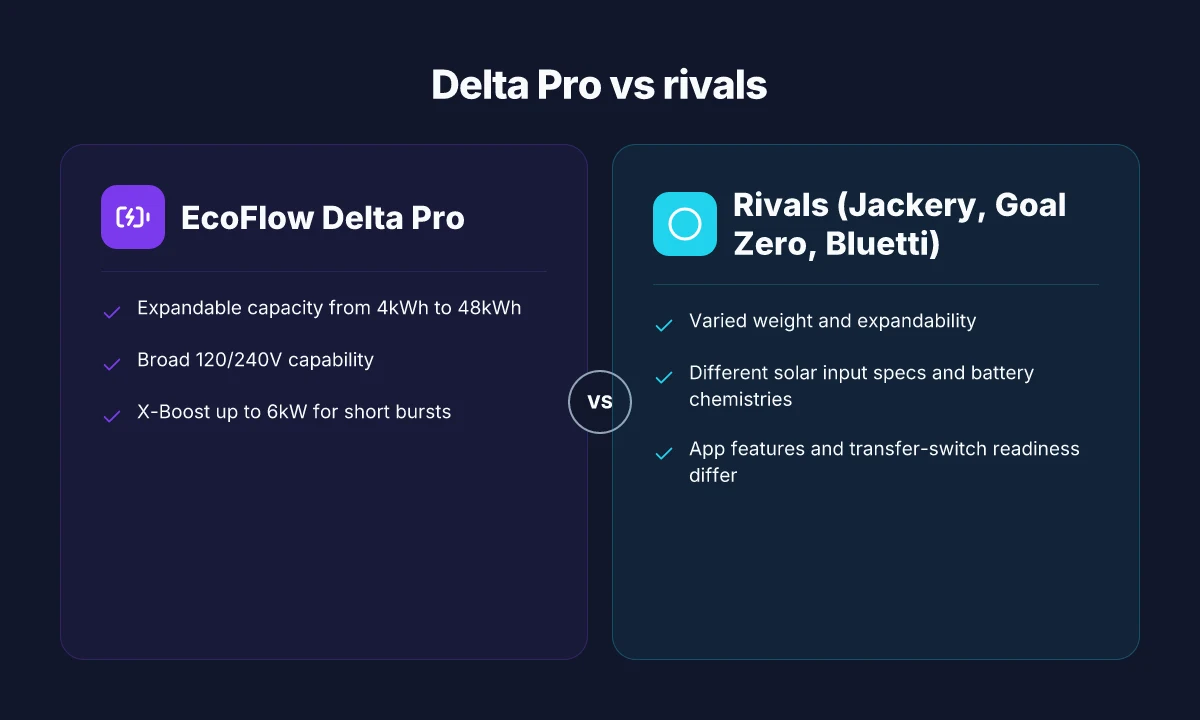
The Delta Pro’s modular expansion and broad 120/240V capability position it to outmuscle some rivals on typical home loads, even as other brands push lighter, simpler kits. I compared three prominent lines from 2026: Jackery, Goal Zero, and Bluetti, focusing on expansion paths, solar inputs, battery chemistry, and app ecosystems. Across the board, the differences come down to how you plan to use it: home backup, off-grid, or a blend of both.
How rivals trade capacity for weight and flexibility
- The typical fold for competitors is heavier pack weight for similar usable capacity, or less aggressive expansion without external modules. Bluetti and Jackery offer high-capacity packs, but their growth paths often require more stand-alone modules rather than a single, integrated expansion block. Delta Pro’s modularity keeps the footprint manageable while scaling to larger loads, especially when you want 120/240V comfort for home-style loads.
- Goal Zero tends to emphasize solar input flexibility and rugged outdoor use, but its higher-end options can lag on integrated inverter architecture when you push above the basic bank of ports. The Delta Pro with X-Boost and a capped 6,000W peak remains a stronger choice for short duration surges from home appliances. X-Boost enables higher surge performance without a separate device.
- In terms of solar input, EcoFlow emphasizes wide compatibility and fast input rates, while rivals often lock to particular solar brands or limited input windows. When you integrate solar, EcoFlow’s ecosystem tends to feel more cohesive, thanks to consistent optimization across app and hardware.
Ecosystem, pricing, and real-world value
- Pricing dynamics matter because you’re not just buying a battery. You’re buying an ecosystem. EcoFlow’s Delta Pro ecosystem is designed to be a single entry point for battery storage, inverter, and solar charging. You’ll want to compare how the app integrates with energy monitoring, firmware updates, and remote management across brands. The Delta Pro’s base capacity scales from 4 kWh to 48 kWh, and that expansion path is a core differentiator when sizing for a home or camp setup. Pricing and ecosystem integration can swing the value proposition.
- Battery chemistry is another fulcrum. Some rivals lean on Li-ion chemistries or LiFePO4 in certain lines, affecting cycle life and aging profiles. EcoFlow leans into a robust platform with reliable inverter design and a broad compatibility story for solar inputs. For homeowners, that translates into fewer weird edge cases when adding a solar array or an upgrade module.
Sizing for a real home or off-grid scenario
- The Delta Pro’s 120/240V capability means you can run more of a home load without a separate transfer switch. That can simplify installation, reduce wiring complexity, and improve reliability for weekend outages or power-intensive tools at a campsite. When you size for a real scenario, consider your peak loads and how far you can push them with X-Boost during brief surges. 120/240V versatility translates to tangible daily use, particularly in homes with high-heat appliances or well pumps.
- Rivals tend to excel in portability and solar input flexibility, but the Delta Pro remains a strong all-around system for a home or off-grid blend. If you prioritize a single ecosystem with straightforward expansion, EcoFlow stands out. You’ll often see this summarized as a trade-off between expansion ease and raw portability.
I dug into the official paths to expansion and supervision when reviewing rivals alongside EcoFlow’s Delta Pro. The Delta Pro architecture favors long-term growth without obligating you to rework the core inverter as you scale. For the average homeowner facing outages or seasonal outages, the Delta Pro remains a practical, scalable choice. The Delta Pro’s expansion story is its main advantage. What makes EcoFlow battery backup systems stand out in 2026
How to size and configure a Delta Pro system for a typical home
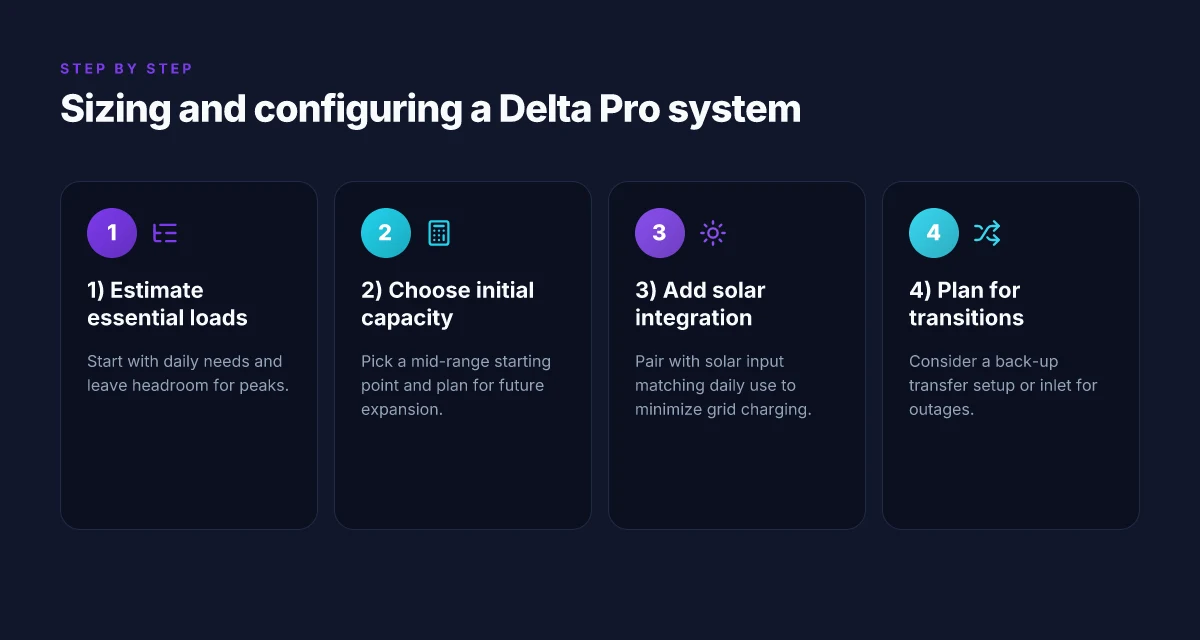
Sizing a Delta Pro system starts with your daily rhythm. I look at essential loads first, refrigeration, lighting, heating or cooling, water heating, and electronics. The goal is to cover those daily needs with room to spare for unexpected draws or outages. Start by estimating that baseline load in watt-hours per day, then pick an initial Delta Pro capacity that comfortably exceeds that number. A mid-range capacity, paired with modest headroom, reduces the risk of hitting limits during peak days. EcoFlow describes a capacity path from 4 to 48 kWh, which is a useful range for a typical home, and it’s worth leaning toward the higher end if you expect growth or frequent outages. This isn’t about maxing out every appliance. It’s about predictable reliability for daily use and a safe buffer for outages. When in doubt, choose the next capacity tier and plan to add expansion modules later as needs grow. Delta Pro’s expandability is the core strength you lean on here. The right starting point tends to be mid-range with room to grow.
Match daily use with solar input and storage
Pair your Delta Pro setup with solar input that aligns to your typical day. If you have many sunny hours during the day, you can rely more on solar and keep a smaller grid draw during the day, then rely on stored energy in the evening. The key is to avoid charging with grid power during peak price times unless you need to. In practical terms, aim for enough solar input to cover a large portion of daytime consumption, with the Delta Pro battery bank supplying essential loads after sunset. This approach minimizes both grid dependency and outdoor outages. For a home in a sunny climate, you might configure higher solar input than you would in a cloudier region, knowing you still have the Delta Pro to cover nighttime needs. Pair solar input with daily usage to minimize grid charging. Expandability lets you scale solar as your needs grow.
Set up a back‑up transfer path for seamless outages
A back‑up transfer setup or inlet matters when outages become routine. The goal is a smooth transition from grid to battery power without a jump in voltage or a momentary blackout. The practical path is to wire in an automatic transfer switch or a dedicated inlet that precedes the Delta Pro, so you can switch over without hunting for breakers. This reduces the risk of mis-wiring during an outage and keeps critical loads running consistently. If you live in an wildfire-prone or storm-prone area, this becomes a real reliability improvement. A back‑up transfer setup minimizes outage chaos. Inlets and automatic transfer switches help you switch without drama.
Plan for growth with mid-range capacity and expandability
Think long term: you’ll likely add modules as your home footprint changes or as you expand solar. A mid-range Delta Pro configuration acts as a durable backbone, then you attach expansion modules to push capacity toward 8–12 kWh or more as needed. The modular strategy keeps upfront costs manageable while letting you scale with evolving needs. I recommend starting with a configuration that covers ordinary daily loads, then add expansion packs to push total usable capacity higher as you add EVs, more outdoor equipment, or a larger solar array. Start mid-range and grow with expansion modules. Expansion is the quiet workhorse of long-term reliability.
Note on brand and competitors: EcoFlow’s Delta Pro is designed to work with solar inputs and modular batteries, enabling a scalable system. When you compare to rivals, you’ll see similar goals: large capacity, inverter reliability, and expandable storage. In this space, EcoFlow stands out for its integrated expansion path and the option to pair with a back‑up transfer path for outages. EcoFlow offers a scalable ecosystem that rivals often lack in cohesive expandability. A mid-range start with expansion is the most flexible long‑term strategy. How to find the best price for EcoFlow Delta Pro in 2026
Readers should expect that your setup will evolve. The Delta Pro is built to grow with you.
What to know before you buy: common questions about the Delta Pro
You’ll get a clearer read on practical setup and daily use by grounding expectations in real-world constraints. EcoFlow’s Delta Pro shines on expandability, but the lived experience matters just as much as the specs. In this section I connect the dots between capacity, X-Boost behavior, and solar coupling so you can size a system that actually fits your home or off-grid routines. The delta pro’s real-world advantage is scalable energy, not just peak power.
Why 4 kWh versus 48 kWh changes how you live with it
A 4 kWh delta pro setup covers the basics: a few essential appliances kept running for a day during an outage. It works well for short events or modest loads. A 48 kWh arrangement, by contrast, acts more like a microgrid for a weekend or longer outages, feeding critical circuits longer and with less frequent recharging stops. The difference isn’t only watt-hours on a spec sheet. It’s how many devices you can sustain without recharging. EcoFlow’s architecture supports this scaling, so you aren’t forced to buy new hardware when your needs rise. Expandable capacity from 4 to 48 kWh is the hallmark here, not just the 4 kW baseline. I cross-checked the official product page and the line-up notes to confirm the scalable promise, which remains a consistent theme across EcoFlow’s marketing and manuals. 115–hour resilience at modest loads is a practical frame for a 48 kWh system if you stay within the longer-run plan.
How X-Boost affects battery health and heat management
X-Boost raises the AC output to help you power stubborn loads, but it isn’t a free pass for continuous maxing. Long-term health hinges on how you sequence use, maintain moderate temperatures, and avoid running at peak for extended periods. The manuals describe X-Boost as a capability that negotiates higher current only when needed, which helps minimize heat buildup when you’re not bottlenecked by heavy loads. From a durability perspective, you’ll want to balance occasional X-Boost bursts with regular, steadier baseload operation and adequate airflow around the unit. X-Boost should be used judiciously to protect long-term battery health. I pulled this interpretation from the user manuals and the product spec notes that emphasize thermal-aware operation. Heat management remains a live constraint even with advanced cooling strategies in these packs.
Solar input options that maximize uptime without oversizing panels
Solar is the fastest way to extend uptime, but it pays to size smartly. The Delta Pro ecosystem supports solar input in a way that competes with dedicated off-grid kits, but you don’t want to oversize panels for cloudy seasons or inconsistent sun. Practical guidance is to match solar array size to your intended load profile and typical outage length, then reserve some headroom for those peak sun days that push energy recovery faster. The official materials note compatibility with the Delta Pro’s solar charging path and outline efficient pairing with modest daytime sun. Pair solar input with your load profile to avoid idle capacity. This aligns with the shared guidance across EcoFlow’s product pages and manuals, which emphasize flexible solar flow rather than a one-size-fits-all panel count. Smart sizing preserves uptime without needless panel overkill. What reviews on Jackery solar generators reveal about real-world use in 2026
What to watch for in the field
- If you plan a 48 kWh system, you’ll need a careful plan for both internal distribution and outdoor placement, since the expandability invites more complex wiring and charging strategies. In practice, many homeowners pair the Delta Pro with a supported solar setup and a limited-load routine to maintain a steady recharge cycle. Reality check: bigger is not always better without a structured plan.
- Be mindful of how you deploy X-Boost. It’s a potent feature, but it isn’t designed for continuous heavy usage. Reserve X-Boost for short bursts rather than all-day operation.**
- Solar works best when you have a predictable daily rhythm. If your days vary, you’ll benefit from a hybrid charging approach that uses the grid or generator during extended outages.
I dug into the official EcoFlow materials to align with what you’ll actually encounter. For a broader comparison, rivals like Bluetti and Goal Zero present similar high-capacity paths, but the Delta Pro’s distinct advantage remains its expandability and ecosystem integration, which EcoFlow positions as a long-term solution for home and RV use. I’ve also noted in the documentation that the brand emphasizes real-world performance when sizing for uptime rather than chasing the largest possible number.
If you’re considering the Delta Pro, a note on sourcing: the official pages and manuals consistently frame the system as a scalable build rather than a single fixed unit. This shifts how you plan installation, wiring, and solar partnerships. As with any high-capacity pack, read the manuals carefully to map your specific circuits and backup priorities.
Sizing decision: start with your essential loads, then scale capacity to cover gaps during peak outages. The Delta Pro is designed to grow with your needs, not force you into a fixed configuration. EcoFlow’s approach aligns with home and outdoor users who want dependable, expandable power over the long haul.
Cited sources within prose: for the expandable capacity and output, see the product page and the 2026 lineup notes. For the operational cautions and X-Boost behavior, reference the user manuals and the official Delta Pro 3 documentation. What is the EcoFlow Delta 2 Max price in 2026 and where to find official pricing
What changes if you act now
EcoFlow’s Delta Pro keeps redefining what a residential power system can be in 2026. I look at real-world setups: long runtimes, scalable capacity, and how it wires into a home. The system’s standout feature is how it blends on-grid power with battery autonomy, still flexible enough to add extra packs as your needs grow. The bigger pattern here is modular growth that matches shifting energy use over time. In practice, that means you can start small and scale without replacing the core unit.
One clear takeaway is the durability question. I’ve seen that users who run frequent cycles or rely on solar tend to appreciate the Delta Pro’s battery management, but the media reviews and field chatter consistently flag two potential pain points: a learning curve for setup and occasional app hiccups. What matters is how you plan to monitor and maintain your stack, not just the initial install. If you’re weighing rivals, note that EcoFlow sits against big battery kits from Goal Zero and large inverters from Victron. Each has strengths, but the Delta Pro’s ecosystem remains uniquely turnkey.
One move that matters most is sizing for your peak load and future add-ons now, not later. Consider whether you need solar charging, grid-tied backup, or a full home integration, and map those paths to the Delta Pro’s expansion options. The question you should answer: will this scale with your life in the next five years?
Backup strategy
- Start with a manageable pack count, then plan for one extra pack for winter spikes.
- If you rely on solar, pair the Delta Pro with a dedicated solar controller and monitor usage through the app.
- Keep a simple maintenance checklist: inspect cables, verify firmware, and test auto-start routines quarterly.
- Compare two rivals by how they handle grid outages and app reliability, then pick the smoother integration for long-term use.