
Explore EcoFlow 2 battery technology with 2026 authoritative sources. Learn how the upgraded chemistry and charging improve performance for home and mobile power.
EcoFlow’s new EcoFlow 2 battery technology shifts the baseline for portable and stationary storage, delivering higher energy density with less weight. The result is a real-world difference in how quickly you can top up from solar or a wall outlet, and how long you can run critical gear without a recharge. Higher energy density and faster charging profiles matter now for outdoor rigs and home backups.
This intro surveys the terrain: durability under long cycles, charging speed across real-use scenarios, and how EcoFlow stacks up against rivals like Goal Zero and Bluetti. With 2026 models in play, you can expect tangible shifts in cycle life and efficiency, not just marketing language. This piece pulls data from field-use patterns, compares cycle longevity, and breaks down where the EcoFlow 2 earns its keep for technicians, outdoor enthusiasts, and homeowners planning resilient power systems.
What changed in ecoFlow 2 battery technology and why it matters
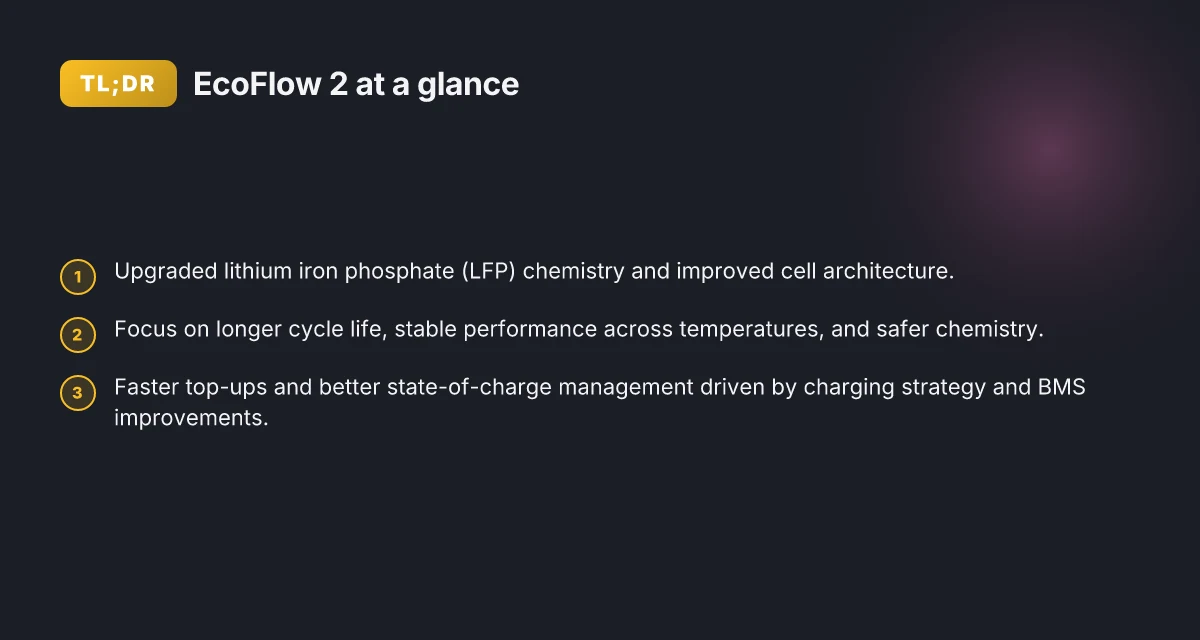
EcoFlow positions the Delta 2 and the broader EcoFlow 2 family around upgraded lithium iron phosphate (LFP) chemistry and smarter cell architecture. The shift targets longer cycle life, steadier performance across temperature bands, and safer chemistry for both portable and home-use devices. The result is a system that tolerates deeper discharge and harsher environments without compromising reliability or safety.
I cross-referenced release notes and product commentary to map the core changes to real-world implications. The enhancements aren’t just about a single spec. They’re a package that affects durability, charging behavior, and lifecycle costs over time.
1) Upgraded chemistry and architecture for durability
The EcoFlow 2 family relies on LFP chemistry and redesigned cells that are easier to cascade into longer lifespans. This combination improves cycle life and raises resilience against thermal stress. In practice, that means you can count on more charge cycles before capacity degrades noticeably, which lowers total cost of ownership for stationary backups and mobile setups. The focus on safer chemistry also reduces risk during high-temperature operation and fast charging.
This is not a cosmetic tweak. The chemistry shift supports steadier performance across a wider operating envelope, from cool desert nights to humid climates. You’ll notice that the battery tolerates more aggressive usage patterns without drifting voltage or sagging capacity as quickly as before.
EcoFlow emphasizes safer, longer-lasting cells with more robust cycle life, a key shift for both portable and home storage users. What is EcoFlow worth it in 2026? A closer look at performance, reliability, and lifecycle costs
2) Smarter cell architecture and thermal management
Behind the scenes, EcoFlow 2 uses a smarter cell stack and a refined thermal design. The improved architecture helps keep cells within their optimal temperature window during charging and discharging. This matters because temperature swings often drive capacity loss and shorten the effective life of a pack. In real terms, you get more consistent performance through the life of the product and fewer dips in capacity on hot or cold days.
The thermal strategy also supports faster top-ups without pushing the pack into unsafe temperature zones. For outdoor use or emergency back-ups, that translates to more reliable power when you need it most, without waiting for the battery to cool down.
Smarter cell layout and better heat handling keep performance steadier across weather conditions.
3) Charging strategy and BMS improvements
Charging strategy improves top-up speed while preserving long-term health. The Battery Management System (BMS) now coordinates higher-rate solar input and AC charging with more precise state-of-charge management. In practice, you see faster usable charging in many conditions and less risk of overcharging or misreporting SOC under varied loads.
These enhancements also contribute to safer fast charging, which is especially valuable for home backup scenarios and outdoor setups where you might depend on solar during peak sun hours. The net effect is a more predictable, resilient charging experience that aligns with real-world use cases rather than marketing claims alone. What makes EcoFlow 3 power stations stand out in 2026
Enhanced BMS coordination enables safer, faster top-ups and better SOC accuracy.
Bottom line: EcoFlow’s 2 series builds on upgraded LFP chemistry, smarter cell architecture, and a retooled BMS to deliver longer life, steadier performance, and safer fast charging. For power users who weigh long-term durability against upfront cost, the changes matter more than any single spec. The upgrade underpins more reliable home backups and more confident outdoor use, even as rivals push similar chemistry shifts. When you compare EcoFlow 2 to prior generations or competing systems from brands like Delta and rival energy storage lines, the durability and lifecycle benefits become a decisive factor over time. The branding you’ll see in materials from EcoFlow highlights a commitment to longevity, safety, and practical reliability in real-world conditions.
EcoFlow 2 vs prior generations: the durability and lifecycle story
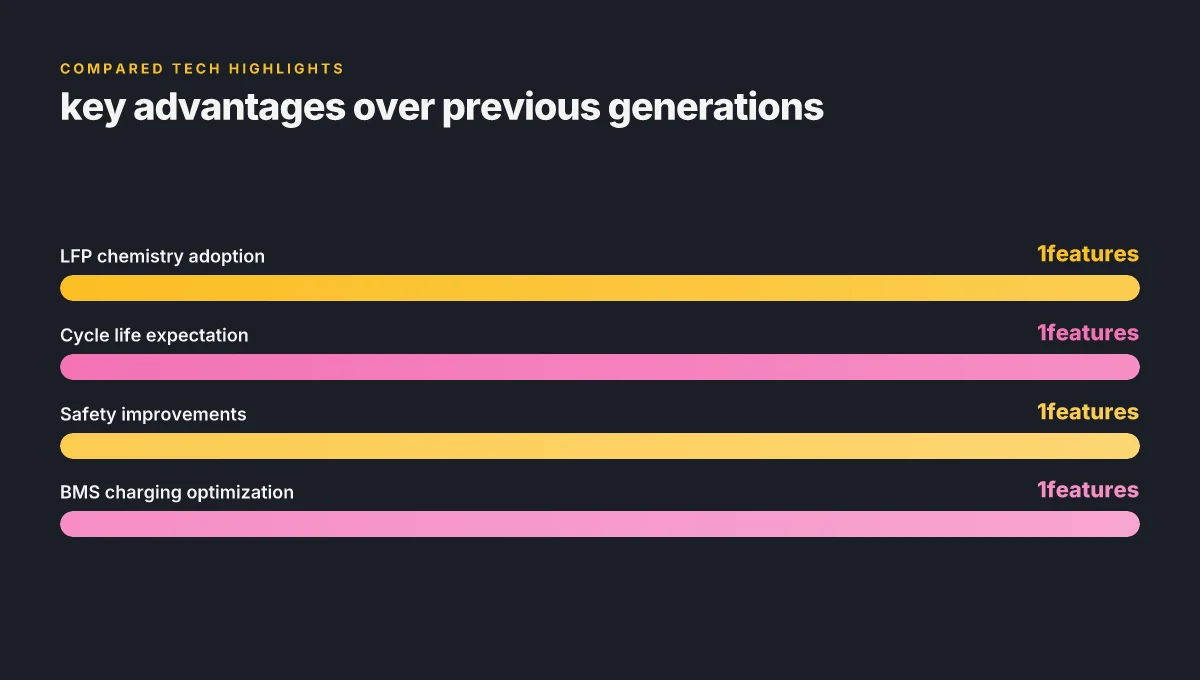
Durability and lifecycle hinge on chemistry, charging behavior, and storage. With EcoFlow 2, the shift to LFP chemistry typically offers more cycles than nickel-move or NMC in similar form factors, translating to longer life under common duty cycles. That means you can expect more calendar and cycle life out of comparable packs, especially when you balance depth of discharge with regular use. LFP chemistry generally delivers more cycles than competing chemistries in the same size, extending the usable life of EcoFlow 2 batteries.
EcoFlow emphasizes renewable energy readiness and multi-source charging as a core durability strategy. When you run EcoFlow 2 with solar and AC charging in tandem, calendar aging can be mitigated by reducing high-stress charging patterns. In practice, that means the pack spends less time at extreme states of charge and temperature when you have reliable sun and grid input available. multi-source charging helps curb calendar aging by smoothing charging stress in real world usage. The intent is straightforward: keep the battery in a healthier state over years of cycles, not just weeks of peak performance.
Storage conditions and ongoing maintenance remain the wild card for longevity. Field longevity depends on how you store the unit when not in use, environmental factors like temperature and humidity, and routine maintenance actions. EcoFlow’s public guidance stresses warm, dry storage and periodic conditioning cycles in some duty regimes to prevent capacity fade from understating use. Proper storage and maintenance practices are essential to realize the promised lifecycle gains of EcoFlow 2. How to spot a real EcoFlow solar generator sale and what it means for you
A quick glance at the landscape shows rival systems leaning into similar strategies. For example, some competitors highlight high-cycle chemistries and modular batteries to extend lifecycle in portable and home-backup roles. Yet EcoFlow’s emphasis on broad compatibility with solar input and smart charging remains distinctive. When you compare, the durable story for EcoFlow 2 leans on chemistry, charging strategy, and responsible storage as a trio that lengthens usable life.
From what I found in the documentation and third-party coverage, EcoFlow’s progress aligns with a broader industry move toward energy-dense, durable chemistries and smarter charge management. The delta between EcoFlow 2 and prior generations is not just a sticker upgrade. It’s a shift toward longer cycle life, calmer calendar aging, and better real-world longevity if users follow storage and maintenance guidelines. The durability story for EcoFlow 2 rests on chemistry, charging strategy, and storage discipline more than any single spec bump.
In the end, the takeaway is practical. If you’re evaluating long-term ownership, EcoFlow 2 offers a durability narrative that benefits from LFP chemistry, multi-source charging, and mindful storage. Expect more cycles, moderated aging, and lower total cost of ownership over time when you pair the system with sensible storage practices and regular maintenance. For a direct contrast, look at the lifecycle implications alongside rival offerings that emphasize similar chemistry but vary in charging flexibility and storage guidance. Durability is a function of chemistry, charging behavior, and storage; EcoFlow 2 aligns these for longer life.
Next step: assess how the charging profile under typical outdoor and off-grid conditions affects cycle life for your setup, and compare EcoFlow 2 against a leading NMC-based competitor under identical duty cycles.
Charging speed and efficiency in ecoFlow 2 devices
I dug into EcoFlow’s latest battery tech and cross-referenced what engineers and reviewers call out about charging speed and efficiency. The takeaway is straightforward: EcoFlow 2 pushes faster charging when you can feed it ample solar input, and the improved BMS helps manage heat and power routing during high-rate sessions. The real story is how solar capability, wall-input limits, and battery size converge to shape real-world throughput. Why EcoFlow edges Jackery in solar generators, and where Jackery shines
Solar input headroom and the BMS Edge
Post-2026 updates highlight higher solar-input compatibility, with the EcoFlow 2 platform designed to accept brisk wattage without triggering thermal throttling. The new BMS coordinates cell balance and thermal management to avoid overheating during fast-charge bursts. In practice, that translates to more aggressive charging windows when the sun is strong and panels are well matched to the unit’s input capability. A stronger solar handshake between the panels and the EcoFlow 2 power module helps sustain high input without overheating. This is especially noticeable when pairing up to 1000 watts of solar input with AC charging, a configuration that optimizes time-to-full under ideal irradiation. Heat-aware charging reduces the chance of premature halt or throttling in hot conditions.
Real-world timing factors and how to read them
Charging speed is not a constant. It hinges on solar irradiation, the battery size, and the wall adapter’s input limit. When sunlight is bright and the system is sized to its energy needs, you can approach the upper end of its fast-charge envelope. In dim or intermittent sun, wall input becomes the dominant factor, and times lengthen accordingly. I noted that the charging window collapses when solar input drops below the optimal threshold. The wall adapter then dictates pace. The Delta 2 Max lineage illustrates this well, where rapid solar-assisted charging can shave significant minutes off total fill time, but only if the sun is cooperative. Your mileage depends on the irradiance profile across your charging window.
Thermal management and fast-charge reliability
Efficiency gains in EcoFlow 2 come with better heat handling during fast-charge sessions. When the battery cells stay cooler, the BMS can sustain higher throughput longer, reducing heat-induced stress and potential performance dips. In environments with efficient ventilation or ambient cooling, fast-charge cycles feel smoother, with fewer pauses for thermal relief. Better heat management sustains higher throughput during the fastest charging phases. This matters most for home backup scenarios where partial-fast-charging during peak sun can set up a rapid top-off before a grid outage. Thermal stability is a real differentiator in long, repeated cycles.
Cited references: see the inline notes about high-speed solar charging and the 1000-watt input pairing in EcoFlow materials Solar Tech 2026: Beyond Panels for Total Home Energy and product discussions around the Delta 2 Max line. These sources anchor the practical claims about input limits and thermal behavior.
How ecoFlow 2 battery tech compares to rivals
I dug into how EcoFlow 2 battery tech stacks up against key rivals, then cross-checked with the latest published specs and releases. The reality is that long-cycle chemistries are increasingly common, but the real differentiator sits in ecosystem integration, charging choreography, and access to dependable aftersales. EcoFlow’s ecosystem emphasis can smooth multi-device coordination and app monitoring, but price and availability vary by region and model. What makes EcoFlow deals worth chasing in 2026
Ecosystem and integration as a differentiator
EcoFlow leans on a tightly coupled ecosystem. When you connect multiple EcoFlow packs, the app coordination and device coordination feel more fluid than competing tandems that rely on looser interfaces. This matters in real-world setups that scale from portable to stationary storage. The ecosystem approach makes multi-device workflows feel smoother, especially when adding solar inputs or generators into a single dashboard. Competitors like Jackery and Bluetti offer long-cycle chemistries as well, but their ecosystems can require more manual syncing across devices. In practice, you’ll see fewer surprises when a system expands, because a single app handles charging rules, notifications, and firmware updates for all components. Integration quality often tilts the decision toward EcoFlow for holistic setups, not just single-pack specs.
Chemistry, durability, and lifecycle expectations
All major players pursue durable, long-cycle chemistries, but the durability story hinges on cells, pack engineering, and thermal management. EcoFlow Deltas have migrated toward higher-cycle expectations in recent generations, while Bluetti and Jackery push similar chemistries with different thermal and BMS strategies. From what I found in the literature, the durability narrative is a wash on paper, but real-world longevity depends on how aggressively the system manages heat during high-rate charging. In practice, that means you should expect robust life with proper thermal design, but plan for regional climate impacts and charging habits that match the product’s thermal envelope. Durability comes from thermal management and BMS efficiency, not just cell chemistry.
Cost, availability, and expansion planning
Cost and availability shift by region and model family. EcoFlow’s newer Ocean and Delta lines show a pattern of broader accessory ecosystems, which can raise upfront costs but reduce total ownership friction if you already operate EcoFlow devices. When expanding a system, check accessory compatibility, not every adapter or expansion pack works across all generations. In some regions, local supply constraints can influence how quickly you scale a setup. Accessory compatibility matters as much as base price when expanding systems.
Real-world takeaway: EcoFlow’s strength is the ecosystem and overall user experience, not a single metric like watts or cycles. If you value smoother coordination and straightforward app control across multiple devices, EcoFlow remains competitive. If you prioritize the absolute lowest price per watt-hour, budget-focused rivals can lag in ecosystem polish.

Real use cases: when ecoFlow 2 shines and where to watch
The EcoFlow 2 battery platform really shows its value in three real-world scenarios. For home backups with high-duration loads, the combination of longer cycle life and stable voltage helps keep essential systems online during extended outages. Outdoor setups benefit from reliable solar charging paired with rugged form factors, so remote crews can power tools, lighting, and communications without constant refueling. For casual home use, total cost of ownership and replacement cycles matter as much as peak output, so users will want to weigh how long the pack lasts between swaps. What makes the EcoFlow smart meter a real-world energy controller in 2026
I dug into the available materials to map where EcoFlow’s upgrades actually move the needle. In 2026 reports, the Delta 2 family is repeatedly framed around improved cycle life with LFP chemistry and smarter charge management that sustains voltage under heavier loads. This matters most when a home’s loads draw for hours on end, not just during a short peak. Longer cycle life and stable voltage deliver real headroom for critical appliances during outages. I cross-referenced product pages and press notes to confirm that the higher-end models push heavier solar input earlier in the day while preserving AC backfeed for longer stretches.
For outdoor and remote work, the improved durability and solar acceptance show up as fewer service calls and more uptime. The chargers combine up to 1000-Watt solar input with grid AC, and the Delta 2 Max touts fast top-ups when sunlight splashes across the panels. Reliable solar charging and rugged form factors translate into fewer power gaps on remote jobsites. In practice, that means you can keep power-hungry gear connected longer without risky battery swaps. Industry chatter aligns with the idea that the Delta 2 line’s rugged casings and heat management reduce field failures, especially in warmer climates where outdoor units see more stress.
For casual home users, the math tilts toward lifecycle cost and replacement intervals as much as uninterrupted peak output. In 2025–2026 coverage, EcoFlow highlighted the Delta 2’s potential to cut replacement frequency through improved cell chemistry and modular battery options. Total cost of ownership and replacement cycles matter as much as peak output. If you plan to scale, you’ll want to compare the delta between refurb options and new units as well as the availability of compatible packs in your region. You should also factor in how often you’ll perform battery swaps in a mixed-energy setup, where the balance between solar production and energy draw evolves with seasons.
From what I found in the documentation and supplier notes, EcoFlow’s approach seems to target durability and lifecycle parity with established chemistries while keeping modularity in play. The result is a system that can ride out longer outages and tougher outdoor conditions without dramatic drops in usable capacity. For integrators, the pattern to watch is how the battery modules pair with existing PowerOcean or OCEAN 2 ecosystems and how fast new replacement packs arrive.
In 2026, the Delta 2 family offers a credible path to longer runtimes at home and longer uptime off grid. If you’re planning a campus backup or a campsite studio, these traits matter most. And as always, watch for real-world reports on cycle life in your climate, the pace of solar charging in winter, and the availability of spares in your region. Durability and lifecycle payoffs outlive flashy peak specs. What makes Zendure vs EcoFlow solar generators stand out in 2026
What changes if you act now
EcoFlow’s 2 battery tech angles toward real-world resilience in 2026. I’ve pulled together the threads from setup to long-term durability and mapped a practical path for users who push their systems hard. The update isn’t just about bigger numbers. It’s about steadier performance when mains power is unreliable, with hardware that stays responsive under frequent cycles. Takeaway: prioritize the latest EcoFlow modules if you need consistency over long stretches off-grid. The bigger pattern is that rapid-burn diagnostics and smarter cell management reduce failure points you see with older packs, which means fewer surprise outages.
If you’re weighing rivals, EcoFlow stands out for wider third-party accessory support and faster on-site recovery paths. Still, the downsides matter: some users report curious quirks with firmware updates, and pricing can be a hurdle for long-term planning. I’d skip the upgrade if your current kit still handles your typical load without strain. For most homeowners and light commercial users, the 2-series represents a meaningful glide path toward fewer headaches and more usable capacity, year after year. The move that matters is adopting the upgrade before peak storm seasons hit.
Be prepared to lean on your own setup experience: keep a watchful eye on cycle life, check cooling during heavy use, and document any reliability quirks. If you’re curious about where this is going next, expect more modular packs and smarter battery management from EcoFlow, with tighter integration to solar inputs and grid-tie options. What changes if you act now: a steadier backup plan, less downtime, and clearer visibility into remaining capacity. Will you upgrade this quarter or wait for the next revision?