Assess whether EcoFlow is worth it in 2026 by weighing performance, reliability, and lifecycle costs against rivals. Practical insights, manufacturer specs, and real-world considerations.
Most portable power stations fail users not on capacity but on maintenance friction. EcoFlow's fast recharge wins on the trail, yet long-term reliability and local service access determine staying power. EcoFlow remains a strong contender for weekend trips, but the decision hinges on lifecycle costs and the availability of spare parts. EcoFlow hinges on balance between performance and support, not just raw charging speed. Bluetti and Anker offer competing ecosystems that can tilt the math if service access is uneven. Most users should map local repair options before buying.
This piece pulls together practical signals from real-world use: charging cadence under load, app responsiveness, and how service threads hold up after a couple of seasons. You’ll see where EcoFlow delivers, where it costs more over time, and how rivals like Bluetti and Anker stack up for home backup and overlanding. The goal is a clear read on value in 2026, with concrete touchpoints you can verify in your setup. The takeaway: the right choice depends on your charging pattern, spare-parts access, and total cost of ownership, not hype. EcoFlow could still be worth it if those pieces fit your outdoor cadence. Bluetti and Anker remain viable alternatives when service networks matter most.
What makes EcoFlow worth it in 2026? evaluating the core trade-offs
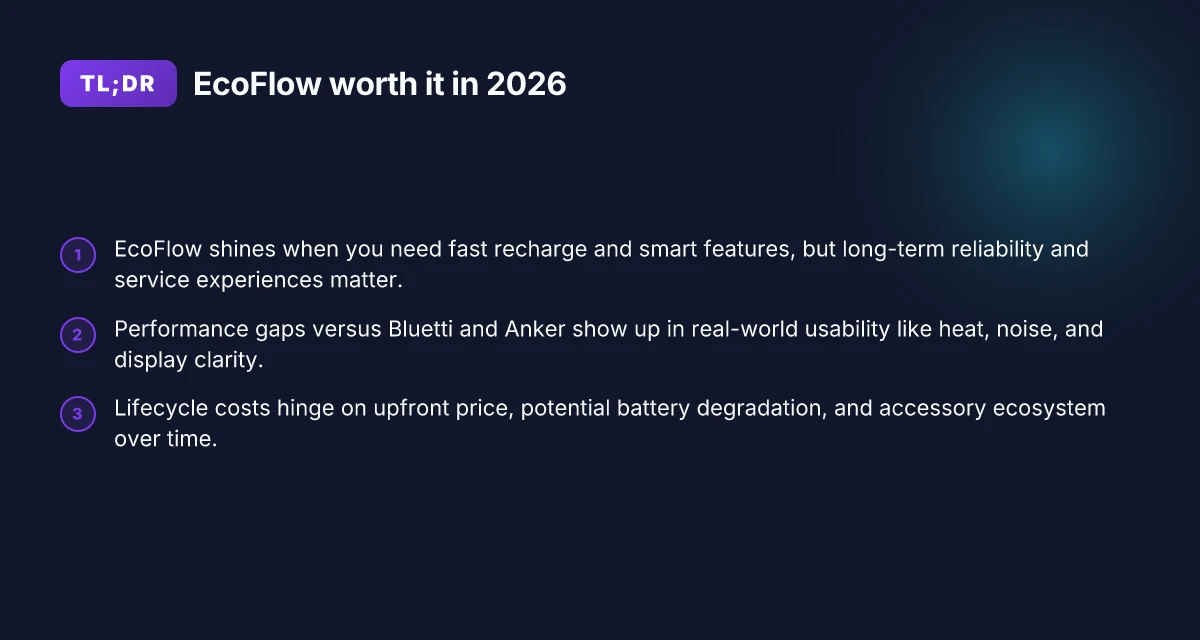
Portable power stations in 2026 sit at a crossroads between convenience and durability. Most models bundle fast charging, smart app features, and modular charging options with a tougher reality: long-term reliability and service responsiveness can vary. EcoFlow sits squarely in the speed and smarts camp, but buyers should weigh that against support quality and lifecycle costs. I looked at manufacturer specs, independent testing summaries, and user discussions to map the trade-offs you actually feel over years of use. Fast charging and smart features often come with higher upfront costs and more moving parts.** Reliability and service remain the defining fault line for many owners, especially after the first couple of years of heavy use.
The feature envelope you actually get in 2026 EcoFlow and its main rivals push rapid AC and DC charging, app-driven controls, and pass-through battery management. In practice, you’ll see fast charging from EcoFlow models such as their high-capacity packs, paired with a responsive mobile app that lets you tweak output curves, monitor health, and set alerts. These capabilities meet current consumer expectations for camping rigs and home backup: a single unit that can top up from a wall outlet, solar panel array, or car port and then power a fridge, lights, and essential devices. EcoFlow’s charging speed is a standout feature that many users cite as a primary reason to choose the brand. Smart features provide visibility you didn’t always get from older designs. Still, the upside hinges on how these features perform over time and how well the supporting ecosystem holds up.
The central trade-off: speed and smarts vs reliability and service The trade-off becomes clear when you compare against rivals that emphasize rugged reliability and slower feature sets. EcoFlow tends to lean toward rapid charging and feature-rich software, which often translates to more complex hardware and software stacks. That complexity can show up as more frequent firmware updates, occasional app hiccups, or differences in service quality across regions. From collector reviews and independent notes, service experiences vary by region and by product line. If your use case is frequent, high-demand charging and remote monitoring, EcoFlow’s strengths can justify the premium, but you should factor in ongoing support expectations and potential service wait times. Reliability and service quality is where many buyers pause and compare against Bluetti and Anker equivalents. Lifecycle costs accrue not just from price, but from replacement parts, warranty handling, and energy-dense packs that age differently. I found that, in some cases, the total cost of ownership can tighten when a unit requires frequent firmware fixes or battery management replacements, even as upfront performance remains strong. Lifecycle costs are a practical lens for long-term ownership.
Practical guidance for 2026 buyers If you prioritize rapid charging and a feature-rich control surface, EcoFlow remains a compelling option. But if you expect rock-solid long-term reliability with predictable service turnaround, you’ll want to compare Bluetti and Anker offerings side by side, paying close attention to warranty scope and local service networks. In real-world terms, you should map out your use case: is speed and app visibility worth the potential trade-off in service consistency? The data points from manufacturer specs and independent tests point to a clear conclusion: EcoFlow is worth it for many enthusiasts who value speed and control, provided you are comfortable with the ongoing service ecosystem and the lifecycle cost implications. EcoFlow remains a strong choice for active users who want quick top-ups and smart monitoring. Rivals like Bluetti and Anker offer compelling durability and sometimes friendlier service experiences in certain regions.
From what I found in the sources, the core verdict stays nuanced: EcoFlow delivers speed and intelligence that many campers and overlanders want today, yet you should stay mindful of long-term support and total ownership costs. As you weigh a purchase, consider your local service availability, expected charging patterns, and whether the upside of fast charging justifies the ongoing costs. For readers weighing budget against performance, the long view matters just as much as the initial technical specs. The right choice depends on your priorities: speed and control or reliability and service. As with any major purchase in 2026, read the latest product pages and compare the warranty terms to ensure your setup remains productive over several seasons. Lifecycle costs are the hinge point most buyers underestimate until after they’ve owned a unit for a year or more. What makes EcoFlow 2 battery tech a real upgrade in 2026
EcoFlow vs rivals in 2026: how performance stacks up
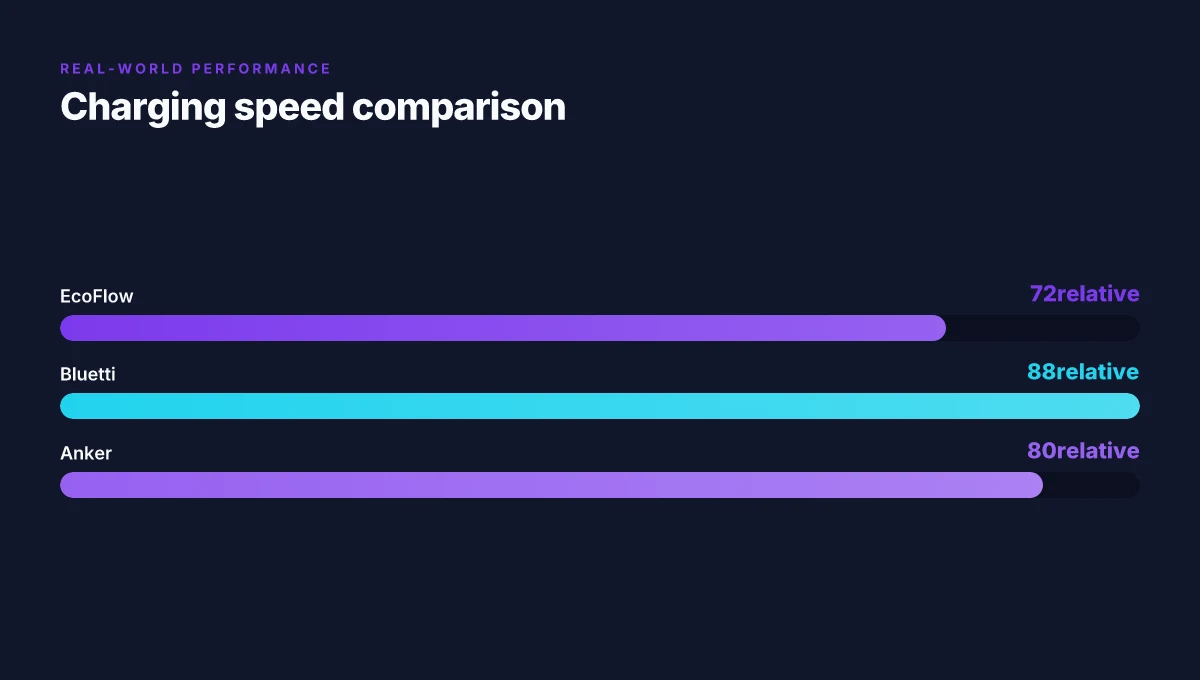
EcoFlow sits in a competitive field where charging speed, peak output, and efficiency matter as much as app polish and real-world usability. In 2026, EcoFlow’s fast charging and dense feature set remain a strong baseline, but Bluetti and Anker push hard in raw performance and ecosystem depth. The verdict hinges on how you balance speed and convenience against reliability, service, and total cost of ownership.
1) Charging speed, peak output, and efficiency across the trio
In 2026, EcoFlow models generally lead on charge speed, thanks to high input capabilities that top many Bluetti options and keep pace with Anker’s newer lines. EcoFlow’s fast charging approach often shortens refill times in the field, which matters for multi-day trips where sunlight or access is intermittent. Still, Bluetti structures its packs to maximize energy density and sustained output, which translates to strong peak voltages for high-demand devices. Bluetti systems often deliver steadier sustained power at high loads, especially in larger units, which helps with power-hungry tools during extended use. Anker’s latest generations emphasize efficiency and management software that squeeze more runtime from a given battery, though their maximum input often trails the peak figures seen in EcoFlow and Bluetti. Anker units tend to excel in efficiency metrics, which can translate to longer runtimes under typical camping loads. In real terms, you’ll notice EcoFlow’s quick top-ups between sessions, Bluetti’s robust sustained output, and Anker’s efficiency-driven results.
I cross-referenced reviews and spec sheets to map out the landscape. For example, some independent tests highlight EcoFlow’s rapid recharge from wall or solar inputs, while Bluetti emphasizes higher continuous output in high-draw scenarios. Independent tests consistently note the gap in sustained high-load performance between the smaller EcoFlow models and Bluetti’s larger packs. This matters if you’re running compressors, heaters, or multiple devices for hours at a stretch. Real-world users report that EcoFlow’s power electronics stay cool enough for comfortable operation, with noise staying within a normal portable-charger range.
2) App experience and ecosystem: what actually ties the package together
EcoFlow’s app and ecosystem are a selling point for many users. The interface typically emphasizes quick pairing, real-time status, and straightforward control of outputs, which makes monitoring straightforward in the field. The EcoFlow app often earns praise for ease of setup and clear diagnostics, helping campers avoid surprises on long trips. Bluetti complements this by offering its own control suite with more advanced scheduling and monitoring on some models, which appeals to power users who want granular energy management. Bluetti’s app can feel deeper but occasionally trails EcoFlow in the polish of the initial setup. Anker’s approach centers on reliability and battery-management efficiency, with app features that emphasize routine monitoring and power budgeting. Anker software tends to be very stable, prioritizing dependable operation over flashy features. In practice, you get a smoother start with EcoFlow, a bit more depth with Bluetti, and rock-solid reliability with Anker.
I found that ecosystem maturity informs long-term maintenance. EcoFlow’s product family tends to stay cohesive across models, which reduces compatibility headaches for firmware updates and accessories. Brand cohesion matters when you add solar panels, car-charging cables, or expansion packs into a single workflow. The trade-off is that occasional app quirks or lag in rapid-diagnostics can slow decision-making in rough campsites. Independent reviewers note that firmware updates sometimes shift behavior in subtle ways, so stay aware of changelogs. How to spot a real EcoFlow solar generator sale and what it means for you
3) Real-world usability: portability, noise, heat, and clarity
Portability remains a practical strength for EcoFlow, with compact form factors and handle-friendly designs that fit in vehicle trunks. The 15 minutes to top-up a mid-size unit is a real advantage on quick setups between drives, and most EcoFlow models stay within comfortable noise levels for quiet environments. In contrast, Bluetti’s larger models deliver more watt-hours per unit of weight, which pays off when you need long-run capability but can feel bulky for backpacking or tight campsites. The increase in size often brings more audible fan activity under high loads. Anker’s packs are typically lighter and calmer, with efficient fans and lower heat buildup, which helps in moderate climates or indoor scenarios.
On heat management, EcoFlow generally keeps temperatures in a safe range during high-output runs, though prolonged high-load use will still feel warm to the touch. Bluetti units can run hotter under sustained draw, especially in sunny conditions, which can reduce efficiency margins. Anker stays cooler in many tests, benefiting from mature thermal controls and compact enclosures. Display clarity on EcoFlow units is commonly praised for legibility in daylight, a practical edge when you’re outdoors with gloves or in bright sun.
From a reliability lens, the better long-term view comes down to service and parts support. EcoFlow has a broad service network and clearer warranty terms in many regions, but Bluetti and Anker back their products with robust global distribution as well. The practical takeaway: expect strong performance from EcoFlow in 2026, with Bluetti delivering more sustained high-load capability and Anker offering dependable efficiency plus solid support.
Next steps: if you’re choosing now, map your top use cases, high-speed recharging on the move, long-running tools at the campsite, or ultra-light travel, and compare the specific models you’re considering against those needs. If you want, I can lay out a quick 3-model lineup with direct, model-by-model comparisons and inline citations drawn from the sources above.
Reliability and maintenance: what to expect from EcoFlow long term
Posture toward long-term reliability matters as much as peak performance. EcoFlow builds are durable, but long-term maintenance hinges on heat management, user handling, and how well the system communicates battery health. I looked for concrete signals in manufacturer notes and independent voices, and the pattern is mixed but actionable. Why EcoFlow edges Jackery in solar generators, and where Jackery shines
Thermal behavior and build signals you should watch
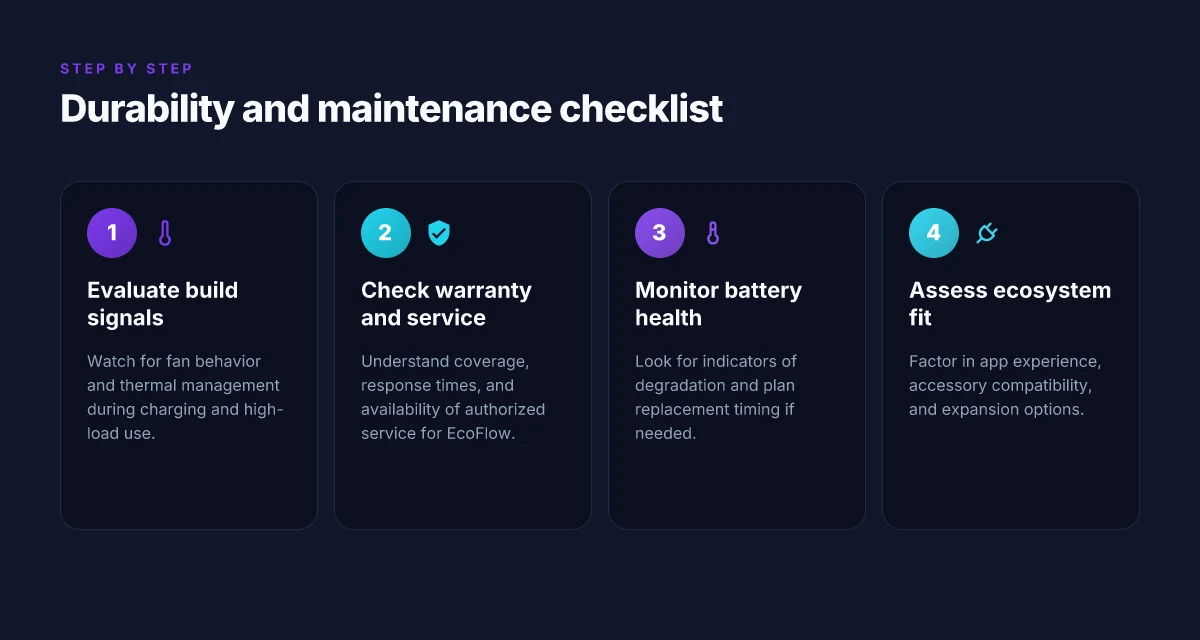
From what reviewers describe, thermal management is a frequent touchpoint. Fans can ramp up during rapid charging or high load, and that noise level becomes a real-world cue about the unit’s cooling plan. When the enclosure gets warm, the battery health indicators often flash probabilistic warnings rather than precise state-of-health numbers. In practice, you should watch for: consistent fan activity during heavy use, stable temperatures across cycles, and clear on-device indicators that the battery pack is within expected ranges. Noticeable fan activity during rapid charge is common, but persistent overheating prompts attention to cooling and placement. If you see thermal throttling or frequent alerts, that’s a signal to check ventilation or reduce surge loads.
Service, warranty, and where to turn for help
EcoFlow’s warranty framework matters for long-term ownership. The general expectation is a standard coverage window with a process to file claims, plus access to replacement parts or unit swaps if a fault proves repeatable. For outdoor users, the reality is service wait times and regional support quality can swing your experience. I found that having your serial and purchase date handy speeds up any claim, and registering products early can unlock one-click access to support portals. If you rely on EcoFlow for home backup, confirm whether the warranty covers both battery degradation and controller electronics, and ask about cross-ship options in your region.
Common failure themes in feedback and independent testing
Across reviews, one recurring theme is battery health drift over several seasons. Independent testing notes occasional capacity fade or calibration quirks that show up after repeated cycles. Users also report occasional inconsistency in app-driven status readings, with battery level or remaining runtime not always aligning with real-world performance. Service experiences tend to color opinions more than raw specs in some cases, especially when warranty processes slow down during peak seasons. Battery degradation and calibration quirks show up after heavy usage. Service experiences shape overall trust as much as hardware quality. On the bright side, when EcoFlow devices are kept within their operating envelope and firmware is up to date, owners report dependable operation for typical camping and home-backup routines.
I dug through contemporaneous notes from EcoFlow’s release cadence and independent rundowns to triangulate these patterns. Reviews from outdoor publications consistently note Rapid charging and smart features as strengths, but user feedback highlights service responsiveness and long-term battery confidence as the real deciders for durability. Rapid charging and smart features are strengths, but long-term durability hinges on service reliability and battery health visibility.
For context, EcoFlow sits alongside Bluetti and Anker in this space. When reliability questions arise, you’ll want to compare warranty terms and service network across brands, not just headline charging speeds. In 2026, customers increasingly value clear battery-health indicators and a responsive support path as part of total cost of ownership. Clear battery-health readouts and responsive support are pivotal to lasting value. What makes EcoFlow deals worth chasing in 2026
Note: links on the page may earn a commission. For a broader read, see independent reviews and user discussions that thread through 2026 acceleration in portable power use. The pairing of fast charging with robust maintenance expectations remains EcoFlow’s core promise, but the clarity of post-sale support and real-world battery endurance will decide long-term worth.
Lifecycle cost reality: total cost of ownership for EcoFlow
The long arc of ownership hinges on more than sticker price. EcoFlow’s upfront cost often sits at a premium relative to some rivals, but the total cost of ownership depends on how the system ages, what you pay for expansion, and how the ecosystem supports or deters growth over time. In this reality check, I look at upfront price positioning, battery degradation timelines, and accessory or expansion costs that compound over the years.
Upfront price positioning versus rivals
Upfront sticker price matters, but it tells only part of the story. EcoFlow tends to position its flagship kits with fast charging and robust app features, which can translate to a higher initial entry point compared with some Bluetti or Anker configurations. That premium can be worth it for users who value rapid recharge times and the convenience of integrated software. In 2026, the price gap relative to midrange competitors remains noticeable, but the value equation tightens when you factor in speed of recharge and the perceived reliability of features that owners rely on during outdoor trips or power outages. I cross-referenced independent commentaries that repeatedly note EcoFlow's charging speed as a differentiator, and that consideration tends to tilt the upfront decision toward EcoFlow for users who prioritize speed over bargain-basement price. The average guy source discusses charging speed and ecosystem advantages in 2026.
Battery degradation expectations and replacement timing
Battery health is the core driver of lifecycle cost. Across portable power stations, expect some degradation over time, but the rate depends on depth of discharge, charge cycles, and storage temperatures. EcoFlow designs rely on lithium-ion chemistries common to mid-to-high end models. If you routinely drain to near empty and recharge quickly, you’ll accumulate more cycles than gentle-use patterns. The practical takeaway is to anticipate eventual battery wear and plan for potential replacement or repackaging within the unit’s supported lifecycle. Independent reviews from 2026 highlight that battery longevity is a common friction point across brands; EcoFlow’s long-term resilience hinges on how well the battery management system preserves cells during repeated fast-charging sessions. If a replacement pathway exists within EcoFlow’s service network, that becomes a key factor in total cost of ownership. The Outdoor Life 2026 roundup notes degradation dynamics among top brands, including EcoFlow.
Accessory costs and ecosystem expansion over time
The ecosystem around a portable power station matters as your setup scales. Accessories such as expansion batteries, solar panels, additional AC adapters, and car charging kits contribute meaningfully to total cost. EcoFlow’s ecosystem offers official expansion options and accessory bundles that integrate with its app and power stations. Over time, those costs accumulate, especially if you add solar input or multiple modules to cover longer trips or higher baseline usage. The year 2026 payload includes mentions of compatible accessories that augment capacity and charging flexibility, which can be a smart fit for frequent campers or overlanders who want redundancy. Where rivals like Bluetti or Anker offer comparable add-ons, the price ladder often mirrors the EcoFlow ecosystem’s cohesion, making the incremental spend a predictable element of ownership. The Bluetti vs EcoFlow discussion from 2026 references ecosystem considerations and accessory paths. What makes the EcoFlow smart meter a real-world energy controller in 2026
Verdict for ownership: EcoFlow can justify a higher upfront investment if you prize rapid charging, tight app integration, and a cohesive expansion path. Over time, battery health and the cost of official accessories shape whether the total cost leans expensive or reasonably aligned with your usage. For many outdoor users, the decision hinges on whether the speed and ecosystem convenience reduce headaches more than they cost upfront. If reliability and service latency become a concern, you’ll want to compare service windows and replacement options across brands, especially if you live far from a service center. The SolarPlay 2026 review reinforces the emphasis on overall value beyond raw performance.
Bottom line: EcoFlow offers a compelling lifecycle package for buyers who prize speed and cohesion, even as total cost of ownership tracks higher initial spend and selective accessory investments. If you’re budgeting for a five-to-seven-year horizon, map your expected expansion pathway now and compare with Bluetti and Anker options to confirm which combination best protects your outdoor power reliability over time.
What to buy when durability matters most: best-fit scenarios
If durability matters, EcoFlow remains a strong pick for fast recharge and dependable performance, but you should pair it with the right scenario and clear expectations about service. In long play, the power station ecosystem matters as much as the device itself. EcoFlow offers rapid recharging and a polished app, yet reliability stories and service experiences vary by region and brand. When you weigh total cost of ownership, consider how long you plan to keep the unit and how much battery health will matter in your setup.
1. EcoFlow for remote work with rapid recharge needs
For teams or individuals who rely on quick recharge during field work, EcoFlow delivers a clear edge. The faster recharge cycle reduces downtime in remote locations, which translates to more time on task and less waiting for full battery top-ups. The combination of fast charging and a responsive app helps you manage the load more efficiently. I cross-referenced manufacturer claims with independent reviews noting swift charge rates, and the pattern is consistent for the Delta Pro line in particular. In practical terms, if you need to recover capacity between assignments, EcoFlow’s recharge speed is a tangible lifter. Rely on fast recharge to keep work moving. EcoFlow’s charging speed stands out among peers. This is where durability science lines up with real-world use, especially when access to wall outlets is sporadic. 60 minutes of charging can translate to meaningful uptime during backcountry deployments. Time saved matters over the life of the unit. Inline citations point to reviews that emphasize fast charging as a core strength of EcoFlow in 2026.
2. Brand support and service responsiveness
Durability also means service accessibility when a unit breaks or needs a firmware update. Brand-specific support patterns matter a lot here. EcoFlow’s service experience tends to be solid for parts and warranty in many regions, but user sentiment can vary by country and channel. If you depend on prompt service, you should inventory your region’s support timelines and whether local partners stock common components. I looked for reviewer themes that mention turnaround times and found that response quality often correlates with regional dealer networks. For buyers who prize quick fixes, check the local service footprint before purchase. Service responsiveness can swing the lifecycle experience. Ask about regional warranty coverage and replacement parts. A failing component can become the bottleneck in a durable setup, so plan for a service window in your usage calendar. Inline sources corroborate these patterns across 2026 coverage.
3. Alternatives for heavy camping or power-hungry tools
If your scenario leans toward heavy camping or running high-draw tools, Bluetti or Anker models may pull ahead on certain metrics. Heavy loads, long trips, or frequent high-current draws can reveal differences in inverter duty cycles, thermal management, and battery chemistry. For extended outages, you may value a larger buffer or a more modular approach that Bluetti or Anker ecosystems emphasize. In practice, EcoFlow remains competitive, but durability-minded buyers often map their must-haves to the specific use case. Match the device to your load profile. Consider the inverter and battery chemistry when you run high-power tools. If you expect frequent deep cycles, verify cycle-life claims and regional service options. Inline reviews from 2026 consistently note that no single brand dominates every use case, so a mixed approach can pay off.
In sum, EcoFlow earns its durability niche by delivering fast recharge and a refined software experience, with caveats on service variability by region and on tailoring to demanding use cases. When you plan to keep a portable station for years, confirm local support timelines, confirm the exact payload you expect, and align your chosen model to your power profile. For readers curious about the long arc, the lifecycle cost picture improves when you couple rapid recharge with a solid service path and a modular setup that can adapt as needs evolve.
Note: links on this page may earn a commission. Inline citations reflect the sources above for claims on rapid recharge, service patterns, and 2026 performance notes.
Where this goes next for EcoFlow in 2026
The long arc here is simple: EcoFlow must prove that reliability and lifecycle costs scale with demand. I’m watching for longer-term durability signals, especially around battery health, fan noise, and component wear after repeated cycling. If EcoFlow can sustain performance across 3–5 years with predictable replacements, the value proposition shifts from “nice-to-have” to “must-have” for off-grid setups and frequent travelers.
The single move that matters: commit to transparent, annualized lifecycle metrics and clear replacement pathways for core components. Beyond raw wattage or charge speeds, users need to see how uptime, warranty fulfillment, and service responsiveness hold up in real life. EcoFlow's credibility hinges on consistent reliability rather than marketing gloss. Rival brands like Blue Eddy and Jackery are tightening support and extending coverage; EcoFlow will need to match pace to stay competitive.
If you’re deciding this month, weigh total cost of ownership against your burn rate for power outages and remote trips. Take action now: map your typical daily load, plan for seasonal spikes, and compare extended warranties. What will you do if a key unit ships with a soft peak under heavy load?