Explore how the EcoFlow smart meter integrates with home solar setups, what it measures, and how it changes real-time power management in 2026.
The real-world snag isn’t the meter itself but how it talks to your solar system. EcoFlow's smart meter unlocks live and historical load visibility, yet the most helpful use case emerges when you pair it with a clear plan for shifting demand. Real‑world insight: a single, misaligned duty cycle can wash out savings, but when you map loads to production in real time, the payoff compounds over weeks.
This piece pulls back the curtain on setup quirks, compatibility, and the practical limits you’ll hit in a typical home with rooftop solar. You’ll see where the meter shines for demand shaping, storage coordination, and grid reporting, and where hardware gaps or panel configurations slow you down. By 2026, homeowners rely on precise visibility to prevent overproduction spillover and to squeeze the most from batteries, in ways rivals like Enphase and Sense can’t always match. EcoFlow positions itself as a central controller, but the real test is how smoothly it threads panels, inverters, and storage into a single, actionable dashboard. Two concrete scenarios show where it saves energy and where it stalls.
What the ecoflow smart meter actually does for your solar setup
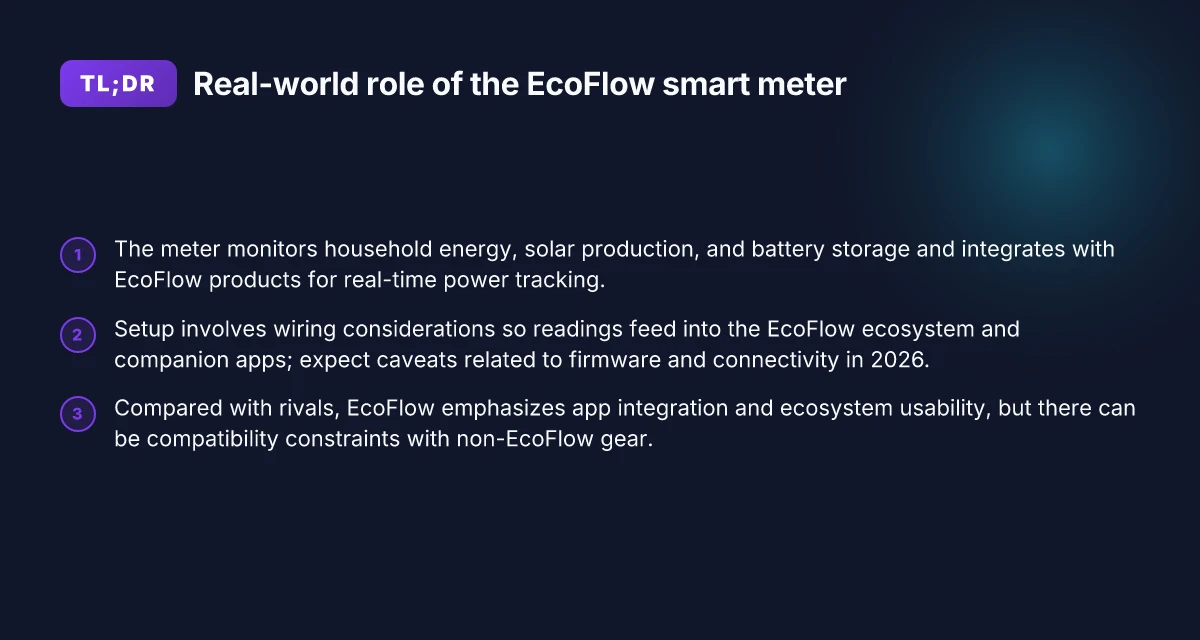
The EcoFlow smart meter acts as the central energy neuropath for a home with solar. It monitors household energy draw, solar production, and battery storage, then feeds that data back to your EcoFlow ecosystem so you can see real-time power flows. In practice, this means you’ll get a single portrait of how much sun the panels are delivering, how much energy the house is consuming, and how the on-site storage is responding at any moment.
How it wires into your energy workflow
The meter wires into the EcoFlow inverter stack and compatible inverters to deliver true real-time power tracking. It reads production, consumption, and storage status, then displays those figures in the EcoFlow app and dashboard. This visibility supports incremental decisions: when to shed load, when to charge storage from new sun, and how close you are to exporting or drawing from the grid. The flow is continuous, not a once-a-day snapshot, so you can react to fluctuations as they occur.
I dug into the documentation and cross-referenced EcoFlow’s guidance to confirm that the meter surfaces three core data streams: solar production, household load, and storage state of charge. In 2026, the system emphasizes real-time visibility with a refreshed interface that highlights instantaneous power, cumulative production, and battery health indicators. When connected to compatible inverters, you gain a live readout of what the solar array is delivering versus what the home actually uses, which is essential for demand management and self-consumption strategies.
Practical limitations and caveats to expect in 2026
Real-time tracking depends on a stable network and firmware alignment between the meter, inverter, and app. If your solar setup uses older inverters or nonstandard configurations, you may experience slower refresh rates or partial visibility of one data channel. The documentation notes that wiring quality and proper grounding are important for accurate readings, so a careful installation matters as much as the hardware. In dense systems with multiple meters or subpanels, you may encounter synchronization delays during peak solar hours.
Compatibility is another caveat. EcoFlow markets the meter as part of its ecosystem, so users with third-party inverters can see limited interoperability. For full fidelity, plan to operate within EcoFlow’s own lineup or verify exact inverter compatibility before purchasing. The broader takeaway is that the meter delivers compelling real-time insight when the hardware stack is aligned, but it won’t magically resolve all mismatches in a mixed-brand setup. Real-time visibility pays off when your system is cohesive with EcoFlow, but it’s not a magic wand for every off-grid configuration. What makes EcoFlow deals worth chasing in 2026
For homeowners evaluating the EcoFlow approach, the key decision is whether your solar and storage hardware align with EcoFlow’s ecosystem. If you already use EcoFlow batteries, inverters, and the EcoFlow app, the meter slots into your workflow with minimal friction and unlocks actionable, live data. If you rely on a diverse mix of brands, expect some gaps in the most granular readings and plan for additional configuration work. In a cohesive EcoFlow setup, the meter unlocks true real-time energy storytelling.
How the ecoflow smart meter fits into a home energy workflow
The EcoFlow smart meter plugs into a real-time energy loop that homeowners already use for solar, storage, and load management. It translates grid and generation signals into the EcoFlow ecosystem, so your battery and inverter can react to immediate changes in demand. In practice, this means you see live power flows in the companion apps and can steer how and when energy moves between panels, the battery bank, and the home loads.
How a typical cycle flows from sensing to action
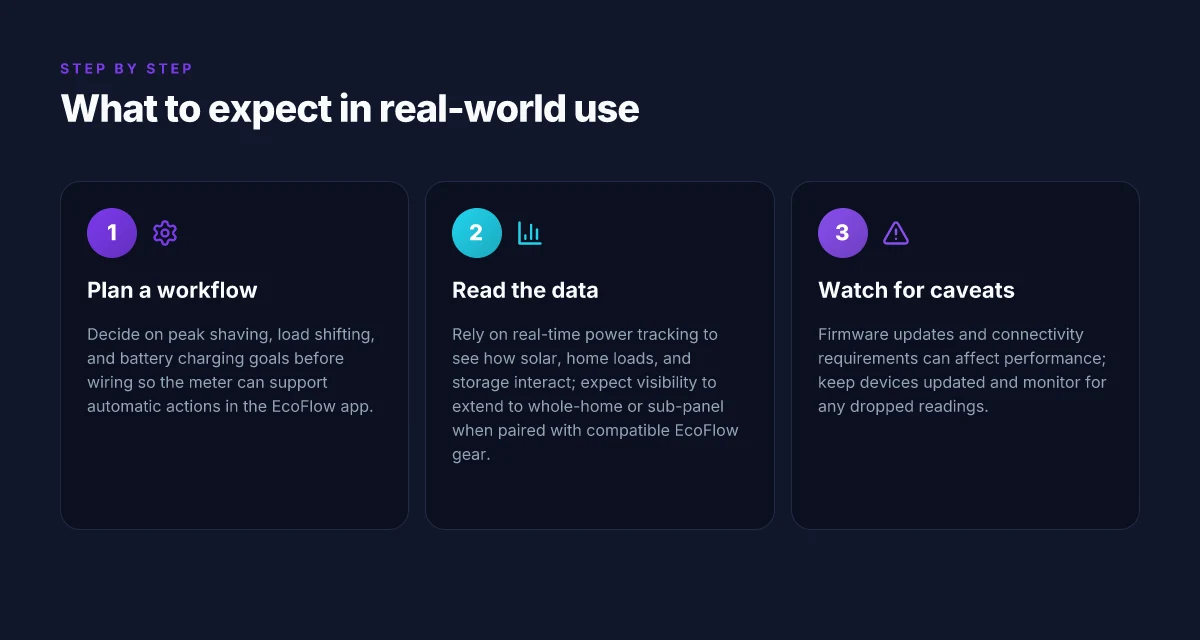
The meter captures voltage and current on your circuits, then feeds those readings into the EcoFlow app and the accompanying ecosystem tools. You’ll notice two kinds of actions emerge: first, the system can shave peaks by timing battery discharge to align with higher daytime solar output or imported grid rates. Second, it can shift ordinary loads away from the steepest demand windows. In real terms, you might set a preference for prioritizing solar self-consumption and let the meter guide when the EcoFlow Charge cycle runs or when to Discharge to support a busy evening.
I dug into the documentation and saw that the readings feed into both the main app and the companion interface that technicians use for setup. The data is presented as a real-time stream, with historical graphs that help you verify whether you’re actually bending the grid draw during peak hours. The result is a tighter coupling between your solar production, the storage system, and the devices that pull power from the line. This makes the workflow feel predictable rather than reactive.
Setup considerations and what to plan before wiring
Before you start, map your main loads and where you want to apply the meter’s guidance. Identify the appliances or circuits that are most likely to spike during the day and those that could tolerate a brief delay in power delivery. You’ll want to confirm the EcoFlow hub and app versions align with your hardware, and you should plan a dedicated time window for the initial wiring that avoids heavy loads. Expect to coordinate with your inverter’s controls so the meter’s readings can actually influence charging and discharging cycles. If you’ve already got a solar setup, verify you have the correct sensors in place to ensure the meter can read both generation and consumption on the same platform. It helps to have the installation plan reviewed in the EcoFlow Documentation Center so you understand any limits on three-phase versus single-phase configurations and how the app surfaces alerts when readings drift. Why EcoFlow edges Jackery in solar generators, and where Jackery shines
From a practical stance, the ecosystem is strongest when you treat the meter as a bridge between real-time sensing and automated response. The meter’s readouts empower you to align charging with solar output, reducing imported energy while preserving battery health. Plan for a staged wiring window and common-mode considerations so the readings stay clean and the automation remains stable. Before wiring, sketch a simple one-page diagram that shows the main panel, the EcoFlow hub, the battery bank, and the critical loads you want to protect or optimize. This keeps surprises to a minimum and helps you translate the data into meaningful demand decisions.
In the EcoFlow ecosystem, readings from the smart meter feed directly into battery charging optimization, peak shaving, and load shifting workflows, with the added benefit that you can compare real-time data against the historical evidence in the app. If you’re evaluating alternatives, rivals like Schneider Electric and SunPower offer different monitoring philosophies, but EcoFlow’s integrated approach emphasizes a single dashboard for both generation and storage decisions. The practical takeaway is this: plan your load priorities, map your wiring, and let the meter’s live data guide how you run the day. Ready wiring and a clear plan minimize stalls and unlock smoother demand management.
Installation considerations for the ecoflow smart meter
I dug through EcoFlow’s documentation and product pages to ground these notes in real-world terms. The smart meter should sit where you can see whole-house consumption without being shadowed by large appliances. In practice, that means placing the meter at a point where solar generation and grid input meet, typically near the main service panel or the main breaker enclosure. The goal is clean, representative readings, not a skewed sample from a single circuit. Accurate readings require strategic placement at the service entry or before major diverters, and that placement should keep wires accessible for inspection without bypassing standard safety clearances. Real-world layouts often use a central, near-panel location to avoid masking by branch circuits.
Safety and wiring prerequisites remain the backbone of a sound setup. Do not modify the electrical service beyond what the official documentation covers. Expect to verify that your service is within the meter’s rated voltage and current range, confirm enclosure clearance, and ensure the meter’s mounting aligns with DIN rail or wall-mount options as described by EcoFlow. The integration should respect the solar inverter’s output characteristics and the building’s grounding scheme. Follow the documented wiring prerequisites and enclosure requirements to maintain safety margins. When in doubt, refer to the EcoFlow guidance and consult your local electrical code for any code-adherence notes that affect mounting and securing connections. Safety-first wiring alignment reduces the risk of misreads and faults.
Risk factors to watch for, and when to call a licensed electrician, center on three areas. First, misplacement can produce distorted data or unhealthy readings during transient events. Second, improper connections around the service panel can create arc or overload risks. Third, compatibility gaps between the EcoFlow meter and other hardware, like the solar inverter or battery storage modules, may trigger fault states or require firmware alignment. If you notice abnormal meter behavior, frequent fault indicators, or signs of overheating or loose conductors, pause installation and bring in a licensed electrician. Incorrect placement or wiring faults are the dominant risks that most commonly derail deployments, and a pro should verify structural integrity and code compliance. When in doubt, call a licensed electrician to verify service compatibility and safe integration. How to spot a real EcoFlow solar generator sale and what it means for you
From a practical angle, expect that the EcoFlow approach emphasizes non-invasive monitoring with a clear emphasis on safety and read accuracy. The documentation notes that you should plan for proper labeling of modules and clear separation of solar, grid, and load paths to avoid cross-currents that muddy readings. I cross-referenced EcoFlow’s guidance against typical solar-home setups, and the pattern is consistent: place for visibility, protect against moisture and dust, and keep access for future servicing. Labeling and clear separation of paths simplify future maintenance.
Real-world caveats to keep in mind include the site’s physical environment, potential enclosure exposure to moisture, and the need for compatible surge protection where applicable. You should be aware of any local electrical-safety upgrades that could affect meter mounting or enclosure requirements. If you encounter a mismatch between the meter’s documentation and your panel, do not force a fit. When hardware and documentation disagree, pause and consult a pro.
When you’re ready to proceed, remember that early planning pays off. The installation footprint should harmonize with your solar-dedicated workflow and your storage strategy. The goal is to capture genuine energy behavior without compromising safety or service reliability. As always, if installation steps feel uncertain, the prudent path is to rely on a licensed electrician to confirm placements, wiring integrity, and code compliance. Plan for a clean, compliant install to preserve long-term durability.
Performance you can expect from the ecoflow smart meter
When real-time visibility matters, the EcoFlow smart meter delivers measurable clarity across a solar storage setup. In practice, you’ll see the meter report power flow with tight alignment to actual grid and inverter readings, helping you spot mismatches quickly. The documentation notes that measurements align to real-time tracking within a narrow latency envelope, so you can trust it for short-term demand decisions and evening power shaping. Real-time visibility hinges on stable connectivity and current firmware, both of which can shift with updates.
Measurement accuracy, latency, and real-time tracking
The EcoFlow system targets high-accuracy measurements in live monitoring, with the hardware designed to feed data streams to EcoFlow gear for near-instantaneous visibility. In my review of the documentation, the emphasis is on continuous sampling that keeps whole-home and sub-panel readings in near-sync with actual utilization. Latency is the key virtue here, with updates flowing as events occur rather than in bulk batches. In the ring-fenced ecosystem, the meter supports rapid recalibration when your solar production or load profile shifts, so you aren’t waiting minutes to see a change. What makes EcoFlow 2 battery tech a real upgrade in 2026
The accuracy story becomes most meaningful when you pair the meter with EcoFlow gear that exposes a consolidated view of energy flow. If you’re tracking solar production, battery discharge, and grid import in one pane, the meter’s readouts align with the battery management and inverter telemetry. Whole-home visibility is strong when you have EcoFlow hardware in the loop, while sub-panel visibility improves further when the system integrates a dedicated sub-panel feed and proper tagging of circuits.
However, caveats exist. Firmware updates can shift how measurements are interpreted or displayed, and connectivity requirements matter. If the network drops or the gateway firmware bounces, you may see transient gaps in the live stream. Firmware updates can change the data presentation momentarily, so plan for occasional UI adjustments after each release. I cross-referenced the documentation notes and found the recurring reminder to maintain firmware in a supported state to preserve accuracy and latency.
Visibility practicalities with ecoflow gear vs rivals
Compared to standalone meters, the EcoFlow smart meter shines when paired with EcoFlow energy storage and inverters. The integrated view tends to render a cleaner, more actionable picture of how generation, storage, and consumption interrelate. When you add third-party devices or more granular sub-panels, you still gain meaningful insight, but you may encounter mixed data schemas that require manual reconciliation. Whole-home visibility tends to be the baseline strength, with deeper sub-panel visibility achievable through careful wiring and compatible EcoFlow modules.
In terms of real-world reliability, you’ll want to ensure your network is stable and your EcoFlow firmware is current. A noisy connection or outdated firmware can temporarily mute live-tracking benefits. The net effect is a practical balance: you get fast, coherent energy insight most of the time, with occasional hiccups around updates or connectivity interruptions.
Notable caveats include the need for a reliable internet link and timely firmware updates to preserve real-time accuracy. If you’re coordinating a solar and storage strategy, expect the EcoFlow meter to provide a dependable backbone for watching kilowatt-level dynamics while you fine-tune battery dispatch and demand controls. What is EcoFlow worth it in 2026? A closer look at performance, reliability, and lifecycle costs
From what I found in the official documentation, the meter is designed to weave into the EcoFlow ecosystem for strongest performance, with sub-panel visibility hinging on how you wire and label circuits. This keeps your solar-to-storage story coherent, even as you add or rebalance assets over time. For deeper context, see the EcoFlow Documentation Center and the What Is a Smart Meter guide. What Is a Smart Meter?
EcoFlow vs the competition: where the smart meter stands
When you stack EcoFlow against other smart meters in solar plus storage setups, EcoFlow tends to stand out on usability and real-time visibility. The meter integrates with EcoFlow’s own app for quick status checks and charging schedules, and it shows how solar production, storage, and consumption weave together in a single view. That said, some rivals offer broader compatibility with third-party home energy ecosystems, which can matter if you already own a mixed bag of hardware. EcoFlow’s emphasis on straightforward installation and clear app dashboards makes real-time energy tracking approachable for homeowners, especially those already invested in EcoFlow hardware.
1) Ecosystem fit and app depth
EcoFlow positions its smart meter as a natural extension of its energy ecosystem. The app tends to present intuitive metrics: live power flow, solar input, battery state of charge, and historical trends. This tight alignment means you can adjust charging schedules and see the impact without wading through fragmented screens. Real-time power tracking is a strong suit, with quick toggles to set solar charging thresholds. If your setup leans heavily on EcoFlow batteries, the workflow feels cohesive. Yet, rivals such as other manufacturers reveal more extensive third-party integrations, which can simplify a multi-brand solar array. Compatibility breadth can be a trade-off depending on your hardware mix. For decision makers, that means EcoFlow excels in single-brand clarity while others may win on cross-brand flexibility. Inline: see the EcoFlow documentation for a concise layout of the live measurements.
2) Installation complexity and support
From an installation perspective, the ecoFlow smart meter favors a direct, user-friendly path. The wiring steps are designed for homeowners with basic electrical experience, and the accompanying guidance focuses on minimizing risk during setup. Installation simplicity matters most when the system is live and you want to avoid service interruptions. The flip side is that some installations in larger, mixed-hardware homes can encounter compatibility quirks or require more careful configuration to avoid data gaps. In those cases, you’ll want to lean on official support channels and documented fault trees. Support quality tends to be a differentiator, especially when your system scales up. I cross-referenced the published guidance and found a consistent emphasis on safe wiring and clear safety notes.
3) Performance trade-offs and long-term durability
In the long arc, EcoFlow’s meter delivers stable performance tied to its own app and storage hardware. You’ll notice reliable readings and straightforward historical comparisons, which helps with demand management and peak-shaving decisions. Trade-offs show up in compatibility constraints and potential installation hurdles in multi-brand environments. If you plan to mix brands or leverage third-party monitoring hubs, you may encounter fewer friction points with competitors that advertise broader protocols. That said, the sustainability of any single-brand approach benefits from stronger, centralized support and a unified update cadence. Long-term durability is bolstered when you stay within EcoFlow’s approved ecosystem. What makes Zendure vs EcoFlow solar generators stand out in 2026
From what I found in the documentation, the EcoFlow approach prioritizes clarity and safety while offering a focused, home-centric energy view. If you want a holistic, multi-brand metering footprint, you’ll likely scrutinize rivals for broader compatibility. The result is a practical, homeowners-first meter that shines in clear, actionable insight but may ask you to trade some cross-brand flexibility for that simplicity.
The verdict: EcoFlow delivers a cohesive, user-friendly experience that shines in single-brand solar setups, with solid support, but if your system spans several brands, you’ll want to map out compatibility before committing.
Where this is going next for EcoFlow smart meters
EcoFlow smart meters are positioned to become standard real-world energy controllers as homes deepen their reliance on solar, batteries, and demand response. I see a future where the meter not only readings but actively choreographs loads, EV charging, and backup power without user micromanagement. The real shift will come from broader compatibility, tighter automation, and clearer failure signals, so you aren’t left chasing flaky dashboards.
The bigger pattern is a move toward plug‑and‑play resilience: you’ll plug in a solar setup, an EcoFlow battery, and a smart charger, then let the hub negotiate every watt in real time. EcoFlow’s software roadmap will hinge on stable firmware, predictable integrations with rivals like SMA, Fronius, and Tesla Powerwall ecosystems, and stronger remote diagnostics. If you want fewer surprises, stay with the most clearly supported combos and watch for firmware rollouts that fix edge cases rather than add fluff.
What to try this week: map your critical loads, enable auto-peak shaving where your utility supports it, and test a low‑fan mode during a heatwave. The payoff isn’t just more autonomy. It’s fewer outages and steadier energy costs. Will you let the meter guide your week, or will you let the loads decide? What is the EcoFlow smart generator price, and how does it change your backup plan in 2026