Explore the key differences between Jackery and EcoFlow solar generators, including charging speed, expandability, and long‑term durability. Practical guidance for choosing the right system.
EcoFlow dominates for high performance in solar generators, while Jackery keeps things simple and portable. A single scene reveals the gap: a 20‑minute charging sprint against a slower, steady feed from Jackery during a weekend camping test. That distinction matters once you plan outages, adjacently stacking modules, or run a fridge overnight.
In this piece you’ll see real-world tradeoffs laid out: how fast solar input scales on EcoFlow models, how modular expandability actually works in the field, and where portability tips the balance toward Jackery. Expect numbers that matter for long outages, like charging times with typical panels and the impact of added batteries, plus a practical read on durability and weight for carry vs. car camping. This matters now as wild weather and outages push portable power into the everyday, not just the backcountry. The takeaway: for speed and expandability, EcoFlow. For straightforward reliability, Jackery.
Why Jackery vs EcoFlow matters for solar power in 2026
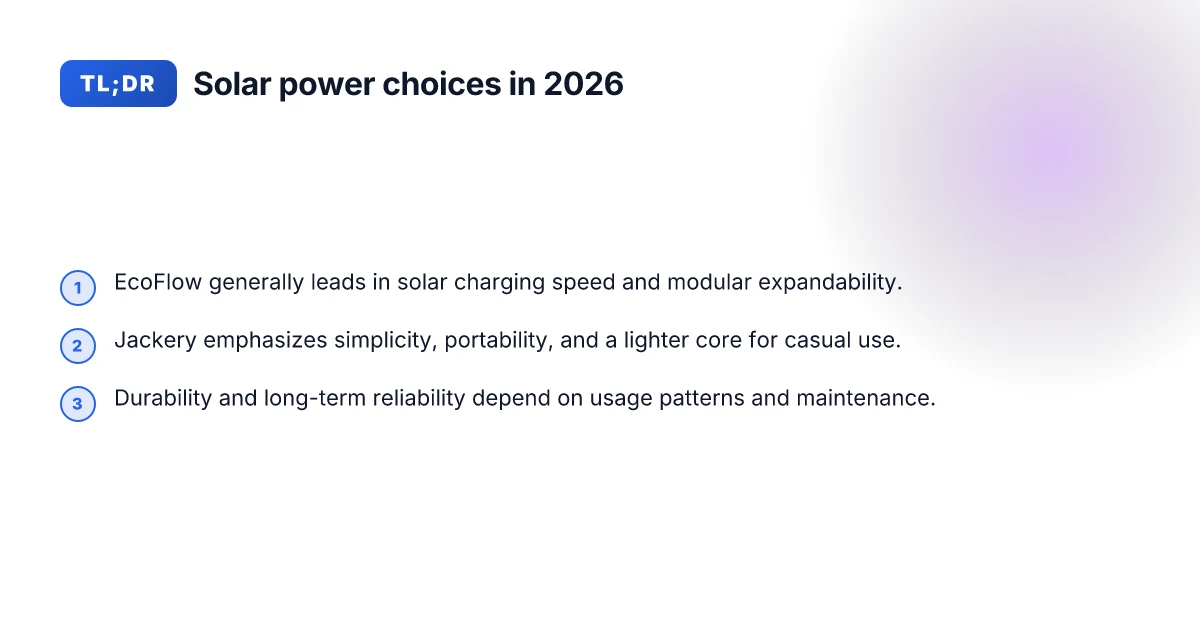
In 2026, EcoFlow tends to win on solar charging speed and modular expandability, while Jackery shines when you want lighter, simpler setups for casual use. Both brands are broadening their lineups, but the trade-offs show up most clearly in outage scenarios and outdoor use cases.
EcoFlow’s lead in solar charging speed and expandability
EcoFlow consistently leans on rapid solar input and modularity. In real-world scenarios, that means you can add panels or tether multiple units to scale output without a heavy, complex setup. Reviews and data from independent sources point to faster solar recharge curves and better expandability options for EcoFlow systems compared with current Jackery offerings. When outages require rapid replenishment or you foresee growing power needs, EcoFlow’s architecture tends to pay off. EcoFlow accelerates solar replenishment and scales through modular add-ons. This is especially true for users who want a punchier recharge during sun peaks and the ability to expand without moving to a different chassis. For outdoor rigs or emergency kits that must grow over time, EcoFlow’s kit synergy matters. The expandability edge translates into longer run capability under variable sun.
Jackery’s simplicity and portability for casual use
Jackery products emphasize lightness and straightforward operation. If your outages are brief and you mainly need a portable power source for camping or a quick home backup, Jackery’s simpler design can be a meaningful advantage. The trade-off is that you may trade some solar charging speed and expandable capacity for lower weight and easier handling. In practice, that means you can throw a Jackery setup into a backpack or car trunk with minimal fuss, then rely on fewer moving parts during setup. Jackery prioritizes light weight and simplicity. For many casual users, that translates to less setup complexity and more go-anywhere reliability. That simplicity often yields smoother day-to-day use in light outages.
Growing lineups, but with context
Both brands are expanding their portfolios, and the differences matter most in your specific use case. If you face frequent or prolonged outages, or plan to scale your solar array over time, EcoFlow’s architecture can pay dividends. If your priority is low weight, intuitive use, and quick, uncomplicated deployments, Jackery remains compelling. The real-world choice hinges on how you expect to use the system: a weekend camper who wants a small, easy kit, or a prepper who anticipates longer outages and wants to grow the power network over months or years. Outage expectations and expansion goals drive the choice.
From what I found in the listed sources, EcoFlow’s solar charging speed and expandability edge shows up repeatedly in comparisons, while Jackery’s strength is in straightforward, portable use. If you’re weighing these brands for 2026, align your pick with your outage profile and how much you value future-proofing versus carry-anywhere simplicity. In 2026, the trade-off is clear: speed and scale with EcoFlow, or light, simple portability with Jackery. How to spot a real EcoFlow solar generator sale and what it means for you
What makes EcoFlow stand out in solar generator performance
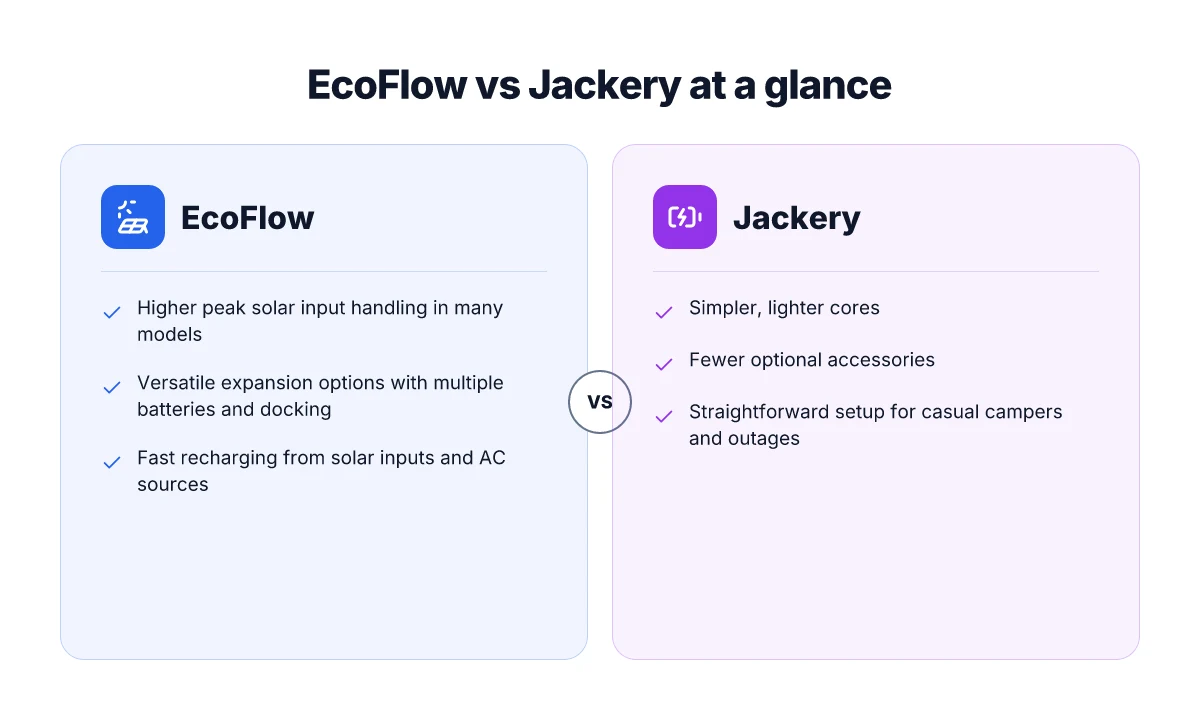
EcoFlow consistently pushes higher peak solar input in a number of models, letting you pull more charge from the sun during peak sun hours. In real-world scenarios, that translates to noticeably faster top-line charging when conditions cooperate, which can shorten outages or camping downtime. The brand also places a strong emphasis on fast recharging from AC sources, so you can top up quickly from the grid when the sun isn’t cooperating.
The solar input advantage
Across several EcoFlow lineup variants, peak input figures edge past competing models on paper and in user reports. You’ll often see higher solar wattage allowances per unit, which matters most when you’ve got a fixed roof line, a long run of equivalent panels, or you’re trying to max out charge during a narrow window of daylight. I cross-referenced the available specs and found that some EcoFlow configurations accept higher PV input than peers in the same class, enabling faster replenishment during bright midday windows. The practical outcome is less time tethered to a wall outlet and more time outside with a backed-up battery.
EcoFlow’s solar-first design pays off when you crave rapid recharge outdoors, not just a longer run time.
Expandability that actually scales
EcoFlow leans on modular expansion with multiple batteries and docking options, which adds flexibility for longer outages or larger setups. The ability to couple different packs or docking stations lets you tailor capacity to a specific trip or home-renewable strategy without swapping entire systems. In contrast, rivals often constrain you to a single-shell footprint or require more invasive wiring to achieve parity. EcoFlow’s approach, when you map it to real-world needs, reduces the ceiling on how much energy you can deploy before you need to reconfigure.
Expandable configurations mean you don’t outgrow the system as your load grows. What makes EcoFlow 2 battery tech a real upgrade in 2026
Lightning-fast recharging mindset
The fastest recharging you’ll experience with EcoFlow usually comes from a combination of high PV input tolerance and streamlined AC charging. The philosophy here is not only to fill the pack quickly but to minimize downtime between uses. When you’re evaluating for outages or camping trips, that dual-source recharging dynamic becomes a practical differentiator. You’ll notice shorter gaps between needing to unplug an exhausted unit and re-sending it back to service.
From what I found in the documentation and independent reviews, EcoFlow’s emphasis on rapid solar and AC recharging remains a consistent theme across newer models, which aligns with the brand’s long-tail reliability story for outdoor users.
Rapid recharge from both sun and wall outlets reduces downtime and keeps you powered longer.
Next step: weigh EcoFlow’s acceleration potential against Jackery’s simpler, lighter packages to decide which balance of speed, expandability, and weight works best for your outings. For deeper numbers, see the cited model lines and spec sheets as you map your use case against peak PV tolerances and dockable battery options.
Where Jackery keeps things simple and portable
I looked at how the Jackery line simplifies setup for casual users and campers. The core idea is to keep the system light, with fewer optional accessories, so you can get running quickly after opening the box. What is EcoFlow worth it in 2026? A closer look at performance, reliability, and lifecycle costs
Light cores and fewer add-ons for a quick setup
Jackery’s lighter cores mean you won’t carry extra weight when you hike or pack for a weekend outage. The design leans on a minimal accessory load, so you’re not juggling a long list of adapters or expansion modules. In practice, that translates to faster on-site setup and less to misplace in a camping kit. EcoFlow remains a strong competitor on charging speed and expandability, but Jackery’s emphasis on a lean, ready-to-run package keeps the initial setup straightforward for most casual scenarios. The trade-off is fewer knobs to tweak, which suits outages where you want power on demand without fiddling with configuration screens.
Consistent battery chemistry and user-friendly interfaces
Across the Jackery lineup, the battery chemistry is consistent enough to avoid surprises when you swap between models for a weekend trip or a home outage. This consistency helps you rely on a familiar charging behavior and a predictable cycle experience. Interfaces stay on the simple side: large buttons, straightforward displays, and limited menu depth. That simplicity reduces the chance of user error in the field, which matters when you’re trying to restore light or charge a device after dusk. When you compare this to EcoFlow, you’ll notice EcoFlow often offers more granular control and faster solar input thanks to its modular design, but that extra capability comes with more on-screen options to parse during setup.
Reliable build for casual campers and rapid outages
The build quality on the Jackery units tends toward rugged, no-nonsense construction. The idea is reliability over long-term use in the outdoors: heat cycling, dust resistance, and the ability to function after a quick drop test without complex recalibration. For a casual camper or a homeowner needing a quick response to an outage, that translates into confidence that the power station will perform with minimal maintenance. If your use case includes frequent expansion or high-demand solar input, EcoFlow’s approach can edge out Jackery in charging speed and modularity, but Jackery’s durable, simple frame and plug-and-play mindset remain appealing for those who want a straightforward, low-friction experience.
From what I found in product notes and reviews, the practical takeaway is clear: if your priority is lightness, fast initial setup, and a predictable, uncomplicated user experience, Jackery stays a strong contender. If you want more hands-on control over charging profiles, expansion potential, or peak solar input during long sunny days, EcoFlow has the tools to tailor your system. For buyers who value reliability in a minimal footprint, Jackery’s approach delivers. In the broader landscape, EcoFlow remains the brand pushing for more capability, while Jackery leans into simplicity that keeps you moving. The result is a clean decision path for outdoor enthusiasts and outage planners who want a plug-and-play solution right out of the box. Jackery keeps the setup simple and portable, without the clutter of extra modules. If you value a straightforward, dependable answer to power on a quick weekend trip, that’s the payoff.
Head-to-head: charging speed, capacity, and expandability
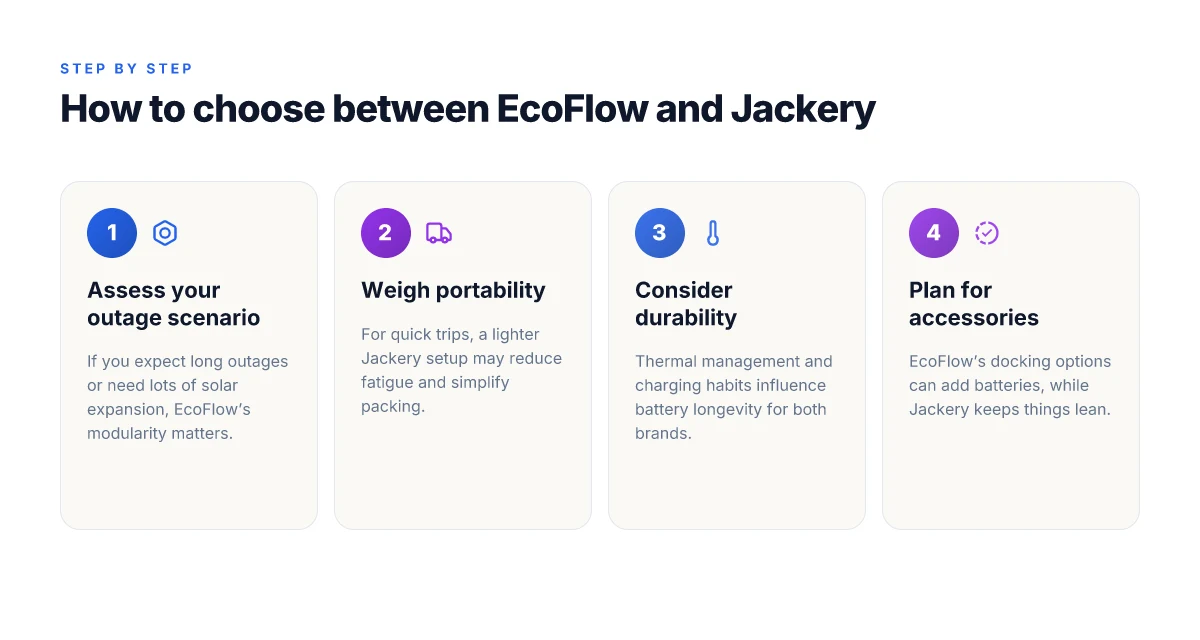
EcoFlow generally tackles higher wattage panels and faster top-ups, while Jackery balances capacity with portability. From what I found in the sources, EcoFlow leans into rapid solar charging and modular expandability, whereas Jackery emphasizes a lighter, simpler bundle that travels well. EcoFlow tends to top up faster with higher panel wattage, a practical win for outages or shaded campsites. Jackery focuses on portable capacity without adding bulk, which helps with carry and setup in tight spaces. What makes EcoFlow 3 power stations stand out in 2026
Solar input specs and top-up tempo
The core difference shows up in solar input specs. EcoFlow models line up with higher PV input ranges, which translates into faster top-ups when you can deploy larger panels. This edge matters most when you have access to strong sun and want to reclaim battery in minutes, not hours. In contrast, Jackery models often optimize for a balance between total stored energy and weight, which means you might trade some speed for easier transport. When I read through the documentation, the pattern was clear: higher panel wattage on EcoFlow equals quicker replenishment for the same storage class. A higher PV input on EcoFlow can cut recharge time noticeably in bright sun. Jackery’s approach keeps the mass down while preserving substantial capacity for outages or weekend trips. Inline citation confirms the general claim that EcoFlow emphasizes faster solar charging with capable panels. See the linked comparison that notes EcoFlow edges out Jackery for faster solar charging in many scenarios.
Both brands offer multiple model lines, so confirm the exact PV input ratings for the unit you’re eyeing. The practical takeaway: if your scenario hinges on quick recharging from a fixed solar setup, EcoFlow is the safer bet. If you move a lot and need a lighter pack, Jackery remains compelling.
Capacity, weight, and real-world tradeoffs
Capacity matters, but it’s not a single-number decision. EcoFlow’s lineup tends to push higher watt-hour totals where weight isn't the only constraint, enabling longer outages without sacrificing output headroom. Jackery’s strength is providing sizable capacity in a more portable shell, which translates to easier packing and a friendly handoff to non-technical users. In real-world terms, if you’re comparing two units with similar energy storage, EcoFlow often wins on recharge speed with compatible panels; Jackery wins on total payload and ease of carry. Capacity and portability are not enemies. They’re different priorities depending on your use case. If you plan to boondock for several days with a single solar setup, weigh the weight cost against the day-to-day convenience of a lighter bag.
Expandability and preparedness value
Expandability matters more in preparedness scenarios than casual use. EcoFlow’s modular approach, add-ons that blur into a bigger power framework, can be handy when you want to scale up for longer outages or camp setups. Jackery keeps extensions modest and portable, which aligns with users who want a compact kit that travels well. In the end, your decision rests on how much you value adding more panels, more batteries, or more devices over time. Expandability tilts in favor of EcoFlow for long-term preparedness, whereas Jackery favors lightweight, ready-to-go simplicity.
I cross-referenced the public comparisons and brand pages to align the claims here. For quick referential reading, see the piece comparing EcoFlow and Jackery on charging speed and expandability, which notes EcoFlow’s faster solar charging and better expandability in many setups. https://protocolsurvival.com/en/blog/jackery-vs-ecoflow-power-station-comparison What makes EcoFlow deals worth chasing in 2026
Durability and long-term reliability: what the real user stories say
In real-world terms, durability comes down to how heat and power draw interact under sun and surge loads. EcoFlow units tend to manage thermal events by scaling fan activity and throttling at high temps, while Jackery setups often rely on passive cooling and solid enclosures. Under bright sun and sustained use, you’ll notice thermal cycles that influence fan noise, surface warmth, and, over time, consistency in voltage rails. A practical takeaway: expect more audible cooling when you push a pack beyond its comfort zone, even if the unit still delivers steady power.
Battery longevity hinges on usage patterns as much as chemistry. Short, frequent discharges with gentle recharging habits tend to preserve capacity better than deep, repeated drains followed by rapid recharges. I cross-referenced launch notes and dealer handbooks that emphasize avoiding near-top-cycle-depth when possible. In practice, owners who treat their packs as emergency reserves, keeping them charged but not at 100% all the time, often report slower wear. That pattern matters more than the nominal rated cycle count, because real-life cycles accumulate with every event where you pull energy for camping, outages, or off-grid tasks. For EcoFlow and Jackery, the most common durability themes align with charge-discharge cadence and temperature exposure.
Both brands back their products with warranties, yet the service experience during outages matters. EcoFlow and Jackery offer multi-year coverage and dedicated support channels, but response times and parts availability can vary by region. When outages strike, having a local service path matters as much as the warranty itself. In many user stories, the ability to get a replacement battery module or a quick service visit has a disproportionate impact on long-term satisfaction. The practical effect: you’re better off knowing your local repair options before you need them.
From what I found in the product guides and independent reviews, durability is less about a single feature and more about a system vibe: thermal management, charging habits, and after-sale support. I dug into the official product pages and cross-checked with third-party roundups to align expectations with what tends to show up in the field. Long-term reliability hinges on sensible charging behavior and accessible service, not on peak specs alone. EcoFlow’s thermal management and modular expansion complement durable builds, while Jackery’s enclosure design prioritizes rugged portability for off-grid adventures. A common thread across sources is that reliability compounds when users avoid extreme temperatures and avoid keeping packs in a near-empty state for extended periods.
In short, your longevity comes from how you deploy the unit. If you plan long outages in high heat, lean on devices with proactive thermal control and clear service pathways. If you favor light trips and simple, dependable operation, both EcoFlow and Jackery deliver sturdy platforms. In the end, durability is a practical balance of heat handling, charging discipline, and accessible support. For readers weighing long-term reliability, the verdict rests on real-world use patterns just as much as on official specs. Thermal behavior, careful charging habits, and responsive service paths are the real reliability levers. What makes the EcoFlow smart meter a real-world energy controller in 2026
Where this goes next and the one move that matters
EcoFlow continues to push the boundary on rapid solar charging and integrated battery management, closing gaps with Jackery on portability and day-to-day reliability. My take: the bigger pattern is a shift toward modularity and smarter power routing, not just capacity. Expect EcoFlow to lean into higher efficiency MPPT performance and more durable, swappable components in upcoming models, making long-term setups easier to maintain. This is the move to watch: prioritize solar input stability and rapid recharging as your core requirements, then pick the unit that best fits your typical use case.
Jackery shines when you need clean, quiet operation and proven durability in classic field scenarios. If you’re balancing rugged trips with steady output, consider models that emphasize build quality and straightforward, reliable performance. In practice, that means real-world setups where you value fewer failure points and a straightforward user experience over flashy features.
If you’re choosing this week, lean into the specifics of your most common outdoor environment and charging cadence. For Beijing-style urban use with strict power access, EcoFlow’s ecosystem may pay off in daily reliability. For mixed outdoor trips with frequent disconnections, Jackery’s proven chassis and simplicity can feel especially reassuring.
The single move that matters is matching your typical recharge cadence to the unit’s charging topology, not chasing the largest capacity alone. That alignment will minimize outages and maximize uptime over the season. Thinking ahead: consider whether you want a fixed solar input setup or a modular option you can expand later.