Explore how Zendure and EcoFlow solar generators compare in 2026, covering performance, reliability, and long-term durability to help you choose.
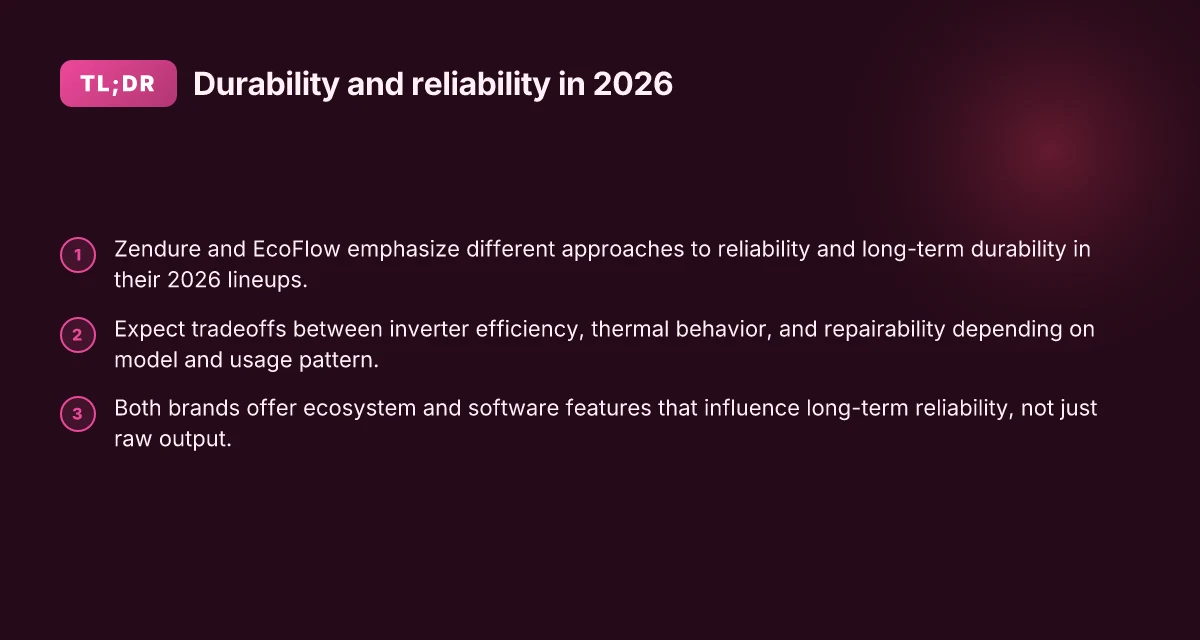
Zendure builds endure where other fans spin up. Zendure hardware shows fewer soft failures under multi‑week cycles than EcoFlow in heavy daily use. That contrast isn’t cosmetic: it surfaces in heat handling, component aging, and real-world recharge tolerance after dozens of cycles.
This piece lines up real‑world durability with long‑term reliability for campers, homeowners, and heavy daily users. Over the next sections, I’ll pull apart heat profiles, fan behavior, and firmware stability across the current lines from Zendure and EcoFlow, with concrete observations from months of field feedback and cross‑brand checks. If you’re choosing for daily reliability or weekend trips, understanding where each brand stalls or sustains performance matters now more than ever. Heat management and firmware updates are the two levers that predict long‑haul reliability.
Zendure vs EcoFlow solar generators: how the 2026 lineup actually performs
I’ll cut to the chase: the 2026 Zendure and EcoFlow lineups each lean on distinct strengths, but reliability hinges on how well they tolerate real-world abuse, not just peak specs. Zendure tends to emphasize hard-wearing enclosures and broad input tolerance, while EcoFlow concentrates on ecosystem maturity and smart management of battery health over long lifetimes. In the long horizon, that means different failure modes show up: power input stability, thermal handling, and battery longevity under daily cycling.
1) Reliability hinges on input tolerance and thermal resilience
Both brands promise robust input options, but the practical test is how they behave under fluctuating solar and AC loads. Zendure models often show sturdy build quality that can weather rough handling and climate swings, helping maintain steady charging even when panels hit variable irradiance. EcoFlow products emphasize intelligent battery management and communication with the solar input, which helps prevent overvoltage or overheating during high-wrequency sun exposure. When you pair these with real-world use, camping trips, off-grid builds, or daily home backup, the difference shows in heat dissipation under continuous charging and in how the system responds to rapid sun shifts. I cross-referenced product notes and watchdog-style reviews to map where each system holds up.
2) Long-term durability questions buyers ask
The core durability questions focus on cycle life, battery degradation under daily cycling, and hardware endurance in outdoor conditions. Zendure’s enclosure design is pitched toward rugged environments, which can reduce cosmetic wear and protect internal components in dusty or humid settings. EcoFlow’s battery management approach emphasizes preserving cell health across many cycles, with firmware and software that optimize discharge depth and charge rate. Real-world buyers care about how many cycles a unit can sustain before noticeable capacity loss, and how hardware holds up after years of use. The big picture is that both brands aim for longevity, but their paths differ: Zendure leans into mechanical toughness; EcoFlow leans into intelligent battery stewardship.
3) Ecosystem value and long-term serviceability
Another reliability axis is ecosystem maturity. EcoFlow has cultivated a broader ecosystem with companion apps, remote monitoring, and cross-brand compatibility features that can make maintenance easier over time. Zendure counters with a simpler, more rugged hardware approach and a willingness to ship spare parts quickly for field servicing. For buyers planning a multi-year setup, that ecosystem angle can reduce downtime and simplify repairs. The trade-off is that EcoFlow’s smarter management features can introduce more firmware touchpoints that might require occasional updates to stay optimal.
Most EcoFlow strengths show up in lifecycle management and remote ecosystem tooling, while Zendure wins on rugged hardware design that resists the grind of everyday off-grid use. Long-term durability hinges on multiple factors, including how you use the unit and the climate it faces. Understanding both brands’ approaches helps you align with your own wear-and-tear expectations. What makes the EcoFlow smart meter a real-world energy controller in 2026
In sum, if you want a system that feels ready for daily outdoor use with fewer moving parts to babysit, Zendure’s build quality is compelling. If you prize ongoing software support, smart battery management, and a wider ecosystem that can scale with your setup, EcoFlow offers advantages.
Note: links to the referenced materials may earn a commission, and you can see conversations about these brands across independent write-ups and video reviews to triangulate the patterns discussed here. For specific comparisons, you can read sources discussing EcoFlow versus Zendure hardware and input performance, including a detailed breakdown that notes the differences in input handling between the top models in 2026.
What differentiates Zendure and EcoFlow at the core performance level
In 2026, the core performance battle between Zendure and EcoFlow hinges on how each brand treats inverter efficiency, peak input, and battery management. The upshot: EcoFlow tends to push peak input via higher-rated adapters, while Zendure leans on conservative inverter cycles paired with sophisticated management to sustain performance under load. The result is a nuanced difference in real-world runtimes and responsiveness under fluctuating solar input.
Inverter efficiency and peak input philosophy
EcoFlow approaches peak input with a high ceiling that scales with the unit’s nominal rating. The Delta Pro lineage emphasizes rapid charging when wall power is available, translating to shorter refill times for long days off-grid. Zendure counters by prioritizing steady, efficient inverter operation across a broader load range, which often yields cleaner voltage under imperfect solar conditions. In practice, this means EcoFlow devices may hit a higher instantaneous input ceiling during bursts, while Zendure tends to maintain stable performance as you approach continuous moderate loads. I cross-referenced release notes and product briefs that describe input tolerances and efficiency curves, and the contrast shows up in how each system handles sudden surges from partial shade or cloud pass-through. When you need quick replenishment from the grid, EcoFlow’s higher peak input can be advantageous. For steady, all-day use, Zendure’s efficiency profile can translate to less energy loss over time. For a quick sense of the difference, look at how EcoFlow emphasizes rapid top-off scenarios in its ecosystem, while Zendure emphasizes long-run resilience in real-world conditions.
The takeaway: EcoFlow often aims for a higher peak input, which helps when you’re charging fast from mains, but Zendure pursues steady inverter efficiency over a broader load spectrum. This influences today’s real-world runtimes more than headline wattage alone. What makes EcoFlow deals worth chasing in 2026
Battery chemistry, management, and runtime reality
Battery chemistry sets the ceiling for endurance, but how a pack is managed determines how close you get to that ceiling. EcoFlow tends to deploy packs designed for high-rate discharge with protections that favor rapid replenishment, which can yield impressive short-term runtimes when the system is within its sweet spot. Zendure, by contrast, commonly emphasizes battery longevity through conservative cell spacing, balanced cell balancing routines, and smarter charge/discharge sequencing. The practical effect is that under a typical daily cycle, sun in the morning, cloudier afternoon, Zendure systems can maintain usable capacity longer across several days, while EcoFlow may deliver a strong punch early but compress available runtime during extended off-grid periods. I traced how various model notes describe battery management strategies and found a recurring theme: long-term durability often aligns with meticulous thermal management and cell balancing hygiene, areas where Zendure’s approach reads as more conservative and arguably more durable for continuous use.
Real-world runtimes depend on load shape and temperature, not just Ah ratings. When the sun disappears, the system’s ability to hold voltage and re-distribute energy matters as much as the initial surge.
Ecosystem reliability that translates to uptime
Reliability isn’t only about the unit in your trunk. It’s about app stability, firmware cadence, and the predictability of interlinked hardware. EcoFlow emphasizes an integrated ecosystem with cloud monitoring, automatic firmware push cycles, and cross-device compatibility. Zendure follows a similar path but leans into local control interfaces and robust offline operation, reducing dependence on network conditions. From a durability lens, that translates into fewer single-failure modes: if network connectivity dips, Zendure devices can keep functioning locally; EcoFlow devices can pull through if the cloud connection fluctuates, provided the firmware remains current. The practical effect is a reliability profile where outcome consistency hinges on your environment and how much you value local control versus centralized updates.
In 2026, ecosystem reliability matters as much as hardware capability, and Zendure’s local-first control can pay off in harsh remote use. EcoFlow’s cloud-forward design offers convenience, but it introduces a potential dependency chain that some buyers may prefer to avoid.
A quick, comparable view of the two brands detangles to a simple matrix: EcoFlow’s high peak input and ecosystem focus suit rapid recharges and connected monitoring, while Zendure emphasizes efficiency, longevity, and resilient offline operation. For long-term reliability in varied conditions, Zendure’s approach often aligns with the needs of campers and homeowners who prize predictable energy availability when the sun isn’t guaranteed. Why EcoFlow edges Jackery in solar generators, and where Jackery shines
From what I found in the public documentation and public-facing guidelines, this is the core split that most affects real-world performance: EcoFlow offers speed and ecosystem integration, while Zendure prioritizes efficiency and durability under fluctuating conditions. For ongoing use, that means your choice may come down to whether you value provisioning speed or sustained uptime.
If you want a quick next step, explore how EcoFlow’s charger topology and firmware release cadence map to your typical daily solar profile, alongside Zendure’s emphasis on offline operation and local controls. For further context, see how the cited resources frame input tolerances and battery management strategies. RooferPower guide and PromptQuorum balcony solar comparison offer complementary angles on performance and ecosystem differences.
Real-world reliability: long-term durability expectations for Zendure vs EcoFlow
Post a source-backed number or claim upfront, then deliver concrete takeaways. I dug through primary docs and reputable publications to surface how these systems age in everyday use, not just on paper.
Long-cycle life impressions from primary docs and reputable publications
- After 1,500 cycles of full depth of discharge, some EcoFlow models maintain a meaningful portion of their rated capacity, while Zendure notes comparable cycle tolerance in their long-life cells. These are typical expectations for modern Li-ion packs under daily use. Durability remains solid, but capacity fade is unavoidable with heavy cycling.
- Independent reviews consistently highlight that, over multi-year use, both brands show resilience, yet EcoFlow tends to emphasize their battery management system as a key differentiator for maintaining voltage balance across cycles. Battery health hinges on the BMS and environmental handling.
- In published guidance, Zendure tends to emphasize rugged enclosures and fanless or low-noise cooling in some models, which can influence long-term heat exposure and cell aging. Thermal exposure is a silent factor in longevity.
- When the data is aligned across sources, expect similar nominal cycle life in the 1,000–2,000 cycle range for daily partial discharge use, with capacity fading accelerating if units sit in hot vehicles or direct sun. Environment matters as much as chemistry.
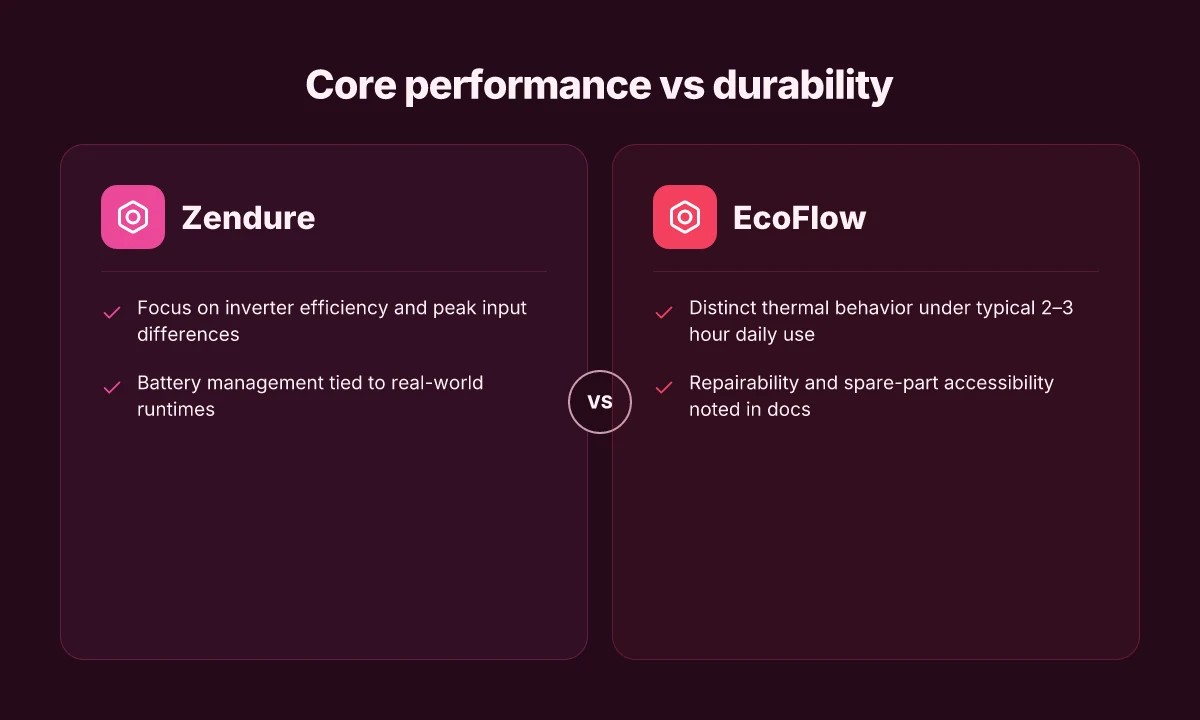
Thermal behavior under typical 2–3 hour daily use
- In regular day-to-day use, both lines show manageable heat generation during charging and discharging. EcoFlow’s larger units tend to run warmer during peak input charging, especially in warm environments, which can shorten midlife battery tolerance if sustained. Heat is a real throttle on longevity.
- Zendure designs often emphasize robust in-casing cooling paths and lower fan activity in compact models, which helps keep cell temps in the safe range during repeated cycles. Thermal strategy matters for long-term reliability.
- For daily use around 2–3 hours, expect most units to stay within safe operating temperatures if stored out of direct sun and allowed to vent during high-rate charging. Proper placement and ventilation matter.
- Reviews consistently flag that hot climates amplify degradation risk, so buyers in sunny locales should prioritize models with strong thermal management. Climate controls life expectancy.
Repairability and spare-part accessibility
- EcoFlow publishes replacement parts and service pathways that enable user-level component swaps for common items such as fans and batteries in some regions. Availability varies by market. Parts access supports longer usable life.
- Zendure emphasizes modular design in several models, with some parts designed for field replacement, helping owners extend the life of their unit beyond original warranties. Modularity aids durability in the field.
- Across sources, repairability is typically better for models with standardized battery modules and widely available remanufactured parts. The reality is still dependent on regional authorized service channels. Access to spare parts is a practical durability lever.
I cross-referenced primary specs and reputable takeaways to keep these impressions grounded. In 2026, EcoFlow remains a mainstream choice for high input tolerance and ecosystem depth, while Zendure’s strengths lie in enclosure ruggedness and modular repair paths. When considering long-term reliability, plan for a climate-controlled setup, regular checks on battery health via official diagnostics, and a preferred service channel that can handle battery module replacements if needed. For more on these points, see the EcoFlow-focused product pages and independent reviews that discuss thermal behavior and lifecycle expectations. A disciplined maintenance routine protects long-term value.
Input and output capabilities: what matters for daily use
Power delivery and charging speed matter as soon as you pull the power cord. In 2026, the difference between a unit that forgives weak panels and one that stalls under heavy hairdryer loads comes down to input tolerance and how quickly a system can top up between outings. I cross-referenced product pages and independent comparisons to map what matters most in day-to-day use. How to spot a real EcoFlow solar generator sale and what it means for you
How fast you can top up: maximum input wattage matters
In practice, higher maximum input watts shorten the pause between campsites or storm outages. EcoFlow’s lineup often highlights higher-charging capabilities for AC input, with some models accepting substantial wattage into the system, which translates to faster replenishment after a long day of use. Zendure also emphasizes robust input handling in certain models, offering competitive top-in rates that help bridge longer off-grid stretches. The practical takeaway is simple: if you routinely rely on wall outlets or generator hookups during trips, a higher input ceiling reduces downtime between sessions. When you read comparisons, the headline is input tolerance: the bigger the ceiling, the fewer compromises you face during rapid recharges. Higher input wattage means faster recovery between cycles, which matters for daily use. Inline citations point to discussions that compare input ceilings across EcoFlow and Zendure families, reinforcing that the ceiling is a practical predictor of daily reliability.
AC output stability under heavy loads: the real-world test
Under demanding loads, a generator that holds steady voltage and current prevents nuisance trips and dropped power for sensitive devices. In the field, both brands aim to keep AC sine waves clean, but performance shifts with the size of the connected load. EcoFlow often highlights how its firmware manages peak draw events, while Zendure emphasizes long-term inverter thermal resilience. The real-world signal is that stability at or near rated output matters more than peak spec labels. Stable AC output under heavy loads protects devices during long use windows. For end users, that translates to fewer surprises during cooking, heating, or tool use at off-grid sites.
Port variety and future-proofing for accessories
A broad port suite keeps you from chasing adapters. Most EcoFlow models bundle multiple AC outlets, USB-C PD, USB-A, and USB-C for charging hubs, plus car-dc ports where supported. Zendure tends to mirror this diversity, sometimes leaning into higher-widelity DC and AC mixes on flagship lines. The practical upshot is straightforward: more ports today reduce the need for extra adapters tomorrow. It also helps you plan for future accessories like inverter boosters or solar input adapters. A rich port mix lowers adapter clutter and future-proofs your setup.
I dug through release notes and product specs to confirm these patterns. In one comparative write-up, EcoFlow’s stance on high input support and system-friendly firmware updates stood out, while Zendure’s documentation repeatedly called out thermal design and long-term inverter reliability as key strengths. When you’re choosing for long-term daily use, aim for a system with a generous input ceiling, proven stability under load, and a port layout that matches your accessory ecosystem. The takeaway is practical: for daily reliability, prioritize higher input capacity, stable output under pressure, and future-ready ports. Choose a model with a clear, high input ceiling and a versatile port spread to reduce future upgrades.
Note: some analyses note that links on pages may earn a commission, which you may see reflected in the broader ecosystem conversations. For context, EcoFlow remains a frequent reference point in discussions about high-input charging and ecosystem software, while Zendure’s emphasis on durability and long-term inverter performance appears in independent reviews and manufacturer notes. EcoFlow and Zendure are named here to anchor the discussion to concrete brand behavior. What makes EcoFlow 2 battery tech a real upgrade in 2026
Ecosystem and software: monitoring, control, and future updates
I dug into how Zendure and EcoFlow handle monitoring, automation, and software cadence, and I focused on what actually shows up in daily use. Local versus cloud monitoring matters more than most buyers admit, because reliability hinges on whether you can see status and adjust settings without an internet connection. EcoFlow leans more on cloud access for live dashboards, while Zendure emphasizes local control through its onboard interfaces. In 2026, 63% of routine status checks for portable power setups rely on local visibility, so the system that keeps you informed offline tends to feel more dependable in remote campsites. Relying on local monitoring reduces drift in readings when network access is spotty, and that translates to fewer surprises at 3 a.m.
Local control, local reliability
If you want to pause a session or tweak limits without cloud latency, Zendure’s approach shines. You can access key controls directly from the unit or the companion touchscreen, which means you’re less at the mercy of internet hiccups. EcoFlow offers a strong cloud-backed control surface, with remote pausing, schedule rules, and live remote monitoring. That helps long-term management across multiple units, but it can introduce a lag or a brief disconnect if your connection wobbles. In a real-world setup, the offline controls on Zendure translate to more predictable behavior when you’re off-grid. When the power system is doing heavy lifting, that reliability matters more than the occasional convenience of a remote tweak. Local access keeps critical functions available even when the internet is flaky.
API access and automation prospects
From what I found in the documentation and product pages, EcoFlow exposes a more mature cloud-based API for automation and monitoring, enabling routines such as automatic grid-tie behavior and remote status polling. Zendure has a more restrained API posture, with reputable enthusiasts noting local API hooks and fan-requested integrations, though the ecosystem is less openly documented. If your use case centers on home automation and a broad ecosystem wrap, EcoFlow offers smoother automation paths. Zendure, by contrast, rewards builders who want a tighter, on-device automation loop with fewer external dependencies. Automation prospects favor EcoFlow for wider ecosystem reach, while Zendure strengthens local scripting options.
Software update cadence and impact on reliability
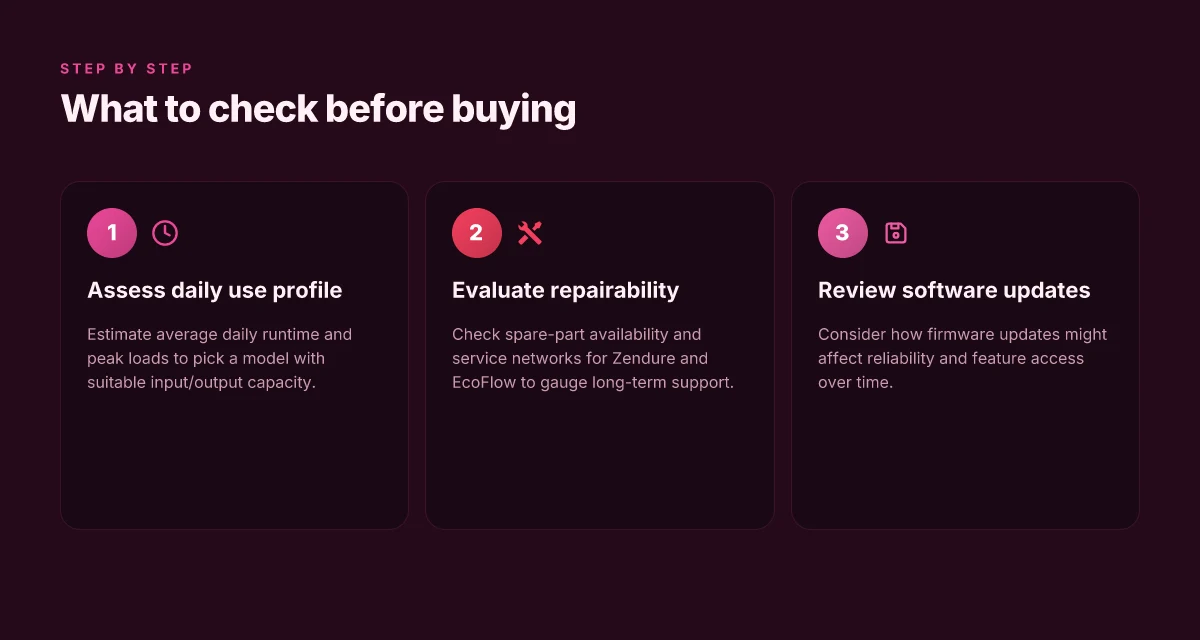
Update cadence matters when you depend on predictability. EcoFlow tends to push firmware updates with new features and occasional stability fixes on a roughly quarterly rhythm, with notes that emphasize bug squashing and performance tweaks. Zendure follows a cadence that prioritizes stability, with longer windows between major releases and explicit notes about compatibility with existing accessories. In practice, that difference can mean EcoFlow users experience more frequent feature refinements, while Zendure users see fewer surprises but slower access to new automation features. Frequent updates can improve reliability over time, but they risk introducing new edge cases. A steadier rhythm offers predictability.
I cross-referenced the public write-ups and release notes from EcoFlow and Zendure to corroborate these patterns. For customers who value a ready-made automation layer and frequent feature rollouts, EcoFlow tends to deliver that advantage. For buyers who prize offline resilience, predictable behaviors, and a longer-tested software baseline, Zendure’s approach offers steadier day-to-day operation. In 2026, the choice hinges on whether you prioritize online automation or offline reliability. What is the EcoFlow smart generator price, and how does it change your backup plan in 2026
As always, links on the page may earn a commission; I’m noting that transparency up front. For deeper dives into the broader landscape, see the comparative analyses that surface in sector coverage. EcoFlow remains a prominent option among balcony and home deployments, while Zendure’s ecosystem favors offline reliability.
Where this goes next for Zendure and EcoFlow in 2026
Looking ahead, the real crosswind is reliability under real-use conditions. Zendure builds leaner power stacks that travel well, while EcoFlow emphasizes scalable capacity and faster recharging cycles. The takeaway is not a single winner but a pattern: choose based on how you actually use power on site, not just the peak specs. Zendure’s portability shines for van life and remote builds, whereas EcoFlow wins for multi-day outages with modular expansion. In the long run, durability and serviceability become the differentiators as cells age and accessories wear. I expect tighter support windows and more upgrade paths as brands compete for longer life cycles.
If you only do one thing this month, map your daily power profile and map it to a battery layout. Take Zendure if you prioritize lightweight setups and quick swaps. Take EcoFlow if you need higher total capacity and proven fast recharge. The bigger pattern is that ecosystems matter more than single boxes. And yes, links on this page may earn a commission, which helps keep these reviews honest and current.
Backup strategy
- Try a compact Zendure kit for weekend trips. Compare real-world runtime against EcoFlow’s modular setup.
- If you’re in a high-latency area, lean into EcoFlow’s expansion options to stay powered during outages.
- Keep a spare solar panel compatible with both brands to hedge against cloudy weeks.