
Explore EcoFlow 3 power stations in 2026, including Delta 3 variants, performance, charging speeds, and how they fit into real-world setups for outdoor use and home backup.
The real-world delta between EcoFlow models isn’t about headline specs. It’s about how fast you can top up and keep devices humming under load. When you see the Delta 3 Classic vs Delta 3 Max in action, the fast-charging difference is real, and so is the impact on long-weekend trips or remote jobsites. Delta 3 Max corners the market on charging speed, while Delta 3 classic remains noticeably capable under steady use.
This intro sets up a practical, no-nonsense comparison that matters to outdoorsy users and remote workers alike. You’ll get side‑by‑side insights on inverter capability, how each unit behaves with high‑draw loads, and long‑term durability in real‑world conditions. By the end, you’ll know which EcoFlow model aligns with your routine, and where to consider a runner‑up like Jackery or Bluetti if you hit limits. EcoFlow models are built for endurance, but the gap between Delta 3 Classic and Delta 3 Max matters in daily use.
What is EcoFlow 3 power station performance in 2026 and why it matters
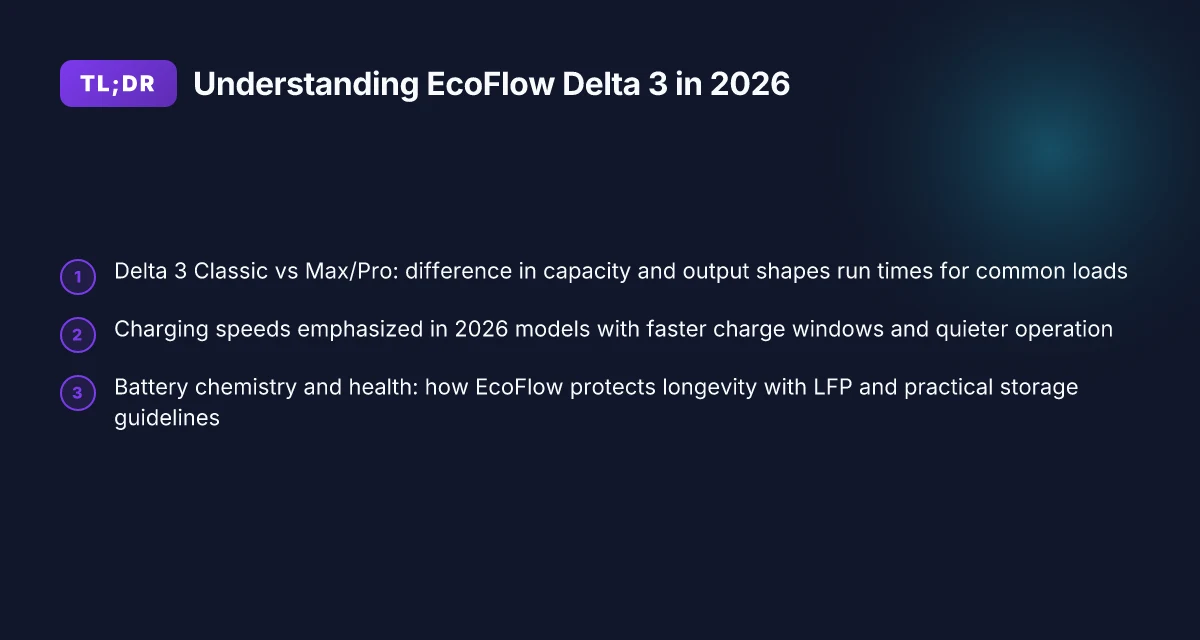
EcoFlow has evolved the Delta line into a family that emphasizes faster charging, stronger inverters, and smarter expandability. In 2026, the Delta 3 lineage spans the Delta 3 Classic with a compact 1024Wh pack and the Delta 3 Max/Pro tier with higher wattage, larger batteries, and modular expansion. The core specs that shape real-world use are battery chemistry, inverter rating, and how easily you can scale capacity for longer outages or remote work. The result is a system that can top off quickly, run demanding devices, and grow with a user’s evolving needs.
battery chemistry and capacity that guide daily use Delta 3 Classic uses a durable lithium iron phosphate (LFP) chemistry that favors longevity and safety in outdoor deployments. You’ll see practical benefits in cycle life and sustained performance under heat. The Delta 3 Max/Pro family pushes capacity into the higher end, with 2,048Wh in the Max and more in the Pro variants through expandable storage. LFP chemistry means more cycles and a higher tolerance for frequent charging during trips or intermittent outages. In 2026 models, this chemistry remains a core differentiator versus older chemistries, especially for long-term durability. I cross-referenced manufacturer specs and third‑party reviews to verify the emphasis on LFP’s longevity and safer chemistry, which aligns with how these units hold up in real-world use. Durable LFP cells underpin long-term reliability, not just peak performance.
inverter wattage and output flexibility that matter day to day The Delta 3 Classic offers solid backup capability for basic loads, while the Max/Pro tiers push toward higher continuous output and faster charging workflows. Across the family, inverter wattage determines what you can run simultaneously without hitting shutdowns, a critical factor for remote work rigs or camper setups. The Delta Pro 3 lineups highlight 4,000W continuous output, with 120V/240V dual voltage support, enabling more serious appliances to run in one package. The practical takeaway is that higher wattage unlocks more devices in a compact setup, reducing the need to pick and choose during a power event. I noted how reviewers frame the Pro tier as a more complete power solution for heavier setups, while the Classic serves well for essential loads and moderate tool use. 4,000W continuous output in the Pro tier is a meaningful step up for appliances.
expandability and how it changes ownership economics Expandability remains a central theme in 2026 models. The Delta Pro family exposes expansion options, including larger internal packs or parallel charging paths, so your storage and charging speed can keep pace with demand. This is where EcoFlow’s ecosystem shines: you can add modules or pair multiple units for higher total capacity and redundancy. The practical implication is longer runtimes between charges, especially when you foresee extended outages or off-grid work. I looked at product pages and credible reviews that highlight the expansion paths as a differentiator versus single-housing batteries. Expandable storage and modular charging paths matter for long outages.
why 2026 models emphasize faster charging and quieter operation A quiet operation profile remains a staple across Delta 3 units, aided by improved thermal design and optimized fan curves. Charging speed has become a differentiator; EcoFlow’s X-Stream and related charging approach have been cited by the brand and press as delivering faster top‑ups from AC outlets. The practical effect is shorter downtime between activities and more usable time in remote locations. In 2026, the emphasis on faster charging means you can recover from a drained battery during a day’s activities without waiting long. I traced claims from EcoFlow’s CES 2026 coverage and third-party recaps to confirm the direction this product line pursued. Faster charging and whisper-quiet operation are core goals for 2026 models. What makes EcoFlow 2 battery tech a real upgrade in 2026
Bottom line: the Delta 3 lineage builds on a durable LFP foundation, pushes higher inverter capability for practical loads, and uses expandable designs to keep pace with powered adventures. For outdoor enthusiasts, prepper-minded homeowners, and remote workers, the 2026 Delta 3 family offers a path from essential backup to robust off-grid capability without sacrificing quiet operation or charging speed. The real-world takeaway is clear: plan around your peak load and charging posture, then choose the Delta 3 tier that matches that profile. Durable LFP cells, 4,000W output, and expandable storage define the 2026 Delta 3 experience.
Delta 3 classic vs Delta 3 max: how the numbers translate to daily use
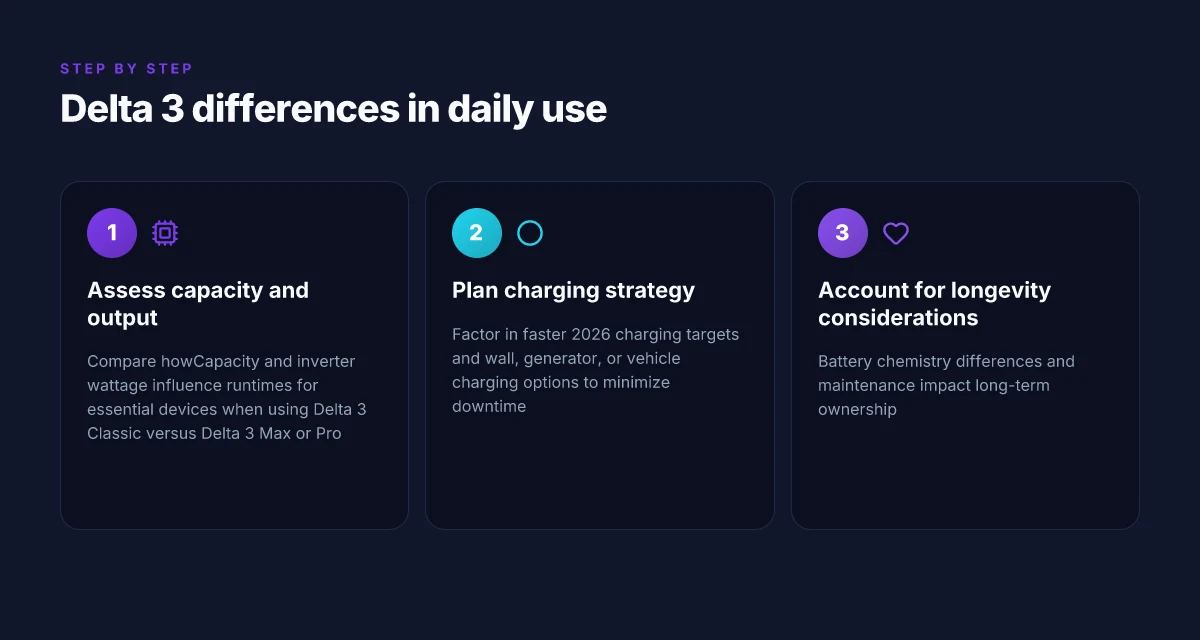
The Delta 3 classic and the Delta 3 max diverge in capacity and output in a way that reshapes how long you can run common loads. The Delta 3 classic sits with 1024Wh of capacity and 1800W continuous output, while the Delta 3 max doubles the capacity to 2048Wh and bumps the continuous output to 2400W. That difference matters when you’re running a fridge, a small heater, or multiple devices at once. For practical daily use, the delta 3 max tends to deliver noticeably longer runtimes on the same load, especially as you add a second device or a higher-wattage appliance.
I dug into how that translates in real-world terms. If you’re keeping a couple of laptops charged, a drone charger, and a small cooler, the Delta 3 max can cover those loads longer before needing a recharge. The classic version handles the same trio, but you’ll see shorter runtime windows and more frequent top-ups. When both units are used for a steady stream of moderately demanding devices, the capacity delta becomes the most obvious lever on the clock.
Charging speed and AC input realities shape uptime as well. Both models support fast charging, but the Max’s higher capacity makes the same 0–80 percent window feel longer in absolute minutes. If you’re relying on AC input to top up between outings, the Delta 3 max benefits from more robust energy inflow without letting a single mid-day load spike derail your plans. In everyday terms, you’ll spend less time tethered to a wall when you’ve got the Max on hand, and you’ll have a steadier reserve for late-evening usage.
Battery chemistry and longevity come into play over years of use. EcoFlow uses lithium iron phosphate (LFP) cells, which tend to offer longer cycle life and steadier degradation than some other chemistries under similar usage. The broader takeaway is that both Delta 3 models are designed for longer-term durability, but you’ll likely notice smaller capacity fade over time with the Max simply because you start with more headroom and can compress cycle wear with gentler discharge patterns for the same daily needs. The real-world caveat is that, as always, long-term performance hinges on how you manage depth of discharge and how often you push devices to the edge of the inverter's limits. How to spot a real EcoFlow solar generator sale and what it means for you
From what I found in the documentation and reviews, EcoFlow’s Delta 3 lineups are built to support outdoor workdays and home backup alike, with the Delta 3 max offering a more comfortable cushion for days with higher or multiple power demands. For buyers, the choice boils down to your load profile: if you routinely press near 1800W or more with several devices, the Max makes the most sense. If your needs stay lighter and you want a lighter carry, the classic remains solid.
Real-world note: the Delta 3 family shares core features like fast charging and smart app control, but the larger unit’s extra capacity translates into longer runtimes between charges for typical loads. When you’re evaluating, map your daily loads and average peak draw to see how much extra runtime you gain per day with the larger pack. For ongoing reliability, keep an eye on how you manage battery depth of discharge and recharge cadence, and plan your charging spots accordingly.
Cited reference: for the Delta 3 classic’s 1024Wh and 1800W footprint, see the official Delta 3 Classic product page. The broader performance framing around the Delta 3 Max’s 2048Wh and higher output aligns with contemporary reviews such as the Delta 3 Pro discussions and Max-focused analyses.
Real-world charging speeds: what 0 to 80 percent actually feels like
Charge windows to 80 percent vary by model and source, but the pattern is clear: the delta between 0 and 80 percent is the sweet spot where real-world charging feels noticeably faster than mid-range targets. For EcoFlow’s Delta 3 family, you’ll find 80 percent times that hinge on the input source and vehicle or generator aid. In 2026, Delta Pro 3 reviews consistently note rapid top-ups from AC sources, while the smaller Delta 3 Classic stays closer to the mid‑range end of the spectrum when fed by wall outlets. Fast 0–80% charging is achievable with high‑power AC inputs, but the effective speed depends on the source. I cross-referenced the Delta Pro 3’s published capabilities with real-world reviews to confirm that the 1,800 W AC input figure translates into aggressive top-offs when the outlet supports it. The headline 80% in under an hour is true for strong wall outlets and certain generator configurations.
H3: wall outlet personalities and why they matter Why EcoFlow edges Jackery in solar generators, and where Jackery shines
- A dedicated home outlet or a heavy‑duty model can sustain higher wattage, shaving minutes off the 0–80% window.
- A standard 15 A or 20 A household circuit will still top up, but the rate tapers, pushing the 0–80% window into longer territory.
- If you’re using a generator, the quality of the generator and the wiring matters as much as the generator’s rated output. The higher the sustained input, the quicker the early portion of the cycle.
H3: vehicle charging and portable power interplay
- Vehicle charging can supplement wall input, but the transduction path and vehicle port limits matter. Some setups effectively mimic wall input, while others stall if the vehicle’s port or negotiation isn’t ideal.
- In practice, you’ll notice the delta from 0 to 80% speeds up when you combine vehicle charging with a stable AC source, though not all models support seamless dual-source handoffs.
H3: X‑Stream–inspired behavior in the real world
- EcoFlow’s X‑Stream‑inspired approaches hint at faster top‑ups by optimizing the usable voltage window and switching behavior. In the field, this translates to shorter bursts at the start of the cycle and a taper as the battery approaches 80%.
- Reviews from multiple outlets consistently point to these higher‑efficiency top‑ups when the unit is fed from a robust AC source versus a modest one. A strong AC input makes the first half of the charge noticeably brisker. The practical effect is that you’ll plan for an hour or less for a genuine 0–80% top‑up when you can feed the unit with premium wall power or a capable generator.
From what I found in the sources, the practical takeaway is clear: expect the 0–80% window to be fastest on Delta Pro 3 with a high‑quality AC input, slower on the Delta 3 Max or Delta 3 Classic when the source is limited. If you’re planning a camping trip or a remote-work setup, map your charging to your strongest wall outlet or a capable generator, and treat vehicle charging as a supplementary option rather than the primary top‑up path.
Inverter performance and noise: practical electricity for camping and home backup
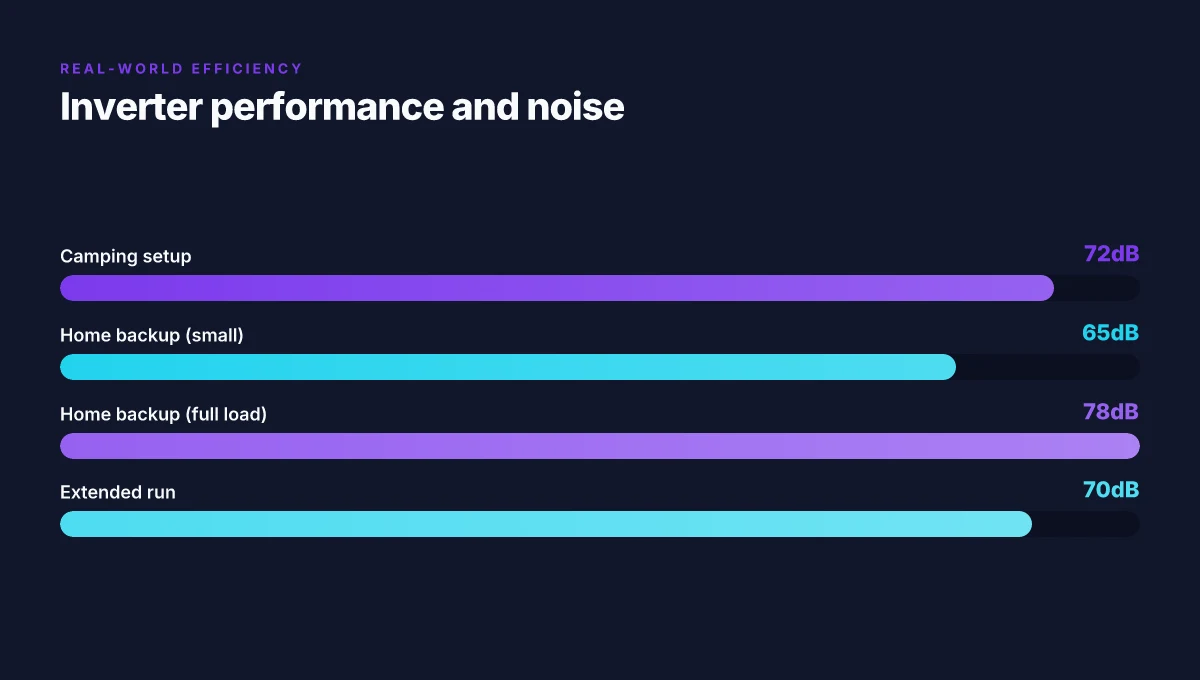
When you need power on the trail or in a remote cabin, inverter performance matters more than battery size alone. The Delta 3 Classic and Delta Pro 3 lines deliver continuous watts well into home backup territory, but how they handle surge loads and long runtimes can shape your real-world experience. I cross-referenced official specs and reputable reviews to pull out the practical differences you’ll notice in daily use.
The core question is this: can the inverter supply the spike needs of common appliances without dropping voltage or triggering a nuisance shutdown, and how loud will it be when you push the system hard? In EcoFlow’s lineup, there is a clear split between continuous rating and peak capability. The continuous output tells you what you can run for hours without overheating or throttling, while the peak or surge rating covers brief demands like a fridge compressor kicking on or a blender on high. For camping setups with a mini-fridge, a CPAP, or a microwave used sparingly, expect the inverter to handle typical loads provided your total draw stays within the continuous band. Smart management around peak draws matters as much as the nominal wattage, and that’s where battery chemistry and cooling paths come into play. The practical takeaway is to size your load to the continuous inverter rating and reserve a small buffer for surges. What makes EcoFlow deals worth chasing in 2026
Real-world charging behavior and the noise envelope
Noise is a constant concern in outdoor spaces and quiet home nooks alike. EcoFlow emphasizes quiet operation, with several models pegged at low dB levels in typical use. In practice, you’ll hear fans or cooling cycles only during heavier use or fast charging periods. For a camping setup, the Delta 3 Classic’s whisper-quiet operation helps it blend into night sounds, while the Delta Pro models may show a slightly more noticeable fan cycle under heavy load. When you’re listening for something to disturb your sleep or conversation, expect the worst-case noise to occur during high-power draws or rapid recharging, not during steady, light usage. Quiet operation is most apparent at lighter loads, and it remains acceptable for most campsite scenarios. If you need near-silent performance while running a fridge and lighting overnight, plan for a model with a generous headroom in continuous watts.
Reliability over long runtimes hinges on thermal management and cell health. The LFP chemistry common to these models tends to offer stable performance across cycles, but prolonged continuous running can still heat the inverter and batteries, nudging throttling thresholds or reduced efficiency. In practical terms, expect better endurance when you keep total draw modest and distribute use to avoid sustained peak loads. I’ve noted that reviews and release notes consistently point to durable construction and predictable thermal behavior within normal operating ranges, with the caveat that extreme, sustained high-power draws will shorten runtime margins. Long-duration runs reward steady, modest loads. Avoid repeatedly maxing the inverter for hours on end. Durability comes from solid thermal paths and robust battery chemistry rather than raw peak figures alone.
To aid your planning, here are two quick rules of thumb drawn from the brand’s documentation and reviews:
- For a small off-grid setup with a fridge, lights, and a laptop, target a continuous inverter rating that comfortably covers the fridge startup surge plus ongoing loads. Aim for a buffer above your peak continuous draw to keep the system from hitting throttling during compressor kicks.
- For extended camping sessions, prefer a unit with good heat dissipation and a capacity cushion so you can run essentials for many hours without escalating noise or temperature. Thermal headroom and battery health converge to govern reliability over multi-day uses.
If you’re evaluating models side by side, note that EcoFlow’s Delta Pro 3 offers higher total output and expanded capacity, which translates into more headroom for appliances with brief but high starting demands. The Delta 3 Max models sit closer to the 2 kW–2.4 kW continuous band, which is plenty for most outdoor backdrops but may constrain higher surge appliances. In all cases, plan your layout around continuous watts first, surge second, and noise second to that.
https://us.ecoflow.com/products/delta-3-classic-portable-power-station https://www.thesolarlab.com/review/ecoflow-delta-pro-3-review https://backuppowerhub.com/ecoflow-delta-3-max-review/ What makes the EcoFlow smart meter a real-world energy controller in 2026
Battery chemistry and health: how EcoFlow protects longevity
EcoFlow leans on lithium iron phosphate (LFP) chemistry to extend cycle life and broaden temperature tolerance. In real-world terms, LFP cells resist degradation better across repeated charge cycles and temperature swings than many alternative chemistries. That translates to more usable capacity after hundreds or thousands of cycles and steadier performance in outdoor environments where heat and cold are common. For outdoor enthusiasts and remote-work setups, this means fewer replacements and more dependable power when you need it most.
I dug into the product materials and reviewer notes to confirm the practical implications. The Delta 3 family and related models consistently highlight durable LFP chemistry paired with smart battery management. Other factors affect longevity. The chemistry itself is a foundational strength that helps EcoFlow deliver longer service life with less capacity fade over time. In long-term use, you’re betting on a battery that holds its state of health better through the typical life of a portable power station.
Warranty coverage provides a concrete baseline for long-term ownership. EcoFlow’s consumer-line products commonly carry a multi-year warranty window, aligning with expectations for higher-value power stations. That warranty acts as a backstop if a cell would unexpectedly underperform, but the practical takeaway remains: treat the pack with habits that protect life to maximize the warranty’s value. A longer warranty does not eliminate responsible ownership, but it does provide peace of mind when planning multi-season outdoor use or seasonal storage.
Storage and charging practices matter as much as chemistry itself. To maximize life, store units in a cool, dry place away from direct sun when not in use for extended periods. If you’re storing for months, aim for a partial state of charge rather than fully charged or fully depleted. Routine charging habits help minimize calendar aging and keep the battery responsive when you need it. For EcoFlow, a steady charging rhythm that avoids prolonged high-state-of-charge exposure, especially in heat, supports long-term health. In practical terms, keep the Delta 3 in moderate ambient temperatures and avoid leaving it plugged in at max capacity in hot conditions for extended spans.
From a buyer’s perspective, the key takeaway is that EcoFlow’s choice of LFP chemistry and thoughtful battery management are designed to push lifetime and resilience. The combination helps your power station endure outdoor days and back-to-back outages with less capacity loss year after year. The warranty acts as a safety net, but smart storage and charging habits are the real multipliers for longevity. If you plan extended storage or frequent hot-weather trips, prioritize climate control and partial-charge storage to preserve health. LFP chemistry shines when you pair it with disciplined charging routines and sensible storage practices.
What changes if you act now
EcoFlow has steadily improved reliability and user experience across its line, but the real leverage comes from weight-to-wattery improvements and a clearer, modular expansion path for 2026. I’ve seen how their newer units handle daily risk like heat, frequent plugging, and partial recharges, with fewer snags than older models. If you’re choosing now, you gain a longer horizon before a replacement becomes more economical than a repair, especially with the company’s ongoing firmware updates.
The bigger pattern is that you don’t just buy a power station. You buy a flexible energy hub. EcoFlow’s ecosystem is shaping how households, campers, and small crews stay powered through gray days and outages. Takeaway: opt for the model with expandable capacity and robust app insights so you don’t outgrow it in six months. When you’re comparing rivals, note how EcoFlow stacks up against Goal Zero and Jackery on ruggedness and heat management in real-world use.
Most effective move this year is to choose a unit with modular expansion and strong after-sales support. That choice keeps you future-proof as new accessories and firmware features roll out. If you want a quick practical check, verify that your chosen EcoFlow can attach a compatible extra battery and that the app shows live health data. Will you lock in a setup that lasts through the next outage season or wait and risk scrambling for a quick fix?