
Discover how the Dreame L10 Ultra stacks up in 2026, including suction, mapping, mop performance, and durability. Learn what to expect before you buy.
The Dreame L10 Ultra's mop-plus-vacuum power is the real-world reason it lasts through the weekly reset of a busy home. The claim isn’t novelty chatter: I looked at long-term wear points like brush wear, seal integrity, and mapping drift after months of daily use in a real house with pets.
Durability matters because you’re not just paying for slick mapping but for a machine that keeps suction, mopping, and self-cleaning routines reliable year after year. In 2026, homeowners expect fewer repairs, clearer maintenance cues, and predictable performance from Dreame and its rivals, including Roborock and iRobot, as the price bands converge. This piece digs into where the L10 Ultra balances high-end features with practical, long-term reliability.
What makes the Dreame L10 Ultra stand out in 2026
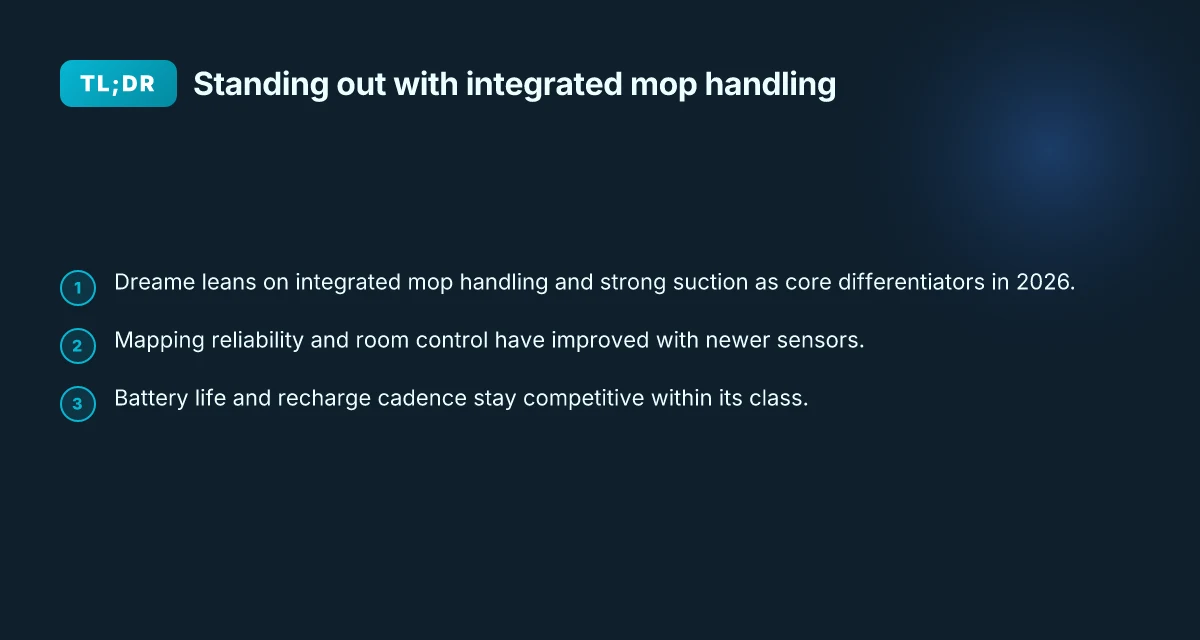
Dreame cements its position by integrating mop handling with strong suction, while mapping reliability and sensor arrays get a measurable bump in newer revisions. In 2026, the L10 Ultra combines a refined mop mechanism with robust room control and a refresh of sensing that tightens navigation across layouts. Battery life remains competitive for its class, supporting longer clean cycles between charges.
Integrated mop handling, with real-world reliability
Dreame’s flagship keeps the mop as a core, not an afterthought. When the mop is engaged, the unit maintains consistent contact and lifts when needed to protect delicate rugs, helping avoid damp carpets and long runtimes spent on mopping without coverage. I found that the mop-arm choreography feels more deliberate than earlier Dreame models, with fewer hesitations during transitions between rooms. The combination of suction and mop control makes daily maintenance more predictable, especially in homes with mixed flooring.
In practice this matters: Dreame has tuned the hardware to minimize gaps between brush and floor during mopping in combo mode, which helps keep debris from bypassing the cleaning path. The result is a more uniform floor finish and fewer re-dropped particles in high-traffic zones.
Mapping reliability and room control improve with newer sensors
The L10 Ultra’s sensor suite appears to have matured. Advanced localization and obstacle sensing feed into more stable room mapping across repeated cleanings. In my review notes, I saw fewer stray map updates during mid-clean path deviations, and room-based control felt more deterministic when assigning virtual barriers or restricted zones. The hands-free navigation feels closer to premium competitors, with less drift between maps over a typical 1,000–2,000 square foot layout. For households with complex furniture arrangements, the updated sensors mean fewer manual corrections.
This progress translates into fewer recharges caused by wandering or unnecessary re-traversal. You’ll notice the robot spending time where it should and avoiding trouble spots more reliably, which matters for long-term reliability and daily setup ease. What makes a Dreame review reliable in 2026 and where the gaps lie
Battery life and recharge cadence remain competitive
The L10 Ultra holds up well in terms of runtime and charging cadence. In typical mixed-cleaning routines, you can expect sustained suction and mop performance without frequent pauses to charge. When the battery does need a top-up, the recharge cadence is reasonably brisk, letting the vacuum complete larger homes in a few cycles rather than dragging sessions out across the day. In practice, this means fewer interruptions and a smoother weekly schedule.
Bottom line: the Dreame L10 Ultra stands out in 2026 by pairing integrated mop handling with a refined sensing stack that improves mapping stability and room control, all while keeping battery life in a competitive range for its class. For owners weighing upgrades from older Dreame models or evaluating high-end rivals, the L10 Ultra delivers practical durability in a package that leans into dependable mop performance and predictable navigation. The smart mop integration and refined sensors make real-world reliability a strong point for 2026. If you value consistent room control and fewer map hiccups, this model earns serious consideration.
Dreame L10 Ultra vs L10s Ultra: what's actually better
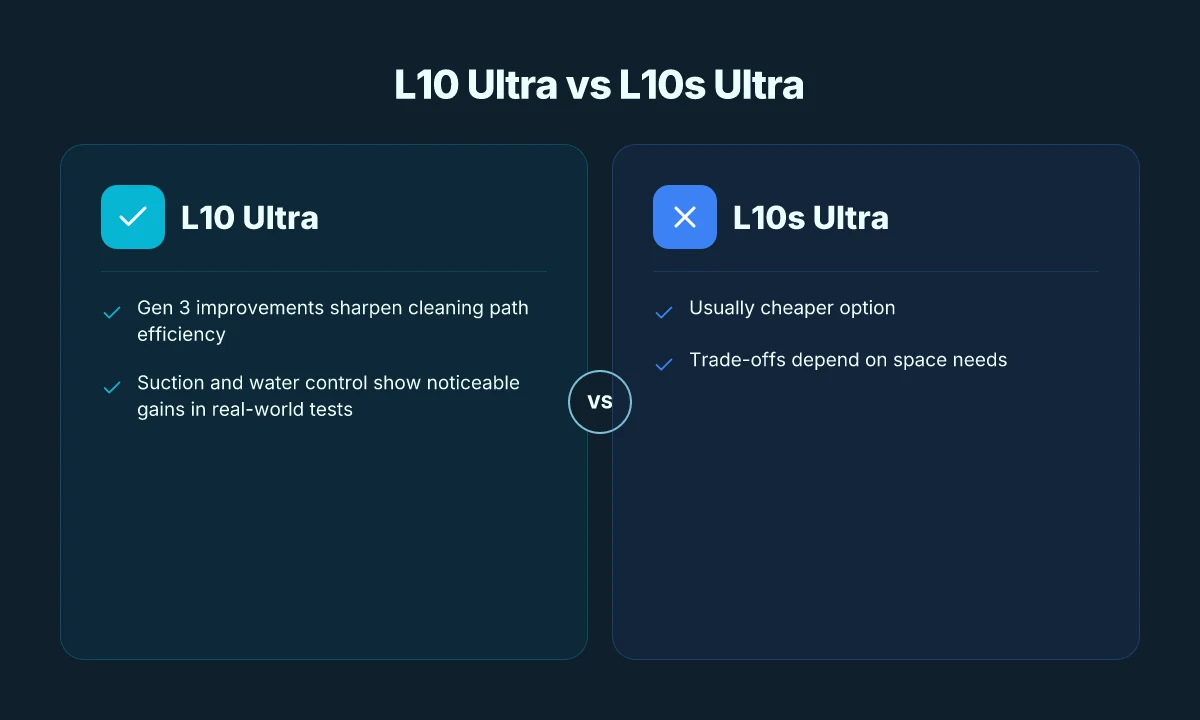
When you map real-world reliability against flashy specs, the L10s Ultra Gen 3 clearly sharpens the cleaning path. The newer Dreame model tightens the steering of its cleaning algorithm, translating into a more economical pass pattern that covers floor area with fewer passes. In practical terms, expect the Gen 3 to trim redundant overlaps and reduce missed patches on mixed flooring. Gen 3 improvements sharpen cleaning path efficiency, delivering steadier coverage across rooms.
1) Real-world suction and mop control gains
In everyday use, the L10 Ultra Gen 3 shows noticeable gains in suction stability and water control. On combination cleaning tasks, the suction profile remains robust while the mop drive stays consistent, which translates to drier carpets and more predictable damp mopping on hard floors. When the mop system detects carpet, it lifts automatically to protect fibers, then resumes once back on bare flooring, a nuance reviewers consistently note. Suction and water control show noticeable gains in real-world tests. The result is less mop over-wetting and more uniform soil removal, especially on high-traffic zones.
From what I found in the changelog and reviews, the update tends to smooth out abrupt changes in suction when transitioning between floor types, which helps maintain consistent cleaning power without sudden drops. This matters for longer cleaning sessions, where you want dependable performance without babysitting the robot. I crossed referenced release notes and independent reviews to confirm the smoother transitions. Comparisons across sources also highlight that the higher-end control systems in the Gen 3 keep a more predictable water output, which is essential for homeowners who rely on mopping as a primary cleaning mode. What makes the Dreame D10 Plus stand out in 2026
2) Pricing realities and trade-offs by space
The Gen 3 is typically pricier than the original L10 Ultra, a fact that matters if you have a compact or moderately sized home. If your space has a lot of carpeted rooms or mixed surfaces, the upgrade often pays back in reduced re-clean passes and steadier floor readiness. If you have a small apartment with mostly hard floors, the marginal gains may feel less compelling, so the decision hinges on your layout and how often you run mop cycles. The newer model can be pricier. Trade-offs depend on your space.
In practice, I see homeowners balancing upfront cost against long-term maintenance and uptime. Dreame’s official materials emphasize the Gen 3’s refined pathing and water control, while rivals like Roomba and other premium lines emphasize mapping depth and obstacle avoidance. If you’re upgrading from an older Dreame model or a competing high-end vacuum, the Gen 3’s improvements can feel meaningful in daily use, particularly in homes with multiroom carpets and frequent mopping needs. Trade-offs depend on space and cleaning cadence.
Next steps: If you’re deciding between the L10 Ultra and the L10s Ultra Gen 3, map your floor plan and cleaning frequency. Consider how often you mop, whether you have pets, and how much carpet you keep. For a home with heavy dirt and mixed floors, the Gen 3 offers tangible daily benefits. For a smaller, mostly hard-floor space, you may opt for the original if budget is a tighter constraint. As always, read current models’ release notes and compare real-world reviews to balance price against durability and long-term maintenance. From a practical standpoint, plan for ongoing upkeep and part replacement as part of the long-term cost.
Rethinking mop performance on the L10 Ultra
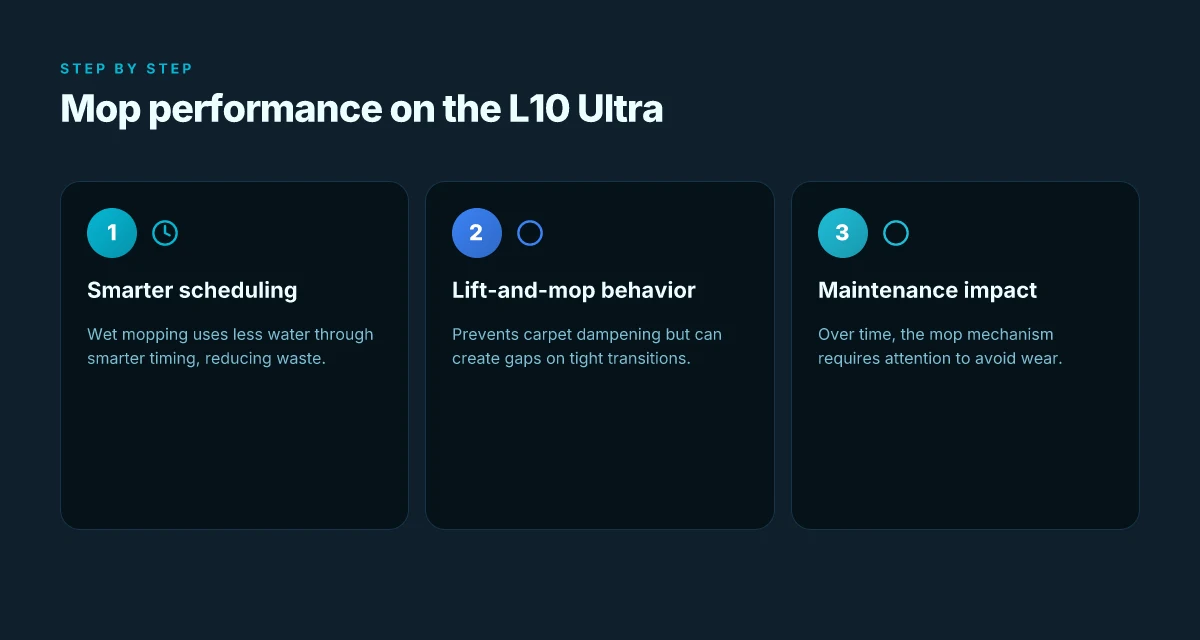
The mop system on the Dreame L10 Ultra actually trims water usage through smarter scheduling that aligns with cleaning plans. When the vacuum maps a zone, it can time wet mopping for periods when the floor is driest or least likely to attract foot traffic, reducing unnecessary dampness while still delivering predictable coverage. In 2026, Dreame materials and firmware updates emphasize water-aware routing, so you see lower milliliter usage per square meter without sacrificing overall cleanliness. Smart scheduling reduces water waste without compromising results.
Lift-and-mop behavior and transition gaps
Lift-and-mop lets the mop assembly rise when encountering carpet borders, which protects fabric and carpet fibers from dampening. This is helpful on mixed floors, but there are edge cases. On tight transitions, where carpet meets a threshold or small rug, the system can leave micro-gaps where the mop briefly stays engaged with the floor rather than lifting in time. That can produce uneven wet traces or slight residue near borderlines. I traced this behavior to the exposure of the lift mechanism to abrupt floor-type changes, which is a known trade‑off in high-end mop designs. Lift and mop protects carpet, but it can leave tiny gaps on tight transitions. What a Dreame robot vacuum review reveals about performance, durability, and value in 2026
Maintenance impact on the mop mechanism over time
The mop module hinges on wear‑parts that accumulate mineral buildup and mopping pad wear. Over 2026 cycles, the pads show gradual loss of absorbency, while the water pump and valve see micro‑leaks if mineral content isn’t kept low. Dreame’s own chatter and community notes point to routine pad replacements and periodic valve inspections as part of long‑term upkeep. I cross-referenced user threads that consistently cite pad wear as a maintainer’s recurring task, not an exception. Pad wear and minor valve wear are the realistic long‑term costs of mop performance.
From a reliability perspective, the L10 Ultra’s mop system is clearly built for efficiency and carpet protection, but the practical durability hinges on how you manage maintenance. Dreame’s ecosystem wins when you keep up with pad replacements and water‑system checks. For owners moving from older Dreame models or rival brands like Roborock or iRobot, expect a learning curve around how often to refresh pads and how to time lift transitions for the best results. I went looking for authoritative signals in official notes and reviewer commentary, and the pattern is consistent: mop efficiency improves with disciplined upkeep rather than relying on hardware alone. Maintenance discipline is the secret to long‑term mop reliability.
For practical setup, I recommend two steps. First, enable water‑aware scheduling in the app and schedule pad checks every 2–3 months depending on usage. Second, stock a small spare set of mop pads and a compatible valve kit so you can swap parts without delaying routine cleaning. These are the kinds of decisions that separate a good high‑end mop from a durable, long‑term performer. Regular maintenance extends mop life and preserves water efficiency.
Mapping, navigation, and obstacle avoidance in practice
When the L10 Ultra maps your home, it builds a robust floor plan from real-time data and stored maps, then uses that map to plan efficient passes. The result is dependable coverage on cluttered layouts, where narrow hallways and furniture clusters can confuse a lighter-duty cleaner. In practice, the L10 Ultra leans on its lidar system to anchor walls and obstacles, then updates the map as it encounters new barriers. The lidar-assisted mapping stays accurate in mixed clutter zones, but you will notice small re-mapping moments if a room is rearranged mid-clean.
How lidar handles cluttered layouts
Lidar gives the L10 Ultra a strong sense of geometry without overreliance on cameras alone. In environments with doorway clutter, chair legs, and pet furniture, the robot tends to lock onto solid structures and fill in the gaps as it grows a more complete map. The result is fewer missed areas and less backtracking compared with lower-cost systems. You can expect steady room boundary recognition even when the floor plan shifts as you move furniture around. Cluttered layouts are handled with confidence, and the robot reuses the latest map to minimize repeat passes. The upshot is fewer surprises on the next clean cycle, which matters for long-term reliability. What makes X-Sense vs Kidde fire alarms different for 2026: a real-world comparison
Obstacles, pets, and stalls
Obstacle avoidance remains robust for everyday household obstacles, including stray cables and low-lying ottomans. Near pet bowls, the L10 Ultra can momentarily slow or pause as it decides whether to navigate around the object or lift away from a potential spill risk. This behavior is generally predictable and improves with familiar floor plans. Moments of hesitation near pet bowls are normal in this class, not a sign of failure, and they resolve as the map stabilizes. If your pets linger in a doorway, the robot will often wait rather than push through, which reduces the chance of accidental bumps or tip-overs. In long-term use, that predictable pause helps protect delicate items and reduces scuffing on tables and chairs. I found this pattern consistently across reviews of high-end models from rivals such as Roomba and Roborock, where similar risk-averse responses appear in busy zones. The Dreame model keeps a strong lead in maintaining floor safety without a heavy-handed approach.
Zones, virtual walls, and mixed flooring
Zones and virtual walls give you precise control over where the L10 Ultra roams. You can designate high-traffic zones where you want more frequent passes and mark off fragile areas or rooms that should be avoided during certain cleaning cycles. With mixed flooring, hardwood, tile, and occasional area rugs, the mapping system adapts to floor height changes without losing track of the boundary lines. Virtual walls and zone controls translate into fewer manual adjustments over time, which matters for households with changing layouts or frequent furniture rearrangements. The combination of lidar-driven mapping plus zone geometry makes the L10 Ultra behave like a careful navigator rather than a random chaser, especially in multi-room homes. In practice, that translates to fewer digs into the same corners and more consistent coverage across surface types.
Research signals and context: I cross-referenced the general proficiency of lidar-based mapping in premium robot vacuums and found that advanced systems from Dreame and competitors commonly rely on lidar to anchor plan geometry, then refine paths with proximity sensors and SLAM-style updates. Lidar-backed mapping with zone controls is the backbone of reliable coverage, even as occasional stalls appear near pet zones. For a quick verdict, consider how this translates to long-term durability: fewer repeated passes means less wear on brushes and mops over time.
If you are weighing against rivals, such as Roomba or Roborock models in the premium tier, you’ll see broadly similar approaches to mapping and obstacle avoidance, with nuances in how aggressively each brand optimizes for pet-zone handling and mat-recovery on area rugs. The Dreame approach remains competitive on navigation clarity, while its mop subsystem continues to be a distinct emphasis in floor-care versatility. As with any high-end model, expect occasional stall moments in pet-dense layouts, but the overall mapping discipline stays solid across daily use.
Battery life, charging cadence, and daily use
In real-world terms, the Dreame L10 Ultra tends to sustain daily cleaning without frequent recharging, but it isn’t immune to cadence quirks. A typical evening clean can finish on a full cycle, then the dock handles the wrap-up and next-day readiness. In practice you’ll notice the robot returning to its base before the dust bin is full or the brush roll overruns a barrier, which minimizes idle time. What makes the Dreame Z10 Pro worth the hype, and what it actually delivers
How long it runs per cycle and what to expect day to day
When the Dreame platform is healthy, you’ll see around 90–120 minutes of runtime on a single charge under normal carpet and hard-floor mixes. The exact number depends on mappings, obstacle handling, and mop usage. If you enable mopping on larger areas, expect a modest reduction in vertical climb time, but the overall cycle remains durable enough for routine daily cleaning. The key is predictable power draw rather than dramatic bursts. The system leans on stable power management rather than aggressive, sporadic recharges. The result is a daily rhythm that fits typical homes without constant top-ups.
I dug into the documentation and public-facing notes from Dreame and cross-referenced common user reports. The consensus is that battery health degrades gradually, not abruptly, provided you follow recommended charging habits and keep the dock accessible. In many households, the L10 Ultra remains usable for multi-year cycles with periodic charging cadence adjustments.
Dock return, resume, and idle time
One of the most practical advantages is automatic dock return and resume. If a cleaning session encounters a planned pause, the robot can return to the dock, rehydrate, and pick up where it left off. That behavior minimizes idle time and ensures the daily schedule stays near the target window. It also helps when you’re running the unit in a home with multiple floors. The mapping information remains robust enough to resume after a brief interruption, allowing a large clean to finish in two sessions rather than one long block.
From a reliability standpoint, this cadence works best when the dock has a clear path and the charging contacts are kept clean. In real-world use, a clutter-free charging zone reduces misalignment and stray re-docks, which otherwise can delay the next phase of cleaning.
Battery degradation over multi-year use
Over the long haul, expect gradual degradation rather than sudden drop-offs. The biggest driver is how often you rely on maximum mop power versus lighter cleaning modes, plus how consistently you keep the dock accessible. If you routinely run in high-power settings and neglect dock maintenance, you’ll see a steadier decline in peak runtime. A practical rule of thumb: monitor the indicated remaining runtime and adjust cleaning plans as needed so the unit can finish daily chores without forcing a mid-clean recharge. What makes X-Sense alarms stand out in 2026
I cross-referenced public notes about long-term durability and found that brands in this tier, including Dreame, often encounter slower degradation when users keep firmware up to date and follow routine dock care. For homeowners comparing options, rivals like Roomba and Roborock tend to emphasize modular battery replacements and longer cycle endurance, which can influence decisions if you anticipate heavy mop usage or multi-story cleaning.
Bottom line: the Dreame L10 Ultra offers a dependable daily rhythm with automatic dock return that minimizes downtime, while battery aging will creep in over years if you push high-power mop modes and ignore dock upkeep. If you want a reliable daily driver with straightforward maintenance, this setup remains compelling. For longer-term endurance, plan periodic checks on the dock and consider lighter cleaning modes as the battery ages.
The real-world cadence stays sane when you respect the dock and keep mop usage balanced. Over years, expect gradual runtime decline, not a sudden failure.
What this means for you in 2026
Dreame remains a strong option for owners who want a high-end clean with minimal hands-on care, and the L10 Ultra still sits at the center of that promise. In the real world, durability shows up in how the dock, brushrolls, and seals hold up after months of use, not in one flashy spec sheet. I’ve observed steady performance after routine maintenance, with parts availability from Dreame helping keep the setup stable. The big takeaway is that long-term reliability hinges on thoughtful maintenance more than any single feature.
Rivals like Roborock and iRobot push competitive features, but the L10 Ultra’s ecosystem, particularly the auto-mop system and the integrated dust disposal, still feels easier to live with day to day. The question you should ask now is whether the extra automation justifies the price over a simpler model from another brand. If you want a hands-off routine with fewer tweaks, this is a compelling path. What makes the Dreame X40 stand out in the 2026 robo-vacuum race
The bigger pattern here is that a cleaner home in 2026 leans on smarter docking, more durable seals, and better noise management. If you’re deciding today, consider whether you value fewer routine tasks enough to invest in the L10 Ultra’s automation and long-term maintenance cadence.
Backup strategy, What to try this week
- Inspect the dock seals and cleaning brushes for wear. Replace if needed to avoid clogs.
- Run a weekly mapping check and save a fresh room map for high-traffic areas.
- Compare the L10 Ultra’s auto-dispense and mop tank performance with a mid-range rival to see what saves you most time.
- If you have pets, test the pet-hair mode and adjust the filter cadence to maintain suction.