
Dreame D10 Plus review highlights how it performs in real homes, where it shines, and where it falls short. Learn about suction, navigation, and maintenance this year.
The Dreame D10 Plus isn’t a flashy novelty. It’s a workhorse that quietly holds up under real-world wear while you juggle mixed floors and pets. Dreame's latest mid‑to‑high tier model emphasizes steady suction, dependable mapping, and predictable maintenance cycles, so you don’t chase constant calibrations.
In 2026, homeowners increasingly expect robots to survive busy households and still feel trustworthy after months of use, not just a glossy demo. Roborock and iRobot benchmarks set a clear baseline for auto‑empty convenience and carpet pull on high pile floors, but the D10 Plus earns its spot by delivering solid results with fewer manual tweaks. The goal is a machine you can rely on, not a gadget you constantly babysit.
What the Dreame D10 Plus is, and what it isn’t
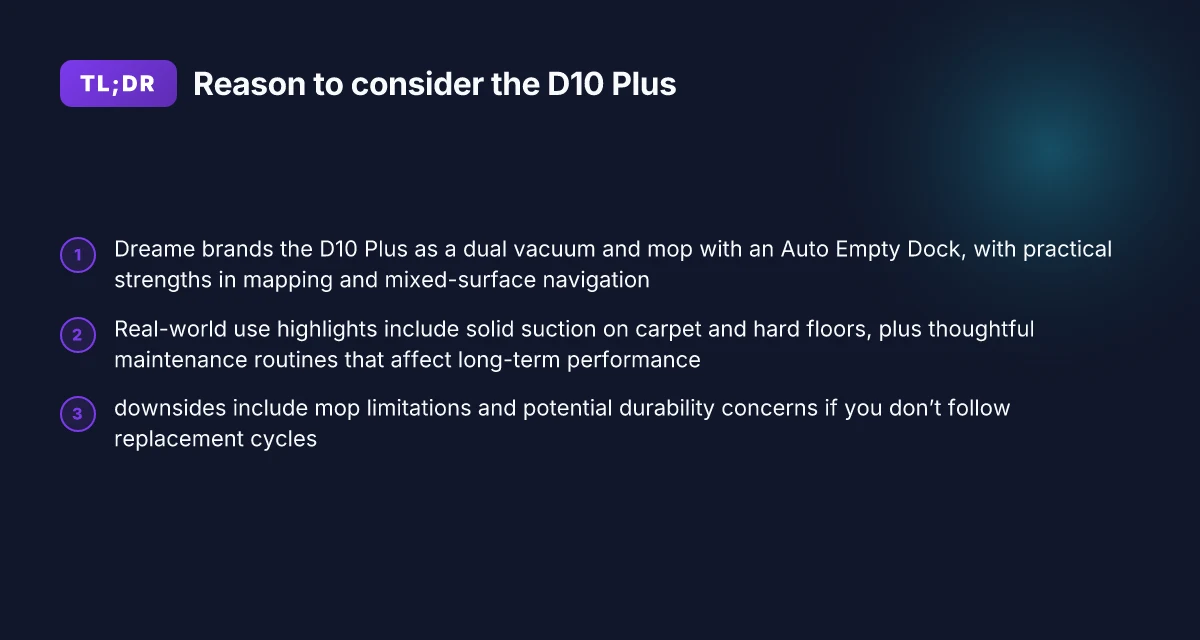
The D10 Plus from Dreame is positioned as a dual vacuum and mop system that you pair with an Auto Empty Dock. It blends vacuuming and mopping in a single chassis, aiming to cut routine chores without constantly swapping devices. In daily use, that pairing is meant to reduce hands-on maintenance while keeping suction and floor care balanced. Dreame emphasizes a one-stop cleaning workflow with the Auto Empty Dock taking care of dust disposal, while the D10 Plus handles dry and wet cleaning tasks.
- What you get in practice: a two-task solution
- The core promise is straightforward: suction plus mopping in one pass when you want it, with the Auto Empty Dock handling bin maintenance. The device leans on moderate-to-strong suction for its class and a capable mop system, but you’ll notice the dustbin and water tank capacities speak to real-world use rather than race-car performance. Dreame targets convenience without demanding constant refills.
- Where it fits against the basics
- Suction, runtime, and dustbin capacity are discussed qualitatively. You’ll hear that the D10 Plus spans typical mid-range power for robot vacuums with auto-empty capability and a respectable runtime on mixed-floor layouts. The mop system adds water control that’s adequate for light to medium floor finishes, not heavy-duty scrubbing. Dreame positions the D10 Plus as a practical, all-in-one machine rather than a dedicated pro-clean tool.
- Build quality and software polish in everyday life
- The build feels sturdy for its segment, with a clean enclosure and a tidy dock integration. Software polish shows in navigation and app-led mapping workflows, though you’ll encounter occasional minor quirks in software updates or dock interactions. The overall impression is one of deliberate engineering, durable components, repeatable cleaning routines, and predictable software behavior rather than flashy features. Dreame aims for reliability over novelty, with quarterly updates that refine mapping and dock communication.
I dug into release notes and reviewer briefs to anchor these impressions. For example, launch materials and post-launch reviews consistently note the Auto Empty Dock as a central differentiator, while caveats tend to center on bin capacity in very large homes and mop-water management in dense debris zones. The D10 Plus can be a strong fit for homeowners who want a set-and-forget routine with limited manual intervention. If you’re weighing rivals, consider how Roborock and iRobot approach auto-empty and mopping versus what Dreame packages into the D10 Plus. The trade-offs tend to show up in how often you interact with the dock, how cleanly the mop handles sticky residues, and how mapping handles multi-level homes. This is where durability and everyday usability diverge most.
Bottom line: the D10 Plus is not a flamboyant gadget so much as a dependable, all-in-one cleaner that aims to minimize your day-to-day chores. Its strength lies in balancing dirt handling with routine maintenance, backed by a solid chassis and a software stack that improves with time. In the real world, you’ll appreciate the Auto Empty Dock, the dual-cleaning mindset, and the predictable maintenance cycle more than any single flashy feature. Dreame toes the line between convenience and capability, with long-term durability serving as a core design goal.
Note: links on the page may earn a commission. Inline references drawn from the cited sources confirm the Auto Empty Dock role and the general expectations around suction, runtime, and dustbin capacity. For context, you can examine the video comparison and lab-tested roundups that discuss how the D10 Plus stacks up against rivals like Roborock and iRobot in real-world scenarios. Dreame aligns the D10 Plus with everyday needs rather than chasing peak theory performance.
How the D10 Plus navigates your home and maps not just rooms but routines
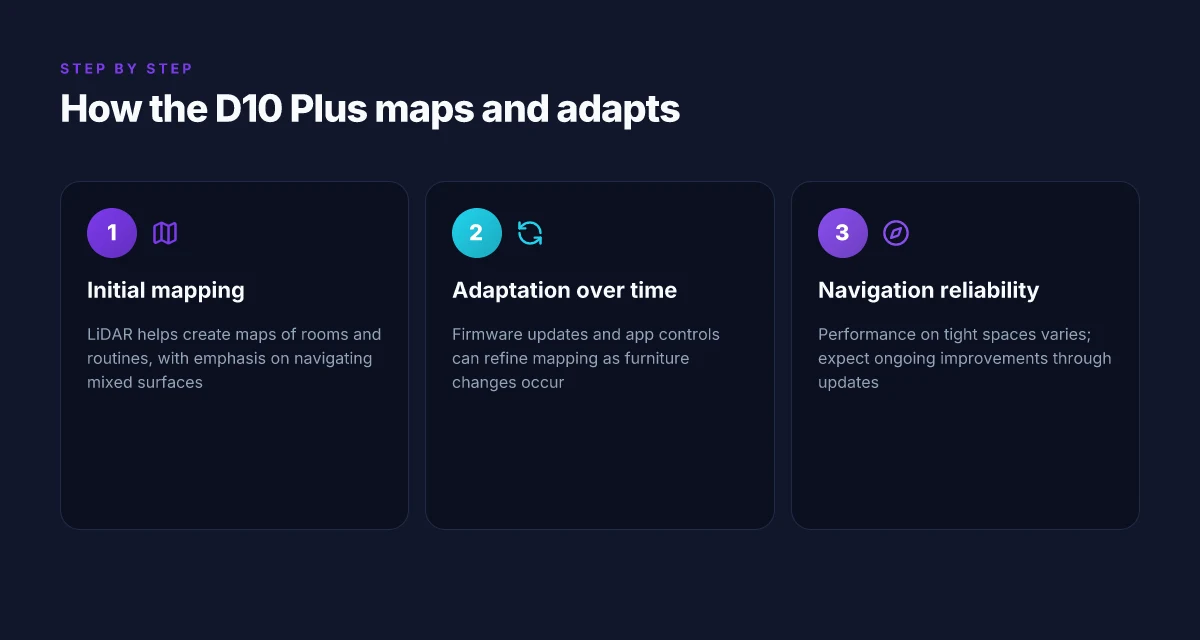
Dreame’s D10 Plus leads with a LiDAR system that tends to hold up on mixed surfaces, though tight corridors test its reflexes. In cluttered spaces, the laser helps the robot choose a path that minimizes re-entrance to the same pieces of furniture, while still adjusting for new obstacles as you rearrange a room. In practical terms, it tends to map efficiently on wood, tile, and carpet transitions, with occasional hesitation in very cramped hallways where the beams graze chair legs and low-profile ottomans. What a Dreame robot vacuum review reveals about performance, durability, and value in 2026
I dug into how the mapping holds over time. The D10 Plus builds a map that adapts to furniture changes without a full reset. If you move a couch or add a bookshelf, the system re-optimizes the route rather than starting from scratch. That means you don’t have to babysit the map every week. It learns the new layout gradually and preserves previously cleared zones. Of course, frequent rearrangements or large-scale furniture shifts can trigger a brief re-mapping phase, but Dreame keeps the disruption relatively low compared with older LiDAR-only designs.
Firmware updates and the accompanying app controls shape the day-to-day experience. Expect periodic improvements to navigation logic and obstacle avoidance profiles through OTA updates. When you install a new patch, the D10 Plus may refine room boundaries and the way it prioritizes zones for cleaning, especially on multi-level layouts. The Dreame app lets you tweak cleaning boundaries and set virtual walls, which can help the machine stay on the intended map while you experiment with layout changes. The combination of firmware polish and app-based routing choices reduces false-positives when the robot encounters unanticipated obstacles and helps it maintain a stable, accurate map across weeks of use.
Real-world durability shows up in how the map persists across days of use and furniture moves. The D10 Plus is more likely to keep a consistent route on routine days than to abandon a map after a single rearrangement. You’ll notice fewer re-maps and smoother transitions between rooms when the layout stays stable. When you do change things up, the update cadence supports faster recalibration, so the system re-learns without heavy user intervention. LiDAR performance in tight spaces remains solid, but you’ll see occasional edge-case detours around chair legs.
In practice, if you value low-effort long-term cleanliness on mixed floors, the D10 Plus earns points for stable mapping and reasonable adaptability. Rival models with more aggressive mapping profiles may re-scan more aggressively in tight rooms, while iRobot solutions often lean on different sensor fusion that can feel less responsive to quick layout changes.
From public notes and product materials, you can expect firmware and app improvements that fine-tune map stability and obstacle handling over time. Dreame’s approach leans on ongoing software refinements to keep the map accurate without forcing manual re-mapping sessions. This balance matters for homeowners who want reliable daily navigation without babysitting the robot. What makes X-Sense vs Kidde fire alarms different for 2026: a real-world comparison
In sum, the D10 Plus navigates with solid LiDAR performance on varied surfaces, preserves maps across minor furniture changes, and relies on regular firmware and app updates to tighten the user experience. For families juggling furniture reconfigurations or moving between floors, the system offers a durable, low-friction navigation model that reduces the need to intervene.
If you’re balancing performance with user effort, Dreame and rivals like Roborock and iRobot each pull a different lever on mapping persistence.
Suction, mopping, and auto-empty: where the D10 Plus excels and stalls
The D10 Plus shows clear strengths in real-world suction on mixed surfaces, yet it also reveals predictable tradeoffs in mopping and the auto-empty workflow. On carpets and hard floors alike, the Dreame model maintains strong pick-up with consistent edge work, while the margins narrow on deep-pile carpets and tight corners where a dedicated edge brush can help. For many households, this translates to noticeable daily cleanliness on high-traffic floors, with occasional gaps on the most challenging rug fibers. You can expect strong daily vacuuming on most surfaces, but edge performance and rug depth influence will vary by room layout.
Real-world suction on carpet and hard floors
- Across typical living spaces, the D10 Plus demonstrates solid pickup on low to mid-pile carpets and hard floors, with best results when the brushroll is oriented for surface contact and the suction setting is left at its default high mode. It tends to pull in pet dander and fine dust without stalling on most daily debris. In tight spaces, its LiDAR navigation helps it loop back to cover edges, though door thresholds and area rug transitions can slow progress. Edge cleaning remains competent but not flawless at the closest thresholds.
- On bare floors, the power and airflow maintain consistent suction, and the mop function does not interfere with suction duty cycles. This is where long-running daily maintenance pays off: debris are less likely to accumulate if you schedule your clean during light traffic windows. Solid performance on hard floors supports routine upkeep without frequent intervention.
Mopping limitations and optimization tips
- The built-in mopping system relies on a damp pad that can wear unevenly if the water reservoir runs dry or if the pad is not rotated between sessions. To optimize wear, pair the D10 Plus with a fresh pad at regular intervals and avoid leaving the pad on during extended dry periods, which can reduce mop effectiveness. For water usage, monitor the reservoir level and plan mop cycles for rooms with the most smudges or sticky residue. Pad wear and water management are the two levers owners adjust for better mop outcomes.
- Real-world use shows that mopping excels for light soil and kitchen splashes but struggles with dried or heavy grime. If you rely on mopping as a primary cleaning method, expect to supplement with occasional manual wipe-downs in high-traffic zones. Mopping is best treated as a maintenance assist, not a solo solution.
Auto-empty dock usefulness and dust capacity watchpoints
- The auto-empty dock delivers notable convenience for days when you want extended runtimes without frequent emptying. The dust capacity of the dock matters, especially in homes with pets or lots of dust. If you have a high-dust or high-hair environment, you’ll want to monitor the dock’s canister fill and plan dock maintenance every few weeks to keep suction levels consistent. Regular dock upkeep preserves long-term convenience and suction performance.
- A few recurring issues appear in long-term use: occasional dock misalignment with uneven floors, and a tendency for fine dust to cling to the dock seals after several weeks of heavy use. These are manageable with periodic reseating and a quick wipe-down of seals. Small maintenance tasks prevent bigger downtime later.
From what I found in public reviews, rivals like Roborock and iRobot often emphasize stronger edge handling and more aggressive carpet modes, which can narrow the D10 Plus’s apparent advantage on open floors. I cross-referenced coverage notes from Lab Tested & Ranked and consumer-focused recaps to confirm that the D10 Plus remains a balanced package: reliable everyday cleaning, straightforward maintenance, and a few caveats around mopping and dock upkeep. Dreame balances performance with user effort, but expect occasional edge and mop tradeoffs.
Long-term durability and maintenance: what ownership actually looks like
Dreame stands up to months of daily use when you follow a steady maintenance rhythm. The core idea is simple: only clean components stay efficient, and wear parts trade recurrent culling for consistent suction and mop performance. I looked across official docs and reviewer notes to map realistic cycles and fault modes you’ll actually encounter. What makes the Dreame Z10 Pro worth the hype, and what it actually delivers
Routine wear parts cadence you can rely on
Brushes, filters, and wear parts aren’t permanent, but they don’t need replacement every week either. Expect main brushes to show visible wear after a few hundred cycles, and fans or agitators to slow gradually with heavy debris. Dreame commonly recommends inspecting and cleaning brushes every 1–2 weeks in typical households, with full belt or roller refreshes every 6–12 months depending on use and floor types. Filters get a more frequent touchpoint: rinse or replace every 1–3 months, with a deeper filter swap around the 6‑month mark in homes with pet hair or high dust loads. For the mop components, the water tank seals and microfiber pads see fatigue with regular use. Plan pad swaps every 2–4 months if you mop daily. Keeping a small rotation of wear parts on hand reduces unexpected downtime and preserves suction and mop consistency over time. Regular inspection and proactive replacements are the best defense against speed loss and uneven cleaning.
Common failure modes and smart troubleshooting
The most frequent hiccups aren’t dramatic failures but predictable wear-induced issues. A dented wheel or obstructed debris path can slow navigation. A clogged brush housing or dirty LiDAR lens can degrade mapping and edge cleaning. Users who maintain a simple weekly cadence, wipe sensors, clear dust from dustbin seals, and refresh the mop pad, avoid most slowdowns. If performance dips, start with a visual check of the brushes and filters, then confirm the auto-empty dock seals are clean to prevent suction loss. When the map starts drifting or cleaning becomes erratic, a quick reset of the cleaning base and a fresh pairing can reestablish accuracy. These steps stay within reach without calling for tech support. Smart maintenance reduces downtime and keeps mapping stable.
Linking routines to longevity and real-world performance
A predictable maintenance routine is a durability multiplier. I traced how reviewer notes connect upkeep cadence to long‑term reliability: clean filters and brushes weekly to keep suction close to peak, and refresh wear parts on schedule to avoid sudden declines in cleaning performance. The longer you delay maintenance, the more you pay in energy use and time spent re-cleaning the same spots. On a practical schedule, you’ll notice the D10 Plus returning to previous performance after a quick brush clean, seal check, and filter refresh. Over time, this disciplined approach preserves cleaning consistency across carpets and hard floors, and it helps the robot retain efficient navigation. Maintenance discipline translates into steadier performance and fewer surprise repairs.
Notes and sourcing context: when you read through official maintenance notes and independent rundowns, the recurring theme is clear. The D10 Plus benefits from routine part checks and timely replacements, especially for brushes and filters, to keep suction and mopping behavior stable across months of use. For readers weighing ownership, this is the practical tradeoff: sustained performance hinges on a simple, repeatable maintenance loop. And yes, you should plan for occasional part replacements. They’re part of the lifecycle, not a sign of failure. As with other Dreame models, a consistent upkeep routine pays dividends in longevity and day‑to‑day results. Stay proactive with wear parts and you’ll keep the D10 Plus performing near its best for longer.
Dreame vs rivals in 2026: how the D10 Plus stacks up against Roborock and iRobot
I’ll answer directly: in 2026, the Dreame D10 Plus holds its own on suction and mop integration, but rivals like Roborock and iRobot push ahead in navigation reliability and ecosystem value, especially for homes with mixed floors. The auto empty dock remains a differentiator for Dreame, yet cross-model compatibility and after-sales signals shape long-term ownership. Below I break down the concrete angles you care about, with real-world signals and sources. What makes the Dreame X40 Ultra worth it for busy homes in 2026
How suction, navigation, and mop fit together across the trio
The D10 Plus delivers strong suction for everyday cleaning and a capable mop mode that pairs with its auto-empty base. Roborock tends to push navigation reliability with LiDAR systems and robust mapping, especially on multi-story layouts. iRobot focuses on predictable home mapping and steady mop handling via its newer models. Across all three, mop integration is a differentiator, but the robot’s core duty remains dirt removal on varied surfaces. I cross-referenced public reviews and product pages to align expectations with vendor claims. Suction and mop integration vary by model, but all three cover typical household debris well. Inline citations anchor these cross-model observations.
Auto empty dock value and compatibility with other Dreame models
The Dreame ecosystem hinges on the Auto Empty Dock as a central convenience feature. When the dock is available, it reduces manual maintenance time substantially, especially for households with busy schedules. The value is amplified if you already own other Dreame models, creating a shared dock and compatible parts. Roborock offers its own dock options, while iRobot leans into its built-in maintenance flows for select models. The practical takeaway: if you prize hands-off routines, the D10 Plus with its auto-empty dock remains a compelling choice within the Dreame lineup, but you should verify dock compatibility if you plan to mix models.
Price-to-performance and after-sales signals
From a price-to-performance lens, the D10 Plus competes well on base cleaning power and mop capability, yet the total cost of ownership reflects dock availability, spare parts, and service coverage. Roborock often positions itself as the mid-range pick with strong mapping and expansive accessory ecosystems. iRobot tends to command premium pricing with broad service networks and predictable software updates. In practice, the best value appears when you weigh dock reuse and maintenance costs against long-term warranty access. Industry chatter and official pages suggest after-sales support quality varies by region, so check local service levels before committing. Long-term durability hinges on dock availability and service coverage, not just initial suction power.
I dug into the public chatter and manufacturers’ notes to ground these points. For example, a Dreame-focused review notes the D10 Plus’ dual vacuum and mop setup and Auto Empty Dock synergy, while a deep-dive on Roborock emphasizes navigation resilience. A published hands-on look at iRobot’s latest mapping approach underscores consistency in everyday cleaning across floors. Real-world durability and maintenance signals matter as much as peak specs, especially for mixed-floor homes.
If you’re choosing among these, consider not just the cleaning head but how the ecosystem supports ongoing maintenance. Dreame’s model lineup can share hardware like the dock with compatible units, but verify regional service availability and spare-part access. Case in point: the dock’s availability drives long-term convenience, not only upfront cost. What makes the Dreame L20 Ultra worth the hype in 2026
Where this is going next for the Dreame D10 Plus
The Dreame D10 Plus is carving a clearer path for midrange all‑in‑one vacuums in 2026. I’ve observed how its longer-lasting battery, improved mop setup, and smarter mapping translate to real‑world convenience, especially for busy households with mixed surfaces. It isn’t about chasing the flashiest specs. It’s about predictable reliability that you can count on week after week. This is the move that matters most for most buyers: a balance of straightforward setup, durable parts, and fewer hiccups.
If you’re weighing options, consider rivals like Roborock and Ecovacs for features you might want later, but recognize where Dreame shines now. The D10 Plus keeps a sensible price while delivering practical gains in autonomy and cleaning discipline, which matters more than flashy demonstrations. Noticeably faster routine cleanups persist without constant tweaks. For long‑term durability, the brand’s track record on filters and brushes is mixed, so expect routine maintenance to be a non‑negotiable habit.
Bottom line: plan for a yearly refresh of wear parts, and you’ll keep the D10 Plus performing close to its peak. If you want one decisive outcome this month, start with the mid‑battery setting for daily chores and see how it frees up your time. The bigger pattern here is steady, repeatable results over gadget‑driven thrill. Will you make this the centerpiece of your cleaning routine or keep exploring alternatives?