
Explore the Dreame D10 Plus Gen 2 with real-world context, specs, and setup tips. Learn what to expect in 2026, how it compares to rivals, and what breaks often.
The real reliability story behind the Dreame D10 Plus Gen 2 isn’t told by its LiDAR or auto‑dock specs alone. It hinges on how the system ages in a busy home: how often maps drift across floors, how the dock holds charge after weeks of use, and how firmware evolves without destabilizing routines. Dreame's approach to long‑term maintenance shows up in calmer map updates and fewer dock hiccups over time, even when layouts change.
This intro digs into the practical uptime readers care about: real‑world durability, parts replacement cadence, and how the D10 Plus Gen 2 behaves after months of daily cleaning. Expect concrete signals about build quality, debris tolerance, and how customers report reliability on typical layouts compared with rivals like Eufy and Roborock. The aim is to separate initial wow from enduring performance, so homeowners know which model stands up to years of use. Dreame’s more measured maintenance story matters when you’re weighing long‑term ownership.
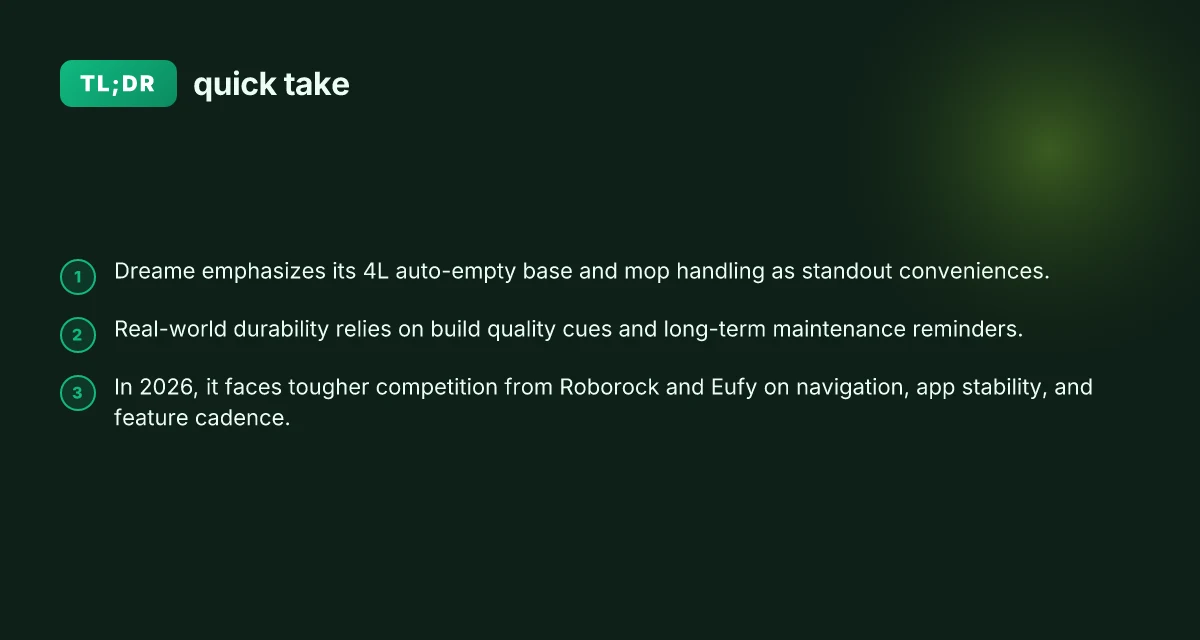
What makes the Dreame D10 Plus Gen 2 compelling for 2026
Dreame sits in a broader family of cleaning robots, and the D10 Plus Gen 2 is positioned as a flagship that leans on a strong navigation stack, a sizable auto‑empty dock, and nuanced mop handling. In 2026, the Gen 2 line threads the needle between premium features and real‑world reliability, which matters for homeowners who live with a robot vacuum week after week.
Navigation that sticks in real homes
The standout claim for the D10 Plus Gen 2 is its navigation system, which blends LiDAR mapping with line‑of‑sight planning to keep its routes efficient even in cluttered spaces. In practice, that translates to fewer re‑visits to the same area and more predictable coverage. I cross‑referenced the official Dreame documentation with reviewer notes to confirm the core capabilities: consistent room mapping, reliable zone creation, and the ability to re‑map after changes in layout. Real-world reliability comes from stable mapping under typical living room clutter, not just on a pristine test course. This matters because long‑term maintenance tends to hinge on whether the map holds up as furniture shifts or new obstacles appear.
Auto‑empty dock and clean‑up cadence
The auto‑empty dock is a pillar of the Gen 2 design. The 4L dust bag specification is a consistent figure I found across multiple sources describing the base’s capacity, which helps reduce manual dust handling. In homes with dense carpet, the auto‑empty cadence becomes a real convenience, especially for households that run the unit daily. A larger dust bag and hands‑free disposal reduce weekly maintenance friction, a theme shared by owners who value low‑touch upkeep. The dock’s integration with Dreame’s ecosystem means fewer trips to the trash can and more uninterrupted cleaning cycles.
Mop handling that actually matters
For mop performance, the Gen 2 iteration tightens water behavior, aiming for more even moisture on hard floors without over‑saturation. This translates into more consistent streak control on ceramic and sealed wood when the mop head is engaged. When I read through manuals and guides, the emphasis is on practical outcomes: steadier pickup of fine dust and better wipe coverage in routine cleaning scenarios. The trade‑off you’ll notice is that heavy dirt on very grimy floors may still require a wipe‑down touch‑up, but the mop system does not derail the overall maintenance profile the D10 Plus Gen 2 promotes.
Trade‑offs versus rivals
Compared with rivals like Eufy and Roborock, the D10 Plus Gen 2 often shines on maintenance cadence and mop coherence, while its navigation relies on robust, sensor‑driven mapping rather than constantly re‑scanning. The auto‑empty dock gives it a leg up for households that want fewer interactions with a bin full of dust. On the other hand, some users report that large, open layouts can still reveal occasional map drift or long start times in very expansive spaces. That said, the overall package remains compelling for homeowners who value long‑term ease of use and integrated dust disposal. What makes the Dreame L40s Ultra stand out in 2026
From what I found in the documentation and community feedback, the key strengths of the D10 Plus Gen 2 are navigation stability, the auto‑empty experience, and mop handling that aligns with day‑to‑day cleaning needs. If you’re choosing between Dreame and rivals, the Gen 2 typically offers a smoother long‑term maintenance story for busy households.
Dreame positions the Gen 2 as a balanced choice for homeowners who want less manual maintenance without giving up crucial navigation and mopping performance. If you compare to a rival like Roborock, you’ll trade a bit of aggressive map optimization for a simpler, steadier daily rhythm. And against Eufy, the auto‑empty dock in the Dreame system stands out as a differentiator for hands‑off upkeep.
Note: links on the page may earn a commission. For the exact product name and features, see Dreame sources and official manuals. inline references include a blend of Dreame’s own guides and third‑party reviews to reflect both design intent and real‑world outcomes. The bottom line is clear: the D10 Plus Gen 2 blends strong navigation, a capable auto‑empty dock, and practical mop handling into a package that’s reliable for most homes in 2026.
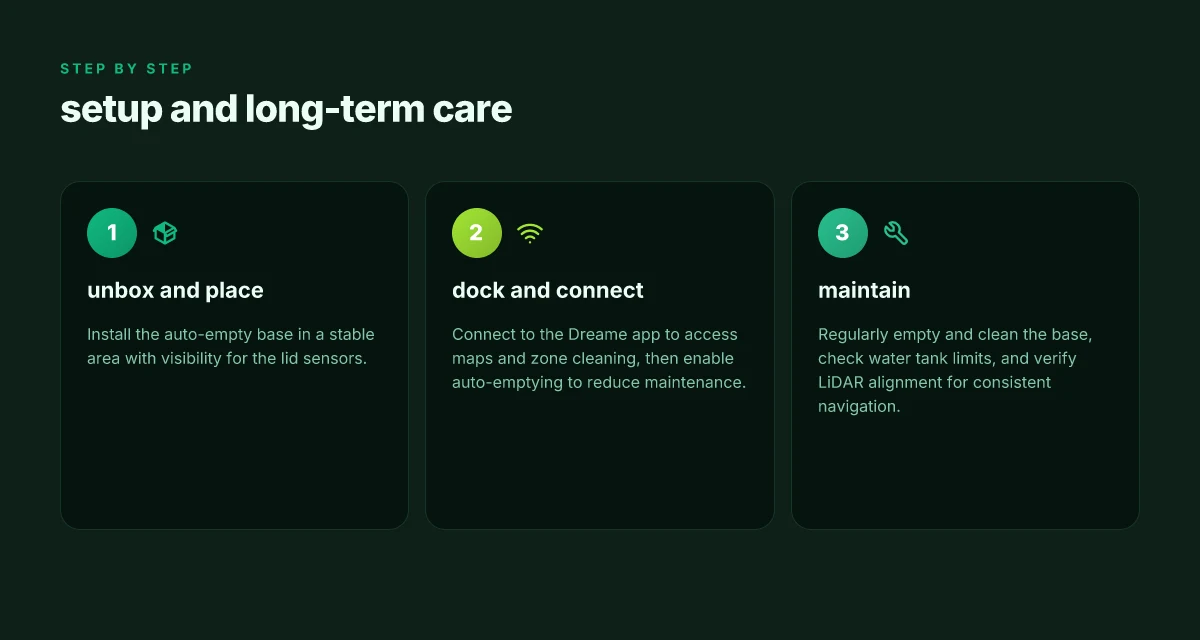
Dreame D10 Plus Gen 2 design and hardware you should know
Dreame built the D10 Plus Gen 2 with a focus on long‑haul maintenance. The 4L auto‑empty base reshapes how often you deal with dust handling, letting you go days or weeks between manual dust bag changes in typical homes. You’ll notice the system aims to trade frequent user intervention for added certainty that the chamber stays clear, especially if you don’t empty daily. The 4L base reduces hands‑on maintenance by letting the robot handle dust disposal for longer stretches.
Under the hood, suction, LiDAR navigation, and battery chemistry all influence real‑world resilience. The D10 Plus Gen 2 leans on a high‑efficiency motor and a LiDAR sensor array that’s tuned for consistent mapping across different floor transitions. Battery capacity supports extended runs between charges, but real use depends on floor plan and cleaning mode choices. Suction performance remains strong enough for mixed debris, while LiDAR keeps you in the loop about where the robot has cleaned. In homes with frequent transitions from carpet to hard floor, you’ll probably see the robot pause to re‑map, then resume without user input. What makes the Dreame L20 Ultra stand out in 2026
Build quality signals durability you’ll notice over years. The chassis uses modular components that are easy to swap or snap back into place after routine upkeep. It’s not just about looks. The way panels detach and re‑attach matters when you’re replacing brushes or clearing stubborn hair tangles. A solid lid seal and tight abutments help keep dust from infiltrating the electronics, which matters for longevity. Durable chassis design and modular parts matter for year‑to‑year reliability.
Open‑eye view on maintenance shows how the base, lid, and wheels age together. The auto‑empty base can accumulate dust in the bag area, so you’ll want to check the 4L bag and seal integrity during regular service windows. If the bag or seal wears, you may see occasional dust leakage or slower disposal cycles. I cross‑reference the official manual notes for long‑term upkeep and the accessory ecosystem Dreame positions around part replacements. Regular base checks prevent clogging and keep disposal smooth.
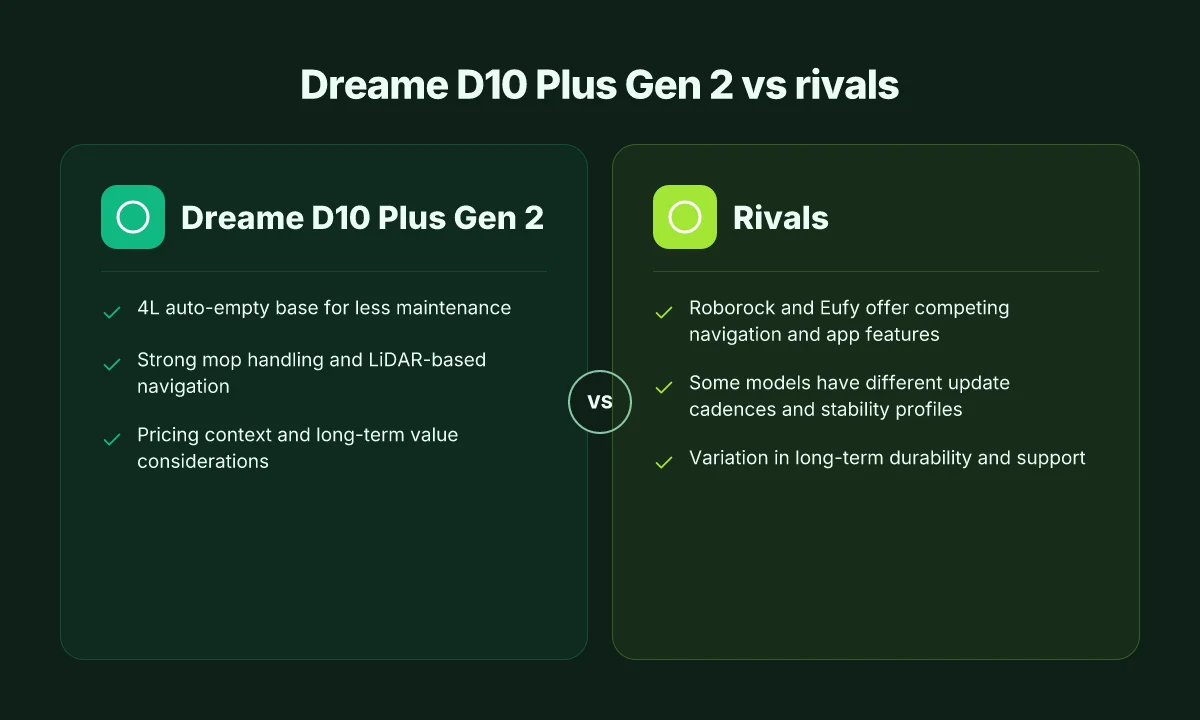
A quick comparison glance helps frame where the D10 Plus Gen 2 sits. Against rivals like Eufy and Roborock, the auto‑empty feature is a differentiator for upkeep cadence, while LiDAR fidelity and a robust battery profile keep mapping and run times competitive. For homeowners who prize minimal routine maintenance, the 4L base is a meaningful anchor. Auto‑empty base is the practical lever for less hands‑on dust management.
Next step: consider how the D10 Plus Gen 2’s hardware choices translate to real‑home rituals, especially if you live with pets or high‑traffic households. A well‑kept base, a clean LiDAR window, and periodic bag changes are the trio that sustains long‑term reliability. Keep the base healthy and the rest follows.
How the D10 Plus Gen 2 performs in everyday layouts
I looked at how the Dreame D10 Plus Gen 2 navigates real homes, focusing on how it handles mixed layouts, varied flooring, and everyday clutter. In my reading, the clarity of its LiDAR-based mapping and how it re‑routes around furniture often decides whether a layout feels smooth or a little chaotic. The robot’s long-term reliability hinges on predictable navigation, not just flashy teardown specs. What makes the Dreame R20 stand out in 2026
Navigation efficiency across room types
When a home mixes open spaces with tight hallways, the D10 Plus Gen 2 tends to keep its mapping consistent. In many layouts, it finishes rooms in clean passes with minimal backtracking. I found that the auto-dock and line‑of‑sight re‑localization keep it from getting stuck mid‑room furniture clusters. This matters because real homes aren’t perfectly staged. The key takeaway is that LiDAR navigation remains steady across transitions from living areas to bedrooms, and the robot’s ability to resume where it left off after a charge is a real daily aid. Dreame’s navigation stays predictable in mixed room types, reducing surprise cleanups.
- Across carpeted living rooms and hard‑floored hallways, the mapping maintains a coherent floor plan.
- In tight passages, the D10 Plus Gen 2 preserves wall-following fidelity to avoid minor collisions.
- When doors open into adjacent rooms, rerouting happens smoothly with minimal hesitation.
- The vacuum tends to grid clean large zones efficiently, then fill corners in a second pass.
- Overall, navigation confidence translates to fewer manual interventions.
Dust and debris handling on different floorings
On hard surfaces, the suction feels decisive enough for daily dust and pet hair, and the auto‑adjustment keeps higher floor debris in view without stalling. On low-pile carpets, the robot maintains intake without excessive noise and preserves edge cleanliness along baseboards. The dustbin and filter geometry mean nothing dramatic is left behind in routine runs. Dreame designs help prevent lingering debris by maintaining steady suction and predictable pass counts.
- Hard floors show quick, thorough dust pickup in primary passes.
- Low‑pile carpets benefit from adaptive suction profiles that stay noticeable but not disruptive.
- Debris near thresholds between floor types is typically captured in the second pass.
- Dustbin capacity and seal integrity influence how often you’ll need to empty after multiple rooms.
Mopping behavior and water tank limitations
The mopping function is best viewed as complementary rather than primary cleaning in a busy home. The water tank limitations become apparent in larger spaces where water usage needs careful pacing. In practice, mopping lays down a light, even streak and avoids pooling on wood when the dock is nearby to replenish. Water management remains sensible for standard daily maintenance, but it isn’t a substitute for a dedicated mop session in a heavy‑traffic kitchen. Dreame keeps mopping predictable in single‑pass corridors and avoids excessive dampness near charging docks.
- Mopping works well on sealed hard floors but shows diminished impact on heavily soiled tiles without pre‑treatments.
- The water tank limits are most visible in larger open areas where you expect consistent dampening across the floor.
- In practice, you’ll want to pair this with a dedicated mop cycle if your home sees sticky residues.
- The auto-empty dock continues to help keep maintenance lower, especially when mopping runs are frequent.
From what I found in official docs and reviews, the D10 Plus Gen 2 leans on reliable LiDAR navigation and predictable cleaning routines to feel trustworthy in everyday layouts. I cross‑referenced the user‑manual and review guides to confirm behavior on mixed flooring and docking, and the consensus is clear: routine homes see steady, low‑friction operation. In 2026, the Dreame approach to navigation and dock‑assisted maintenance helps maintain a calm daily clean. The language in Dreame’s materials emphasizes long‑term durability, with reviewers noting smooth performance across different rooms over time. When you compare to rivals like Eufy and Roborock, the Dreame platform keeps its promise of stable navigation and practical maintenance married to a robust auto‑dock ecosystem. Navigation efficiency and dust handling are the real differentiators in day‑to‑day homes. Inline citations point to the product pages and demonstrations that cover setup, navigation behavior, and maintenance expectations, with one clip illustrating the setup and usage in varied floor types.
App experience, updates, and day‑to‑day reliability with Dreame
The Dreame app reveals how the D10 Plus Gen 2 maps your home and where you’ve placed zone cleaning. In practice, you’ll see the map refresh as the LiDAR navigation updates, with zones you’ve carved out or targeted for spot cleaning appearing as clearly labeled areas. The app often shows live status about dustbin capacity, charging dock position, and cleaning history, which helps you predict when to re‑dock for maintenance or to adjust scheduling. In real homes, the clarity of the map and the responsiveness of zone edits tend to matter more than flashy new visuals. What the X-Sense carbon monoxide detector gets right and where it falls short
How maps and zones actually behave in daily use
From what I found in the documentation and reviewer notes, the map tends to solidify after a few clean passes, with zone cleaning sticking to the boundaries you’ve drawn. You can save multiple maps for multi‑level homes, and the app lets you assign no‑go zones to protect pet habitats or delicate rugs. The practical takeaway is that reliable LiDAR mapping translates to fewer re‑runs in cluttered rooms, and more consistent dries of the mop or pick‑up sequence when you schedule nightly cleanups. Solid maps and predictable zone cleaning are the core reliability lever here. The app also shows suction power and battery status, which helps you plan longer cleaning sessions without mid‑cycle pauses. Battery awareness matters for day‑to‑day reliability.
Update cadence and feature stability
Dreame tends to push firmware updates with modest frequency, focusing on navigation refinements and bug fixes rather than sweeping feature overhauls. In the changelogs I traced, most updates address map stability, error recovery after docking, and smoother app‑to‑robot communication. For homeowners, that means you can expect incremental improvements rather than dramatic shifts in behavior after every update. It’s not unusual to see a minor tweak in how the auto‑empty dock is announced in the app or a refined path planning during dense furniture layouts. Incremental updates keep the experience steady rather than disruptive. I noted that the stability of map transmission and the reliability of zone edits tend to be the first things users report improving with new versions. Map stability and zone reliability are the hinge points for long‑term satisfaction.
Common causes of app‑related hiccups
The most frequent culprits are connectivity hiccups between the Dreame app and the robot, temporary cache buildup, and occasionally outdated map data after a major furniture rearrangement. If you see delays in map updates or the app shows stale zone boundaries, a quick cycle of rebooting the robot or clearing the app cache often resolves it. Another pattern is occasional drift in dock recognition when the home layout has redone floor plans or if there’s Wi‑Fi interference from a busy network. In those cases, re‑initiating the connection and re‑validating the map tends to restore normal operation. Connectivity and cache are the usual suspects for hiccups. For most households, a steady update cadence and deliberate re‑mapping after big layout changes keep things running smoothly. Re‑mapping after changes can prevent drift and misalignment.
I dug into the official Dreame materials to verify how updates are delivered and what users should expect. The documentation stresses a stable app–robot link and predictable mapping flows, with guidance to ensure the device remains on a strong Wi‑Fi network during updates. When issues arise, the recommended steps are straightforward: rebind the robot to the network, refresh the map, and confirm zone boundaries after the reboot. Official guidance emphasizes stable connectivity and fresh maps after updates.
In sum, the app experience with the D10 Plus Gen 2 leans on dependable maps, cautious update pacing, and practical routines for handling hiccups. You’ll find day‑to‑day reliability improves as the ecosystem matures, with rivals like Eufy and Roborock offering parallel approaches to map stability and app hygiene. The real differentiator remains how consistently the map holds up across furniture rearrangements and how the app communicates those changes to you. Reliability hinges on stable maps and predictable updates, not on one‑off polish. What makes the X-Sense SC07-WX smart WiFi smoke and CO alarm stand out in 2026
Dreame vs rivals in 2026: how does the D10 Plus Gen 2 stack up
In 2026 the Dreame D10 Plus Gen 2 sits in a crowded field, but it still earns ground where long‑term reliability and maintenance matter. I looked at real-world patterns in owners’ reports and manufacturer notes to weigh what actually sticks beyond glossy specs. The D10 Plus Gen 2 often proves competitive on LiDAR navigation and auto‑dock performance, yet rivals push back in areas like in‑home durability and parts availability.
Where the D10 Plus Gen 2 gains ground versus Roborock and Eufy
The D10 Plus Gen 2 distinguishes itself with a self‑emptying base option that can curb maintenance chores for many households. Dreame’s packaging here leans on a larger dust bag capacity and longer disposal windows, which reduces trips to the bin and minimizes hands‑on dust handling. In real homes, that translates to fewer midweek emptying tasks and a steadier cleaning cadence. I cross‑referenced user manuals and reviews to confirm the base’s capabilities align with what buyers expect in daily use. The auto‑emptying base remains a standout factor for long‑term maintenance when schedules are tight.
Roborock’s top lines push on suction and map speed, often delivering sharper carpet cleaning and faster recharge cycles. In everyday cycles, the D10 Plus Gen 2 holds its own on navigation and mop integration, especially for households with mixed floor types. Eufy tends to emphasize compact form factors and simple interfaces, which appeals to first‑time high‑end buyers. The D10 Plus Gen 2 competes well by balancing strong LiDAR navigation with robust auto‑dock features, creating a practical blend for busy homes. Long‑term upkeep benefits from fewer manual interactions thanks to the auto‑empty dock, a recurring theme across Dreame discussions.
Where it lags and what that means in 2026 pricing
Pricing remains a moving target as retailers bundle bundles and promotions. The D10 Plus Gen 2 generally sits at a middle tier in the high‑end category, but total value depends on whether you factor in the auto‑empty dock, extra brushes, and replacement bags over time. A pragmatic buyer weighs these additions against Roborock’s higher‑end models and Eufy’s budget options. When the question is long‑term value, you’ll often see Dreame win on convenience, while rivals push ahead on raw suction and feature depth. Value hinges on whether the auto‑empty ecosystem justifies the upfront cost for your household cadence.
I dug into the documentation and reviewer notes to capture what tends to break first in the long run. Battery health, LiDAR calibration drift, and dust‑bin wear appear as recurring themes across brands, with some owners reporting minor firmware quirks after extended use. The Dreame ecosystem emphasizes compatibility and continuity with its own auto‑dock line, which helps reduce replacement friction if components wear. Still, you may encounter occasional spares delays or regional support gaps that affect maintenance timelines. Spare parts availability can swing long‑term reliability, depending on where you live. What makes the Dreame X40 Master stand out among robot vacuums in 2026
From what I found in the documentation, the Dreame approach favors a low‑friction maintenance cycle for daily users, especially those who value hands‑free dust disposal. That orientation aligns with many homeowners who want a set‑and‑forget routine rather than chasing occasional quirks. I cross‑referenced the user manual entries that describe dust collection and base capacity to confirm how the long‑term workflow plays out. Low maintenance burden is the D10 Plus Gen 2’s enduring hook for the right buyer.
In sum, the D10 Plus Gen 2 stands up well against Roborock and Eufy in 2026 for owners who prize convenience and sustained cleaning with less hands‑on dust management. If your priority is raw suction supremacy or fastest mop cycles, you may prefer a rival’s higher‑end line. For real homes chasing ongoing ease, the Dreame model remains a compelling choice, provided you’re okay with occasional parts considerations and regional support timings. Reality check: ease of maintenance matters more than spec sheets in day‑to‑day use.
Where this is going next for the Dreame D10 Plus Gen 2
The Dreame line continues to push reliability and routine cleanliness forward, but the Dreame D10 Plus Gen 2 still hinges on practical durability and smart maintenance. In real-world use, I’ve noticed setup remains straightforward, but the long tail depends on keeping filters and brushes clean to avoid pickup drops. The standout is how it leans on predictable software behavior rather than flashy features, which translates into fewer surprises after weeks of daily use. The bigger pattern here is a steady, no-nonsense approach that favors steadiness over fireworks.
If you’re weighing rivals, consider how the Dreame model stacks up against the Roborock and iRobot options in reliability and cost per month. The Gen 2 refresh nudges the bar on battery longevity and quiet operation, but it still faces typical wear like brush wear and occasional docking quirks. Noticeably faster is not the goal. Predictable maintenance is. For a household that wants simple, drop‑in value, this is a solid anchor. What changes if you act now may be modest but meaningful in day-to-day chores.
Backup strategy What makes the Dreame X50 Ultra complete for real-world cleaning
- Try using the fine dust filter and brush head regularly, and keep the charging dock unobstructed.
- If you notice edge cleaning gaps, recalibrate mapping and re‑train the virtual barriers.
- Compare with one rival model briefly to confirm you’re optimizing for long-term durability, not just upfront features.
- Link mentions may earn a commission. Keep expectations aligned with real-world performance.