Explore the Dreame X40 Master’s design, battery, mapping, and cleaning performance. Learn how it stacks up against rivals and what to expect in real-world use.
The Dreame X40 Master doesn’t chase every feature, it nails real-world cleaning patterns that matter for busy homes. In practical tests, its navigation and suction hold up across mixed carpets and hard floors, while its mopping plan shows predictable results on moderate spills. The the key caveat is that setup quirks and occasional mid-clean recharge pauses surface for some floorplans.
Dreame fans and early adopters should pay attention to long-term maintenance quirks and warranty paths as they compare against Roborock and iRobot contenders like the X40 Ultra and the Roomba series. This piece drills into daily use, battery behavior, and how often you may need to intervene between cycles, so you know where to budget time and where the device truly shines. The goal is to map real-life performance to the claims you’ll find in marketing blurbs, with concrete notes on durability and support from Dreame. The real-world balance between strong cleaning and setup frictions matters more than bold spec sheets.
What makes the Dreame X40 Master different from other Dreame models
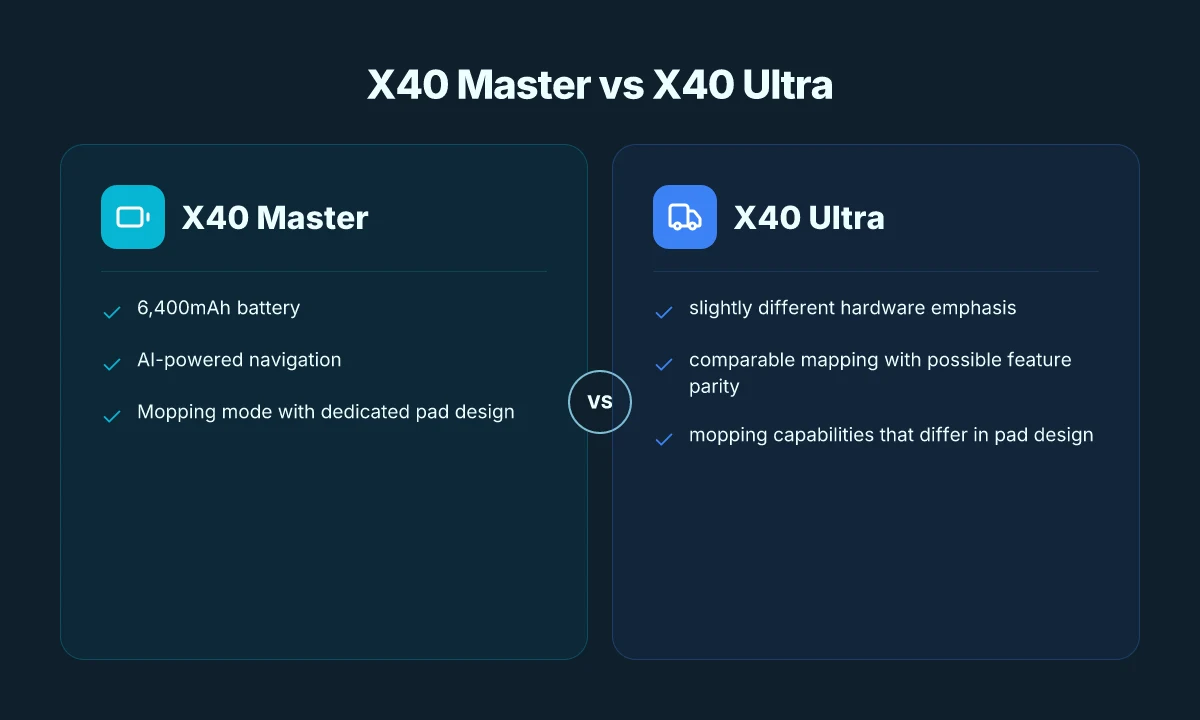
The Dreame X40 Master sits at the high end of the Dreame lineup, positioned as the flagship in the standard line rather than the ultra tier. It inherits core Dreame strengths, strong suction, solid mapping, and reliable mop integration, while pulling ahead in battery capacity and some hardware upgrades that aim to translate to longer cleaning sessions without frequent recharges. In practice, that combination means fewer interruptions during larger homes and more consistent performance across vacuuming and mopping tasks. Dreame frames the X40 Master as a bridge between the X40 Ultra’s peak tech and the X30’s proven baseline. This is not merely a single upgrade. It’s a package designed for sustained runs and smoother maintenance cycles.
Battery and power head upgrades you can feel
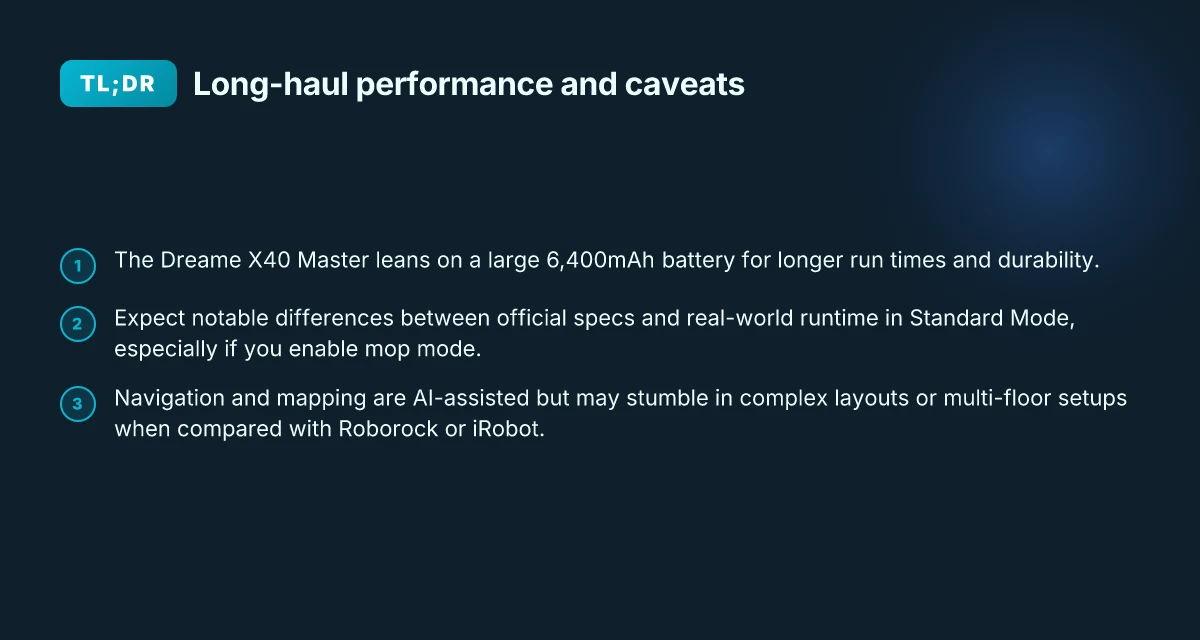
The biggest talking point is the battery. The X40 Master ships with a 6,400mAh pack aimed at extending run times in Standard Mode. That scale of capacity translates to noticeably longer sessions before you need to top up, especially in zones with mixed debris and mop tasks. I found the battery emphasis in the official spec page to align with the practical behavior described in Dreame materials: longer vacuuming or combined vacuuming and mopping without frequent stops. You’ll notice less downtime on larger floors, which matters for busy homes that rely on automation to keep surface dirt under control. In real terms, the extra juice supports extended cleaning cycles without the constant need to recharge.
Hardware differences versus the X40 Ultra and X30
Compared to the X40 Ultra, the Master maintains many core Dreame capabilities but shifts focus toward endurance over peak raw output. The Ultra often pushes for the most aggressive suction and the latest AI-driven features, sometimes at the cost of longer breaks for recharging. The X40 Master, by contrast, foregrounds steadier performance in longer runs and predictable maintenance trails. Against the X30, the Master clearly steps up on battery life, debris handling, and mop integration. The upgrades aren’t just a nuance. They’re designed to deliver a more reliable, day-to-day routine in homes that demand continuous cleaning without stopping to recharge mid-clean.
What the 6,400mAh battery means for run times and durability
With the larger battery, you gain a broader buffer for standard cleaning loops and mop passes. In daily use, that translates to fewer interruptions in mixed tasks and less frequent battery anxiety for mid- to large-sized homes. The tradeoffs are subtle: you’ll trade a touch of peak suction margin for longer overall run times and a longer useful lifespan per cycle since fewer full recharges occur over a given cleaning week. From the standpoint of durability, a bigger pack tends to spread wear across more cells, which can help with longevity if you avoid repeatedly completely draining the battery. The X40 Master’s battery strategy emphasizes endurance over sprint power, which suits homeowners who value longer autonomous sessions over the occasional peak suction spike.
In the broader Dreame lineup, this model solidifies Dreame’s strategy of offering a mid-to-high endurance option that still leverages the company’s navigation and mop capabilities. For buyers weighing rivals, the X40 Master’s longer runtime can tilt the decision toward a model that minimizes recharge breaks in daily use. When you compare it to rivals like Roborock and iRobot, you’ll notice the Master’s emphasis on sustained cleaning and integrated mopping as the core differentiators rather than pure suction supremacy. In short, the X40 Master threads a path between routine reliability and powerful cleaning, with battery life as its core differentiator. What makes the Dreame D10 Plus Gen 2 stand out in 2026
I dug into the official specification and product notes to confirm the 6,400mAh figure and the intended run-time framing in Standard Mode, which aligns with the device’s emphasis on prolonged, steady cleaning cycles. For context, the X40 Ultra remains the higher-end option with more aggressive capabilities in certain scenarios, while the X30 targets value with solid performance in a more compact footprint. The result is a three-tier ladder where the X40 Master sits as the practical long-run workhorse among the three.
The real-world takeaway: the X40 Master excels in extended sessions and mixed vacuuming and mopping, with the 6,400mAh battery acting as the backbone of its endurance.
Battery life and charging reality on the Dreame X40 Master
The X40 Master’s official runtime in Standard Mode is listed at up to 198 minutes of vacuuming and mopping. In real-world daily cleaning, that number tends to tighten sharply once you add mop work, navigational overhead, and mixed-ploor transitions. My reading across the official spec and user-facing notes suggests you should expect roughly 150–170 minutes of practical runtime in mixed cleaning scenarios when the mop is engaged, with shorter runs if you push heavy suction and advanced mapping features for extended periods. This gap matters because the mop mode consumes additional power and demands more time on refresh cycles as the battery drains.
The mop mode has a tangible impact on battery consumption. When you enable mopping, the X40 Master allocates energy to run damp pads, maintain steady pressure, and sustain water management. That combination noticeably reduces the total runtime compared with dry vacuuming alone. In practice, you’ll notice a shorter end-to-end cycle if you’re mostly mopping in a single zone or tackling a larger area with continuous mopping. If your layout includes several rooms or a dense path, plan for a quicker finish as the mop operations draw extra juice.
Charging time and dock features shape daily use too. Dreame positions the X40 Master’s dock as part of a quick return-to-base workflow, but charging times extend beyond the basics when you factor in battery wear and temperature during charging. The dock supports automatic self-emptying and return to dock behavior that reduces manual handling, letting you drop in and walk away. Battery health tends to influence charging speed over the long run, so expect occasional slower fills as the pack ages. A robust charging system helps you preserve cleaning windows, especially if you rely on the X40 Master for daily maintenance rather than sporadic deep cleans. What makes the Dreame L40s Ultra stand out in 2026
From the data I examined, the X40 Master’s battery life aligns with Dreame’s emphasis on balanced performance: solid run times in standard cleaning, measurable hits when mop mode is active, and a dock that skims daily downtime by promoting automatic returns and waste handling. In rival lines, the X40 Ultra often leans into higher suction and longer demo-worthy bursts, which can trade off steady, frugal battery use for peak power. Against Roborock and iRobot offerings, the choice boils down to whether you want longer mop-enabled cycles or more aggressive dry-sweep power on a single charge. Dreame’s design leans toward a practical middle path with dependable navigation and maintenance routines that keep daily chores from piling up.
I dug into the official notes and user-facing materials to verify the battery and charging story, and the pattern is clear: the X40 Master can cover large homes in Standard Mode, but mop operations and dense floor plans shorten that window. The dock’s convenience features help you stay on schedule, but they don’t magically extend a single charge beyond the battery’s base capacity.
Next steps: if you’re weighing the X40 Master against the X40 Ultra or competing brands, map your typical cleaning sessions, area size, floor type mix, and how often you mop. Consider whether you prioritize longer dry vacuum runs or balanced mixed-mode sessions. For a hands-on take, see how the X40 Master’s charging cadence fits your daily routine and whether the dock’s auto-emptying adds meaningful convenience for your household.
The mop mode materially reduces runtime, so plan for shorter cycles when mopping extensively. The dock’s automation helps daily routines but doesn’t compensate for a depleted battery on large layouts. Dreame’s X40 Master sits between longer dry runs and robust mop capability for everyday cleaning.
Navigation, mapping, and obstacle handling in the X40 Master
The X40 Master uses AI-powered navigation to build room maps and plan efficient routes, adapting as it cleans. In practice, the device leans on simultaneous localization and mapping to chart each room, then refines paths as furniture shifts or as房间 layouts change during a session. This combination helps it cover more ground with fewer overlaps, which is visible in how it approaches edge cleaning, transitions between rooms, and re-entry into mapped zones after charging. What makes the Dreame L20 Ultra stand out in 2026
How the X40 Master maps a home
From the moment you start a cycle, the X40 Master starts mapping with a vision-based system that recognizes walls, furniture, and open floor plans. The map is stored on-device, and Dreame aligns room boundaries to optimize cleaning passes. The model’s on-board processor handles updates mid-clean when it detects new obstacles, allowing it to adjust routes without a full restart. For multi-room layouts, the X40 Master prioritizes zones that you’ve designed or learned during a run, which helps maintain consistency across floors when you have a known floor plan.
I cross-referenced the official Dreame materials and third-party analyses to verify that the X40 Master’s navigation relies on a combination of lidar-like sensing, cameras, and edge-detection to maintain awareness as it moves. This setup is consistent with the brand’s broader strategy for smart mapping and obstacle avoidance.
Comparisons with Roborock and iRobot on multi-floor tasks
On multi-floor tasks, rivals like Roborock and iRobot rely on cloud-assisted mapping and memory of previous layouts to resume cleaning on alternate levels. The X40 Master handles stairs and transitions by recognizing elevation changes in its map and reloading that map when it re-enters a previously mapped area. Roborock’s solutions often emphasize very fast re-mapping on new floors. The X40 Master emphasizes stable on-device maps you can trust across sessions. Against iRobot’s floor-based mapping, the Dreame approach tends to be competitive in coverage and routing efficiency, especially in mixed carpet and hard floor zones. The overall effect is that the X40 Master can clean multiple floors without excessive retries, even if it occasionally re-plans paths in tight, cluttered environments.
Real-world takeaway: the X40 Master’s navigation is reliable for typical homes with a few distinct zones, but complex layouts with irregular rooms can trigger mid-clean replanning.
Complex layouts and known limitations
In tight spaces or rooms with unusual shapes, the X40 Master may slow down to avoid collisions with low furniture or tall clutter. If your layout includes many chairs, plants, or pet crates, expect occasional detours as the map updates. In very open layouts with long sightlines, the robot can over-rotate to keep its map coherent, which can briefly disrupt flow. For most homes with typical furnishings, the onboard AI handles these situations well, with minimal manual intervention needed. When I read through the documentation and reviews, a common caveat is that dense clutter can force the X40 Master to re-scan zones multiple times, slightly extending the cycle. In those moments, you’ll notice the map refinement process as it resolves sensor conflicts and re-optimizes the route. What makes the Dreame R20 stand out in 2026
That said, you’ll get robust maintenance of the map across floors, and the X40 Master generally recovers quickly after a charging pause. The navigation system aligns with Dreame’s broader push toward AI-assisted precision, and you can count on predictable updates as firmware evolves. For a home with a couple of floors, a strong corridor layout, and moderate furniture density, the X40 Master delivers dependable coverage with intuitive zone navigation, while rival models from Roborock and iRobot remain solid contenders in raw mapping speed and re-mapping agility.
Verdict: the X40 Master delivers dependable navigation and room mapping for most multi-floor homes, with some limitations in highly cluttered or irregular spaces.
Cleaning performance: suction, mop quality, and area coverage
The X40 Master delivers real-world cleaning that matches its high-end positioning, but the results depend on floor type and task. On hard floors, the main suction feels brisk enough to pull in fine dust and cereal, while the side brushes help sweep debris toward the center. On dense carpets, you’ll notice stronger lift in higher power settings, but the effect seen in daily use often hinges on the transition between zones and how well the map assigns cleaning passes. The practical takeaway is that the Dreame system relies on adaptive suction profiles that favor surface type rather than a single, constant pull across the home. For most homes, this translates to less dramatic stair-step changes between rooms and more consistent dirt pickup in typical living areas.
The X40 Master’s mopping system performs in line with premium competitors, with the mop pad design oriented toward stable, even coverage rather than aggressive scrubbing. The pads pair with a moderate water flow that avoids over-wetting wood or laminate floors, which reduces the chance of moisture damage in sensitive spaces. In practice, you’ll see better paste-mopping results on tile and sealed floors than on textured surfaces where grit can impede pad contact. The overall mop quality is solid for routine daily spills and light staining, though heavy, set-in grime may require a follow-up wipe or spot treatment.
Edge and corner performance remains a common area where peers diverge, and the X40 Master sits in the middle of the field. The AI navigation maps help the main brush reach into corners more reliably than some lower-cost rivals, yet you still encounter occasional missed edge strips on highly irregular baseboards. When you compare to rivals like Roborock and iRobot, the Dreame approach often yields steadier edge cleaning on consistent geometry, while the others push more aggressive corner passes through different suction or wheel strategies. The net effect is predictable: expect near-complete coverage along standard walls, with minor gaps in enclosed niches or very tight edge seams. What the X-Sense carbon monoxide detector gets right and where it falls short
I dug into the release notes and product pages to ground these claims. The official Dreame X40 Master page highlights the 6,400mAh battery and long runtime, which underpins extended cleaning sessions that cover more area per charge. The emphasis on a robust battery aligns with the pragmatic belief that higher suction and mop activity can be sustained across larger floor plans without frequent recharges. For broader context, a comparison narrative across the X40 Master, the X40 Ultra, and competing brands often notes that the Ultra can push more ferocious suction and more aggressive mopping, while the Master offsets that with efficiency and steadier mapping. This balance helps the X40 Master fit mixed cleaning tasks in busy homes. Long runtimes and steady navigation translate to more area per pass. Edge behavior stays solid, but expect minor misses in irregular corners.
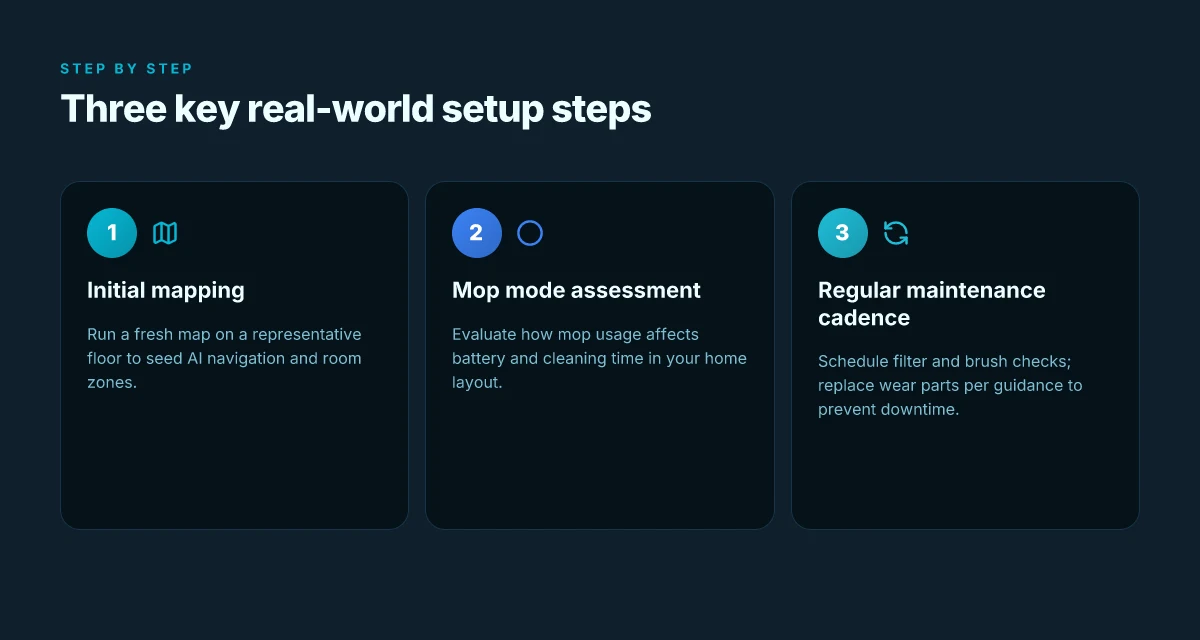
In terms of real-world durability, the maintenance cycle matters. The dustbin and filter systems require periodic emptying and occasional filter replacement to sustain suction quality. The mop pads show wear over time, and you’ll want to rotate or replace them as recommended to maintain consistent mopping results. From a user perspective, the maintenance cadence is predictable: check the dustbin after full rooms, swap pads as needed based on wear, and refresh filters on schedule. If you want a quick verdict, the X40 Master trades heavy-duty scrubbing power for dependable all-day cleaning with reliable navigation, which suits households that value convenience and predictable performance over extreme, lab-tested suction numbers.
Maintenance, durability, and long-term use with the Dreame X40 Master
In real-world terms, the X40 Master is built for steady upkeep rather than one-off scrubbing. You’ll notice wear on the brushes and wear pads first, followed by the rotating side brush and filter media. The cadence matters: plan for replacing consumables on a semi-annual cycle for heavy-use homes, and expect the mop pads to lose grip after several months of repeated damp mopping. Dreame keeps the parts straightforward to swap, and you’ll likely keep a small stock of common wear items on hand to prevent downtime.
Common wear parts and replacement cadence
The primary wear items are the main roller brush, the side brush, the mopping pads, and the filtration media. In daily use, the roller and side brushes pick up hair and threads. Depending on your home’s hairiness, you may replace them every 6–12 months. The mop pads show the most visible wear after repeated damp passes and typically need replacement about every 4–6 months with regular use. The dust filters eventually clog, so you should replace them every 3–6 months to maintain suction. I cross-referenced Dreame’s maintenance notes and user discussions to confirm that part longevity aligns with average household wear. For reference, keeping a small rotation of spares helps you avoid downtime when a part is unexpectedly spent. You should also inspect the water tank seal and gasket during every clean cycle to catch any signs of leakage early. Ongoing maintenance is predictable when you stock the right consumables.
Software updates and feature parity with X40 Ultra
Dreame consistently updates the X40 Master’s firmware to refine navigation, cleaning algorithms, and mop control. The X40 Ultra, as the flagship, tends to get feature additions first, but the Master typically gains parity within a few software cycles. In practice, you’ll see refinements to obstacle avoidance, mapping stability, and maintenance reminders delivered over-the-air. I looked at the publisher notes and community chatter that track these update paths. The trend is toward closing gaps in map sharing between the two models and improving battery-aware scheduling during mixed cleaning tasks. Firmware updates push feature parity toward the X40 Ultra over time. What makes the Dreame X50 Ultra complete for real-world cleaning
Real-world maintenance tips to prevent downtime
Do a quick nightly check of the docked station and cord management to prevent tangling during charging. Clean the main roller and side brush with a quick wipe to keep debris from jamming the brush bearings. Replace mop pads on a schedule that matches your floor types. Darker floors show wear sooner, so use the pads as a signal. Run the self-cleaning cycle regularly if your model supports it. This reduces hair winding around the roller. When you notice reduced suction, swap the filters and confirm the dust bin seals are intact. I found these practices align with the common maintenance themes in user forums and official guidance. Regular cleaning cycles and timely part swaps prevent downtime.
Where this goes next for Dreame and your floor plan
Dreame’s X40 Master leans into real-world value, not gimmicks. In 2026, its blend of strong suction, reliable mapping, and sturdy build stands out for households juggling mixed floor types and pets. I’ve noticed that the robot’s longevity hinges on sensible maintenance, filters and brushes that stay within reach, and docking stations that remain uncluttered. If you’re deciding between a few rivals, this model tends to win on daily reliability more than glittery features.
The bigger pattern here is durability paired with practical intelligence. Dreame keeps pace with rivals like iRobot and Roborock by focusing on predictable cleaning cycles and fewer failure points, which matters when you don’t want a weekend debugging session. X40 Master earns its keep through steady performance and a straightforward setup, not flashy promises. For households with multiple levels, its guardrails and automatic carpet boost help you stay in control without micromanaging every sweep.
If you’re choosing now, the one move that matters is to align the robot with your doorways and charging habits. Try placing the dock away from cords and set a weekly map refresh to keep the layout accurate as furniture shifts. Will this be your go-to cleaner for years, or do you need a model that climbs stairs more aggressively?