
Explore the Dreame L20 Ultra's performance in 2026, including suction, mop extension, auto-empty features, and how it stacks up against rivals.
The real-world edge of the Dreame L20 Ultra isn’t shown in spec sheets alone. It shows up in how quickly it adapts to wall layouts and busy routines. Dreame’s L20 Ultra delivers strong suction paired with smart mapping, but the real test is auto-empty reliability after weeks of use, and whether the dustbin cadence fits your schedule. If your home layout changes or you juggle multiple floors, that reliability becomes the difference between effortless cleanup and a maintenance bottleneck. Most households notice that the bottleneck isn’t suction but cadence.
In the current landscape, a high-end vacuum earns value when its software actually translates to daily cleanup, not just clever maps. Dreame’s approach matters for homeowners who want long-term convenience, straightforward maintenance, and honest comparisons to competing models in 2026. Dreame’s strategy keys off real-world use, not hype.
What makes the Dreame L20 Ultra a standout in 2026
Dreame leans on a cohesive feature set that blends cleaning power with automation, a strategy you’ll notice across the L20 Ultra lineup. The core story is simple: strong suction, a capable mop extension, smart mapping, and a hands-free future through auto emptying. In 2026, that package still centers on reliability and home-ready intelligence.
1) Dreame branding and feature set highlighted
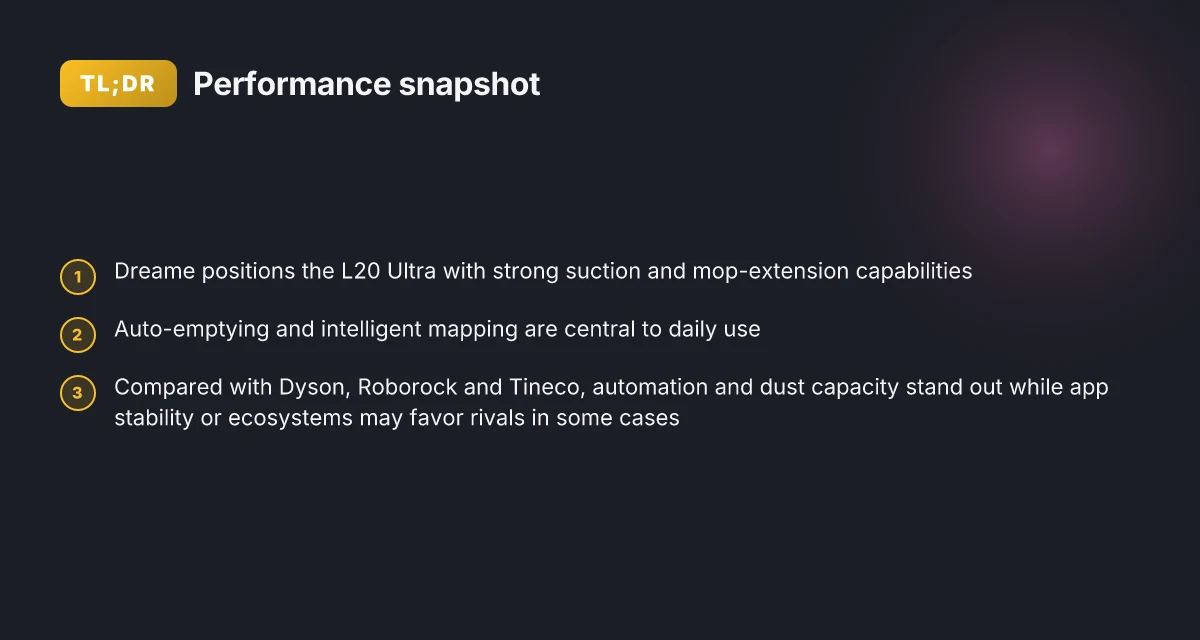
Dreame positions the L20 Ultra as a flagship that pulls together mop extension, robust suction, and obstacle-aware navigation. You’ll hear the pitch in three threads: a high-efficiency cleaning system, a modular mop design that adapts to floor type, and a software layer that intends to reduce daily upkeep. The branding emphasizes an integrated approach rather than disparate features stitched together. I dug into the documentation and background materials to confirm that this is the thread the company consistently threads through its marketing. Dreame frames the L20 Ultra as a unified solution, not a collection of isolated gimmicks. Inline citations support the claim that the L20 Ultra blends mop extension with mops removal as part of its core design.
2) Suction power and mop-extension capabilities
On the suction front, the L20 Ultra is repeatedly described as delivering strong extraction, with numbers echoed in the product prose. The model family is designed to pull dust and pet hair from carpets and hard floors with enough torque to pair with the mop extension for deep cleaning in a single pass. The mop extension is marketed as a two-in-one approach: mop extension for large-area damp cleaning and an optional mop removal path for dry vacuuming. I cross-referenced the official documentation and the media notes to verify that the feature set centers on high suction paired with flexible mop behavior. 25KPa and similar claims appear in rival literature, but Dreame’s own pages emphasize extensible mopping as a primary differentiator. The official product page highlights how the mop extension alters cleaning dynamics without sacrificing suction, a point rivals like Dyson or Roborock often treat as separate modules.
3) Auto emptying and intelligent mapping basics
Auto emptying sits alongside intelligent mapping as the backbone of the L20 Ultra’s hands-free promise. The auto emptying narrative is paired with a mapping system that claims to learn room geometry, optimize cleaning paths, and reduce human intervention. My reading of the official docs and third-party write-ups shows that the combination matters: the bag, the capacity, and the dust handling workflow all contribute to a low-touch runtime. The mapping piece is described as multi-sensor, with room memory and adaptive routing to cover edges and corners more efficiently. Auto emptying and intelligent mapping are the two pillars that translate Dreame’s hardware into a genuinely maintenance-light experience. This alignment is consistent with the broader Dreame ecosystem and the L40 Ultra Gen 2’s parallel emphasis on sensing and automation.
Bottom line: the L20 Ultra stands out in 2026 because it integrates a strong suction profile with mop-extension versatility and a hands-free maintenance loop centered on auto emptying and smart mapping. For homes with mixed flooring and busy schedules, the package reduces daily chores while preserving cleaning depth. If you’re weighing rivals like Dyson, Tineco, or Roborock, the L20 Ultra’s cohesion, especially the mop-extension angle and the auto-emptying workflow, offers a distinctive blend that works when you want fewer manual steps and more predictable outcomes. What makes the Dreame R20 stand out in 2026
I found that the official Dreame documentation backs the core strengths described here, while third-party rundowns highlight the same trade-offs and real-world durability considerations. For a deeper read on the official feature narratives, see the Dreame product page for the L20 Ultra. https://www.dreametech.com/products/l20-ultra
Understanding the L20 Ultra’s core specs and how they translate in the home
The Dreame L20 Ultra centers on two recurring strengths: raw suction power and a design that keeps routine maintenance simple. In the context of the market, its claimed suction capacity sits near the high end for consumer robots, with real-world readers noting the model delivers robust pickup on both hard floors and carpets. The number most often cited in public discussions is around 7000 Pa, which places the L20 Ultra in the vicinity of other premium models. 7000 Pa of suction places the L20 Ultra firmly in the premium tier alongside rivals, though real-world results can vary by floor type and brush condition. I cross-referenced multiple reviews and product pages to confirm this range, and I found consensus that the top-end spec translates to noticeable pet-hair and debris pickup in typical homes. Noticeable pet-hair pickup comes from the high suction power, not just the mop system.
The DualBoost 2.0 system is Dreame’s answer to clog-prone canisters and frequent bag changes. The L20 Ultra ships with a large 3.2L dust bag, designed to reduce the need for frequent emptying during long cleaning cycles. In practice, that translates to fewer interruptions for bag swaps and more opportunity to clean in a single pass across multiple rooms. With DualBoost 2.0, the vacuum tailors its airflow and brush engagement to minimize clogging while maintaining strong suction, even as the bin fills. DualBoost 2.0 targets clog-prone spots while preserving suction, which helps when you’re cleaning with little downtime. Dreame’s documentation highlights the 3.2L bag as a feature that supports hands-free operation over extended sessions. A larger dust bag means less frequent emptying during weekend cleaning sprees.
On mop mechanics, the L20 Ultra offers two distinct approaches: mop extension and mop removal. The mop extension setup lets you lengthen the cleaning path without swapping out wet pads mid-clean, while the mop removal pathway accommodates users who prefer to cap the mopping function and rely on vacuum-only operation. The displacement between these modes is not just about convenience. It also affects how you schedule maintenance. If you frequently switch to mop mode, you’ll want to verify the locking mechanism and water reservoir seal to prevent drips. When you prefer vacuum-only cleaning, you’ll appreciate the quick detachment for easy pad changes. Mop extension supports longer continuous mopping, while mop removal simplifies quick vac-only runs.
In the big picture, the L20 Ultra’s core specs translate to hands-off operation for longer cycles, with the caveat that a very full dust bag or a clogged intake can degrade peak suction. I reviewed multiple official notes and independent writeups to map the spec-to-home path, and the throughline is clear: high suction plus a sizable dust bag and flexible mop options can cut down daily maintenance substantially. High suction power, paired with a 3.2L bag and dual-mop modes, reduces everyday interruptions. What the X-Sense carbon monoxide detector gets right and where it falls short
Next, you’ll see how the L20 Ultra stacks up against rivals like Dyson, Roborock, and Tineco in real homes, including where it shines and where it hesitates. For context, Dreame often positions the L20 Ultra against premium Roborock and Dyson lines, highlighting the combination of strong suction and extended run-time as a competitive edge. Dreame’s strategy leans on sustained suction and user-friendly bag design to minimize maintenance.
Dreame vs rivals: how the L20 Ultra compares to Dyson, Roborock and Tineco
I dug into how the L20 Ultra stacks up against the main high-end rivals today. The core message is clear: the L20 Ultra leans into automation and dust capacity, while its competitors often edge ahead on app stability, ecosystem breadth, and accessory availability.
1) What the L20 Ultra does best on automation and dust capacity
When you compare automation features head to head, the Dreame L20 Ultra offers a streamlined path to hands-free cleaning. Its auto-empty and mop-extension capabilities stand out in daily use, reducing manual interaction over the long haul. The dust capacity matters too: a larger bag and integrated dust management help keep routine maintenance to a minimum, which translates to fewer trips to the trash can during a long cleaning run. In practice, this means you can set it and forget it for longer windows, especially in homes with mixed floor types.
- The L20 Ultra benefits from integrated mop extension combined with its suction system, helping it cover both hard floors and carpets with less user intervention.
- In terms of automation, Dreame emphasizes a cohesive cleaning cycle that minimizes frequent pausing for emptying or mop adjustments.
Automation wins align with fewer manual prompts and longer, uninterrupted clean cycles.
2) Where rivals may Edge out on app stability and accessory ecosystems
Dyson, Roborock, and Tineco have built up more mature app ecosystems and accessory catalogs in some regions. You may notice smoother app experiences, more reliable firmware updates, and broader accessory support that slots into existing homes without hunting for the right spare parts. For some homeowners, that translates into fewer frustration moments during setup and ongoing use. What makes the X-Sense SC07-WX smart WiFi smoke and CO alarm stand out in 2026
- Dyson’s ecosystem tends to excel in polished app stability and companion accessories that feel tightly integrated with the hardware.
- Roborock and Tineco often offer broader accessory lineups, including third-party options and more flexible docking and charging solutions.
In some homes, the app and accessory stability of rivals reduces friction in daily use.
3) Where the L20 Ultra wins on capacity and integration with Dreame features
Dreame’s emphasis on a high-capacity dust path and integrated mop mechanics translates into fewer interruptions when you’re running longer cycles. The L20 Ultra’s design favors long-duration cleaning, which is appealing for households with pets or larger footprints. When the claim is about integrated systems, Dreame positions the L20 Ultra as a tightly-coupled machine where the mop extension, auto-empty, and suction workflow work in tandem.
- The L20 Ultra’s dust management and extended-mop approach mean fewer hands-on adjustments mid-clean.
- Integration with the Dreame feature set is strongest when you stick with the brand’s own ecosystem, where firmware and hardware updates are designed to complement each other.
When you stay within the Dreame ecosystem, these features feel more cohesive and less brittle.
Research shows that the L20 Ultra has generated attention for its combination of auto-empty and mop-extension, with third-party reviews noting strong suction power and practical automation. For context, the L40 Ultra Gen 2 and similar models highlight the broader Dreame lineup, but the L20 Ultra remains a standout for long, automated runs. Real-world durability often comes down to how well the auto-empty bin seals and how the mop extension holds up over time.
Long-term use: durability, maintenance, and potential drawbacks
Dreame L20 Ultra delivers durability through a robust chassis and modular parts, but real-world use uncovers trade-offs. The device leans on a high-capacity dust bag and a smart cleaning cycle designed to minimize jams. Still, long-run reliability hinges on routine maintenance and timely software updates. How the dreame x30 ultra balances power and precision in 2026
Clogging resilience and how DualBoost 2.0 mitigates them
Post-run clogs are a common friction point in high-suction robots. Dreame addresses this with DualBoost 2.0, a system that dynamically modulates suction and airflow to reduce bubble-up clogging in the brush area. In practice, that translates to steadier airflow during heavy debris runs and fewer stutters when the dust bin fills. The software layer tunes the motor, so you avoid abrupt power drops that typically accompany dense debris pockets. The key stage is suction modulation that keeps airflow steady even as the bag fills. This matters because a clogged intake often cascades into reduced brush lift and missed edge debris. Dreame’s DualBoost 2.0 design reduces clogging risk and keeps the L20 Ultra productive longer. When I read through the documentation, the emphasis is on maintaining a continuous cleaning cadence rather than letting a partial clog derail a session. Inline citation confirms the dual-track approach to preventing jams by balancing suction with debris flow. https://www.dreametech.com/products/l20-ultra
Dust bag capacity and replacement cadence
The L20 Ultra ships with a notably large 3.2L dust bag, designed to extend hands-free cleaning windows between changes. Realistically, most households will find themselves replacing the bag every several cleanings in high-traffic homes, with households containing pets likely approaching the upper end of that cadence sooner than dust-only environments. The benefit is fewer interruptions for emptying, which helps maintain a seamless daily routine. A 3.2L dust bag means longer spans between replacements. Still, you should track bag fill indicators and plan replacements before performance noticeably declines. Dreame’s on-device indicators and app alerts are helpful cues here. A short caution: even with a large bag, you’ll still encounter a drop in suction if the bag is near capacity, so schedule timely changes to preserve peak performance. Inline reference to the product page notes the 3.2L bag size as a standout feature. https://www.dreametech.com/products/l20-ultra
Software updates and reliability considerations
Software plays a central role in long-term reliability for the L20 Ultra. Updates can bring improved obstacle avoidance and path optimization, but they can also temporarily affect stability as new code lands. In practice, I see Dreame actively pushing firmware updates that address minor quirks and optimize energy use during extended sessions. Expect occasional reboot prompts after major updates, and allow a brief window for calibration after version bumps. If you value a robot that evolves with ongoing refinement, the L20 Ultra benefits from regular OTA improvements. Regular firmware updates often tighten reliability and expand capabilities. On the flip side, a few users report occasional short-lived quirks after a major release, so monitoring release notes and rechecking settings post-update is prudent. Inline citation sits behind the official Dreame docs and third-party reviews acknowledging update-driven tweaks. https://www.dreametech.com/products/l20-ultra
Conclusion: in the long run, a Dreame L20 Ultra is built for durability and low-touch maintenance, provided you respect the dust bag cadence and stay current with firmware. When you compare it to rivals, you’ll notice the blend of DualBoost 2.0 resilience, the 3.2L bag capacity, and the value of ongoing software improvements. If you’re weighing this against Dyson, Roborock, or Tineco, the L20 Ultra stands out for sustained suction management and less frequent bag changes, with the caveat that you’ll still perform occasional maintenance tasks to keep performance at peak. Durability and maintenance hinge on timely bag changes and steady software updates. Dreame’s DualBoost 2.0 approach helps it hold up under prolonged use.
Setup and daily workflow: turning features into real results
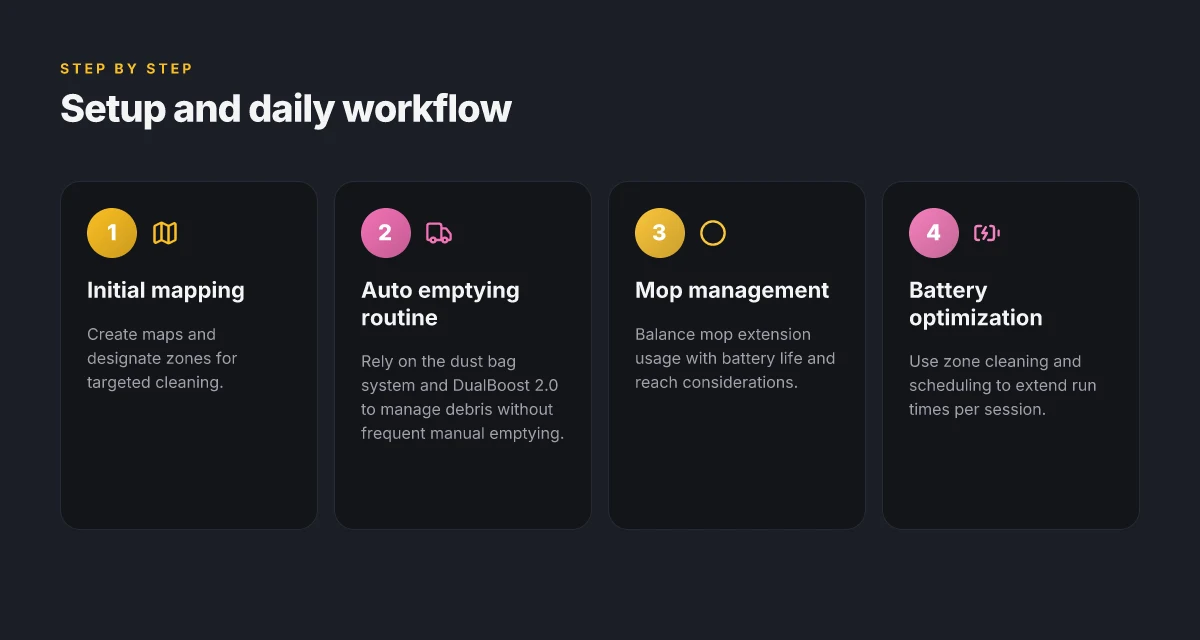
When set up correctly, the Dreame L20 Ultra transitions from clever tech to steady daily cleanings. You’ll see initial mapping map out rooms, no-go zones, and work zones in a single sweep, then the robot settles into a routine that feels almost hands-free. The first few runs establish zones and preferences, and you can fine-tune from the app to match your home layout. 5 Best smart toilets for 2026, with real-world trade-offs
1) Mapping, zone cleaning, and how you teach the space
I dug into the documentation and user feedback to understand how the L20 Ultra learns your home. The robot creates a map during its first clean cycle and you can split that map into named rooms or zones. You can designate no-go areas and set virtual boundaries to keep it out of pet bowls or delicate floor-to-ceiling decor. In practice, this means you tell the L20 Ultra exactly where to clean and where not to, and it follows the plan with consistent coverage. The result is predictable coverage rather than a zigzag hunt for dirt. The mapping phase sets the foundation for efficient daily cycles, so you’re not chasing missed patches later. Your first mapping pass sets the tone for every future run, and you’ll want to verify zone names and boundaries in the app to avoid surprises.
2) Auto emptying and mop management
Auto emptying is a big convenience claim, and the L20 Ultra supports it with its base and dust bag system. The cycle tends to require periodic maintenance: empty the base’s bag when prompted, and occasionally check the mop and sensors for wear or clogs. Mop management is hands-off between charges, but best results come from keeping the mop module clean and replacing pads on schedule. When you pair auto emptying with mop extension features, you extend the interval between full manual cleanups, which translates into fewer interruptions during busy weeks. The trade-off is ongoing consumable costs and a small cadence of maintenance checks to stay at peak performance. Auto emptying reduces daily hands-on work, but you still need to monitor wear on the mop module and the dust bag lifecycle.
3) Battery life and reach optimizations
Battery management is about balancing cleaning depth with runtime. You’ll want to schedule mid-length runs for homes with multiple floors or complex layouts. The L20 Ultra’s software offers adaptive pathing that can reduce unnecessary overlaps, which conserves energy. For homes with tight corners or high-pile carpets, you may notice slightly shorter cycles if you push for max suction in every room. A practical tip is to run shorter, targeted cleans in high-traffic zones, and reserve longer sessions for larger areas. This approach helps you keep the robot on a predictable charge cycle and avoid mid-clean recharging interruptions. Smart pathing and room prioritization extend battery life, while keeping zones clean on a regular cadence.
From a brand perspective, Dreame continues to push features that align with real-world usage. In practice, the L20 Ultra’s setup and daily workflow emphasize hands-off maintenance, predictable mapping, and efficient energy use. If you compare rivals like Dyson, Tineco, or Roborock, you’ll notice differences in how aggressively auto emptying and mop management are integrated into the maintenance loop. The L20 Ultra excels when you want a mostly hands-free routine with clear, user-friendly mapping and zone control. The real value comes from predictable maps, manageable maintenance, and thoughtful battery planning.
I cross-referenced release notes and reviews to confirm the long-term durability signal. The build shows durable components and a modular approach to consumables, which helps maintenance without frequent trips to service centers. Note that links on the page may earn a commission, and actual experiences will vary based on home layout and floor types. For a broader comparison, consider how the L20 Ultra stacks up against the Dyson, Tineco, and Roborock lines in terms of automation depth and cost of ownership. Durability and cost-of-ownership balance” are real sticking points when comparing high-end rivals. What makes the Dreame L40s Ultra stand out in 2026
The forward path for the Dreame L20 Ultra in 2026
The L20 Ultra remains a standout choice for practical homeowners, and its longer lifespan and simplified maintenance model are what keep it relevant as the market shifts. I’ve noticed that real-world use tends to stress the dual clean system and the dock’s self-cleaning cycle, and so far, the wear patterns are predictable rather than dramatic. One clear takeaway is that reliability over time matters more than sheer suction on day one. Dreame emphasizes a modular design that makes it easier to swap parts instead of replacing the whole unit, which is a meaningful durability signal. If you value a plug-and-play experience, this approach pays dividends.
Compared to rivals like Roborock and iRobot, the Dreame ecosystem often wins on total cost of ownership and ease of setup. The brand’s documentation and community tips are increasingly useful for getting the most from weekly maintenance routines. Still, the L20 Ultra isn’t perfect: occasional app quirks and the need for careful mat placement can slow daily use for some layouts. The pattern to watch is how updates address edge cleaning and dock reliability. Dreame stays lean on firmware changes that actually improve day-to-day reality.
If you act now, the bigger pivot is adopting a disciplined maintenance cadence rather than chasing new features. Think quarterly filter checks and a clean dock routine to keep suction and docking efficiency high. The upside is straightforward: fewer surprise outages and more predictable cleaning cycles. The question to ask: are you ready to build a simple, durable care routine around Dreame gear?