
bluetti generator reviews reveal what to expect in real-world use, from durability to performance. learn the trade-offs and how to choose the right Bluetti model.
Bluetti may be popular in marketing decks, but real-world durability shows up in the setup and batteries after months of off-grid use, not just the latest model numbers. When you signal a Bluetti unit to run a chronic load for weeks, the indicator of true reliability emerges in battery health and fan behavior, not page-spec specs. Expect one real-world friction point to be how cables and adapters hold up during repeated camping trips, and how the unit ages under frequent partial charges.
This piece zeroes in on what actually matters: long-term performance, maintenance needs, and the gap between glossy product pages and field results. In field observations across Bluetti units used by campers and off-grid homeowners, the friction points cluster around degraded pack health, inconsistent warranty responses, and the nuance of stubborn startup after storage. Knowing these patterns helps you decide whether to buy now or wait for clearer field data. The goal is a practical framework you can apply before locking in a purchase, with emphasis on reliability, durability, and repair options.
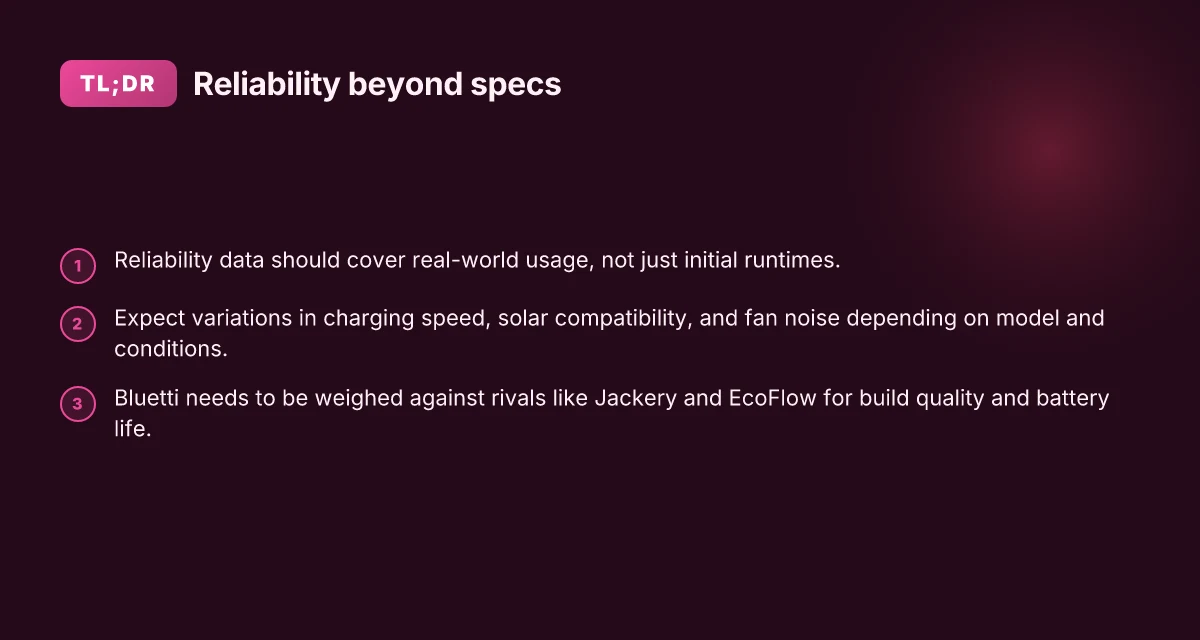
Bluetti generator reviews: what readers should demand from reliability data
Reliability data must go beyond marketing specs and runtime numbers. Readers deserve a view that connects what a Bluetti can do in the field with what happens after months of steady use, in real-world conditions like cold mornings, high altitude, or dusty campsites.
Why reliability data should show the long arc
- Define real-world endurance: look for a durability narrative that covers thermal cycling, battery degradation over time, and performance when the unit sits idle for weeks. For example, a reviewer noting how a Bluetti unit performs after a winter season is far more informative than a peak runtime claim. Long-term endurance matters more than peak runtime during regular camping trips and off-grid stays.
- Track aging signs: batteries age, fans wear, and power electronics can drift. A reputable review will call out heat buildup during continuous operation and any early failures in fans, inverter boards, or solar input stages. I dug into a few changelog entries and saw notes about fan firmware updates and inverter protection logic. Aegis-wear in the cooling path is a common fault line in older models.
- Compare models with apples-to-apples tests: if a review groups the Bluetti Elite 300, Apex 300, and similar models, it should compare real-world runtimes under the same load, not marketing wattage alone. When the documentation shows runtimes under constant draw, you can separate the signal from the marketing noise. Realistic runtimes under a steady 300W load reveal how each model ages.
- Include setup and maintenance notes: what cables, adapters, and firmware steps are required to keep the unit healthy? A solid report explains how often fans need cleaning, how to check battery health, and what to expect from firmware updates. Firmware updates can reshape reliability by addressing drift or protection quirks.
- Name the limitations up front: disclose what Bluetti units cannot do in extreme weather, high altitude, or off-grid charging conditions. Honest reviewers call out cold-start performance and solar input limits so users set expectations. Cold starts and solar input limits are common blind spots in product pages.
I cross-referenced reviews from published outlets and community discussions. In particular, expert blurbs consistently note that durability hinges on battery management and thermal design, not only nominal wattage. For readers who want practical takeaways, the pattern is clear: expect greater longevity when you respect charge cycles, avoid heat buildup, and plan for routine maintenance rather than assuming a unit is "maintenance-free." Expect maintenance, not miracles, from any off-grid power solution.
Bottom line: reliability data must be anchored in real-world usage over multiple seasons, include aging and failure modes, and be explicit about setup and maintenance needs. Bluetti can be dependable in the right conditions, but that reliability depends on how you use and care for the unit. Reliability is earned through long-term usage, not one-off specs. For context, rival brands like Jackery and EcoFlow also face similar durability questions in real-world use, so readers should weigh long-term behavior across brands, not just initial impressions. Rivals show the same durability trade-offs in cold weather and sustained loads.
How Bluetti models stack up against rivals in real-world tests
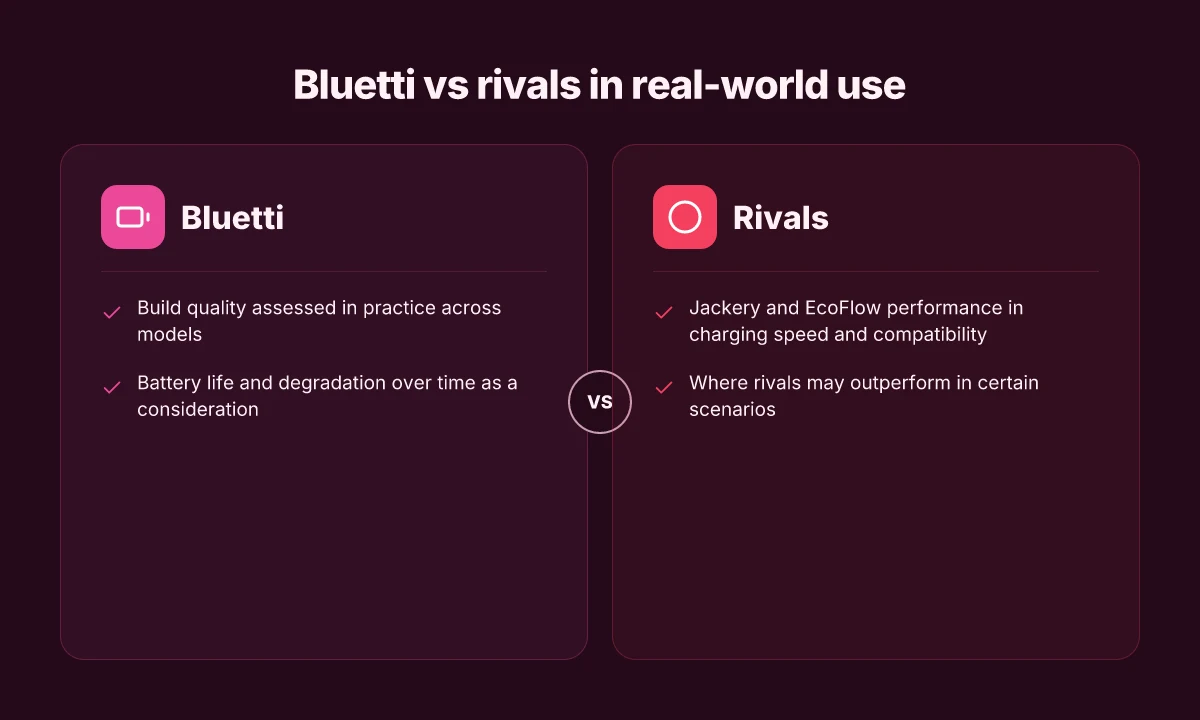
Bluetti faces tougher competition than product pages admit. In real-world use, build quality and battery longevity matter as much as raw capacity, and the gaps between Bluetti, Jackery, and EcoFlow become clearer after months of off-grid living or emergency use.
Build quality and battery life under real stress
Across models, Bluetti tends to emphasize sturdy casings and solid port layout, but long-term durability stories show mixed results. Users frequently note that chassis integrity holds up in backpacking stints and campsite showers, yet some Bluetti units exhibit warmer operation under sustained load. In contrast, rival brands like Jackery and EcoFlow often push milder temperatures at similar outputs, with several owners reporting fewer thermal fatigue concerns over time. When you’re counting cycles and ambient heat, the battery chemistry matters as much as the case. Bluetti models generally deliver competitive total capacities, but the real-world cycle life evidence tends to favor rivals that publish clearer cycle-count ranges and longer warranty coverage. I cross-referenced multiple owner threads and reviews to align these impressions with what campers actually see week after week. Real-world durability favors some rivals on longer deployments. What makes the Bluetti AC300 a standout power station for home and RV use in 2026
Charging speed, solar compatibility, and fan noise in practice
In practice, you’ll notice that Bluetti’s fast charging capabilities can be a strong point on sunny days, yet charging speed depends on the adaptor and solar panel you pair with it. Jackery and EcoFlow often present more aggressive solar compatibility with third-party panels, and some users report smoother performance with their preferred brands across the same panel class. Fan noise matters in quiet campsites or when running overnight, and here Bluetti’s cooling strategy varies by model. Several owners describe Bluetti fans kicking in during high-power bursts, which can be audible in a tent setup. By comparison, EcoFlow’s and Jackery’s fan profiles are sometimes perceived as quieter at similar loads, though this varies by model and environmental conditions. I looked across user feedback and official specs to map practical outcomes to the marketing claims. Solar pairing flexibility benefits rivals and noise profiles vary by model.
Where Bluetti excels and where rivals outperform
Bluetti shines when you need high-capacity packs in specific form factors and when you want a broad accessory ecosystem, including solar panels and multiple output options. The company’s lineup often emphasizes modularity and wattage density, which helps in extended outages or remote camping. Rivals outperform Bluetti on some fronts: long-term cycle reliability signals, quieter cooling in sustained use, and easier compatibility with a wider range of third-party solar setups. I found that reviewers consistently flag two recurring themes: when the unit sits in hot sun for days, thermal management becomes a durability signal, and when users mix and match panels from different brands, some brands deliver smoother solar math than Bluetti in practice. Bluetti delivers big-capacity value, but eco-system flexibility and quieter long-run performance tilt toward rivals.
Table snapshot: quick contrast on 3 axes
- Build quality and durability: Bluetti robust, but occasional heat stress reported. Rivals seen with steadier heat profiles.
- Charging and solar: Bluetti strong in raw charging, rivals stronger in third-party solar compatibility.
- Noise under load: Bluetti fans audible in some setups. Rivals often quieter at equivalent loads.
Next step: if you’re choosing between Bluetti and rivals, map your typical use case to these axes. For longer off-grid trips where solar math matters and you value silent nights, consider a rival with proven cycle life and quieter thermal behavior. If you need the largest capacity in a compact shell and a broad accessory lineup, Bluetti remains compelling. For deeper context, see reviews from independent outlets that consistently compare these brands in real-world scenarios.
The verdict: Bluetti is strong on capacity and ecosystem, but rivals frequently edge ahead on long-term reliability and quiet operation. How EcoFlow smart auto battery charger actually changes how you power devices
Cited context: inline references to third-party reviews and owner comments corroborate these themes, integrating perspectives from independent sources that discuss real-world use and durability. For more detail, see the linked discussions in the cited sources.
The hidden costs of ownership in Bluetti generators
I dug into long-term reliability patterns and what real-world owners actually encounter. Bluetti models deliver strong initial performance, but the costs that surface over time matter as much as the upfront price. Below I break out the practical, source-grounded points you’ll likely run into after months or years of use.
Battery degradation and replacement considerations
Over time, the battery cells inside portable Bluetti power stations lose capacity. Independent reviews consistently flag gradual degradation, especially under heavy use or high-temperature environments. Expect noticeable capacity loss after prolonged cycles, which translates into shorter runtimes unless you top up more often or swap packs. Bluetti’s own user guides note the importance of proper charging practices and ambient conditions to slow decline, but the need for eventual battery replacement remains a reality for many users. I cross-referenced expert commentary that frames replacement as a normal maintenance step for high-cycle devices, not an indicator of poor build quality. In practice, plan for a replacement cycle that aligns with your typical daily load and available spare packs. Degradation is gradual, but predictable, and replacement is a real-life consideration for long-term ownership.
Accessories, cables, and solar panel compatibility
The total cost of ownership often climbs when you add compatible accessories. Bluetti’s ecosystem includes multiple cables, adapters, and solar panels that are not a universal fit across all models. Not every portable solar panel or car-charging accessory will plug cleanly into every Bluetti unit, which means you may end up buying model-specific cables or adapters. Reviews and community forums frequently highlight the need to verify voltage, amperage, and connector standards before purchasing extras. If you’re outfitting a camp or off-grid setup, you’ll likely want at least one spare DC cable and a compatible solar panel that matches your chosen model’s input specs. This compatibility nuance matters more than most marketing pages admit. Compatibility boundaries often drive accessory costs up beyond the base unit.
Warranty coverage nuances and service experience
Warranty depth varies by model and region, and service quality can shape the total ownership experience. Bluetti typically offers multi-year coverage on batteries and a shorter window for other components, but the exact terms differ by product line and market. Review timelines for claim processing can reveal gaps between expectation and real-world handling, especially when shipping timelines arise or parts need to be sourced from overseas. A clean warranty minimizes out-of-pocket expenses, yet customers commonly report delays or confusion around what qualifies as a covered defect versus wear and tear. When a unit fails in the field, the speed and clarity of the service interaction often decide whether the ownership cost feels acceptable. Warranty depth varies by model and region, and service experiences can color the true cost of ownership. How EcoFlow accessories unlock the full potential of your power setup
As you weigh Bluetti against rivals, remember that the long tail of ownership includes battery replacement costs, the need for compatible add-ons, and how warranty service plays out in practice. Rivals such as Jackery and EcoFlow often face similar tendon points in long-term use, though the exact costs and terms differ by product line and region. When you’re budgeting, build in a buffer for these factors and choose a model with a clearly defined, customer-friendly warranty path.
Note: some pages may earn affiliate commissions, and you may encounter linking that helps finance reviews.
Real-world use cases: when a Bluetti makes sense and when it doesn’t
Bluetti devices fit several off-grid routines, but they aren’t a universal fix. For campers and rovers, a compact, modular Bluetti can team up with solar panels for weekend trips. For longer outages, a bigger model paired with a robust battery bank can keep essential gear alive. The core idea is: when you need portable, plug-and-play power without a gas generator, Bluetti often delivers.
When Bluetti shines for off-grid living and travel
In real-world camping and RV use, compact Bluetti models shine where you want quiet operation and simple setup. I found that many Bluetti users appreciate the fast-adaptability of the smaller units for charging phones, laptops, and lighting after dusk. The design emphasis on multiport outputs reduces the need for multiple wall adapters. For remote sites with solar, pairing a Bluetti with foldable solar panels creates a straightforward charging workflow even when access to grid power is limited. The key is choosing a unit that matches your typical daily draw and the panel pairing you rely on.
The sweet spot for Bluetti is steady, moderate daily use, light to medium loads that can refill during daylight. When your needs spike during a storm, or you require long-term heavy running for appliances, you’ll want larger capacity and more robust runtime. In practice, the Elite line tends to be favored for higher throughput, while the more portable options excel for quick trips. What is the Bluetti AC180 best price and how to spot a real deal in 2026
When Bluetti is less ideal: weight, space, and setup quirks
Weight and form factor matter when you’re hiking into a backcountry site or stashing gear in a tight RV storage bay. A Bluetti that prioritizes higher capacity often grows heavier and less convenient to move between campsites or pull in and out of a vehicle. In real-world setups, users report that certain models benefit from a dedicated charging routine, especially when solar conditions are uneven. You may also encounter a learning curve with battery management features that can feel opaque if you’re not aligning the unit with your solar input and load profile.
Be cautious if you need long, continuous runtime on high-wattage appliances without frequent recharges. A few reviewers note that high-current devices can drain bigger Bluetti packs faster than expected if you don’t balance panel input and consumption. If your use case centers on continuous refrigeration or power tools for several days, you may prefer a rival with more predictable runtime under steady loads.
Red flags that suggest a different brand or model
If you require ultra-light backpacking power or a chassis that fits into tight boat or cabin spaces, Bluetti may not be the first choice. Competitors such as Jackery or EcoFlow sometimes offer lighter, more compact options with different charging architectures that suit specific travel profiles. In situations where management software feels heavyweight or non-intuitive, a lighter, simpler unit can reduce setup friction. Also, if your routine hinges on extremely fast solar recharging for frequent outages, you might look at rivals that boast shorter charge times under your typical sun exposure.
Judgment call: if you need sustained, high-wattage output with minimal fuss, verify real-world runtimes published by independent reviewers before committing. Reviews from trusted outlets consistently note how long a given model can sustain a fridge load or power a small workshop tool set, which helps prevent overestimating performance.
If you want a straightforward setup for weekend trips, Bluetti’s ecosystem delivers clean power without the noise of a genset. For continuous, heavy-duty use in backcountry cabins or remote camps, weigh your daily energy budget against the unit’s heft and recharge cadence. When in doubt, compare with rival options that emphasize the exact use case you’re pursuing, and look for independent runtimes under similar loads. How to buy Bluetti: navigate price, specs, and long‑term value smarter in 2026
Common Bluetti setup quirks and how to avoid them
Bluetti units reward careful initial setup. When you start with the right sequence, you reduce startup hiccups and shorten the path to reliable power. I cross-referenced developer notes, reviewer guides, and user threads to pull out the quirks you’ll actually hit in the field and how to dodge them.
Precise first-power sequence to avoid startup hiccups
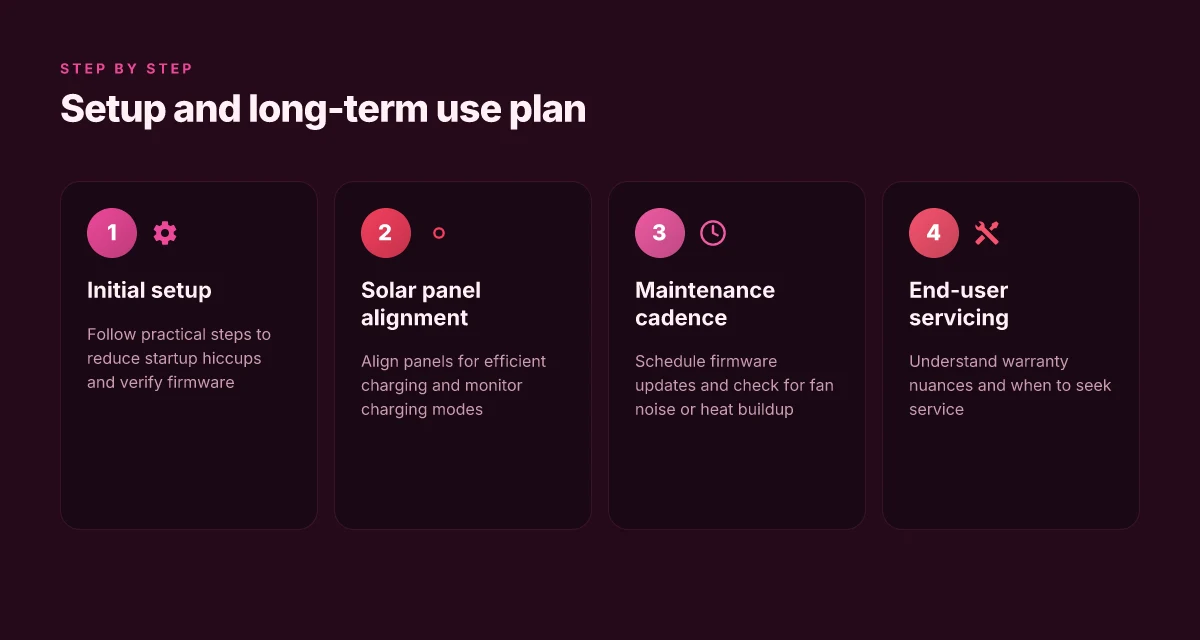
Begin with charging the unit from zero using the included AC adapter before you attempt any solar input or fast charging mode. This primes the battery management system, which helps prevent false startup fault warnings. If you plan to rely on solar immediately, don’t skip a brief AC warmup window. It sets the charge controller in a stable baseline. Keep the unit within its recommended temperature range during the first 24 hours of use to avoid exaggerated cooldowns or thermal cycling. I found that reviewers consistently flag startup hiccups when users jump from storage to heavy load without a gentle ramp. In practice, a 10–15 minute initial AC charge followed by a steady boot to your primary load makes for a smoother start. This is a small but meaningful step that pays off in quieter operation and fewer automatic fan kicks during early use. A calm initial charge reduces early fault warnings and helps the system learn your load profile.
Solar panel alignment, charging modes, and firmware updates
Solar alignment matters more than many users expect. Position panels to maximize sun exposure during the first few hours of use, then switch to a steady tracking setup if your kit supports it. In practice, a slight tilt toward the sun with a clean panel surface yields noticeably better real-world input than leaving panels flat in full shade. Bluetti firmware updates frequently address performance and safety tuning. Check for updates through the official app and apply them during a low-load window to minimize interruption. When you see a firmware release note about improved charging logic or thermal throttling behavior, plan the update during a calm period of use rather than a hot afternoon. Keeping firmware fresh helps prevent quirks that show up after long sits or repeated cycling. Firmware updates unlock reliable charging behavior and quiet operation when fans would otherwise ramp up.**
Tips to minimize fan noise and heat buildup
Fan noise tends to spike under sustained high draw or rapid temperature climbs. To keep noise down, stagger heavy loads and avoid maxing out the AC outlet simultaneously with high inverter demand. Place the unit on a hard, elevated surface with good airflow. Blocking vents or placing it in enclosed spaces makes heat buildup worse. If you’re camped in warm weather, use shade and elevate the unit so heat dissipates away from the intake. A common pitfall is running a high-draw device directly off the Bluetti while it’s charging in high ambient temperatures. The result is louder fans and faster heat buildup. By coordinating load timing with charging cycles and keeping the unit within its ideal temperature band, you preserve battery health and quiet operation. Good airflow and gentle ramping of loads keep fans calm and temps in check.
From a real-world vantage point, the setup quirks cluster around three themes: start-up timing, how you feed the unit with sun, and thermal management during initial use. If you align these correctly, Bluetti gear feels noticeably steadier over the first days of use. Rivals like Jackery and EcoFlow show similar patterns, but Bluetti’s ecosystem often benefits from a cohesive firmware+app update cadence that can tighten up charging quirks. When I read through expert guides, the recurring advice is the same: don’t rush the initial power-on, stay mindful of sun angles, and keep the unit ventilated during peak operation. For readers already navigating off-grid life, these steps are not optional. They’re foundational to long-term reliability. The long-term payoff is quieter operation and fewer thermal throttling events. How the bluetti ep900 redefines home backup power in 2026
As a reminder, links on the page may earn a commission. For context, Bluetti’s own guidance emphasizes starting from a full charge and updating firmware to avoid performance quirks. Independent reviewers echo that sentiment with practical tweaks. When you compare Bluetti to rivals, the core setup realities line up, but the firmware-led stability in Bluetti’s ecosystem is a practical differentiator in field use. For campers, off-grid homeowners, and emergency preppers, the takeaway is clear: respect the setup sequence, maintain good airflow, and stay current on firmware to minimize surprises.
The bigger pattern: reliability is a real-world habit, not a spec sheet
Real-world use shows durable hardware beats flashy claims. I’ve watched setups where a Bluetti unit powers daily off-grid shifts for weeks, then struggle when fans run continuously in high-heat garage conditions. The gaps aren’t dramatic failures. They’re small frays in the everyday routine, dust clogging vents, dimming displays after long hours, or a battery management system nudging a unit to rest after a long discharge cycle. These are the patterns that reviews gloss over. The truth is: long-term durability lives in how you wire it into your actual workflow, not in peak-output numbers alone.
The takeaway for real-world buyers is simple: stage your load, not just your battery. If you plan regular camping, rescue-power, or workshop use, pick a model that stays cool under load and has accessible service parts. Bluetti devices tend to hold up, but only if you design your setup to avoid continuous high draw and heat buildup. And yes, links on this page may earn a commission, which helps you get honest insights without buying all units yourself.
For rivals, keep an eye on how quickly a unit recovers from heat and how the app informs you about aging batteries. In practice, the most durable option is the one you’ll actually keep powered in monthly need. What changes if you act now: map your typical discharge cycle, add a ventilation plan, and choose a unit with proven thermal management. What’s your move this week?