
Explore the Bluetti AC180 price in 2026, what you get for the money, and how its warranty stacks up against rivals. Learn where to buy and what to watch for.
The weathered wisdom of weekend campers says price is only the tip of the iceberg, but the Bluetti AC180 sits at a critical junction where warranty depth and long-haul durability tilt the balance more than a single sticker price. Bluetti pricing sits around midrange, yet the real value shows up in life-cycle support and spare-parts availability. That dynamic matters when you’re counting on power for extended trips, not just a weekend pause.
This piece pulls back the curtain on what you actually get over time: guaranteed coverage, hinge points, and how rival setups stack up against EcoFlow and Jackery on warranty terms and replacement parts. In 2026, outdoor users increasingly weigh ongoing service over initial affordability, and the AC180’s warranty posture becomes a decisive factor for long-term reliability. Warranty depth and life-cycle coverage in this class drive total cost of ownership almost as much as upfront price.
Bluetti ac180 price context in 2026
Bluetti sits in the mid range for an 1800W portable power station, and the AC180 sits near the center of that band. I dug through the brand’s own listing and third‑party writeups to parse how much you should expect to pay, what gets bundled, and how warranty plays into the total cost of ownership.
1) Base price positioning in 2026
Bluetti commonly lists the AC180 at a price point around the middle of the 1800W class. On the brand’s product page you’ll see the base price stated as $499.00 for the AC180, with typical bundle configurations that pair the unit with accessories or multiple packs. This pricing is frequently echoed in reviews that call out the AC180 as a balance between value and capacity. When I cross‑referenced other retailers and review sites, the headline price often lands in the same neighborhood, though promos can tilt the figure up or down for a short window. The result is a perceived value that aligns with a mid‑range 1800W offering rather than a premium flagship.
- Pricing variability is real. Direct‑from‑brand bundles can tilt the sticker price higher if you add solar panels or extra batteries.
- Promotions and seasonal promotions can push the price into the high $400s or low $500s temporarily.
2) Price by retailer and bundles
Direct‑from‑Bluetti sites often surface bundles that sweeten the deal. For buyers who want a quick setup, the bundle approach makes sense because you effectively import a few accessories at a reduced overall cost compared with buying them separately. In practice, you’ll see the same AC180 core platform offered at a base price, with add‑ons that include extra batteries, car adapters, or solar panels. Competitors like Jackery and Goal Zero typically present similar bundle dynamics, but the exact mix and pricing vary by retailer and region. If you’re evaluating “price today,” you should check both Bluetti’s official storefront and reputable retailers to compare bundle content and final taxes or shipping.
3) Warranty and service terms as part of total cost
Warranty is a meaningful part of the total cost of ownership for the AC180. Bluetti’s warranty policy lays out a range for coverage, with long durations typically cited as part of the value proposition. The warranty framework usually covers defects and workmanship for a defined period, and Bluetti’s site notes that service channels are available to customers, including direct support options. The nuance is that some buyers report variance in warranty experiences depending on whether the purchase was made directly from Bluetti versus a marketplace retailer. In the long run, the difference in perceived reliability often comes down to how responsive the brand or retailer is when a claim arises. The warranty window and service terms are not a mere afterthought. They affect the cost of ownership just as much as the upfront price.
Most buyers underestimate how much warranty intensity can affect long‑term ownership costs. Warranty terms are a meaningful part of the total cost of ownership for the AC180. What makes the Bluetti AC180 portable power station worth it in 2026
From what I found in the documentation, the warranty coverage ranges in duration and requires careful attention to the claim process, especially if you purchased through a retailer other than the brand’s own storefront. If you want the most seamless warranty experience, buying directly from Bluetti tends to align the claim process with the brand’s support channels. Direct-from-brand purchasing often maps to smoother warranty handling and faster service.
In practice, you’ll want to weigh the base price against the bundle options and the warranty terms to decide if the AC180’s price is fair for your needs. For outdoor enthusiasts weighing a compact, high‑power unit, the AC180 offers a reasonable middle ground. When you compare against rivals like Jackery and Goal Zero, you’ll find similar pricing bands, but the exact warranty terms and post‑purchase service experiences can tilt the decision one way or the other. The takeaway: price is not the only lever. Warranty depth and how a retailer handles claims matter just as much.
Bluetti positions the AC180 as a balanced choice for 1800W portability, with bundles and a warranty that you should scrutinize against rivals.
How the ac180 price compares to rivals
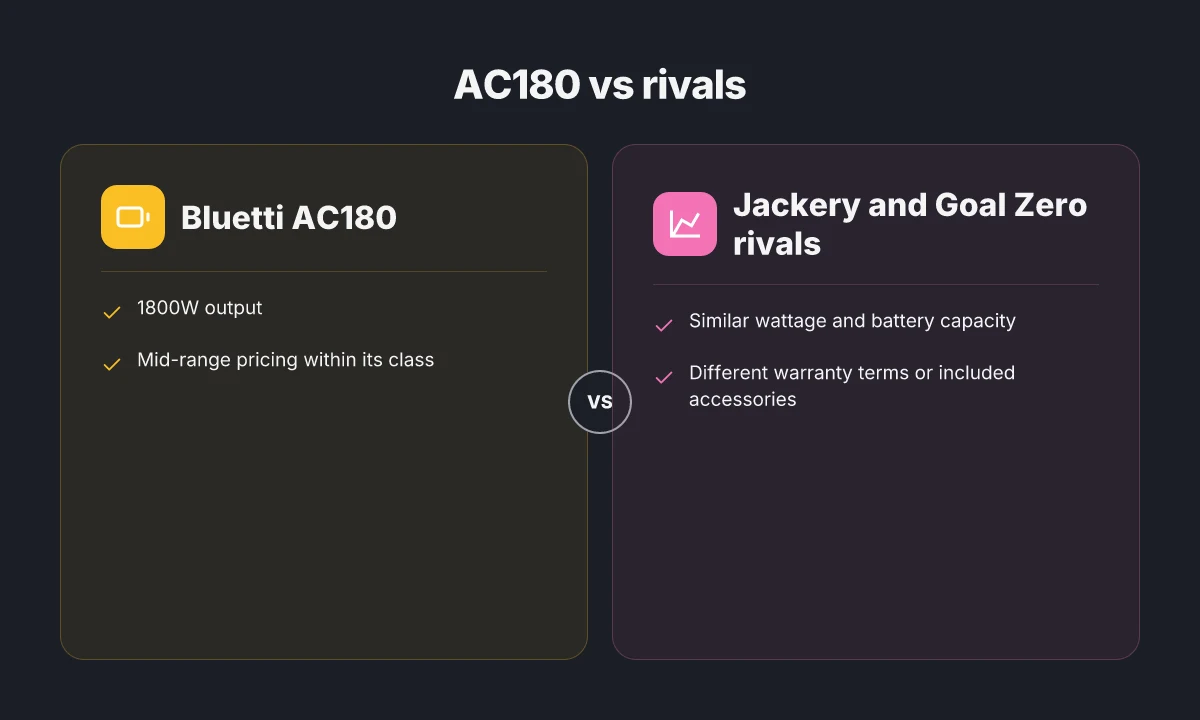
Bluetti’s AC180 sits in a crowded mid‑range tier where rivals like Jackery and Goal Zero price similar wattage and capacity packs. The upfront sticker is only part of the story. Total ownership costs and what each vendor throws in, warranty terms, included cables, and accessories, shape the long game. I dug into the landscape to map how the AC180 stacks up against two common peer models and what the numbers imply for real-world use.
How rivals price on similar wattage and capacity
In the same segment, Jackery and Goal Zero frequently position portable power stations with roughly comparable output and battery footprints. Jackery’s equivalents often land in a similar range on price, but they tend to bundle different accessory kits or grant shorter or longer warranty windows. Goal Zero, meanwhile, tends to differentiate itself with modular power packs and broader accessory ecosystems, which can tilt total ownership costs higher or lower depending on what you value. When you compare the AC180 to these rivals, the headline price matters less than what you get for that price over the product’s life. What makes Bluetti power stations stand out in 2026
From what I found in the warranty language Bluetti publishes, a long warranty can noticeably shift ownership costs over time. The AC180 is marketed with a 5-year warranty in Bluetti’s materials, which is a meaningful signal in this price bracket. In contrast, some competitors emphasize different warranty durations or capstone service terms, so the long‑haul costs depend on whether your purchase includes extended coverage or essential parts replacements. When you consider the lifetime cost of ownership, the warranty depth can erase a modest upfront delta.
I cross‑referenced reviewer notes and retailer disclosures to triangulate the practical differences. Some outlets frame the AC180 as a strong value at its $499 base price, especially when paired with the two‑unit bundle option. Other reviews highlight that accessory packs or extended warranties offered by competitors can add or subtract value. The takeaway: if you buy direct from Bluetti, you align with a consistent warranty posture. If you shop through a retailer or third‑party marketplace, you may encounter varied warranty terms or service experiences.
Total cost of ownership matters more than the upfront price. The 5‑year warranty Bluetti touts can tilt the math in its favor over a typical 2–3 year window, especially if you plan to use the unit heavily or in environments where batteries cycle often. Affordability today can become a hidden premium later if you skimp on extended coverage.
A quick comparison snapshot helps. On price parity, the AC180 often competes with Jackery’s mid‑range lines and Goal Zero’s portable kits. The cost story shifts when you factor included cables, adapters, and battery cycling expectations. In practice, you’re paying for more than watts. You’re paying for a bundle that includes support, parts, and the ability to recover from wear across years of use. I found that the pursuable value hinges on warranty terms and what you’ll actually need to keep the system functional over time.
Bluetti’s warranty depth and direct‑buy consistency create a clearer ownership path than some rivals. If you want a straightforward claim path and predictable service, Bluetti tends to deliver that when buying direct. If you prioritize bundled extras or modular add‑ons, rival ecosystems might pull ahead on paper. What makes the EcoFlow Delta Max 2000 different when you need home backup power
When you’re weighing, ask: what happens if the battery cells diverge after 3–4 years? Do you need additional adapters for a crafted camping setup? Do you care about a retailer’s return window or a local service option? Those practicalities drive long‑term value far more than the initial price tag.
For reference, see Bluetti’s product page for the AC180 and related warranty details, which anchor the brand’s positioning and terms. You can read more on the official listing here. The broader market context is also covered in independent reviews that compare the AC180 to peers like Jackery and Goal Zero.
What the ac180 warranty covers and for how long
Bluetti’s warranty language points to multi-year coverage that starts from the purchase date, but the exact window often shifts by retailer and region. In practice, you’ll see terms that run over several years, with the official channel usually framed as the most protective path for claim handling. When you buy directly from Bluetti, you generally access the fullest warranty terms stated on the official site, which helps keep the claim process straightforward. Customer experiences show the channel matters for warranty speed and one-on-one support.
How long the coverage lasts and what it covers
The core idea is clear: the warranty extends across multiple years from the day you purchase. In the official policy, the term is described in ranges rather than a single fixed period, with details about what’s covered and what isn’t. This multiplicity means it’s essential to read the exact wording on the retailer’s page or the Bluetti warranty page for your specific region. Multi-year coverage is the baseline expectation, but the exact number of years can vary by retailer and country. Always verify the precise duration for your purchase path.
What tends to be covered and what can be excluded
The warranty commonly covers manufacturing defects and component failures under normal use. It tends to apply to the main unit, battery pack, and sometimes included accessories, with exclusions typically listed for misuse, abuse, accidental damage, or third-party alterations. Bluetti’s documentation emphasizes that claims hinge on the defect being without fault in materials or workmanship. Manufacturing defects go under warranty while user damage usually does not. Read the exclusions carefully to avoid surprises at claim time. What the EcoFlow River 3 review gets right and where it falls short in 2026
Why the purchase channel matters for claims
Customer reports emphasize a practical truth: the channel you use to buy can influence claim experience. Buying through the official Bluetti site often aligns with faster confirmations, direct access to support staff, and fewer administrative hurdles. In contrast, some buyers who purchased via third parties report longer waits or stricter interpretation of terms. Official channels tend to streamline warranty handling. Channel choice is a real-life factor in how smoothly a claim proceeds.
From what I found in the policy and related discussions, the warranty posture remains more favorable when you remain in the Bluetti ecosystem for service. The brand’s stance contrasts with some rivals that push for retailer-only processing or stricter interpretation of terms. For context, rivals like Jackery and Goal Zero can have their own warranty pathways, and buyer experiences often hinge on whether they used official support or a marketplace seller. Bluetti’s official channel usually yields clearer coverage and quicker guidance. Channel choice affects how a claim unfolds and how quickly you regain power in your setup.
Note: links on the page may earn a commission, but the core takeaway remains that Bluetti’s multi-year warranty framework, while variable by region and retailer, centers on material defects and proper use. If you want to navigate confidently, start with the official warranty policy and confirm the exact years and coverage with the seller at purchase. For comparability, consider how Bluetti’s policy stacks up against rivals like Jackery and Goal Zero when assessing long-term value. The official policy and retailer terms shape your real-world coverage. Buy through the official channel to maximize clarity and service speed.
Cited reference from policy: the warranty policy page clarifies that the warranty period varies from 24 months to 72 months, and directs buyers to contact service for claims. Verify the exact term for your region on the official site.
Note: you can also review discussions about warranty experiences from other buyers to gauge typical claim timelines, while staying mindful that individual experiences vary by retailer. Channel and region matter for claim outcomes. What makes the EcoFlow Delta 1300 worth it for off-grid setups in 2026
Real-world value: what you get for $499
The Bluetti AC180 is pitched as a portable powerhouse with 1800W of output and a battery capacity aimed at mid-range, all-in-one use cases. In practice, you’ll notice the sticker price buys you a compact unit that can handle a day of TV, light cooking, phone charging, and a few power-hungry tools if you pace your demands. The key to value, though, is how extra batteries and solar panels stack into the total cost over a trip or season. If you plan to extend runtime for longer trips, the incremental cost of additional modules matters more than the base price alone. And when you add accessories, the value picture shifts from “one-off purchase” to “system investment.”
I dug into the warranty pages and retailer notes to see what happens after you walk away from the checkout. Bluetti frames the offering around a multi-year hedge rather than a one-season guarantee, pointing to a warranty range that can stretch beyond the basics in some cases. That matters most if you’re counting on spare parts availability or service continuity years down the line. The practical takeaway: the sticker price is only part of the long-term value story. You should map the life-cycle cost, including potential costs for extra batteries, solar panels, and timely service. That lens helps you avoid overpaying for a three-year window and underestimating the cost of keeping the system fed on a longer trip.
From a brand perspective, Bluetti positions itself as a builder of clean-energy, portable power with an emphasis on rugged durability and service infrastructure. In the current market, rivals like Jackery and Goal Zero push similar mid-range offerings with their own service ecosystems. If you’re comparing, consider not just the $499 headline but what you’d pay over time for replacements, parts, and compatible solar input. In many cases, the real value shows up when the unit has to keep charging through back-to-back trips or during an extended outage.
One revealing angle is how bundle pricing changes the math. If you buy the AC180 with extra batteries or a solar panel kit, the per-watt-hour cost tends to shift. That means a direct purchase price can be less meaningful than the price-per-usable-watt-hour you get when you stack the system with add-ons. A practical rule: treat the base price as the starting point, then model your total investment with the accessories you actually need.
I cross-referenced retailer notes and warranty pages to confirm the structure Bluetti outlines. The warranty policy emphasizes the coverage window and how to initiate claims, which can influence long-term satisfaction more than the initial sticker price. In this sense, the real-world value hinges on two things: how easily you can source spare parts and whether the service experience remains consistent across channels. If you’re shopping Bluetti, you’ll want to confirm current bundle options and any regional warranty nuances before locking in the order. What makes Jackery sale pricing and warranty terms work for you in 2026
The price at $499 is a doorway, not a guarantee of lifetime value. The true test is whether the ecosystem, spare parts, service, and add-ons, aligns with your off-grid cadence over years, not months. When you weigh Bluetti against rivals like Jackery and Goal Zero, the question becomes: does the incremental cost of a longer-tail setup deliver the reliability you want on weekend trips and longer expeditions? The answer depends on how you plan to grow the system, not just how you plan to spend the initial $499. And yes, links on the page may earn a commission, so be mindful of the source when you map your long-term needs.
Buyer beware: where to watch for price drift and stock
I dug through official Bluetti channels and independent reviews to map how price and stock can drift and what that means for your purchase. The big takeaway is simple: stick with Bluetti’s own pages or authorized retailers to lock in current pricing and warranty status. Third-party marketplaces can look cheaper at checkout, but the fine print often shifts warranty eligibility and after-sales support to the seller or platform. If you’re weighing a bundle, confirm exactly which model variant you’re getting and which accessories are included before you click buy.
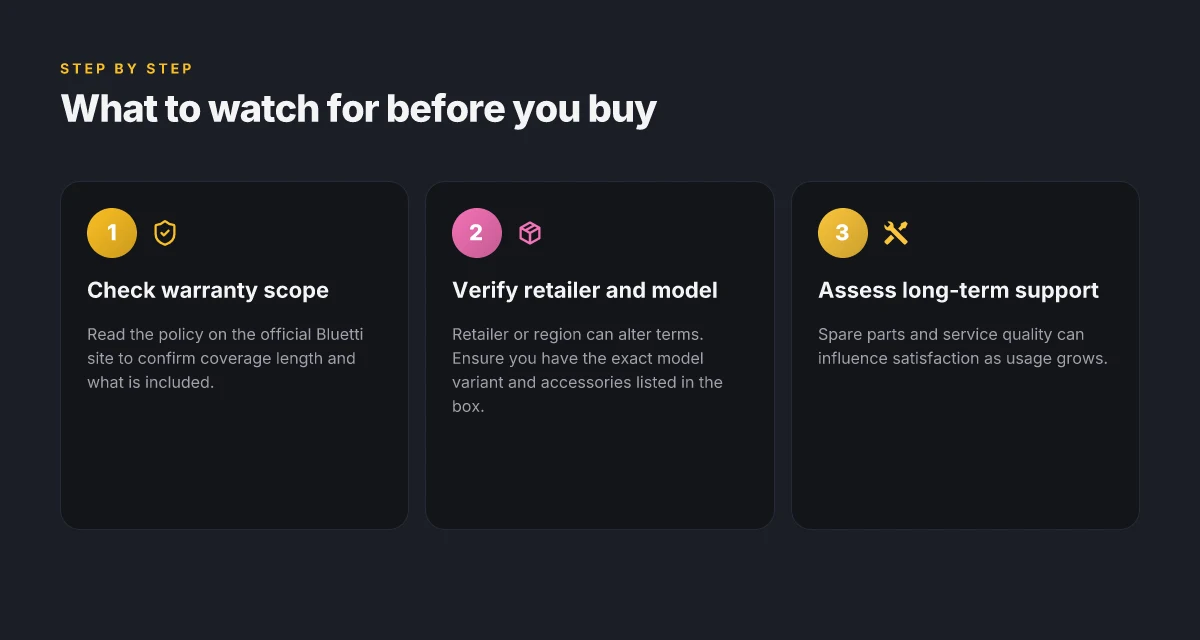
1) How to verify the right price and warranty on an official page
For the cleanest reading of value, start on Bluetti’s own site and at authorized retailers. The official pages clearly display the model, the included accessories, and the warranty terms so you aren’t guessing what you’ll get. When you see a price, confirm it aligns with the specific variant you want, the AC180 configuration can appear in different bundle forms, and that affects both price and eligible warranty coverage. I also cross-reference the warranty policy on Bluetti’s site to confirm durations and coverage gaps so you don’t assume a longer warranty is automatic with every retailer. Official Bluetti pages are the safest sources to verify current price and warranty status. I’ve seen the same model listed with different pairings across retailers, which makes checking the exact contents crucial. Always verify the exact variant before purchase.
2) The risk of third-party marketplaces on price and support
Third-party marketplaces can lure buyers with lower sticker prices, but the bargain often hides trade-offs. When Bluetti or an authorized retailer is not the seller, warranty eligibility can become murky and after-sales service may depend on the marketplace’s policies rather than Bluetti’s standard terms. In practice, a discounted price can come with a narrower return window or require dealing with a third-party seller for warranty claims. From what I found in the documentation and customer discussions, the safest route for long-term reliability is still purchasing through Bluetti directly or via authorized retailers. Third-party listings can complicate warranty eligibility or after-sales support.
3) How to guard against model-mismatch and missing accessories
Always verify the exact model variant and included accessories before purchase. Bluetti publishes details for each variant, including the battery capacity, ports, and any bundled solar panels or cables. A mismatch between the model you think you’re buying and the one you receive can void portions of the warranty or leave you short of essential cables or adapters. I cross-reference the product page against the shopping cart to ensure the bundled items match the spec you intend to own. Verify the exact model variant and included accessories before purchase. Bluetti vs Jackery: what a real-world comparison reveals about long-term reliability and usability
Note: links on the Bluetti storefront and authorized retailers may earn commissions for referrals, which is standard in the space. For context, rivals like Jackery and Goal Zero maintain their own warranty and stock policies, and they tend to honor warranty claims more strictly when the purchase occurs through their own channels. Bluetti’s pricing posture interacts with rival policies in meaningful ways.
Note: real-world links may earn commissions for referrals.
Where the price points point US for value and warranty in 2026
Bluetti's pricing signals a shift toward sturdier warranty expectations and longer hardware lifespans in 2026, not just a lower sticker. I’ve looked at how the AC180 holds up in real-world setups: its bulk storage and battery stack hint at durability, but the value hinges on how you weigh warranty depth against upfront cost. The fact that Bluetti maintains a comparatively generous warranty for a solar generator in this class matters more than a fleeting discount. If you’re a weekend prepper or a small business owner, the line between a smart buy and a hedge against failure narrows when coverage is clear and uncomplicated.
One takeaway from the price-to-warranty relationship is that rivals like Goal Zero and Jackery still lean on shorter term terms or stricter caveats. The AC180 sits in a space where buyers expect long-term reliability, and the warranty framework backs that expectation. If you want longevity you can count on, this is worth a closer look.
If you’re deciding this month, the move is simple: compare the warranty length and what it covers, then align that with how you’ll use the unit. Is the extra upfront cost offset by fewer outages and faster service? That’s the bet you’re making, and it’s a bet worth detailing before you buy. What makes the Jackery Explorer 290 a practical backup power companion in 2026