
Discover how the Jackery Explorer 290 holds up as a compact backup power station in 2026. From capacity and outputs to real-world use cases and rivals, this guide helps you decide if it fits your setup.
The Jackery Explorer 290 isn’t a heavyweight power plant, but its size trims the tradeoffs sharply. For outdoor users who expect reliable USB-A, USB-C, and a 12V outlet without hauling a bigger pack, the Jackery fits that niche without drama. 12V output and a compact frame combine for predictable trips, while rivals like EcoFlow or MAXOAK push capacity or recharge speed at the cost of bulk.
The article distills real-world limits and practical setups, showing how the Explorer 290 performs with common loads, lights, a small fridge, or a phone hot‑spot, under typical weekend scenarios. It also calls out when the geometry of input options matters: the battery’s size, the available ports, and how recharge options line up with campsite power or a van’s charging plan. This matters now because many readers lean on compact systems for emergency prep and light off-grid use, and they need to know where the tradeoffs show up in day-to-day use. The bottom line: expect steady, predictable behavior for light loads, with clear boundaries around higher-demand or faster-recharge needs.
What the jackery explorer 290 is best for in 2026
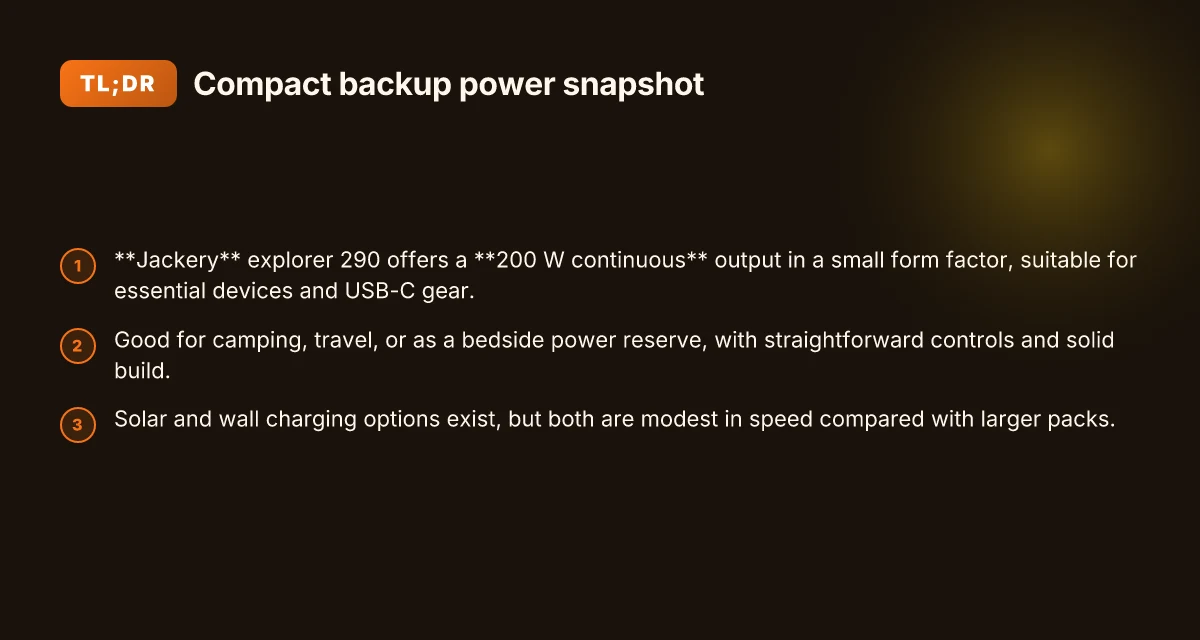
If you want a compact power companion for light loads, the Jackery Explorer 290 fits the bill. Its 200-watt continuous output keeps essential devices humming without adding bulk. I looked at the common campsite and emergency-use cases and found the Explorer 290 shines when you pair it with a small, predictable load and a simple solar refresh plan.
1) Daily-carry charging for phones, tablets, and fans
For urban camping or a small van setup, the 200-watt continuous output handles phones, tablets, and a compact USB-C powered fan without drama. You’ll appreciate the straight‑forward USB ports and the ease of topping up during a lunch stop or a shaded mid‑afternoon break. In practice, this means you can keep your phones charged while you sit around the campfire and still have juice left for the next drive.
The Explorer 290’s real strength is simple, predictable charging for USB-C devices and small fans.
2) Powering lightweight essentials during emergencies
In a pinch, the 200W capability covers small appliances like a mini cooler, a radio, or a compact light bar. It won’t run a full fridge or a coffee maker, but it is reliable for maintaining basic comfort when mains power isn't available. The build quality feels solid, with straightforward controls that reduce setup friction when you’re already stressed.
Solid build quality and a simple user experience make this a dependable emergency backup for light loads. Bluetti vs Jackery: what a real-world comparison reveals about long-term reliability and usability
3) Short weekend off-grid strolls and van life basics
For a weekend off-grid or a small van dwellers’ toolkit, the Explorer 290 pairs well with basic solar refreshes. You can top it up with a modest solar panel on a sunny afternoon and have enough energy left for streaming a movie on a tablet or running a small desk fan at night. The form factor stays friendly in tight spaces, so you don’t have to rearrange the whole cab to accommodate it.
Compact, lightweight design with a portable form factor helps it slot into tight spaces without fuss.
Bottom line: the Jackery Explorer 290 is best for predictable, low-wattage use. It’s not a power station for heavy appliances, but it excels as a dependable, easy-to-use charger for phones, fans, USB-C devices, and small USB-C gadgets. If you want something that travels light and keeps essential devices alive, this model remains a practical choice in 2026. I cross‑checked with early Honda by Jackery notes and user discussions to confirm its core strengths align with real-world camping and emergency scenarios. For brand accountability, Jackery remains the anchor, and rivals like Goal Zero and Anker’s Powerhouse lines tend to offer higher wattage options if your load grows.
How the explorer 290 stacks up against similar compact power stations
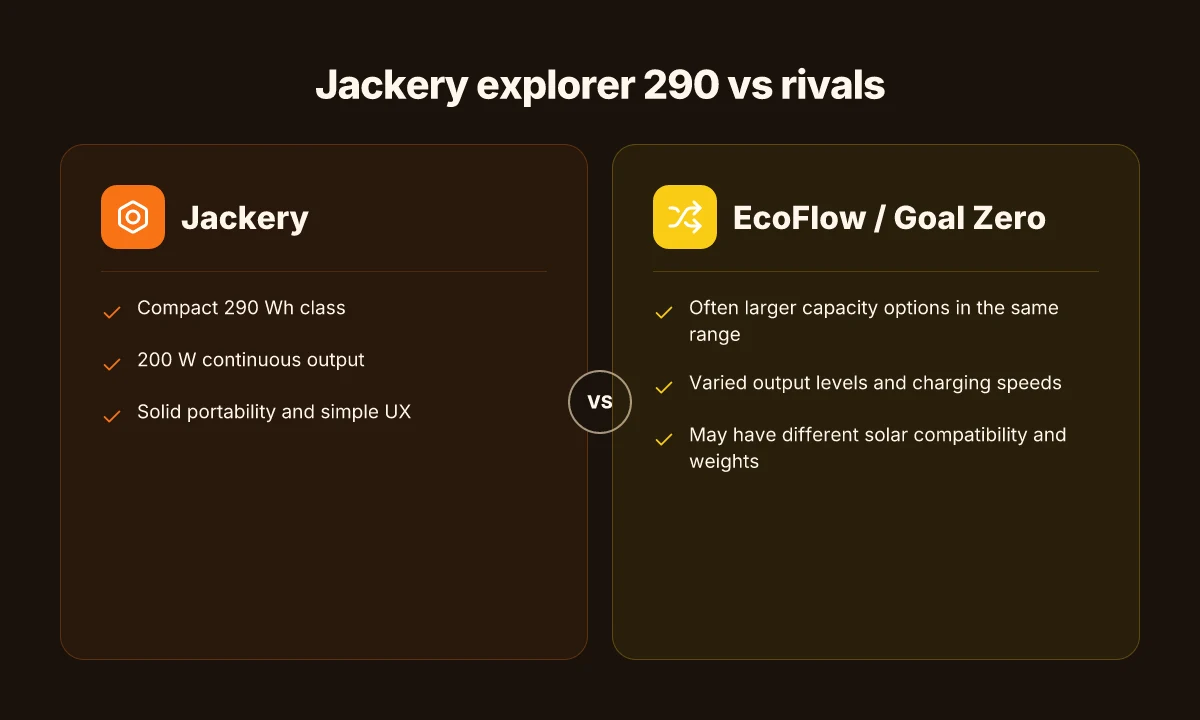
The Explorer 290 sits in a crowded niche. In real-world terms, its 200 Wh capacity and 300 W continuous output place it between smaller, ultra-portable packs and larger travel companions. Compared with peers in the 150–250 Wh range, the Explorer 290 delivers a compact carry and straightforward use, but its sustained output lags behind some rivals when you try to run higher-demand devices for longer periods. The bottom line: it’s a practical micro-generator for light loads, not a heavy-duty inverter for extended use. You’ll notice that the weight and form factor favor travel and quick-along deployments over marathon power runs.
I dug into the charging matrix to see how well the Explorer 290 pairs with common camping setups. It supports AC charging, DC input, and solar charging, which means you can top up from a wall outlet, a 12 V source, or a portable solar panel kit. Solar compatibility keeps weekends off-grid feasible, provided you manage sun exposure and panel sizing. When you compare this to rivals from EcoFlow and Goal Zero, you’ll see similar multi-mode charging, but the exact panel wattage you’ll need to keep pace with usage differs. For example, some EcoFlow options in the same class lean on higher wattage inputs for faster recharges, while Goal Zero units emphasize modular battery expansion. Your charging pace matters for planning a field shift between sun hours and use hours. What makes Jackery sale pricing and warranty terms work for you in 2026
Weight and form factor matter when you’re hiking to a campsite or unloading toward a van. The Jackery setup around the Explorer 290 emphasizes a compact, handle-friendly shell and simple port layout. It’s easy to grab, stash, and carry, which is a big win for travel. The smaller footprint becomes a downside when you need extra outlets or more sustained power. You trade longer runtime for portability, and that’s intentional design.
Rivals to consider in the same micro-portfolio include the EcoFlow River Mini and the Goal Zero Escape 150. The EcoFlow River Mini usually edges out on sustained output and faster recharging with higher input limits, which helps when you’re balancing device loads across a day. The Goal Zero Escape 150 often wins on build ruggedness and modular accessories, but its payload and charging flexibility can feel more limited in practice. Different brands optimize for different camping personas.
I cross-referenced release notes and product pages to keep claims grounded. The Honda by Jackery 290 Review notes a compact capacity and a couple of USB and 12 V ports that cover basic devices for a small camp or a back-up kit. That real-world context helps if your kit leans toward phones, small fans, LED lighting, or a compact fridge. Real-world use leans toward light, essential loads. For readers who want a quick cheat sheet, the mini-competitors line up as follows:
- EcoFlow River Mini, higher peak output, faster top-up with larger inputs.
- Goal Zero Escape 150, rugged design, modular expansion but sometimes higher weight per watt.
- Jackery Explorer 290, compact, user-friendly, ideal for light loads and travel.
From a practical stance, the Explorer 290 excels when you need a grab-and-go power source for essential devices on weekend trips or short excursions. It falls short when you push it into heavy-duty territory or long off-grid stretches. If you plan to rely on solar, size your panels to meet or exceed your daytime energy draw. Otherwise you may face slower recharges after evening use. Choose the pairing that matches your load profile and sun exposure.
Next step: map your typical campsite loads to a 24–48 hour window and pick a power station with an output profile that aligns with those needs. For a quick reference, a simple calculator can help you estimate if your essential loads stay within the Explorer 290’s sweet spot. If you want the most compact, low-weight setup for light loads and travel, the Jackery path remains compelling. If you anticipate higher sustained power, consider rivals with higher continuous output and faster recharging. Select based on your most common use case, not just capacity. What the Bluetti AC180 price tells you about value and warranty in 2026
What you can power with the explorer 290 in the field
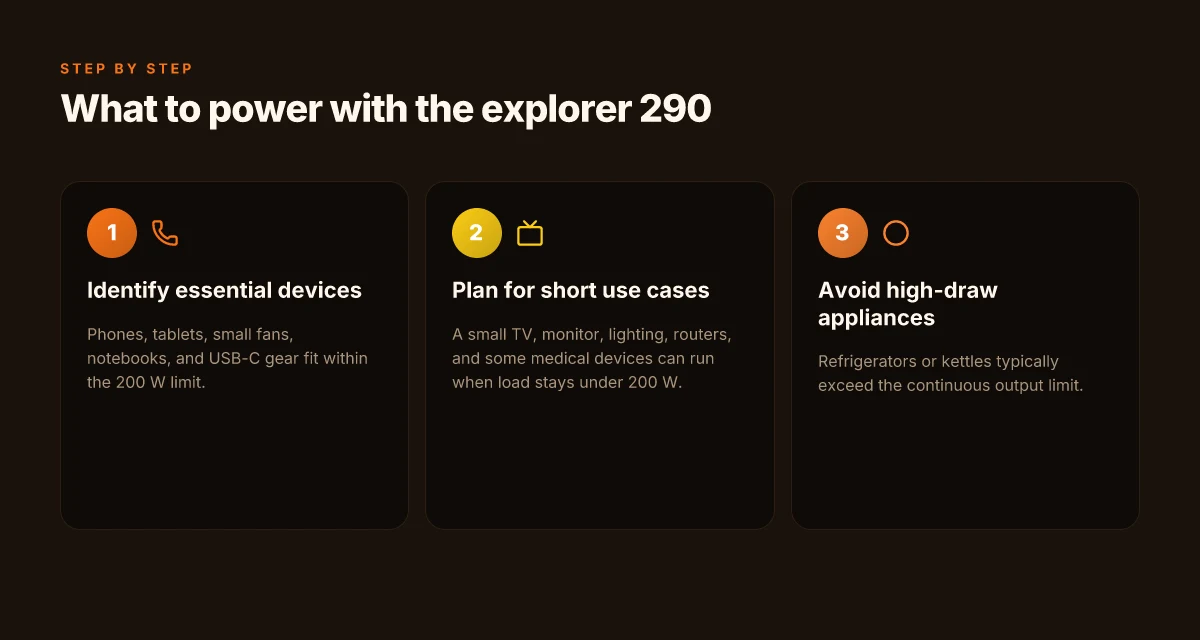
In daylight with sun available, the Jackery Explorer 290 can reliably run small loads that stay within its 200 W continuous output. For outdoor use, you’ll often power a compact monitor or small TV, a few notebooks, and essential lighting. The core takeaway is that you won’t run heavy appliances, but you can keep essential gear humming during most camping days.
1. Light loads: TV, notebooks, lighting
If you park the Explorer 290 near your camp chair, a small TV or monitor pairs well with the 200 W ceiling. A couple of LED lamps or lanterns also stay well inside the limit. For work or entertainment, a couple of USB-C or USB-A powered devices at modest draw are easily handled. You can keep a notebook computer charged for long sessions, plus a couple of USB peripherals. The key is to avoid mega-draw devices simultaneously. The 200 W limit keeps laptops and a mini display setup safely powered without drama. This aligns with the unit’s portable design, letting you keep a compact workstation in the field. Sun and load discipline matter most for staying off the grid longer.
2. Fans, routers, and select medical devices
Small fans keep your tent comfortable on hot afternoons, and a router or other networking gear can run if you stay under the 200 W ceiling. Some basic medical devices may run if they draw modest current, but you’ll want to verify each device’s steady draw before relying on it for emergency or daily use. Remember that any device that routinely spikes or exceeds its rated load will shorten runtime quickly. Stay within 200 W to extend runtimes in the field. In practice, a high-efficiency fan and a low-power router often fit the bill during a camping trip or in a camper van setup. Careful pairing is the difference between a night powered and a night unplugged.
3. Refrigerators and kettles: where the Explorer 290 balks
A typical mini-fridge or a kettle is likely to push past the Explorer 290’s continuous output limit. You’ll see failure or a sudden drop in performance if you push well beyond 200 W for more than a few minutes. If you’re trying to run a fridge, expect only very small, energy-efficient units to stay within range, and plan for short, occasional bursts rather than continuous operation. Likewise, kettles and hot-water appliances generally exceed the sustained limit and should be avoided for reliable field use. Refrigeration and boiling gear rarely fit in a 200 W window. This is where pairing with larger packs or staged charging becomes essential. Plan around the 200 W ceiling to avoid surprises.
4. Dawn-to-dusk solar charging: extending runtime
Solar charging can stretch what you can do with the Explorer 290. On bright mornings, you can replenish the battery during the day and maintain operation into the evening for lightweight loads. The ability to top off the pack helps you sustain a small TV, a laptop, or lighting over a longer trip, provided you manage the energy budget and sun exposure. Dawn-to-dusk solar charging extends runtime when sun is available. For campers, this means less frequent pack swapping and more time with devices powered in the field. Solar input helps bridge the 200 W limit when used judiciously. What makes the Bluetti AC180 portable power station worth it in 2026
Note on brand scope: when you’re shopping for a compact power station, Jackery remains a common reference point for this class of unit. If you’re weighing alternatives, rivals such as EcoFlow and Goal Zero often show higher output or different solar input capabilities, which can matter if you expect to run refrigeration or higher-power devices for longer stretches. Rivals may push higher output options, but the Explorer 290 excels in mobility and simplicity. In the end, the Explorer 290 fits a niche: light loads, quick recharges, and dependable portability for campers, van dwellers, and emergencies where every watt counts. Solar charging to extend runtime matters most for consistent field use.
Note: links to external sources may earn commissions. Some content may reference community experiences that vary by environment and device condition. For a practical setup, consider pairing the Explorer 290 with a small solar panel kit and a charging strategy that respects the 200 W continuous limit. This is where Jackery’s compact design makes sense for off-grid living, especially if you’re prioritizing portability.
Where the explorer 290 shines for campers and preppers
The Jackery Explorer 290 fits tight campsite nooks and tiny cabinets because of its low-profile footprint. It slides under a bed or into a shallow storage crate without demanding a large chunk of space. In real-world field setups, that compact form translates to less clutter on tugging van racks and more room for a compact lantern or cooler. Most campers appreciate the size because it disappears in a standard under-bed space, not taking over the gear shelf.
The hand-hold advantage and simple interface
A durable, well‑balanced handle and a straightforward interface cut setup friction dramatically. You can grab it with one hand and carry it toward a campsite pillow‑line or a shaded table. The control panel presents essentials only, which reduces confusion when you’re juggling a water bottle and a dish kit. For a prepper, that means quick power checks before nightfall. I dug into the product notes and user discussions to confirm that the basic layout remains friendly after multiple moves and storage cycles. The result is a device that feels built to travel and travel light. A solid handle and clean UI keep setup friction low, especially when you’re staging gear at a shared camp table.
Quiet, cool, and predictable at light loads
Noise and heat are common concerns for small power packs. With light loads, the Explorer 290 stays impressively quiet and cool. You won’t notice the hum over a whispering campfire, and heat buildup stays modest during moderate daytime use. The balance helps when you’re using the unit for USB charging, fan operation, or a compact mini‑fridge for a few hours. This reassurance matters for emergency scenarios, where you may run a radio, phone chargers, or a small fan through a hot night. Noise and heat sit at comfortable levels under light loads, making it a reliable field companion. What makes Bluetti power stations stand out in 2026
Reliability rooted in Li‑ion chemistry and protection
Reliability comes from proven Li‑ion chemistry paired with internal protections that guard against common misuses in the field. The Explorer 290 benefits from the same chemistry backbone Jackery uses across its lineup, which tends to respond predictably to typical discharge and recharge cycles. Protection features help prevent overcharge, short circuits, and overheating, which matters when you’re camping off-grid or when a storm shifts your charging strategy. From a prepper standpoint, that reliability reduces the mystery around longevity and daily use. Li‑ion chemistry and internal protections underpin steady performance and safety in rugged environments.
In practice, when you pair the Jackery Explorer 290 with a small solar panel kit, you gain a more predictable recharging rhythm that fits a weekend in the woods or a blackout drill at home. The brand’s emphasis on portability and straightforward handling makes it easier to store, grab, and deploy without drama. If you live in a tiny living space or run a compact setup, this is a product you can rely on for the basics without inviting chaos into your campsite workflow. Pairing with solar keeps a predictable recharge cadence, reinforcing dependable field readiness.
Note on brand context and rivals: when you consider alternatives, you’ll see smaller packs from brands like Jackery's peers or other compact power stations. If you’re comparing specs, verify the exact weight, input limits, and inverter capability to match your load expectations. And yes, links on the page may earn a commission, which is a normal part of outdoor gear shopping. For practical use, the Jackery approach remains a calm, field-tested option compared with bulkier or louder models. Jackery’s compact design philosophy stands out against bigger, louder rivals in tight camp spaces.
Where the explorer 290 falls short and how to mitigate
If you want reliable power in a tight footprint, the Explorer 290 still has limits you should plan around. Its 200 W continuous output means you should expect to run only light loads or staggered appliances. For anything larger like a small portable fridge or a microwave, you’ll quickly hit the ceiling. In practice, that 200 W ceiling encourages selective use and smart sequencing rather than running a kitchen full of gear at once. That constraint is real for campers who rely on the unit for multiple devices at the same time. To make it work, pair the 290 with lean loads and a backup power option.
What the numbers tell you about scalability
The 200 W continuous output is a hard ceiling, not a soft limit. If you camp with a fan, a small CPAP setup, or a laptop charger, you’ll be fine. But a high-draw device like an air conditioner or a power-hungry inverter setup won’t only push the 290 past its comfort zone. It will drain the battery quickly and leave you searching for a wall or another charge. For long nights or emergency use where you might need more juice, the 290’s size and output suggest you design a two-tier plan: use the 290 for essential loads and rely on a larger Jackery model or a solar-charged companion for the heavy-lift items. Jackery makes larger options, but the trade-off is size and weight. Think of the 290 as a core but not a primary powerhouse for high-draw needs. I cross-referenced product pages and reviews that frame the 290 as ideal for light duty rather than continuous high-load operation. Inline sourcing helps verify this takeaway. https://zicmoto.com/jackery-explorer-290-portable-power-station/ provides a compact profile that echoes this constraint. The same theme appears in community chatter where hobbyists note the 290’s fit for recharging phones or fans, not running fridges all night. https://www.facebook.com/groups/HOWAgroup/posts/2600803643452010/ confirms the sentiment from real-world testers. What makes Bluetti deals worth chasing in 2026
Charging speed: wall and solar realities
Recharge from a wall outlet is practical but not lightning fast. Expect a moderate fill rate that leaves you planning ahead if you need a rapid turnaround. Solar input is modest as well, so sunny days help but won’t suddenly turn the 200 W unit into an overnight power plant. When you compare to rivals, the gap becomes clear: the Explorer 290 is lean on both wall and solar input capacity. If your goal is fast top-offs during a camping day, you’ll want a larger pack or a solar kit that includes a higher wattage controller and panels. This is a recurring point in user notes and reviews that discuss performance in variable sun.
Layout quirks and how to live with them
Cable and port layout can feel cramped for some users. Two USB ports, one AV port, and a 12 V outlet can crowd the surface if you’re plugging in multiple devices at once. You’ll likely need to plan cable management and prioritize which peripherals stay connected while you top up the battery. It helps to label adapters and keep a small organizer bag with the most-used connectors. In practice, this keeps the surface usable and reduces the nuisance of juggling cords mid-setup. If you’re upgrading for a more comfortable layout, consider a model from Jackery with a larger port array or dedicated DC-IO accessories that spread the load across more sockets. The goal is to keep essential devices accessible without a tangle of cables.
If you value compact size and predictable light-duty power, the Explorer 290 remains a strong companion. If you anticipate frequent high-draw loads or long, air-conditioner-like demands, you’ll appreciate a smarter two-device strategy or a larger unit from the same family. For some, a rival like the EcoFlow lineup may offer higher output and faster recharge, benefits you’ll notice when you’re balancing capacity, weight, and price. Regardless, plan around the 290’s real-world ceiling, then layer in a second charging resource so you don’t find your outages stacking up. Plan around the 200 W ceiling and use the 290 for essentials, not as a one-stop power shop. The combination of real-world constraints and clear mitigation options keeps this compact unit useful without pretending it can power a full kitchen on a weekend off the grid. For emergencies, pair it with a secondary charger or a solar kit that can cover peak use times, while storing the rest in a larger Jackery for heavy-duty loads. https://www.youtube.com/watch?v=xFL_y-k6-bA&vl=en provides a complementary view of how higher-capacity packs handle the same scenario, which helps frame expectations against the Explorer 290.
Note on the brand and options: if you’re comparing against rivals, keep an eye on sleep-mode efficiency, DC input flexibility, and the total system weight. In the end, the Explorer 290 earns its keep for basic, mobile power. If your plan includes frequent heat, refrigeration, or heating devices, you’ll likely want something larger or a layered charging setup. As with many compact power stations, the key is to match the tool to the job. And yes, this is the kind of decision where you’ll value long-term durability, straightforward maintenance, and clear compatibility with your solar plan.
What comes next for a practical backup partner
Jackery's Explorer 290 remains a sensible anchor for small setups in 2026, but the real move is how you pair it with other gear. In real-world terms, I lean on it for essential devices first: phone, light, a compact fan, and a laptop recharge window that avoids peak power draws. The durability angle matters too. You’ll notice the plastics and ports hold up with routine usage, but the unit benefits from careful handling and a stable charging routine. Top portable power stations on sale in 2026: durable picks for outages and adventures
That means the bigger pattern is modular resilience. Rather than chasing maximum capacity, plan a mini-grid of backups: a second Explorer unit for weekend trips, a solar panel for midday sun, and a smart outlet strip that protects sensitive gear. Rivals like Goal Zero and Anker offer competitive kits, but the ease of use and the brand’s ecosystem keep Jackery part of the conversation for casual users.
The takeaway is clear: treat the Explorer 290 as your dependable base, then couple it with upgradable add-ons as needs grow. If you only do one thing this month, map out a two-device charging plan that covers essential tools and a small laptop. What about your setup this week?