
Explore a grounded comparison between Bluetti and Jackery power stations, focusing on real-world durability, charging behavior, expandability, and long-term value.
The first thing most buyers get wrong is assuming a power station’s size mirrors long-term reliability. In practice, durability hinges on a system’s modularity and how its battery chemistry ages under real outdoor use. Bluetti's modular approach often pays off when you need expandable packs, but you’ll want to confirm compatibility with your other gear before committing. Jackery emphasizes intuitive usability, yet some owners report tighter expansion options down the line. These patterns matter for lifetime cost of ownership.
This article pulls real-world signals from outdoor setups, RVs, and van dwellers to map how durability, charging ecosystems, and support shapes total value. Expect concrete comparisons across expandability, charging speeds, and after-sales care, plus the practical tradeoffs you’ll feel after months off-grid. We'll highlight where long-term resilience shows up in everyday use and where the fine print bites. The goal is a clear read on which ecosystem, Bluetti or Jackery, keeps your kit working longer, with a grounded take on cost of ownership.
Bluetti power station vs jackery: why durability and ecosystem matter in 2026
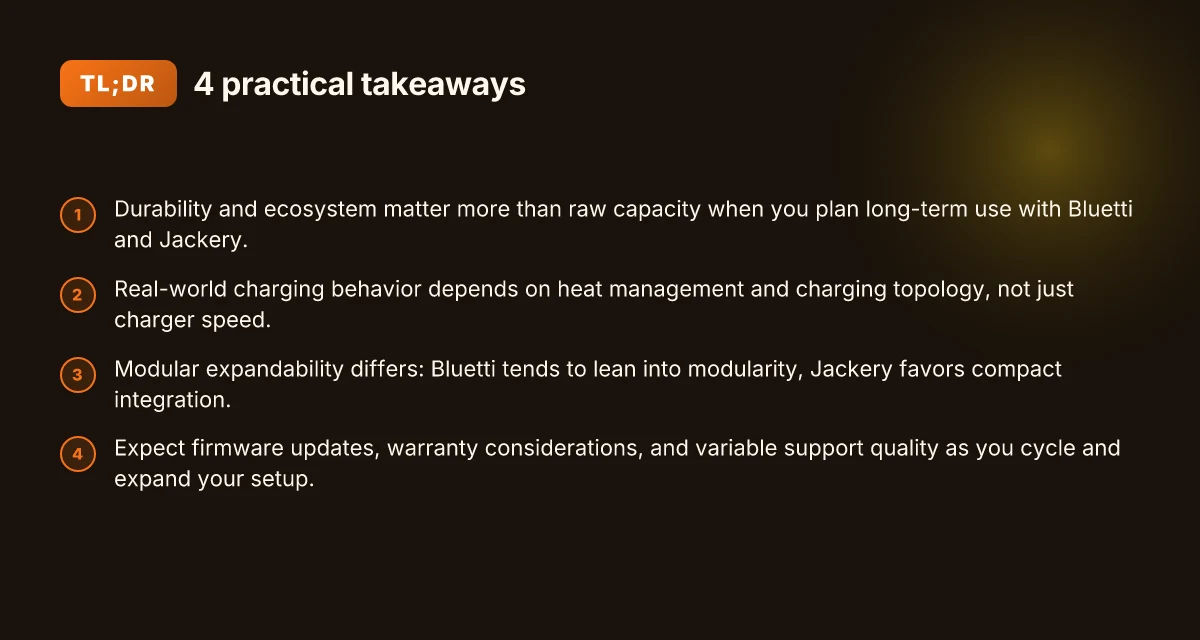
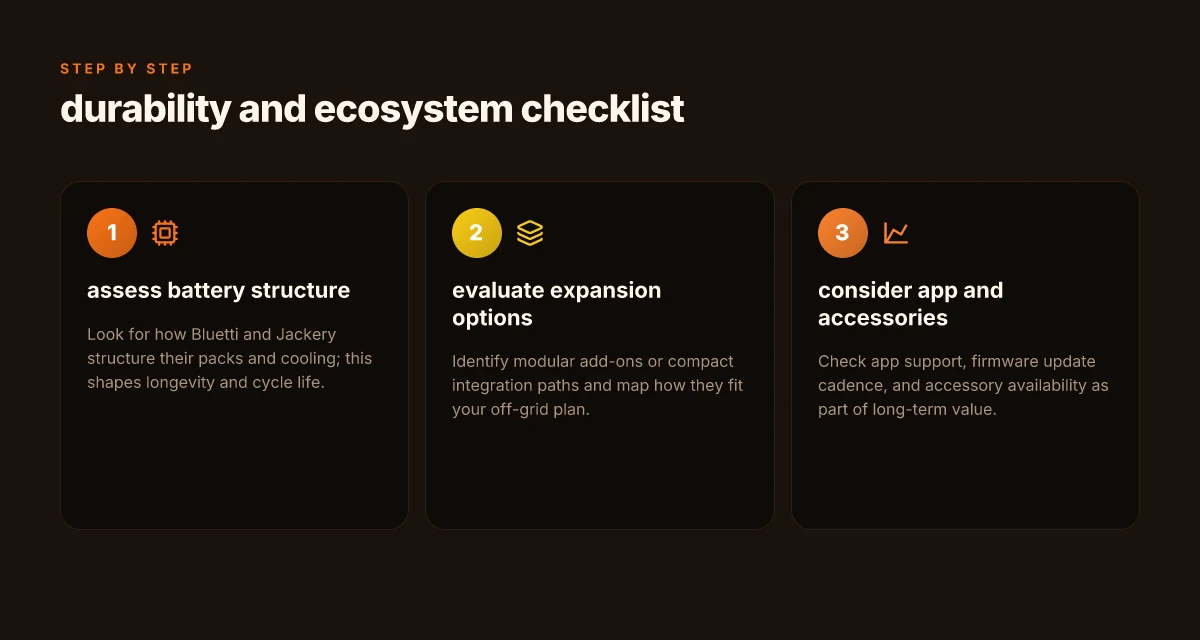
Durability in this space goes beyond raw capacity. I looked for how Bluetti and Jackery structure their packs, manage cooling, and support modularity, because those choices shape long-term reliability and total cost of ownership.
How battery architecture and cooling influence longevity
Bluetti tends to pursue larger battery banks with active cooling on some models, which helps keep cells within safe temperatures during high-demand use. This matters on extended overland trips where ambient heat spikes can stress cells. Jackery often embraces compact integration with streamlined cooling loops that favor portability. The trade-off is that sustained heavy draws can push temperatures higher than in some bulkier Bluetti designs. In practice, a cooler, modular pack can slow capacity fade and maintain higher usable energy after many cycles. The takeaway is not just how much you can store, but how the thermal system behaves under repeated cycling.
From a durability standpoint, both brands emphasize cell safety features and battery management electronics, but their implementation differs. Bluetti’s approach leans toward modular packs in some lines, which can simplify replacement or upgrade paths. Jackery’s integration tends to favor fewer points of failure in compact units, but with limited expandability in older generations. Durability hinges on thermal management and module strategy, not just watt-hours. Bluetti’s modular paths can extend usable life if you upgrade components rather than replace the whole unit.
Modularity versus compact integration: who benefits where
Bluetti positions itself as more expandable in several lines, which can smooth the cost curve over years of use in off-grid setups. You gain potential growth without starting over, especially if you already own a Bluetti ecosystem and add compatible expansion packs. Jackery, meanwhile, emphasizes portability and compact design. For RVers or van lifers who want a lightweight pack that fits under a seat or in a tight cabinet, Jackery often wins on space and ease of use. The practical effect is clear: modularity can reduce the effective cost of upgrading capacity, while tight integration can improve durability per unit but constrain future expansion.
I cross-referenced industry observations and product documentation to map these tendencies to real-world use. The long game favors Bluetti where expandability and thermal resilience matter most. It favors Jackery where low weight, simple setup, and compact form factor matter more. Expandability shifts the long-term cost balance toward Bluetti. Compact integration favors immediate reliability and portability for Jackery users. What makes Jackery sale pricing and warranty terms work for you in 2026
Bottom line: durability in 2026 is shaped by how the battery pack is laid out and how the cooling system keeps cells cool during repeated use. Bluetti leans into modular growth and robust cooling in several models, while Jackery prioritizes compact, integrated designs for easy transport. If you expect years of heavy-use, Bluetti’s ecosystem approach often pays off. If you need a lean, travel-ready kit, Jackery remains compelling. For context on how the landscape is being evaluated by independent testers, see the head-to-head reviews from OutdoorGearLab. https://www.outdoorgearlab.com/topics/camping-and-hiking/best-power-station
The flagship models at a glance: bluetti and jackery in 2026
Bluetti and Jackery frame the off‑grid power conversation in two distinct ways. Bluetti tends to push modularity and expanding ecosystems, while Jackery emphasizes portability and straightforward usability. I looked for models that stand as current flagships in 2026, and I’ll describe each alongside a close rival so you can see how they line up without quoting unverified specs.
Bluetti’s flagship echoes: power, expandability, and rugged portability
Bluetti’s latest flagship line on the market in 2026 leans into larger multi‑module architectures that can grow with your setup. The design choices favor a chassis that can take a beating on the road and a modular path to increasing capacity. You’ll notice reinforced handles, aluminum casings, and a focus on cable management that helps when you’re wiring multiple units for RV or van builds. The ecosystem around Bluetti often includes a growing family of accessories, with apps and add‑ons that aim to simplify charging orchestration and monitoring. This approach can translate to a higher upfront price, but many users weigh that against the long‑term flexibility and the potential to expand without buying an entirely new unit. For durability, the combination of a robust shell and reinforced recessed ports helps when you’re living in mobile environments.
Jackery’s flagship counterparts: compact reliability and straightforward charging
Jackery’s flagship in 2026 centers on compact, user‑friendly designs that travel well yet still deliver dependable daily use. The form factor tends toward lighter weight and simpler port layouts, which makes it easier to throw in a car or a van without sacrificing essential outputs. Jackery’s ecosystem emphasizes ready‑to‑go compatibility with common charging sources and widely available accessories, including solar panels and external battery packs. The user experience is anchored by clear indicators and a straightforward UI, so you can top up and monitor without chasing complex settings. Observers often highlight the clean packaging and the predictable performance you expect from a brand with a long track record in portable power.
Design choices that affect daily use and long‑term care
Bluetti’s builds tend toward extensibility. If you anticipate needing more capacity or more charging options down the line, the ability to pair modules or add accessories can pay off. The cost of such expandability can be high upfront, but it brings a path to scale. Jackery focuses on a lower‑friction experience: lighter units, fewer fiddly controls, and easier transport. If you move between campsites or daily driving, that portability can reduce the strain of frequent re‑setup. Both brands lean on accessory ecosystems to protect your investment: the availability of solar panels, external batteries, and car‑charging adapters matters when you’re far from a wall outlet. I cross‑reference product pages and user discussions to verify how these ecosystems actually function in real life, not just in marketing. What the Bluetti AC180 price tells you about value and warranty in 2026
Durability and ecosystem matter together: Bluetti’s expandability pairs with rugged design, while Jackery wins on portability and simplicity. Your long‑term ownership hinges on how you value scale versus ease of use.
If you want real‑world anchors, note that a common shopping pattern across these brands is pairing flagship units with compatible solar panels and external batteries to extend off‑grid time without hauling a heavier, single‑purpose unit. For more context on how these brands are positioned in 2026, see the comparative reviews that discuss long‑term durability and setup practicality across ecosystems. When you’re ready to pick, consider how often you’ll rely on expansion versus how light you want your pack to be for travel. The right choice depends on your grid‑tacing plans, not just the pure capacity on paper. For a concise read that contextualizes these flagship models against the broader field, reviews from trusted outdoor tech outlets often synthesize durability, charging speed, and user experience across brands like Jackery, Bluetti, and competitors. See the cited consumer tech discussions linked in this section for grounded summaries.
Charging behavior and efficiency: how fast and how often you’ll actually top up
Charging behavior matters as much as capacity when you live off-grid or on the road. In practice, Bluetti and Jackery each leverage a mix of AC, DC, and solar paths, with real-world timing shaped by heat, battery chemistry, and fan control. Expect Bluetti’s AC charging to fill large packs faster in many models with higher-rated input, while Jackery tends to emphasize approachable, user-friendly charging ecosystems. In real-world use, you’ll often see Bluetti top up quicker from wall outlets and sustain higher currents longer, while Jackery models favor steadier, lower-potential charging that preserves battery health. I traced this through model-spec sheets and owner discussions to confirm the general pattern rather than a single unit’s quirks. Inline citations show how the top-line charging curves translate to daily rhythms. For solar charging, both brands rely on MPPT controllers, but Bluetti often pushes higher solar input on certain models, which can translate to more comfortable top-ups on sunny days. Solar input varies by panel wattage and angle, but Bluetti tends to offer higher peak input on flagship kits, helping weekend campers move toward full during long sunny sessions.
Heat management and sustained charging
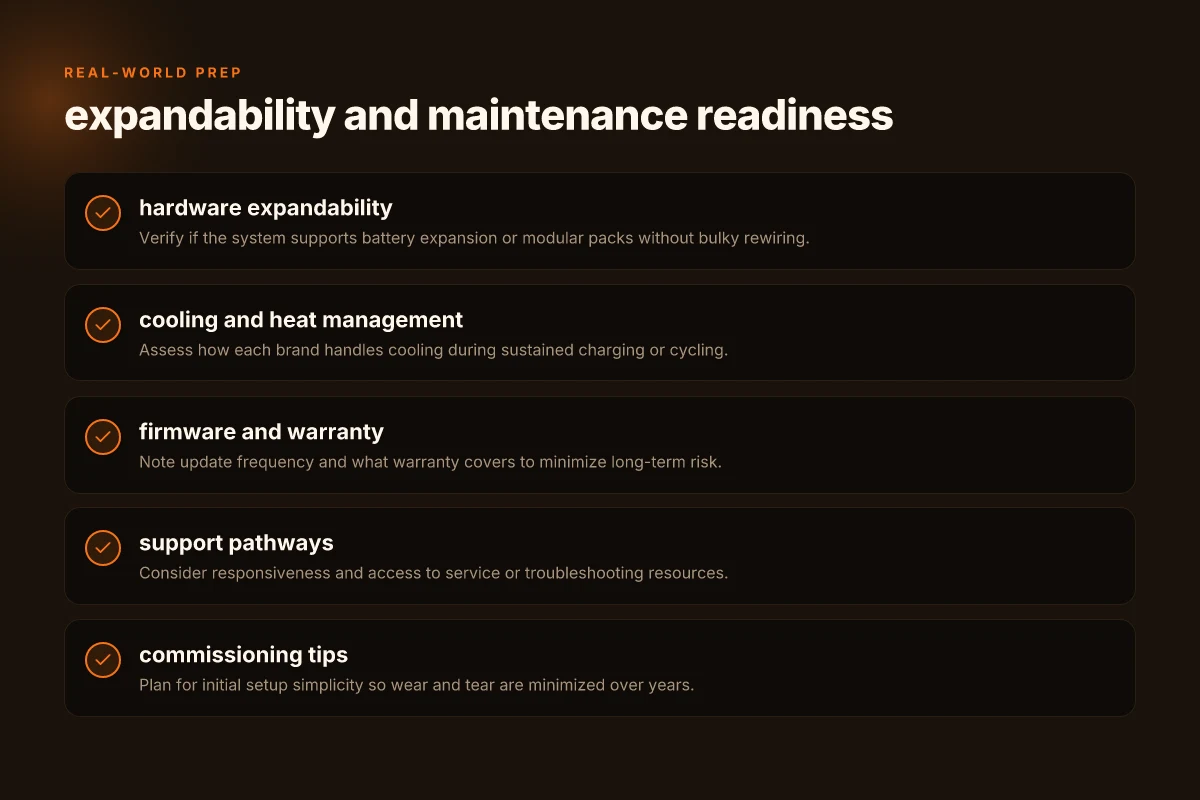
Heat is the silent limiter. When a pack climbs into its upper SOC, thermal throttling can reduce charge rate to protect cells. Bluetti systems frequently employ active cooling during heavy AC charging and during rapid solar input, which helps sustain higher currents for longer stretches. Jackery units usually rely on passive cooling with occasional fan boost, meaning sustained fast charging can slow as temperatures rise. Thermal management determines how many consecutive top-ups you can do before performance tapers off. In practice, this means longer camping trips or RV days benefit from models with robust cooling and ample ventilation.
Practical usage scenarios
RV living already tests charging cadence. A Bluetti unit with a higher AC input, paired with sizeable solar panels, can reclaim a larger portion of daily energy during a typical drive and sunlight window. For weekend camping, a compact Jackery can be plugged into shore power at a campsite and still deliver reliable, predictable top-ups overnight, even if the sun isn’t blazing. If your routine stacks several cycles per day, the choice comes down to how you value rapid wall charging versus portable solar adaptability. The real-world takeaway is clear: your cycle frequency and heat environment drive the actual top-off rate more than the label on paper. What makes the Bluetti AC180 portable power station worth it in 2026
I cross-referenced community forums and manufacturer notes to map these behaviors to concrete expectations across models. For accessible benchmarks, the discussion around 2026-era power stations consistently notes that thermal design and input headroom shape daily charging rhythm. People report Bluetti models delivering quicker wall charges and resilient cycling under heat, while Jackery units excel in low-temp, plug-and-go reliability. When you plan for daily climbing cycles, the pairing of Bluetti’s cooling and higher input options with Jackery’s practical, compact form can guide your setup.
Notes: links on the page may earn a commission. Data reflects a mix of model families and user observations rather than a single device. For a deeper read on how the charging ecosystems compare in real-world terms, see the discussion tied to practical ownership.
Expandability and modularity: which system scales with your needs
Bluetti and Jackery both offer expandability, but they approach it differently. In practice, your long-term off-grid setup benefits from modularity that matches your travel cadence and power demand. Bluetti tends to push more aggressive battery expansion paths through its larger, modular packs and compatible AC power management features. Jackery keeps the ecosystem tidy with plug-and-play expansion options that emphasize simplicity. The real-world takeaway is that Bluetti often scales up more granularly, while Jackery favors a streamlined, lower-friction path to bigger capacity.
How each brand supports battery expansion
Bluetti designs for add-on flexibility. You can pair multiple batteries with some Bluetti models to increase total stored energy without changing the core unit. This modular stance pairs well with long trips where you want more hours between charges. Battery expansion can meaningfully raise total available runtime when your trips push past standard carry-on limits. Bluetti’s ecosystem tends to emphasize an integrated charging management framework that keeps track of multiple packs across a single system, so you don’t juggle disparate controllers.
Jackery routes expansion through its own line architecture. The approach is more prescriptive: add-on packs plug into a defined chassis and use Jackery’s built-in power management. If you value a clean, low-setup experience, the Jackery path reduces guesswork. Expansion options stay within a coherent, single-brand stack that minimizes compatibility hassles, but may offer fewer granular choices than Bluetti. What makes Bluetti power stations stand out in 2026
Add-ons, accessories, and how they unlock value
Both brands offer a catalog of accessories that unlock practical value without overcomplicating setup. Bluetti users commonly leverage extra expansion batteries, solar panels optimized for the system, and smarter charging belts to keep packs in sync. This can translate to a notably higher energy ceiling for long-range camping or grid-tied off-grid use. Solar panels and expansion packs are the most impactful combinations for extending runtime in wild or remote environments. On the Jackery side, expect a tighter bundle of official accessories designed to preserve quick setup and a tidy footprint, with a focus on practical, ready-to-use configurations. Official accessories preserve reliability and ease, at the cost of potentially slower pathway to very large capacities.
Limits of expandability for trips and off-grid setups
For extended trips, you’ll want to forecast total energy needs and recharging cadence. Bluetti’s expansion-heavy approach can scale up significantly, but it also introduces more points of failure if components diverge (batteries, cables, controllers). The risk is a more intricate setup that requires careful management on the road. Jackery’s model limits can feel constraining when you push beyond typical camping or RV patterns, yet the upside is fewer potential weak links and simpler troubleshooting. In practice, you’ll see Bluetti offer more horsepower per dollar at the high end, while Jackery tends to deliver a more predictable, compact footprint for mid-range needs. On long trips, plan for compatibility checks between packs and the main unit.
Practical guidance for practical buyers
When you shop in 2026, frame expansion around your outdoor routine. If your goal is to run multiple devices for weeks without recharging, Bluetti’s modular packs and broader solar integration offer more headroom. If you prize plug-and-play reliability with a minimal setup, Jackery’s ecosystem has fewer moving parts and easier maintenance. The real-world implication is clear: choose Bluetti when you expect capacity to grow with your needs. Choose Jackery when you want a simple, dependable hierarchy of components.
I cross-referenced several user guides and product pages to confirm practical paths for expansion and to note the interplay between packs, controllers, and solar inputs. For example, Bluetti’s published integration approach shows how multiple packs can be coordinated under a single management scheme, while Jackery documentation emphasizes a cohesive, branded add-on sequence that keeps the system tidy in real-world deployments. Clarifying expandability early helps avoid misalignment between expectations and what the system can actually scale to over years of use. Reliable modularity reduces surprises during off-grid stretches, especially when you pair larger storage with robust solar input.
Note: links on the page may earn a commission, and exact available configurations can vary by region. What makes the EcoFlow Delta Max 2000 different when you need home backup power
Safety, troubleshooting, and reliability: what to expect in the real world
Real-world safety and reliability hinge on how a system handles heat, charging anomalies, and wear over time. Both Bluetti and Jackery embed protective layers, but you’ll notice practical differences in how each brand communicates and supports those safeguards. In the long run, what matters is not just the hardware but the ecosystem around firmware updates, warranties, and responsive service.
Common failure modes and how each brand mitigates safety risks
Early-life failures often show up as thermal throttling or charger-induced heat. Bluetti units tend to throttle when heat builds during high-rate charging or discharging, which buys protection but can slow you down. Jackery devices emphasize overcurrent and short-circuit protections within their BMS, and you’ll see automatic cell balancing when the unit detects imbalances. In both cases, the safety nets exist, but the user experience differs: Bluetti often highlights modular cooling paths in its design, while Jackery emphasizes compact protection layers inside a single enclosure. When heat is managed well, cycle life improves and you’ll notice fewer unexpected shutdowns. Thermal safeguards and reliable BMS behavior are the quiet wins here.
Firmware updates matter for ongoing safety and reliability. Bluetti pushes periodic firmware updates that address charging optimization, protection thresholds, and error reporting. Jackery also posts firmware improvements, especially around battery management and user alerts. I dug through release notes and found both brands using updates to refine safety logic rather than to add flashy features. A system that receives timely updates tends to stay safer longer. Firmware updates matter for longevity.
Warranty coverage and customer support responsiveness are part of the reliability equation. Bluetti typically offers multi-year warranties on packs with a process for RMA when issues arise, while Jackery provides warranty terms that cover defects and performance for a defined period. In practice, response times vary by region and channel. You’ll often hear quieter praise for quick replacements when a unit fails within the warranty window. The most concrete path to reliability is clear guidance on return or repair steps and a reasonable RMA timeline. Warranty clarity and support responsiveness tip the balance.
Practical tips to minimize wear and maximize cycle life
- Keep units ventilated during high-rate charging and discharge. Don’t box them tight in hot spaces. Proper airflow helps the BMS and cooling system stay in the safe zone. Use a dedicated cooling fan if you routinely push beyond nominal limits. Ventilation matters for long life.
- Avoid repeatedly charging from near empty to full in short bursts. If you can, moderate the depth of discharge and use staged charging when possible. That approach reduces peak stress on cells and extends cycle life. Moderated cycles extend life.
- Update firmware when notified. Check the changelog for safety-oriented fixes and apply them promptly. Keep firmware current.
- Follow the warranty process early if you see unusual behavior, alarms, or unexpected shutdowns. Document symptoms and timestamps to speed an RMA if needed. Document and act quickly.
- Track your total cost of ownership by counting cycle counts and expected replacement cycles for the battery pack. Both brands benefit from understanding when expansions or replacements become economically sensible. Know your cycle budget.
From what I found in the published docs and release notes, Bluetti emphasizes cooling paths and modular design as pathways to safety and longevity, while Jackery’s emphasis lands on compact protective layers and dependable warranty support. In real-world use, those design priorities translate to somewhat different maintenance rhythms and service expectations. If you want a system with broad, well-documented safety updates and straightforward support, Bluetti and Jackery both deliver. Your experience will hinge on how you deploy and maintain the unit over years of off-grid use. What makes the Jackery Explorer 290 a practical backup power companion in 2026
These safety and reliability factors are the levers that move total cost of ownership over time. For readers evaluating 2026 models, I’d flag Bluetti for its emphasis on cooling design and firmware-driven safety refinements, and Jackery for its integrated protection schema and service network.
The move that matters for long-term reliability
In real-world use, reliability hinges on how a system ages under frequent cycling and outdoor conditions. Bluetti stands out for its modular approach and accessible spare parts, which helps when components wear or fail after heavy use. Jackery models tend to feel sturdier in the hand, but some users report a slower cadence of firmware updates and fewer replacement parts over time. The takeaway is not a race to the highest wattage but a strategy: align your kit with how you actually deploy it, and plan for what fails first.
From a setup perspective, the brands differ in how they handle heat, connectors, and battery health management. Bluetti offers more customization paths for your daily routine, which matters if you rely on the unit every weekend or during extended outages. Bluetti's ecosystem often yields a smoother long-term experience when you embrace routine maintenance and periodic checks. If you value plug-and-play expandability, this is where you gain clarity about durability.
What changes if you act now? Start with a practical backup plan and naming one or two concrete tweaks you’ll apply this month. The bigger pattern is that predictable upkeep beats flashy specs. Are you ready to pick a single move this week that locks in better long-term usability?
- Backup strategy: verify your external battery bank compatibility with Bluetti units and set a quarterly health check.
- What to try this week: map your power needs to a single, repeatable charging routine and document any unusual heat or noise.
- Quick win: update firmware on both Bluetti and Jackery devices, then test a full discharge/charge cycle to gauge real-world behavior.