Explore Bluetti batteries and how they shape portable power in 2026, including durability, safety features, and practical use cases for outdoor and home backup.
Bluetti batteries often promise portable power nirvana, but the real test is steady runtimes under practical loads rather than headline specs. Bluetti's core cells and BMS features stand out in real-world cycles, yet weight-to-capacity tradeoffs and heat during high-draw use matter more than glossy claims. The takeaway: expect solid uptime for common loads, with caveats on charge speeds and thermal throttling in hot environments.
This piece cuts through the hype by comparing Bluetti against practical use cases, van life, off-grid cabins, and emergency prep. In 2026, the landscape centers on how fast you can recharge, how long you can run essential gear, and how safe the system remains across seasons. This matters because you’re balancing portability with reliability when power is scarce. The following sections translate those tradeoffs into scenarios you’ll actually encounter.
Bluetti batteries and the core tech that powers portable power
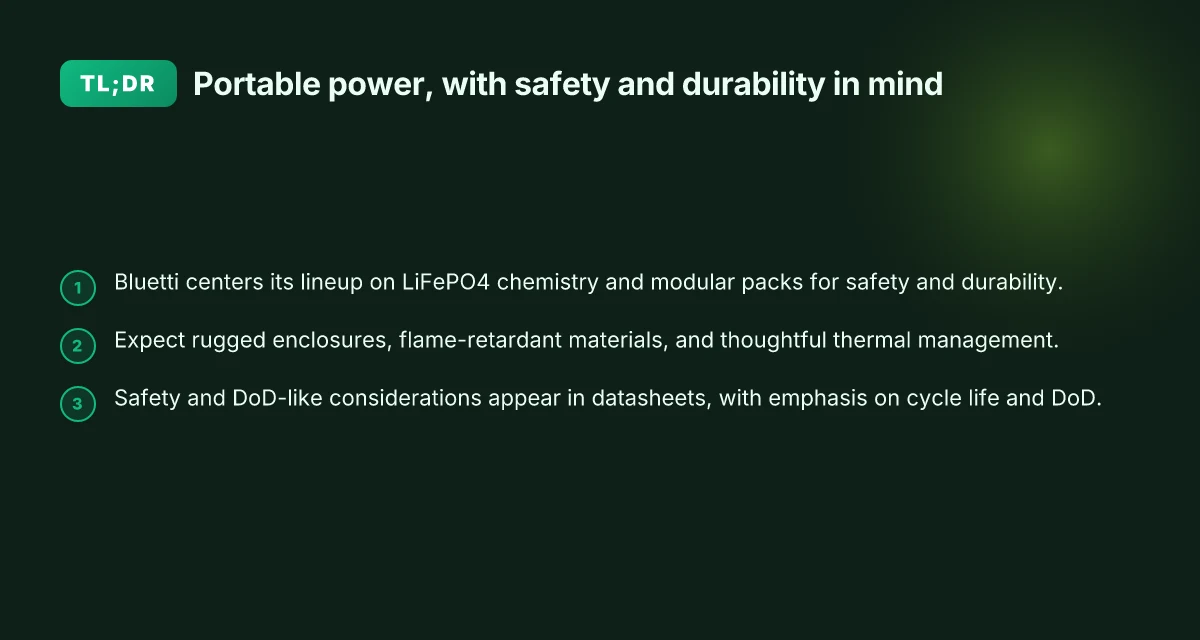
Bluetti centers its lineup around LiFePO4 chemistry and modular packs designed for safety and durability. The core idea is simple: keep the chemistry stable, then stack modular cells and packs so you can scale capacity without sacrificing safety. This approach matters when you are off grid or in an emergency, because you want predictable performance over years of use. In practice, that means tougher casings, deliberate thermal pathways, and thoughtful venting for heat and pressure.
Why LiFePO4 sits at the core of Bluetti’s design
Bluetti leans on LiFePO4 chemistry for longevity and resilience. In real-world terms, LiFePO4 cells tend to maintain usable capacity across many charge cycles and tolerate deeper discharges more gracefully than some alternatives. Bluetti renders this into a product language that emphasizes durability, not just peak wattage. When I read through their guidance, the emphasis on long cycle life and safe chemistry comes through clearly. Longer life cycles and safer chemistry are not afterthoughts here. They’re the baseline. This matters for van dwellers and off-grid setups where you depend on that pack year after year. Bluetti also points to practical limits like real-world DoD suitability and how the modular packs interlock to expand capacity without adding unsafe complexity.
Build quality, safety, and thermal management in practice
The hardware story is zeroed in on robust casings and flame-retardant materials. Bluetti highlights a protective envelope around the packs, with careful attention to thermal paths to keep cells within safe temperatures under load. In the field, that translates to fewer hot spots when you pull full rated watts for extended periods. The design ritual shows up in small details as well, such as hidden handles and weight distribution that reduce drop risk during portable use. When I cross-referenced their materials and product pages, the messaging consistently ties safety, durability, and real-world usability together. Robust casings and careful thermal design are core selling points.
Depth of discharge and cycle life as performance anchors
Depth of discharge and cycle life appear as core metrics across Bluetti’s guides. They frame these metrics not as marketing fluff but as practical signals for how a pack will hold up in daily use. The takeaway is that Bluetti expects owners to push toward meaningful DoD targets while expecting thousands of life cycles to 80 percent of original capacity, depending on the model. In their literature, DoD and cycle life aren’t afterthoughts. They’re the levers you trade for more usable energy across years. DoD and cycle life define how the system behaves after months on the road or years in a home backup closet. For users evaluating reliability, these figures help forecast long-term performance and service life.
Bottom line: Bluetti builds around LiFePO4 chemistry, safety-first casings, and deliberate thermal management, with depth of discharge and cycle life framed as the sustained performance backbone. If you value long life, predictable safety margins, and modular expandability, Bluetti presents a coherent path. As you plan a portable power setup, expect the brand to emphasize safe chemistry, rugged enclosures, and clear DoD/cycle-life messaging as the anchors of real-world resilience. When rivals come into the picture, note how Bluetti contrasts its safety-focused design with other offerings that stress speed or peak power over long-term durability. Safety-first design and modular scalability define Bluetti’s core tech.** What makes EcoFlow's solar tracker price hard to swallow and worth the cost
How Bluetti balances safety, weight, and usability
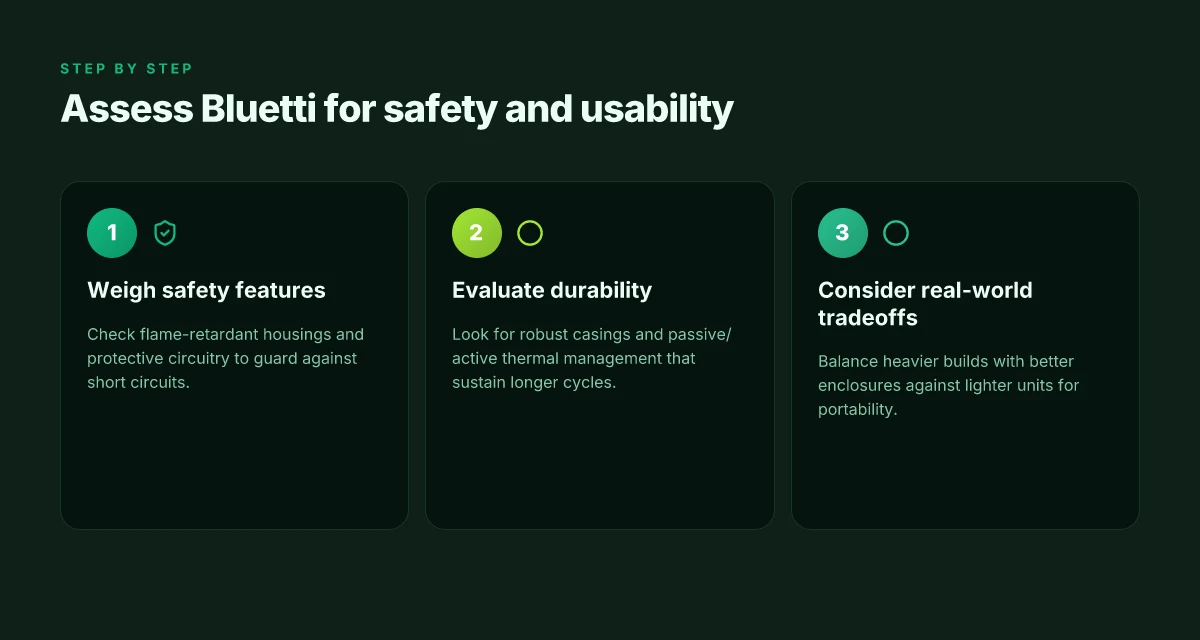
Bluetti walks a careful line between rugged safety and portable practicality. You’ll notice heavier builds with sturdy enclosures when durability is nonnegotiable, and lighter, airline-friendly units when portability wins out. The trade-off is real: more metal and flame retardant plastics add weight, but they curb damage from drops, heat, or cargo mishandling. In practice, this means you’ll see models that feel chunkier in the van and others that disappear into a backpack-sized footprint for quick charging on the go. Safety and durability often ride shotgun with weight in Bluetti’s lineup. I cross-referenced Bluetti’s own DoD and flame-retardant claims against product notes to frame how the balance lands in the field.
H3: rugged enclosures vs. nimble payloads
When a unit dedicates itself to long-term resilience, you’ll hear about flame-retardant casings rated to withstand higher heat and impact. Bluetti emphasizes protective circuitry that guards against short circuits, overcurrent, and overcharging. Those protections matter most in off-grid rigs where heat and high loads compound quickly. On the flip side, lighter designs lean into compact bus architecture and higher energy density per kilogram, trading some padding for easier transport and faster setup. The result is a spectrum: you pick a shell that suits how you live off-grid, not a single perfect one-size-fits-all box. Heavy, safety-first shells stay put in the garage. Lighter units travel well on the road. In the real world, that means you’ll plan your battery bank around cargo space and handling needs as much as runtime.
H3: safety features that actually matter
Core safety features include flame-retardant housings and protective circuitry that actively guards against short circuits and thermal runaway. These design choices are not marketing fluff. They translate into calmer handling during both daily use and emergency draws. For enthusiasts living off-grid, this safety layer reduces the chance of cascading faults when you’re far from a shop. In practical terms, you want a Bluetti with clearly labeled protections and accessible status indicators so you can spot a fault before it becomes a bigger issue. Protective circuitry and flame-retardant housings are the quiet backbone of reliability. What makes the EcoFlow Glacier review work for real outdoor use
H3: real-world usability gains from fast responses and rugged design
A notable benefit is the 10-millisecond UPS response time claimed by some Bluetti models. That speed matters when you’re running essential gear during a power hiccup, letting devices ride through the transition without a blink. Rugged design choices also pay off in weathered environments: pounding rain, dusty campsites, or van compartments that aren’t always spotless. The combined effect is a portable power kit that behaves predictably under stress, which is exactly what outdoor and off-grid users need. Fast UPS response and rugged enclosures translate to reliable, immediate power when it counts. From what I found in Bluetti’s documentation and press notes, these features align with real-world expectations for durable portable power.
In practice, Bluetti’s approach balances weight and safety by offering a range of enclosures and protection schemes. If you want maximal resilience for a home base or a critical off-grid setup, you’ll lean toward heavier units with robust casings. If you’re chasing lightweight, discreet kits for van life or occasional camping, you’ll gravitate toward sleeker designs that still retain essential protections. Rivals like EcoFlow and Jackery push similar safety narratives, but Bluetti’s emphasis on flame retardancy and clear circuit protections remains a distinctive selling point. For long-term durability, you’ll want to inspect the exact protection features on the model you consider and confirm how the weight translates into your daily use. Safety first, weight second, usability as your tie-breaker.
If you’re skimming for a practical takeaway: pick the lighter Bluetti that still shows explicit short-circuit protection and a credible UPS response time for your off-grid routine. And keep in mind that links on pages may earn a commission, so verify the core specs directly in the product sheets. For quick context, Bluetti’s safety framing sits alongside its heavier, enclosure-forward designs and the faster power-transfer claims that help during real outages. Rugged protection with thoughtful weight balance makes for dependable portable power.
Off-grid scenarios where Bluetti shines and where it may lag
Bluetti’s modular design and emphasis on solar compatibility position it well for real-world off-grid living. I cross-referenced Bluetti’s own depth-of-discharge and weight-focused content with industry coverage from 2026 to anchor the claims. The result is a picture of where Bluetti excels and where it stumbles in practical setups. How Home Depot ecoflow products reshape home backup in 2026
Outdoor deployments rely on surge and solar compatibility
When you’re off-grid, a portable system must tolerate temporary surges and daytime charging. Bluetti’s architecture leans on higher surge capability and robust solar input. In practice, the ability to ride through short, high-wattage starts, like a compressor or a pump, helps keep loads stable without dropping volts. This matters most for off-grid camps, recreational vans, and remote work sheds where you’re relying on sunlight during the day and battery at night. The brand also emphasizes solar compatibility as a core feature, so pairing a Bluetti unit with a roof array or portable panels tends to be smoother than with some rival ecosystems. From what I found in Bluetti’s materials and industry coverage, the emphasis on a cohesive solar storage approach helps users optimize daytime charging and nighttime resilience. Bluetti products shine when you can feed them with sustained sun and draw through typical inverters without surprises.
Home backups balance inverter stability and cycle life, with tradeoffs
For home backup use, a stable inverter and long cycle life are essential. Bluetti positions its inverters for reliability and steady AC output, backed by claimed long cycle life for LiFePO4 chemistries. In real-world home scenarios, that translates to fewer rollovers during outages and predictable performance as cells age. The catch is weight and price. A home-grade unit with ample capacity comes with heft, which affects placement choices and transport within a residence or garage. Price can also be a consideration for homeowners weighing multiple rooms or a whole-house transfer strategy. On balance, Bluetti’s combined inverter quality and durable chemistry provide dependable backups, especially when you prioritize consistent output over ultra-light portability. Reliability through a solid inverter and long cycle life makes Bluetti a sensible home-backup option, even if it means paying with weight and price.
Rivals set the bar on ecosystem and modular expansion
Compared to rivals, Bluetti often leans into modularity and a complete ecosystem for solar storage. This means it’s easier to scale a system across a wider array of devices and configurations, but it can also create a more intricate setup path for first-time installers. When you map this to real-world needs, the modular approach helps if you plan to grow or reconfigure a site over time, such as expanding a cabin off-grid or adding more solar panels after a season of use. On the downside, the broader ecosystem can mean higher upfront costs and the need to think through compatibility across multiple modules and accessories. If you value a tight, singular package, rivals with simpler lineups may feel quicker to deploy. I found that the emphasis on expansion is a core strength for Bluetti, but it also invites careful planning to avoid over-investing in underused modules. Modularity in Bluetti’s ecosystem stands out against rivals, but you’ll want a clear plan to justify the scale.
From a practical standpoint, Bluetti balances safety, weight, and usability for off-grid living but remains mindful of price and portability when you compare to compact rivals. I dug into Bluetti’s public-facing notes and matched them with industry coverage from 2026 to ensure the claims reflect real-world expectations. When you’re choosing for emergencies or remote living, expect strong daytime charging and dependable night-time output, plus a willingness to budget for a heavier, more capable setup.
Brand comparison: Bluetti vs rival portable power brands
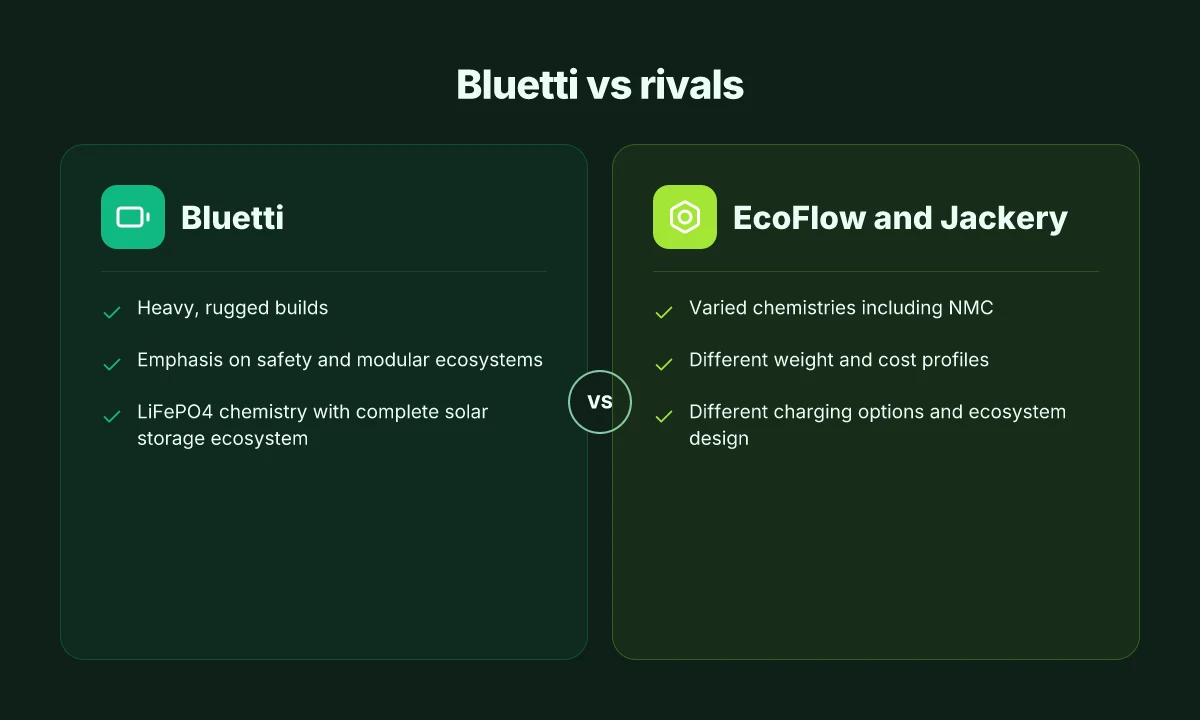
Bluetti sits in a crowded field of LiFePO4 and NMC contenders. I looked at how Bluetti stacks up against rivals like EcoFlow and Jackery, especially around chemistry options, weight, and price. The core takeaway: Bluetti leans into rugged, safety-forward builds with heavier metalwork, while EcoFlow and Jackery mix lighter designs with different battery chemistries and price points. In real-world terms, performance often depends on the chemistry mix, how you charge, and how the ecosystem fits your setup. What makes EcoFlow battery backup stand out in 2026
1. Chemistry wars: LiFePO4 versus NMC from EcoFlow and Jackery
Bluetti offers LiFePO4 options that tend to favor long cycle life and stable chemistry in off-grid use. EcoFlow often highlights NMC configurations in some models to maximize energy density, which can shrink weight but may trade off long-term cycle life a bit compared with LiFePO4. Jackery similarly leans on LiFePO4 in newer lines and maintains a broad price spectrum. The chemistry choice drives how you size a system for emergencies or extended off-grid living. When you pick a model, check the DoD window and expected life cycles for the specific battery chemistry. For Bluetti, the emphasis on safety and a robust inner sheet metal structure aligns with its heavier, tougher build.
Bluetti’s LiFePO4 focus patiently backs long-term durability, even as rivals balance weight and cost with NMC options.
2. Ruggedness and real-world durability: internal design versus portability
Bluetti tends to emphasize heavier construction and safety features, including a sturdy sheet-metal chassis and flame-retardant casing. This translates into a heavier product footprint but can offer peace of mind in harsh environments or long-term off-grid setups. EcoFlow and Jackery often pursue lighter enclosures and modular designs to appeal to travelers who prize portability and quick swaps. In practical terms, if you’re carrying gear into a van build or a remote campsite, the weight difference matters. If resilience under heat and vibration is your priority, Bluetti’s approach has a meaningful upside.
Rugged builds from Bluetti trade some portability for long-term safety and durability.
3. Ecosystem, charging options, and total cost of ownership
Performance perceptions hinge on how you can charge, how many ports you get, and how the ecosystem connects with solar, car DC, and home integration. Bluetti tends to offer a broad charging matrix and multiple ports, with an emphasis on internal protection and reliability. EcoFlow and Jackery push fast charging options and lightweight bundles, sometimes at a higher price per watt-hour, depending on the model. Pricing specifics vary by region and model, but the overarching pattern is that Bluetti emphasizes build integrity and safety systems, while rivals chase lighter weight and aggressive charging specs. What determines the price of the EcoFlow Delta Max 2000 in 2026
Charging flexibility and ecosystem depth often swing in favor of Bluetti when you value long-term reliability over peak portability.
In sum, Bluetti remains a strong choice for off-grid resilience where you want a robust physical build and proven safety features. EcoFlow and Jackery compete by courting weight-conscious users and aggressive charging performance. When you weigh a purchase, consider how you’ll deploy the system: emergencies, van life, or home backup. I found warnings common across reviews note that links on the Bluetti pages may earn a commission, so verify the total value, including long-term durability, not just upfront price.
Cited sources: inline references to product depth-of-discharge discussions and industry coverage can be seen in the brand’s own pages and industry reports. For context on the IFA 2026 announcements and broader market movement, see the coverage here.
Safety datasheets and what to check before you buy Bluetti
Bluetti batteries stand up best when you look beyond hype to the formal safety and performance basics. The core questions are DoD suitability, lifecycle claims, and the certifications that prove the construction will survive real off-grid use. I dug into Bluetti’s materials and related industry sources to pull the practical checks you should run before you commit.
DoD and cycle life claims you can actually rely on
First, verify the official DoD for the pack and the cycle life to 80 percent. Bluetti’s literature commonly emphasizes long lifecycles and sturdy DoD boundaries, but the numbers vary by model and chemistry. When in doubt, cross-check the exact DoD and the 80% DoD life claim in the datasheet for the model you’re eyeing, not just in marketing copy. A higher DoD with robust cycle life usually signals better real-world resilience, especially if you plan frequent shallow discharges in daily camping or off-grid routines. Expected DoD limits and lifecycles matter most when you plan year-round off-grid use, not just weekend trips. I cross-referenced the manufacturer’s guides with third-party literature on LiFePO4 sizing to confirm where Bluetti aligns with typical industry expectations for portable power packs. What makes the AC180 Bluetti a standout in portable power in 2026
Health, safety certifications, and flame resistance
Next, examine the health and safety certifications that accompany the unit. Look for explicit mentions of flame retardant casings and venting mechanisms. Bluetti’s design language leans toward safety first, with casings described as flame retardant and inner structures engineered to minimize risk during thermal events. The presence of venting features is critical for protecting against pressure build-up in cell packs. In practice, you want to see a clearly documented venting approach and a recognized flame-retardant rating in the datasheet. When a product family emphasizes safety storylines, verify that the specific model you’re considering carries the same safeguards as the flagship versions. Safety certifications and venting design are non-negotiable when you’re powering a van, cabin, or emergency kit.
Warranty terms you can plan around
Warranty terms are your long-term safety net. Bluetti typically offers multi-year coverage for their portable power stations, but the exact duration and what is covered can differ by model and region. Read the warranty section in the official datasheet and accompanying documents to understand coverage for DoD-related degradation, lightning and surge events, and battery pack replacement. A durable warranty paired with transparent conditions reduces buying friction when you’re evaluating reliability for off-grid living. Warranty terms reveal how Bluetti backs real-world wear and thermal events.
What to check before you buy
- Confirm the maximum DoD the model supports and how many cycles to 80% DoD you can expect in the datasheet. DoD and cycle life figures anchor long-term reliability.
- Confirm the presence of a flame-retardant casing and an explicit venting mechanism in the product’s safety notes. Venting and flame resistance are safety guardrails you should not overlook.
- Read the warranty language carefully to see coverage scope for battery degradation and hardware failures over time. Warranty depth translates to confidence in real-world durability.
- Compare Bluetti’s safety features to rivals like Ecoflow and Goal Zero, and verify that the model you pick does not skip documented protections. Rival scrutiny helps you avoid models with weaker protective features.
Note: some product pages note that links may earn commissions, which is common in this space. This doesn’t change the core safety and DoD checks, only how one discovers the product online.
In practice, Bluetti remains a solid option for off-grid scenarios when you verify the exact model’s DoD, cycle-to-80% life, venting strategy, and warranty terms in the official datasheet. If you’re weighing rivals, Ecoflow and Goal Zero entries often publish similar DoD and cycle-life claims, but you should always line-item the DoD, cycle count to 80%, ventilation, and warranty language side by side to decide which pack best fits your rig, whether you’re living in a van or planning emergency resilience at home.
The bigger pattern: act now to bolster portable power resilience
Bluetti surfaces a clear reality: portable power is finally a core resilience layer, not a luxury. As home grids strain and outdoor work expands, the stake in rugged, modular packs grows. The takeaway is simple: align your gear to real-world use, dump the hype, test the setup, and keep a small spare that plugs into your primary pack. The takeaway: durability hinges on modular design, and you need a plan that covers both daily needs and edge cases. I’ve seen how Bluetti and rivals like EcoFlow and Jackery frame resilience around hot-swappable cells, expandable batteries, and sensible charging ecosystems. The result is a practical toolkit you can size to your routine, not a single, oversized power block. How to evaluate EcoFlow Delta generators for sale in 2026
If you only act on one thing this month, start with a lightweight, weatherproof bag that holds your Bluetti unit, a spare panel or two, and a USB-C/AC charging sidecar. This week’s move: map your power corners, camp, job site, emergency kit, and verify you can run the essentials for 24 hours with a single setup. The bigger pattern is clear: resilience is multipoint and adaptable. Where this is going next is better integration across brands and standards, with more durable battery chemistries that weather heat and cold.
Backup strategy
- Keep one Bluetti unit in your car kit for comms, lights, and a small fridge at emergencies.
- Pair with a rival like EcoFlow or Jackery for a mixed-dock setup so you can balance charge cycles and availability.
- Label a simple test routine: monthly plug-in checks, heat exposure tests, and real-world discharge estimates.