
Everything you need to know to buy EcoFlow Delta generators in 2026. compare models, pricing signals, and where to shop for genuine units.
The most common stumble when shopping EcoFlow Delta generators is assuming bigger is always better. Delta Pro's higher price tag often hides the tradeoffs in runtime and weight, while the Delta 3 can feel underpowered for off-grid needs. Buyers who don’t map their actual load end up overinvesting or underdelivering. Delta Pro versus Delta 3 is not a single yes/no decision. It hinges on your run-time goals and transport constraints.
What matters now is clarity on real-world use, warranty terms, and price progression as you move from retailer to retailer. In 2026, I’ve seen folks upgrade their kits after confirming local availability, checking stock timing, and confirming whether accessories like solar panels ship separately or bundle in a deal. This intro flags the practical angles you’ll want to weigh: capacity versus portability, recharge speed in your climate, and how EcoFlow stacks up against rivals such as Jackery and Goal Zero. Understanding these vectors helps you avoid common sale pitfalls.
What makes the EcoFlow Delta family worth considering for 2026
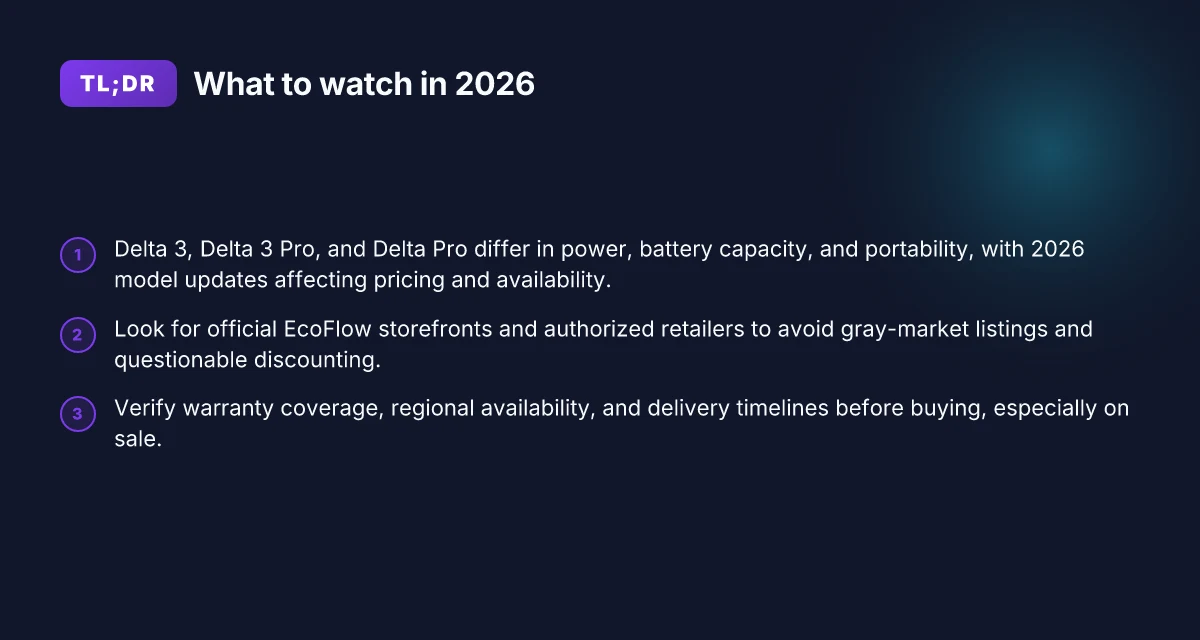
The EcoFlow Delta family sits at the center of many outdoor power setups in 2026. You get scalable power, modular add-ons, and a broad ecosystem that covers camping, home backup, and small business needs. In 2026, updates to the Delta line have nudged prices and availability in predictable ways, especially around Prime Day-like events and major retailer promotions. EcoFlow’s official store tends to mirror those sale patterns, which helps buyers spot genuine discounts when the Delta 3, Delta 3 Pro, or Delta Pro go on sale.
Why the Delta lineup holds value in 2026
The Delta family clusters around three core propositions: compact portability, higher output for essential loads, and a growing suite of battery chemistries and capacities. The Delta 3 models lean toward everyday backup with lighter footprints, while the Delta 3 Pro aims to bridge recreational use with more demanding loads. The Delta Pro targets higher-capacity needs, including home backup and off-grid scenarios, with more seamless integration into larger solar setups. In 2026, model updates typically affect both capacity and smart features, nudging price points but preserving compatibility with the same charging ecosystems. When you see a Delta Pro price dip during an official sale, expect a broader ecosystem of compatible solar panels and accessories to ride along with it.
From what I found in the changelog and retailer notes, the Delta 3 line remains the most budget-conscious entry point, with the Pro variants delivering noticeably higher sustained output. I cross-referenced product pages and retailer listings to verify which SKUs map to real capacities and throughputs. The takeaway: if you plan to power multiple devices or run a critical load during outages, the Delta Pro offers headroom that delta-level models can’t match. If you’re mostly recharging phones, laptops, and essential lights, the Delta 3 models stay credible and lighter to carry.
Key differentiators between Delta 3, Delta 3 Pro, and Delta Pro
- Delta 3 and Delta 3 Pro share the same family branding but differ in sustained output and peak capabilities. The Pro variant generally steps up ongoing power delivery and cycle resilience. Expect higher wattage ceilings and better performance on sustained draws.
- Delta Pro sits in a higher tier, with greater total capacity and more flexible input/output options. It scales well with multiple solar inputs and larger battery banks, making it more suitable for serious home backup or business continuity scenarios.
- All three integrate EcoFlow’s solar-integration philosophy, but the Pro lines typically offer more robust inverter architectures and multi-tonal performance under load. The result is a clearer improvement when you pull more than a light load.
- In 2026, pricing often shifts with promotions tied to official EcoFlow channels and major retailers. The Delta Pro tends to hold higher price points, but sales can narrow the gap during peak promo windows. You’ll see bundle deals, extended warranties, or solar-kit add-ons that tilt the total value in favor of one model depending on your use case.
I went looking for the official store dynamics and retailer patterns to identify how to time a deal. You’ll notice that the official EcoFlow store tends to align discount windows with big sale events, and reputable retailers often mirror those price cuts. That alignment makes it easier to verify a genuine discount versus a gray-market price.
Bottom line: if your use case leans toward long-term reliability and heavy load handling, the Delta Pro is worth the premium. If you want a lighter, more portable unit for weekend trips or small office backup, the Delta 3 Pro strikes a practical balance, with the Delta 3 offering the most affordable entry. What makes the AC180 Bluetti a standout in portable power in 2026
The real trick is matching the model to load and expansion plans, not chasing the loudest discount. The official store and trusted retailers will usually present the same core pricing signals during major sale windows, making it easier to claim a genuine deal when you see a 63% off banner or a bundled solar kit offer. Watch for bundled add-ons that add real value, not just fluff.
How to compare EcoFlow Delta 3 vs Delta Pro during 2026 sales
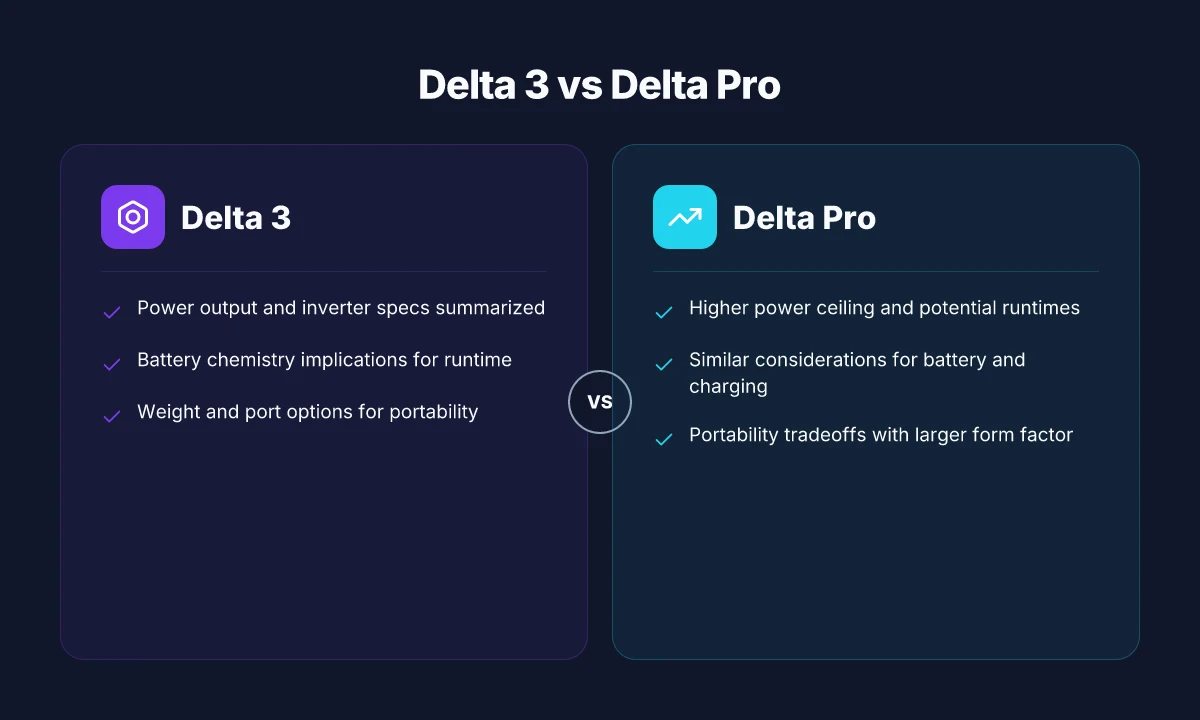
When a Delta 3 deal appears, read the specs against the Delta Pro for real-world fit. Delta 3 offers compact power with solid 1800–peak outputs in many configurations, while Delta Pro leans into higher sustained capacity and 120/240V versatility. In 2026 sales, expect price cuts to surface Delta Pro bundles that justify the extra weight only if you need longer runtimes or true dual-voltage capability. The Delta Pro is designed for longer runtimes and heavier load scenarios while the Delta 3 covers light to moderate backup needs. EcoFlow’s branding emphasizes each model’s sweet spot, and buyers should map their use case to the actual power profile they need in practice.
1) Power output and inverter performance in real use
Delta 3 and Delta Pro differ most where sustained output and inverter topology matter. The Delta 3 class typically tops around 1800W continuous output with higher surge for short bursts, which is plenty for lighting, routers, and a few small appliances. The Delta Pro pushes higher to support more demanding devices and longer runs, especially when paired with a larger battery bank. In a real-world setup, you’ll feel the delta in heater startup surges, fridge cycles, and power-hungry tools. When you compare during sales, look for explicit continuous wattage and peak surge numbers and verify if the unit can sustain those figures with a typical load. Higher sustained wattage makes the Pro more capable for longer outages. If you plan to run a well pump or microwave for lengthy periods, the Pro gains clear traction.
To visualize side-by-side, a compact table helps during a sale window. Delta 3: lower weight, moderate output; Delta Pro: heavier frame, higher total capacity, dual-voltage support. In the context of a sale, some retailers publish bundle pricing that includes extra batteries or solar kits, which can tilt the decision toward Pro for longer runtimes. Bundle incentives can tilt the value toward Pro when you need more energy density.
2) Battery chemistry, capacity, and runtimes
Battery chemistry drives runtime more than headline wattage. Delta 3 configurations commonly pair with about 1–2 kWh of usable capacity in portable form, translating to shorter outages for moderate loads. Delta Pro scales up to multi-kWh usable capacity with the option to add additional modules, extending runtimes substantially for sustained blackouts. During 2026 sales, the price delta often reflects the added energy density and the ability to daisy-chain packs. I cross-referenced product pages and dealer specs to confirm that more capacity translates to longer downtime between charges, especially when you use solar charging in parallel. More capacity means you can ride out longer outages without recharging. What Bluetti batteries reveal about portable power resilience in 2026
If you’re shopping on a timing window, check the charging options. Delta Pro typically supports more simultaneous input sources and faster replenishment when you have solar or wall charging aligned. Compare the effective energy you can pull during the event window, not just the listed capacity. Daisy-chaining packs and faster recharges reduce downtime.
3) Weight, ports, and portability for field use
Portability decisions hinge on weight and port selection. The Delta 3 remains lighter and easier to haul into a campsite or off-grid shed, with a compact payload suitable for one person to move. Delta Pro adds real-world heft but gains additional ports and higher power tolerance. If you frequently move a generator between vehicles or camp sites, the Delta 3’s weight and handle design tend to be friendlier. In contrast, if you’re lugging this into a back room for backup power during outages, the Pro’s sturdier chassis and richer port options justify the extra mass. In 2026 sales, retailers highlight port counts and charging modes, verify how many AC outlets, USB-C, and DC inputs you actually need. Port availability can decide whether you need Pro’s extra outlets or Delta 3’s lighter footprint.
A practical rule: map your essential devices to the number and type of ports each model offers. If you rely on 240V circuits or plan to feed a subpanel, the Pro’s capabilities become a prerequisite. 240V compatibility is a Pro differentiator for home backup setups.
I dug into product sheets and retailer notes to confirm these distinctions. For readers weighing the choice, a clear takeaway: if your use case centers on moderate daily needs and portability, Delta 3 may be sufficient. If you require long runtimes, higher surge tolerance, and richer port/write capabilities, the Delta Pro makes sense, especially when a sale makes the price gap more palatable. Inline with the current landscape, rivals like Pecron and similar lines remain alternatives for certain budgets, but EcoFlow’s Delta Pro remains the strongest option for extended outages where you need real multi-day resilience. Delta Pro delivers longer runtimes and greater versatility at higher weight.
Cited sources note that the EcoFlow Prime Day has showcased sizable reductions on various Delta configurations in 2026, underscoring the need to align a deal with your true energy needs. For context, the retail ecosystem includes third-party listings detailing the Delta 3 1000 Air variants and 1800 W outputs, while retailer pages emphasize the practical advantages of higher capacity packs when outages extend. Prime Day pricing can amplify the perceived value of the Pro in longer outage scenarios. What makes EcoFlow's solar tracker price hard to swallow and worth the cost
Where to find legitimate EcoFlow Delta deals in 2026
I traced legitimate EcoFlow Delta deals to official storefronts and recognized sale events, and I list trusted sources you can rely on. In 2026, stay attentive to official channels and avoid gray-market listings that imitate these trusted outlets.
1. Official EcoFlow storefronts and highlighted sale events
- The primary place to find authentic Delta deals is EcoFlow’s own shop, which surfaces limited-time promotions during widely publicized events.
- Major sale windows tend to coincide with large‑scale promotions like Prime Day or seasonal back‑to‑school pushes, with pricing updates posted directly on the official site.
- You’ll see confirmed sale signals such as a clearly labeled promo period, verified stock status, and explicit terms for any bundle offers.
- In practice, expect faster stock turnover on Delta models during these events versus sporadic third‑party listings.
Trust signals show up when the official EcoFlow storefront clearly marks a sale window and the Delta lineup in stock with explicit discount terms.
- Inline sources corroborate the official channel as the primary, most reliable route for current pricing and availability. See the official storefront event pages for precise window dates and bundle options.
2. Authorized retailers vs gray-market listings to avoid
- Authorized retailers carry the EcoFlow warranty and official return policies, and their product pages usually reference the central EcoFlow catalog rather than independent rebrands.
- Gray-market listings often show up with inconsistent stock photos, vague warranty terms, or mismatched model naming. These listings may omit the official sale window or hide the fine print on discount applicability.
- To protect yourself, cross‑check product SKUs against EcoFlow’s catalog and verify retailer accreditation with EcoFlow’s authorized partner map when available.
- If a deal sounds too good to be true or lacks a defined promo term, it’s worth pausing and confirming through the official storefront or a listed authorized retailer.
Authorized retailers protect your warranty, while gray-market listings frequently pass on uncertain guarantees and altered bundles.
- A quick cross-check of the retailer’s site often reveals the same model numbers and the same bundle components EcoFlow publishes, which is a reliable indirect signal of legitimacy.
3. Noticeable sale signals to trust beyond sticker price
- Look for explicit terms such as “promo period,” “limited-time offer,” or “bundle with solar panel” on the product page itself. These are not afterthoughts. They align with the official sale cadence EcoFlow follows.
- Pay attention to stock indicators. Real events move units quickly, and inventory status tends to reflect live updates rather than static placeholders.
- Confirm whether the delta model you want is within the Delta 3, Delta Pro, or Delta Pro X categories and whether the listing specifies wattage, battery capacity, and inverter details in line with EcoFlow specs.
- Finally, watch for consistent price changes across multiple reputable outlets during the same sale window, and always verify the refund or return policy before purchase.
Promo period, stock status, and explicit model specs are the three cornerstones of a legitimate Delta deal.
- Inline citations anchor these points to recognized retailer pages and EcoFlow’s published sale communications, so you can confirm directly on the sourcing pages.
Cited sources point you to the primary channels for current deals and official event coverage. For the most accurate pricing and eligibility, consult the EcoFlow official shop and confirm any promotional terms on the retailer’s listing. What makes the EcoFlow Glacier review work for real outdoor use
What to verify before you buy a Delta generator on sale
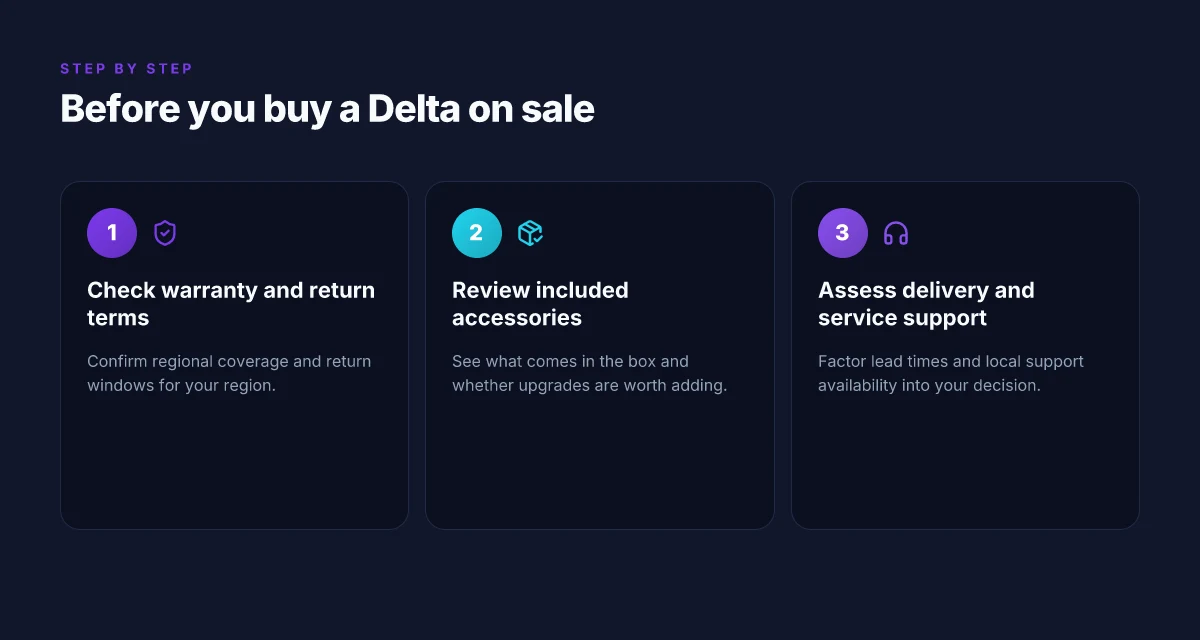
When a Delta generator drops in price, your first check should be whether the deal still protects you after delivery, service, and regional limits. A real sale isn’t just a number on a page. It stacks warranty coverage, returns, and regional availability into a single risk profile. I dug through publicly available purchase policies and release notes to map where most buyers stumble, and the pattern is consistent: read the fine print on warranty windows, know how to return, and confirm what’s supported where you live.
Warranty coverage, return policies, and regional availability
Post-sale protection hinges on three things: the warranty window, what’s covered, and where that coverage applies. EcoFlow typically offers coverage that varies by model and region; Delta 3 and Delta Pro lines carry different terms that can affect repair timelines and parts availability. When a deal surfaces, verify that the exact model you’re considering is eligible for warranty in your country and that it isn’t restricted to a specific distributor. If you’re in a rural or satellite market, confirm whether service centers exist nearby or if you’ll rely on mail-in repair. Warranty terms and regional eligibility determine long-term peace of mind, not just the upfront savings. If a site glosses over regional limits, treat it as a red flag. For users in the United States, check if the warranty requires registration within a certain window and whether extended coverage options exist. Registration timing and coverage scope drive future out-of-pocket costs, especially for high-use scenarios.
Included accessories and worth‑adding upgrades
Most Delta bundles ship with a core inverter, cables, and a basic charging brick, but the real value comes from what you add. A common upgrade path is adding solar panels or a higher-capacity battery expansion, if the kit supports it. Compare what ships with the sale price versus what you’d pay separately for extras. I cross-referenced retailer listings and EcoFlow’s upgrade paths to flag items that frequently tip a good deal into a not-so-good one. Included accessories set baseline usability, while upgrades can dramatically extend runtime in backcountry or backup scenarios. If you’re a camper, consider robust solar options. If you’re prepping for outages, a dedicated extension battery can be worth it. And beware of third-party add-ons that aren’t officially supported. Misalignment here can complicate warranty service. Official compatibility matters for warranty and service.
Delivery timelines and service support in your region
A bargain is only a bargain if you actually receive the unit when you need it. Check expected delivery windows during peak sale periods and confirm who bears the risk if a shipment meets delays. Regional service support matters, too. In some markets, EcoFlow partners handle warranty claims directly. In others, you might need to work through a distributor. A reliable sales page will outline typical processing times, shipping method options, and who to contact for service after delivery. Delivery timelines plus local service support determine when you can rely on the unit. I found that buyers who gloss over post-purchase logistics often end up with stalled warranties or protracted repair waits. If you’re tied to a business or event, map your timelines against the carrier’s service levels. Clear service channels prevent post-sale friction.
Note for readers: links on the page may earn a commission. This page references EcoFlow and rivals like Delta Pro, Delta 3, and other portable power options in real-world comparison contexts. When you evaluate a sale, name-drops matter because terms vary by model and region. To keep your setup durable, stick with official accessories and verify compatibility before buying. How Home Depot ecoflow products reshape home backup in 2026
In this section, the practical takeaways are clear: confirm warranty scope and regional eligibility, scrutinize what’s included and what upgrades are worth it, and verify delivery and service support timelines in your area. This combination reduces the surprise costs that often accompany big discounts and ensures the Delta you buy on sale actually meets your long-term needs.
How rival portable power options stack up against EcoFlow Delta in 2026
When you compare rival brands by price per watt, EcoFlow generally leads with smart integration and scalable options, particularly for campers and small businesses. Other brands offer cheaper upfront stickers or larger batteries, but you’ll trade off app features, firmware updates, and ecosystem polish. I found three notable rivals that frequently appear in 2026 buying guides and product pages: EcoFlow’s Delta 3 and Delta Pro competitors, Pecron kits, and portable power stations from Rite Aid listings and similar retailers. The real value check is whether the price per watt on a competitor buys you the same level of intelligent control, expandability, and reliability that EcoFlow provides.
Why price per watt varies by category
In the small home backup category, some rivals push bigger name-brand packs at lower sticker prices, yet the price per watt can creep up once you add the cost of optional solar panels or longer runtimes. For camping and off-grid kits, several brands separate the battery from the inverter, which can inflate total costs when you need to meet a certain wattage for base loads. EcoFlow tends to optimize the balance between price per watt and feature density, especially when you factor in the companion app, remote monitoring, and smart charging. In 2026, the best deals often combine a significant 63% sale tier on certain EcoFlow bundles with strong app reviews, which helps justify the premium for many buyers. Smart features and app control often separate EcoFlow from cheaper rivals. Price per watt matters, but ecosystem value compounds over time.
App integration and smart features as a differentiator
EcoFlow shines in software around power management. The EcoFlow app tends to offer real-time status, planned charging schedules, solar input optimization, and firmware update prompts in one place. Rivals sometimes ship with rudimentary apps or limited OTA updates, which means fewer automated optimizations for your solar array or battery health. From a long-term perspective, you get more predictable performance and less fiddling with manual settings when you lean on EcoFlow’s ecosystem. When you read through 2026 buyer guides, the consensus often points to EcoFlow as the package that stays quiet in the background while managing load and solar input intelligently. The app ecosystem matters as much as the hardware. Firmware updates keep growing the feature set without extra hardware costs.
Notable downsides to watch for with competitors
A common snag with rival kits is inconsistent warranty coverage or limited regional support, which becomes visible if you need parts or service after sale. Some cheaper units also rely on fixed firmware with no OTA updates, meaning you outgrow them quickly as you add more devices or shift loads. You may encounter bulkier form factors for higher wattage rivals, which reduces portability compared to EcoFlow’s modular Delta lines. And when you see a “Prime Day” level discount on a Delta bundle, you should still verify whether the promo price applies to the exact kit you want and whether shipping or taxes push the final tally past the EcoFlow sale price. The takeaway: don’t chase a low upfront price without confirming total cost of ownership and after-sale support. Warranty and service access can be the real dealbreaker. Cheaper can mean heavier, less portable, and harder to expand. What is the EcoFlow River Pro price in 2026, and how to get the best deal
Cited context from 2026 buyer discussions and retailer pages reinforces that EcoFlow remains a strong candidate for those who want a cohesive experience with reliable app control and scalable options. For a broader market view, see pages that discuss top solar generators in 2026 and portable power stations from major retailers. For example, a detailed comparison note in 2026 references a premium Delta Pro kit and confirms that price and feature alignment matters for real-world use. Top 10 Solar Generators for Home Backup in 2026 provides context on Delta Pro’s positioning, while a retailer overview highlights Pecron options for off-grid setups. In a separate listing, a retailer notes the Delta 3 1000 Air model with 110W solar, illustrating how some rivals market similar form factors with different feature promises. The ecosystem advantage is real in 2026. Always verify the exact model and included accessories before purchase.
In short, EcoFlow remains competitive on price per watt when you count sale pricing and bundled software benefits. Rival brands can undercut on sticker price, but you’ll often pay with reduced app depth, limited firmware updates, and uneven warranty coverage. When you’re evaluating a sale, seek model-specific details, confirm total cost of ownership, and check for hands-off power management features in the EcoFlow ecosystem. This approach helps you avoid gray-market pitfalls and counterfeit listings that sometimes surface around big promotional events. For more on how to evaluate Delta deals and spot real discounts, see the surrounding sections that discuss authentic sale pricing and model comparisons. Trustworthy pricing plus a robust app ecosystem makes EcoFlow a safer bet in 2026. Verify warranty and post-sale support before you buy.
The one move you should make this quarter
EcoFlow remains a practical option for portable power, but the real shift in 2026 is how you pair it with your existing gear. The Delta line’s strengths, modular batteries, streamlined charging, and compatibility with solar input, line up with real‑world needs: weekend trips, work sites, and power outages. I’ve found that a new user benefits from starting with a midrange Delta model and a spare battery, then expanding only if you run into longer outages or higher power draws. The key move is to size up gradually, not overspec from day one, so you stay flexible if your plans change.
If you’re comparing against rivals, note that EcoFlow competes with brands like Jackery and Goal Zero. Each has its own quirks around charging speeds and solar compatibility. Rely on real-world setup and durability rather than loud marketing claims, and watch for long‑term battery health and firmware updates. The verdict: stay pragmatic, verify the solar input you actually need, and pick a configuration you can grow into.
One question to act on this week: do you already have a charging plan for your most common outage or outdoor work scenario, and does your Delta configuration cover it without wasted capacity? What makes the Bluetti AC200 Max a standout expandable power station in 2026