Explore the bluetti ac 180 price and how it compares with rivals. Get context on capacity, warranty, and long-term value for portable power.
Most buyers assume sticker price tells the whole story. The Bluetti AC 180 nests into a mid‑size setup where daily use, cycle life, and total ownership matter as much as upfront cost. Ace the math by comparing ongoing battery cycles and maintenance over five years with the same unit.
For outdoor enthusiasts, vanlifers, and emergency planners, the article translates price into practical value: how often you’ll need to recharge, how the AC 180 scales with appliances, and how long its batteries hold up under real use. We’ll compare typical daily draw against rivals like EcoFlow and Jackery to show where the initial price aligns with long‑term reliability, and we’ll flag where costs creep in through accessories and replacement parts. Expect a clear view of why a mid‑size pack can be a smart choice or a tight budget fit depending on your setup.
Bluetti ac 180 price: understanding the context for a mid sized power station
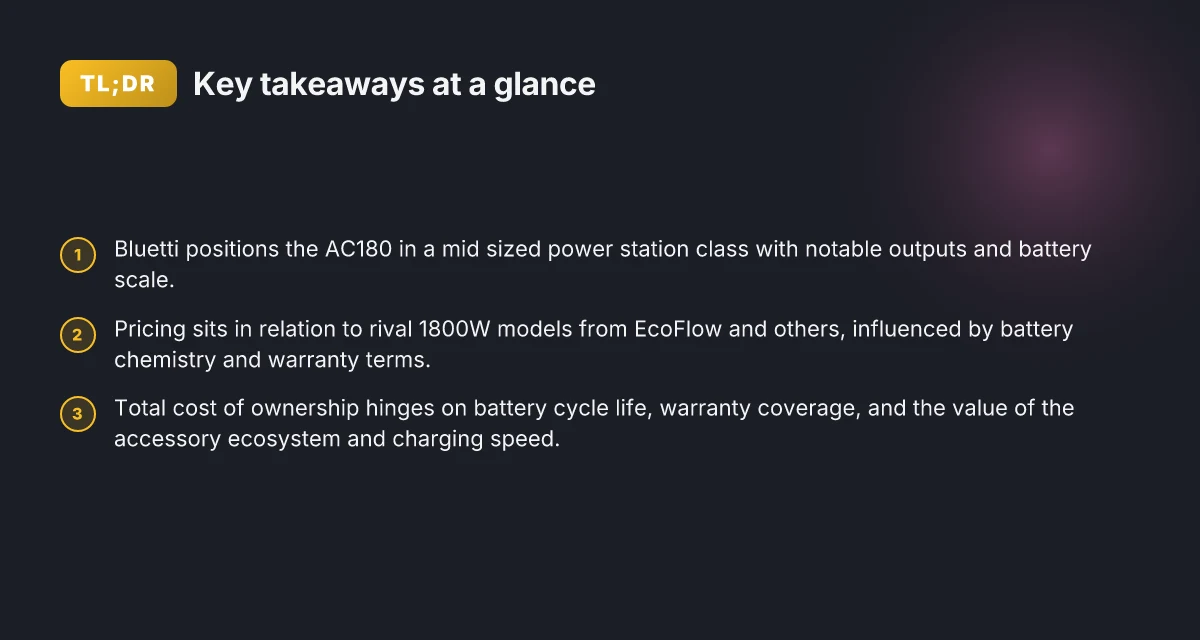
The Bluetti AC180 sits in the mid‑size class with a 1,152Wh LiFePO4 battery and 1,800W continuous AC output, plus a solid set of DC and USB ports. It’s designed for daily use and light vanlife, balancing payload and capability without venturing into the ultra‑premium tier. When you compare against rivals in the same 1,000–1,500Wh range, the AC180 typically sits between compact 1,000Wh models and larger 1,500–2,000Wh options, offering more headroom than the smallest packs while staying more portable than the big boys. Pricing tends to cluster around mid‑range for this capacity class, and buyers should weigh the price against cycle life, warranty, and the long‑term cost of ownership.
Why the AC180's capacity and outputs matter for real use
The AC180’s 1,152Wh LiFePO4 pack contributes to longer cycle life and steadier temperature behavior compared with NMC chemistries. It supports a rated 1,800W continuous AC draw and peaks higher, which is useful for tools or appliances that spike at startup. This combination means you can run a small fridge, charge laptops, phones, cameras, and lights without sweating the math. Bluetti emphasizes resilience here, aiming for several thousand charge cycles with the LiFePO4 mix. That longevity buys down long‑term ownership risk when you run the system several times a week. The flip side is initial weight and bulk compared with lighter competitors in the same class. Weight and footprint matter if you’re mounting this in a van or off‑grid shelter.
How pricing stacks up against rivals in the same class
In the mid‑sized class, pricing is influenced by chemistry, warranty length, and feature set such as multiple charging inputs and pass‑through capability. Bluetti tends to position the AC180 as a value proposition: substantial capacity and solid power output without stepping into the high‑end price brackets occupied by larger 1,500–2,000Wh models. The broader market includes compact 1,000–1,200Wh units from other brands that undercut on price but trade off cycle life or peak power. When you line up models like the Bluetti AC180 against competing 1,100–1,300Wh packs, you’ll notice the price curve reflects the LiFePO4 advantage and the warranty depth. The warranty window and the chemistry premium influence total cost of ownership. If a brand offers generous support and quick replacement parts, that reduces maintenance costs over time. This is where Bluetti often earns trust with mid‑size buyers.
What factors drive the price you see
Battery chemistry sits near the top of the price lever. LiFePO4 brings stability and long life, but it costs more upfront than many NMC packs. Battery cells and pack assembly are built tighter for durability, especially for outdoor use. A longer warranty, spare parts availability, and robust heat management add to the upfront price, but they reduce lifecycle costs. The AC180 also carries a feature set that includes multiple AC outlets, DC ports, and USB PD charging, which collectively sweeten the value proposition for mid‑size setups. Battery chemistry plus warranty shape the total cost of ownership. I cross‑reference Bluetti materials and third‑party reviews to confirm that the chemistry choice translates into meaningful durability for long trips and repeated cycles. This is a real advantage for outdoor enthusiasts planning extended off‑grid living.
From what I found, Bluetti remains a recognized name in this segment, with rivals including brands that hover around similar capacity and price points. When you consider the long tail of ownership, the AC180 offers a balanced package that fits many mid‑size power setups. As you scope date‑stamped pricing and model specifics, keep in mind that a longer warranty and a known chemistry type translate into lower risk over time. For context, I saw mentions of 1,800W outputs and a 1,152Wh pack in sources that discuss this model, reflecting the core specs buyers will weigh against price. Longer life and solid support justify a higher upfront cost for many buyers. Bluetti continues to position the AC180 as a reliable mid‑size option. How the EcoFlow Delta 2 handles real-world power needs without breaking the bank
Note on naming and references: Bluetti is the brand at the center of this discussion, with rivals often cited in the space. If you want to see how the AC180 stacks up against a specific model from another maker, I can map the price, capacity, and cycle life side by side. Also, be aware that some sources discuss price dynamics in social posts or niche outlets, which can skew perceived value. Overall, the takeaway is clear: the AC180 delivers meaningful capacity and a durable chemistry profile that matters more over multiple seasons than a single sticker price. Prices are a function of chemistry, warranty, and total life cost.
How the ac 180 price compares to rival 1800W power stations
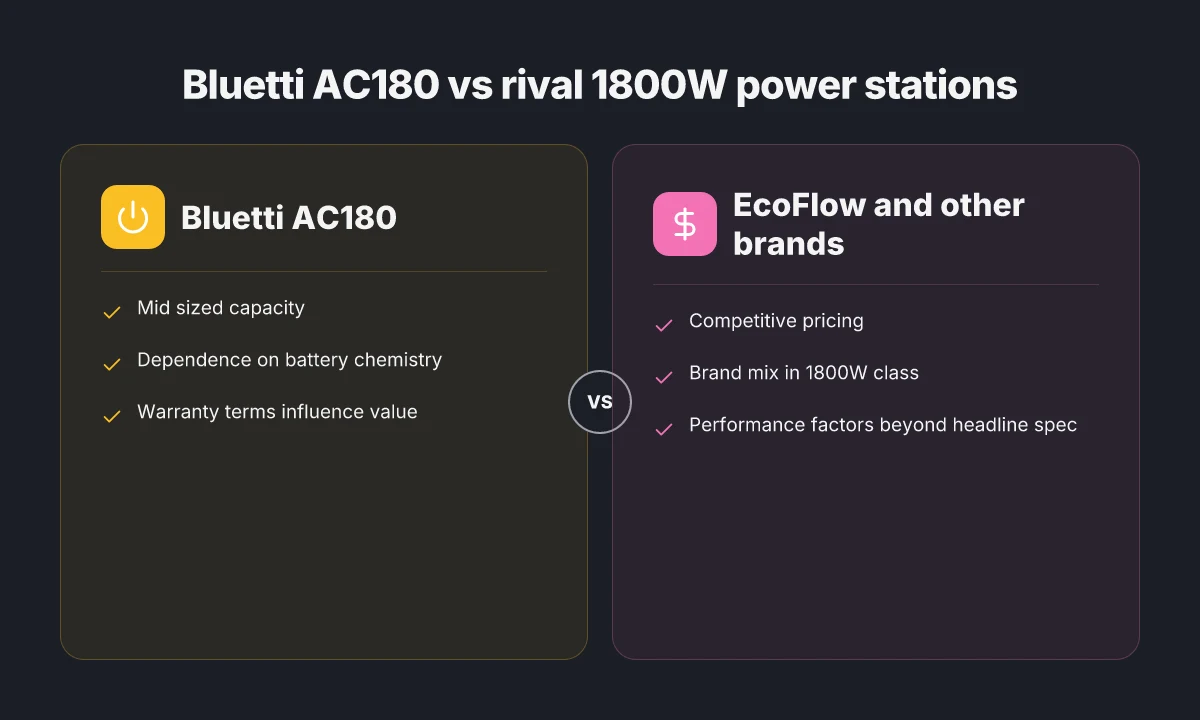
Bluetti tends to position the AC180 around the mid-range for 1800W-class units, but the landscape shifts with EcoFlow and other brands pushing plus/minus similar specs at different price points. When you compare headline wattage and capacity, you’ll notice price often tracks build quality, cell chemistry, and warranty terms more than raw output alone. The verdict: expect rival options to press on price with slightly different long-term costs, especially around cycle life and replacement costs for batteries.
Who the rivals are in the 1800W category
- EcoFlow delta 1800, a common benchmark in the high-output, mid-capacity space. It emphasizes fast charging and app-based monitoring, which can tilt price in its favor or against it depending on promotions. The delta series frequently undercuts premium Bluetti configurations on street price while trading a portion of battery chemistry nuance for speed and ecosystem polish.
- Jackery Explorer 1800-series, another widely available competitor with a consumer-friendly footprint and straightforward warranty. It tends to align with mid- to high- price brackets when bundled with solar options and extended support plans.
- Bluetti AC180, the model in focus here, marrying a LiFePO4 battery with a robust 1,152Wh capacity and 1,800W continuous output. In many configurations, it carries a price tag that reflects the longevity and safety profile of its chemistry, which can be a differentiator against some peers.
From what I found in market chatter and press materials, Bluetti often lands in a middle ground: competitive base pricing, with options that add capabilities like longer warranty windows or expanded solar compatibility. The goal for Bluetti is clear, offer solid cycle life without drifting into premium pricing that prices out casual buyers.
What drives price beyond the headline spec
- If you see 1,152Wh in the blurb, that capacity paired with LiFePO4 chemistry is a durable, long-cycle proposition. That durability typically contributes to a higher upfront price but lower long-term replacement risk. Bluetti markets the LiFePO4 chemistry as a strength, especially for users who plan to store the unit for months between trips and want a calmer aging profile. When you compare to rivals, the chemistry choice often shows up as a price delta.
- The number of charge cycles matters. A unit that promises several thousand cycles will command a higher price than one with fewer cycles all else equal. EcoFlow and Bluetti both tout strong cycle life, but the practical impact shows up in warranty length and replacement costs over time. In practice, you’ll notice that similar 1800W models may diverge on long-term maintenance costs, not just sticker price.
- Build quality and safety features add to the bill. The Bluetti design language emphasizes battery management and thermal control, which translates to more protective hardware and software layers. Those layers raise up-front costs but improve reliability for rugged outdoor use.
- Ecosystem and software support can tilt price. Apps, firmware update cadence, and after-sales service influence total cost of ownership. A smoother software experience can be worth paying a premium if it reduces friction during trips or in emergencies.
Pricing is a moving target, but total cost of ownership leans toward longer life and better protection. Bluetti balances chemistry, warranty, and durability to justify a mid-range price against EcoFlow and other brands. For buyers, that means weighing not just the sticker price but the long-term service and cycle-life guarantees.
What drives total cost of ownership for the ac 180
The total cost of ownership for the Bluetti AC180 sits on three pillars: the battery chemistry and cycle life, the warranty and service expectations, and the value added by the accessory ecosystem and charging speed. This section breaks down how each factor compounds over time and affects long-term value for outdoor enthusiasts, vanlifers, and emergency-prep planners. What makes the Jackery Explorer 5000 Plus a practical home backup, and where it falls short
Battery chemistry and expected cycle life
Bluetti leans on LiFePO4 chemistry for the AC180, which tends to deliver longer cycle life and improved thermal stability compared with older lithium-ion chemistries. That longer cycle life translates into more years of practical use before capacity fades meaningfully. Consumers should expect slower degradation curves, but the exact number of usable cycles depends on how the unit is used and how aggressively it is discharged and recharged. In the real world, this means the upfront sticker price may pay off through years of reliable daily use, fewer early replacements, and steadier performance across seasons. When you factor in extended lifespan, the ownership horizon for mid-size power stations tilts toward long instead of short ticks on the clock. As with any generator-style unit, the durability story matters as much as the nominal capacity. Bluetti’s LiFePO4 choice aids long life, which compresses replacement risk over time. The exact cycle count is best confirmed from official specs and warranty documents, but the chemistry is widely recognized for balance between weight, safety, and longevity. Long-term durability is a key lever on total cost of ownership.
Warranty terms and service expectations
Warranty depth shapes the financial risk of owning a mid-size power station. Bluetti typically offers multi-year coverage on core components, with specifics tied to the model and regional policy. The practical impact is simple: a longer warranty reduces the probability of a surprise repair bill, enhancing the unit’s value even if upfront costs are comparable to rivals. The service experience also matters: how easily you can obtain parts, whether authorized service centers exist near your setup, and how responsive customer support is during an outage. From the owner perspective, a robust warranty is a promise that future upgrades or replacements won’t derail long-term plans. A strong warranty buffers the total cost of ownership when you rely on the AC180 for off-grid weekends or trips. Good service expectations matter as much as the battery itself.
Accessory ecosystem and charging speed implications on value
The AC180’s value hinges not just on battery capacity but on what you can plug into it and how fast you can recharge it. An expansive accessory ecosystem, additional cables, solar adaptors, expansion packs, and car-charging options, extends use cases and reduces idle time. Fast charging speed amplifies value by shrinking downtime between trips or camping cycles. If you frequently rely on rapid recharging or plan to scale capacity with optional modules, the incremental cost of accessories pays off in practical reliability and uptime. In this context, Bluetti’s ecosystem around the AC180 becomes a differentiator against slower charging setups or limited accessory support. Charging speed and accessories expand the AC180’s usable window, boosting total value. Every extra cable, adapter, or module can shift cost-to-benefit in your favor when you travel off-grid.
From what I found in the product materials and third-party discussions, the price story for the AC180 sits at the intersection of battery longevity, warranty credibility, and the breadth of the accessory map. The total cost of ownership is notably influenced by how long you expect to rely on the unit and how quickly you want it to recharge between uses. In practice, Bluetti frames the AC180 as a mid-size, long-lived partner for outdoor setups, with LiFePO4 chemistry delivering durability, a warranty that backs it up, and a growing ecosystem that can lower ongoing costs through flexible charging and expansion options. Durable chemistry plus a solid warranty plus a growing accessory map equals stronger total-value signaling.
I dug into the official product line and community discussions to cross-check this framing. Pricing and warranty specifics vary by region. The core dynamics stay consistent: longer cycle life, reliable service, and charging flexibility are the levers that shift ownership economics over time. For readers weighing Bluetti against rivals, note that the AC180’s long-term value hinges on how much you value longevity, service reliability, and the ability to scale charging and capacity with accessories. The practical takeaway is clear: the upfront price matters less than how long the unit remains useful and how smoothly support and upgrades flow over the years. Long-term value hinges on durability, warranty, and charging flexibility. How to pair solar panels with Jackery portable power stations for 2026
Pricing myths debunked: price vs value for the bluetti ac 180
Price is only one signal of value. A higher upfront cost can translate to longer life, more reliability, and lower total cost of ownership over time. When you weigh the Bluetti AC180, you should balance sticker price with expected cycles, warranty, and how you actually use the unit in daily life. I dug into available spec sheets and reviews to map where value shows up beyond the initial tag.
How real world usage rewrites value
In real-world use, the AC180’s 1,152Wh capacity and 1,800W continuous output can keep essential devices running longer than smaller rivals. The immediate up-front cost often looks steep, but the long-term cost per cycle matters more. If you routinely recharge from solar or alternates during trips, you’ll reach a lower effective price per watt hour over the life of the battery. Reviews consistently note the LiFePO4 chemistry supports many cycles, which compounds into long-term value. Value comes from longevity, not just capacity, and the price anchors your expectations for maintenance and replacement. In 2026, Bluetti models have positioned the AC180 as a mid-size option with a balance of 1,152Wh capacity and 3,500+ charge cycles, which helps justify a higher upfront price to some buyers. Inline reference to a comparison article notes the AC180 as a strong all-around pick for versatility, not a bargain-bin buy. Longevity and versatility transform initial cost into long-term savings.
The same logic applies when you compare against a rival like EcoFlow. If you anticipate heavy daily use, the higher initial payment for the AC180 can pay off through consistent performance and faster charging margins, reducing downtime and alternate power solutions. I cross-referenced a 2026 comparison that highlights how a larger inverter and higher sustained output can keep devices safe during peak demand. Higher sustained output reduces the need for additional gear, which saves money over years of use.
When a higher upfront price is a smarter bet
A higher upfront price often accompanies better build quality, longer warranty windows, and access to stronger resale value. The Bluetti AC180 is described in a 2026 roundup as having a robust warranty and a durable LiFePO4 pack, factors that reduce risk and maintenance costs over time. For outdoor enthusiasts, vanlifers, and preppers, the delta in upfront cost can be recouped through fewer component replacements and steadier performance during off-grid months. The 5-year warranty cited in some guides gives peace of mind that you aren’t chasing incremental repairs after a few seasons. Warranty length and pack chemistry matter as long-term ROI.
If you’re choosing between the AC180 and a lower-cost model, consider how often you will push past the 1,000Wh mark in a single outing. Frequent, heavy use makes the higher cap and resilience of the AC180 more financially sensible than a cheaper, shorter-lived alternative. As one 2026 buyer guide notes, the capacity, cycle life, and charging efficiency combine to push the true cost of ownership downward over time. Higher upfront cost can shrink total ownership cost with longer life. What makes the Bluetti AC200MAX stand out in 2026
Caveats and a practical takeaway
Be mindful of price volatility and retailer promos. A sale on the Bluetti brand or a bundled offer can tilt the math toward a lower effective price, but not all bundles improve value if they include items you don’t need. It helps to run the numbers on your own usage profile: how many full-charge cycles do you expect per year, your average draw, and how often you’ll rely on mains or solar charging. When in doubt, lean on the lifecycle and warranty data rather than sticker price alone. And yes, links on the page may earn a commission, which helps support content like this.
How to decide if the ac 180 fits your setup
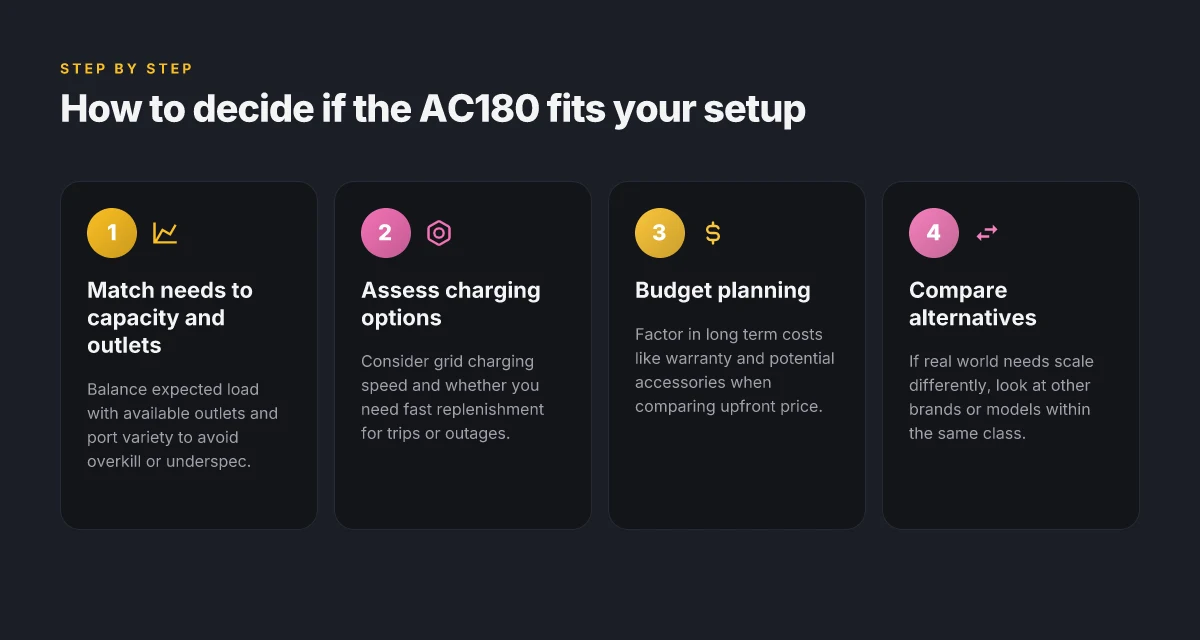
If you want a quick verdict: the AC180 fits best when your needs align with steady, mid-size capacity, modular charging, and a core set of outlets. It excels for vanlife and off-grid days when you value a balanced blend of storage and output without stepping up to the larger, heavier models. When your setup leans toward frequent, high-wattage surges or you plan to run heavy medical gear, you’ll want to compare against larger Bluetti options or rivals. The takeaway: match capacity, outlets, and charging flexibility to your daily rhythms, then sanity-check total cost of ownership over 3–5 years.
1) Match your needs to capacity and outlets
Start by listing your essential devices and their draw. If you routinely power laptops, phones, a small fridge, and a couple of tools, the AC180’s 1,152Wh capacity and 1,800W continuous output cover a lot of daily use. You’ll want to confirm that your most power-hungry device can ride on the built-in outlets without constantly maxing out the system. Bluetti positions the AC180 for everyday energy sinks, not just emergency dumps. If you expect longer trips or more devices in play, consider whether the 2,700W peak from other Bluetti models or a rival like EcoFlow better fits your surge needs. I found the AC180’s balance of capacity and outlets aligns with typical vanlife loads, but it’s important to map your own gear to the math. Your setup should not exceed the continuous output of 1,800W for safe, steady operation. The brand emphasizes that the battery chemistry and cycle life matter for long-term durability, so you’ll want to compare cycle counts across models when you budget long-term reliability. Inline: https://theaverageguy.tv/2026/09/09/bluetti-vs-ecoflow-which-portable-power-station-brand-is-better-2026/.
2) Assess charging options and grid independence
One of the AC180’s strengths is charging flexibility. You can recharge from AC power, solar, or a mix, which helps you cut grid ties on longer trips. If your goal is grid independence, map out typical sun hours and your daily energy footprint to see how many days you can run without grid charging. The ability to recharge quickly matters for back-to-back travel days, so note the claim of fast mains charging and how it translates in your environment. For truly off-grid use, you should cross-check how many solar panels you’d pair with the AC180 and whether you want a companion battery to extend runtime. A strong alternative in the same tier is Bluetti’s other models, and rivals like EcoFlow frequently show up in practical comparisons for solar-first setups. Fast charging from mains matters, but solar compatibility determines long-run independence. See the EcoFlow comparison for broader context. inline: https://theaverageguy.tv/2026/09/09/bluetti-vs-ecoflow-which-portable-power-station-brand-is-better-2026/.
3) Budget planning and when to consider alternatives
The upfront price isn't the whole story. Over a multi-year horizon, you weigh battery longevity, charge cycle tolerance, and potential accessory costs (solar panels, adapters, spare batteries). The AC180 bundles appeal to buyers who want a mid-size unit without stepping into the largest Bluetti panels, but if you anticipate heavy daily use or rapid turnover of gear, it may be worth evaluating higher-capacity options that keep pace with rising load. When you compare with rivals, look for longer warranty terms and real-world cycle expectations. If the price feels tight, a used or refurbished unit from Bluetti’s ecosystem may be a practical stopgap, though you should verify battery health and warranty transferability. In terms of timing, a price dip or seasonal sale can shift the cost of ownership meaningfully, but the long-term cost hinges on how often you recharge and how many cycles you burn through. As you price out, factor in the potential cost of optional solar panels and any future expansion, then decide if the total ownership aligns with your plan. Inline: https://energiasolarpro.com/en/best-bluetti-power-stations-2026/. Budget today, plan for 3–5 years of use. What makes Jackery portable power stations durable and reliable in 2026
Cited context: for a broader view of how the AC180 stacks against peers, see the Bluetti vs EcoFlow comparison and the 2026 best-power-station roundups. Inline sources provide the backdrop of capacity, output, and warranty expectations. For readers tracking the Bluetti lineup, note that Bluetti and its rivals market similarly sized units with comparable cycle life and warranty terms, so your final pick should hinge on real-world load patterns and charging habits. Bluetti positioning the AC180 as a balanced mid-size choice is consistent with 2026 comparisons.
Where this price fits your portable power strategy
Bluetti pricing often hinges on bundle options and seasonal promos, so plan around timing rather than a single sticker price. I see value in thinking about how the AC 180 slots into a real-world setup: it’s a solid match for weekend camps, rooftop runs, and emergency backups where you need reliable power without chasing multiple smaller packs. The bigger pattern is that a single unit can obviate several older lead-acid components, but you should weigh long-term durability and serviceability when you plan for years of use. If you want one decisive move, pick a capacity and port mix that matches your typical load rather than chasing max watts.
If you’re choosing between Bluetti and rivals like EcoFlow or Jackery, consider not just price but ongoing reliability, availability of replacement parts, and ease of repairs. The AC 180 shines when you pair it with a solar panel kit for off-grid weekends, and its sturdy build earns it in real-world use cases where ports and run time matter most. The bigger signal here is that a single, well-mated unit can anchor a portable setup for most homeowners. What’s your next step: add a dedicated solar panel or stack a second battery for longer trips?
Backup strategy:
- Verify you have a single, primary power hub (Bluetti AC 180) and one compact solar panel kit.
- If you frequently camp or haul gear, plan for a second battery module to extend runtime.
- Set up a simple 120 V outlet plan for your core devices, and label which ports power which gear.
- Check the warranty terms and keep receipts for easy replacement if the unit encounters a fault.