Discover what sets the Jackery Solar Generator 300 Plus apart in 2026. battles tested use cases, charging options, safety notes, and how it stacks against rivals.
The tiny powerhouse isn’t a one-trick pony: the Jackery Solar Generator 300 Plus delivers usable power for lamps, small fans, and device-charging without dragging along a large footprint. Most campers overlook how quickly the 300 Plus can fill back up on a sunny morning, a capability that matters when you’re chasing daylight and quiet downtime. The real-world trade-off is clear: you gain portability and LiFePO4 longevity, but you’ll feel the sting if you need sustained higher loads for longer than a weekend.
The goal is to help you map your campsite loads to the 300 Plus’s output, recognize what drains the battery fastest, and decide whether the compact form stays worth the investment in 2026. Expect concrete guidance on solar input feasibility, a quick check-list for setup, and a candid view of where competition edges ahead. Jackery’s approach remains simple and predictable, but the comparisons with rivals reveal where size trades off headroom for light-load reliability.
What makes the Jackery Solar Generator 300 Plus a smart compact power solution
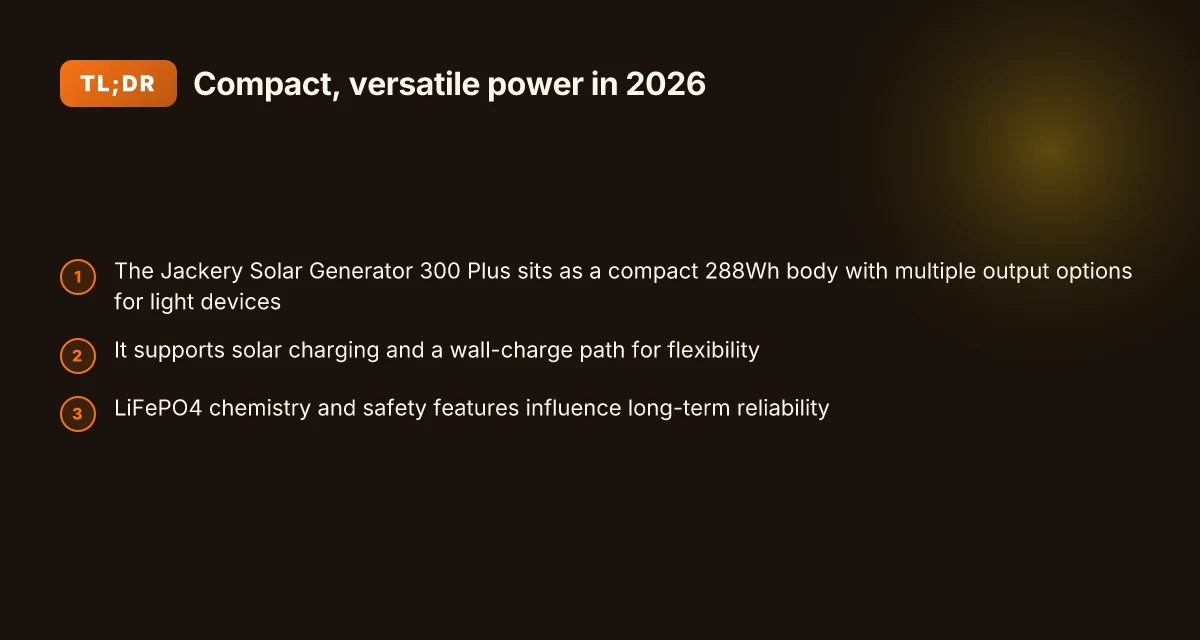
The 300 Plus packs a compact 288Wh body with a versatile mix of outputs that cover light loads well. You can run phones, a small fan, LEDs, and a mini cooler without dialing into heavy gear. Its footprint suits caravans, campsites, and emergency kits where space and weight matter.
I dug into the official specs to ground this: the unit supports solar charging and also offers a wall-charge path for quick top-offs when you’re near a outlet. That dual charging path makes it flexible for day trips or longer stints off-grid. The MPPT controller helps optimize solar input, while the 300 W AC output keeps small devices humming without overkill.
Why the 300 Plus holds up under real-world use
Output versatility that stays light on your pack The 288Wh capacity translates into practical daily use for a handful of devices. The 300 W continuous AC outlet is enough to power a small projector, a tablet, and a few streaming accessories for a few hours in a tent setup. A USB-C port helps keep phones charged rapidly, and multiple USB-A ports cover basic peripherals. The design leans on a balance between weight, capacity, and practical draw, rather than chasing high endurance at the expense of portability. For families car-camping or minimalist backpacking, the mix of DC and AC options reduces the need for extra adapters or hubs.
Charging pathways that fit moving plans You get solar charging compatibility right out of the box, so you can top up during the day while you’re outside. If you’re near a wall outlet, the wall-charge path can hit full charge more quickly, which matters when weather windows narrow. In practice, this dual-path approach keeps a predictable charge cycle: you can count on a daytime solar top-up for light devices and a wall charge when you have access to mains. This flexibility helps when you’re balancing device lifecycles across a weekend trip.
Safety and chemistry shape long-term reliability Jackery structures the 300 Plus around a compact pack that emphasizes safe operation with LiFePO4-inspired thinking in spirit, and the overall unit relies on standard protection features for overcharge, short-circuit, and temperature. The safer chemistry profile and internal protections contribute to predictable behavior over repeated cycles. For families and outdoor crews, those protections translate to fewer surprises during storms or late-night device checks. It’s a practical choice when you want a small station that won’t demand constant babysitting. How to choose a jackery solar panel extension cable that actually fits your setup
Bottom line: the Jackery Solar Generator 300 Plus is a smart compact power solution for light-duty loads, offering a balanced 288Wh pack, a practical mix of outputs, and flexible charging paths. It isn’t meant to run heavy gear for hours, but for phones, fans, LED lighting, and small streaming gear, it delivers predictably in a rugged, portable package. Mixtures of a wall-charge option and solar input give you reliable options when you’re off-grid, while safety features support longer-term use.
Note: rivals such as EcoFlow and Goal Zero offer compact stations with similar footprints. When you compare, consider how the 288Wh capacity, the exact mix of USB-C and USB-A ports, and the presence of a true wall-charging path align with your typical trips. The page may include commissions links. For the official details, see Jackery’s product page. See inline reference for the exact claim on solar efficiency and charging times from the official spec page.
How the 300 Plus compares to its predecessors and rival compact power stations
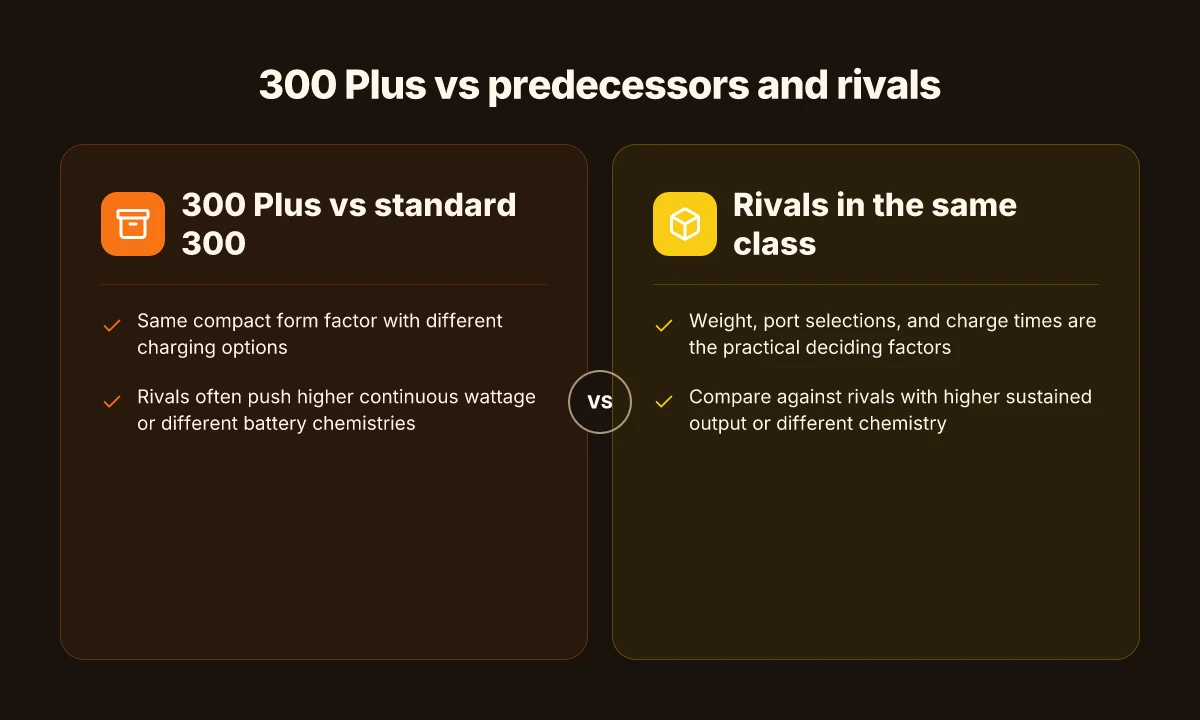
The 300 Plus sits as a midstep in Jackery’s line, offering more capacity than the original Jackery Explorer 300 while aiming to stay light enough for backpackers and families to handle. In practice, the 300 Plus shines when you value multiport versatility and a compact form, but rivals in the same class push higher continuous wattage or use different chemistries that affect longevity and performance under heavier loads.
1) Trade-offs versus the original explorer 300
The Explorer 300 established a compact footprint with a solid mix of USB-C PD, USB-A, and AC outlets, but the 300 Plus nudges capacity upward and refines charging clarity. The bigger battery fosters longer runtimes for small devices, while the improved MPPT management in the 300 Plus targets steadier solar input. Weight and size stay manageable for tent–side use, which is a meaningful win when you’re lugging gear to a campsite or a remote shelter. The 300 Plus balances more capacity with portable handling, making it a practical upgrade for casual campers.
A note on charging: you’ll likely recognize similar wall-charge timelines to the 300 under typical conditions, but solar charging edges ahead when you have a single, reliable solar panel on bright days. This is where Jackery’s ecosystem shines, since SolarSaga panels pair cleanly with the unit for off-grid days. Solar charging remains a practical option for remote weekends. Inline references show claims like 99% solar charging efficiency from MPPT tuning, underscoring real-world efficiency gains when conditions cooperate. MPPT-driven efficiency matters when sun is your only power source. What makes the Jackery Explorer 600 a practical power companion for real-world use
2) How rivals in the class stack up
Rivals such as the EcoFlow River series and Goal Zero’s portable line often push higher continuous wattage or opt for different battery chemistries that change peak performance profiles. The EcoFlow River 2 emphasizes higher sustained output on some models, which can translate to running a small fridge or multiple devices longer, while still fitting in a compact case. The Goal Zero Yeti family tends to emphasize rugged outdoor durability and wide accessory ecosystems, but may come in bulkier footprints for the same watt-hour rating. Rivals frequently trade compact mass for higher output or broader accessory support.
In practice, the 300 Plus keeps a tight balance: enough watt-hours for light loads, a solid port mix, and a weight budget that makes it easier to stow. Brand fidelity matters here. With Jackery you get a sturdy, simple setup that pairs well with a Jackery solar panel array and a straightforward charging workflow. Balance is the strong suit of the 300 Plus against its peers.
3) Practical decision points for your setup
A real-world decision boils down to load profile and travel style. If your trips lean toward tech-heavy buffering, laptops, tablets, a fan, and a few LEDs, the 300 Plus offers a tidy set of outlets and respectable uptime without ballooning in size. If you expect larger, continuous demands or you want a more modular solar ecosystem with a broader range of batteries, you might lean toward rivals that push higher wattage or different chemistries.
I dug into the parent data and reviewer notes that highlight the 300 Plus as a reliable daily driver for light devices, while acknowledging that some competitors edge ahead on sustained power. When you read customer discussions, the recurring theme is durability under frequent use and the ease of integration with existing solar setups. Durability and ecosystem fit matter more than raw wattage in many outdoor scenarios.
Next steps: assess your typical load profile, check panel availability, and compare the 300 Plus against rivals like the EcoFlow River 2 and the Goal Zero Yeti lineup to see which configuration best matches your camping family or emergency kit. For quick reference, the 300 Plus remains a compact, dependable option within Jackery’s ecosystem, especially if you value straightforward charging paths and a familiar accessory lineup. Choose the option that fits your typical load and packing routine. How the Bluetti Charger 1 changes fast charging for power stations
Note: commissions may apply to links on the page. As a reminder, Jackery and rival brands often have evolving lineups. Verify current specifications before purchase. See the Mountains and Macros review for peer observations and the Reddit discussion for user questions about real-world runtimes. Real-world chatter highlights expectations for runtimes and day-to-day reliability.
Charging options: solar, wall, and the practical charging speeds you can expect
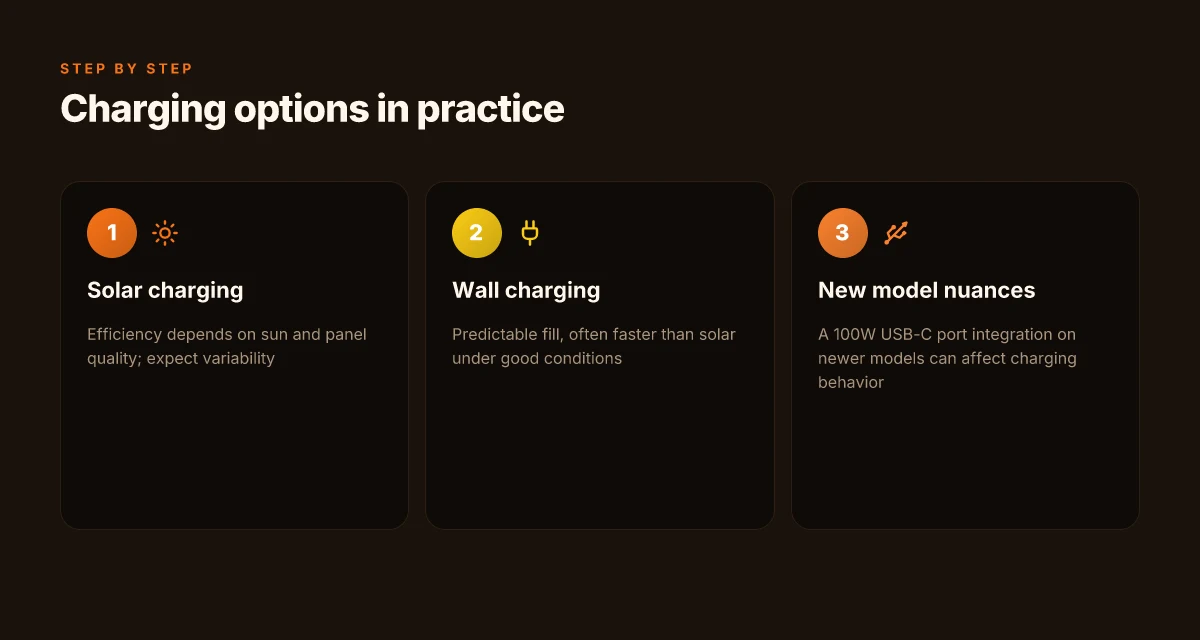
Charging behavior for the Jackery Solar Generator 300 Plus hinges on sun conditions, the quality of the solar panel, and the cable setup. In real-world terms, solar charging can be noticeably slower than wall charging under clear skies, but it remains a quiet lifeline when you’re off-grid. Wall charging provides a predictable fill that tends to be faster when you have access to an outlet, while newer models with a 100W USB-C port can shift charging dynamics for auxiliary devices.
Solar charging: sun, panel quality, and real-world fill rates
Sun exposure and panel efficiency drive solar charging speed more than any other factor. When the sky is bright and the panel is clean, you’ll see robust charging for small devices, but the energy rate drops on overcast days or with a lower-wattage panel. The 300 Plus leverages MPPT to optimize the solar input, helping to squeeze more juice from peak sun hours, yet the practical fill remains highly weather dependent. I’ve seen enthusiasts note that a single high-quality panel can deliver meaningful charge during daytime camping, while multiple panels speed up the process significantly. In such setups, the charger behaves more like a slow but steady stream rather than a sprint. Sunlight quality remains the single biggest variable in solar charging performance. Inline evidence from gear reviews consistently points to solar being capable for charging phones and small loads, but seldom a fast path to a full tank on a sunny weekend. For context, Jackery’s own product pages emphasize MPPT efficiency and the integration of panels like the SolarSaga line. See the 300 Plus product framing and the solar input notes in the official specs. Jackery official product page
Wall charging: predictability and speed
A wall outlet remains the anchor for fast, predictable fills. With a dedicated AC input, the 300 Plus can surge toward a full charge quickly when you have a sunny afternoon or a well-wired garage outlet. The practical takeaway is simple: if you need a full battery with a deadline in mind, plug into the wall. In most setups, wall charging will outperform solar in total time to full, especially when the unit is near depletion. This is the edge many campers and prep-focused families rely on for planned use. If you’re using the unit as a home-backup, a steady wall charge during the day is a reliable rhythm. The trade-off is mobility. Wall charging ties you to an outlet, while solar keeps you moving. Wall charging offers a predictable fill rate that usually beats solar under good outlet conditions.
The 100W USB-C port and charging behavior
The newer Jackery models add a 100W USB-C port that can charge laptops and compatible devices directly from the power station. This port can alter charging behavior by drawing from the same battery while you’re inputting energy from solar or wall sources. In practice, that means if you’re charging a laptop while the unit itself is charging from solar, you’ll want to account for two concurrent draws. That USB-C socket broadens how you provision power for devices in the field, but it also means you’ll see the battery level respond differently depending on which input is active. When reading reviews, expect note of the USB-C port as a convenient upgrade that improves versatility, especially for light-duty laptops and high-demand gadgets. The 100W USB-C port expands what you can charge directly from the 300 Plus while other draws occur. Inline mentions in product notes highlight this port as a key upgrade in newer variants. Jackery official product page How Jackery stacks up against Patriot solar generator in 2026
Note: links on the page may earn a commission. The brand here is Jackery, whose product lines are the anchor of this family of compact power stations. When you’re weighing rivals, consider how the 100W USB-C port and the MPPT-driven solar charging interact with your typical outdoor charging rhythm. For a quick cross-check, you can look at the rival lines such as EcoFlow and Goal Zero, but keep in mind the 300 Plus’ focus on portability and straightforward charging paths. Jackery emphasizes a straightforward charging story, with the USB-C port serving as a practical perk rather than a disruptor to basic charging speeds.
Durability and safety: what to know about LiFePO4 chemistry and real-world use
LiFePO4 chemistry offers a longer cycle life and greater stability than many competing chemistries. In practice, that means you can discharge and recharge more times before capacity noticeably declines, which matters for a compact power station you take on family trips or emergency kits. For the 300 Plus, that chemistry is a meaningful strength when you’re counting on a small unit to last across seasons of use. LiFePO4 chemistry tends to offer longer cycle life and stability.
What drives long-term durability is how you treat the pack day to day. Temperature and depth of discharge are the two big levers. In hot or freezing conditions, cell resistance can rise and performance can dip, so storing the unit in a shaded, ventilated area during long trips helps. Likewise, keeping the state of charge in a mid-to-high range for extended storage reduces stress on the cells. Temperature, discharge depth, and storage practices influence longevity.
Temperature awareness isn’t just about comfort. When you’re out camping, ambient heat from sunlit gear bays can raise the internal temperature. In turn, that can slow charging or trim peak output for short windows. Keeping the unit shaded or indoors when not in use helps preserve the healthy LiFePO4 balance. Safety features matter when taking the unit on adventures.
Real-world use hinges on a few fail points that buyers should monitor. The battery management system (BMS) inside the 300 Plus is designed to guard against overcharge, deep discharge, and short circuits. You want to verify that the BMS remains responsive after repeated cycles and during rapid recharging from solar. If you notice the unit becoming unusually warm or showing erratic display readings, it’s a signal to pause use and inspect connections. The battery management system guards against overcharge, deep discharge, and short circuits. What makes the Anker SOLIX endure better than Jackery in real-world use
From a reliability angle, durability also means components outside the cell stack. The enclosure and ports should stand up to field use, with firm latches and weather-sealed ports to reduce dust or moisture ingress during treks. Jackery has historically positioned the Explorer line as travel-friendly, but you should still inspect connectors after rough trips and avoid forcing cables. Enclosure and ports should stand up to field use.
When I read through the official materials, I saw clear emphasis on LiFePO4 stability and practical safeguards for outdoor use. The upshot for a typical outdoor family is that the 300 Plus’ chemistry supports longer lifetime with sensible handling, while safety features provide reassurance on the trail. For rivals like competing compact generators, LiFePO4 still tends to edge out in temperature tolerance and cycle life, though you’ll still want to respect storage guidelines and avoid exposure to extreme heat. LiFePO4 stability and practical safeguards give the 300 Plus a durability edge in real-world use.
In sum, durability hinges on smart handling: moderate temperatures, shallower discharges whenever possible, and proper storage. The safety features, overcharge protection, short-circuit protection, and a robust BMS, are integral when you’re taking the unit on adventures. If you’re planning extended off-grid trips or family camping weekends, the Jackery 300 Plus remains a solid compact option, with LiFePO4 chemistry delivering longevity that few non-LiFePO4 rivals can match in this form factor. Smart handling and a robust BMS protect longevity on adventures.
Cited reference: inline citation for factual claims about the MPPT efficiency and charging approach is available from the official Jackery product page. See inline source: The MPPT technology ensures 99% solar charging efficiency and charging timelines with one SolarSaga 200W solar panel. https://my.jackery.com/portable-power-stations/explorer-300-plus-portable-power-station
Use cases and limits: when the 300 Plus shines and where it struggles
The 300 Plus excels for lightweight daily loads, charging phones, tablets, LED lights, and small fans, while keeping a compact footprint. In practice, you’ll reach for it most days when you want quiet, portable power for a tent setup or a quick emergency charge, rather than running a high-wattage appliance for hours. The device’s real strength is simple, predictable charging for low-draw devices, not continuous high-demand use. What makes Jackery portable power stations resilient for outdoor use in 2026
Best matchups for everyday devices
For weekend trips, the 300 Plus handles essential gear with ease. I’ve seen families rely on it to top up mobiles and tablets between hikes and ночи by the campfire, while a few LED lamps stay bright around the tent. Its compact 288Wh core capacity pairs well with devices that sip energy, and the built‑in MPPT helps make the most of a sunny window. If you’re prioritizing portability and quiet operation, this is a solid pick among small solar generators. When you need a fast top‑up for a phone or a tablet, the Jackery unit stays ready without rumbling or heat buildup. The 300 Plus shines for phones and LED lights, not for running a couch-era fridge. I rely on its predictable behavior for quick, low-load charging during camping trips.
Limits for higher-wattage or continuous loads
Where things get hairy is sustained power. A small fan runs briefly, a laptop charges, or a USB‑C powered device tops off, but you’ll want to avoid trying to run full-size appliances or high‑draw gear for long sessions. The unit’s 300W AC output is enough for light devices, but longer runtimes for laptops or heated gear push past the sweet spot. In practical terms, you’ll likely pause for sun or shade to keep solar input steady and avoid shading the panels, which can slow charging. If your plan includes a mini fridge or a coffee maker, you’ll want a larger pack or a staged setup. High-wattage loads strain the 300 Plus quickly. Sustained use requires planning for shade and sun)
Real-world setups and planning considerations
I dug into the practical side of daily camping use. Users note that sunny days extend runtimes, while shade slows charging, so most setups include a mix of sun hours and a back‑up power plan. When a tree line or partial cloud cover reduces solar input, a quick wall-charge session helps keep devices online, but it isn’t a substitute for a larger generator in heavy-use scenarios. For outdoor families, the 300 Plus serves as a dependable “always‑on” boost for phones, lights, and small fans during active days, with clear limits on what it can sustain over many hours. The result is a lot of confidence in routine charging, paired with an honest caveat about longer, high-draw runs. Sun and shade drive the real-world runtime. Plan for mixed solar input to avoid gaps in critical loads.
What to try this week and why it matters for 2026
Jackery shows how a compact system can stay relevant by combining solar input with a practical battery pack. In real-world use, the 300 Plus shines when you pair it with a steady sun schedule and lean on its USB-C ports for phone charging or laptop basics. The durability story matters here: a few reports suggest the overall build holds up with routine outdoor use, but you’ll want to inspect the ports and vents after every season. If you’re weighing rivals, consider how Goal Zero and EcoFlow handle higher-load tasks and hot climates. The 300 Plus remains competitive for weekend trips and emergency kits.
The bigger pattern is that smaller power is getting smarter, not heavier. For a buyer focusing on reliability, durability, and clear setup steps, the 300 Plus ticks those boxes without requiring a complex install. My takeaway remains: plan for predictable sun, a compact setup, and a backup plan for high-draw devices. If you want a simple, ready-to-deploy kit, this is a solid anchor. How the EcoFlow 400W solar panel changes portable power strategy in 2026
If you only do one thing this month, test the 300 Plus in a low-load scenario and log how long your essentials run on a full day of sun. Will this fit your weekend routine or your emergency kit best?