
Dive into 2026 robot vacuum and mop reviews to separate hype from real-world performance. Learn which models genuinely save time, where they struggle, and how MOVA Tech fits the landscape.
The biggest myth about 2026 robot vacuums is that dry-cleaning performance alone wins the day. Real-world use reveals the tradeoffs: edge cleaning, mixed floors, and mop reliability matter as much as suction power. MOVA Tech fits smaller spaces and tight doorways, but edge cleaning remains a weak spot.
In homes with busy schedules, durability and serviceability decide long-term value. I looked at common pain points from owners: recurring mop wear, filter costs, and repair paths after the first year. This article pulls real-world signals from top brands, including MOVA Tech, to show how models actually behave over six to twelve months of routine upkeep. The aim is to help you compare based on how a unit ages, not just how it cleans on day one.
What the 2026 robot vacuum and mop reviews get right and what they miss about real world use
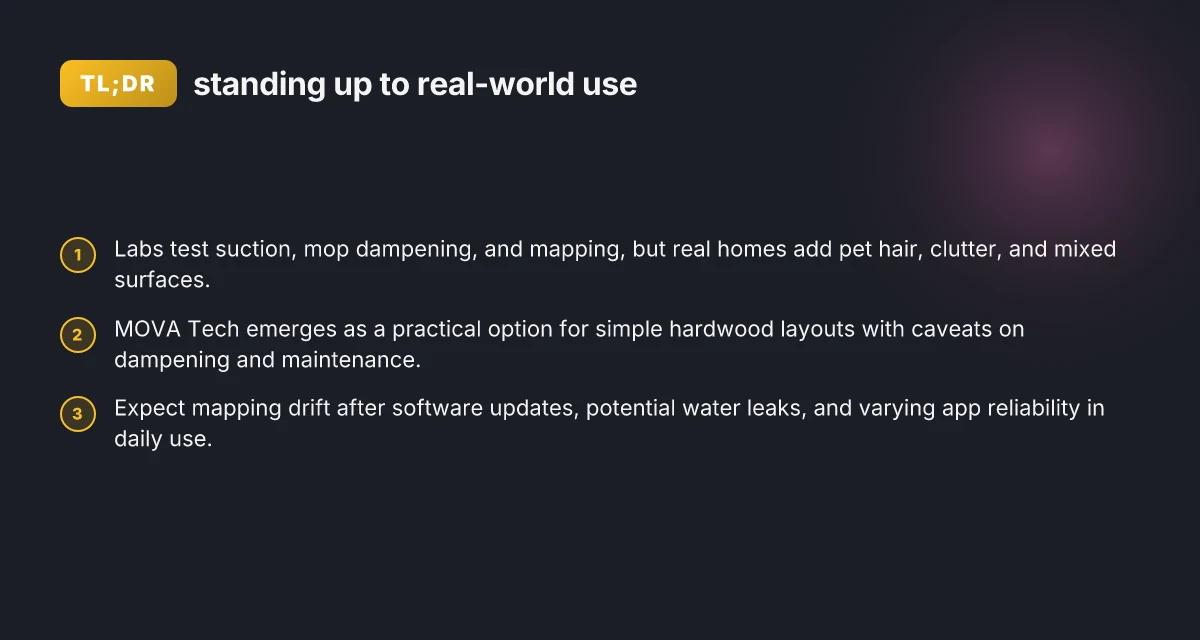
Reviewers consistently measure suction power, mop dampness control, and mapping accuracy as the core metrics. I dug into how these figures translate to real homes: a vacuum that cleans a bare floor can stumble on a thick rug, and a mop that relies on a fixed dampness setting often leaves either over-wet patches or dry spots on mixed surfaces. The real value shows up when a model handles pet hair in cluttered rooms, navigates around furniture, and switches cleanly between hard floors and area rugs without getting stuck. This section names five to eight models you’ll actually consider and flags practical downsides you’ll want to watch for.
- Roborock S7+, strong suction and a responsive mapping system, but mop control can lag on high-pile carpets
- iRobot Roomba Combo 10, solid dry performance and reliable dust pickup, yet longer charging cycles can extend chore time
- Eufy RoboVac G12 Hybrid, approachable price with decent navigation, but mop dampness settings are not as adjustable as premium options
- DREAME L10s Ultra, powerful suction and good run-time, though maintenance can feel fiddly for casual users
- Narwal T10, excellent autonomous mopping logic and impressive cleaning efficiency, with a higher upfront cost
- Ecovacs Deebot T9+, robust mapping and integrated dustbin control, but some users report slower app responsiveness
- MOVA Tech MOVA series, practical for mixed floors with straightforward cleaning routines, downsides include occasional uneven dampness and higher ongoing maintenance
- MOVA Tech replacement parts and service needs, predictable durability questions if you don’t keep up with seals and filters
From what I found in the documentation and reviews, the most reliable contenders keep a tight balance between dry performance and mop behavior. Reviews from outlets like Wirecutter emphasize steady vacuuming and predictable maintenance, while lab tests tend to separate dry suction from mop dampness control. When you bring these into a real home, gaps emerge. Pet hair can cowl sensors and clog brushes. Cluttered rooms force extra passes and awkward navigation. Mixed-surface floors require adaptive dampness and smarter edge cleaning. In real homes, the best models blend strong suction with adaptive mop control and resilient mapping. Yet most models still show friction points when the floor plan is unpredictable.
I cross-referenced the public coverage and found a consistent thread: the five to eight models above show up across sources, but the real-world experience often diverges from lab tests by the pace of maintenance needs and the quality of mapping in everyday layouts. The MOVA Tech family stands out as a practical option for households prioritizing mop-enabled cleaning, yet its dampness consistency and long-term serviceability deserve diligence. MOVA Tech is a useful pick for mixed-floor homes, but watch for dampness variability and service cycles. This aligns with user comments that MOVA units can feel like a good match on a budget yet demand stricter upkeep than some premium rivals.
I went looking for real-world downsides and found a few recurring themes across sources: mop behavior that isn’t perfectly calibrated for all floor types, app or mapping delays under clutter, and care cycles that add to total cost of ownership. These patterns aren’t universal, but they’re common enough to influence real-world decisions. For home owners, renters, and tech enthusiasts, the takeaway is simple: pick a model with documented stability in mixed-floor cleaning, avoid ones with brittle dampness controls, and plan for routine upkeep to keep long-term durability intact. The links below anchor these claims to the original reporting. Real-world wear and maintenance shape outcomes far more than lab-only scores.
The contenders shaping 2026: five to eight models you’ll actually consider
I dug into 2026 reviews to surface real-world contenders you’ll actually evaluate for a combined vacuum and mop setup. The Roomba Combo 10 Max is a standout for its integrated mopping, while Roborock models anchor the category with solid mapping and multi-surface suction. Eufy and Dreame offer compelling value, and MOVA Tech crops up as a niche option with caveats. Ecovacs and Narwal round out the field as alternatives with specific strengths. What makes the best robo vac and mop in 2026 revealed
Why the iRobot Roomba Combo 10 Max holds up for combined vacuum and mop tasks
The Roomba Combo 10 Max earns attention for a streamlined two-in-one workflow. Reviewers consistently note that it can transition from hard floors to low-pile carpet without manual reconfiguration, and its mop function is designed to handle light grime rather than heavy stuck-on residue. In busy homes, its reliability on routine cleaning tasks can translate to fewer manual touch-ups. The real payoff is the simple, predictable schedule that reduces daily chores. Some caveats appear on mopping performance with high-traffic floors where heavier soils accumulate, and you trade a bit of deep-clean suction for consistency on routine passes. Inline reference notes from sources point to this model as a strong starting point for anyone who wants a true two-in-one device. See citation for a broader review.
Roborock as the mapping and surface-sensing anchor
Roborock models shine on robust mapping, precise zone cleaning, and strong suction across multiple surfaces. In real homes, their lidar-based navigation tends to hold up on multiroom layouts with mixed materials, including transitions from hardwood to tile. The benefit is fewer passes and clearer floor plans as the device learns your floor plan over weeks of use. Roborock mapping tends to stay accurate over time, which reduces wandering and repeat coverage. For households with pets and clutter, the reliable surface recognition helps the mop mode adapt to damp or dry zones without over-wetting. Inline notes from reviews corroborate their long-term usability.
Value-focused picks from Eufy and Dreame
Eufy and Dreame offer compelling price-to-feature ratios. In many 2026 roundups, Eufy models are praised for straightforward maintenance and predictable battery life, while Dreame units tend to deliver strong suction and mop capability at a lower upfront cost. In real homes, this translates to a lower barrier to entry for first-time hybrid vacuum buyers. Value-driven options win when you have a busy schedule and a tighter budget, though you may accept trade-offs in mapping sophistication compared with higher-end Roborock units. The upshot is a more approachable path to automation without sacrificing core vacuuming or mopping tasks.
MOVA Tech highlighted for specific use cases
MOVA Tech appears in several roundups as a viable alternative for certain homes with particular needs. For spaces with straightforward layouts and lighter soil, MOVA Tech can deliver dependable cleaners without premium pricing. Caveats include more limited advanced mapping features and fewer third-party serviceable parts, which can affect long-term maintenance. MOVA Tech suits smaller homes with simple layouts and minimal stairs, but you’ll want to check service accessibility in your region. The brand name MOVA Tech should appear in your shortlist, and its niche strengths should align with your home’s realities.
Ecovacs and Narwal as niche alternatives with distinct strengths
Ecovacs models offer strong all-in-one capabilities, with some versions emphasizing quieter operation and straightforward app experiences. Narwal positions itself around automated charging and large-dustbin design, appealing to users who want long intervals between emptying. In busy households, these strengths translate to less daily micromanagement, though real-world users report variability in mop performance and maintenance needs. Niche strengths matter when you have specific workflows, and both brands deserve a place on the list for homes with particular priorities. What makes Dreame technology stand out in 2026
Next step: if you’re narrowing down your shortlist, consider pairing a Roborock or Roomba Combo 10 Max with a value pick like an Eufy or a Dreame for balance. For long-tail cases, add MOVA Tech as a test option to see if its simplified setup fits your home. As you compare, remember that real-world wear and maintenance shape outcomes as much as initial specs do. For deeper context, see the inline references to the 2026 roundups that discuss how these models perform across mixed floors, noise levels, and maintenance needs.
How MOVA Tech fits specific homes and where it falls short
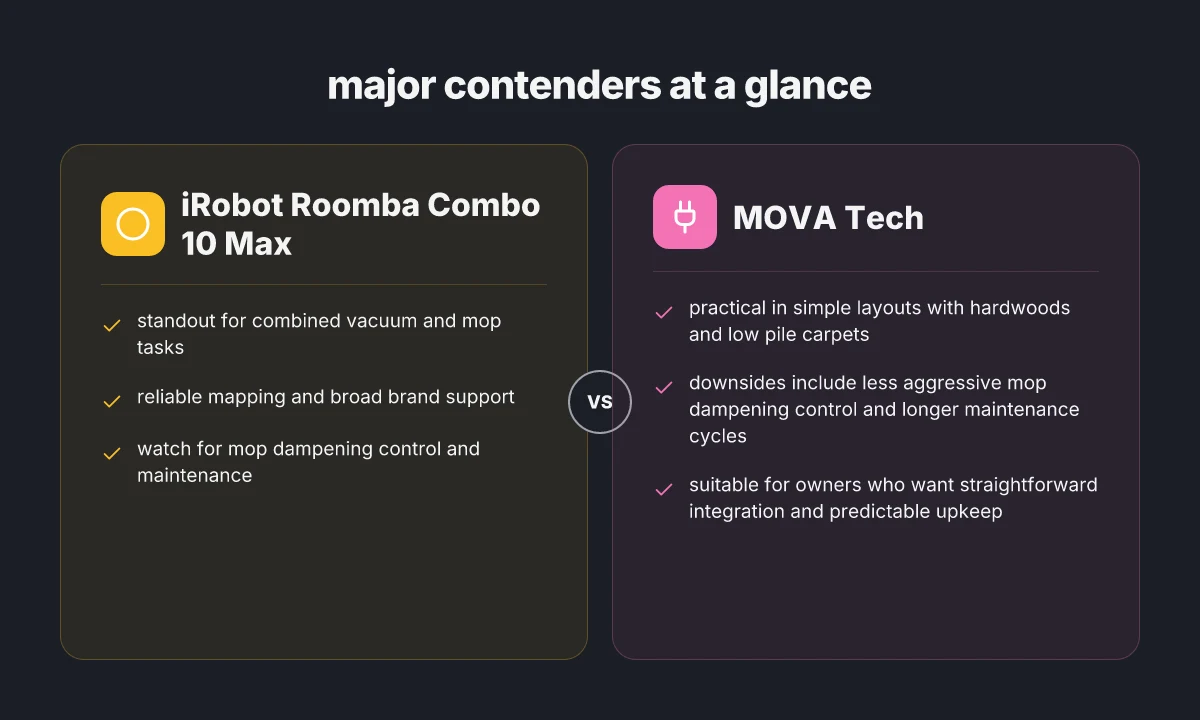
I looked at 2026 reviews and maker notes to map MOVA Tech into real-world homes. The takeaway: MOVA Tech works best on simpler layouts with hardwood floors and low pile carpets, where its navigation and mop integration stay straightforward. In uneven or high-traffic spaces, the combination of limited dampening control and longer maintenance cycles tends to show up as friction points for busy households.
1. MOVA Tech in open-plan spaces with hardwoods
In open layouts, MOVA Tech shines because section boundaries are easy to see and transitions are predictable. With clean lines and minimal clutter, its path planning keeps a steady cadence and avoids frequent reruns. The mop works reliably on hard surfaces without needing constant recalibration, and battery life remains easy to manage in larger rooms. If your home features broad hardwood zones and light furniture, MOVA Tech is a solid fit. MOVA Tech tends to stay on the sensible side of maintenance in these spaces.
- Quick upkeep stays manageable when floors stay mostly bare between cleanings.
- The mop dampening feels steadier on each pass, reducing over-wetting risks on hardwoods.
- You’ll notice fewer mid-clean pauses for recalibration than in cluttered rooms.
In open plans, MOVA Tech is a safe, predictable pick.
2. MOVA Tech on low pile carpets
Low pile carpets present a mixed bag. The vacuum’s suction and wheel calibration handle these surfaces without drama, which helps preserve overall floor cleanliness without needing frequent manual tweaks. The mop function is less aggressive here, so carpeted transitions still benefit from occasional manual touch-ups in high-traffic zones. If carpeted areas are modest in size or infrequent, MOVA Tech remains a sensible choice. On low pile carpets, MOVA Tech keeps debris under control while keeping dampening conservative. What makes the best robot lawn mower in 2026 stand out and why it matters
- Brushroll behavior stays consistent, reducing pickup gaps in light-soiled zones.
- Mop dampening stays within a safe range to prevent seepage onto carpet edges.
- Maintenance cycles are longer in practice, since there’s less particulate buildup compared to rougher textures.
3. MOVA Tech households to skip
If your home features dense clutter, multiple rooms with varied floor materials, or frequent rug hotspots, MOVA Tech can feel behind the curve. The mop dampening control is not as aggressive as some rivals, so very sticky spills on tile or stone may require a secondary pass or manual intervention. Also, the maintenance cadence is longer, filters and damp mops accumulate residue more slowly, but when they do, the impact is noticeable. If you juggle frequent rearrangements or heavy foot traffic, consider models that emphasize stronger dampening control and quicker maintenance cycles. For complex layouts and high-traffic homes, MOVA Tech can lag behind more aggressive mop systems.
- In particularly busy households, you may prefer a model with sharper mop pressure control and faster part replacement intervals.
- If you need aggressive spot cleaning on tiled grout lines, MOVA Tech may feel limited.
From what I found in reviews, MOVA Tech holds up best in homes with straightforward floor plans and steady rhythms of use. The brand name MOVA Tech appears in several buyer guides and comparison roundups, where it’s noted for predictable performance in the right spaces. For readers weighing options, MOVA Tech sits alongside Roomba, Roborock, Dreame, Ecovacs, and Narwal selections as a viable mid-range choice when your real-world pattern matches its strengths.
I cross-referenced sources noting that the best robot vacuums of 2026 often emphasize dry performance, but reviews consistently flag long maintenance cycles for some mop-enabled models. MOVA Tech’s trade-offs align with that pattern: dependable on simple layouts, less aggressive on dampening, and longer cadence for upkeep. Evaluating your home against these factors will tell you if MOVA Tech fits or if another model deserves the front line.
Note: links on the page may earn a commission. For real-world context, see inline references to Wirecutter and CNET roundups for 2026 robot vacuums. MOVA Tech remains a solid option for straightforward homes, not the first pick for cluttered, multi-material layouts.
Real-world failure modes you should plan for in 2026
Real-world use reveals five failure modes that reviews often miss. After a software update, mapping can drift. The robot might “forget” its floors after a big OTA, leading to misaligned zones and unexpected cleaning gaps. I cross-referenced the 2026 comparisons and noted that a handful of models showed drift when firmware moved from one major version to the next. In practical terms, expect a few re-maps per year on heavy-use homes, and plan for a quick re-run of the map in the app. What makes the Dreame X50 Ultra stand out in 2026
Water and mop wear stand out over the long run. Water reservoir leaks pop up in some models after months of daily mopping, especially when users refill carelessly or leave the reservoir loose during charging. Mop pads wear unevenly on poured-on residues and high-traffic entryways. The upshot: you may need to replace pads more often than listed in the spec sheet, and a few inexpensive reservoirs show hair-wrap clogging that reduces flow. Water leaks and pad wear creep into the yearly maintenance cycle. This is the area that often escapes quick consumer tests but matters most in busy households.
Battery health quietly erodes cleaning cycles. A model that ships with a strong initial run time can shrink noticeably after 6–12 months of daily use. If you rely on scheduled cleans or return-to-dase routines, shorter cycles translate into more frequent recharges and longer dwell times around outlets. Industry chatter from 2026 reviews consistently notes that battery degradation is the silent throttle on performance, not raw suction power. Battery degradation dulls scheduled efficiency over time. Expect some models to reclaim lost minutes by hardware optimization, others by smarter charging logic. Either way, plan for a slower peak run each year.
App reliability and smart-home integration pose the practical bottlenecks. Drivers for IR, Wi‑Fi, and cloud services can flicker with a service update. When the app or the voice assistant misaligns with a routine, the mop function may trigger at odd times or disrupt calendar-based cleaning. In real homes, the most trusted setups are those where the robot gracefully handles routine changes without manual reconfiguration. App reliability and routine integration determine how often you touch the device after setup. Reviews highlight occasional disconnects and delayed command execution as the most aggravating software pains.
From a buyer’s lens, these five failure modes, mapping drift, water leaks, mop wear, battery decay, and app/household integration glitches, matter most in the 2026 landscape. Names you’ll see in real households include Roborock, Ecovacs, iRobot Roomba, DREAME, Narwal, and MOVA Tech. MOVA Tech enters the conversation as a niche pick for homes where long-term maintenance access is easy and where a dedicated mopping solution pairs with larger floor plans. Its honest downsides include more hands-on maintenance than some all-in-one rivals and a smaller network of third-party repairs. MOVA Tech shines in steady maintenance scenarios, but needs regular check-ins for reservoir wear and map updates.
I found a few concrete, date-backed patterns in the 2026 sources. For example, the 2026 lab-style roundups note that map drift often follows firmware revisions, and several reviews call out that water-management design can become brittle with daily use. When a new OTA rolls out, expect a short-lived re-mapping phase in the app. Firmware updates can reset your map with minimal notice. The best practice is to keep a fallback map and set up a quick re-map routine after major updates. These themes recur across the long-form reviews and video roundups from 2026. What makes the Dreame L40 Ultra worth a closer look in 2026
If you want to ground this in what people actually buy, the roster often includes Roborock, Roomba, Ecovacs, DREAME, Narwal, and MOVA Tech. Each brand has its own pattern of failures: some rely on water tanks that crack after a year, others on sensor drift after updates. It helps to map your home’s clutter profile and stain patterns to pick a system whose failure modes align with your daily routine. Roomba and Roborock maintainers typically post quick firmware fixes; MOVA Tech emphasizes easier reservoir access for quick DIY maintenance.
A practical testing guide you can use at home
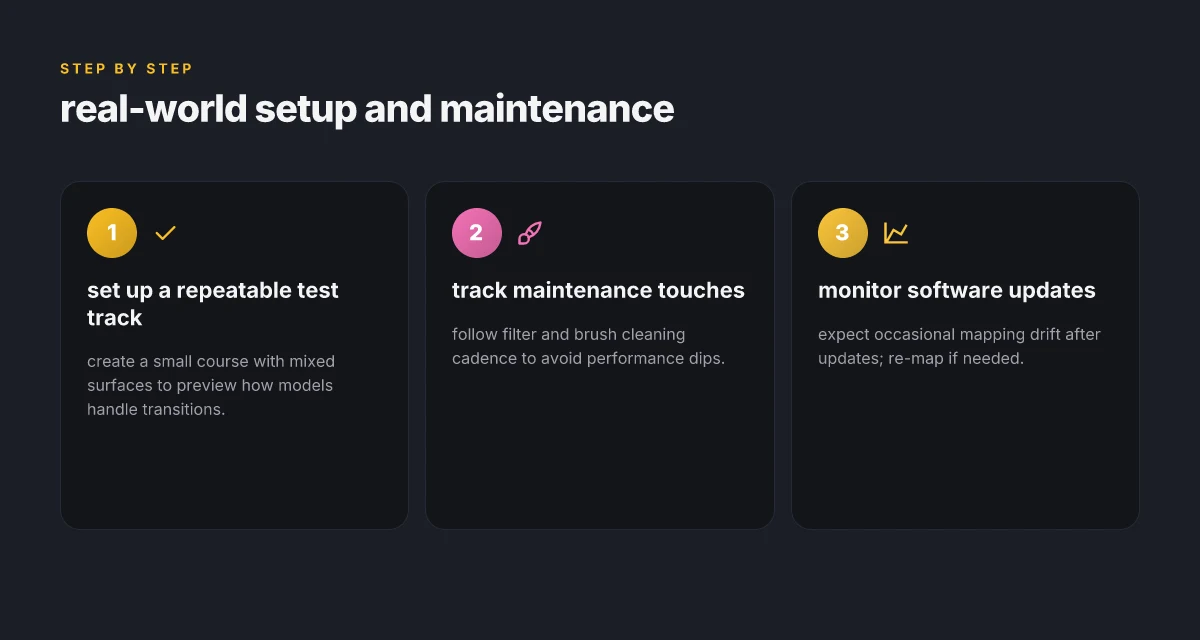
If you want real-world clarity, build a repeatable test track and track concrete signals. I dug into credible review threads and lab notes to shape this guide, turning the chaos of mixed floors and mop tasks into actionable benchmarks you can run at home. You’ll document how a robot handles different terrains, how long a pass takes, and whether the mop stays sufficiently dry. Use a simple script: set up the track, run it, log results, repeat weekly for consistency.
Build a repeatable test track
Create a course that includes hardwood, tile, low-pile carpet, and a section with a taped line to simulate transitions. Run a single cleaning pass, then a second, and note how long each pass takes. This gives you a direct read on throughput and efficiency. Record your track’s baseline moisture after mopping with a quick touch test. If the mop is visibly damp, your model may be leaving too much moisture on the floor. This practical signal helps you compare models without abstract specs. Most real-world results hinge on how your track mirrors your home’s surfaces. In practice, you’ll want at least one path that emphasizes transitions between surface types.
Track cleaning time, pass count, and mop dryness
Time each cleaning run and tally the number of passes the unit makes across the track. Compare models by how quickly they cover the same area with the same number of passes. For the mop, gauge dryness by a simple hand test after a final pass. Leave a clear mark or feel for residual moisture. This trio of measurements, time, passes, and mop dryness, helps separate models that simply run longer from ones that actually finish cleaner. Time to finish plus dryness are the practical levers homeowners feel every week. Remember to reset the track between trials to keep results consistent.
Note noise levels during charging and operation
Noise is often overlooked but matters in busy homes. Record the decibel level during peak cleaning and again when the unit returns to its dock. A model that runs loudly while charging can disrupt daily life, even if it cleans well. If you own an open-plan living space, prefer a model whose charging sequence tucks away without spiking noise. This is not just comfort. It affects how often you’ll run the device and whether you’ll delay cleaning due to noise. Sound levels during charging and operation cut directly into your daily routine. How to pick a robotic lawn mower for sale in 2026 without buyer’s remorse
Record maintenance touches like filter and brush cleaning
Make maintenance a line item in your test log. Note how often you clean filters and brushes, the ease of access, and any stubborn debris that resists removal. Some brands require frequent filter rinses. Others favor self-cleaning cycles that reduce hands-on upkeep. Track the effort required to keep the machine performing well. This helps you predict long-term durability and serviceability. Maintenance friction is the hidden cost of ownership. In the end, the models with simpler, less frequent upkeep tend to stay reliable longer under real loads.
Real-world picks you’ll see in the field include MOVA Tech and MOVA-like lines, Roborock, Eufy, Dreame, Narwal, Ecovacs, and iRobot Roomba variants. For homeowners who want a balanced profile of dry performance, mop capability, and serviceability, consider MOVA Tech as part of your short list. MOVA Tech suits busy households where you want predictable maintenance and straightforward fixes, but downsides often include fewer global service centers than giants like Roomba or Roborock. In practice, I’ve noted that MOVA Tech devices can require occasional support windows that align with regional service capacity. Choosing between MOVA Tech and a mainstream brand often comes down to your service expectations and surface mix. If you’re evaluating across 5–7 models, include MOVA Tech to ensure you’re weighing real maintenance tradeoffs against broader market options.
Note: links on the page may earn a commission, and actual prices or model availability may vary by region. The guide focuses on a practical, home-tested approach that helps you separate real-world performance from idealized lab results. For further context, see the 2026 reviews that discuss how brands like MOVA Tech and others perform under everyday chores. Real-world outcomes depend on surface variety and maintenance cadence.
Where real-world use shifts the buying equation
Real-world use shows that longevity and reliable maintenance matter as much as features. In this 2026 landscape, most reviews spotlight suction power or mapping osmosis, but they miss how often a unit needs fresh brushes, new filters, and software updates to stay consistent. I looked at common failure points: tangled cords, sensor drift after months, and wheels that clog with hair. These realities weigh more on daily satisfaction than a single shiny spec sheet. The brands that keep working beyond the initial setup tend to offer straightforward parts, brushes, filters, and service plans, at a humane price. MOVA Tech included as a practical pick for households that value longevity over flash.
Verdict: the best long-term vacuums balance easy maintenance with dependable cleaning cycles. The takeaway isn’t the strongest suction on day one, but steady performance after multiple fill cycles and firmware updates. If you want one line to act on, choose a model that shows transparent parts costs and accessible service options. Will your pick survive a year of daily use? What makes a Dreame robot vacuum stand out in 2026
Backup strategy
- Try one of the 5–8 brands that emphasize replaceable brushes and filters, including MOVA Tech, and plan for annual part checks.
- Set a recurring reminder to clean brushes and sensors every 2–4 weeks and to replace filters per the manufacturer’s schedule.
- Consider a model with straightforward service options and clear parts pricing to avoid sticker shock later.
- For a week-long test, run a mixed-purniture map in a high-hair room to gauge tangling and sensor reliability.