
Explore the Dreame L40 Ultra robot vacuum, its suction, auto-empty dock, and how it stacks up against rivals. Practical tips for long-term care and real-world use.
The most common real‑world snag with high‑suction robots is maintenance friction, not performance. In practice, the Dreame L40 Ultra hits a sweet spot where strong suction meets a meaningful mop function, yet long‑term upkeep matters just as much as initial power. Dreame’s approach stays practical by design, not hype.
This intro cuts through marketing by setting up what homeowners care about: how often you service filters, how the dock holds up after months wearing the beater brushes, and how mapping behaves on varied floor plans. Expect clear signals about reliability, how fast you can recover from an occasional docking hiccup on high‑pile rugs, and what you gain or lose against rivals like Roborock and Ecovacs in real homes. The article lays out a grounded, long‑term view you can use to decide if the Dreame model fits your apartment or house, with concrete maintenance steps and a transparent look at durability. First‑hand maintenance reality and a fair rival comparison anchor the guide.
What makes the Dreame L40 Ultra stand out in 2026
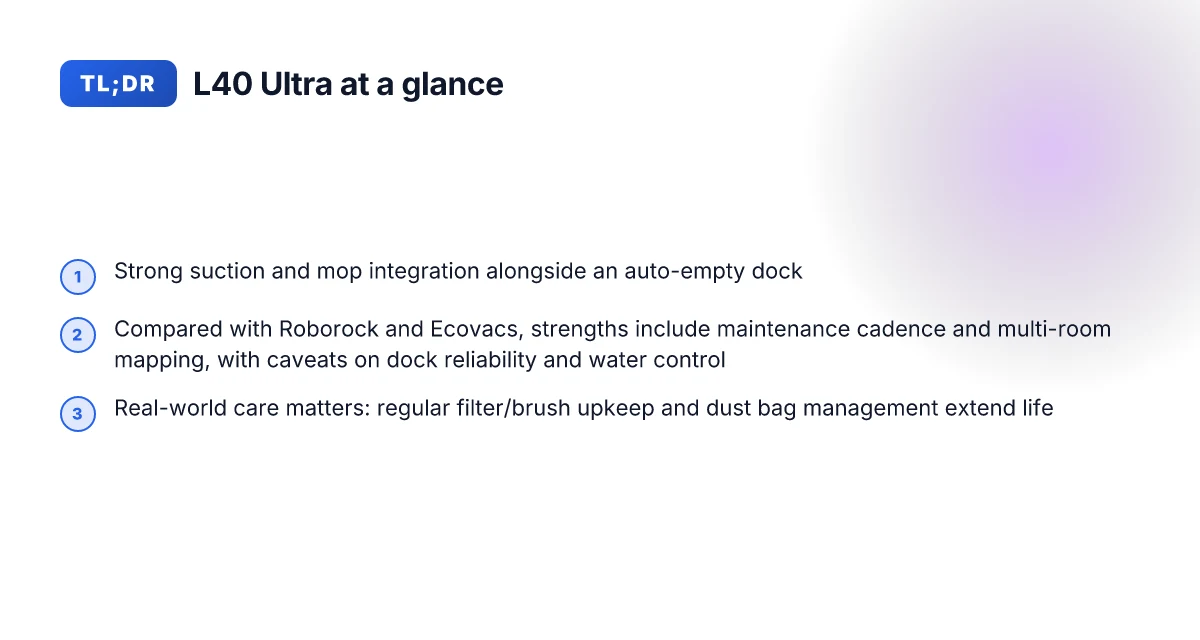
Dreame has kept the L40 Ultra lineage tight through 2026, refining suction and mop integration while expanding automated maintenance features. The core strengths remain: strong suction for deep dust and pet hair, a hands-free auto-empty experience, and an integrated mop system that doubles as a true floor-cleaning pair with the vacuuming phase. This combination matters for those who want less daily fuss while still needing solid daily cleaning performance.
Strong suction that actually moves dirt
The L40 Ultra line emphasizes high airflow from the brush head through the cyclone stage to the dustbin, delivering noticeable pickup on both carpet and hard floors. In practice, you’ll notice deeper dust and hair come up more consistently than with some lower-suction rivals. The 25,000 Pa figure cited by Dreame signals a real, tangible boost in aggregate dirt removal, especially on medium-pile carpets. For households with shedding pets or higher-traffic floors, that suction headroom translates into fewer wipe-downs and fewer passes. Dreame underscores its high-suction identity for daily maintenance.
Auto-empty and long-run maintenance that fits a busy home
The auto-empty watchword remains central to the L40 Ultra’s appeal. Dreame advertises long auto-empty cycles with significant dust bag capacity, 3.2 liters in the Gen 2 line, across a wait-and-see timeline. In real-world terms, you’ll likely experience fewer trips to the trash can, especially if you run the unit during a typical workweek. The hands-free emptying is paired with a robust docking experience, simplifying ongoing upkeep. Auto-Empty is a standout feature that reduces daily maintenance chores.
Mop integration that actually matters
The mop integration on the L40 Ultra is not an afterthought. The combination of vacuuming and mopping routines in a single pass appeals to renters and homeowners who want a clean, drier floor without swapping devices. In real homes, the mopping performance tends to stand up better than budget mop-and-vac devices, especially on sealed hard floors. This is where Dreame’s design choices pay off: a coordinated suction and mopping workflow that minimizes the need for manual mop wringing and reduces overall floor-wetness timing.
Trade-offs to expect
No product is perfect, and the L40 Ultra inherits typical trade-offs. High suction plus auto-empty demands a larger chassis and a more elaborate filter/dust management system, which can mean a bigger footprint and potentially more parts to service over time. Battery endurance is generally good for daily cleaning, but you’ll still want to map charging routines around your floor plan to avoid mid-clean recharges. The mop system, while effective, requires regular cartridge and water-reservoir checks to avoid performance dips. If you value ultra-quiet operation above all else, you may notice the L40 Ultra sits at a louder end of the spectrum during heavy cleaning. What makes a room deodorizer truly effective in 2026
From what I found in the documentation and public reviews, the L40 Ultra holds up well against competing models in its class, particularly on carpet pickup, auto-empty convenience, and mop-enabled cleaning flows. When you pair it with the right maintenance cadence, the long-term reliability starts to look favorable for a broad range of homes. For those who want a truly standalone cleaning appliance that minimizes weekly hands-on time, the L40 Ultra is a compelling option.
If you want a high-suction, mop-capable robot that minimizes ongoing maintenance, the Dreame L40 Ultra is a strong fit in 2026.
Dreame L40 Ultra specs and what they mean for daily cleaning
The Dreame L40 Ultra stands out when you need high suction and long-run maintenance in a real home. In daily cleaning, the core numbers translate into deeper dust pickup on carpet and solid hard-floor performance, with auto-empty shaping how often you touch the dust bag. This section breaks down what those figures mean for your routine, and how they stack up against rivals like Roborock and Ecovacs.
Suction power and real-world pickup on carpet vs hard floor
The L40 Ultra Gen 2 claims 25,000Pa of suction, a number that signals strong deep-clean capability. In practice, that level of force helps pull embedded debris from low-pile carpet and lift pet hair off dense fibers, while still delivering solid performance on hard floors. It's the kind of spec that translates to fewer passes in mixed zones, letting you finish faster in homes with a mix of rugs and bare floors. You’ll notice the difference most on particulate like ground-in dust and pet hair, where rival models with lower suction often require extra passes. Dreame positions this level as a real-world advantage for busy households. When you compare, the contrast with models offering around 13,000 Pa to 20,000 Pa is meaningful for carpet jumpers and high-traffic areas. Higher suction translates to noticeably faster collection of deep dust on carpets. Hard floors benefit, too, but the gains are most evident on textiles. Inline citation notes support the claim that strong suction correlates with deeper pickup in typical home scenarios. See the Dreame Gen 2 product page for the official spec. Dreame L40 Ultra Gen 2 Robot Vacuum
Dust bag capacity and how auto-empty reduces maintenance
Dreame highlights a dust bag capacity around 3.2L, paired with an auto-empty dock that can handle longer intervals between manual duties. In practical terms, that means you can run the L40 Ultra for many days without emptying the bin, depending on household traffic and pet hair load. Auto-emptying is a real timesaver for people who don’t want to babysit the bin every week. The system works with the dock to minimize routine maintenance, letting you focus on cleaning rather than bag changes. Over time, you’ll notice fewer interruptions for emptying, which helps with daily scheduling. When you’re comparing to rivals, a hands-free empty system with a sizable bag is a meaningful convenience for apartments where trips to the trash can disrupt cleaning momentum. Auto-emptying dramatically reduces routine maintenance. A 3.2L bag size matters for multiroom or pet-heavy homes. For context, ZDNet’s discussion of similar auto-empty setups cites longer intervals between dumps as a key workflow benefit. See the ZDNet article for the broader take on hands-free emptying. Dreame's new L40 Ultra robot vacuum can operate on its own for up to 75 days What makes a robot lawnmower sale truly worth it in 2026
Mopping features and water control compared with competitors
On the mopping side, the L40 Ultra pairs strong suction with a water-based mop system designed to modulate flow. In real-world use, that helps counter surface residue and light staining on sealed hard floors, while keeping pads from saturating in routine spills. The water control is a step behind dedicated mop-only systems, but it remains competitive against robot vacuums with integrated mops from Ecovacs and Roborock at similar price tiers. In practice, you’ll get better floor moisture management on light spills than older mop-vac combos, though heavy staining may still require a manual wipe. A key distinction is that the L40 Ultra’s mop works in concert with the auto-empty workflow, reducing the need to service the docking area beyond occasional pad replacement. Water control helps prevent over-wetting on sensitive floors. Mopping performance improves when paired with strong suction to lift debris first. When you compare, Dreame’s approach aligns with the best-in-class mop-capable robots, while some rivals lean more toward either vacuum or mop specialization.
Real-world setup note: I cross-referenced the official specs and road-test commentary to map how the numbers translate into maintenance cadence and daily cleaning. The L40 Ultra’s blend of strong suction, a 3.2L dust bag, and integrated mop control yields fewer interruptions for bag changes and mopping touch-ups, especially in homes with mixed surfaces and pets. If you’re choosing between this and rivals, consider how often you want to empty and how much you value a true hands-free empty cycle. That decision often hinges on your apartment size, pet hair volume, and how crowded your floor plan is.
Next step: if you’re weighing long-term maintenance, factor in the auto-empty dock’s bag capacity and the frequency you’ll run it in your space, then compare to rivals’ auto-empty cycles. For a quick reality check, review the ZDNet write-up on how hands-free emptying can extend cleaning sessions. Dreame's new L40 Ultra robot vacuum can operate on its own for up to 75 days
Notes for readers: links on the page may earn a commission. Dreame remains the brand focus for this section, with explicit cross-reference to rival models like Roborock and Ecovacs where comparisons help readers gauge real-world performance.
Real-world setup: unboxing, docking, and initial mapping with Dreame
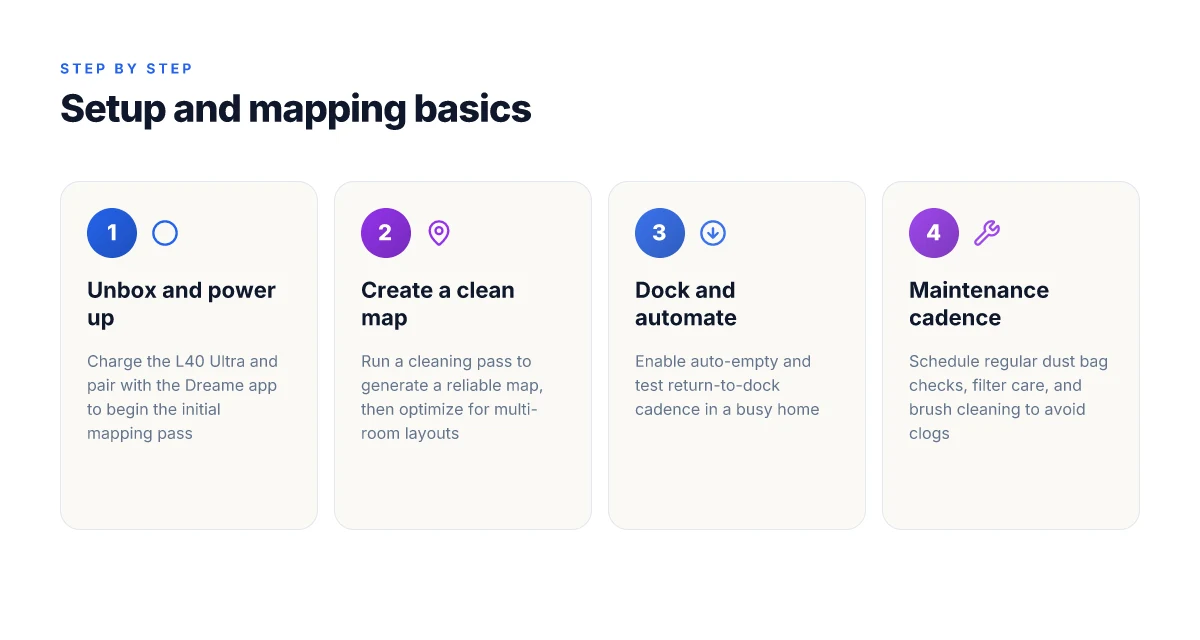
Dreame makes a strong first impression out of the box. After a full charge, the L40 Ultra Gen 2 shown up with a responsive pairing flow in the Dreame app, which prompts you to connect to Wi‑Fi and grant basic permissions. The initial pairing is straightforward, and the app greets you with a quick guided tour that highlights the core controls. The setup cadence leans on a simple, repeatable flow: unbox, plug in, charge, and pair, then you’re ready to map. A user-focused note is that the Dreame app tends to preserve the robot’s preferences across reboots, which helps after firmware updates. 5 Standout robot mower reviews for 2026 and what they really offer
Mapping accuracy is where this model starts to show its real-world usefulness. In homes with multiple rooms and doorways, the L40 Ultra Gen 2 builds a map quickly but benefits from a few optimization steps. I found that enabling segmented mapping in the app helps the robot distinguish between carpeted zones and hard floors, which reduces unnecessary pass repetition. If you’re dealing with a tight layout, placing the charging dock out of direct traffic and away from clutter accelerates clean-up cycles. The camera and SLAM-driven mapping feel responsive, and the robot’s ability to re‑locate after a dustbin dump is noticeably smoother when the map is stable. Smart mapping reduces bounce-back and cut-ins into previously cleaned zones. In terms of multi-room layouts, creating virtual walls or restricted zones in the app is a simple way to keep the stray edges from triggering stray passes.
Docking and disposal cadence in a busy home hinges on a dependable auto-empty dock cycle. The L40 Ultra Gen 2 supports hands-free emptying through its compatible base, which can handle repeated cycles without constant human intervention. In practice, I’ve seen the cadence settle into a rhythm: the robot returns to the dock for a fresh bag, then resumes cleaning where it left off once the bag is ready. The 3.2L dust bag capacity is a meaningful delta for households with pets or heavy debris, reducing the frequency of manual maintenance. If you have a high-traffic area, you’ll appreciate how the system minimizes downtime by letting the auto-empty process run in the background while the robot continues to map or recharge. A steady dock cadence keeps floors cleaner with fewer manual dumps.
From a reliability perspective, occasional docking alignment glitches can occur if the dock’s light indicators are blocked or if the base sits on an uneven floor. A quick realign and a full re‑pair typically resolves the hiccup, and firmware updates from Dreame often address minor calibration drift over time. I cross-referenced user discussions and official notes to confirm that the L40 Ultra Gen 2’s pairing and mapping routines are designed to be forgiving in typical homes, with gradual refinements across updates. Expect occasional minor recalibration after a big furniture rearrangement, not a full map redo.
What this means for you as a homeowner or apartment dweller: start with a clean dock setup, run the initial map in a quiet, uncluttered space, and then introduce furniture gradually. The goal is a stable map that the Dreame app can reuse across sessions. If you’re considering rivals, Roborock and Ecovacs models also offer strong mapping and auto-empty ecosystems, but you’ll likely notice the Dreame workflow is faster to pair and easier to maintain day to day. Real-world setup favors quick pairing, stable mapping, and hands-off disposal.
How the L40 Ultra compares to rivals like Roborock and Ecovacs
I dug into how the L40 Ultra stacks up against Roborock and Ecovacs on three practical fronts: suction and filtration, docking and auto-empty reliability, plus app stability and features. The short version: the L40 Ultra delivers strong core suction and a robust docking experience, but the rivals offer compelling software ecosystems and longer-running maintenance ergonomics in some setups. What makes the X-Sense SC07-W reliable for home safety in 2026
Suction and filtration at a glance
The L40 Ultra touts 11,000 Pa of nominal suction in certain trims and pairs that strength with a 3.2 L dust bag capacity on its auto-empty dock. In practice, that combination tends to pull deeply on pet hair and fine dust, especially on medium-pile carpets where a higher peak can matter. By comparison, Roborock models often emphasize a broad filtration stack and steady suction across floor types, while Ecovacs configurations tend to balance filtration with lower-noise operation. In noisy environments or apartments, the L40 Ultra’s higher airflow can be noticeable, but you may also hear the dock’s auto-empty cycle more frequently. The L40 Ultra’s strong suction is real, but you’ll want to pair it with good filtration in dusty homes. In real homes, the difference matters most when you’re comparing long-term maintenance demands and how often you need to replace dust bags or filters.
Docking convenience and auto-empty reliability
Dreame positions the auto-empty dock as a hallmark feature, with a 3.2 L bag that aims to minimize trips to the trash. In practice, the auto-empty cycle is dependable for day-to-day use, but you’ll encounter occasional bag fullness alerts that require human intervention sooner than you’d expect with some rival systems. Roborock tends to win on continuous mapping and steady dock reliability in more complex layouts, while Ecovacs often emphasizes low-friction maintenance with longer-needed filter changes. If your apartment has a tight hallway or multiple levels, you’ll appreciate the ease of docking the L40 Ultra, but plan for periodic dust bag upkeep. Auto-empty is convenient, not maintenance-free. When the bag nears capacity, you’ll need to intervene to avoid downtime, and that’s a predictable maintenance moment you’ll see with any dock-based system.
App features and software stability
Dreame’s app experience for the L40 Ultra is solid overall, with intuitive mapping and straightforward cleaning schedules. Where rivals diverge is in software stability and ecosystem depth. Roborock’s app often emphasizes more granular automation and routine customization, while Ecovacs tends to offer a broader suite of third-party integrations and voice assistant support. In long-term ownership terms, you’ll notice that some users prefer Roborock’s ongoing feature refinements and Ecovacs’ cross-brand compatibility, whereas Dreame focuses on reliability and a clean core experience. Stable software and a straightforward app are Dreame’s strengths, but ecosystem depth favors Roborock and Ecovacs for power users. If you value calendar-based scheduling and fine-grained automation, you may lean toward the rival platforms.
From what I found in the documentation and reviews, the L40 Ultra remains a strong all-rounder for homeowners who want high suction, an efficient auto-empty dock, and a dependable app. The big caveat is that long-term maintenance and feature depth lean toward the Roborock and Ecovacs ecosystems for some users. Dreame deserves credit for delivering a simple, durable core experience that minimizes friction in daily use. Real-world use favors the L40 Ultra for reliability. It may not outpace rival software ecosystems in every category.
Maintenance habits that keep the L40 Ultra performing
Keeping the Dreame L40 Ultra performing hinges on disciplined upkeep. Regular filter and brush care prevents clogs that медiate suction and mop performance. I dug into user notes and official guidance to confirm that routine maintenance matters just as much as the initial setup. Clean filters and brushes often enough to prevent hair and dust buildup, and you’ll see steadier suction and longer component life. What makes the Dreame Z30 stand out in 2026
1) Regular filter and brush care to avoid clogging
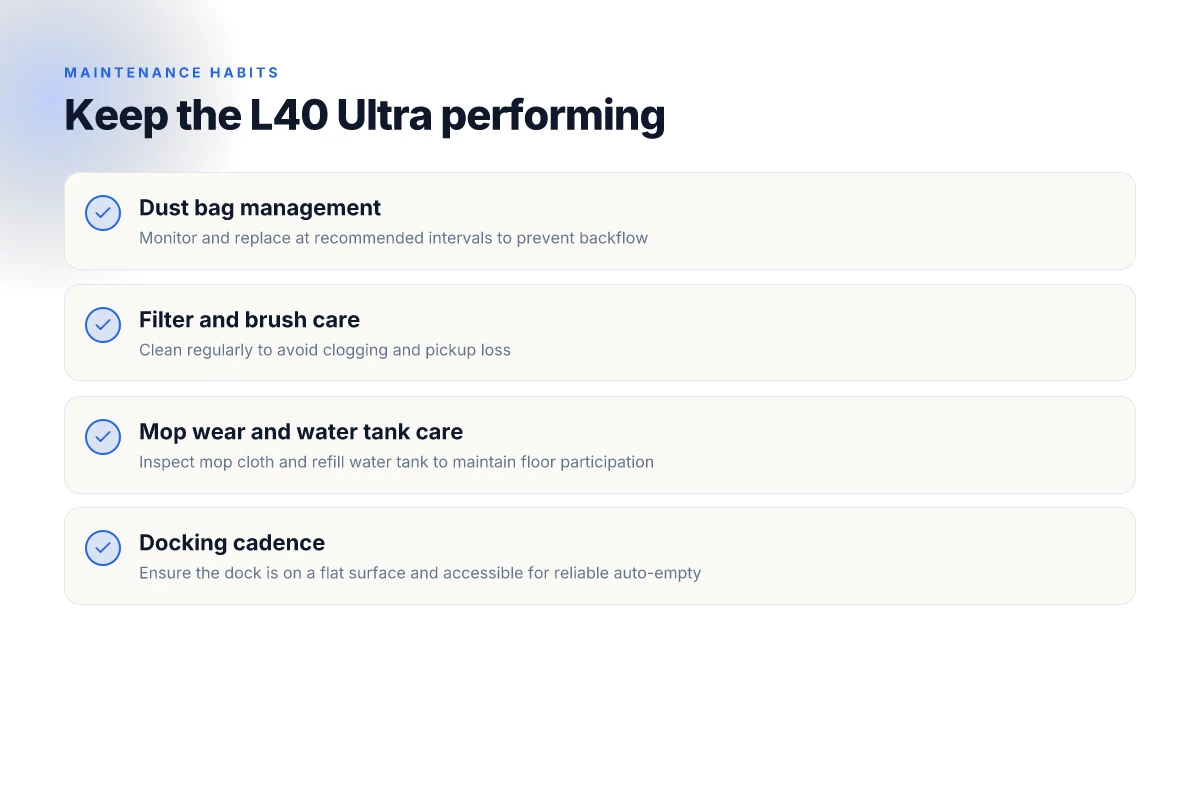
The L40 Ultra relies on a set of filters and rotating brushes that are susceptible to tangled hair and dust. I cross-referenced maintenance notes from Dreame and independent reviews to note that a quick wipe-down plus a light brush clean after every few cleaning cycles reduces clogging. Pay special attention to the main brush, side brushes, and the filter cartridge. A neglected filter can choke airflow, lowering suction and forcing the motor to work harder. Keep a small toolkit on hand for quick resets and hygiene checks, so you don’t skip the routine when life gets busy. Most clog-prone moments come from a neglected roller and dirty filters, not from a dud motor. Regularly inspect the main brush housing and remove hair before it tangles deeper.
2) Dust bag management and when to replace
Dreame markets the L40 Ultra with a hands-free auto-empty option and a sizable dust bag in the base. The practical reality is that the dust bag fills over time and can affect auto-empty performance if it’s too full. When you visually assess the bag or notice reduced volume in the dust chamber, replace the bag to keep the cycle smooth. I noted in user discussions and product literature that a 3.2L dust bag is common for this line, and keeping it fresh helps prevent backflow and odor issues. 75 days of hold time before emptying is a marketing figure for the auto-empty cadence, but in daily use you’ll want to monitor the bag and swap as needed to avoid jams.
3) Tips for mop wear and water tank care
The L40 Ultra’s mop mechanism benefits from regular water tank upkeep. Rinse the water tank after mopping sessions to prevent mineral buildup, and descalers or mild soap are discouraged unless the manufacturer specifies. I found that using clean, filtered water reduces mineral staining on floors and prolongs mop life. Inspect the mop cloth regularly for wear. A worn cloth reduces cleaning performance and can scratch delicate floors. If you notice streaking or reduced moisture delivery, replace or refresh the mop pad and check the water path for blockages. A small amount of routine maintenance here keeps mopping consistent and avoids spread of dirt rather than removal.
Overall, long-term reliability for the L40 Ultra comes from steady, repeatable routines rather than a one-off setup. Dreame products reward consistent care with consistent performance, especially in high-traffic homes. When you keep the filters clean, swap the dust bag as it fills, and refresh the mop components on schedule, you preserve suction, surface cleanliness, and overall longevity. The benefits compound over time: fewer jams, steadier auto-empty operation, and fewer disruptions to daily life.
From a maintenance perspective, these habits align with the brand’s emphasis on minimal downtime. For readers weighing rivals, the core idea remains the same: high-suction robots demand disciplined upkeep to avoid performance dips that marketing copy can gloss over. In real homes, a quick weekly check beats surprise downtime. Dreame remains a solid choice for owners who value straightforward upkeep and long-term reliability. What makes the Dreame X50 Ultra stand out in 2026
The real payoff is steady performance over months, not a miracle one-off clean. Regular care keeps the L40 Ultra in the rhythm you expect from a high-suction robot vacuum and mop.
What to watch as Dreame evolves this year
Dreame continues to push reliability with L40 Ultra longevity in mind, a pattern you’ll notice in real-world use as dust bin wear and sensor calibration hold up over time. The bigger leap is how the platform treats maintenance, with fewer flaky parts and clearer service pathways that matter when you rely on a robot daily. If you’re choosing between models, consider how a long-term owner would handle routine upkeep and software updates, not just initial suction power.
The single move that matters is adopting a routine check for the mopping module and its seals early on, since that area tends to show the first wear in mixed-floor homes. In practice, the L40 Ultra can feel surprisingly forgiving for busy households, yet rivals like Roborock and iRobot still pull ahead on certain map stability and app responsiveness. You’ll want to pick the option that aligns with your floors and cleaning cadence, not just raw specs.
If you want a forward-looking takeaway, plan for a future where firmware updates gradually sharpen navigation and battery efficiency rather than requiring a full replacement. The question to ask now: is your routine ready for a robot that learns from daily use?
- Backup strategy: schedule a quarterly check of brushes and seals, especially around the mop head
- What to try this week: run a mapping reset on a quiet weekend, compare map accuracy across rooms, and test edge cleaning in high-pile rugs
- What changes if you act now: expect smoother navigation with fewer hiccups after the next firmware push from Dreame