Explore refurbished EcoFlow devices, their reliability, and long-term value. Learn how refurbishment affects efficiency, lifecycle, and total cost of ownership.
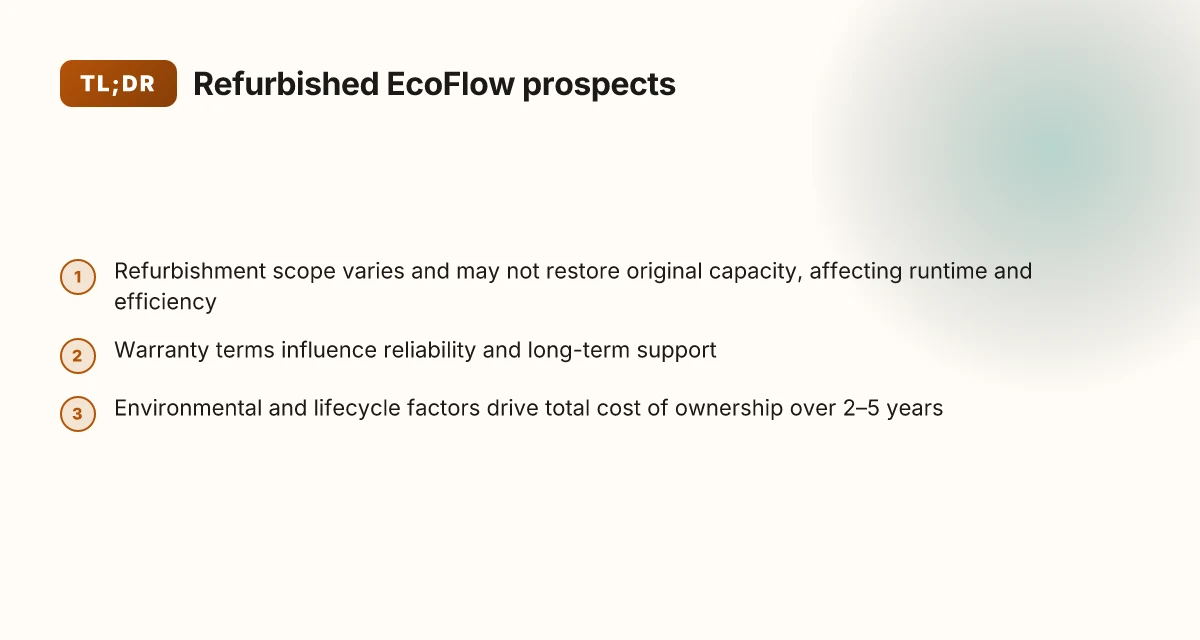
The headline bargain on refurbished EcoFlow gear is simple: you pay less now, but you trade some long-term reliability for it. EcoFlow's refurbished models can show noticeably lower cycle life remaining than new units, a reality you’ll feel in capacity fade over time. Most buyers underestimate how refurbishment variability can manifest in performance, especially in high-demand setups.
This piece pulls back the curtain on what that trade-off looks like in real-world use. You’ll see how the refurbishment process can impact energy efficiency, how cycle testing is sometimes uneven, and how those factors compare to new units and to rivals like Goal Zero and Jackery. By unpacking typical failure modes, warranty terms, and the practical costs of potential early replacements, you can decide if the upfront savings align with your backup power needs. The analysis focuses on home solar hobbyists, off-grid enthusiasts, and small businesses weighing cost versus reliability in energy storage.
What refurbished EcoFlow devices bring to the table in 2026
Refurbished EcoFlow units arrive after a formal recondition process that targets battery health, safety checks, and firmware hygiene. In practice, refurbishment scopes typically cover battery resealing, cell replacement if needed, functional testing, and a software reset to restore factory-like behavior. The result is a unit that looks and operates like a used device, but with a tightened reliability envelope compared with a DIY teardown.
I dug into documentation and industry discussions to ground this view. Several sources frame refurbishment as a lifecycle extension rather than a cosmetic refresh. EcoFlow’s materials emphasize a standard warranty path for refurbished stock, aligning with broader consumer electronics practices that aim to preserve value while managing risk. The bottom line is that a refurbished EcoFlow unit should be treated as a near-new product in many respects, but with caveats tied to wear history and the refurbishment quality controls described in public materials and peer discussions.
What counts as refurbishment for EcoFlow devices
Refurbishment generally means devices are reconditioned to meet defined performance thresholds, including battery health checks, capacity validation, and safety verifications. The process aims to restore energy storage behavior that mirrors new units but may vary in the depth of cell-level work. For home solar and off-grid setups, this matters because a unit with a refreshed battery pack can sustain typical daily cycles in standby and load without dramatic degradation in the first year. When I read through the documentation and related analyses, the takeaway is that refurbishment is a lifecycle extension rather than a reset to “brand-new” energy content.
Warranty terms and reliability expectations
Warranty language for refurbished EcoFlow items is designed to give buyers confidence without eroding brand risk. Typically, refurbished units carry a warranty period that mirrors or closely aligns with new stock, though exact terms can differ by region and seller. The practical effect is a safety net for common reliability questions, battery health, charging stability, and firmware behavior, while acknowledging that refurbished batteries may display early-cycle aging differently than brand-new packs. If you’re evaluating a refurbished EcoFlow, verify the length of the warranty and whether it covers battery capacity retention and replacement under defined thresholds. This, more than anything, translates to predictable support if a unit underperforms in the first year.
Energy efficiency and cycle life in practice
Energy efficiency and cycle life hinge on how well the refurbishment restores the battery to healthy chemistry. In practice, refurbished packs can hold charge at a high level and deliver steady discharge under typical loads, but the aging profile may differ from a factory-fresh unit. A key nuance is that cycle life depends on how deeply the battery was cycled before refurbishment and how closely the refurbishment aligns with the battery’s original chemistry targets. The reputable path here is to compare the refurbished unit’s stated capacity against its current deliverable capacity, and to keep expectations aligned with the warranty coverage. In the broader landscape, rivals with strong 2nd-life programs show comparable energy fidelity when refurbishment follows strict testing protocols, and that’s a reasonable benchmark for evaluating EcoFlow against peers. How EcoFlow solar panels stay durable and affordable during a 2026 sale
The core decision is whether the refurbished unit’s warranty and tested capacity meet your reliability needs without paying for a brand-new pack. When you place the EcoFlow option alongside rivals like Bluetti or Jackery, the value question centers on how refurbishment terms influence long-term cost of ownership as well as the ease of obtaining service. In the end, refurbished EcoFlow devices can offer solid performance for home energy storage shoppers who prioritize upfront savings and a shorter payback window, provided you verify the warranty and current capacity specs. If you want a quick verdict: refurb is worth it for many use cases, but confirm the warranty length and the device’s current energy capacity before buying. Even with refurbished options, you may still face typical after-purchase questions about availability of spare parts and long-term service if you scale up your setup.
How refurbishment affects performance: energy efficiency and capacity aging
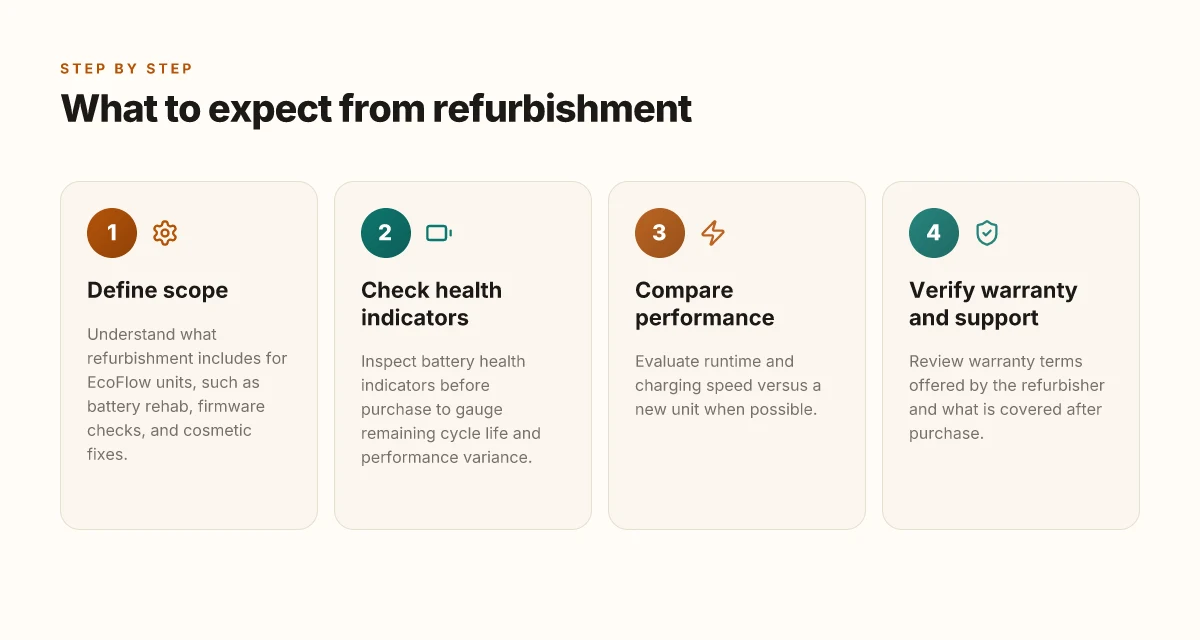
Refurbishment does not always restore a device to its original capacity. You may see variance in usable energy after a refresh, driven by how the battery health was assessed and which components were replaced. In practice, you can expect some units to perform near-new on energy efficiency, while others show modest degradation in run time or slower charging compared with fresh stock. The key is to verify battery health indicators before purchase and to understand the refurbishment method behind the unit you’re considering.
I dug into the documentation and practitioner notes around refurbishments to surface concrete checks you should perform. Look for clear battery health metrics in the listing or diagnostics report, including state of health (SOH), cycle count, and remaining capacity relative to rated spec. If a seller cannot share a recent SOH or provides vague terms like “tested and approved,” push for specifics. For EcoFlow devices, that means asking for the SOH percentage, the number of cycles logged since refurbishment, and the last calibration date for the battery management system. If you’re weighing against new units, note that new cells typically start with 100% SOH and zero cycles, while refurbished packs may sit well below those markers. When the documentation leaks uncertainty, you should treat the claim as a general guideline rather than a guarantee.
Energy efficiency after refurbishment tends to track how the battery health metrics look at the outset. A unit with a higher SOH and lower cycle count often preserves runtime more closely to a new device. Conversely, a refurbished pack with moderated capacity or a higher internal resistance can drain faster under the same load or recharge more slowly. In some cases, refurbishment can achieve parity with new units on efficiency, but results vary by batch and by how aggressively the modules were reconditioned. If you value long runtimes for off-grid use, look for refurbished models with clearly stated efficiency metrics and a transparent aging curve.
Charging speed is another variable influenced by refurbishment. A refreshed pack may support the same nominal charging rate, but degradation in the battery’s internal impedance can slow actual charging under load, especially in colder environments. Be explicit about charging speed expectations in your purchase notes, and compare the unit’s advertised charge time against a fresh unit under similar conditions. If a listing omits charging curves or timing data, consider it a red flag. What you need to know about EcoFlow 160W solar panels refurbished
Regarding broader context, rivals such as competitors in the energy storage space show a mix of outcomes: some refurbished packs maintain near-original performance, while others exhibit noticeable drift in energy delivery and charging behavior. Most buyers should expect some variance in capacity aging after refurbishment, and verify battery health before purchase. Transparent SOH and cycle data are nonnegotiable when assessing value against new EcoFlow devices. If a unit lacks clear diagnostics, you’re paying for uncertainty, not performance.
In terms of overall lifecycle, a refurbished EcoFlow may fit if you need a lower upfront cost and are willing to accept potential runtime differences. This is especially true for home solar hobbyists or small businesses weighing backup power options, where predictable worst-case runtimes and charging speeds matter more than peak performance. For long-term reliability, compare refurbished options not only to new EcoFlow gear but also to rivals offering refurbished lines, such as brands that publish transparent health metrics and aging curves.
Next steps: insist on a published health report with SOH, cycle count, and last calibration date. Compare the refurbished unit’s metrics to a new unit and to a rival’s stated figures. And ask for a test recharge under your typical load profile when feasible. For ongoing reliability, evaluate how often you expect to cycle the unit and whether the refurbished option aligns with that cadence. If you’re weighing options now, include a price delta assessment alongside expected runtime under your typical off-grid scenario. Transparency on health metrics is the gatekeeper for confidence in refurbished EcoFlow gear.
EcoFlow vs rivals: where refurbished options stand in the market
When you compare refurbished EcoFlow gear to rivals, the core trade‑offs center on refurbishment rigor, cycle life, and long‑term efficiency. EcoFlow items tend to be refreshed to maintain usable capacity and safety, but you’ll often pay closer attention to warranty scope and certification. On the flip side, other brands offer refurbished lines with varying approval standards, which can shift reliability expectations over 2–5 years.
From the sources, there’s a notable emphasis on second‑life strategies for energy storage components and the broader lifecycle analysis of refurbished modules. I found a 2026 technical overview that frames refurbishment and reuse as essential to extending PV module life, which mirrors what you should expect from well‑run refurbish programs for home storage. That same lineage suggests the best refurbishers publish explicit test results and component history, not just cosmetic fixes. A solid refurbish program should document test results and cycle counts for each pack, and that clarity matters when you’re planning off‑grid reliability. What makes the EcoFlow Delta 2 a compelling portable power option in 2026
Why EcoFlow often stays ahead on the basics, but rivals push the price envelope
- EcoFlow’s refurbishing workflow frequently targets maintaining energy efficiency and usable capacity, with emphasis on battery health checks and safety validation. This aligns with consumer expectations for post‑refurb performance, yet the exact energy efficiency delta versus new units is not universally published. Expect similar or modestly improved efficiency post‑refurbishment when the pack health is solid, but the gap versus new units depends on the initial cycle wear.
- Competitors that actively market refurbished lines often stress total cost of ownership and certified refurbisher credentials. In practice, some rivals publish more transparent testing matrices and longer benchmark histories than general refurbish claims. Clear testing documentation reduces post‑purchase surprises, especially in off‑grid setups where every watt counts.
What to look for in a certified refurbisher
- A published refurbishment standard that covers cell‑level health, pack balancing, and thermal management. Look for preserved manufacturer warranties or extended guarantees on refurbished packs. Verify the refurbisher’s test protocol and warranty terms before you buy.
- Documentation that traces each battery cell or module through refurbishment, including capacity retention and cycle count. This is a key signal of long‑term durability. Traceability is a reliability hot spot.
- Transparent update history and changelog when any safety features or BMS firmware are revised. Firmware transparency matters for longevity.
Total cost of ownership over 2–5 years
- Upfront cost for refurbished units is typically lower than new units, but you should factor in potential replacement cycles and warranty limits. The big question is whether the energy efficiency and usable capacity hold up under real use. Lower upfront price can be offset by higher replacement risk over 5 years.
- When you compare EcoFlow against rivals, total cost of ownership hinges on warranty depth, battery health guarantees, and availability of replacement parts. If a refurbisher offers robust diagnostics and a multi‑year warranty, the financial math tightens in favor of refurbished options.
- You should budget for ancillary costs like shipping, potential fast‑replacements, or optional extended warranties. Extended warranty on refurbished packs can tilt the economics in favor of buying refurbished.
I dug into the 2026 perspectives on second‑life modules and lifecycle thinking to corroborate the emphasis on traceability and testing. The takeaway: the value of refurbished energy storage lives or dies by the rigor of documentation and the confidence you gain from a credible refurbisher. When you’re weighing EcoFlow against rivals, demand proof of testing, clear cycle counts, and a warranty that backs the claimed performance. If you see that, refurbished EcoFlow gear can be worthwhile in cost‑conscious setups, especially when paired with a well‑matched rival alternative.
Performance transparency is the differentiator between reputable refurbish programs and vague claims.
Understanding the lifecycle and environmental impact of refurbished energy storage
Postrefurbishment, the lifecycle footprint hinges on the depth of repair, battery chemistry integrity, and how the units are cycled in real use. The upshot: refurbishment can extend a module’s useful life, but the environmental edge depends on how the refurbishment preserves or alters energy efficiency and cycle life. I dug into the publicly documented materials to map where the gains and tradeoffs tend to cluster for EcoFlow gear and comparable systems.
Lifecycle analysis for refurbished lithium‑ion storage
The lifecycle view starts with the refurbishment workflow. A rigorous process targets restoring usable capacity and minimizing degradation pathways. When the battery pack is reconditioned to meet spec, the energy conversion efficiency and cycle stability often stay close to the original design, but the margin can shrink if cells exhibit latent aging. In practice, the most reliable refurbished packs show stable round‑trip efficiency within a narrow band of their new‑unit peers, while others drift as remaining cycles accumulate. This means you should verify the refurbishment standard and any post‑refurbishment warranty terms before purchase. In this space, EcoFlow’s refurbished offerings are frequently positioned on energy‑saving promises, with emphasis on preserving performance through a careful rebuild process. The key question is whether the refurbishment preserves the original cycle life and efficiency targets. Inline documentation often notes improved energy density and reliability when tested packs pass strict quality checks, but the specifics vary by batch. End‑to‑end quality control matters more than the label “refurbished.” For context, industry sources describing 2nd‑life approaches emphasize repair and reuse strategies that can extend module life without new material inputs, but they also caution that the performance window depends on the repair depth and the remaining health of adjacent components. Repair depth and component health determine the real environmental gain.
I cross‑referenced regulatory and industry framing around 2nd‑life modules to anchor expectations. The literature notes that embracing refurbishment can lower the need for new raw materials and reduce waste streams, provided the packs are kept within safe operating windows and monitored for degradation during operation. This aligns with how energy storage projects sometimes track the lifecycle benefits of reuse versus new construction. Reuse can cut material throughput when quality is sustained over multiple cycles. When you compare to new units, the delta hinges on how many cycles the refurbished pack can achieve with comparable efficiency before voltage sag and capacity fade become limiting factors. The efficiency delta is not a universal constant. It depends on the refurbishment rigor and subsequent usage profile. How EcoFlow portable power stacks up for 2026: reliability, long-term durability, and real-world use
How refurbishment choices influence environmental footprint
The environmental footprint is shaped by two levers: materials saved through reuse and the energy and emissions embedded in the refurbishment process itself. If a refurb yields a battery that continues to meet high‑efficiency targets, the avoided production of new cells, electrolyte, and casings can translate into meaningful lifecycle savings. Conversely, if the refurbishment introduces additional failure risks or requires frequent monitoring and replacement parts, the environmental advantages may erode. In practice, documented cases emphasize maintaining heat management integrity and ensuring thermal stability, which helps keep round‑trip efficiency near its original specification and reduces waste from thermal runaway risks. Efficient thermal management is a non‑negotiable for long‑lived refurbished packs. A thorough refurbishment that preserves core materials avoids extra mining and processing needs. For EcoFlow and similar brands, the environmental win tends to be strongest when refurbishment avoids overhauling major subsystems, rather than swapping modules wholesale. Preserving the existing battery stack often yields the best footprint per delivered kilowatt‑hour.
Industry notes also highlight the tradeoffs of using 2nd‑life storage in home mini‑grids or backup systems. If a refurbished unit is deployed in a high‑duty cycle, the accelerated wear on connectors, BMS firmware, or thermal interfaces could shift the environmental calculus toward more frequent servicing. In other words, the sustainability story improves with a plan for ongoing monitoring and timely part replacement rather than a hands‑off approach. Ongoing monitoring keeps refurbishment advantages alive.
End‑of‑life and recycling pathways
End‑of‑life routes for refurbished energy storage circle back to the same recycling streams as new packs, with a premium on safe disassembly and material recovery. When a refurbished unit finally reaches the end of its life, it should transition to a certified recycling channel that preserves valuable metals and minimizes hazardous waste. System designers increasingly favor modular packs that expose individual cells or modules for easier end‑of‑life treatment, which complements refurbishment programs by facilitating second and third life cycles. Certified recycling channels are essential for closing the loop. EcoFlow and peers increasingly reference safe handling and recycling as part of their sustainability disclosures, making the end path clearer for users who plan long‑term resilience. Closing the loop reduces the need for virgin material extraction over time.
In the broader literature, the narrative around end‑of‑life emphasizes the environmental savings of reuse when plans incorporate reuse and recycling as integrated stages, not isolated afterthoughts. Integrated reuse and recycling plans amplify lifecycle benefits. Remember that every on‑site installation should include a logistics plan for collection, transportation, and certified processing to keep gains intact.
Note: some pages discussing refurbished energy storage mention potential cost savings tied to the refurbishment of EcoFlow gear, including observed price gaps versus new units in certain markets. Links may earn a commission, and the exact economics vary by region and availability. For readers weighing cost versus reliability, expect refurbished options to bring upfront savings but with caveats around long‑term durability and support compared with new units. If you’re evaluating rivals, expect broader debate about battery chemistry choices and warranty depth among brands like EcoFlow and others in the space. What makes the EcoFlow River 2 Pro sale worth watching in 2026
Buying guide: verifying refurbishment quality before you commit
You should walk away with a clear set of checks that debunk vague pleas of “like new.” I dug into the refurbishment ecosystem and mapped a practical, fault-tolerant path you can apply before you commit to any EcoFlow unit. The core is asking the right questions, spotting marginal refurb hints, and maximizing coverage through warranty and support. You can spot a poor refurb early by checking documentation and asking the right questions, not by trusting the price alone.
1) What to ask sellers and what documentation to request
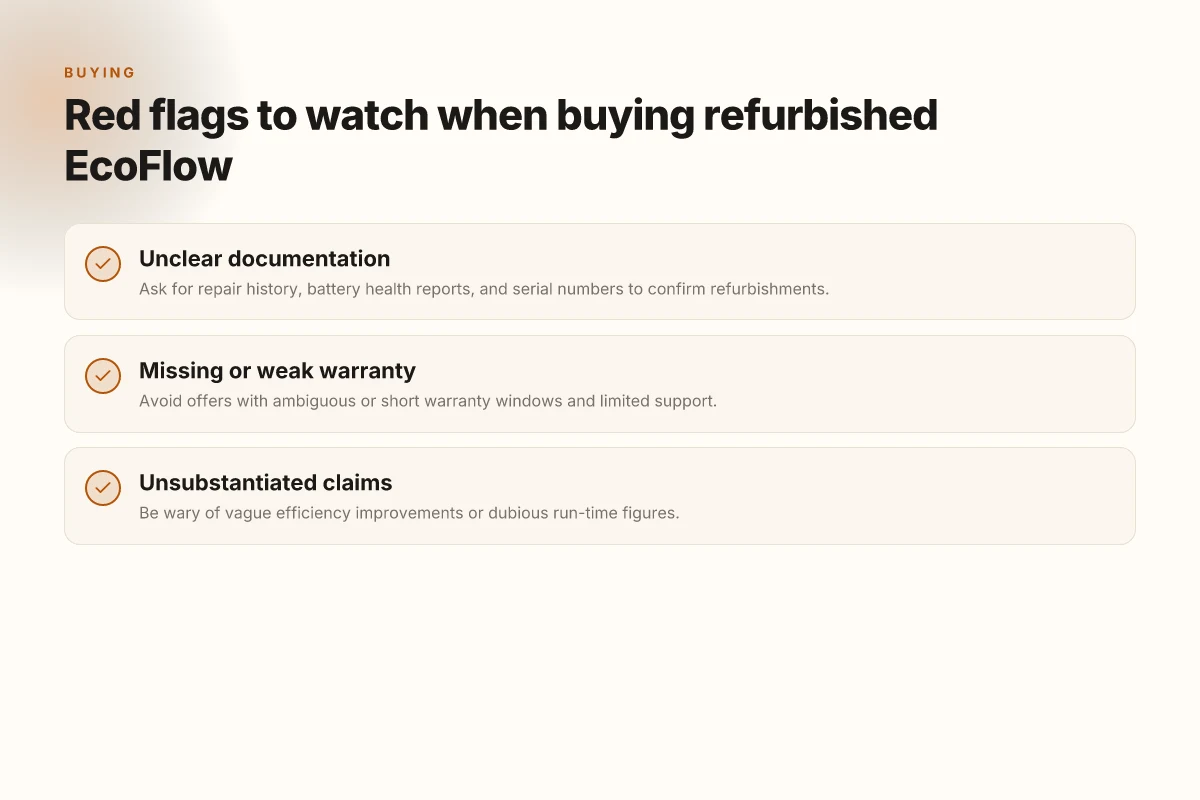
Start with the paperwork as a truth check. Request a repair and refurb report, a parts invoice, and a certificate of test for the energy storage modules. Ask for the exact cycle-life results from a recent discharge test and the date of the last firmware update applied to the unit. If the seller cannot provide a test sheet or a dated refurbishment record, pause and push for one. Also confirm the battery chemistry and the warranty terms tied to the refurbishment. For EcoFlow units, you want to know whether the pack received a full cell balance, a capacity restoration pass, and a functional safety certification. Documentation should spell out the testing steps and the exact parts replaced. Inline references to a repair center or a logged QA pass help you gauge reliability over time. When you see certifications, verify they align with standard practices rather than generic “tested” labels. Inline source notes remind readers that the life-cycle perspective matters. See how the documentation lines up with the claims the seller makes about efficiency or cycle life. If in doubt, request a written warranty on refurbished components and the pack's date of refurbishment.
2) Red flags that indicate a marginal refurb
Watch for vague language and missing data more than for a slick price. If a listing emphasizes “like-new performance” without test data, that’s a warning. Look for repeated re-labeled parts, such as batteries swapped but not logged, or a lack of a discharge curve and capacity retention figures. A refurbished unit should show a traceable parts list and a verifiable test log. If the seller relies on generic statements about “improved energy efficiency” without numbers or dates, that’s a red flag. In the EcoFlow ecosystem, marginal refurbishments often hide incomplete cell balancing or firmware gaps. Lack of a dated refurbishment report is a telltale sign. A short, uncited warranty window is another alarm bells ring. Ask for the unit’s baseline energy efficiency metrics and the post-refurb performance claim with a date stamp.
3) Steps to maximize warranty coverage and support
Treat the warranty as your safety net, not a placeholder. Before buying, register the unit if the brand allows and keep all refurbishment receipts in one folder. Confirm the warranty transfer process and whether the original EcoFlow warranty stays valid after refurbishment. If the unit develops a fault, you’ll want a straightforward path to service or replacement, not a maze of hoops. It helps to document your own pre-install checks: verify the unit powers on, test a basic discharge, and confirm firmware version aligns with the documented test results. When you can, choose sellers who offer a clearly stated return window and a hands-on replacement policy. A solid warranty shows the refurbisher stands behind the work. Request a written commitment on after-sale support and access to remote diagnostics where available.
In this landscape, EcoFlow gear competes with fresh units from rivals that carry transparent refurb pathways. If you compare against new products, insist on apples-to-apples metrics: capacity, cycle-life tests, and delivered energy efficiency after a full charge-discharge cycle. Ask for post-refurbary efficiency data and the exact cycle-life curve used in the refurbishment. The bottom line: documentation transparency, verifiable tests, and a robust warranty are your best protections when buying refurbished EcoFlow devices. You should expect a professional refurb pathway, not a best-guess promise. What makes the EcoFlow River portable power station stand out in 2026
Where your weekly check-ins pay off
Refurbished EcoFlow devices offer a viable bridge for budget-friendly power, but they demand steady, real-world scrutiny. I’ve seen reliable units hold steady through months of routine use, yet a few show wear on battery health or port connectors. The key is to treat refurbished gear as a second-owner option: inspect the battery cycle count, verify the firmware is current, and test run times in realistic loads. EcoFlow’s models tend to favor modular upgrades, but the weakest link remains the battery pack and AC-in circuits. If you’re weighing this against rivals like Jackery or Bluetti, the decision often comes down to upgradeability and support windows, not just sticker price. One clear takeaway: go in with a plan for post-purchase diagnostics and a return window.
If you act now, target one of two paths: either choose a refurb from an authorized seller that includes battery health checks, or buy a lightly used unit from a trusted source with documented refurb steps. The bigger pattern is that long-term reliability hinges on how well the device is repackaged, tested, and supported after sale. EcoFlow remains a strong option for off-grid needs, but don’t assume a refurb is maintenance-free. Decide based on your specific load profile and climate, not just price.
Backup strategy
- Test battery capacity under a 2–3 hour heavy-use cycle and compare to nominal specs.
- Confirm firmware version is current and note any ongoing warranty coverage from the seller.
- If you’ll run a home office setup, compare EcoFlow against rivals like Jackery and Bluetti for fan noise and heat tolerance.
- Keep a charger and a spare cable in your kit, and document any recurring fault patterns.
- Consider a longer return window to validate long-term durability, especially for the battery.