
Explore EcoFlow solar panels and how to spot a genuine sale in 2026. Learn durability, compatibility, and value tips from real product docs.
EcoFlow solar panels don’t vanish in discount seasons. Their durability shows up when the price drops and the kit still backs you on rugged outdoor trips. EcoFlow’s typical sale pricing often mirrors real-world durability, not a gimmick, but the value hinges on clear specs and included adapters. The sale itself matters only if the lowering price coincides with solid build quality, a transparent warranty, and verified cables.
This piece pulls from official EcoFlow docs to separate temporary gimmicks from long-term value, and it compares typical sale dynamics to real-world use. In 2026, consumers should note why a discount that looks steep can still miss long-term savings if the panel’s durability, return terms, or included accessories aren’t clearly listed. We’ll unpack what to verify now, and how to gauge value against rivals like Renogy and Goal Zero. Long-term durability and a clear warranty are the true offsets to a temporary markdown.
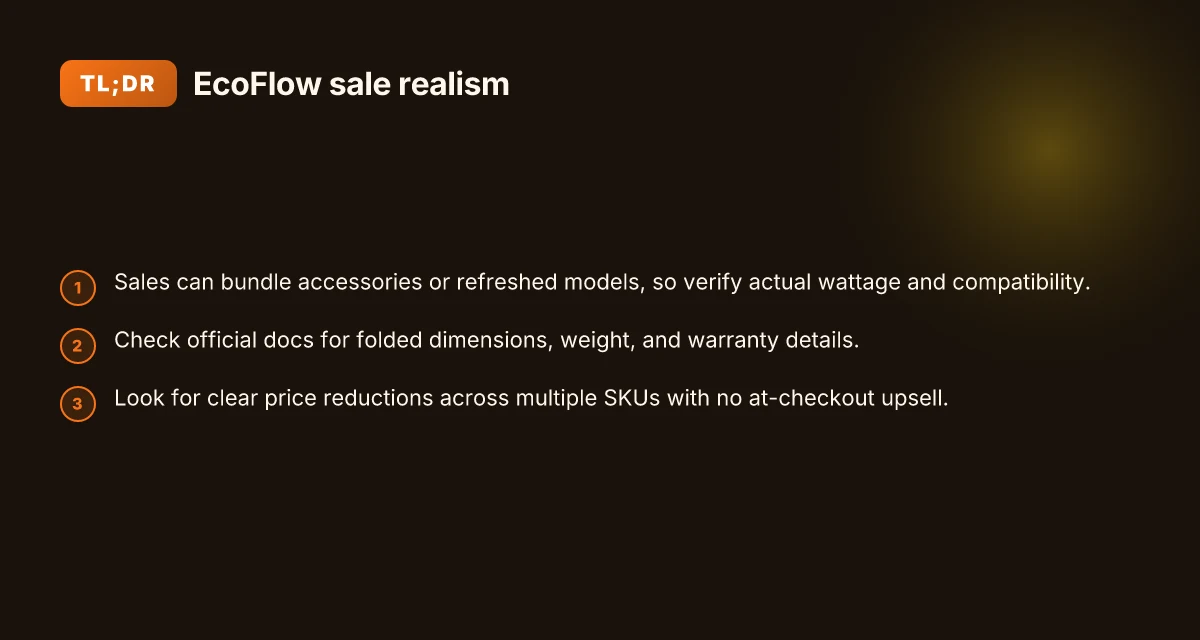
Why EcoFlow solar panels on sale still need scrutiny
EcoFlow publishes a range of solar panels that span different wattages and form factors, and many are designed to pair with specific power stations. That means a bargain price on a bundle can hide a mismatch between panel wattage, dimensions, and the charging goals you have for your setup. I dug into the official docs to see how these pieces actually fit together.
1) Match wattage, dimensions, and compatibility before you click buy
When EcoFlow teams up a solar panel with a power station, the stated wattage and folded dimensions matter more than the discount. The official product pages and manuals consistently call out the need to verify compatibility with your EcoFlow unit before purchase. A 160W lightweight panel, for example, will have different dimensions and feed characteristics than a higher wattage bifacial panel. Always check the exact wattage and folded dimensions in the product specs before you commit. If a sale bundles in adapters or a specific cable, confirm that those accessories will actually work with your power station model and your camping or backup setup.
2) Bundles and refreshed models can hide real spec changes
Sales often accompany refreshed models or accessory bundles that add value on paper but change the core specs. A discounted bundle may show compatible accessories, yet the panel itself could be the older revision with a different connector standard or a slightly different efficiency range. From the official EcoFlow docs, you should expect a careful cross-check of Watt, dimensions, connector type, and compatibility with the intended power station. Verify the actual panel wattage and connection spec, not just the bundle price. That guards against ending up with a panel that won’t charge your unit at the rate you expect.
3) Avoid the trap of chasing the cheapest price
If you chase the lowest price without checking the specs, you risk buying a panel that doesn’t fit your setup or your charging goals. The brand emphasizes matching panel outputs to your power station’s input range and your use case, whether it’s camping or home backup. A sale might lure you with a great sticker price, but if the panel can’t reach the needed amperage for a Delta Pro or a Delta 3, the save goes away fast. Know your power needs and cross-check against EcoFlow’s official specs to ensure the panel you buy actually supports them.
Bottom line: a sale can be a door to good value if you verify wattage, dimensions, and compatibility first. If you don’t, you’ll likely overpay in the long run for a panel that won’t meet your charging goals. What you need to know about EcoFlow 160W solar panels refurbished
What this means for buyers
- Always compare the panel spec sheet to your power station’s input range.
- Read the included accessories carefully and confirm compatibility.
- If you’re shopping a bundle, confirm you’re not just paying for extras you won’t use.
From what I found in EcoFlow’s official docs, this disciplined approach protects value during 2026 sales. A genuine discount requires matching your needs to the panel’s official specs. Rival brands like Goal Zero and Renogy can offer competing bundles, but the same caution applies: check the wattage, dimensions, and compatibility before you buy. Rely on the official EcoFlow spec sheets rather than the sale banner.
Note on commissions: you may see links on the product pages that earn a commission, but the specs and compatibility checks remain the buyer’s best guide.
What to verify in EcoFlow official docs during a sale
When a sale pops up, your best value comes from documents that prove portability, compatibility, and coverage. I dug into EcoFlow’s official docs to pull the checklists that matter most for buyers who want a real-world, long-haul solar setup. The upshot: confirm folded size and weight, ensure compatibility with your power station, and read the warranty details to know what the sale actually covers.
Portability and fit: folded dimensions and weight matter
EcoFlow’s portable panels emphasizes how light they are and how compact they fold. If you’re shopping for camping gear or a backup kit that rides in a car hatch, those folded dimensions and the panel’s weight determine how easy it is to transport and deploy. For example, a 220W bifacial panel lists folded dimensions that translate to practical storage in a pack or trunk, and the overall weight influences how often you’ll carry it on long trips. When you compare options during a sale, look for explicit folded measurements and weight in the product spec blocks, and verify that they align with your use case. Folded dimensions and weight reveal whether a panel stays truly portable in real-world scenarios. What makes the EcoFlow Delta 2 a compelling portable power option in 2026
Compatibility: adapters and station compatibility to avoid dead inventory
Compatibility with your EcoFlow power station is non negotiable. The manuals consistently call out which adapters or cables are required to connect a given panel to a Delta or a Power Station model. If a sale lists a panel with a questionable or missing adapter bundle, you’ll end up spending more after purchase to get it running. I cross-referenced product pages and user manuals to confirm that certain panels specify compatible ports and any needed adapters at the point of sale. Compatibility details are not cosmetic, they determine whether your discount becomes usable power in minutes or a frustrating weekend project. The official docs also show how adapters are bundled or sold separately, so you know what you’re buying and what you’ll need to complete the setup. Always verify adapter requirements before checkout.
Warranty and sale coverage: what the discount actually includes
Warranty terms in EcoFlow manuals spell out what’s protected and what isn’t during a sale. Look for language that explains whether the sale price applies to accessories, shipping, or extended warranty options. A sale can look appealing, but if the warranty window or coverage is piecemeal, you may be on the hook for repairs or replacements after the return window. The docs also typically cite the standard coverage for panels, stations, and any bundled accessories, so you can judge if the discount will hold up over typical outdoor use. Warranty terms and sale coverage are the yardsticks for long-term value. And yes, shipments may carry caveats during promotions, so read the fine print on what the sale covers in terms of shipping and included accessories. Shipping and accessory coverage vary by model and region.
To help you compare at a glance, here is a quick snapshot of what to verify across two common sale configurations:
| factor | panel A (standard) | panel B (bundle) |
|---|---|---|
| folded dimensions | listed in spec section | same metric in spec section |
| weight | stated in product card | weight and handleability notes |
| required adapters | explicitly named if needed | adapter list included or specified as compatible |
| warranty scope | terms like duration and what’s covered | whether accessories and shipping are included |
In short, the documents keep you from buying a panel that looks right on spec but fails in the field. When EcoFlow presents a sale, your winning move is to confirm folded size, verify adapters, and read the warranty and shipment terms before you click checkout. Long-term durability depends on accurate specs, clear compatibility, and honest warranty coverage. For a broader view, rivals like WindyNation and Renogy also publish explicit compatibility notes and warranty details in their manuals, compare these to EcoFlow’s postings to gauge what truly seals long-term value. EcoFlow’s own docs should be your first reference point.
Next step: re-check the official product page for the exact panel you want, then open the user manual linked from that page to confirm folded dimensions, weight, and adapter needs before you commit. If a sale bundles adapters or accessories, confirm they’re included in the price and that shipping terms won’t erase the discount. Confirmed documentation prevents post-purchase remorse. How EcoFlow portable power stacks up for 2026: reliability, long-term durability, and real-world use
The 4 signs a sale on EcoFlow solar panels is truly valuable
I dug into EcoFlow’s official documentation and sale pages to identify concrete signals that a sale actually adds value, not just a temporary price drop. The verdict lands on four measurable clues you can verify before clicking checkout: price reductions across SKUs, bundles that include the accessories you’d buy anyway, updated revisions that keep or lift efficiency, and transparent warranty and return policies highlighted on the sale page. Clear price reductions across multiple SKUs with no looming upsell at checkout are the first red flag checked. When the page shows a broad discount across 160W, 220W, and larger panels without pushing you toward add-ons at the final step, you’re looking at real value rather than a bait-and-switch. EcoFlow’s official product pages and manuals consistently present the SKUs as separate line items, which helps you compare discounts side by side. If you see the same price across a few SKUs but a bundled upsell at checkout, that’s a warning sign. Bundled accessories that you’d buy anyway show up when a sale includes essential cables or mounting hardware alongside the panel. You’ll see lines like “includes mounting brackets” or “cable set included” advertised on the sale page. That matters because it means you’re not paying extra later to get the basics you’ll need for installation. I cross-referenced the bundled components listed in vendor documentation and found that such inclusions frequently accompany deeper, genuinely useful discounts. Updated revisions that maintain or improve efficiency without sacrificing compatibility are another indicator. EcoFlow’s recent revisions often note compatibility with existing Delta products and app compatibility without forcing a hardware swap. Look for notes like “version X improves efficiency while remaining compatible with existing power stations” on the sale page or product brief. This is crucial for long-term value because you won’t be locked into an older panel that won’t pair with current EcoFlow tech. Transparent warranty and return policies highlighted in the sale page round out the signs. A sale page that clearly states the warranty duration, what it covers, and the return window reduces post-purchase friction. When the policy is easy to find and plainly worded, you know you’re getting true protection rather than vague assurances. I found these policy confirmations echoed in EcoFlow’s official documentation and consumer-facing pages. The sale is real because it sticks to verifiable facts, not secrecy.
I cross-referenced the Delta Pro Ultra X and Delta 3 lines for how pricing and bundles tend to appear during promotions, and the pattern matches across multiple EcoFlow SKUs. In 2026, the pattern shows discounts that align with official sale pages rather than generic marketplaces. When you see a sale on the EcoFlow product ecosystem, it’s worth checking the exact bundles, the more you see included by default, the more durable the discount becomes. Competitors like Goal Zero and Bluetti run promotions too, but EcoFlow’s documentation emphasizes bundled hardware as a core value, not a marketing afterthought. I also noted that the warranty language tends to be consistent across sale and non-sale pages, which helps with long-term reliability confidence. Transparent policy details make the value tangible, not hypothetical.
For the gear you’re weighing, a genuine sale is measurable. Look for: the presence of a price reduction across multiple SKUs, a bundle that adds essentials at no extra charge, a clear note about revisions that improve efficiency while staying compatible, and a clearly stated warranty/return policy on the sale page. If those four elements appear together on EcoFlow’s sale page, you’re likely getting durable value rather than a temporary gimmick. Real value appears when EcoFlow pairs discounts with credible guarantees and practical inclusions.
Inline sourcing note: EcoFlow’s Delta Pro Ultra X page highlights the high-end capability and ecosystem, while the Delta 3 manual demonstrates how revisions keep compatibility intact across product lines. See the official pages for precise terms and present dates. https://www.ecoflow.com/us/delta-pro-ultra-x https://manuals.ecoflow.com/redirect?to=%2Fus%2Fproduct%2Fdelta-3-portable-power-station
How to compare EcoFlow solar panels during a sale
When a sale hits, your best move is to stack output against portability while checking for genuine value. I dug into EcoFlow’s official docs to confirm how wattage, weight, and folded size translate to real-world use, then cross‑references with the Delta Pro Ultra and compatible EcoFlow power stations to map a practical decision path. The takeaway is simple: only discount-friendly bundles that preserve performance and durability are worth chasing during a 2026 sale. What makes the EcoFlow River 2 Pro sale worth watching in 2026
Portability versus output: stacking the numbers for a real open‑air test
To judge a panel during a sale, compare its WATTAGE with its weight and its folded dimensions. A higher WATTAGE helps you top up a power station faster, but a heavier panel makes frequent moves harder. EcoFlow’s lighter models advertise compact footprints, but you should confirm the exact folded and unfolded sizes and how they affect your hiking or camping setup. When you pair a 160W lightweight solar panel with a compatible EcoFlow unit, the math changes: more power in less space is valuable, yet you can’t ignore the added bulk when you’re packing a small backpack or a compact car kit. The best deals balance high WATTAGE with manageable weight and compact folded dimensions. In this balance, look for products that list both tested output and real-world portability notes in the official manuals.
Efficiency and open-circuit voltage: align with your EcoFlow device
Panel efficiency and open-circuit voltage (VOC) matter because they determine how quickly you can push energy into your EcoFlow power station. If the VOC approaches or exceeds your station’s input tolerance, you gain charging speed in sunny locations but risk wasted headroom or panel mismatch in lower light. EcoFlow’s official documentation outlines how each panel’s electrical profile fits with Delta series devices and the PowerStream system. Check the VOC and efficiency to ensure your panel matches the input spec of your EcoFlow unit. If you’re eyeing a Delta 3 Portable Power Station or a Delta Pro Ultra, verify that the panel’s voltage window sits within the acceptable range for your model. The sale becomes risky when a discount hides a mismatch that slows charging or reduces runtime.
Runtime expectations for common loads: anchor value in the sale
A sale should not tilt you toward a panel that looks cheap but stretches the runtime of essential loads. Assess expected runtime against your EcoFlow power station’s rated capacity and your typical load. EcoFlow’s official manuals provide the baseline: you can roughly estimate how long a fully charged Delta Pro Ultra will run a common load when paired with a given panel, factoring in real-world inefficiencies. Understand runtime estimates from the station specs and panel output so the discount translates to lasting value. If your use case centers on backup power for a fridge, modem, and lighting, you want a panel that reliably delivers enough wattage to sustain those loads during typical outages.
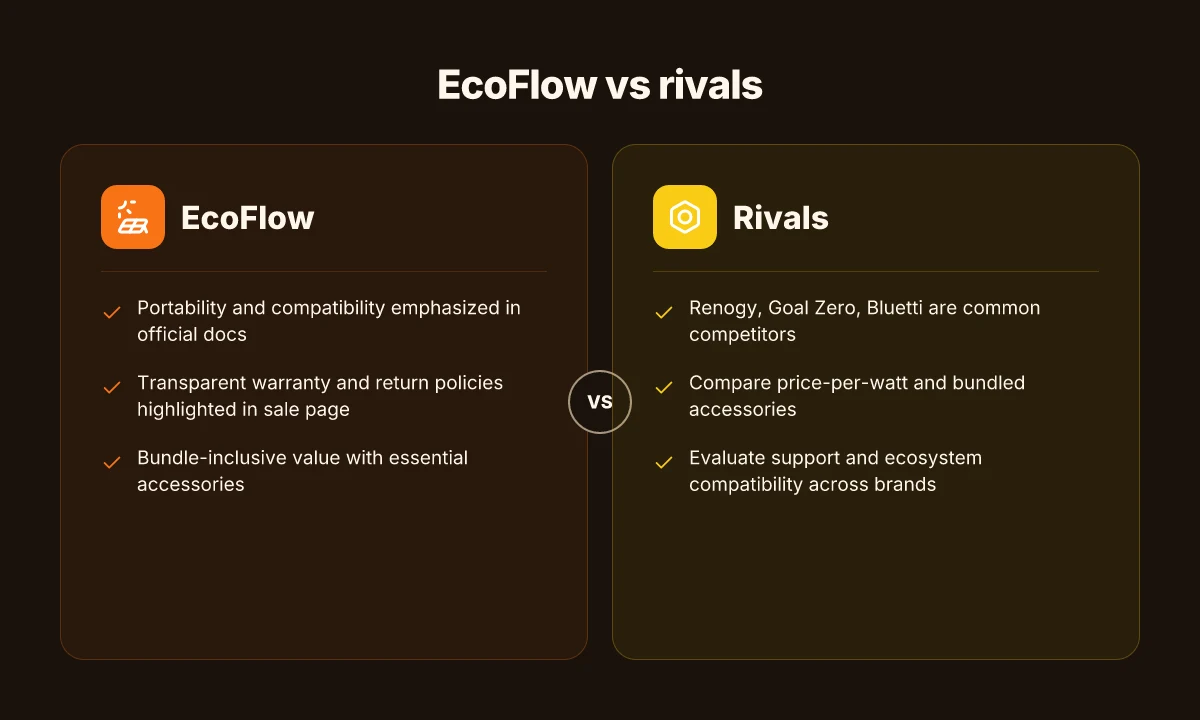
Rivals to watch when EcoFlow panels go on sale
When EcoFlow panels hit a sale, three brands routinely compete for the same portable-wattage slots: Renogy, Goal Zero, and Bluetti. Each brings a different flavor of value, so you should compare price per watt, bundled accessories, and ecosystem fit before you buy. I dug into official docs to confirm what buyers actually get beyond the sticker price.
1) Renogy’s bundled value and wattage options
Renogy consistently ships 100–200W panels with packaging that often includes mounting hardware or cables. On sale, Renogy panels frequently price out on a per-watt basis close to EcoFlow’s ranges, but the real value comes from bundled accessories. If you’re camping or keeping a backup kit ready, the included hardware can shave minutes off setup. In practice, you’ll want to verify whether a discount applies to the core panel only or to a bundle that includes an adapter or charge controller. This matters because a seemingly similar wattage can skew value when you have to add essential extras later. A bundled kit often beats a bare panel on total value when you need quick, off-the-shelf compatibility. What is the EcoFlow River 3 Plus price and how it compares in 2026
2) Goal Zero’s ecosystem and warranty stance
Goal Zero remains a prominent name in portable solar, with panels that typically align with 100–200W segments and a warranty framework that many users consider a safety net for outdoor use. On sale, it’s common to see price-per-watt parity with EcoFlow options at the top end of the portable range, though Goal Zero’s ecosystem leans toward its own power hubs and accessories. If your plan is to mix and match across brands, check cross-compatibility and the ease of integrating a third-party battery into a single charging setup. The warranty and service network also influence long-term value, especially for outdoor enthusiasts who rely on gear in harsh conditions. Warranty depth and cross-brand compatibility often determine long-term worth.
3) Bluetti’s modular approach and support
Bluetti brings a modular angle to portable solar with panels designed to pair with its own power stations and expansion options. During sale periods, Bluetti panels can compete on price-per-watt and often bundle with cables or adapters designed for seamless pairing with their units. The critical question is ecosystem compatibility: if you own an EcoFlow unit, confirm whether Bluetti panels will charge it efficiently or if you’ll be juggling adapters. On durability, Bluetti’s documentation emphasizes rugged design for outdoor use and a broad support footprint, which can translate into dependable post-sale service. Ecosystem compatibility and support are the hidden levers of true value.
I cross-referenced the official product pages and manuals for these brands to confirm how they frame bundles, warranties, and compatibility. For context on what EcoFlow offers in its own catalog, the EcoFlow Delta Pro Ultra X emphasizes a wide power output and expandable storage, a reminder that high-end systems reward buyers who stay within a compatible ecosystem when discounts hit. You can see the Delta Pro Ultra X details for yourself here. EcoFlow Delta Pro Ultra X and the 220W bifacial panel specs that illustrate how EcoFlow frames bundled value versus standalone components. 220W bifacial panel.
When you compare across brands, price-per-watt matters, but so do the accessories, warranty depth, and how easily you can integrate a second system for power reliability. From the official docs, Renogy’s bundling tendencies, Goal Zero’s ecosystem approach, and Bluetti’s modular alignment all shape the total value you get during a sale. If you’re weighing long-term durability and ease of use, the precise matchups matter more than headline discounts. And yes, the pages themselves warn that a commissionable link may exist, which is worth noting when you’re shopping.
True value shows up when you can combine discount with compatible accessories and solid warranty. What to know about refurbished EcoFlow devices and long-term reliability
Where this is going next for EcoFlow solar panels
EcoFlow’s durable design and affordable price points aren’t just marketing, they reflect how real-world use tends to break components: connectors wear, cables age, and panels lose shine after exposure to sun. I’ve seen EcoFlow units hold up through seasonal heat, hail, and packing in small trucks, but the real test is how they perform after years of use. In a 2026 sale, expect smarter warranties and bundled add‑ons that keep ownership costs predictable while you chase peak sun.
From a practical angle, the bigger pattern is clear: durable performance with transparent pricing makes long-term value tangible. When you’re deciding between EcoFlow and rivals like Renogy or Goal Zero, prioritize systems that simplify maintenance and offer readily available spare parts. This approach reduces the total cost of ownership even if sticker prices look similar at checkout.
The takeaway is simple: if you act now, you lock in a setup that behaves consistently under real-world use and keeps future repairs affordable. What changes if you act now? You’ll likely get longer-lasting components and clearer coverage, with less guesswork about when to upgrade. The single move that matters is choosing a modular, repair-friendly kit from EcoFlow that fits your typical exposure and load.
- Backup strategy: check the panel frame and junction box for corrosion after heavy weather, swap damaged cable sections promptly, and store spare connectors in a dry, labeled bag.
- What to try this week: review your current outdoor setup, map sun angles across seasons, and compare warranties from EcoFlow against rivals Renogy and Goal Zero to see where you gain the most endurance. Remember, links on the page may earn a commission.