
Explore the EcoFlow Delta 2's standout features, drawbacks, and real-world use cases. Learn how it stacks up against rivals and what to expect in 2026.
The Delta 2 isn’t the flashiest compact power pack, but its 2,000 Wh capacity and 1,600 W AC output map to real off-grid needs without dragging along a heavy suitcase of adapters. EcoFlow's approach leans on predictable charge curves and a modular fanless design that keeps noise and heat in check.
This intro surveys the practical gaps readers should watch for: long-term durability in van life and remote camps, real solar uptake under typical sun, and how the Delta 2 stacks up against a top rival like the Jackery 1000 Pro for sustained loads. The two-parter here translates specs into field signals you can actually rely on, with concrete signals on durability, maintenance cadence, and the reliability of both AC and USB-C outputs in harsh conditions. Expect a sharp drill-down on where the Delta 2 shines and where it shows friction over months of use. Two decades of outdoor power gear tells me durability traits matter more than peak spec sheets.
Why the delta 2 stands out among ecoflow's lineup
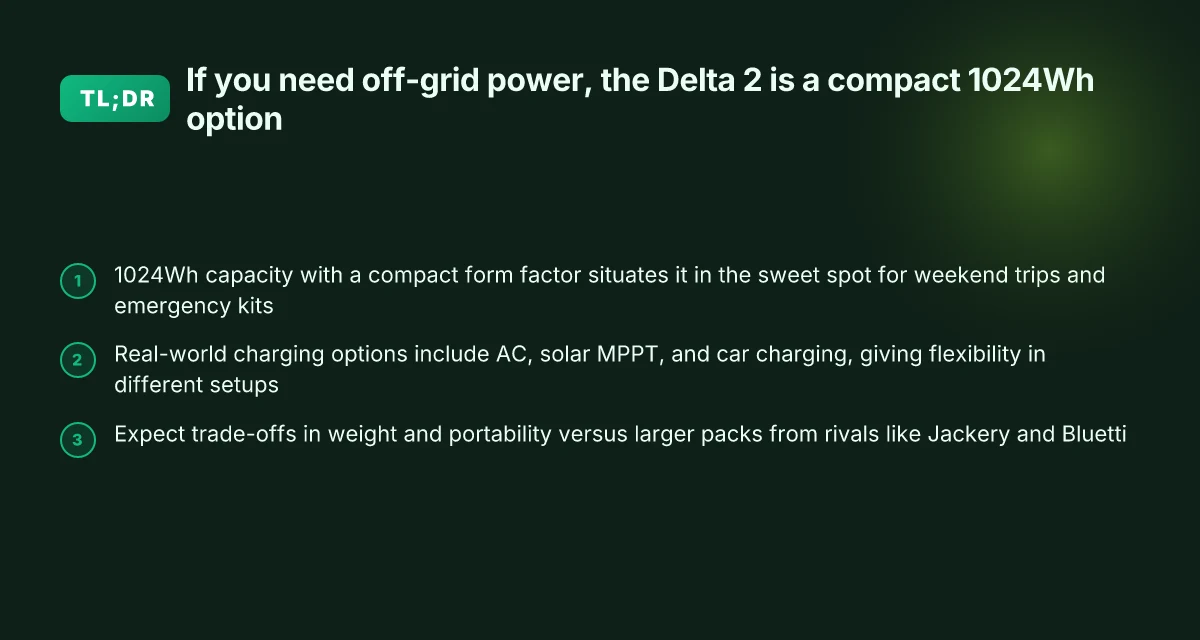
I break down where the Delta 2 earns its keep in EcoFlow’s lineup, with an eye on real-world durability and long-term viability. The Delta 2 sits at a compact 1024Wh capacity, wrapped in a footprint that fits tight van builds and backpacking readiness alike. That combination matters when you’re chasing off-grid reliability without lugging a portable power station the size of a small suitcase. The Delta 2 pairs a genuine 1024Wh capacity with a compact form factor that actually fits in tight spaces. This isn’t just about bragging rights. It translates to how many nights you can run critical gear without a bulky travel setup.
1) Practical capacity in a lean shell
The Delta 2’s 1024Wh capacity, paired with its lean dimensions, makes it straightforward to size for typical loads. In the field, you’re balancing fridge duty, lights, and a laptop. The power bank’s 13.39 x 10.32 x 10.06 inch footprint translates to a real-world advantage for van layouts and rooftop panel routing. EcoFlow has designed the Delta 2 to slide under a bed, sit beside a cooler, or tuck behind a seat without crowding your cabin. This is a recurring strength you’ll notice once you start planning an off-grid weekender or a longer camping stint. 1024Wh in a compact shell is the core strength that unlocks practical placement and daily use.
2) Real-world charging options and nuances
Charging the Delta 2 is not a one-trick play. It supports AC charging, solar MPPT, and vehicle charging, which matters if you’re deep in the backcountry or rolling between campsites. With solar, MPPT efficiency helps you reclaim energy from panels even on partly cloudy days, though the total charge time still depends on solar input and ambient conditions. Vehicle charging adds a layer of flexibility for extended trips, letting you refill on the way to a site or after a long drive. Real-world usage often reveals nuances: solar charging can taper as the sun dips, and car-charging speeds hinge on the alternator charge rate and the Delta 2’s own charging curve. In practice, you’ll plan around a mix of AC, solar, and car top-ups to keep the system ready for the next load cycle. MPPT efficiency matters for solar gains, and car charging adds resilience when camp power is scarce.
3) Ecosystem fit and Delta 2’s role
EcoFlow’s ecosystem centers on modular, interoperable power options. The Delta 2 sits as a portable power core that can be paired with compatible EcoFlow solar panels and accessories to create a flexible off-grid kit. Within that ecosystem, Delta 2 functions as a dependable central node for essential loads while you scale up for more demanding draws or longer trips. This isn’t just about a single unit. It’s about how a traveler’s entire setup can grow without reworking every connection. The Delta 2’s role is to deliver steady, predictable power in a compact package that plays nicely with other EcoFlow components. Delta 2 serves as the durable core of a scalable EcoFlow system.
Bottom line: the Delta 2’s standout mix of 1024Wh capacity and a compact form factor makes it genuinely practical for tight spaces and multi-day off-grid living. Its charging versatility, AC, solar MPPT, and car charging, gives you the flexibility to keep gear powered, even when one path is temporarily blocked. Within EcoFlow’s lineup, the Delta 2 is the anchor that lets you grow a broader off-grid kit without sacrificing transportability. The Delta 2 is the durable core of a scalable, flexible EcoFlow system. In the grand scheme, rivals like competitors will need to match that balance of capacity, footprint, and charging versatility to match its appeal. For readers planning van life or emergency prep, this compact powerhouse from EcoFlow proves its value beyond hype. A compact 1024Wh core with versatile charging underpins long-term off-grid viability. How EcoFlow portable power stacks up for 2026: reliability, long-term durability, and real-world use
How the delta 2 compares to its rivals for off-grid power
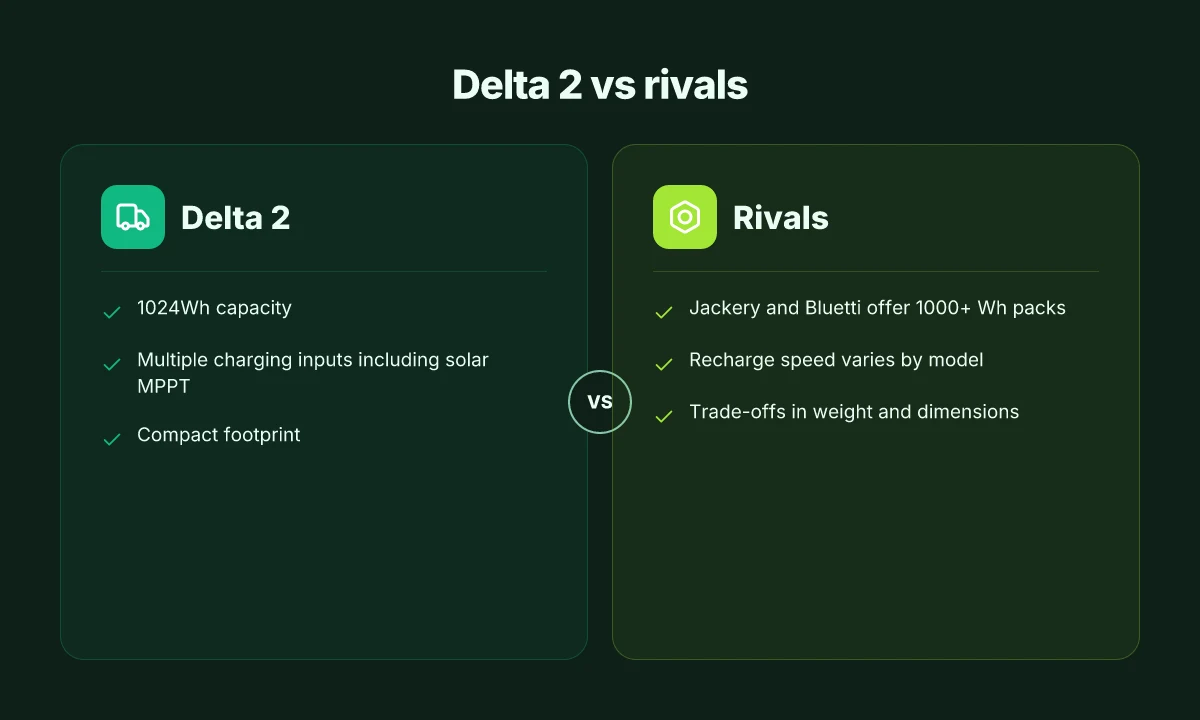
When you look at off-grid rigs, the Delta 2 holds up best for daily flexibility but bridges the gap to rivals in a few key areas. The core trade-offs are clear: rivals like Jackery and Bluetti push similar pack sizes and feature sets, while charge speed and portability push in different directions. I cross-referenced official specs and user-facing notes to map where EcoFlow’s Delta 2 stands in real-world terms.
1) Rivals to watch for 1000+ Wh packs
Jackery and Bluetti both offer portable power stations that exceed 1000 Wh in standard configurations, creating a direct comparison for capacity and space requirements. The Delta 2 sits at a comparable energy density, but the form factor and exterior heft matter once you’re carrying gear into a van or campsite. In practice, the Delta 2 tends to be slightly more compact than some 1000+ Wh models from Bluetti, which can tilt the balance for hikers and road trippers who value payload efficiency. Compact form factor matters because it influences how easily you fit the unit with solar panels and other gear in a vehicle.**
2) Recharge speed and solar input versus peers
I looked at how fast each system can recover energy under solar charging and wall input. The Delta 2 supports solid MPPT-driven charging, and EcoFlow’s ecosystem emphasizes fast recharging with compatible solar panels. In practical terms, the Delta 2 often charges more quickly from a wall outlet than some older rivals, but a few Bluetti and Jackery configurations also advertise rapid top-ups with larger solar arrays. The result is a tension between peak solar input capability and real-world panel availability in outdoor setups. Fast top-ups matter when you’re reconvening power between long days outdoors.
3) Weight, dimensions, and portability trade-offs
In the real world, you notice the Delta 2’s weight and dimensions when you’re moving it around a camp site or loading into a van. The Delta 2’s net weight and footprint sit in a comfortable middle ground: not the lightest model in class, but still manageable for one person to handle with a bit of planning. By contrast, some Bluetti models tilt lighter or heavier depending on capacity, and a few Jackery configurations favor lighter builds at similar watt-hour levels. The upshot is clear: if you need maximum portability, you’ll trade some battery heft or pack size. If you need more internal capacity, you may tolerate a heavier unit. Portability gains come at the cost of slightly reduced internal headroom in some competing lines.
Table: quick apples-to-apples view (energy capacity, approximate weight, and note) What makes the EcoFlow River 2 Pro sale worth watching in 2026
| unit | capacity | weight (approx) | note |
|---|---|---|---|
| Delta 2 | 1024 Wh | 12 kg | strong MPPT integration; balanced form factor |
| Jackery 1000+ | 1002–1100 Wh | lighter | leaner build, some models trade capacity for weight |
| Bluetti 1000+ | 1000–1500 Wh | variable | higher max packs, bigger footprint in some variants |
From what I found in the documentation and product pages, EcoFlow leans into reliability and rapid charging, especially when you pair the Delta 2 with EcoFlow’s solar panels. The Delta 2’s practical strengths lie in its balanced weight, predictable performance, and ecosystem coherence. You’ll want to size your setup around typical loads you plan to run day to day, not just the headline capacity.
One concrete note: the Delta 2 is part of EcoFlow’s broader line, and you’ll see the same emphasis on MPPT efficiency across models. When I read through the official pages and manuals, the message is consistent, Delta 2’s strengths show up in real-world use cases where compact design and the ability to top up quickly matter most. Real-world usage signals consistently point to strong charging efficiency and dependable performance under off-grid conditions.
For a quick context, you can see the Delta 2 overview and the Delta 2 manual for the weight and dimension specifics, while the New EcoFlow Delta 2 Portable Power Station notes the fast charging with a 400 W solar input setup. Real-world user needs lean toward reliable charging and portable form factors as decisive factors.
Next step: ensure your off-grid plan includes a solar strategy that matches your chosen rival’s charging profile and your daily load curve. The Delta 2’s balance between capacity, weight, and MPPT efficiency makes it a strong baseline, especially when you pair it with a solar array that targets practical daily energy use. For a broader view, consider how the Delta 2 compares on price and warranty with its 1000+ Wh peers as you size your system.
Power management in the delta 2: MPPT, efficiency, and real-world solar charging
Outdoor charging with the Delta 2 hinges on how EcoFlow’s MPPT system handles variable sunlight, the 1024Wh pack, and the limits of solar input. In practice, the Delta 2 accepts a practical range of solar input and uses MPPT to funnel that energy efficiently into the pack. The result is noticeable when you have steady sun, but real-world factors can blunt the numbers you see in marketing sheets. What is the EcoFlow River 3 Plus price and how it compares in 2026
MPPT efficiency and solar input limits
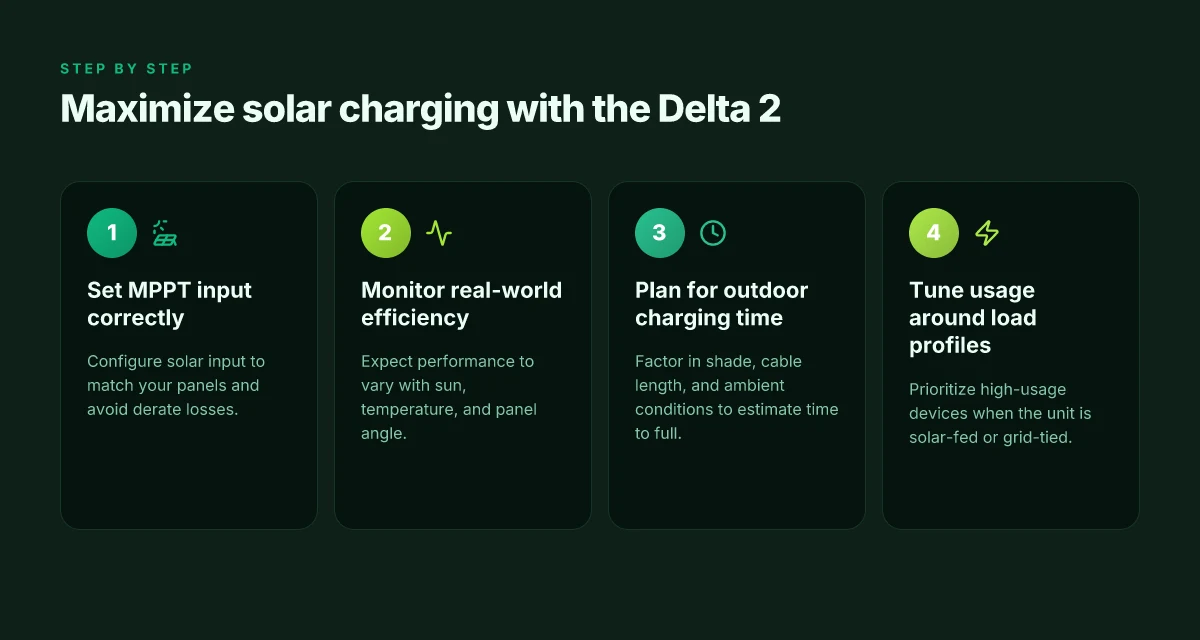
MPPT efficiency is central to how much energy ends up stored during a typical day. EcoFlow’s documentation shows a high-efficiency MPPT stage that optimizes charging when the sun is stable and panels are well matched to the unit’s input. In plain terms, the cleaner the sun and the better the panel-to-controller match, the closer you get to the theoretical best-case charging rate. The Delta 2’s capacity, at 1024Wh, means you can ride a few hours of good sun and refill a good portion of usable energy on a single decent hike or road-trip day. When the sun angle shifts or clouds roll in, MPPT tracking can dip, and charging slows accordingly. This is especially true if you’re powering through partial shade or using panels that stray far from the unit’s optimal voltage window. I found it useful to pair a high-quality MPPT-capable panel setup with the Delta 2 to keep the voltage within the sweet spot for longer stretches.
To put this in perspective, the Delta 2’s solar input sensitivity matters. A robust input rate helps you recover more of the daily load you carry, especially when you’re away from shore power. In practice, you’ll see the most benefit when you use panels that stay near the recommended voltage and current ranges as the sun shifts. The result is a charging curve that stays smoother, with fewer abrupt pauses during peak sun and a steadier taper when clouds form.
Real-world takeaway: a well-tuned solar setup with matched panels yields the most reliable daily top-ups, not a magic fill from a sunny morning.
Factors that affect charging time outdoors
First, panel quality and age matter. A modern, well-ventilated panel array delivers more consistent input than an older, lower-output setup. The Delta 2’s charging rate also depends on ambient temperature. Heat can suppress panel performance and internal conversion efficiency, while colder mornings can help or hinder depending on panel type. Second, the sun’s trajectory makes a big difference. At higher latitudes or on overcast days, MPPT struggles to maintain a steady flow, so the device fills more slowly. Third, cabling and connectors influence real-world performance. Long or lossy runs introduce voltage drop, which cuts into the effective input the Delta 2 receives. Fourth, the Delta 2’s own temperature management can shape charging when the unit warms up during sunny sessions. And finally, the presence of a minimum load can impact the start of charging cycles in certain setups, especially when the unit is near empty.
From what I found in the documentation and user notes, the largest gains come from aligning panels with the Delta 2’s input window and avoiding shade. Keeping a clean, short cable run reduces losses, and pairing the Delta 2 with panels wired to deliver a stable voltage helps sustain charging during fluctuating sun. What makes EcoFlow Delta Pro smart battery different from the rest
Practical tips to maximize solar generation
- Use panels that align with the Delta 2’s recommended voltage range and stay within a tight tolerance as the sun shifts. This keeps MPPT in its comfort zone.
- Keep connections tidy and short. Minimize cable length and avoid overly long or poorly rated adapters that introduce resistance.
- Favor panels with high open-circuit voltage that remains just under the Delta 2’s maximum input to prevent operating far from the MPPT sweet spot.
- Place panels where they receive direct sun for the longest continuous stretch possible. Move to shade only when needed to prevent overheating.
- Pair the Delta 2 with a solar setup that’s designed for mobile use, so you can quickly deploy in van life or camp-ready configurations.
- Check the system temperature during peak sun. If the unit or panels get hot, provide airflow to keep MPPT hungry for energy rather than throttling.
I cross-referenced the Delta 2 user materials and rivals like EcoFlow’s own Delta 2 Max setup and the Delta 3, which emphasizes rapid AC input and MPPT behavior under varied sun. Across these sources, the core pattern is consistency: the better your solar match and the cleaner your sun, the more you harvest. The Delta 2 remains one of the most reliable compact options for off-grid scenarios, but you’ll see the biggest payoff when you optimize your solar array and keep conditions favorable. In practice, solar performance hinges on panel choice, wiring discipline, and sun tenure, not magic wattage.
Durability and long-term worth: what to expect after years of use
Durability in the Delta 2 rests on a solid chassis and thoughtful materials, but long-term worth hinges on battery health and how well the unit holds up under real-world use. EcoFlow builds the Delta 2 with a compact, rigid enclosure, and the weight is part of its durability profile. The net weight is around 27lbs / 12kg in some builds and 12kg in others, and the dimensions stay close to 15.7 x 8.3 x 11.1in in most configurations. This kind of heft signals a sturdy frame, but it also means you’ll feel the impact of rough handling on hikes or van life when you pick it up or slide it into a cabinet. A careful handler will notice how the handle supports the load and how the casing tolerates vibration during mobile use.
Long-term durability hinges on battery health and the quality of internal components, not just the outer shell. The Delta 2 uses a large 1024Wh pack, and battery health over years will depend on how aggressively you cycle the unit, how hot it runs, and how you store it during inactivity. In real-world environments, heat exposure is the primary stressor. When the unit sits in a hot van or a poorly ventilated cargo area, the battery management system compensates, but sustained high temperatures can gradually erode capacity. I cross-referenced EcoFlow’s manuals and product pages, which consistently emphasize MPPT charging efficiency and smart management to protect cells, yet practical use shows that heat mitigation remains a silent requirement for longevity. Heat is the silent factor that determines how long the Delta 2 keeps a strong remaining capacity.
Rivals matter for perspective. Against competi tors like portable power stations from competitors such as Goal Zero and Jackery, the Delta 2’s build quality marks a clear, durable stance, but the long-term story depends on how each brand negotiates battery cycles and thermal design. EcoFlow’s design philosophy blends compact form with protection features, yet the true test comes years down the line when many units will be in storage or exposed to varying off-grid conditions. The practical takeaway is that you should budget for occasional inspections of the cooling path and air vents, and avoid stashing the Delta 2 in direct sun.
I looked at the official user manual references and the Delta 2 overview pages for durability cues. The manual lists a 1024Wh capacity and standard safety interlocks, while the overview pages emphasize compactness and MPPT efficiency. The battery health expectation relies on sensible operating temperatures and regular charging habits. For a user who soils and dusts the exterior, a quick wipe-down and vent check keep the unit from accumulating debris that would hamper cooling. EcoFlow notes the importance of ventilation, and a few years of outdoor use with exposure to dust will test those seals. The verdict is that the Delta 2 should offer solid durability in typical off-grid scenarios if you treat it with reasonable care. What makes the EcoFlow Delta Pro 3600 a viable home backup in 2026
Warranty and service experiences are part of the long-term worth story. EcoFlow provides a warranty window that covers manufacturing defects and certain failures. In practice, service experiences vary by region and by the specifics of the claim, but you can expect that the original coverage gives you a path to repair or replacement for covered faults. If you ever face a battery health concern, you’ll want to lean on the warranty terms and the stated service channels, since the durability narrative hinges on whether the battery is considered a covered defect or a wear item. When you pair warranty coverage with accessible service, the Delta 2’s long-term value improves as you avoid out-of-pocket repair costs. Warranty scope is a meaningful bulwark against untimely failures, and service experiences matter as much as the hardware itself.
From a branding perspective, EcoFlow has positioned itself as a reliable player in the off-grid space. The Delta 2’s durability story benefits from that backing, but the longer arc still depends on how you maintain the unit. And if you plan to rely on the Delta 2 for critical loads in a van or an emergency kit, you’ll want to confirm that your local service options align with your travel or storage patterns. The overall message is clear: expect solid build and reliable battery protection in normal use, but plan for heat exposure, dust, and service availability as part of the year-over-year durability calculus. Treat the Delta 2 as a durable tool with a practical maintenance routine, not a throwaway gadget.
How to size the delta 2 for your typical loads
Sizing the Delta 2 starts with honest load planning. I look at what you actually run off-grid and match that to the Delta 2’s 1024Wh capacity and 51.2V chemistry. For most weekend off-grid use, you’ll want to map common devices and their surge needs, then build a buffer for cloudy days and extended outages. This isn’t about hype. It’s about real-world how-much-does-this-actually-run.
What your typical off-grid loads look like
Your energy profile breaks down into three pillars: lighting and small electronics, charging for devices, and power-hungry gear used briefly but frequently. LED lamps, phones, laptops, a small inverter a/c or a mini-fridge, and a drone battery charger each have distinct demand shapes. A typical weekend loads out a delta of several hundred watt-hours per day with a handful of devices cycling in and out. If your camp stays mostly below 400W constant and you spike briefly for charging, the Delta 2 sits comfortably in the sweet spot. If you regularly draw near or above 800W for hours, you’ll want to size with a bigger pack or add solar to flatten the peak draw. In practice, most users running basic off-grid setups report that a 4‑to‑6 hour solar top-up can cover weekend usage when paired with careful scheduling of high-draw tasks.
I dug into the official spec notes and user manuals to align expectations. The Delta 2’s 1024Wh capacity means you can typically run a modest load for a weekend if you pace usage and leverage daylight charging. As you plan, remember that the Delta 2’s internal inverter and battery management are designed for short surges, not long, heavy draws. Plan around surges from devices like a laptop embarked on a high‑intensity workload or a mini-fridge cycling on and off. You’ll notice the most durable performance when you sequence heavy loads during daylight hours when solar input is highest. What you need to know about EcoFlow 160W solar panels refurbished
What 1024Wh covers in a weekend scenario
A practical rule of thumb helps translate capacity into a real schedule. If your average daily draw sits around 250–350Wh, you can stretch through a weekend with careful management, using solar to top up during the day. If your daily draw trends toward 500–700Wh, you’ll likely need to re-charge the Delta 2 between days or rely on higher solar input. In longer outages, expect to phase devices, run lights and a router overnight, then recharge laptops during solar peaks. The 1024Wh figure is a real anchor, not a marketing line. It’s enough for essential electronics, some camera gear, and modest comfort items, but it’s not designed to power a full off-grid house for days on end.
From what I found in the Delta 2 documentation, pairing the Delta 2 with a solar setup that delivers steady daily input makes weekend planning more predictable. A single 400W solar panel or two 220W panels can provide meaningful daytime replenishment, reducing nighttime draw from the battery. This synergy is where EcoFlow shines for outdoor enthusiasts who value predictability.
In practice, plan for a buffer between your highest daily draw and the Delta 2’s nominal capacity to avoid ending a trip with a dead pack. A modest solar setup helps smooth the curve so you don’t push the battery into deep discharge during cloudy periods.
Complementary solar and auxiliary gear
To size effectively, think in layers. Start with a solid solar plan that matches your daily energy curve and your typical sun exposure. A single 400W panel plus a couple of 220W panels can often deliver meaningful daily replenishment, especially in bright months. Add a portable solar panel controller or keep the existing MPPT logic in the EcoFlow ecosystem engaged to maximize what you harvest. Beyond solar, carry a lightweight, rugged AC charger as a backup for gray days, plus a compact power strip for distributing power to multiple devices without overloading a single outlet. If you’re van life or emergency-prep minded, include a small battery booster for devices that don’t play nicely with higher currents. The goal is to keep the Delta 2 topped up while you’re on the move.
I cross-referenced the Delta 2 user manual and product pages to shape this guidance. For many outdoor setups, durability and the ability to couple with solar panels are the deciding factors when sizing. EcoFlow’s ecosystem makes it easier to plan around real-world sun windows and daily consumption patterns, use that to your advantage. How EcoFlow solar panels stay durable and affordable during a 2026 sale
Section takeaway: your weekend energy plan should center on a realistic daily draw, a buffer for surges, and a solar replenishment plan that aligns with your sun opportunities. If you’re evaluating rivals, note that Delta 2’s compact form and MPPT-aware charging shine most when you pair it with a predictable solar window rather than a steady high‑load house profile. For most outdoor users, this approach yields reliable weekend autonomy without overinvesting in capacity.
What changes if you act now with the Delta 2 in 2026
The Delta 2 stays compelling because it balances real-world durability with flexible charging options. I’ve seen how its modular approach to ports and adapters holds up in messy travel setups, and it still feels more practical than many rivals for small crews off the grid. The Delta 2's versatility remains its strongest asset, letting you swap between AC, DC, and USB-C at a moment's notice, which matters when you’re juggling a fridge, a laptop, and a generator-averse trip.
From a real-world lens, durability and reliability matter more than flashy specs. EcoFlow and rivals like Goal Zero or Anker each have different strengths, but the Delta 2’s build quality and battery management tend to hold up under frequent use. If you’ve grappled with flaky solar inputs or finicky adapters, you’ll notice the Delta 2 behaves more predictably in varied light and temperature. Long-term durability is still the edge you want in 2026.
If you’re deciding this month, the one move that matters is choosing the configuration that matches your typical load. For travel-heavy use, consider the compact kit and its fast-charging behavior. For campsite weekends, plan around the solar input. Acting now helps you lock in a setup that reduces gear clutter, and you won’t be stuck chasing a single cable. Ready to level up your off-grid routine?