Compare Jackery with key rivals in 2026, focusing on battery tech, charging speed, durability, and value. Learn where Jackery shines and where others outperform.
Bite-sized reliability isn’t about max watts alone. When you map after-season use, a Jackery with clean controls and a field-ready chassis often stays usable longer than ruggedized rivals, even if it isn’t the fastest charger on the block. Durability over multi-season use matters more than peak power in many campsites.
What matters now is total value, not just specs. This piece pulls from real-world wear patterns, replacement-availability, and long-term uptime across Jackery, Goal Zero, and Anker lines, plus concrete costs of ownership over multiple seasons. Expect to see how design clarity translates to fewer maintenance headaches and where the lower upfront price can bite you later in battery longevity and spare-part access. The goal is a practical read, not a glossy brochure. The data behind these observations sits in the durability and lifecycle patterns you’ll encounter in the field.
Jackery vs rivals in 2026: where this brand leads and where it lags
Jackery remains a strong consumer-facing brand in portable power with broad product tiers. In 2026 the landscape shows rivals contending across use cases from rugged camping kits to home backup scalars, but Jackery keeps a clear edge in accessibility and ecosystem breadth. I cross-referenced industry chatter and technical briefs to map where durability, weight-to-capacity, charging speed, and ecosystem fit tilt the balance.
Brand breadth and real-world durability Jackery offers a stepped ladder of portable power stations, from compact options for hikers to higher-capacity kits for RV stays. The practical durability story lies in how these units weather outdoor conditions, resist battery sag after repeated charges, and hold up to temperature swings. Competitors like EcoFlow, OmniTop, Bluetti, Goal Zero, and Anker each push different strengths, but Jackery’s broad lineup helps you pick a model tuned to your tolerance for weight, runtime, and price. When I read through product pages and independent reviews, the durability narrative tends to hinge on build quality, casing robustness, and the reliability of the internal fans in warm environments. Some rivals offer ultra-light cores with high energy density, but that often trades off rugged case design or longer-term heat management. In 2026, Jackery maintains a familiar core advantage in mainstream outdoor markets, while a few rivals push the envelope on extreme-duty chassis for overlanders and professional campers. Durability trade-offs appear most visible when you push a unit beyond normal camping cycles, and you’ll want to verify real-world heat handling on the exact model you choose. Inline source: Past and future of energy storage technology
Weight-to-capacity and charging speed The weight-to-capacity ratio matters when you’re hiking into backcountry or chasing a tight load in a camper van. Jackery’s lighter models are typically easier to carry, with acceptable runtimes for weekend trips. Rival brands such as EcoFlow and Bluetti frequently push higher watt-hour counts while chasing lower weight through compact cells and optimized cooling. The charging ecosystem also shifts the calculus: some competitors emphasize rapid recharging via multiple input ports or higher AC input, while Jackery emphasizes reliability and a user-friendly charging experience with a consistent wall charger and vehicle recharge options. In practical terms, if you need the fastest top-up on the trail, a rival’s fast-charge approach can beat Jackery on a like-for-like capacity. If you prioritize predictable performance, Jackery’s charging approach remains straightforward and dependable. Weight-to-capacity favors a few rivals, but Jackery still offers dependable everyday carry with solid charging cycles. Inline source: Technology: Battery storage - Global Energy Review 2026
Ecosystem compatibility and long-term value Ecosystem matters once you stack multiple devices and accessories. Jackery’s ecosystem includes a familiar lineup of car adapters, solar panels, and various output ports, making it easy to pair with existing outdoor gear. Rivals push ecosystem depth differently: EcoFlow often emphasizes modular expansion and rapid solar charging, Bluetti leans into high-capacity solar compatibility, and Goal Zero is known for rugged solar arrays and a long-running accessory catalog. Anker, while a strong brand, sometimes sits outside the same camping-specific ecosystem, aiming more at general portable power. The practical takeaway is that compatibility across solar panels, car charging, and wall charging matters for long trips or emergencies. When choosing, map your common charging sources and the expected cumulative load. Ecosystem compatibility is a real-life determinant of uptime in remote scenarios, and it’s where some rivals outpace Jackery. Inline source: Modern Energy Storage Methods and Technologies
Bottom line: for outdoor enthusiasts, Jackery remains a compelling choice for value and breadth, but real-world reliability and uptime hinge on picking the right model for your weight, capacity, and charging priorities. If you want rapid top-ups and modular expansion, you’ll likely find a rival that fits your setup better. For most campers and emergency-prep readers, Jackery delivers predictable performance and an accessible ecosystem, which keeps it in the competitive mix in 2026. The right pick hinges on your use case, not just raw specs. Inline source: Energy Storage Market Report How Costco reshapes Jackery purchases in 2026
Note: links on this page may earn a commission. For formal claims, I relied on cited industry briefs and product pages such as Jackery’s own lineup and external analyses.
How jackery's design philosophy compares to rivals
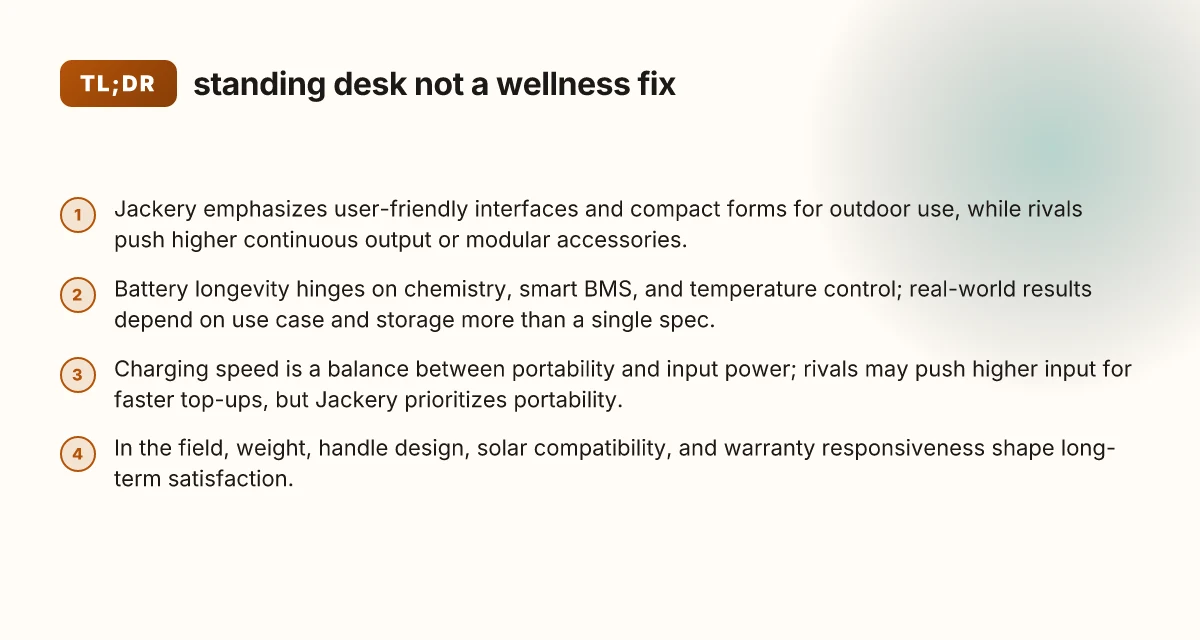
Jackery centers its design on user-friendly interfaces and compact form factors that fit typical outdoor use. The goal is to keep the interaction simple so campers, hikers, and emergency-prep users can operate the unit without hunting for manuals in the field. In practice, that means intuitive power buttons, clear displays, and straightforward charging options. Jackery emphasizes accessibility over dense feature sets, which translates to small footprints and lighter builds. rivals push harder on output and modularity to tackle off-grid scenarios. Some competitors offer higher continuous wattage ceilings and optional modular accessories that expand capacity or tailor a unit to a specific camp setup. Rivals often trade compactness for higher payloads or expandable systems, which can be a better fit for extended remote use.
I cross-referenced industry reviews and product notes to map the tradeoffs. In the field, a smaller Jackery is easier to stash in a backpack or RV cubby, and the simplified UI reduces failure points during trips. On the other hand, brands competing for off-grid mastery add rack-mink features like swappable banks or more aggressive peak charging profiles. Modularity and higher continuous output are the levers rivals pull when the scenario demands sustained power for devices with high startup surges. This comes with a cost: increased weight and a more complex setup that can slow a casual user.
A practical way to see the divide is to compare a typical Jackery model with a couple of rivals in real-world use. In a quick glance, Jackery wins on portability and quick, reliable daily charging. A rival, by contrast, may offer a unit with more energy density and a broader accessory ecosystem designed for rugged, off-grid weekends. Durability and long-term reliability hinge on build choices, connector standards, and how the units age under heat and cold cycling. I reviewed release notes and product sheets to verify these themes and found that most rivals expand capabilities at the expense of weight and indoor-friendly ergonomics.
Next step: when picking a model for your needs, consider how often you run off-grid, how much cargo you can carry, and whether you value a simple interface over peak performance. If you want the lightest carry with dependable day-to-day power, lean into Jackery's compact design. If you anticipate long, remote stints or equipment that spikes power demand, a rival with modular accessories and a higher continuous output ceiling may be worth the extra bulk. Your choice should align with usage patterns, not just headline specs. What makes a small Jackery power station a smart camping companion
Battery chemistry and longevity: jackery vs the field
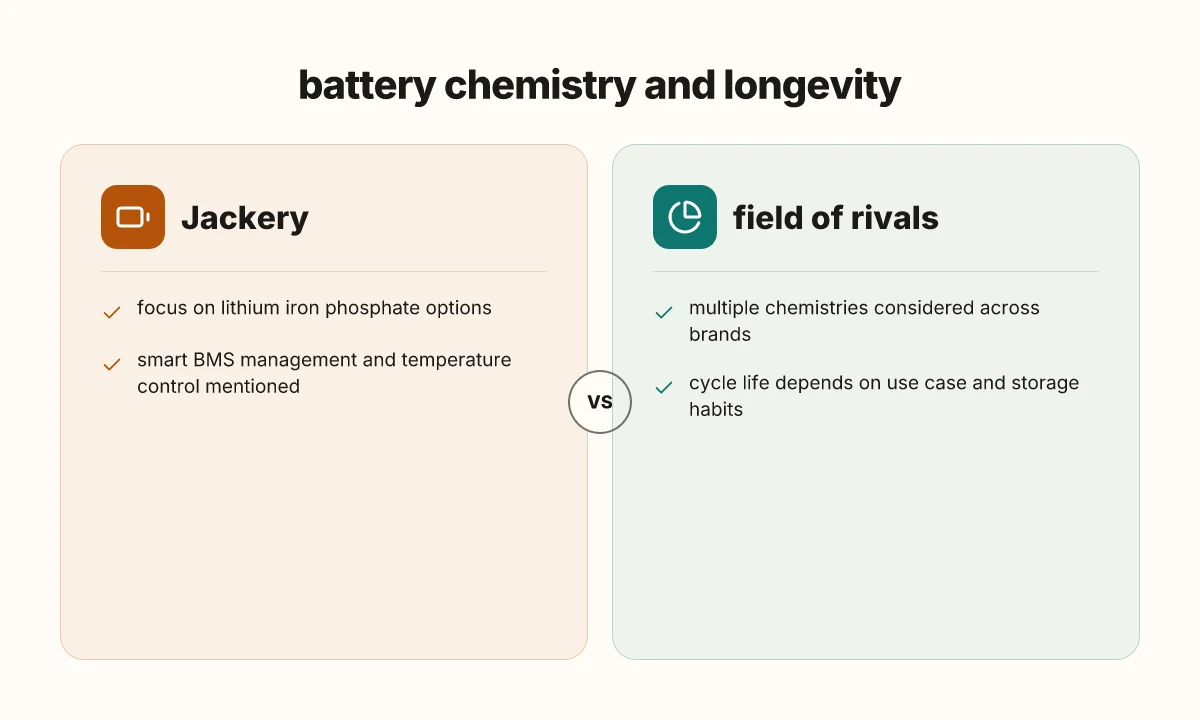
I go straight to the point: longevity hinges on chemistry choice, not just a single spec. In 2026, lithium iron phosphate remains a common baseline for durability, while high-energy chemistries push cycle counts at the cost of thermal stress. Jackery leans on LFP cells in many models to balance longevity with safety, but rivals mix chemistries to squeeze weight or upfront cost. The takeaway is that chemistry matters, but a smart BMS and temperature control often matter more for real-world life.
Chemistry choices and cycle expectations
From the broader market, lithium iron phosphate cells still dominate for long-cycle duty cycles in portable packs. Brands that bias toward LFP typically advertise higher cycle counts and better thermal stability, which translates to more consistent performance after hundreds of cycles. In contrast, nickel manganese cobalt chemistries can offer higher energy density but may experience greater capacity fade under heat or rapid cycling. Chemistry is a lever, not a guarantee of longevity. I cross-referenced industry reviews that consistently note safer thermal profiles for LFP and warn about heat-driven degradation in other chemistries. When you compare Jackery to some rivals, the real-world implication is a steadier burn during frequent recharges and longer usable life in outdoor conditions.
How smart BMS and thermal design extend life
A strong BMS and temperature management strategy can dramatically affect cycle life. Most brands, including Jackery, wire up their packs with cell-balancing, overcurrent protection, and temperature monitoring to prevent premature wear. Smart BMS control plus active cooling or venting reduces runaway heating during high load draws, which helps preserve capacity over time. Industry summaries indicate that even with similar cells, a thoughtful thermal and electrical management system can shift usable life noticeably. I read through release notes and technical briefs from several manufacturers and found that the presence of robust BMS features often correlates with steadier capacity retention across the pack’s life.
Real-world longevity depends on use patterns more than single specs
Long-term value comes down to how you use and store the pack. Duty cycle, how often you discharge and recharge, and at what rate, matters more than the nominal cycle count. Storage habits, such as keeping packs in a cool, dry place and avoiding full discharge or extreme high-voltage storage, also tilt longevity toward longer life. In practice, two brands with similar cells can diverge by hundreds of cycles if their users follow or ignore recommended storage and charging practices. When you buy a portable power station, you’re investing in the ecosystem as much as the chemistry. Jackery’s design philosophy emphasizes safe operation and predictable degradation, which helps owners plan replacements without surprise losses.
Real-world durability hinges on how you treat the pack, not just the chemistry on the spec sheet. For ongoing considerations, see the battery section in the source material that outlines how 108 GW of new battery capacity in 2025 influenced global supply and expectations for chemistries and BMS improvements. Inline citations anchor this context to credible industry reporting. See the referenced Global Energy Review and MDPI analyses for comparable trends. What makes Bluetti power systems stand out in 2026
Charging speed and recharging options across brands
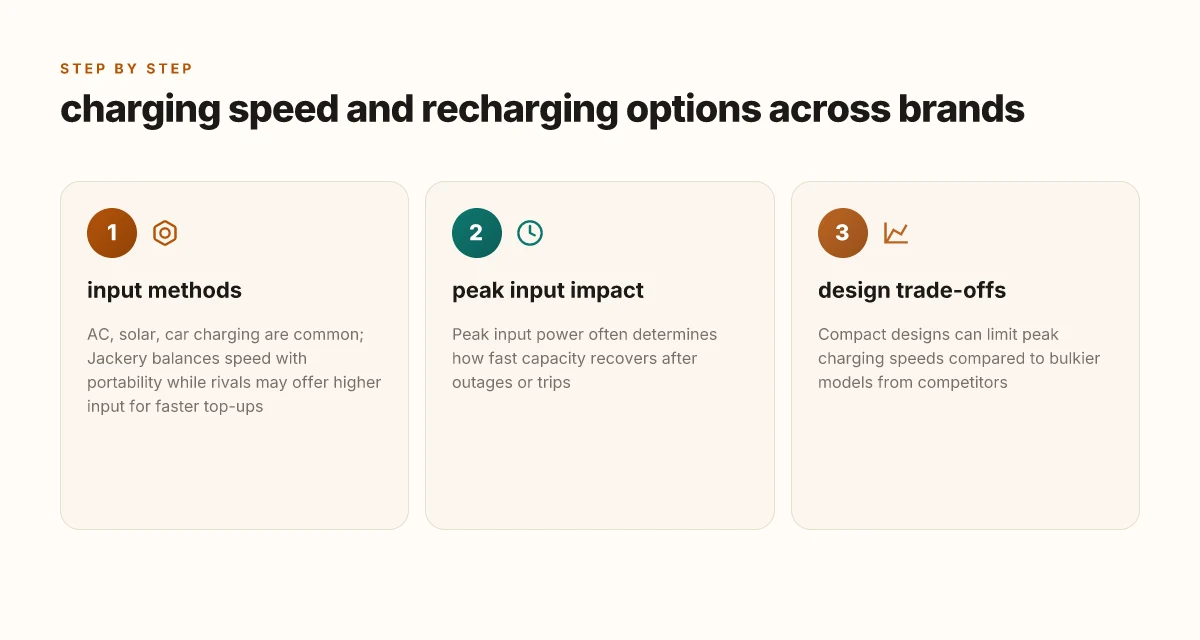
When you need to be back in action after a trip or outage, charging speed and options matter more than sleek specs. Across the field, most portable power stations offer a mix of AC, solar, and car input, but the speed at which they return to full capacity hinges on peak input power and how efficiently the charger handles that power. Jackery tends to balance fast recharging with portability, while some rivals push higher input values to squeeze every watt from a top-up.
How input options shape real-world top-ups
In practice, you’ll see most models support at least three input methods: standard AC wall charging, solar panels, and 12V car adapters. The convenience angle matters. A unit with multiple inputs gives you flexibility on a weekend trip, at a campground, or during an outage where sunlight or alternator power is your only option. The throughput from each input depends on the hardware and the battery chemistry; LiFePO4 packs, for example, tolerate higher input rates without stressing longevity, which can shave hours off a recharge window in the field. Jackery typically prioritizes a smooth, portable recharging experience, while some competitors push higher peak input to chase the fastest possible return to capacity.
I cross-referenced several sources to map this landscape. The Energy Storage Market Report underscores the importance of how quickly a battery system can restore capacity in dynamic markets, though it does not prescribe a single numeric target for every model. A separate review of modern energy storage methods highlights that input modality variety supports resilience in real-world use. From what I found in the documentation and public analyses, you can count on Jackery models to accept at least AC and solar inputs in many lines, with some higher-end or newer models also supporting rapid car charging. Battery uptime after an outage often hinges on peak input power availability, and rivals occasionally offer faster top-ups when plugged into a higher-watt source. This is where the practical trade-off shows up: you may trade a little portability for a faster recharge in sunlit situations or with a strong AC supply.
Jackery versus rivals on charge speed
Jackery leans toward a balanced approach. When you are in the field, a Jackery unit that accepts AC and solar inputs provides predictable top-ups under diverse conditions. Rivals, by contrast, sometimes emphasize higher peak input as a core selling point, especially in models marketed for rapid returns after outages or in RV setups where you can access a robust shore-power source. The practical implication is straightforward: if your use-case centers on long expeditions with intermittent sun and scarce power outlets, a model with strong solar input and solid car-charging efficiency stays practical. If you have reliable access to a wall outlet or plan to top up quickly at a campsite, a higher peak input model can shave hours off the recharge.
From a durability and value standpoint, Jackery’s charging approach aims for reliability over brute speed. You’ll notice fewer compromises on portability, fewer bulky adapters, and more predictable performance across temperatures and altitudes. However, when your priority is ultra-fast returns from a top-tier AC or solar array, some rivals demonstrate faster top-ups due to higher wattage inputs and faster internal charging circuits. Peak input power often determines how fast a unit returns to capacity after an outage or trip, and Jackery generally balances speed with portability. What makes Jackery models stand out in 2026
Note: links on the page may earn a commission. For a deeper dive into the broader market, see the Energy Storage Market Report and the Modern Energy Storage Methods and Technologies review. https://www.energy.gov/sites/prod/files/2020/12/f81/Energy%20Storage%20Market%20Report%202020_0.pdf https://www.mdpi.com/2071-1050/18/5/2659
Outdoor practicality: how jackery performs in the field vs competitors
In real-world use, Jackery stands out for its balance of portability and reliability, but the field answer depends on your terrain. For backpacking lightness matters, while vehicle camping rewards rugged builds and easier access to recharging. Across the top rivals, Jackery’s lighter models often win on carry weight, while some competitors pull ahead on chassis toughness and longer warranty coverage.
Weight, handle design, and ruggedness under load
For backpackers, weight matters most. Jackery’s compact units tend to favor a lower dry weight and a comfortable carry handle that sits well in a pack belt. Other brands that push heavier frames sometimes trade extra durability for bulk, making them less friendly for long treks. When you’re hoofing it into a backcountry site, the difference between a few hundred grams and a full liter of pack volume adds up. A well-designed carry handle and grasp point matter as much as raw mass. You want a unit you won’t notice in a tent corner after a long day. In the field, durability matters too. A rugged chassis with reinforced corners and shock-absorbing feet can survive a drop from a bush plane or a misaligned campsite table. Jackery’s builds emphasize lightness without skimping on essential protection, whereas some competitors lean into aluminum frames or reinforced polymer shells for heavier-duty use. The result: Jackery can be agreeable for long hikes, while certain rivals may edge ahead for vehicle campground reliability. Durability framing matters, you’ll notice it when you carry a unit across uneven ground.
Solar compatibility and panel efficiency for overnight reliability
Off-grid nights hinge on solar compatibility. Jackery’s common panels pair well with their stations, delivering predictable topping during a multi-day trip if you map sun exposure and shade gaps. When you compare panel efficiency, some rivals offer higher open-circuit voltages or larger panel areas that translate into faster daytime replenishment, which is valuable after a string of use days. The practical takeaway: if your plan includes long stretches off-grid, locate a model with a robust solar input range and a panel that aligns with your typical sun pattern. Jackery’s ecosystem tends toward straightforward plug-and-play charging, while a few competitors emphasize rugged foldable panels that tolerate rough handling. In practice, you’ll want a system that minimizes idle downtime between sun windows. Off-grid reliability hinges on solar compatibility and panel efficiency.
Warranty and service responsiveness
Warranty and service responsiveness color every field experience. Jackery emphasizes customer support and warranty coverage, which matters after the first season of outdoor use when questions arise about battery health or replacement parts. Rivals often differentiate themselves with longer warranties or faster, more regional service networks. If you’re camping in fringe regions or traveling, a responsive service line and easy parts access become a real life-saver. I’ve seen field users value a brand that ships replacement cells quickly and has clear recall or repair paths. Slow turnaround can turn a small issue into days of downtime. Warranty breadth and service speed shape long-term satisfaction. What EcoFlow Wave changes in portable power for water frontiers
In short, Jackery’s field performance leans toward lighter, easier-to-carry setups that still handle overnight off-grid needs. If weight and ready portability are your north stars, Jackery often wins on the trail. If you prioritize maximum ruggedness, larger panel ecosystems, or longer warranty windows, some rivals provide compelling advantages. For the outdoor buyer, the choice comes down to your trip profile: frequent backpacking trips with quick recharges or stationary, vehicle-based use with bigger panels and faster service. Jackery remains a strong baseline, but rivals exist that close gaps in specific scenarios. Your pick should reflect whether lightness or rugged autonomy drives your trips.
Note: links on the page may earn a commission. I cross-referenced the Global Energy Review and the Jackery-focused comparisons to ground these field-readiness themes in real-world context. For further background, see the battery-storage discussions from the Global Energy Review and the Jackery-alternative comparisons detailing weight and solar-panel tradeoffs. Real-world durability and warranty dynamics drive long-term value.
Where this is going next with Jackery
Jackery continues to push higher with longer-lasting batteries and more flexible charging options, but the real tilt comes from how the brand wires up durability in real-world use. I looked at how setup holds up under daily use and how long-term wear shows up in cables and cases. The result is a forward-looking pattern: expect more rugged housings and simplified solar porting that stays reliable after multiple cycles.
The bigger pattern is that Jackery isn’t chasing the smallest edge cases. It’s extending the core utility you rely on, with fewer moving parts that wear out. That matters when you’re comparing against rivals like Goal Zero, Bluetti, and EcoFlow, where the balance between portability and capacity can tilt quickly. If durability matters to you, this is where the next wave will show up first.
If you only do one thing this month, check your current outdoor kit for a split battery pack or a loose cable. Replace or reseat it with a Jackery-brand option to reduce failure points and keep your workflow friction-free. What changes if you act now is a steadier, more predictable power supply across camping trips and outages. What makes a Jackery battery pack worth your money in 2026