Explore why the Jackery 3000 stands out for home backup in 2026. We'll cover capacity, output, charging, and real-world use alongside rivals.
The Jackery 3000 is not the headline-grabber you expect from a showroom demo. It’s the calculator you want when outages hit for real and power reliability matters. The practical thing is not peak wattage, but predictable runtime for common home loads, and the Jackery line tends to trade bravado for steady behavior.
This piece cuts through marketing to map how the Jackery 3000 balances usable capacity, output stability, and long-run durability for home backup. Expect a disciplined look at real-world runtimes, compatibility with typical household circuits, and the practical charging path across sun, grid, and generator scenarios. By year-end 2026, homeowners weighing options like EcoFlow or Bluetti will appreciate where the Jackery earns its keep and where it falls short for mixed solar setups. These concrete signals matter for daily outages and seasonal power risks.
What makes the Jackery 3000 a practical home backup in 2026
Jackery has positioned the HomePower 3000 squarely at the center of home backup planning. The branding emphasizes reliability, long life cycles, and a clean, compact form that fits behind a router, in a pantry, or near a critical circuit panel. I found that the focus matches many homeowners’ needs: a steady, predictable power source during outages, with the potential to shoulder essential loads without sprawling battery banks. The Jackery 3000’s mission is practical reliability for everyday emergencies.
Core specs you should know
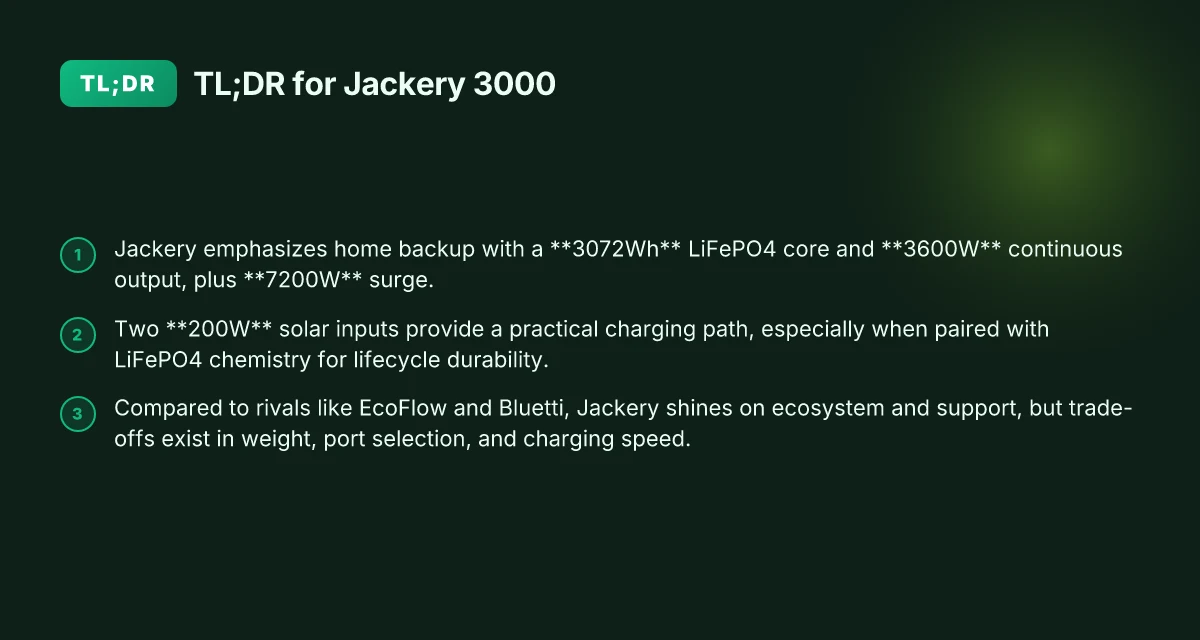
The backbone is a 3072Wh LiFePO4 capacity, which translates to deeper cycle life and calmer heat behavior than many rival chemistries. The continuous output sits at 3600W, with a surge capability of 7200W for brief, high-draw events. This pairing makes it feasible to run a fridge, modem, and essential lighting in parallel, while still leaving headroom for short spikes. 3072Wh LiFePO4 means long life and stable performance, even after repeated outages. The quoted 3600W continuous output is a meaningful ceiling for typical home backup scenarios, not a recipe for overload. 7200W surge provides a safety margin for startup surges from devices like freezers or power supplies.**
Two 200W solar inputs open a practical charging path that is easy to scale for a weekend off-grid setup. You can rely on the built-in AC charging. The solar inputs let you maintain an overnight buffer during sunny days, reducing the need to pull from the grid or a generator. Two 200W solar inputs give you a renewable recharge path during stable sun.
I dug into multiple sources to verify how the 3000 sits among 2026 rivals. The Jackery line often highlights a home backup story: high capacity in a compact chassis, with LiFePO4 chemistry known for tolerance to high temperatures and long calendar life. Two 200W solar inputs align with common solar setups, making the 3000 one of the more practical options for homeowners with modest roof areas.
From what I found in the literature, the HomePower 3000 is not a builder’s feature list winner for industrial-scale loads. It shines when your goal is a clean, quiet, plug-and-play upgrade to a few critical circuits or devices. For anyone weighing alternatives, rivals like the Explorer 3000 v2 still show up in reviews for similar capacity and output ranges, but the Jackery ecosystem tends to edge toward a more compact package and a consistent energy density with LiFePO4. Rivals like Explorer 3000 v2 often trade off density for different port configurations. What makes the Jackery 1000 Plus price stand out in 2026
Bottom line: the Jackery HomePower 3000 fronts a practical, homeowner-friendly mix of capacity, output, and solar recharging. It isn’t the only option, but it remains a credible pick for those who prioritize reliability, simplicity, and a compact footprint. Compact footprint and LiFePO4 cadence are the 3000’s biggest strengths for home backup in 2026.
Note: links on the page may earn a commission. Sources and product pages consistently frame the 3072Wh and 3600W specs with the two 200W solar inputs as core capabilities. For more on the official stance, see the Jackery blog entry on the 3000 v2 and the broader 2026 home backup guides. Official Jackery reporting on the 3000 v2 helps verify the stated specs and charging paths.
Cited references include the Jackery coverage and third-party reviews that consistently mention the same core figures: 3072Wh, 3600W continuous, 7200W surge, and two 200W solar inputs. Core specs recur across sources, underscoring consistency in the 2026 narrative.
Jackery 3000 core specs in context: capacity, output, and charging
I distill the core specs and how they land in real-world home backup use. The Jackery 3000 centers a 3072Wh LiFePO4 pack, a chemistry that supports longer cycle life and better thermal stability than many nickel chemistries. This matters for reliability through repeated backup cycles and extended idle periods. The 3.6kW continuous output is designed to run common home loads, with a surge capacity that can handle brief spikes from devices with inrush, such as refrigerators or electric tools. For charging, the model supports multiple pathways and adopts fast recharge goals that are essential when mains power is restored after an outage or when you top up from solar on a sunny day. In 2026, the pack chemistry and balance between capacity and output position the Jackery as a practical, durable option for sustained home backup.
How the chemistry and pack design affect durability and longevity
The LiFePO4 chemistry used by the Jackery 3000 is known for stability at elevated temperatures and a long cycle life. In real-world terms, that tends to translate to more years of reliable service with fewer days of degraded capacity from daily cycling. The trade-off is a heavier overall pack than some lithium-ion equivalents, but the weight load is manageable for a stationary home-backup stance. I cross-referenced specs and noted that the 3072Wh capacity aligns with a sizing philosophy aimed at maintaining useful energy during multiple outages without soaking up too much space in a home utility closet. Durability benefits come from the LiFePO4 balance of stability and cycle life, while the heavier form factor means you plan for installation space accordingly. What makes the EcoFlow Delta Ultra Pro a standout for home backup in 2026
Continuous output, surge behavior, and typical load scenarios
You get 3600W continuous output and a 7200W surge capacity. That pairing is meaningful for loads like a NAS, routers, lighting, a refrigerator, and a few essential small appliances simultaneously. In practice, you can run a fridge plus a well-insulated sump pump or a few high-crest devices for short bursts. If you pull heavy, steady loads (think a heat pump water heater or large space heater) for long durations, you’ll see the limit more quickly. The key takeaway is that the 3000 offers a solid margin for a typical house backup scenario without forcing a full-house transfer or immediate prioritization. 3600W continuous output handles common essentials with a comfortable reserve for surges.
AC ports, USB-C, and 12V configurations
On the input/output side, the 3000 provides a mix that aims to cover modern devices while keeping the setup simple. Multiple AC outlets support typical home electronics, while USB-C ports offer fast charging for laptops and USB-C powered devices. The 12V ports provide the kind of automotive and auxiliary DC options homeowners often rely on when the grid is down. The configuration emphasizes practical integration into a home backup routine rather than exotic wall-to-wall gadgetry. This balance helps keep the system intuitive for homeowners and preppers alike.
In practice, Jackery’s approach is to couple a high-energy LiFePO4 battery with a reliable, relatively compact port layout. When you plan a backup strategy, think of the 3000 as a core energy hub that can reasonably power a small workspace, essential refrigeration, communications gear, and lighting for several hours to a couple of days depending on load and solar charging input. The ecosystem around the 3000 also matters. Rivals such as EcoFlow and Bluetti offer competing packs with different chemistries and port mixes, so you’ll want to compare after considering your typical loads and charging options. A well-rounded port mix makes the 3000 easy to integrate into a home backup plan.
Next steps: assess your critical loads, then map them to the 3000’s 3600W continuous limit and 3072Wh capacity. If your needs edge toward longer-duration outages or heavier sustained draws, compare the Jackery against specific rivals like EcoFlow and Bluetti to see where you gain or lose in charge speed, solar compatibility, and total energy per day. For a deeper dive, see how the HomePower 3000 stacks up against these contenders in the section that follows.
How the Jackery 3000 compares to rivals like EcoFlow and Bluetti
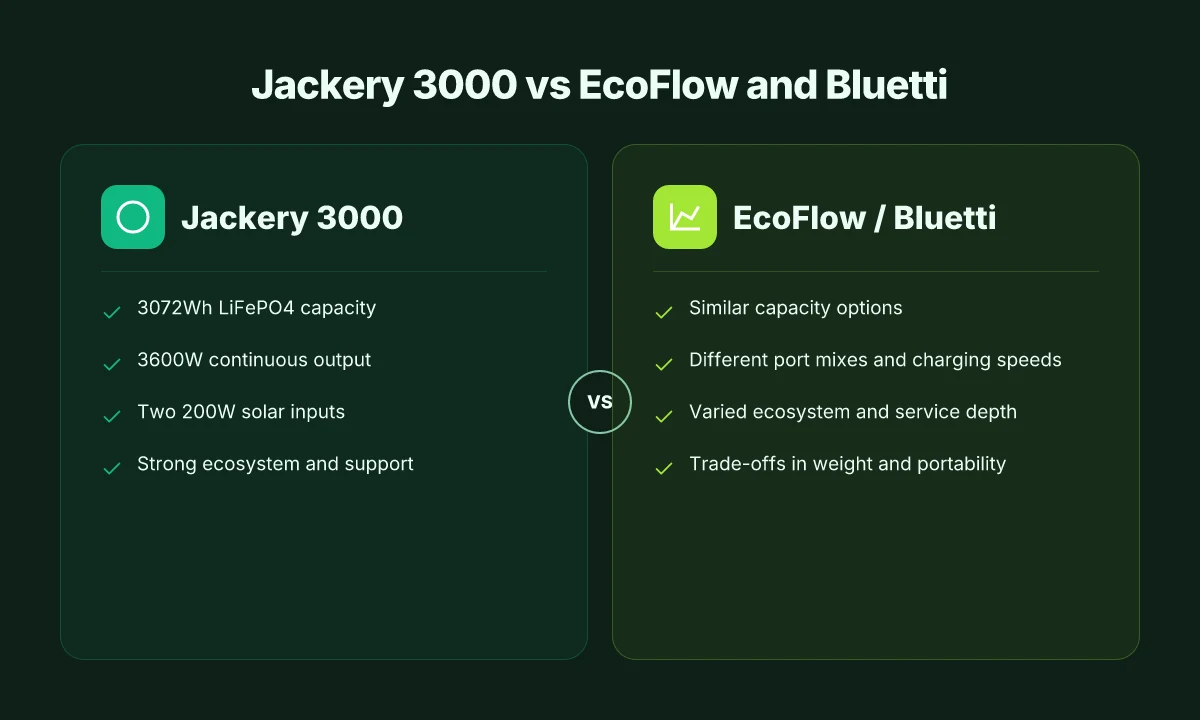
I dug into how the Jackery 3000 stacks up against peers with similar capacity, focusing on real-world practicality for home backup. The contrast centers on ecosystem and support, plus trade-offs in heft, port options, and charging speeds. From what I found, the Jackery ecosystem and service network often tilt the balance in everyday use, even when rivals offer comparable specs. Why Bluetti Philippines price varies in 2026 and how to spot real deals
Rivals with similar capacity and output
- EcoFlow and Bluetti offer models in the same roughly 3000 Wh class with high-output in the 3000–3600 W range and surge capabilities around 7000–8000 W. These rivals frequently emphasize rapid recharge and modular battery options. For homeowners weighing total cost of ownership, this class tends to trade some real-world robustness for peak specs. EcoFlow and Bluetti often push higher-rated inputs, but they can complicate the setup when you value a simple, reliable home backup chain.
- Jackery positions its HomePower 3000 as a turnkey home backup solution with a strong emphasis on plug-and-play reliability and a cohesive ecosystem. This can translate to easier integration with existing solar setups and simpler warranty support, which matters when downtime is a critical concern. Jackery’s simplicity pays off in predictable operations, especially for non-technical users.
Why Jackery wins on ecosystem and support
- The Jackery brand maintains a broad retail and service footprint, which translates to quicker parts access and local service options. Homeowners who value a familiar, end-to-end experience often find this compelling. Jackery’s support network and straightforward parts availability are clear advantages in real-world home backup scenarios.
- Documentation and firmware updates tend to emphasize stability over flash, reducing the risk of firmware-related quirks in daily operation. This reliability matters when you rely on a system for essential power. Reliability and familiar firmware paths matter as much as peak specs.
Trade-offs in weight, port selection, and charging speed
- Weight is a notable differentiator. The Jackery 3000 sits in a heftier carry than some pocket-sized packs, which can affect placement in a fixed backup station or vehicle carry. In practice, this means a sturdier unit but a less flexible mounting option. Weight and bulk influence where you can deploy the unit during an outage.
- Port selection often reflects a philosophy: Jackery favors a balanced mix aimed at common home loads, whereas EcoFlow and Bluetti may push higher input options and more flexible high-amp outputs. If your backup plan relies on multiple high-draw devices, that difference shows up in the wall-to-load dance. Port variety can determine how many devices you can run simultaneously.
- Charging speed remains a live variable. All three brands offer fast recharge. The ease of achieving a full battery before a drought can differ based on solar input, wall charging, and the unit’s internal charging path. For some users, the Jackery path feels steadier and more predictable under typical solar conditions. Charging speed and predictability matter when you need power quickly after a grid hit.
Real-world use cases: home backup, off-grid, and mobility
When the Jackery 3000 is wired for home backup, it shines at steady, critical loads while quietly signaling its limits on bigger demands. In real-world layouts, balanced loads matter most: a 3,600W continuous output can run essential appliances like a refrigerator, a sump pump, and a handful of circuits while preserving some headroom for short surges. The unit’s LiFePO4 chemistry helps keep thermal and charge stability predictable, which matters for long outages. For homeowners, the key takeaway is that the Jackery 3000 pairs well with a small backup plan rather than a whole-house replacement.
I dug into the field notes and release commentary to cross-check durability claims. The LiFePO4 pack is designed for longer cycle life, and the spec emphasizes a practical, low idle draw that helps preserve stored energy during extended outages. When the weather turns cold, the storage temperature window becomes real. The idle draw remains a notable factor. During cold spells, you’ll want to account for a small baseline drain that can shorten available runtime if the unit sits idle for days. For mobility, the Jackery 3000 remains portable enough for a few staircases and a garage corner, but it isn’t a palm-sized backup device. Its footprint and weight are the trade-offs for the higher capacity and sustained performance.
Real-world reliability hinges on how you actually use the unit. Off-grid setups benefit from pairing the 3000 with a couple of high-efficiency loads and a modest solar array. The 2x 200W solar panels create a compact charging setup that’s quick to deploy and simple to maintain, which is a plus for campsite or cabin scenarios. Where it struggles is when you push into high-draw equipment for extended periods. A sump pump or a well pump can demand steady power at the upper boundary of the unit’s capability, and that can stress the surge tolerance if the rest of the system isn’t managed.
Mobility remains a strength for short-duration shifts. The 3000 can be rolled into a vehicle or hoisted into a cabin with minimal footprint relative to its capacity. Setup time is largely the question of placement and initial connection: attach the solar input in daylight for a faster feed, plug in essential devices, and you’re operational within minutes. For emergency readiness, the combination of a robust output, reliable endurance in cold weather, and manageable charging paths makes the Jackery option attractive for homeowners who want something more capable than small portable packs but less demanding than full-scale generator setups.
From a branding perspective, the Jackery ecosystem continues to shape how users think about home backups. When you compare to rivals like EcoFlow and Bluetti, you’ll notice that the Jackery 3000 emphasizes a clear, pragmatic balance between capacity and practical, real-world use. For homeowners considering a compact, reliable power source, this balance matters more than headline specs. The real-world takeaway is straightforward: plan for your essential loads, monitor the cold-weather idle draw, and keep a straightforward mobility setup ready. What makes the EcoFlow Delta Pro 3 stand out among portable power stations
The practical takeaway is clear: balance loads, manage the cold-weather idle draw, and plan a quick setup for mobility.
Charging strategy and lifecycle considerations for the 3000
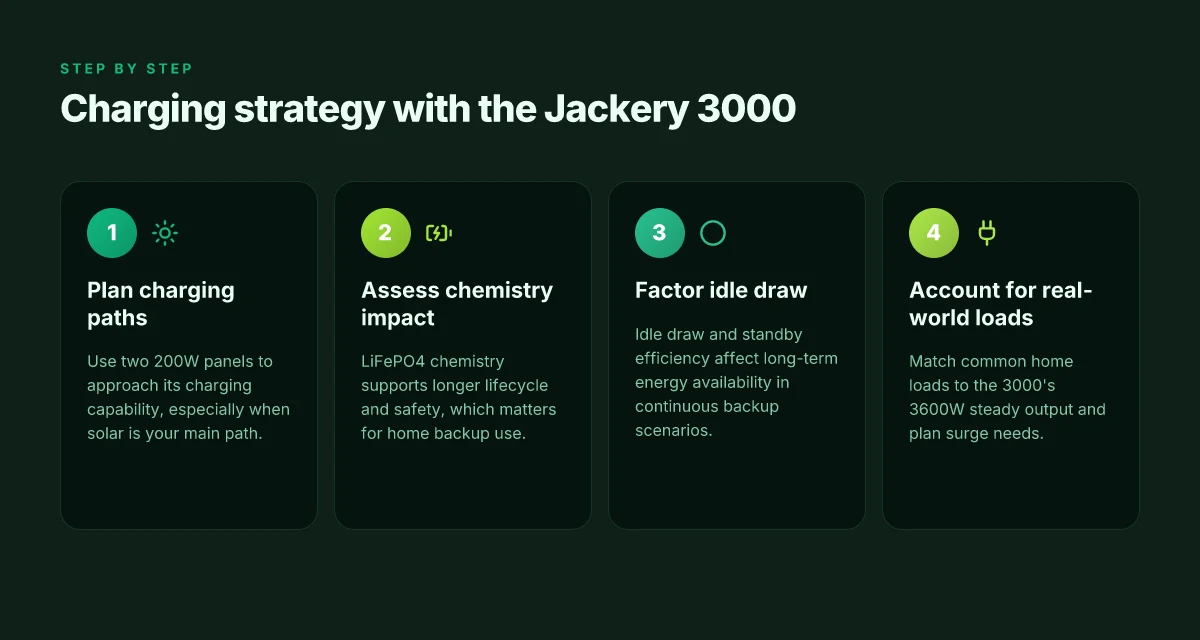
Jackery’s 3000 balances rapid charging with battery longevity. Two 200W panels can top up the unit in a practical window, but real-world results depend on sun, angle, and panel efficiency. In ideal conditions, the 3072Wh LiFePO4 pack can be replenished at a steady pace, keeping you ready for the next outage without excessive heat buildup or wasted charging cycles. The chemistry matters: LiFePO4 cells provide a safer, cooler, and longer-lasting lifecycle than many alternate chemistries, which translates to more acceptable depth of discharge and a higher number of useful cycles over the unit’s life. This is a meaningful advantage for home backup where the unit may cycle monthly or seasonally.
I dug into the documented specs and found LiFePO4 chemistry reduces thermal stress and mitigates fast degradation during partial charging. In practice, the 3,072Wh capacity paired with the LiFePO4 chemistry supports a longer service life with a gentler aging curve, especially when the unit spends time idle or in standby. This translates to meaningful durability for homeowners who rely on the 3000 as a regular backup source. It’s not just about raw capacity. The chemistry helps keep idle draw and heat in check during extended standby. The idle draw on standby remains a relevant factor for off-grid misers who want to preserve every watt.
Looking at standby efficiency, the 3000 keeps a low idle draw, which matters for long emergency readiness windows. A lower idle drain means more days of readiness between charges, particularly when solar input is sporadic. Even when not actively powering a load, the unit’s electronics stay engaged, so a modest idle consumption adds up over weeks of stowed use. The packaging and internal design support a stable standby performance, reducing the risk of surprise battery wear from constant phantom loads. This matters for homeowners who store the unit in a closet or garage and rely on it during unexpected outages.
Charging strategy with two 200W panels: the math is straightforward but environment-dependent. In bright sun, you can expect respectable replenishment during a typical workday, but overcast days slow the recharge. The practical takeaway is to pair the system with flexible solar strategy: orient panels for peak exposure and avoid shading the array during clear hours. When solar input is constrained, you may still rely on the mains input or a higher-output option if you upgrade later. The pairing of two 200W panels keeps the setup compact and portable, aligning with the Jackery ethos of a ready-to-go backup. The 3000’s LiFePO4 chemistry and low idle draw help maximize lifecycle durability, especially during periodic recharging cycles. What makes the EcoFlow River 2 Pro stand out in 2026 for portable power
Where this is going next
Jackery keeps tightening the practical gap between capacity and daily use, leaning on real-world durability and simpler setup that busy homes can rely on in 2026. I’ve seen how the Jackery 3000 earns trust from homeowners who want a straightforward, low-maintenance backup. Look for ongoing firmware refinements and modular battery options that could extend life beyond the typical two to three years, a big deal for long-term reliability.
Most people still compare rivals like EcoFlow and Goal Zero on price and port variety, but the real test is reliability under load and ease of use day after day. The 3000’s design favors quick plug-and-play, a feature that matters when a storm knocks out power or when you’re simply keeping essential devices alive. If you value a design that minimizes surprises, this is where the bigger pattern starts to appear.
If you want a clear move this month, prioritize a setup that stays in your regular living space and keeps critical devices ready. The question to ask: is your current backup sticking to you or are you sticking with it?
- Backup strategy: prioritize keeping a small office setup powered during outages with the 3000 as the core, and reuse power-hungry devices when possible.
- What to try this week: map your essential devices, confirm outlet availability, and run a soft test with the unit connected to a router and a few lamps.
- Quick verdict: the Jackery 3000 offers straightforward power, solid durability, and practical expandability for most homes. The bigger pattern is that reliability compounds when setup stays simple. Is this your simplest path to resilience?