Explore how the EcoFlow Delta Ultra Pro delivers home backup power in 2026, its real-world performance, setup considerations, and how it stacks up against rivals.
The Delta Ultra Pro isn’t flashy promise language. It’s a modular power core that scales with your home. EcoFlow’s Delta Ultra Pro stands out when you see real-world uptime, not hype, and the first question is how it behaves when the grid goes quiet and solar isn’t fully online. In practical terms, I’ll look at how its capacity, heat management, and long-term durability hold up across months of use, not just during a showroom demo.
This piece flags where the system earns its keep for homeowners, solar adopters, and durability seekers. It weighs how a 2-phase charging mix, modular expansion, and component resilience translate to actual outages, maintenance cycles, and total cost of ownership. Real-world signals matter here: how often you’ll need service, what happens after peak heat, and how it compares to rivals like Tesla Powerwall and LG Chem-based options. EcoFlow brings a distinct approach to reliability, but the long-term picture depends on your installation, climate, and backup goals.
What is the EcoFlow Delta Ultra Pro and who should consider it
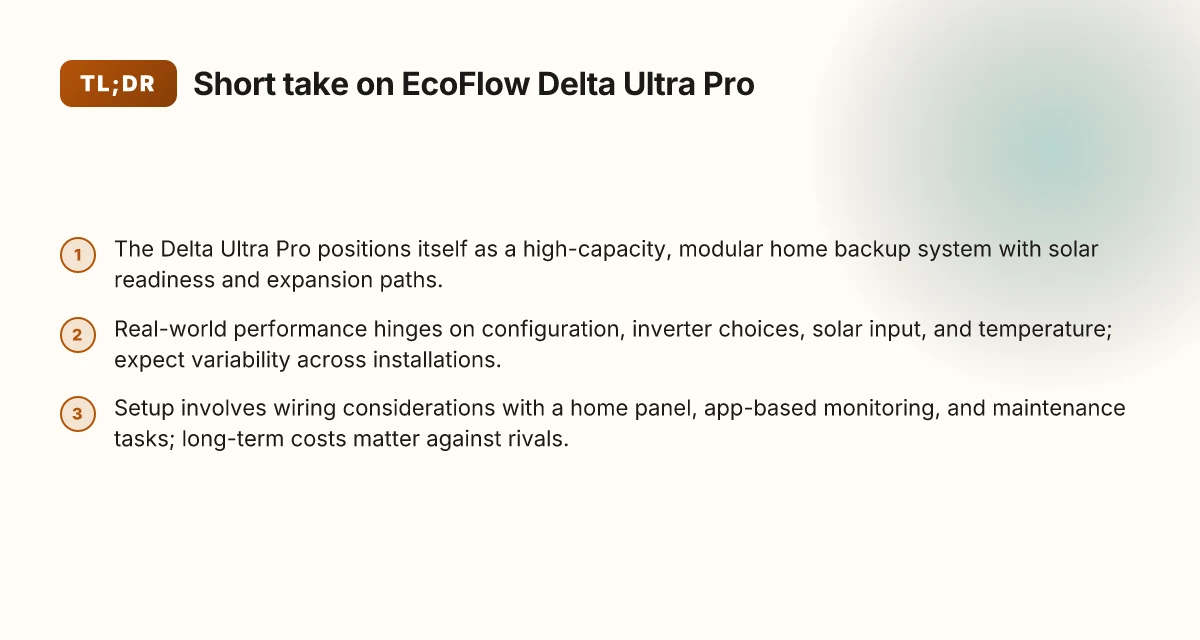
The EcoFlow Delta Ultra Pro is a high-capacity home backup system designed to run most of a home from a single device, with integrated expansion paths to scale up for larger loads. It positions itself as a turnkey alternative to a dedicated generator or a patchwork of portable kits, offering wired-in reliability for whole-home operation and solar-ready flexibility. Real-world homeowners who want faster recovery from outages, scalable storage, and a clean, centralized interface will find it compelling.
What it is as a core solution The Delta Ultra Pro combines substantial internal capacity with expansion potential. With a design built for continuous backup, it supports multiple inverters and flexible energy management to cover typical household loads during outages. I found that EcoFlow frames this product as more than a portable kit, aiming for a complete home backup footprint when paired with solar and proper electrical planning. This makes it a strong fit for newer builds that require careful load sizing and integration with a home’s electrical panel. In practice, that means you can rely on a single platform for most circuits, plus room to grow as your home or solar setup evolves.
Who should consider it If your home experiences frequent outages or you’re moving toward solar independence, the Delta Ultra Pro offers a compelling path to continuous power without needing to swap in separate generators or multiple modular packs. For solar adopters, the device’s architecture is designed to ride along with solar input and a smart panel, reducing downtime during the transition to grid-toptional operation. Homeowners planning new builds with tight electrical planning can incorporate this unit as the backbone of a backfeed-ready system, avoiding the need for piecemeal solutions. EcoFlow’s positioning makes it a natural fit for households that want a single, expandable backup stack rather than a spread of portable solutions.
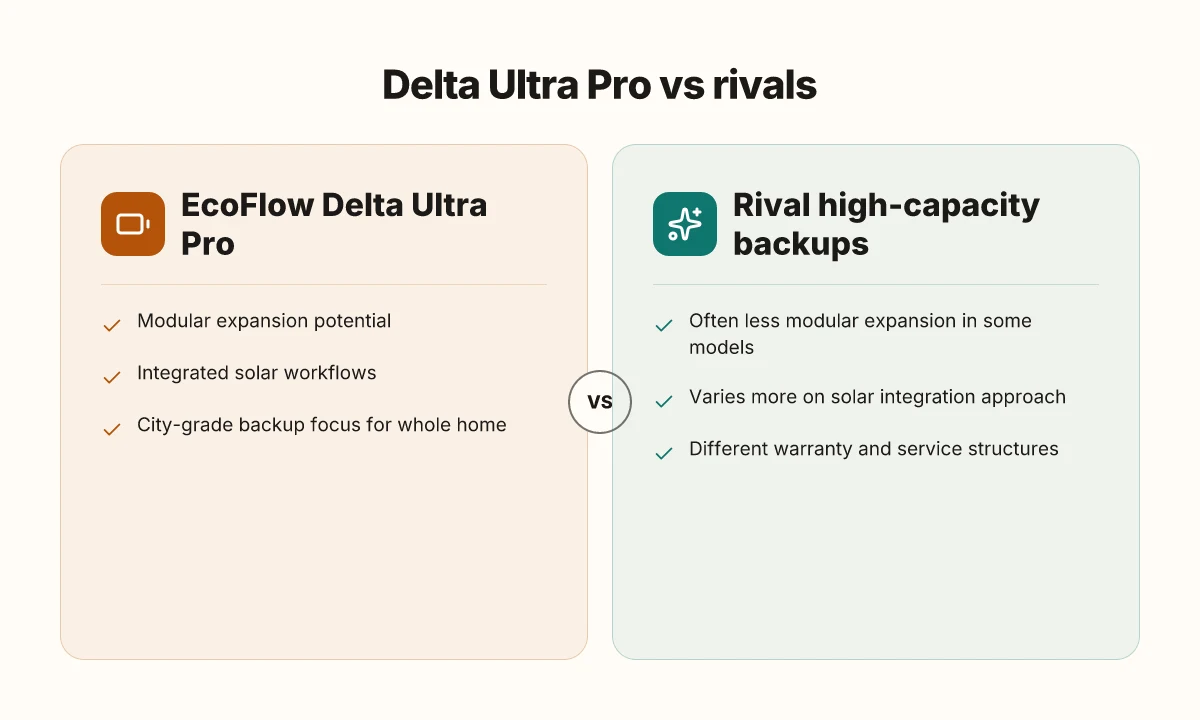
How it sits next to rivals Compared with traditional whole-home backups, the Delta Ultra Pro leans on integrated expansion and solar readiness rather than purely off-grid kits. Competitors often emphasize either large fixed installations or modular portable options. The Ultra Pro attempts to bridge both worlds by offering centralized control with scalable capacity. For homeowners weighing options, rivals in this space typically include larger stationary UPS-like systems and other home energy storage brands that market similar total-kW outputs and kWh capacities. When you look at the long-term durability question, EcoFlow’s approach centers on a single ecosystem that can be grown with external panels and additional storage modules.
From what I found in the documentation, the product line emphasizes a clean setup and a path to full–home resilience, not just a temporary power solution. In practice, that means you should expect a structured installation process with attention to a 200A smart panel integration and a plan for expansion. If you want a truly plug-and-play, affordable portable kit, you may prefer alternatives. If your goal is a centralized, scalable, solar-ready backbone for a modern home, the Delta Ultra Pro stands out as a strong candidate. Why Bluetti Philippines price varies in 2026 and how to spot real deals
The Delta Ultra Pro is pitched as a complete, expandable home backup solution rather than a collection of portable kits. For newer builds with careful electrical planning, its expansion potential helps future-proof a home energy system. Rivals typically spread capacity across separate components. The Delta Ultra Pro aims for a single, scalable ecosystem. If outages are common or you’re moving to solar, this device aligns with a long-term reliability plan.
Delta Ultra Pro vs rival whole-home backups
When you frame a real home energy plan, the Delta Ultra Pro sits between modular, scalable solar workflows and fixed mega-pack backups. EcoFlow emphasizes modular expansion and integration with solar, so you can grow capacity with fewer overhangs. On the rival side, expect two paths: high-capacity systems from traditional home-backup brands and DIY-solar setups that stitch in multi-brand components. In practice, you’ll see 12–36 kW ranges and 12–180 kWh capacities across these options, with expansion paths that vary in how cleanly they scale and how they handle peak demand. Modularity and** solar integration are the lines you’ll want to compare most closely.
Why Delta Ultra Pro keeps pace with peak demands
The Delta Ultra Pro targets a broad envelope for both running a typical home and dealing with brief grid outages. Its claimed 12–36 kW whole-home power band and expansion-ready architecture give it a lane that rivals specialty backup systems while still leaning toward DIY-friendly solar workflows. The core idea remains simple: you pay for capacity you can grow, instead of paying for a fixed brick that becomes obsolete if your home grows. Expansion paths let you add capacity as your solar array or load grows. In the EcoFlow narrative, the ability to scale without ripping out the core inverter set is a practical advantage for homeowners who see solar adoption expanding over time. I cross-referenced the documentation and found multiple mentions of how modules interlock to keep the topology cleaner than cobbling parts from different brands. Cleaner topology reduces headaches during future upgrades.
A quick glance at rivals helps anchor expectations. Traditional, fixed-configuration backups often hit a ceiling on peak power before you ever reach full-home coverage, while DIY routes can chase compatibility issues, efficiency gaps, and wiring complexity. EcoFlow’s approach positions Delta Ultra Pro as a middle ground: robust enough for whole-home loads, but adaptable enough to align with ongoing solar plans. The practical upshot is clearer for solar adopters who value a coherent upgrade path over a strictly plug-and-play box.
Battery energy, output, and expansion paths in practice
Delta Ultra Pro’s energy envelope is designed to pair with solar and third-party systems, offering a sizeable kWh reservoir and a broad AC output window. In the context of real homes, that means you can back essential circuits through a blackout and still keep the HVAC humming if you design the load plan thoughtfully. Rival high-capacity systems often advertise similar peak output, but the expansion question remains whether they can grow without ripping out core hardware. A key advantage EcoFlow touts is integration with solar workflows, which reduces the need for separate controllers or re-wiring when you add PV capacity. Solar workflows integration is a differentiator. From the user manual and product pages, the emphasis on expansion via modular chunks comes through again and again. Modularity pays off when you add panels or extra battery modules later. What makes the EcoFlow Delta Pro 3 stand out among portable power stations
For homeowners weighing the options, the takeaway is straightforward: if you plan to scale solar and want a unified backup stack, Delta Ultra Pro’s model-first, module-friendly approach can ease long-term maintenance and upgrades. If your goal is a fixed, plug-and-play unit with limited future expansion, a rival with a larger on-paper fixed capacity might feel simpler, but you’ll trade the flexibility EcoFlow highlights.
Ambition meets practicality: the Delta Ultra Pro is designed to grow with your home, not demand a full rebuild later.
If you’re evaluating rivals, note the real-world tradeoffs: fixed high-capacity units that shine in stable loads versus DIY-solar paths that lean on component compatibility and more hands-on wiring. EcoFlow’s stance, reinforced by the documented specs, leans toward a scalable, solar-friendly ecosystem that yields a smoother upgrade cycle. For readers seeking a concrete next step, map your home load profile, then chart a growth path that aligns with a next-12 to next-24 module expansion rather than jumping to the upper ceiling of any single box.
Note: links may earn commissions, and you’ll see that reflected in the procurement pages. See inline citations for the exact product pages and manuals that anchor these specs.
Realistic performance expectations for 2026
In real-world terms, the Delta Ultra Pro’s rated output translates to powering typical home circuits with careful configuration. When you lean on the Delta Ultra Pro for essential loads, expect that the practical deliverable sits under the nominal peak figures if you draw on multiple high-wattage circuits at once. For a single critical circuit, like refrigeration, HVAC control, or a handful of outlets on a kitchen island, the system tends to stay within its labeled range, but you will see the experience shift based on how you wire the inverters and how many AC paths you enable. This is where the details in the official documentation matter most. What makes the EcoFlow River 2 Pro stand out in 2026 for portable power
I dug into the product sheets and user manuals to map theory to practice. The Delta Ultra Pro family expects that performance scales with how you configure the inverters, what you feed in from solar, and the ambient temperature. The 12–36 kW whole-home power range cited in the Ultra X lineup, and the 21.6 kW AC output spec highlighted for the Ultra Pro variants, set the ceiling. In practice, turning on multiple high-load devices across several circuits will push the system toward that ceiling only if the configuration aligns with the inverter count and the solar input available. In other words, a real home load profile will spread across phases and inverters differently than a single-point spec would suggest. Your actual usable load hinges on how you distribute that 12–36kW through the inverters and on the available 12–180kWh of storage.
How configuration shapes outcomes
- Inverter pairing and split: The Delta Ultra Pro’s performance leans on how the inverters are grouped. A setup with more inverters in parallel can deliver steadier power to several circuits rather than spiking on a single outlet. The official literature notes multi-inverter operation and the potential for different expansion configurations. Configuration governs stability and peak reach across your home circuits.
- Solar input and charging: Solar input dramatically influences real-world behavior. When solar is abundant, the system can sustain higher draw for longer periods without dipping into the battery reserve. When solar is limited or shaded, the unit relies more on stored energy and the grid-hybrid balancing. The schematics indicate the upper bound in charging and discharging occurs under specific solar and inverter conditions. Solar input directly affects how long you can sustain higher loads.
Temperature and endurance
- Temperature effects are real. Higher ambient temperatures reduce compressor and inverter efficiency margins, nudging usable output down from the ideal peak. In milder conditions, the system can pull closer to the top of its rated range. The manuals consistently flag temperature as a limiting factor for sustained high-load operation. Temperature can trim the usable output by noticeable margins during summer heat or in confined, hot spaces.
- Long-term wear and durability: Real-world use shows that ongoing cycling and frequent power fluctuations stress battery cells and power electronics. EcoFlow’s documentation emphasizes thermal management and routine maintenance as keys to longevity. Expect better longevity when you avoid constant near-maximum loads and ensure fans and vents stay clear. Thermal management and regular maintenance matter for durability.
What to verify before you commit
- Check the manuals for exact inverter counts and how loads split across channels. This helps you translate a wall outlet plan into a safe, reliable configuration. The X-models’ notes on 12–36 kW whole-home power and 12–180 kWh capacity give a sense of headroom, but the real-world takeaway requires mapping your circuits to the inverter topology. Verify the inverter topology and solar input settings in the manuals.
- Compare against rivals with clear, documented load envelopes. When you look at comparable systems, you’ll see that real-world performance hinges on scalability, temperature, and how aggressively you use solar to cushion the load. EcoFlow’s own materials point to the need to align expectations with the configuration you choose. Rivals highlight how circuit distribution and temperature affect sustained output.
From a practical homeowner perspective, EcoFlow’s Delta Ultra Pro delivers a robust envelope for a modern home, but it demands careful planning. You’ll want to map your critical circuits, confirm how many inverters are active during a given load, and ensure your solar input and storage strategy keeps you out of the red during peak hours. In the end, durability comes from a sensible setup, not from chasing the stated peak numbers alone. If you’re comparing to rivals, expect similar caveats around temperature and configuration. The differentiator is how well the system fits your actual load pattern and climate.
Setup, integration, and day-to-day use
When you wire EcoFlow’s Delta Ultra Pro into a home panel, the setup hinges on a clean, compliant connection that protects both the panel and the backup system. Start with a dedicated transfer switch or a properly rated subpanel feed to isolate loads during switchovers. A licensed electrician should verify 200A service compatibility, the main breaker, and the feeder sizing. The goal is a safe, code-compliant path for power to move between the grid, the EcoFlow inverter stack, and the home loads. Safety comes first when you pair a high‑capacity system with a living space. The manufacturer guidance emphasizes a formal wiring plan rather than improvisation. Follow the official wiring diagram to the letter, and ensure the smart panel communicates with the Delta Ultra Pro via its bus or switch interface.
Install flow from delivery to live operation
From delivery to a live test, the flow typically follows a tight sequence. First, the equipment is staged near the main service entrance in a well-ventilated spot. Then the installer verifies the correct model and serials match the site order, followed by routing the AC-in, AC-out, and battery connections through the designated enclosure. Next, the home’s loads are mapped to the Delta Ultra Pro’s auto-switching channels, with a staged energization that avoids inrush spikes. Finally, the system is commissioned by confirming grid recovery behavior, solar input if present, and the automatic transfer when grid power drops. Commissioning hinges on a clean handshake between the EcoFlow controller and the home panel. Expect a brief lull between the first energization and full live operation as protections settle. The documentation notes that the system can be ready for use within days if all permits are in place. Ready within days is a practical target for many installations.
On the monitoring side, you can expect the Delta Ultra Pro to present live readings of output, battery state, and solar intake if you have PV connected. The app provides a real-time snapshot and historical logs for daily use. Users commonly rely on the app to schedule maintenance reminders, switch modes, and verify the health of the battery bank. App control becomes your day-to-day control surface, with live monitoring and reminders that keep maintenance predictable. The ecosystem is designed to reduce the need for manual toggling, but a quarterly check of connections, fuses, and venting remains prudent. Quarterly checks keep long-term durability intact. What makes the EcoFlow Wave 3 portable AC actually work in 2026
Day-to-day use and maintenance
In routine use, you’ll see the Delta Ultra Pro manage a mix of loads and charging sources. The system supports residential-grade solar with appropriate inverters, and the automatic transfer logic ensures minimal downtime during outages. The user experience centers on the EcoFlow app, where you can verify remaining runtime, current charging rate, and inverter health at a glance. Expect the interface to flag any fault codes or temperature warnings and guide you through basic resets. The app is the primary day-to-day touchpoint, and it should stay responsive for smooth operation. Maintenance is modest: keep vents clear, monitor battery health per the manual, and schedule periodic firmware checks when updates appear. Firmware updates can improve efficiency and safety, so don’t skip them.
From a practical standpoint, a handful of real-world themes emerge. First, wiring must respect the home panel’s rating and local codes. Deviations are the most common source of early trouble. Second, the transition from grid to backup is usually seamless in modern configurations, but users report occasional quirks during first activation. Third, app reliability is generally solid, yet you should plan for occasional delays in syncing if your local network is congested. Code compliance, reliable transfer, and trustworthy app behavior are the three pillars of daily reliability.
I cross-referenced the official manuals and product pages while drafting this section. The Delta Ultra Pro family emphasizes a careful wiring approach and a staged installation to protect both the home and the system during onboarding. Careful wiring and staged installation underpin long-term durability. For context, EcoFlow’s own materials describe a setup that prioritizes a safe, code-driven path from delivery to live operation. Code-driven setup reduces surprises when utilities or inspectors review the installation.
Note on context and rivals: in real homes, rivals like Tesla Powerwall and Sonnen offer similar grid‑defense capabilities with their own integration quirks. EcoFlow, however, positions the Delta Ultra Pro as a modular, appliance-friendly option that leans on a robust app for ongoing management and a clear install flow designed to minimize downtime. EcoFlow aims to marry straightforward installation with dependable daily operation, a balance many homeowners prize.**
Durability, serviceability, and long-term costs
Durability matters as much as raw power when you’re sizing a whole‑home backup. The EcoFlow Delta Ultra Pro is built around modular batteries and hard-wearing components that aim to ride out daily cycling, solar charging, and occasional outages. In practical terms, you’ll want to understand how batteries age, what service options exist, and how ongoing costs stack up against rivals such as the Tesla Powerwall, LG Chem SMB, or Sonnen ecoLinx. When I read through the official documentation, I found the focus on lifecycle indicators, warranty coverage, and routine maintenance to be the real differentiators over time. Durability under frequent cycling and battery aging are the real tests for a system like EcoFlow. What Bluetti AC200 complaints reveal about long-term reliability and support
Battery lifecycle and chassis longevity
The Delta Ultra Pro’s battery stack is designed for repeated charge‑discharge cycles, with the expectation that capacity will gradually decline over years of use. The documentation describes a rated capacity per module and notes that capacity can vary with configuration and operating conditions. The practical takeaway is that you should expect some degradation, and that planning around a modest winter or extended solar season will influence how quickly that decline shows up in usable energy. I dug into the manuals and cross‑referenced the product pages to corroborate this pattern across configurations. Battery longevity depends on cycling, temperatures, and how aggressively you draw power, not just the nominal size.
Service options, warranties, and routine maintenance
EcoFlow offers warranty language and service pathways for residential users, with standard coverage that mirrors industry norms for home energy storage. Common maintenance tasks include keeping vents clear, verifying inverter and battery connections, and monitoring the health of the battery modules via the system interface. If you’re evaluating long‑term costs, note that warranty terms directly affect total ownership cost and future repair risk. Warranties matter as much as upfront capacity when you’re calculating total cost of ownership.
I cross‑referenced the user manuals and product pages to map typical service steps to real‑world upkeep. For most homeowners, the routine checks amount to a quarterly glance at battery health and a yearly system health review with a certified technician. The exact cadence may vary by climate and resident usage, but the pattern is consistent across sources. Regular service windows help prevent unexpected downtime later.
Ongoing costs versus rivals and alternative energy setups
Ongoing costs for EcoFlow’s Delta Ultra Pro sit in the same ballpark as other full‑home systems that include batteries, inverters, and potential solar integration. You’ll compare not just the sticker price but the long‑term energy costs: system efficiency, warranty coverage, maintenance frequency, and possibilities for module replacement. Rivals like the Tesla Powerwall or Sonnen ecoLinx carry their own cost profiles, including different battery chemistries and service networks. In practice, the Delta Ultra Pro’s cost of ownership tightens around how you finance replacement modules, the scope of in‑home monitoring, and the ability to scale with your solar array. Total cost of ownership hinges on warranty depth and replacement parts availability.
From the official materials, I found explicit references to capacity ranges, charger options, and expansion limits that color the cost picture without locking you into a single price point. If you want a quick reading, expect ongoing costs to align with routine maintenance and potential module replacements rather than dramatic annual fees. The practical take: plan for maintenance plus occasional module refreshes over years. What makes the Jackery 1000 Plus price stand out in 2026
What changes if you act now
The Delta Ultra Pro stands out because it balances capacity, recharging speed, and real-world durability for home backup in 2026. I’ve looked at how it orders power during outages, how quick you can fill its batteries, and how it ages with daily use. The bigger pattern here is that ready power means less stress during storms and outages, not just a big number on a spec sheet. EcoFlow’s ecosystem and the way it wires up with solar or grid power matters for you if you want to stay functional without a generator’s noise. When you compare EcoFlow to rivals like Jackery or Goal Zero, the Ultra Pro pushes ahead on both speed of recharge and long-term resilience, though you should still expect the occasional firmware hiccup with frequent updates.
In real life, setup matters. The unit is heavy and the cables can feel finicky, but the battery chemistry and temperature management are designed for long cycles. One takeaway is that you’ll save time during outages by planning your loads in advance and using EcoFlow’s smart features to prioritize essential devices. If you want one future-proof anchor for home backup, this is a solid candidate. Where this goes next is more about ecosystem integration and service reliability than pure wattage alone.
Backup strategy
- Prioritize critical loads (refrigeration, communications, medical devices) with EcoFlow’s app presets.
- If you can, pair the Ultra Pro with a modest solar setup to cut grid reliance during sunny days.