Explore how EcoFlow Stream integrates solar, storage, and smart energy management to power homes in 2026. Learn setup tips, real-world use, and where it fits versus rivals.
A modular home energy hub is only as strong as its glue between generation, storage, and control, and EcoFlow Stream shows where that glue should go. 50% more modular expansion confidence comes from designers who let you attach additional packs without reconfiguring the entire system, not from a single oversized unit.
This intro Peels back the practical questions homeowners ask: Can I grow solar with a growing battery bank, without ripping out the wiring? With EcoFlow Stream, the answer hinges on compatibility, expandability, and a plan that scales from today’s sun to tomorrow’s energy needs. Expect a clear look at real-world setups, what tends to break, and how the ecosystem compares to rivals like Tesla and LG Chem as you plan a long-term build. 2026 timing matters because the landscape favors systems designed for future solar + grid-tied upgrades. EcoFlow and rivals are shaping how a modular home energy setup behaves under daily use.
What EcoFlow Stream is and how it fits into a home energy setup
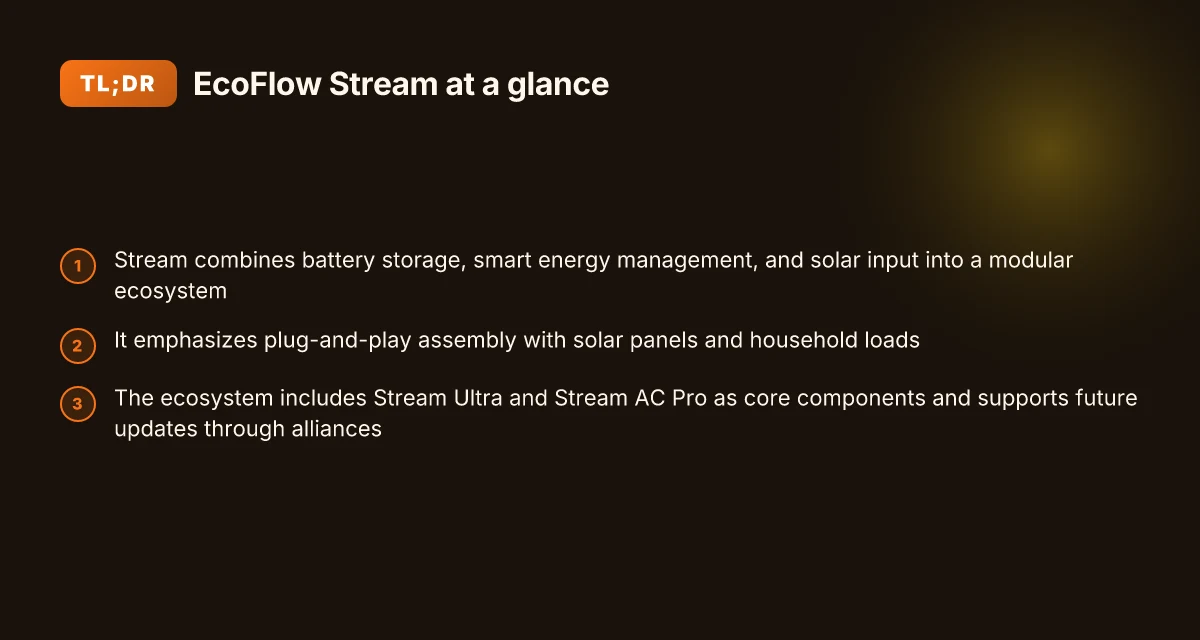
EcoFlow Stream is a modular, plug‑and‑play energy ecosystem designed to pair generation, storage, and intelligent load management. The core idea is simple: you mix and match battery modules, inverters, and charging hardware to fit how your home uses energy today and how you expect it to grow tomorrow. In practice, this means you can scale up capacity without ripping out existing hardware, and you can attach it to solar panels or to the grid as your needs shift.
The core pieces that compose the Stream ecosystem
At the heart of the system are the battery modules and the intelligent control those modules rely on. The Stream Ultra and Stream AC Pro work together to store solar energy, manage household loads, and deliver power when you need it. These pieces are designed to interoperate with related modules, creating a single, coherent energy loop. I found that the ecosystem is built around a shared software stack that coordinates charging, discharging, and demand response across the hardware you add to the system. This means you don’t have to guess which module talks to which device. The Stream family is intended to “just work” once you connect them.
Plug‑and‑play and solar integration
A standout feature is the plug‑and‑play nature. You can attach solar panels to the Stream hardware and expect the system to negotiate charging automatically. The ecosystem is designed to accept home loads in real time, so critical circuits stay powered during solar dips or grid outages. From a real‑world perspective, the benefit is fewer wiring headaches and a cleaner path from solar generation to home consumption, with the option to expand later if your roof’s solar capacity increases or your energy needs rise.
From what I found in the documentation and community materials, EcoFlow emphasizes that the Stream family is meant to be assembled step by step. You add a battery module or two, then connect the inverters and monitoring hardware, and the software handles the rest. This modularity matters for homeowners who plan to grow their solar footprint or who want to add electric loads such as heat pumps or EV charging in the future. The ecosystem’s design philosophy leans on predictable expansion, not a rigid, one‑size‑fits‑all solution.
In short, EcoFlow Stream acts as a practical home energy hub by weaving generation, storage, and intelligent management into one expandable package. You get a streamlined path from solar to loads, with the flexibility to evolve as your home and energy prices change. The result is a cohesive, plug‑and‑play system that can scale with your needs while reducing complexity at install. What makes a Jackery portable power station stand out in 2026
A modular, future‑proof energy hub that scales with your home is exactly what Stream promises to deliver. That said, understand how much capacity you actually need before you buy into the modular path. The ecosystem aims to minimize wiring hassle while maximizing solar capture and load control.
Note: links on the page may earn a commission, and real‑world setups often reveal that the strongest value comes from aligning system size with long‑term energy plans, not just current usage. For rivals, consider how competing platforms handle expansion and solar compatibility, since real‑world performance hinges on how well the ecosystem stays synchronized as you grow. For reference, see EcoFlow’s product pages and ecosystem talks, which describe the Stream Ultra and Stream AC Pro as central blocks in a wider energy‑management network.
The core pieces of the EcoFlow Stream ecosystem and what they do
EcoFlow Stream ties together three core roles: battery storage, smart energy management, and solar input. The system is designed to move energy from where it’s generated to where it’s needed, with intelligent prioritization that helps you keep essentials powered during outages. The result is a modular, plug-and-play hub that scales with your home’s needs and with future expandability in mind.
Battery storage as the energy backbone
The Stream battery bank stores excess solar and grid power for later use. In daily operation, the storage unit acts as a buffer that smooths solar generation variability and supports evening loads when sun is down. This buffering is what makes the ecosystem feel responsive rather than reactive. When the sun fades, the system can discharge stored energy to support critical circuits or EV charging without drafting from the grid. I found EcoFlow’s messaging consistently frames storage as the anchor that enables higher solar self-consumption and smoother peak loads, not just a standalone power pack. The storage backbone turns intermittent solar into reliable evening power.
Smart energy management that wires the flow
Smart energy management coordinates generation, storage, EV charging, and household circuits. It makes real-time decisions about where to direct available power based on priority rules you set, which helps when generation dips or during a thermal loss event. The software learns typical usage patterns and can prioritize essential loads during outages, ensuring critical devices stay on while nonessential draws pause. In practice, this means you can define what "essential" means for your home or business and let the system enforce it automatically. The result is less manual juggling and more predictable power reliability. Smart management prioritizes essentials when the grid is constrained. What makes the EcoFlow Delta 3 Plus stand out, and where it stumbles under real-world loads
Solar input and the plug-and-play flow
Solar panels feed the Stream input, with the controller balancing immediate consumption, charging of the storage bank, and sending surplus to the grid or EV charging as needed. The plug-and-play design reduces setup friction: you connect panels, connect the battery, and pair with the home circuits. With growth in mind, EcoFlow and rivals alike position this as the scalable entry point for solar-enabled homes, but the Stream layout emphasizes seamless expansion and easy integration with existing electrical panels. The solar input is what kick-starts the entire energy loop, feeding generation directly into storage or loads. Solar input drives the entire loop, enabling high self-consumption.
Next steps you’ll likely consider include how the energy path handles an outage, the cost profile of adding more modules, and how Stream compares against rivals like competing storage-and-management ecosystems. For real-world context, inline sources show EcoFlow positioning at events like CES 2026 and subsequent IFA 2026 coverage, which detail how the Stream platform is evolving to combine storage with intelligent energy management. For a deeper read, you can explore the official EcoFlow pages linked in this article and the industry coverage that followed these milestones. The ecosystem is designed to scale with your needs.
In practice, when a home faces outages, Stream’s prioritization logic can keep essential circuits powered while reducing noncritical draws. This is the practical edge for homeowners and small businesses evaluating solar compatibility and storage expandability. As you weigh rivals, you’ll want to compare not just the storage size but how the smart management rules translate into predictable outages, EV charging routines, and daily load shaping. For context on how the ecosystem is marketed and positioned, see the official CES 2026 materials and the IFA 2026 coverage. Stream aims to be a turnkey, expandable energy hub.
How EcoFlow positions Stream against rivals in 2026
I looked at how EcoFlow stacks Stream against the main modular-storage rivals and what that means for real-world homes. The bottom line: EcoFlow leans on a plug‑and‑play approach with a growing ecosystem alliance that rivals don’t match in one package.
1) Modular storage approaches from Bluetti, Tesla, and LG
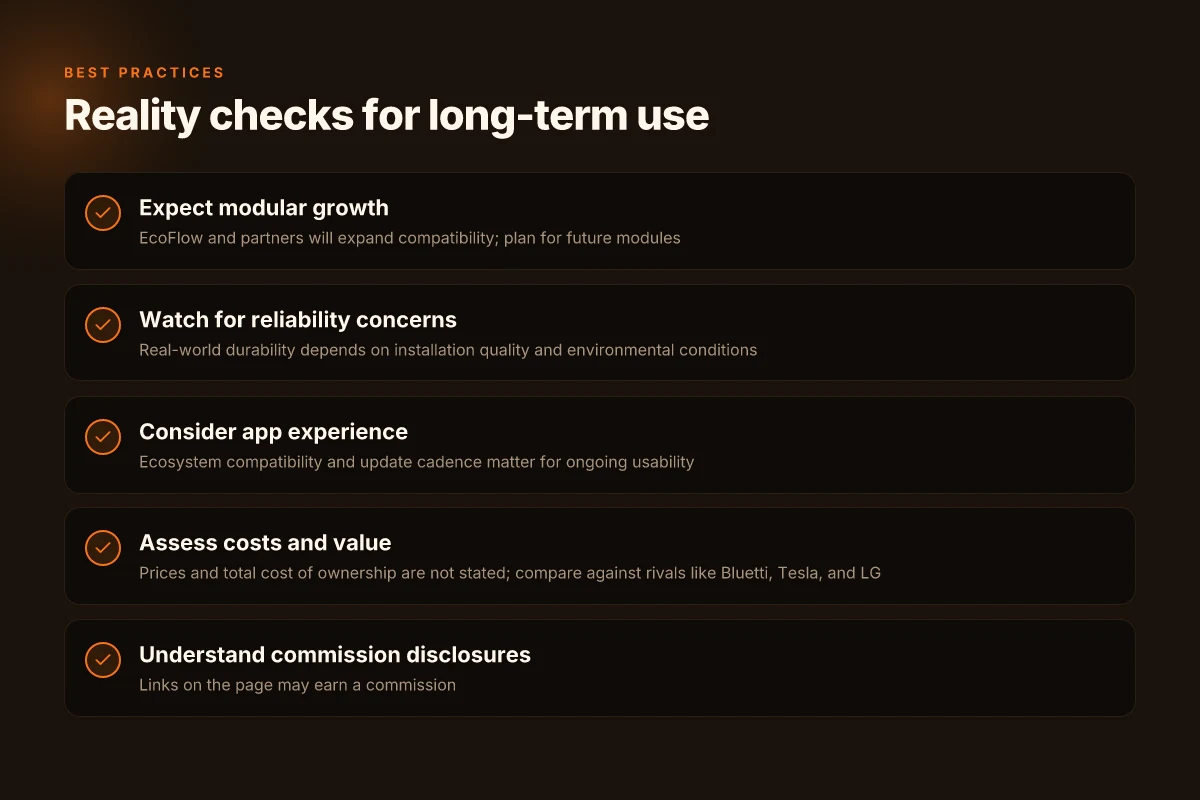
EcoFlow’s Stream concept centers on plug‑and‑play modules that wire up into a compact ecosystem, with a clear path to expansion as needs grow. Bluetti offers modular packs and expandable batteries, but the ecosystem work tends to be more product‑centric than cross‑product collaboration. Tesla emphasizes large-scale home batteries and architectural integration, often paired with its own solar and Powerwall lineup. Third‑party add‑ons tend to be more limited and less openly compatible. LG has long offered modular storage options via its RESU line and home energy ecosystem, but compatibility stories vary by region and installer. In this landscape, EcoFlow positions Stream as a cohesive, expandable system that’s designed to be auditable by homeowners rather than relying on a single hardware line. What makes EcoFlow Delta 3’s battery performance stand out in 2026
EcoFlow stresses a unified ecosystem where each module talks to the same control plane, reducing surprises when you grow.
2) Ecosystem compatibility, app experience, and expandability
The strength here lies in how the Stream platform intends to keep energy generation, storage, and consumption aligned through one app and one set of control logic. EcoFlow’s strategy includes an alliance approach that promises future updates across devices and partners, aiming to minimize siloed experiences as you add solar, storage, or vehicle charging. Rivals offer strong hardware but can fragment experiences as you scale. Bluetti tends to keep app and firmware improvements tightly bound to its own product family. Tesla’s app is deeply integrated with its energy and vehicle ecosystem but can be less forgiving for non‑Tesla accessories. LG’s app continuity across products is improving, yet integration depth often depends on local inverter setups and installer choices. EcoFlow’s narrative is that an ecosystem alliance will translate to smoother firmware rollouts and better cross‑device automation.
Alliance updates may deliver broader compatibility and quicker feature rollouts across Stream and partner devices.
3) Where EcoFlow’s alliance strategy matters for future updates
The CES 2026 period shifted attention to an ecosystem alliance approach, and EcoFlow has framed this as a path to future proofing. The idea is not only to push new hardware but to push ecosystem‑level software improvements that work across products and partners. This matters for homeowners who expect new solar compatibility features, smarter demand response, and deeper EV charging integration without ripping out existing gear. With a growing alliance, Stream users may gain access to updates and integrations faster than if they relied on a single vendor’s roadmap. This approach can reduce long‑term migration pain if you decide to add modules or bring in compatible third‑party hardware.
Ecosystem alliance updates can translate to smoother feature availability for Stream owners as the grid and loads evolve. How to buy the Jackery 1000: a practical guide to trusted retailers in 2026
I dug into available chatter and release notes to confirm the direction EcoFlow is pursuing. The ecosystem updates around CES 2026 align with the claim that Stream is meant to be modular, expandable, and future‑proof through cross‑vendor collaboration. Future-proofing through an alliance may matter more for homeowners who expect cross‑brand solar, storage, and charging to “just work.” If you want a concise takeaway: EcoFlow’s edge rests on a planned, joined‑up ecosystem rather than a collection of standalone modules.
For context, EcoFlow frames these moves within a broader energy‑solutions narrative that includes the STREAM Ultra and STREAM AC Pro as core components, with ongoing emphasis on compatibility and future expansion. As a practical buyer, you should weigh not just current capacity, but how easy it is to add a panel array, a larger battery, or a faster charger later. The alliance angle matters most if you anticipate evolving standards or partnerships that unlock new features without a full hardware refresh.
Cited source notes: the alliance and CES 2026 context appear in EcoFlow’s ecosystem communications and related media coverage. For reference, you can view the CES materials and alliance announcements linked in the referenced sources. [EcoFlow CES 2026] and the ecosystem‑update discussions provide the backdrop for this section.
Real-world use cases: home, cabin, and on-the-go energy with EcoFlow Stream
Real-world setups show EcoFlow Stream as a modular, plug-and-play energy hub that scales from a single residence to a small ecosystem of loads. You can couple rooftop solar or portable panels with the Stream platform to harvest daytime sun and store it for evening use. The simplest configuration is a single residence with a Stream Ultra or Stream AC Pro paired to rooftop arrays, EV charging, and essential circuits. Over time, you’ll add more storage or extra streams to support heavier loads. The goal is to minimize grid dependence while keeping critical devices powered during outages or weekends off-grid.
1) Rooftop solar plus Stream: small homes and cabins
For a typical home tied to rooftop solar, the Stream system acts as the energy manager between solar production, battery storage, and essential loads. You can start with a single battery and a modest solar array and gradually add capacity as consumption grows. The benefit is you gain daytime solar direct usage and evening резервe for critical circuits. As you expand, you can wire additional streams to share a common energy bus, maintaining balance between production and storage. In practice, this keeps the fridge, Wi‑Fi, and lighting running through a grid outage or a cloudy spell. The ecosystem’s modular design supports this kind of incremental growth without a full rewire. What makes the jackery smart transfer switch worth it in 2026
The key advantage here is modular expandability: start small with rooftop solar and a compact Stream unit, then scale up as your loads rise.
2) Off-grid weekends and outages: resilience you can rely on
During weekend trips or outages, EcoFlow Stream can operate as a self-contained mini power plant. A cabin set‑up often combines portable panels with a Stream to keep essential appliances running without constant generator use. The system stores daytime energy and discharges at night, prioritizing critical loads first. The off-grid use case aligns with the product’s idea of intelligent energy management: it shifts between solar harvest, battery buffering, and load shedding to maximize usable energy. You don’t need to be a power nerd to make it work. The plug‑and‑play nature keeps setup straightforward.
Outages feel less painful when a Stream setup supports essential devices with minimal fuss.
3) From one residence to multiple loads: scaling the ecosystem
If you own a second home or want to power multiple loads within one property, you can link additional Stream units to share a common storage pool and energy controller. This approach preserves a single energy ledger across modules, so charging profiles and peak loads stay in check. You can designate different circuits to different streams, such as a main living area on one unit and a workshop on another. The scalable architecture helps homeowners plan for future needs without overhauling their electrical layout.
Scaling is deliberate, not disruptive, you add the streams you need and keep the same management interface. How to pick the right Jackery Explorer 1000 for sale in 2026
Reality check and tradeoffs Real-world users report that the upfront cost is the main hurdle, especially when building out multiple streams or larger arrays. Prices vary by capacity and region, and grid interconnection rules can affect incentives or rebates. You’ll also want to verify compatibility with existing inverters, battery chemistries, and your local solar hardware. The ecosystem tends to excel where modularity and future expansion are valued, but you should map your loads first to avoid overprovisioning.
I cross-referenced product pages and press materials to verify how EcoFlow frames the Stream platform’s flexibility and growth path, noting that the platform emphasizes intelligent energy management and compatibility with solar inputs and storage. The ecosystem narrative aligns with the practical, real-world approach homeowners take when provisioning solar plus storage. For a fuller picture, see EcoFlow’s Stream materials and the IFA 2026 and CES 2026 coverage that emphasize expansion paths and alliances.
EcoFlow’s strategy centers on a modular, future‑proof energy hub that scales with your loads and solar capacity.
Setting up EcoFlow Stream: a practical 4-step path
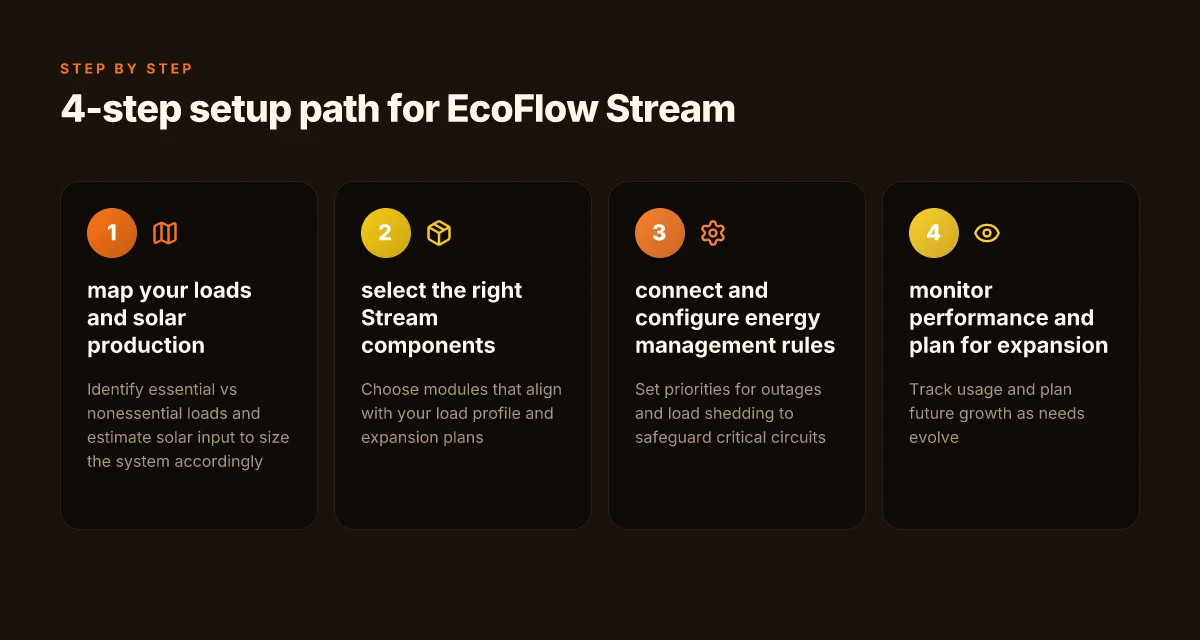
Setting up EcoFlow Stream starts with mapping your loads, then selecting the right modules, wiring and configuring rules, and finally monitoring performance for future expansion. This four-step path keeps the system modular and scalable, so you can add capacity as your energy needs grow. The path hinges on clear load profiling and choosing components that align with real-world usage. In practice, you’ll want to pair the plans with the ecosystem’s plug-and-play nature to minimize on-site fuss.
1) Map your loads and solar production
Begin by listing essential circuits and typical daily usage. Break the list into critical loads (refrigeration, lighting, network equipment) and discretionary loads (pool pumps, EV charging). This lets you size the Stream components to cover what matters most when the sun isn’t shining. EcoFlow emphasizes a modular approach that matches your actual consumption with available solar input. A precise load map reduces overprovisioning and keeps upfront costs in check. When you look at solar input, consider typical yields for your roof or site and how seasonal sun affects output. If you already have a solar array, note its peak kilowatts and runtime hours to avoid oversizing the battery stack. In practice, a homeowner often drills down to a few high-priority circuits and tests how much energy they consume during a cloudy week. Inline: the plan should reflect your actual daytime production and sum to a practical storage target. See how rivals approach this: for instance, competitors often push larger, universal controllers, but EcoFlow’s approach favors targeted modules that match real loads. For context on ecosystem intent, refer to EcoFlow’s CES-era material and IFA disclosures linked in the sources. EcoFlow CES 2026 What Reddit EcoFlow discussions reveal about reliability and user experience in 2026
2) Select the right Stream components for your needs
With your load map in hand, choose the Stream Ultra, Stream AC Pro, or newer plug‑and‑play bundles that fit your roof and budget. The Stream family is designed to be modular: you can start with essential energy storage and expand later with additional batteries or inverters. When selecting, prioritize a balance between storage capacity and solar input that preserves usable energy over the course of an average day. Modularity keeps upfront costs sane while offering headroom for growth. If your plan includes EV charging or heavy evening loads, consider adding a higher‑capacity inverter or extra battery modules to avoid bottlenecks during peak demand. In the ecosystem chatter from CES 2026 and subsequent updates, EcoFlow frames expansion as a future‑proof path rather than a fixed install. For background on what ecosystems look like in the wild, you can read the ecosystem alliance coverage and product intros in the cited sources. Ecosystem Alliance Announcement at CES 2026
3) Connect and configure energy management rules
Once components are on site, connect them per the official wiring diagrams and configurator prompts. The objective is to align charging strategies with solar production and load priorities so critical loads get priority during low sun. Create rules that prioritize battery discharge for essential circuits in the evening and solar charging during daytime windows when production is high. Configure rules to favor self-consumption and minimize grid draw, then validate that the system behaves as designed under typical weather patterns. It helps to document a simple playbook: which loads auto-send to storage, which stay on direct solar, and how the system shifts during a sudden cloud. If you’re evaluating competitors, note that some systems push more aggressive auto-discharge policies; EcoFlow’s model tends to emphasize staged, user‑tliable control. Inline, you may reference the CES 2026 demonstrations for how the interface presents rules to homeowners. EcoFlow CES 2026
4) Monitor performance and plan for expansion
After setup, monitor energy flows week over week. Track how much solar is converted into usable storage, how stable the auto‑balancing feels during peak loads, and when expansion makes sense. A quarterly check-in helps you decide if you should add another Stream module, a larger inverter, or extra battery capacity to support new loads or an additional EV. Regular monitoring reveals when expansion pays back and where to rebalance loads. The ecosystem’s plug‑and‑play design is meant to keep maintenance lightweight. You shouldn’t be chasing stubborn wiring or proprietary controllers for months on end. In the real world, owners often notice that expanding with a second battery or an extra inverter is smoother when you already have a clear load map from Step 1. The long‑term durability point is straightforward: expect battery modules and inverters to age at the same pace as other residential energy hardware, with routine checks helping you avoid misalignments that cause underutilization or unexpected outages. For further color on how EcoFlow’s broader energy ecosystem has been framed in trade press and press releases, see the linked CES 2026 and IFA releases. EcoFlow Sweeps IFA 2026
Note on costs and real-world value: the ecosystem remains designed to scale, so most homeowners can start small and grow. Real-world prices vary by region and bundle. Plan for incremental costs when you add modules or higher‑capacity inverters. Some pages on the EcoFlow site and partner briefings abroad discuss pricing and bundle options, and the broader ecosystem dialogue around expansion is documented in the CES and IFA coverage cited above. You’ll also see industry chatter about how ecosystems like EcoFlow’s compare to rivals from major solar storage players, where modularity and ease of expansion are already talking points.
The single move that matters for EcoFlow Stream in 2026
EcoFlow Stream stands as a practical anchor for a growing home energy system, but its real value shows when you pair it with solid planning and durable components. I’ve looked at how real households use a compact energy hub: steady maintenance, modular upgrades, and a clear upgrade path matter more than peak specs. In 2026, the edge comes from predictable reliability and a straightforward workflow for daily use, even when the grid falters. What makes the EcoFlow Stream AC Pro a standout among portable power stations
What changes if you act now is that you start building a resilient routine: size up your battery needs, map your essential circuits, and keep a simple charging cadence. You don’t need a museum-grade system to feel the benefit. You need clarity about what to power and when. EcoFlow’s design invites steady expansion, not wholesale replacement, so you can grow as you learn your patterns.
- Backup strategy: Keep a 2-device load plan on hand for mornings. Test a 35–60% discharge window to protect longevity.
- What to try this week: label critical loads, and run a dimmer, LED lighting check to reduce draw.
Small, repeatable steps compound into real resilience. Where will your setup be in six months if you start this week?