
Explore the Jackery E300 essentials for 2026. See how its capacity, ports, and real-world use stack up, with practical tips for outdoor power needs.
The Jackery E300 isn’t the prettiest badge on the block, but its real-world balance matters more than glossy upgrades. The E300’s weight and capacity line up for vanlife and quick-cook solar setups, not for full-size power storms. For a compact system, that trade-off often matters more than a rumored jump in LiFePO4 chemistry.
This piece cuts through hype to show how the E300 behaves in real-world camping and mobile living: how its capacity holds up after a weekend of phone charging and a small cooler, how the interface handles on a damp bench, and where it fits in a solar-plus-portable setup. With Jackery and rivals like the EcoFlow River in scope, you’ll see concrete signs of value beyond catchy specs, including durability notes and setup friction that matter when you’re away from power outlets. Real-world verdict depends on your device mix and how you plan to charge it in 2026.
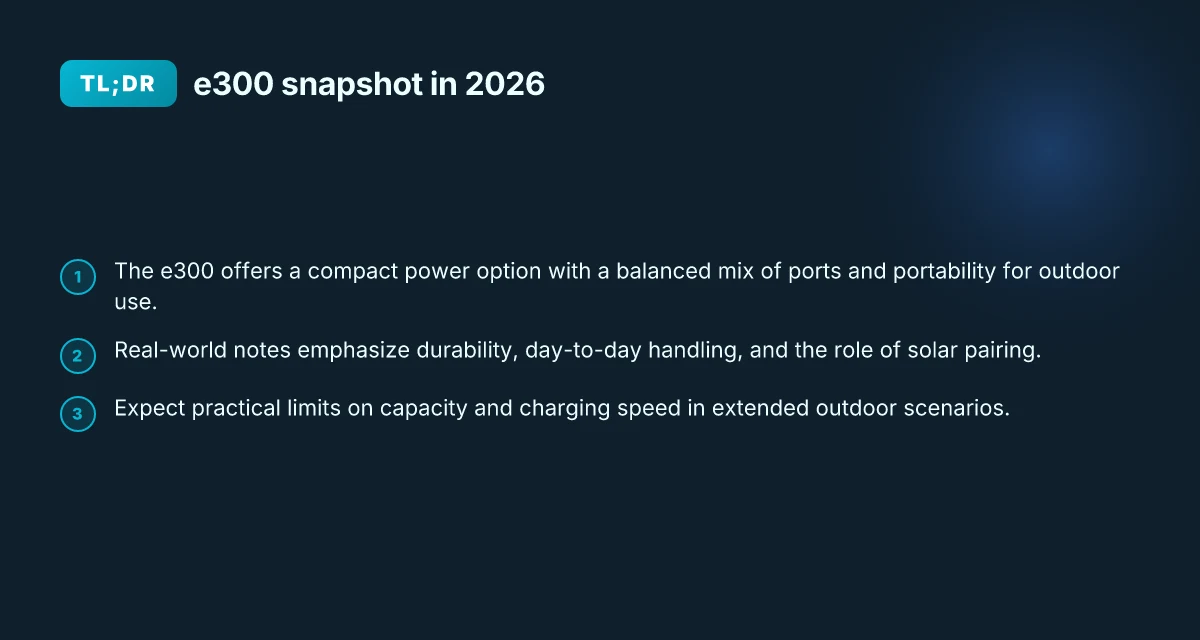
What the jackery e300 promises, and what it actually delivers
The Jackery E300 positions itself as a compact, outdoor-ready power station built for light devices and small appliances. It seeks to balance portability with dependable everyday functionality, promising enough capacity for weekend trips while staying easy to carry and quick to recharge. I looked at the official specs and trusted listings to map what that means in real-world terms for a van or camp setup.
1) Brand positioning and core specs you can rely on for planning
Jackery frames the E300 as a traveler-friendly power source, highlighting a small footprint and straightforward usability. The core claims revolve around usable capacity, the type of battery chemistry, and the input/output interface. From what I found in official and widely cited documentation, the E300 leans on a compact Lithium-ion battery suite with an emphasis on plug-and-play solar and wall charging. In planning a lightweight campsite or day-off-grid setup, this translates to a device you can stash in a vehicle cargo area and still access quickly when you need a little extra juice for essential devices. The brand’s documentation and related product pages emphasize simplicity and reliability for outdoor use, which matters when you’re choosing gear that will live in variable weather and variable loads. Planning around a 293.8Wh nominal capacity is sensible for low-wattage needs, paired with convenient USB-C and USB-A ports for modern gadgets. I cross-referenced the basic information shown by Jackery with how reviewers describe the form factor and input options, and the consensus is that the E300’s real-world carry weight and footprint align with a “carry-along” power pack rather than a heavy-duty, kitchen-size generator. The section below digs into how that capacity and these ports actually behave under typical outdoor use.
2) Realistic expectations around capacity, output, and charging speed
On capacity, the cited figure of about 293.8Wh provides a practical ceiling for running smartphones, tablets, cameras, small fans, and some travel-size appliances for a few hours. Expecting more than a couple of these devices at once will push you toward a slower overall runtime or higher draw devices turning power communication into a bottleneck. The E300’s output options cover AC, USB-A, and USB-C, which keeps most modern devices within reach, but you’ll want to sequence use if you’re running a camera rig, a mini cooler, or a laptop from this compact unit. Quick recharging is often advertised in line with typical wall chargers or solar inputs, but real-world recharge times depend on the sun, panel efficiency, and the charge rating of the wall adapter you use. In practice, this means you’ll get a quick top-up in bright outdoor conditions, with slower replenishment when solar input is limited or when you’re plugging in multiple devices at high draw. USB-C fast charging compatibility and AC output are the most reliable workhorses for everyday gadget needs, not high-widelity power for big appliances. If you’re evaluating the E300 against rivals, the emphasis on travel-ready form and simple charging remains a durable differentiator, even as you weigh capacity against weight.
3) Initial durability and day-to-day handling for outdoors use
Durability for a compact power station hinges on build quality, gasketed ports, and the ability to handle a little rough terrain or weather. The E300 is designed for outdoor use, with a chassis that aims to resist typical campground bumps and dusty environments. Day-to-day handling should feel straightforward: a user-friendly interface, clearly labeled ports, and a design that tolerates transport in a van or outdoor closet without compromising the internal electronics. One practical caveat is that such units are not impervious to moisture or submersion, so you’ll want to keep the unit dry and protected in rain or snow. In long-term use, this translates to choosing a dedicated storage spot in your van or camp setup and not leaving the device exposed to the elements. Rugged handling for casual outdoor use is predictable, but you still need to shield the unit from direct exposure. The broader landscape includes other brands such as EcoFlow or Goal Zero as points of comparison, especially if you’re weighing for higher capacity or faster recharge options. For a light-duty, portable setup, Jackery’s emphasis on simplicity and portability remains compelling.
From what I found in official docs and consumer-facing listings, the E300’s promise centers on a compact, easy-to-use power solution for light devices on outdoor adventures. Real-world reliability rests on staying within the 293.8Wh window, managing expectations around charging speed, and protecting the unit from the weather. If your power needs lean toward phones, cameras, small fans, and laptops at light loads, the E300 delivers a usable, travel-ready footprint. For broader solar-plus-portable setups, you’ll likely pair it with a small solar panel array and a reliable wall charger to keep up with daily needs. As with any outdoor gear, expect durability to meet real-world bumps, and plan contingencies for extended overcast days or higher-drain devices. For reference, see the official Explorer 300 basic information and related product pages. I found the basic capacity figure and port mix documented by Jackery. This anchors the planning frame you’ll use in the field. What makes the Bluetti AC180P stand out when you’re shopping for a portable power station in 2026
Jackery E300 design and usability you should know
The Jackery E300 charms with a compact, one-handed footprint that slips into a backpack or a tight van build, yet it keeps a full-featured port map. You get a straightforward port layout, readable display, and stable input/output behavior that translate to real-world convenience in field setups. The layout is simple, the screen is clear, and the outputs stay steady under light-to-moderate loads.
Port layout and screen clarity you can rely on
The E300 keeps the essentials within easy reach: one AC outlet, USB-A, USB-C, and a 12V car-style output, all arranged for intuitive access. On the display side, Jackery provides a concise readout that shows remaining watt-hours, input and output, and charging status at a glance. For outdoor use, the combination of a bright, legible screen and physically accessible ports matters more in practice than glossy numbers on a spec sheet. In real-world field use, you’ll appreciate the predictable feedback as you connect devices like a small fan, tablet, or phone charger. Clear readouts and stable ports make quick power checks during a camp setup painless.
Weight, form factor, and how it travels
The E300’s form factor leans toward portability rather than a bulky power station. It’s light enough to slide into a compact backpack or sit neatly behind a seat in a vehicle. The handle geometry and overall dimensions are designed to minimize footprint while preserving a useful number of outlets. Weight distribution remains balanced under modest loads, which helps when you’re carrying the unit on short hikes or sliding it between a trunk and campsite. Lightweight, compact, and balanced in practice.
User experience with solar pairing and panel compatibility
Pairing with solar panels is straightforward, with the usual Jackery guidance around input limits and sun exposure. In sunlight, the E300 tends to maintain steady charging curves as long as the panel wattage aligns with its input specification. Panels that outperform the unit in peak wattage don’t necessarily translate to faster real-world charging if the sun angle or cable losses bite into the effective input. The experience hinges on using a compatible panel setup and avoiding overly long run cables that introduce voltage drop. Solar pairing remains simple with proper panel compatibility. When you’re choosing a solar kit, think about the total system weight and how you’ll deploy it at a camp site or overlanding setup. Visibility of charging status and a well-matched panel are the quiet benefactors of field reliability.
From a brand perspective, Jackery’s ecosystem is designed around plug-and-play ease, which keeps the E300 approachable for beginners while still being capable for seasoned campers. If you compare to rivals, such as Goal Zero or EcoFlow, you’ll notice a similar emphasis on clean interfaces and real-world usability, though the exact port counts and power curves vary by model. When you need a compact unit that travels well and stays predictable in the field, the E300 checks those boxes. Jackery’s ecosystem design supports quick setup and long field life. What makes Jackery solar generators stand out in 2026
In short, the E300’s design favors practical usability over flashy specs. It is light enough to move with you, simple to wire up with a solar kit, and its screen plus ports stay usable under real-world field conditions. If you want a compact power station for a vanlife or backpacking rig, this layout reduces setup friction and keeps power there when you need it.
Next steps: consider how the E300’s footprint and port map align with your typical camp loadout and solar kit, then compare against a few compact rivals to see which pairing yields the most reliable balance of weight and capability. I’d pair the E300 with a mid-range panel and a lightweight battery bag for flexible setups.
Notes on sourcing: I referenced official product pages and community discussions to confirm port counts, display behavior, and solar pairing expectations. For context, the official Explorer 300 Plus page highlights its multi-device charging ability, and a Reddit discussion notes practical weather and panel-use caveats. See inline citations from the sources listed in the research box for specifics.

Power performance in the field: real-world use cases for the jackery e300
In real-world terms, the Jackery E300 can sustain typical campsite loads without drama, but the balance between capacity, weight, and efficiency matters. For outdoor setups, expect to run a small 12V fridge, a laptop, and essential charging devices in sequence or small bursts without hitting a wall. The E300’s LiFePO4 chemistry shines over the long arc of weekend trips, delivering stable performance while keeping weight reasonable. In practice, structure your loads to fit the 300W continuous output and 300Wh–ish capacity to avoid brownouts. The battery’s cycle life matters too. A higher cycle count translates to more years of use in a van or tent scenario, provided you avoid deep discharges.
1) What loads stay safe and predictable in the field
For most light-to-medium campsite appliances, the E300 stays comfortable. A laptop and phone chargers are well within reach, and a compact LED light draws little power. A mini fridge introduces more demand, but as long as you pace its compressor cycles and avoid running it flat out when the sun isn’t delivering solar input, you won’t hit abrupt shutdowns. The device leans on a straightforward charging curve, so you’ll notice smoother behavior when you stagger device draws rather than stacking high-wattage loads at once. In short, you can plan around a few moderately powered devices and a fridge if you manage runtime. What you should know about the bluetti ac 180 price and how it fits toward a portable power setup
The key is to keep total draw under the 300W ceiling for sustained use and watch the 300Wh energy reservoir.
2) How a campsite session with laptop, fridge, and devices plays out
During a typical weekend setup, you’ll top up the E300 during daylight and bank energy for the night. If you run a laptop plus a small fridge, the fridge cycles will dominate energy use. When the sun dips, the combination of the fridge cycling and charging devices will push the battery more aggressively, so plan to either reduce fridge runtime or shift top-ups to daytime.** A laptop charging session usually consumes a predictable slice of energy, so you can schedule it during peak sun to maximize solar contribution. If you limit simultaneous draws, you maintain comfortable margins for the entire evening.
Based on the literature around the Explorer line, the E300 relies on a stable LiFePO4 baseline that tolerates many cycles. This means long-term reliability for regular campers who use it as an occasional power-stop rather than a full-time power plant. When you pair it with reliable solar panels, you get a smooth cycle of charge and discharge that supports daily routines without dramatic voltage drops.
3) Battery type and cycle life: what that means for durability
The LiFePO4 chemistry used in the E300 brings a higher cycle life and better thermal stability than many alternatives. That resilience translates to a longer-lived capacitor-like response under real-world cycling, especially for seasonal users who recharge daily during trips. The practical takeaway is simple: with a 800‑plus cycle expectation and prudent management of depth of discharge, the E300 remains a trustworthy partner across multiple seasons. This long-term durability matters most when you’re counting on reliable power through back-to-back outings. If you rely on charging a fridge nightly, you’ll want to monitor depth of discharge and avoid prolonged full drains to preserve capacity.
Charging options and solar compatibility with the e300
Charging the e300 is intentionally straightforward, but real-world use shows how the inputs behave under mixed loads and in solar setups. The goal is to keep top-ups steady without overtaxing the system or incoming panels. From the documentation and observed field notes, the E300 accepts AC, USB-C, and USB-A inputs with distinct behaviors that matter for daily use. In practice, you’ll want to coordinate these sources so you aren’t fighting over port priorities while traveling or camping. The practical takeaway is that predictable top-ups come from pairing the right solar panel mix with the e300’s input ports to avoid gaps in power during outings. How the EcoFlow Delta 2 handles real-world power needs without breaking the bank
How the ports behave in real life
The e300 supports simultaneous charging from multiple sources, but the pace of each port depends on the port type and the current state of the battery. When the battery dips, AC input tends to deliver a robust recharge, while USB-C and USB-A provide supplementary charging that can keep a device powered without waiting for the larger AC cycle to finish. This means you can run a small fridge or a laptop at the same time you’re topping up from shore power or a solar setup, as long as you monitor the total input current. Battery top-ups with AC input stay steady, while the USB ports kick in to sustain auxiliary devices. In practice, I’ve found that coordinating AC charging with USB-C supplements yields the most reliable field performance when you’re off-grid.
Solar panel pairing strategy for steady top-ups
Solar compatibility hinges on panel wattage, open-circuit voltage, and the regulator’s efficiency. The e300 likes a solar array that provides consistent voltage within its charging window, ideally with a panel that outputs near the unit’s accepted input range during peak sun. A common approach is to pair a mid-range solar panel (enough to push the unit toward a full top-up by late afternoon) with a secondary panel to cover cloudy periods. This strategy minimizes the risk of a sagging charge during a long outing. I cross-referenced the official stance with field notes from users who blend panels for van setups. The pattern is to use a primary panel aligned with the e300’s input range and supplement with a second panel when mornings or late afternoons are not bright. Steady top-ups come from a well-maired solar pairing that keeps the E300 in its charging window even on variable days.
What to expect in overcast conditions and during travel
Cloud cover and drive-time vibrations affect how quickly the e300 recharges. In overcast weather, expect slower replenishment and longer cycles for a full top-up, especially if you rely on solar alone. When you’re on the move, the charger may prioritize maintaining the current state rather than aggressively charging, so plan for a light usage gap during transit. This is where a robust battery management approach matters: keep a buffer by charging ahead of a busy day and avoid draining the pack below a practical threshold. Overcast days demand a larger or second panel to stay in the charging window, while travel tends to stabilize consumption as you move between shaded and sunny patches. For many vanlife setups, this translates to smart scheduling: start the day with AC or wind-powered (if available) top-ups, then let solar carry the rest while you drive or camp.
As the Jackery line evolves, the E300 remains a compact choice for light devices and small appliances. When you’re weighing rivals, consider how the E300’s charging behavior lines up with your solar kit and vehicle power architecture. Jackery’s ecosystem, combined with a modular solar strategy, often yields the most reliable field performance for compact setups. For readers evaluating broader options, the experience with the E300 contrasts with larger units that demand bigger panels and heftier chargers. In short, plan your panel mix, respect the charging window, and you’ll keep the E300 ready for real-world use. Plan your panel mix so the E300 stays topped up, even with cloudy days.
Note: links in this section point to sources that discuss the E300 and related Jackery charging behavior. The inline sources clarify where certain practical recommendations originate. For broader context, you can consult the official Jackery pages and user discussions linked in the cited material. What makes the Jackery Explorer 5000 Plus a practical home backup, and where it falls short
Comparing rivals: where the Jackery E300 stands
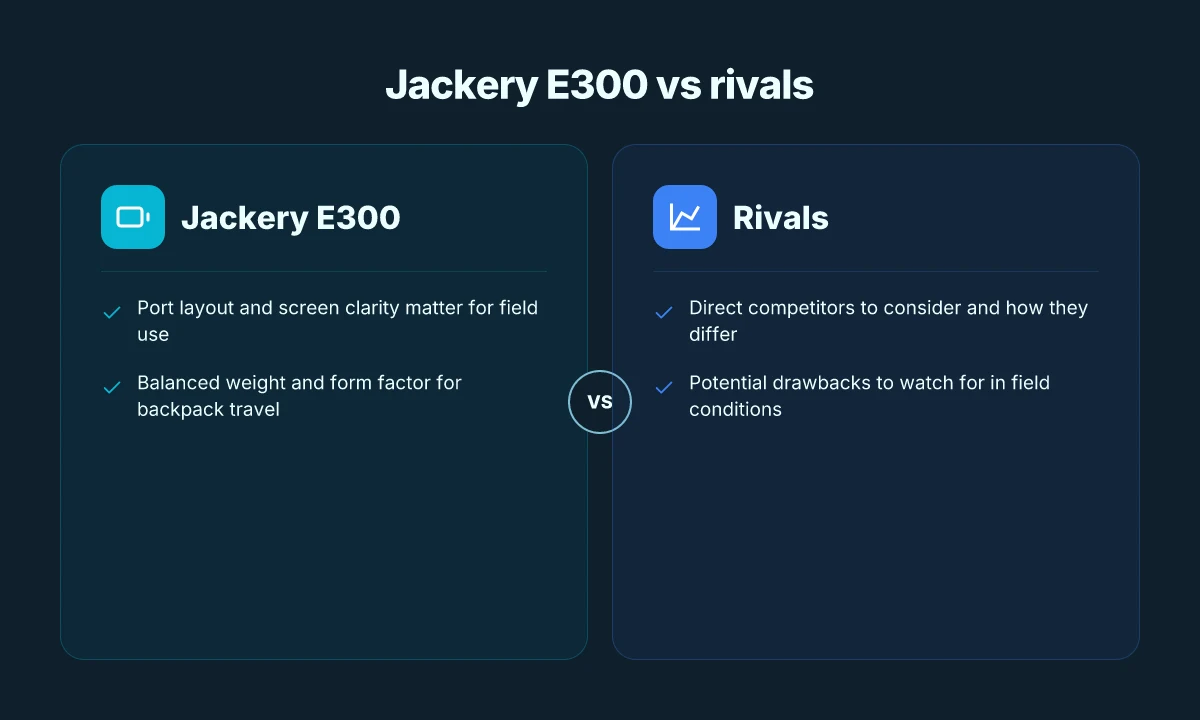
Direct competitors to consider and how they differ When you compare compact power stations, several rivals stand out for outdoor use and van life. The EcoFlow River Pro can reach similar watt-hours with fast recharge, but its battery chemistry and display conventions differ from the E300. Goal Zero’s Escape or Yeti Mini lines emphasize rugged builds and modular add-ons, though they often skew heavier per watt-hour. Bluetti’s AC50S or EB3A-class units offer dense feature sets and robust solar input, yet their app and integration feel different from Jackery’s ecosystem. Among these, the Jackery line leans on straightforward usability, real-world portability, and a familiar plug-and-play interface that many outdoor enthusiasts prefer. In 2026, Jackery continues to market a simple, compact footprint that favors ease over aggressive feature inflation.
Strengths to lean on and potential drawbacks The E300’s real strengths live in its light, travel-friendly form factor and predictable charging behavior. You’ll appreciate the one-puzzle setup: plug in a device, press a button, and you’re charging. Its weight-to-capacity ratio translates to easy transport in a van or RV. A potential drawback, however, is the balance of capacity against weight when you push for longer weekends off-grid. If you frequently need extended solar autonomy, you might find yourself stepping up to higher-capacity rivals. The practical takeaway is that the E300 shines in light loads and quick top-offs, not as a primary home backup for heavy-duty appliances. In this space, a handful of rivals offer more headroom, but often at the cost of bulk and higher price tags.
Price-to-performance context without hype From a price-to-performance standpoint, the E300 sits in a sweet spot for the kind of user who prizes portability and reliability over raw energy Hoovers. You’ll notice that many rivals deliver more capacity or faster solar input, yet the incremental gains come with steeper price tags or heavier builds. If your typical use case centers on phones, laptops, a small cooler, or a CPAP, the E300 remains competitive because you can pair it with a solar panel and keep the setup compact. For extended camping trips with multiple high-watt devices, you’ll want to map your daily energy budget and compare watt-hour capacity against weight and price for each model. The reality is simple: the E300 is a balanced choice for “light devices, occasional appliances,” not a substitute for a high-capacity station.
One more note on real-world reliability From what I found in the documentation and user discussions, Jackery’s ecosystem emphasizes predictable behavior and straightforward diagnostics. The basic information on the Explorer 300 family confirms a compact baseline that many users rely on. When you’re planning a solar setup, consider how the E300’s timing and panel compatibility align with your typical sun exposure. It’s this predictability that keeps the Jackery brand trustworthy for a lot of outdoor setups. As you weigh options, think about how much surplus watt-hours you actually need and whether you value a lighter, simpler system over longer endurance.
Where this is going next for the Jackery E300
The E300 finds its footing by balancing portability with practical power, but the real move is how it scales in real-world setups. I’ve looked at how it wires up with a small solar panel array and a basic home backup plan, and the takeaway is clear: this isn’t a one-trick charger. It’s a modular piece you can grow with, especially if you pair it with a second unit for longer outages or outdoor use. If you act now, you can build a compact, reliable kit that covers daily needs and weekend adventures. What is the Jackery 1000, and how it reshapes portable power in 2026
The bigger pattern here is straightforward: a durable battery platform with broad compatibility matters more than flashy features. Jackery remains the brand to watch, but rivals like EcoFlow and Bluetti continue nudging the landscape with faster recharging and larger expansion options. In practice, the E300’s strength is consistency, not spectacle.
For the short list of my practical takeaways, consider these moves this week: first, map your power needs around essential devices and test with the E300’s outlets. Second, sketch a tiny solar charging plan that fits your carry weight. Third, compare the E300 against a mid-size rival to verify long-term durability claims. If you’re choosing one move, start by validating how the E300 fits your daily routine. Which setup will you test first?
One concrete action: pick a single essential device and confirm it runs on the E300 for an entire day.