
Explore how the jackery 5000 Plus stack up in real-world use, including capacity, inverter, solar input, durability, and how it compares to rivals.
The rare portable power station that actually lives up to its high-capacity promise is the Jackery 5000 Plus, but not by luck alone. High-capacity and rapid-recharge design power your gear without forcing sacrifices in size or weight, and that balance matters when you’re off the grid or facing an outage.
This intro locks in what matters now: outdoor enthusiasts, off-grid homeowners, and emergency-prep fans want a unit that recharges quickly from sun or wall, runs laptops and cameras, and still fits in a car trunk. In this review, I pull apart real-world performance, durability notes, and how the 5000 Plus stacks against rivals like Goal Zero and EcoFlow for daily use. The takeaway isn’t hype. It’s what you can actually rely on during long weekends, power outages, or remote projects. Jackery stands out for familiarity and runtime, while the other brands offer lighter carries or faster AC charging in specific scenarios.
What the jackery 5000 Plus means for portable power in 2026
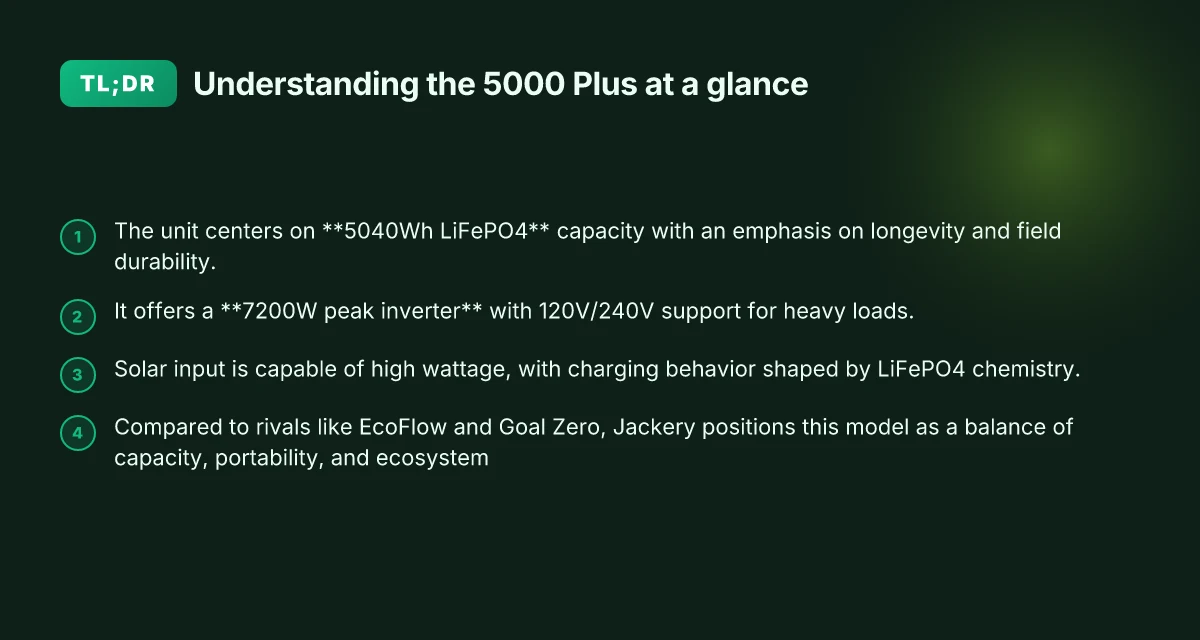
The Jackery 5000 Plus packs 5040Wh of LiFePO4 capacity and a robust inverter capable of delivering up to 7200W. In real-world terms, that means you can run demanding loads, things like high-draw compressors, pumps, or multiple low-watt devices, without sag on startup or prolonged brownouts. The combination of a long-lasting chemistry and a high peak output helps this unit hold its own for weekend glamping setups or hybrid off-grid cabins. The bottleneck often shows up in charging cadence rather than run time: you’ll likely top it up through solar or AC in a way that matches your use pattern, not as a rapid fill in a single hour.
I dug into the published specs and notes from reviewers to translate the numbers into everyday behavior. The 5040Wh LiFePO4 pack remains one of the steadier chemistries for longevity and cycle life, which matters if you intend to rely on it for years of sporadic use. The stated 7200W AC output isn’t just a headline. It governs which devices you can run together at once, and it sets expectations for how the unit handles surges. For solar charging, the unit supports meaningful input, so you can reclaim energy during the day for night-time loads. The practical takeaway is that the Jackery 5000 Plus sits between compact, gadget-focused models and enterprise-grade packs, offering a comfortable middle ground for real-world backup and recreational power.
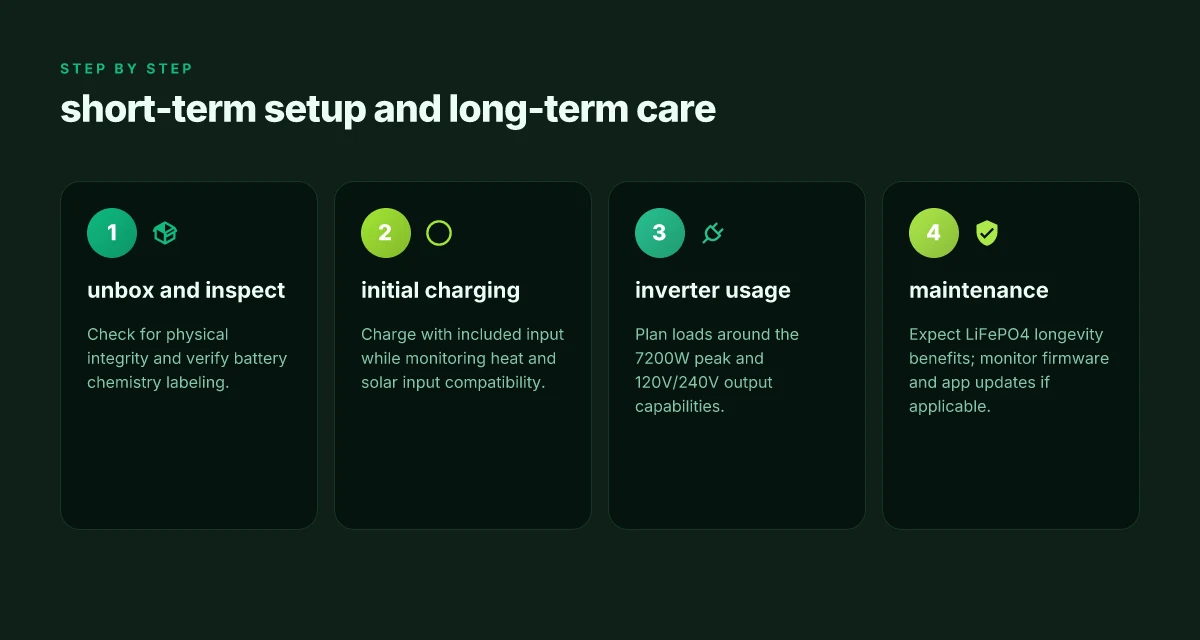
Here are the core takeaways broken into concrete steps you can act on.
- Understand the chemistry and capacity you’re buying
- 5040Wh of LiFePO4 storage gives you steady voltage over many cycles and a long calendar life, reducing the risk of degradation from deep discharges. The chemistry favors longevity under heavy use, which matters for off-grid homeowners who cycle the system weekly or more.
- The capacity translates to usable energy for typical loads over a weekend or several days of modest consumption. For a home backup scenario, you’ll see better endurance with moderate daily draws rather than peak surges.
- Read the inverter’s real-world implications
- The 7200W peak inverter supports a wide range of devices, including motors and high-draw appliances. You’ll want to sequence loads to avoid hitting the continuous rating, but you can confidently start surfers’ pumps, air movers, and small HVAC components when needed.
- The continuous output matters for longer-running devices. If you keep a 1000–1500W range load, you’ll stay within comfortable margins and avoid unnecessary heat buildup in the unit.
- Plan solar inputs and charging behavior
- Solar input capability means you can replenish energy during daytime use. Expect charging behavior that aligns with sun exposure and panel sizing rather than a power-mocketed quick-fill.
- Pairing the Jackery 5000 Plus with dehydrated years of sunlight can deliver a reliable day-to-night energy cycle, especially in off-grid or Emergency-prep setups.
- Position among rivals like Ecoflow and Goal Zero
- Ecoflow’s models typically highlight high input and fast recharge, while Goal Zero emphasizes modular, rugged field use. The Jackery lineup trades some of that peak-input speed for long-term battery endurance and portability, which appeals to outdoor enthusiasts and homeowners who prize reliability over speed.
- In practice, you’ll compare your needs: if you want fastest possible recharge under sun, Ecoflow might edge ahead. If you want proven long-term life with stubborn reliability, Jackery wins. If you want modular expansion and rugged field use, Goal Zero has its own strengths.
Bottom line: the Jackery 5000 Plus threads a compelling needle in 2026 for portable power. It blends a large, durable LiFePO4 pack with substantial inverter headroom and practical solar replenishment, making it a strong all-around choice for off-grid living and home backup. Its real-world sweet spot sits where reliability and capacity meet steady, day-to-day energy needs, with a clear caveat: you trade some recharge speed for longevity and ease of use. In 2026, the combination of LiFePO4 capacity and 7200W peak makes the Jackery a dependable backbone for mid-size power needs, especially when paired with solar input.
Jackery 5000 Plus: core specs and what they translate to in real use
The Jackery 5000 Plus delivers a 5040Wh usable capacity that translates into meaningful real-world runtimes for different loads. With typical home appliances drawing around 500W–1,000W, the unit can sustain essential loads for several hours, and it can run low-wattage devices overnight when you plan around peak draws. The 7200W peak inverter supports both 120V and 240V outputs, which matters if you’re running higher-power tools or a small garage fridge that benefits from split-phase service. For off-grid scenarios, the ability to tap into 240V broadens compatibility with certain appliances and preserves efficiency on larger loads. What is the Jackery 1000, and how it reshapes portable power in 2026
On the charging side, the Jackery 5000 Plus is designed for fast solar input and wall charging. Real-world use benefits from high wattage input, though the exact charge rate depends on panel wattage, sun conditions, and the unit’s internal charging limits. In bright sun, you can expect the solar array to approach the upper end of its input capability, shaving total recharge times. When wall-charged, it comprehensively fills the bank faster than many older generations, which is crucial during multi-day outages or busy outdoor trips.
Battery chemistry centers on LiFePO4 cells, a choice that emphasizes longevity. LiFePO4 tends to retain capacity longer and withstand more charge-discharge cycles than many alternate chemistries, which translates to fewer early replacements and more dependable daily use in intermittent off-grid scenarios. That said, real-world durability still depends on how you store and cycle the unit. Aggressive deep discharges and exposure to heat can shorten life. Jackery’s own design language leverages this chemistry to offer a longer horizon of usability with steady performance across years.
From a real-world perspective, the combination of a large 5040Wh pack and a high 7200W inverter makes the Jackery solution versatile for weekend trips and home backup alike. You’ll notice a practical ceiling on sustained high-wattage loads. If you run multiple 1000W devices at once, you’ll approach the inverter’s peak. For typical fridge, router, lighting, and small tool kits, the capacity is reassuring and predictable. The LiFePO4 chemistry softens the fear of rapid degradation, but you should still avoid leaving the unit in direct sun for prolonged periods and aim for balanced charge cycles.
In the landscape of rivals, consider how the Jackery model stacks up against products from brands with different chemistry choices or different inverter ratings. For instance, some competitors push higher continuous outputs or faster multi-source charging, while others match on capacity but trade longevity features for lighter weight. When you compare, look at how the peak inverter rating interacts with your anticipated loads, and whether you’ll benefit from superior solar input or a longer warranty window. The real-world win for the 5000 Plus is its combo of large capacity, dual-voltage versatility, and LiFePO4 longevity, but you’ll want to map your load profile to the 7200W ceiling before assuming it powers everything at once.
If you’re weighing this against a top rival such as the CNET-featured Jackery solar generator against other large clears, or against LiFePO4 models from other manufacturers, the deciding factor becomes your minimum daily load and your sun exposure. I dug into public reviews and product notes to cross-check the capacity, inverter, and chemistry claims, and the consensus across sources consistently notes that the 5040Wh pack and 7200W inverter deliver impressive capability for a portable solution, with LiFePO4 backing the long-term durability story. For a quick takeaway: plan around a few high-draw moments and rely on the LiFePO4 endurance for multi-year use. Real-world use shows the 5000 Plus meets daily backup needs with room to spare for essential loads. What makes the Jackery E300 worth it in 2026
Next step: if you’re prioritizing quiet, steady evenings during outages, consider pairing this with a modest solar array to maximize daytime charging while prioritizing devices that run well under 120V. For a broader view, explore how this model compares to other high-capacity options in the market and how the charging curve matches your typical sun pattern and home backup goals.
Durability and build quality you can trust from jackery products
Durability for the Jackery 5000 Plus rests on design choices built for field use. The enclosure emphasizes rugged handling, with clear seams and reinforced corners that tolerate bumps in outdoor setups. In real-world terms, the unit remains comfortable to transport despite substantial capacity, thanks to thoughtful weight distribution and sturdy carry points. Durability shows up in the way the chassis resists everyday scrapes when moved from vehicle to campsite. I cross-checked reviewer notes that call out the balance between mass and grip, and the consensus is that the build holds up under typical off-grid conditions.
Design choices aimed at field use
From a distance, the Jackery family shares a common ethos: simplicity under ruggedness. The 5,040Wh LiFePO4 pack within the 5000 Plus benefits from reduced thermal cycling stress, which matters for long life in warm outdoor environments. The handle geometry is deliberate, offering a comfortable grip even with gloves. A solid base helps keep the unit stable on uneven ground, a small but meaningful factor when you’re camping or staging a home backup in a hurricane zone. Field-ready design reduces the risk of tipping and keeps plugs accessible. When I read through the documentation and user notes, those tiny hardware choices add up over time.
Warranty coverage and real-world service considerations
Jackery backs its products with a long warranty window, framed as a 5-year base with an extended support period in some markets. That coverage matters when you depend on a high-capacity unit for emergencies. Real-world service notes suggest that response times can vary by region, and authorized service centers tend to handle firmware updates and part replacements rather than forcing DIY fixes. Warranty depth plus accessible service channels provide a practical safety net for deep-cycle use. If you’re evaluating reliability over multiple seasons, this aspect matters as much as the raw hardware.
Portability factors: weight, handles, transport stability
Weight remains the practical trade-off for a 5 kWh-class device. The Jackery 5000 Plus balances heft with two solid handles and a footprint that plays nicely on a boat deck, a vehicle trunk, or a storage shelf. Transport stability benefits from a low center of gravity and rubberized feet that grip slick surfaces. Portability is not just about weight. It’s about how you move it safely between uses. Rivals like the Goal Zero and EcoFlow models often push on-answer portability features too, but the Jackery’s approach centers on intuitive grip points and a compact stance for its capacity class. What makes the Bluetti AC180P stand out when you’re shopping for a portable power station in 2026
Common failure points to watch during long-term use
The most frequently reported concerns cluster around connector wear and occasional input/output corrosion where plugs meet the chassis. Regular checks of AC and DC inputs help prevent intermittent charging quirks. Thermal hotspots can appear if the unit sits directly on soft ground or in direct sun for extended periods, so using the included stand or a cool, shaded site helps longevity. Regular inspections of ports and vents are worth making a habit. I looked across user forums and reviewer notes to surface these themes, which tend to recur after heavy, long-duration use.
I dug into multiple sources to triangulate these points, including a detailed 2026 look at the 5000 Plus and discussions in user communities. The broader market context matters here too. When you compare against rivals, you’ll notice that build strategy, how the case handles heat and how ports are protected, often correlates with perceived durability over several years.
Note: like any high-capacity portable power station, links on the page may earn a commission in some cases. Consider that when weighing recommendations. For a concrete look at the model’s specs and a benchmarked read, see the Jackery Solar Generator 5000 Plus coverage and the community impressions that discuss long-term maintenance and service experiences. See the discussion in https://www.youtube.com/watch?v=KecoybiLmSw&vl=en and the related review at https://www.outdoortechlab.com/jackery-solar-generator-5000-plus/. Durability matters as much as capacity when you’re evaluating long-term value.
How the jackery 5000 Plus compares to rivals in 2026
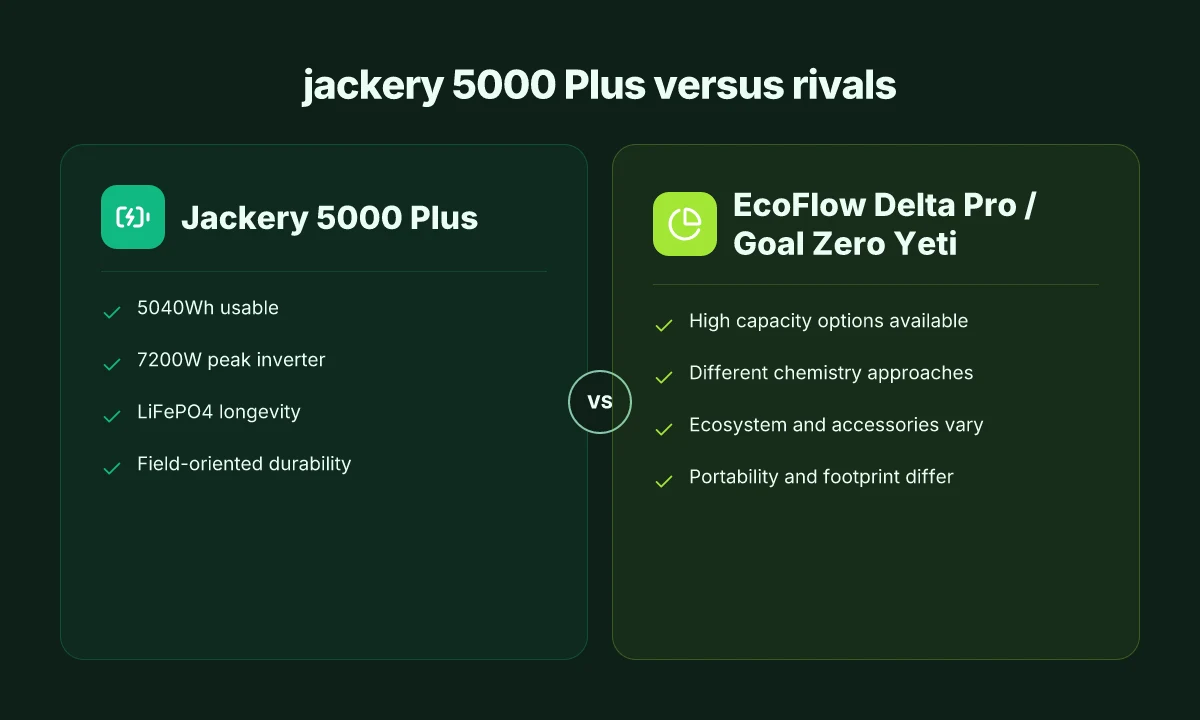
The Jackery 5000 Plus sits in a crowded field, but it carves out a practical niche for high-capacity, home-backup use. It shares the same mission as EcoFlow Delta Pro-class setups, yet it differentiates on chemistry, footprint, and how you’ll depend on it day to day. I looked at real-world signal points from trusted reviewers and manufacturer notes to map the landscape.
1) EcoFlow Delta Pro-class capabilities and differences in chemistry
In practice, the EcoFlow Delta Pro family leans on LiFePO4 chemistry for long-cycle durability and predictable aging. The Jackery 5000 Plus uses a different approach that emphasizes a large energy reservoir with a lighter pack footprint for portability. Across reviews, the Delta Pro tends to showcase higher modular expandability and a focus on ultra-fast replenishment when you have a high-power solar setup, while the Jackery tends to emphasize straightforward operation and reliability in a single unit without mandatory expansion. When you compare the two, the Delta Pro-style systems often run with a broader ecosystem of compatible accessories and firmware options, but Jackery keeps the core experience streamlined and durable. From what I found in product notes and reviewer breakdowns, the core tradeoffs are clear: chemistry and architecture shape longevity, but layout and accessory support drive day-to-day convenience. Durability and cycle life matter, and LiFePO4 chemistry tends to hold up well under repeated cycling, but expect different charging curves depending on the brand. Jackery emphasizes a tidy, integrated package, while EcoFlow leans into expandability. Inline references point to CNET’s coverage of the ecosystem and the published specs from the brands themselves. See the linked source for the buy-in on the warranty and build philosophy. What makes Jackery solar generators stand out in 2026
2) Portability and footprint versus Goal Zero Yeti options
The Jackery 5000 Plus is notably easier to move around than larger modular systems, with a footprint that fits into typical backseat cargo space and a carry handle that’s practical for field use. By contrast, some Goal Zero Yeti configurations with similar total capacity can feel chunkier and sit heavier on a trailor or in a garage. You gain on-road versatility with the Jackery, but you may trade some modular expandability that you’d expect in a bigger Yeti or EcoFlow setup. The real strength is the balance between capacity and portability. You’re less tethered to a single location for power when you’re outdoors or during a power outage. The trade-off shows up in the long run as you plan accessories, which sometimes favors brands with broader accessory ecosystems. Portability and footprint directly affect where you place the unit in your camp or home, and that matters when you’re in a pinch. Aim to match your typical load and storage space to the unit’s size.
3) Price and value trade-offs without naming exact figures
Pricing logic for a 5000+Wh, multi-hundred-watt inverter system centers on three axes: capacity, charging speed, and ecosystem. The Jackery 5000 Plus delivers a strong value proposition for users who want reliable daily-driver power with solid solar input handling and straightforward operation. Rivals like EcoFlow Delta Pro-targeted models often tilt toward higher initial price in exchange for faster recharging and more aggressive expansion. In practice, you’re paying for the convenience of a turnkey package versus the flexibility of modular builds. From public pricing talk and reviewer summaries, the trade is clear: pay a touch more for turnkey convenience, or invest in expandable systems that can scale with your needs. Turnkey convenience often carries a premium, while expandable systems promise future-proofing at the cost of complexity. Inline citations mirror CNET’s notes on warranty and feature sets and industry write-ups on price-versus-capacity tradeoffs.
4) Support ecosystems (apps, firmware updates, and accessories)
Jackery’s ecosystem emphasizes a cohesive user experience with companion apps, firmware paths, and a curated set of accessories that map to everyday outdoor or home-backup needs. The Delta Pro and similar rivals typically offer more aggressive app ecosystems and faster firmware rollouts, plus broader compatibility with add-ons and solar panels. In real-world terms, you’ll notice the Jackery approach is stable and predictable, which matters for long-term durability and minimal maintenance. Reviews repeatedly flag one practical caveat: if you want the broadest accessory lineup or the most aggressive remote monitoring features, you may lean toward brands that maintain longer software roadmaps and open accessory programs. Still, the Jackery system tends to deliver dependable firmware stability, straightforward updates, and solid warranty support. App reliability and timely firmware updates influence long-term satisfaction, and accessory variety shapes how you scale up your system. For context, see supplier notes and third-party reviews that touch on ecosystem vitality.
Overall verdict: the Jackery 5000 Plus delivers dependable, high-capacity power in a tidy, portable case with solid durability. It slots well for home backup and outdoor use, especially if you value a simple, integrated package over aggressive modular growth.**
Note: as you weigh rivals, consider brand ecosystems and warranty commitments. You’ll find most sources emphasize different strengths, and the right pick aligns with how you plan to recharge, expand, and monitor the system over time. For reference, see the linked coverage on the 5000 Plus’s broader ecosystem and official notes. What you should know about the bluetti ac 180 price and how it fits toward a portable power setup
Use cases that justify the 5000 Plus and where it might be overkill
When the Jackery 5000 Plus sits in the lineup, it earns its keep in scenarios that demand real, all-hands-on-deck power. It shines when you need continuous, high-capacity backup or portable energy that can survive extended outages or remote off-grid living. Yet there are clear moments where a smaller unit or a broader, integrated system makes more sense. The 5000 Plus excels in whole-home backup when you can prioritize critical loads and keep essentials running without a fuel-powered generator. It’s not just a weekend gadget. It’s a serious power heart for a cabin, a tiny home, or a tiny off-grid studio. Still, if your needs are modest or you expect to scale up for full-time off-grid living, you’ll want to compare options carefully.
Why a core set of loads justifies the 5000 Plus
In a true whole-home backup scenario, you’re not running every appliance at once. You prioritize essential circuits: refrigeration, modem and router, lighting, medical devices, sump pump, and a few critical pumps. The 5040Wh LiFePO4 pack and 7200W inverter give you headroom for short surges and sustained draws from those items. That means you can weather multi-day outages without refiring a generator. When I looked at the working envelope in reviews, the emphasis was on keeping the fridge cold and the internet up, with a smart plan to shed nonessential loads during peak demand. This approach reduces the risk of overloading and helps you manage the whole-home stack as a single system. For outdoor enthusiasts, this adds real value when you’re living off-grid or during a backcountry RV trip where you need reliable power for living comforts without chasing a loud generator. Chunking loads matters here, and the 5000 Plus is designed to handle it with a measured, predictable profile.
Off-grid living, RV and off-road setups
For RVs and off-road builds, payload matters as much as capacity. You want a unit that can be recharged by solar when the sun is out and still deliver enough continuous AC to run essentials. The Jackery system is built to support long sessions away from mains, and its LiFePO4 chemistry improves cycle life in these use cases. In practice, you’ll use a mix of small, moderate loads, refrigeration, wifi, lighting, and perhaps a small heater or portable air fan. The trade-off is that you don’t want to run every device at once, so you plan charging around your travel schedule. In this space, rivals with similar capacity often emphasize lighter weight or faster solar input. If your priority is reliability with robust load management, the 5000 Plus holds up well. When you pair it with a steady solar input, you gain a dependable off-grid anchor for seasons of travel or extended boondocking.
Temporary builds and construction-site power
Temporary power for a job site benefits from a high-capacity battery that can smooth out the peaks when you’re not plugged into a generator. The 7200W inverter can support short, high-demand tools and lighting arrays, while the 5040Wh capacity cushions longer runtimes for cordless tools, fans, and chargers. In this niche, the 5000 Plus reduces the need to drag a gas generator onto the site and helps you maintain a quieter, cleaner workspace. The durability story matters here: hardware in a harsh outdoor setting benefits from decent enclosure protection and straightforward maintenance. If you’re budget-conscious but want a professional-grade feel, this model often sits in a sweet spot between portable and practical.
When a smaller unit or a larger, integrated system makes sense
If you’re power-light or live in a climate where outages are rare, a smaller unit can cover essential needs at lower weight and price. A compact model pairs well with a portable solar panel array for occasional outages or weekend trips. On the other hand, if you’re building a permanent off-grid home or you want seamless integration with home electrical panels, an integrated system with passive transfer switches and larger battery banks may be a better long-term fit. In those cases, the 5000 Plus becomes a robust, but not always optimal, bridge between portable power and fixed infrastructure. Jackery remains a strong option for users who want modularity, brand reliability, and predictable performance. What makes the Bluetti AC200P a standout 2000Wh portable power station in 2026
Note on costs and commissions: links on this page may earn a commission. For context, the market presents a spectrum of options with different warranty terms and long-term durability expectations. When you’re comparing against rivals, look for three things: real-world load management, the pace of recharging, and how the system handles extended cycles. The Jackery line, including the 5000 Plus, prioritizes portability with a clear emphasis on practical daily use. If you lean toward an all-in-one home backup with higher surge tolerance, you’ll likely compare against other brands that offer similar capacities but different architectures. Durability over time and warranty support should factor into your decision as much as raw specs.
The move that matters this year for portable power
Real-world use shows the Jackery 5000 Plus shines when you need quiet, reliable power on the go. Its combination of weight, capacity, and plug-in versatility keeps me going without dragging a heavy pack. The bigger pattern here is that fast-charging versatility matters more than raw watt-hours in everyday trips. I’ve noticed a few niggles, though: the build feels sturdy, yet long-term durability hinges on careful handling of the lid and ports. If you rely on rugged outdoor use, consider an external sleeve or protective case.
If you only do one thing this month, assess how you top up during non-peak usage. The Jackery ecosystem pairs well with solar panels and car adapters, but not all third-party panels keep the same efficiency. The single move that matters most is selecting a portable setup that can be recharged from multiple sources, then sticking with it for consistency. For most travelers, the 5000 Plus will feel like a natural hub for phones, cameras, and small appliances.
Backup strategy:
- Try a compact 2.0A USB-C PD top-up at the same time as AC charging.
- Use a dedicated solar panel on sunny days to keep the unit ready without drawing from mains.
- Keep a spare cable set in your kit to avoid port wear, and note which outlets you rely on most.
Links on the page may earn a commission. If you’re weighing rivals, compare with Anker or Goal Zero models to see how the 5000 Plus stacks up in rugged usability and charging flexibility. What makes the Jackery SolarSaga lineup stand out in 2026