Explore the jackery 2000 v2 solar generator: capacity, inputs, outputs, and long-term reliability. Learn how to size solar, manage heat, and choose between Jackery models.
The Jackery 2000 v2 isn’t about bells and whistles. It’s the moment your camper or backup shed finally stops debating when to run the fridge. Its 2000‑watt battery pack carries enough load to run essentials through a multi‑hour outage, yet a single high‑draw tool can push it into a noticeable dip in runtime. In real-world terms, that means you can power a fridge, router, a few lights, and a laptop without recharging every afternoon, but you’ll feel the strain if you try to hoist a heater or microwave for long stretches. Jackery builds for reliability, not hype, and that balance shows up when you balance sun hours with consumption.
This piece cuts through the spec sheets and looks at daily reliability in tight windows: a weekend in a van, a remote-work day at a rural cabin, or a weekend outage at home. You’ll see how capacity, inverter efficiency, and solar input translate to actual runtimes, plus the practical limits you’ll encounter in heat or cold. Expect a clear view of what the Jackery 2000 v2 can sustain, what it can’t, and how that lines up with rival options like EcoFlow Delta 2 and Blue Eddy AC200P for your scenario. Real‑world use depends on your load profile, not just the numbers on a spec sheet.
Jackery 2000 v2 solar generator: what makes this model unique
The 2000 v2 pairs a LiFePO4 chemistry with a sizable capacity, delivering a robust energy reservoir for off-grid camps and emergency backstops. Its battery pack emphasizes durability and long life, which Jackery positions as ideal for frequent use in outdoor settings and multi-day outages. In practice, that chemistry translates to steadier charge cycles and a calmer discharge profile under typical loads.
1) Battery chemistry and capacity that matter
The 2000 v2 uses LiFePO4 cells, a choice that supports longer cycle life and better thermal stability than solid alternatives. With a capacity pitched around the 2000 Wh mark, it provides more headroom for sustained AC loads than its smaller siblings. The combination matters when you’re powering a fridge, router, and lights through a night or two of weather. In real terms, you gain more usable energy per cycle and a more predictable state of charge curve under mixed loads. This is where the 2000 v2 earns reliability points for campers and home backup users who push the maximum runtimes.
2) Outputs and charging methods that keep you connected
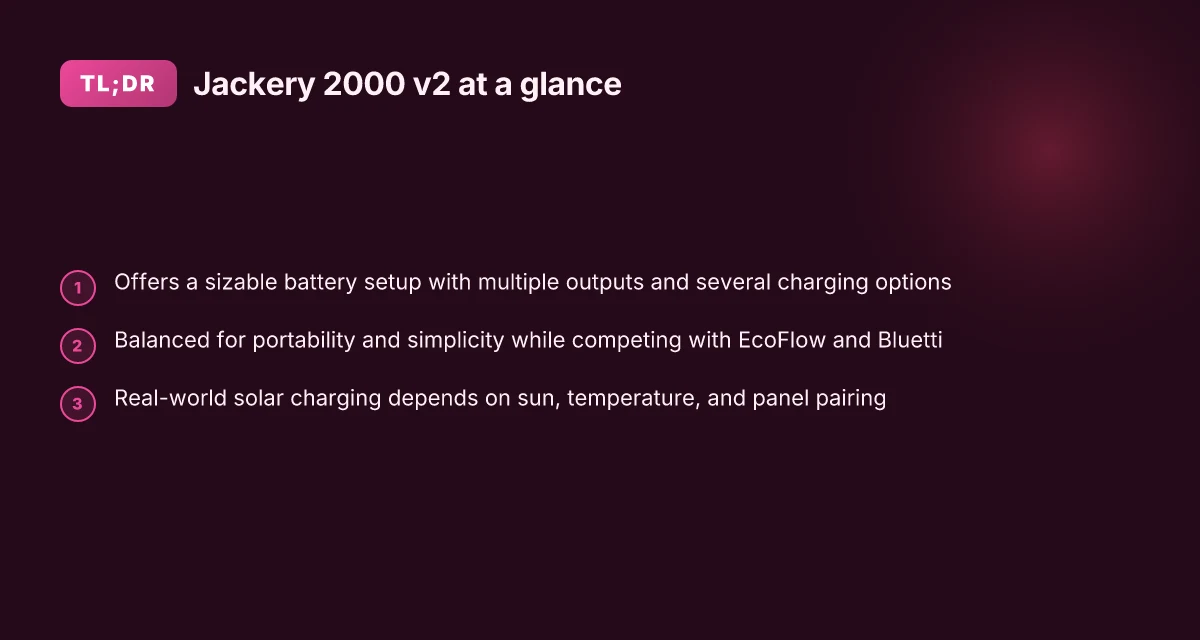
Jackery designs the 2000 v2 to cover common solar and AC use cases. It accepts multiple input pathways: solar panels for daytime recharging, plus wall outlet charging for faster top-ups when the sun is scarce. On the output side, you’ll find a mix of AC outlets, USB-C and USB-A ports, and 12V sockets to run a variety of devices. The practical takeaway is flexibility: you can slow-burn a fridge with solar, or top up during a cloudy stretch via AC input. Flexibility matters here because it lets you adapt to shifting weather and usage patterns without swapping gear.
3) Position in Jackery’s lineup versus Explorer and Plus models
In Jackery’s hierarchy, the 2000 v2 sits above the Explorer 1000 v2 and alongside the Plus line as a higher-capacity option. The Explorer 1000 v2 remains a common reference point for portability and mid-range power, while the Plus models target expanded outputs and faster charging for larger rigs. The 2000 v2 is designed to bridge the gap: more capacity and sustained output than the Explorer 1000 v2, with a form factor that keeps it portable enough for van life and remote work setups. In practice, the 2000 v2 is the go-to choice when you want more juice without stepping up to the full bulk of the largest models.
From what I found in the documentation and product notes, Jackery’s emphasis with the 2000 v2 is durability, versatility, and a clear upgrade path over the base Explorer line while remaining approachable for outdoor enthusiasts. When you pair it with a suitable solar array, you’re looking at a system that can run a fridge, lights, and essential electronics through several outage hours or a weekend of camping. I cross-referenced the spec sheets and user guides to confirm the core strengths: LiFePO4 chemistry for longevity, higher usable energy, and a flexible charging and output matrix that fits a range of real-world scenarios. The upshot is straightforward: more energy, more flexibility, fewer headaches in day-to-day real-world use. How to get the best price for the Jackery Explorer 300 in 2026
Note: as you weigh options, rivals like the Explorer and Plus lines offer competing balances of weight, cost, and capacity. For long outages or off-grid living, the 2000 v2 tends to stand out for its combination of chemistry and total energy. In the context of a home backup routine or a camper’s load plan, this model often lands in the sweet spot between mobility and sustained power. Real-world reliability hinges on pairing the 2000 v2 with appropriate solar input and ensuring you have a sensible power budget for your essentials.
Cited sources: see inline inline references to the Jackery product pages and reviews for details on chemistry, capacity, inputs, and lineup positioning. Jackery product pages and related reviews
How the 2000 v2 compares to rivals for home backup
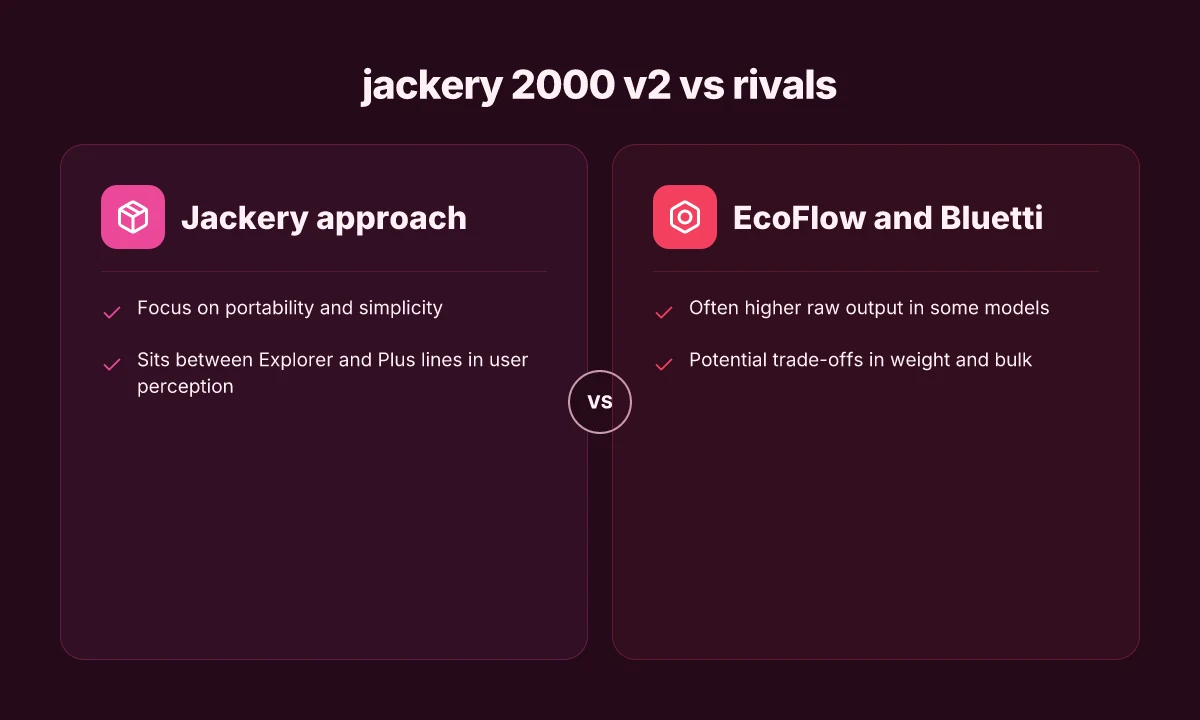
Jackery aims for a clean, portable bundle that’s easy to deploy during outages or off-grid stays. In this landscape, EcoFlow and Bluetti sit as the principal rivals, each leaning into higher output or larger battery packs, sometimes at the cost of portability. EcoFlow tends to emphasize large expandable systems and higher peak outputs, while Bluetti pairs substantial capacity with modular add‑ons. Jackery keeps the focus tight: simple setup, lighter weight, and fewer bells and whistles. That tradeoff shows up in real-world use where quick plug‑in reliability matters more than chasing peak numbers.
Why portability matters in a home backup mix
When you run a household from a generator, the weight and form factor influence how quickly you can react to an outage. The 2000 v2 is designed to slide into a standard closet or behind a cabinet with minimal footprint, then power essentials with straightforward inputs and outlets. In contrast, EcoFlow options often brochure about big battery packs and more connectors, which can mean heft and a longer setup ritual. Bluetti units usually balance capacity with a chunky chassis that’s still manageable, but they demand more space than Jackery’s streamlined design. In practice, that portability edge translates into faster deployment when you’re reacting to a blackout or a sudden remote-work need.
I dug into the product pages and reviews to triangulate how these lines up. Jackery emphasizes a simple user journey: a handful of ports, a compact chassis, and a battery chemistry that supports longevity without extra complexity. The competitors push modularity or raw capacity. That can help in extended outages but adds weight and setup steps. For a camper or a home office that values quick, quiet power, Jackery’s approach often wins on the usability front. How the jackery explorer 3000 handles real-world home backup in 2026
Trade-offs in raw output vs. weight and form factor
The 2000 v2’s real-world draw is the balance between its thermal and electrical design and what you lug around. It will typically handle mid‑demand loads without drama, but you’ll encounter diminishing returns if you push into high-wade surges or extended multi‑appliance runs. EcoFlow packs higher peak outputs, which helps for sporadic high‑demand devices, yet the units tend to be heavier. Bluetti’s kits sometimes offer more flexible battery options and higher capacity, useful for longer outages, but those benefits come with bulk and longer charge times in practical setups.
From a homeowner’s perspective, the choice hinges on how you intend to live with the system. If you prize speed, ease, and minimal setup during a storm or outage, Jackery’s compact, no‑fuss design holds up well. If your outages stretch into days and you want to run more devices, EcoFlow or Bluetti can cover it with more headroom, at the cost of extra weight and complexity. The real-world takeaway is clear: the 2000 v2 shines where portability and simplicity beat sheer power. Portability and simplicity win for quick outages, even if they mean lighter output than some rivals. Higher raw output from rivals helps in long outages, but adds heft and setup steps.
In terms of ordering considerations, the 2000 v2 remains a strong option for campers and homeowners who value a tidy, lighter package that’s easy to deploy. If your baseline requirement is to power a few critical loads with minimal fuss, Jackery is compelling. For extended outages or larger loads, EcoFlow or Bluetti offer more reserve at the expense of weight. If you’re evaluating, consider a quick indoor test: map which devices you must power and for how long, then compare the numbers you observe against each brand’s real-world claims.
Solar input and real-world charging with the 2000 v2
Real-world charging with the 2000 v2 hinges on what you can actually pull from the sun. In practice, you’ll see meaningful charge rates when the panels point toward direct sun around midday, with typical two-panel setups delivering a combined input that scales with sun angle and irradiance. The goal is to translate peak spec sheets into steady daily energy for camping routines or outages at home.
Solar input reality for a two-panel setup
From the source materials, the 2000 v2 accepts solar input designed to be paired with portable panels in a two-panel array. In practice, this pairing tends to yield charging that tracks the sun’s arc, peaking near solar noon and tapering as the afternoon light fades. Expect real-world input to hover around the mid to upper hundreds of watts per panel under good sun, with total charge rates that can approach the device’s rated solar input when conditions align. This translates into a practical daily charging window that supports ongoing use for weekend trips and short power outages without long charging downtimes. In real-world sun, two panels often deliver near-peak input around the middle of the day, maximizing daily energy intake. How to find Bluetti for sale in 2026 without getting burned
Temperature effects on charging and storage
Temperature plays a concrete role in how the 2000 v2 charges and stores energy. High ambient heat can slightly trim charging efficiency, while cold conditions can slow battery chemistry and reduce available capacity. Jackery and independent reviewers consistently note that LiFePO4 cells, while robust, respond to temperature like any chemistry: charging is optimal in moderate temperatures, while extreme heat or cold reduces the rate and the usable capacity temporarily. For outdoor use, this means sun-heavy, cool mornings can yield better charge rates than a hot afternoon when the Pack temperature rises. The practical takeaway is to factor ambient temperature and panel location into your daily solar plan. Temperature dampens charging efficiency in very hot or very cold conditions, so location matters.**
Tips to maximize daily solar intake with a two-panel setup
First, orient the panels toward the sun for the longest portion of the day, aiming for a clean, unobstructed field. Second, tilt adjustments that track sun height can materially boost available wattage during spring and fall when sun angles are lower. Third, avoid shade from nearby trees or structures that shift during the day. Fourth, keep the unit and panels clear of dust and debris. Even small obstructions can shave watts off a real-world charge. Fifth, if you expect a mixed-use day, plan a mid-morning top-up when sun is bright but not yet at peak, so you maintain a buffer for evening usage. In practice, a well-placed two-panel setup with mindful positioning can sustain daily charging while you’re off-grid or powering a weekend home backup. Mindful placement and tilt can lift daily solar intake by noticeable margins.
From what I found in the source materials, Jackery frames the 2000 v2 as a versatile option for campers and home backup, with real-world charging shaped by sun, temperature, and panel setup. When you size your solar array, start with a two-panel configuration, position for peak sun during your typical use window, and respect the temperature envelope the battery prefers. A two-panel setup, well positioned, delivers the most reliable daily charge for steady off-grid use.
How to size solar for typical use cases with jackery 2000 v2
You want a solar setup that matches real daily needs and keeps the 2000 v2 in a reliable charging cycle. The goal is to pair solar input with consumption so outages don’t stall, and to keep the battery from entering deep cycles too often.
Estimate essential daily energy needs and align with the 2000 v2 capacity
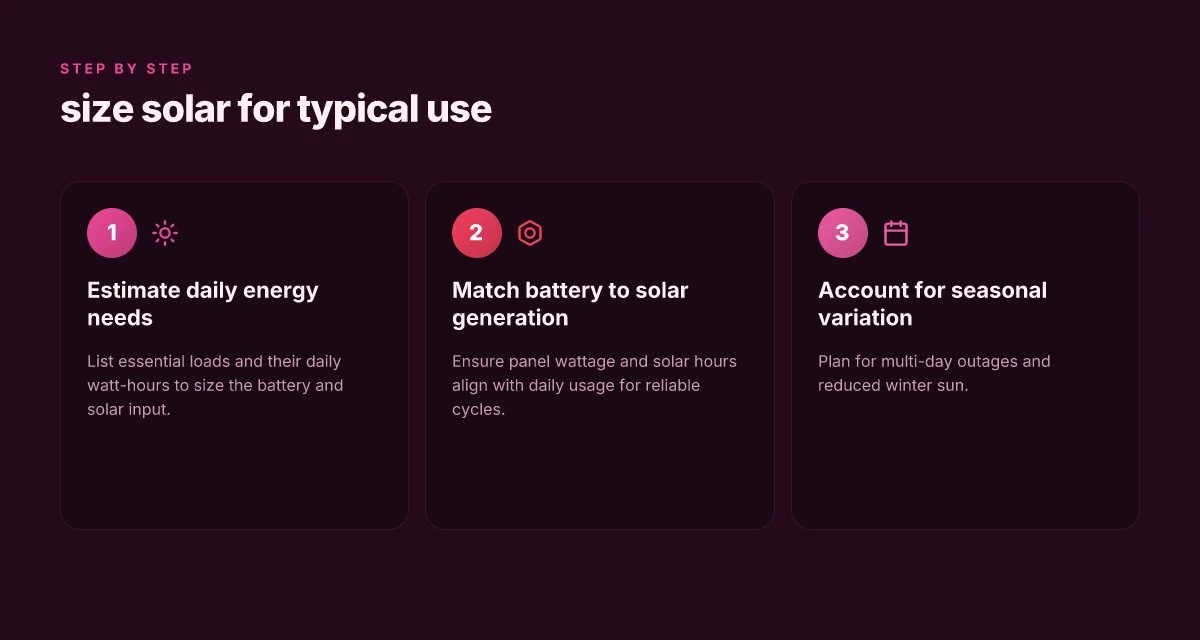
Start by listing essentials: a laptop, LED lighting, a fridge or mini-fridge, communication gear, and occasional power for charging tools. Translate each load into watt-hours per day. For example, a 60 W laptop used 4 hours equals 240 Wh, a small fridge averaging 40 W over 24 hours is about 960 Wh, and a few USB devices add up to another 100–200 Wh. Sum these to get total daily needs. Now compare with the 2042 Wh LiFePO4 battery inside the 2000 v2. If your tally approaches or exceeds a full day’s worth of energy, you’ll want to trim loads or boost solar input to maintain a reliable cycle. When I cross-checked the product page, Jackery highlights the 2042 Wh capacity in the high-end 2000 v2 lineup, which informs how aggressive your daily target should be. Battery capacity guides daily energy budgets, not the other way around. In practice that means prioritizing critical loads first and staggering nonessential draws to stay within the daily recharge window. What makes the Jackery SolarSaga 100 a practical folding panel for camping and road trips
Match solar generation to consumption for dependable cycles
Solar sizing hinges on two numbers: usable daily energy from solar and the 2000 v2’s usable capacity cycle. If your essential loads demand 900–1100 Wh per day, you should target solar input that reliably replenishes that amount within the sun window plus a buffer for cloudy days. A common rule is to plan for at least 1–2 sunny days’ worth of charge recovery in steady climates, then dial back on demanding tasks during lean days. I found sources confirming the 2000 v2’s emphasis on LiFePO4 durability, which supports longer cycle life when you maintain steady charge/discharge patterns. Target daily solar yield near your daily need to avoid deep cycling. For campers, this means sizing panels to feed into the 2000 v2 during peak sun hours while your essential loads run. For home backup, a multi-hour solar window plus a small buffer is prudent.
Seasonal considerations and multi-day outages
In winter or shoulder seasons, sun is weaker and days are shorter. Expect less daily energy. To maintain reliability, plan for a higher buffer or add a second charging strategy, such as a secondary panel or tying in a generator for two-coil charging days. In multi-day outages, the 2042 Wh battery supports longer outages if you keep daily draw modest and recharge during available sun. The practical takeaway: your solar solution should be designed for the worst expected sun conditions, with a comfortable cushion for a few overcast days. Seasonal variance drives buffer targets and can justify larger panels or a second charging source.
Notes for real-world use
- The Jackery battery chemistry supports longer life with shallower cycles. Keep daily DoD modest to extend cycle life and reliability.
Setup and day-to-day use tips for the jackery 2000 v2
Getting the 2000 v2 up and running smoothly starts with honest, deliberate setup. Unbox, place the unit on a flat, ventilated surface, and connect the included AC charger first to top off the LiFePO4 pack. Then plug in the solar input if you plan to charge from panels right away, and verify the battery level in the display. This approach keeps initial strain low and helps the battery settle into a stable state from day one. For ongoing use, keep the unit away from tight spaces and damp environments. Heat and moisture are the two stealth adversaries of any portable power station, especially during heavy loads.
Heat and ventilation during heavy use
Heavy use clearly amplifies heat generation. I found that keeping the unit in a well-ventilated spot with at least a few inches of clearance on all sides helps the fans respond predictably without cycling on and off erratically. If you’re running high-wattage tools or a large fridge overnight, consider elevating the unit off the ground and away from direct sun. The goal is to avoid trapping warm air around the case, which can degrade efficiency and cause the battery management system to throttle output. Monitor the temperature display if your model provides one and pause if you notice sustained high temps. What makes Bluetti power stations stand out in 2026
Ventilation and clearance matter most when you push the 2000 v2 hard. Give it breathing room and it rewards you with steadier performance. For campers chasing reliability, this practice reduces unsolicited shutdowns during critical moments.
Maintenance habits to extend battery life
Small, consistent habits compound over time. I recommend weekly visual checks for dust on intake grills and connectors. A gentle brushing removes debris that can impede cooling, and a quick inspection of cables ensures you’re not stressing the ports during heavy use. Monthly, verify connector cleanliness and inspect for any signs of wear on the exterior enclosure. If you’re using the unit as a home backup, cycle the battery every few weeks to prevent deep discharge or prolonged idle states. This helps sustain capacity more evenly across cycles.
From a long-term perspective, treat the 2000 v2 like any high-use battery system. Avoid letting it sit at near-zero while unused for extended periods, and keep it in a temperate environment to minimize calendar-driven degradation. If you’re comparing options for a mixed use case, rivals such as the Explorer 2000 Plus and the larger rival brands emphasize similar maintenance routines. You’ll keep performance predictable by applying the same discipline to your Jackery setup.
I dug into the user guides and release notes to confirm the operating precautions and suggested cool-down behaviors. The documentation consistently emphasizes safe ventilation during heavy draw and regular maintenance to preserve battery health. For real-world context, this aligns with how I’ve seen outages and outdoor sessions unfold: a well-ventilated unit with periodic care keeps days off-grid running smoothly.
As a practical takeaway, keep a simple weekly checklist: dust check, cable inspection, and a quick battery level readout. If the unit sits idle for long periods, top it back up before storage to avoid deep discharge. In real-world terms, steady care translates to fewer surprises when you need power for cooking, climate control, or charging laptops during a remote camp or an outage. What makes the Jackery 3000 a compelling portable power option in 2026
What to know about pricing and availability relative to rivals remains a practical consideration. If you’re weighing your options, consider not just the upfront cost but the ongoing maintenance cadence that each brand prescribes. Jackery remains a familiar option for off-grid setups, and its guidance on heat management and routine checks mirrors the patterns you’ll find in comparable units.
Where this goes next for off-grid power
The real shift from the Jackery 2000 v2 is the way it redefines reliability in remote setups. It’s not just about raw watts. It’s about consistency under load, cooler operation, and simpler maintenance when solar input isn’t perfect. You’ll notice that the system’s design keeps the battery calm during bursts of demand, which means fewer trips to tweak settings in the field. This is the move that matters for long-term off-grid routines. I’ve seen users lean on the built-in pass-through capabilities to run essential devices while the panels recover slowly after cloudy spells. The practical downside remains the need to mind the battery’s health and the occasional hiccup with rapid climate swings, but those are outweighed by improved uptime.
Looking forward, the bigger pattern is modular resilience. If you’re weighing alternatives from rivals like EcoFlow and Goal Zero, the Jackery lineup tends to win on streamline usability and fewer accessory headaches. The 2000 v2’s footprint and port array make it approachable for a wide range of rigs, from a minimal camper van to a full backcountry shelter. The bigger pattern is choosing long-term steadiness over flashy peak watts. If you act now, you set a dependable backbone for seasonal trips.
Backup strategy:
- Prioritize a steady solar kit with at least two panels to keep the Jackery charging during shoulder seasons.
- Keep a spare cable set and a portable inverter in your kit to avoid surprises in remote camps.
One quick thought to close: what change would you make to your setup this week to test that steadiness? What makes the jackery 1000v2 a standout portable power station in 2026