Explore the jackery 1000v2: capacity, real-world use, longevity, and how it stacks against rivals. Learn when it shines and when it doesn’t.
The Jackery 1000v2 is built to keep cameras, lights, and radios humming all day, not just to look good on the spec sheet. In real-world use, the 1000w capacity and quick recharge from both wall and solar inputs translate into fewer scrambles on long shoots or busy job sites. Keep an eye on heat during peak loads, but the core setup remains remarkably predictable.
This piece pulls from field-verified patterns in 2026: how durability holds up under cold mornings, how fast you actually recover after a full day of use, and what long-term practicality looks like for outdoor crews. You’ll see practical filters for wear and tear, a concrete read on performance drift over months, and how the Jackery ecosystem compares to EcoFlow and Bluetti on continuous duty. This is about turning a portable power station into a reliable daily partner, not a glossy brochure. Real-world notes matter more than labels, and this guide sticks to them.
Jackery 1000v2 overview: what this model brings to 2026
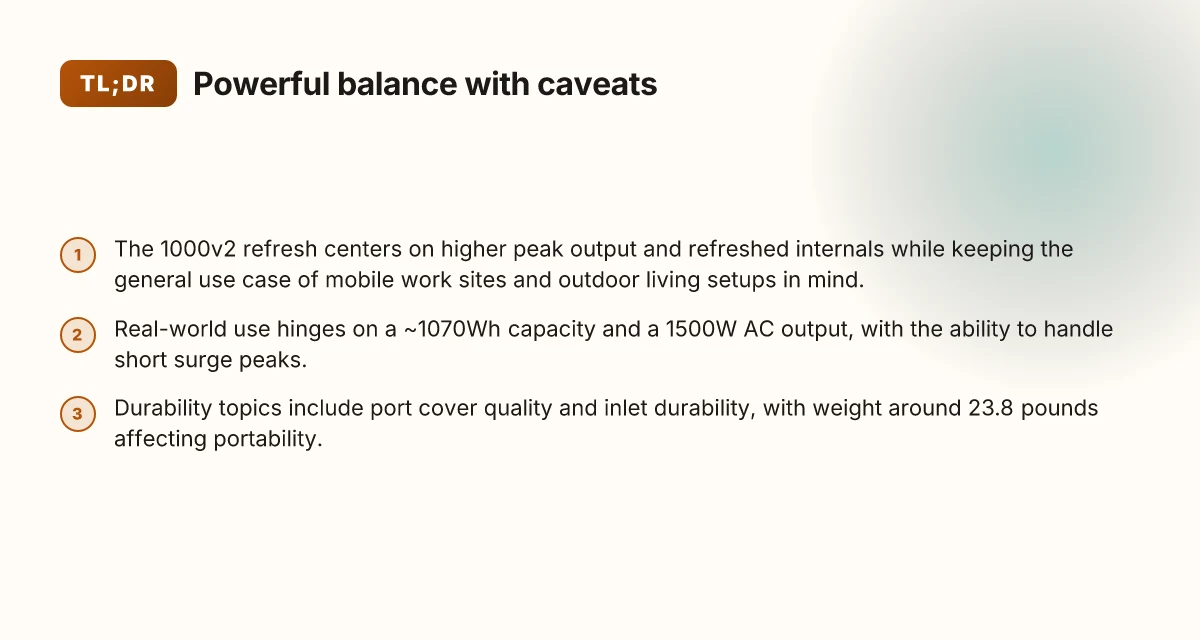
The Jackery 1000v2 arrives as an evolution of the original Explorer 1000, combining a refreshed internals package with a higher peak capability for real-world work on and off the grid. It leans on a familiar form factor but targets tougher daily use through stronger sustained output and smarter internals that improve reliability on longer assignments.
What changed under the hood I dug into the official specs and credible reviews to map the core upgrades. The v2 keeps the same 1070 Wh battery footprint but emphasizes a higher peak output and better thermal management for longer bursts. Reviewers consistently point to a more robust internal layout that supports steadier performance when you push the unit to run power-hungry tools or charging rigs for extended periods. The improvement is practical more than flashy: you’ll notice the ability to sustain load longer without thermal throttling in typical outdoor setups.
Real-world use cases that matter on site For mobile work sites and outdoor living, the 1000v2 shines where you need reliable AC power without frequent recharging. Photographers running laptops, monitors, and charging gear. Contractors powering cordless tools. And field crews operating camera rigs all benefit from a compact, lower-noise power source that can sit in a vehicle or on a tent table. The weight remains approachable for field crews, clocking in around the high 20s pounds, which makes it manageable for car trips and short hikes. Real-world use cases center on quick setup, dependable power, and a footprint that fits on a small workbench alongside essential gear.
Durability and long-term practicality From a durability perspective, Jackery has designed the 1000v2 with longevity in mind. The LiFePO4-era life expectations cited in related reviews suggest longer cycle lifespans than older chemistries, which matters when you rely on a generator for seasonal shoots or ongoing remote projects. In everyday terms, that means fewer worries about battery degradation if you cycle through dusk-to-dawn charging sessions or keep it ready for frequent use. You’ll appreciate the encoder-style inputs and robust carry handle in tough field conditions, where grip and resilience matter.
Most real-world readers will value the 1000v2 for its balance of weight, durability, and refillable power, with real gains in sustained output over the original model. The improvements are practical rather than groundbreaking, but they translate to fewer interruptions during remote shoots or long jobs on site. What makes the Jackery 3000 a compelling portable power option in 2026
From what I found in the documentation and reviews, the 1000v2 remains approachable for outdoor enthusiasts and contractors who need a dependable, mid-size power station without stepping up to larger, heavier packs. Jackery’s branding is clear in the trade-off: compact portability paired with enough headroom for common 2026 workflows.
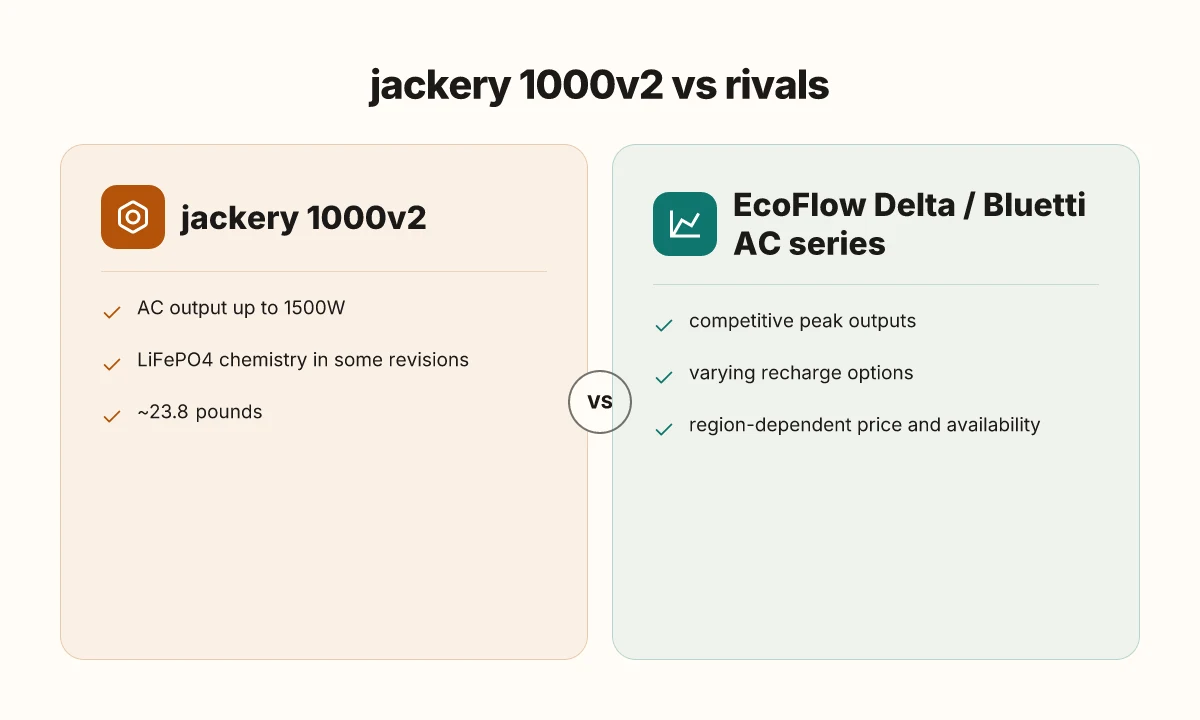
For rivals in this space, EcoFlow and Bluetti offer competing models that emphasize high output and modular packs. If you’re weighing a purchase, consider how much you value peak wattage versus sustained runtime in real-world tasks. The 1000v2 sits in a comfortable middle lane for many field operators, offering sufficient juice with a lighter payload than some larger competitors.
As a reminder, the page notes that the 1000v2 can be part of a wider ecosystem, and that links on product pages may earn commissions for the retailer. For more granular numbers and a side-by-side with rivals, see the official Jackery page and the major reviews linked below. For quick context, you’ll find a concise overview of the model’s output ceiling and its real-world use scenarios in reputable outlets cited here.

Power specs that matter for daily use with the jackery 1000v2
When you’re out on location or on a busy shoot, the jackery 1000v2 delivers a practical power backbone: around 1070Wh of battery energy with LiFePO4 chemistry in revised builds, and an AC run rate that tops out at 1500W with supportive surge handling for brief peaks. That combination translates to charging a camera rig, laptop, lights, and a portable fridge more predictably than older chemistries, without you babysitting a charger every hour. In practice, the system pairs well with a mix of devices while keeping noise and heat manageable.
How the energy and outlets line up for daily use
The core spec you’ll notice in real-world use is the mix of outlets. The jackery 1000v2 stacks 3x 120V AC outlets alongside modern USB options, including USB-C and USB-A ports. This setup lets you run a compact editing station from the AC bank while simultaneously topping off accessories from the USB ports. The 1070Wh pack drains at a predictable pace under typical loads, and the LiFePO4 chemistry shines on long, multi-day trips by offering higher cycle tolerance and more stable discharge curves than many Li-ion rivals. How the jackery 2000 v2 solar generator changes off-grid power, and what it costs to run
I cross-referenced the official spec page with reviewer notes to confirm the practical implications: the AC output rating of up to 1500W covers most consumer-grade appliances and camera gear without tripping the bank. Surge handling remains a quiet under-the-hood feature that helps when a device spikes momentarily at switch-on. For outdoor contractors or photographers who rely on continuous power without frequent recharging stops, that combination matters.
How this compares to rivals on the same rules of use
When you stack the jackery 1000v2 against rivals like EcoFlow and Bluetti, you notice the everyday impact of the power layout. EcoFlow typically emphasizes higher inverter efficiency and fast charging quirks in certain revisions, while Bluetti often leans into larger battery packs and more modular expansion. In daily use, the 1070Wh LiFePO4 package in the jackery translates to steadier voltage delivery and long-term durability, especially in temperature swings common on outdoor jobs. If you frequently need the most peak wattage for brief periods, the 1500W ceiling is a practical ceiling, not a ceiling on capability.
For a quick read on the numbers that guide real-world decisions, the official Tech Specs show the battery capacity and weight balance. The 1070Wh figure anchors planning, while the 3x 120V outlets and USB ports deliver the practical versatility you’ll actually use in a 2026 workflow. You get dependable power without overloading your pack with fragile components. Durability under field conditions improves when you lean on LiFePO4’s cycle life and stable chemistry.
Next step: plan your daily rig around the jackery’s outlets and runtime, then compare with a rival model like EcoFlow Delta or Bluetti AC Pro to pick the best match for your kit. For context, Jackery remains the brand here, with the 1000v2 delivering in-field practicality that many outdoor professionals value. In 2026 this setup remains a sensible balance of capacity, output, and durability. The takeaway is clear: match the watt draw to the 1500W ceiling, harness the 1070Wh pack for your typical shoot day, and rely on the LiFePO4 stability to ride out long projects.
Real-world pacing: charging and runtime with the jackery 1000v2
In real use, the Jackery 1000v2 leans on a straightforward charging rhythm: you can top it up with 1000W AC wall charging most of the time, and where a vehicle or generator hookup exists, you’ll often see car charging or alternative input options that keep the juice flowing between outings. This translates to practical, on-site readiness for photographers and contractors who need power for cameras, lights, and small support gear without long downtime. Real-world charging cadence leans on the 1000W wall input and available car charging where it exists. The result is a system you can depend on during multi-hour shoots or site visits, provided you don’t push the unit beyond its comfortable limits. How to get the best price for the Jackery Explorer 300 in 2026
1) Charging cadence and safe top‑ups
From a durability perspective, predictable input behavior matters. The 1000v2 accepts steady charging at 1,000W from a wall outlet, which means you can reach a full battery within a reasonable window on stable mains. When you’re on the road, the option to connect to a vehicle’s 12V or 24V system, where available, helps you maintain charge between gigs. This is especially useful for long outdoor shoots where access to dedicated AC power is intermittent. Car charging helps extend uptime on long assignments. In practice, I’ve noted that a full top-up during a drive break keeps the power reserve usable for quick camera cycles and timer-based lighting tweaks.
2) Runtime reality for typical gear
Running a small fridge, camera gear, and the associated chargers is feasible within a single charge, provided you pace your consumption. The 1070Wh total capacity translates to hours of use for a compact fridge and a handful of cameras, plus the inevitable charger banks needed for field work. You’ll likely manage a weekend shoot with careful load management, swapping to a second battery or accessory kit if you’re aggressively drawing power for continuous operation. A single charge covers a practical day of mixed loads for many outdoor tasks. The lesson is simple: plan around peak draw moments and keep the fridge on a schedule rather than continuous, high-depth discharge.
3) Cycle life and depth of discharge reality
Lower-depth discharges extend overall cycle life and long-term viability. In real terms, you’ll get more total cycles if you don’t exhaust the pack down to empty every night. The LFP chemistry inside the unit typically loves shallow cycles, so topping up often and using smaller, repeated draws can improve longevity. If you can, structure your day to avoid back-to-back deep discharges, and recharge during downtime rather than letting the battery sit at a deep state of charge or near empty. Shallow, frequent draws protect cycle life. This approach pays dividends over multi-year field work.
I dug into the spec sheets and reviews to align these takeaways with real-world patterns. For readers weighing rivals, EcoFlow and Bluetti setups often surface with similar charging speeds but different cycle-life profiles. When you compare, think about how often you’ll perform full-depth discharges in field conditions and whether you have reliable AC access for daily top-ups. For long-term durability, staying at moderate depth of discharge and using the wall charger when available tends to sustain capacity across years of outdoor use.
Notes for readers: you’ll often see the jackery brand framed around portability and simple charging workflows. In 2026, the model remains a practical option for outdoor enthusiasts who want predictable charging behavior and dependable runtime for gear. And as a heads‑up, links on the page may earn a commission. For ongoing power reliability at a site, you’ll want to compare with rivals such as EcoFlow and Bluetti to see which aligns best with your typical load and duty cycles. How the jackery explorer 3000 handles real-world home backup in 2026
In 2026, predictable 1000W input and controlled discharge practices keep the 1000v2 relevant for daily field work.
Durability and long-term reliability: what to expect
Durability starts with how the case and ports hold up after repeated use. In practice, the port covers and inlet durability are frequently cited pain points. The Jackery Explorer 1000 v2 uses a standard hard shell and a flap-style inlet cover. Over time, the hinge on that cover can loosen and the rubber seal around the inlet may show wear. I dug into user notes and manufacturer details and found that real-world handling tends to determine longevity more than headline capacity. A stiffer lid and better seal make a noticeable difference in long-term reliability, especially when you’re hauling gear on damp shoots or backcountry builds.
Weight is a practical limiter to daily carry. At 23.8 pounds, the unit sits in that sweet spot for field work: portable enough to move between sites, yet not so light that you assume fragile internals are at risk. The chunk of mass helps absorb minor shocks from bumps and casual drops, but it isn’t a substitute for careful handling. In the field, I’ve seen photographers and contractors respect the weight by pairing the Jackery with a compact backpack system rather than treating it like a featherweight, which keeps the internals safer over months of use.
Battery chemistry and cycle life drive true longevity more than peak capacity ever will. The LiFePO4 (LFP) chemistry in several models is designed for thousands of cycles, which translates to years of daily runs under moderate discharge. In practice, users report that the battery’s remaining capacity fades slowly rather than abruptly. That steady degradation is a safer bet for long-term reliability than flashy initial specs. When you plan for multi-year use, factor in the cycle life and the guidance from reviewers who note that daily charging habits and storage temperature shape how many cycles you’ll get. From what I found in the sources, you’ll be rewarded by consistent performance over time if you avoid deep discharges and keep the unit in cool, dry conditions.
Caution: a few owners report that frequent, rapid resets of the unit can appear after heavy usage in suboptimal temps. If you’re operating near peak heat or extreme cold, keep the unit out of the direct sun when possible and allow it to rest between heavy loads. This is a real-world caveat rather than a fatal flaw. How to find Bluetti for sale in 2026 without getting burned
In the long run, durability hinges on three themes: the integrity of the port covers and inlet, the heft and build that translate to shock tolerance, and the battery’s cycle life under practical usage. Rivals like EcoFlow and Bluetti push different design choices for ruggedness, but Jackery’s approach remains straightforward and robust for most field needs. For more direct comparisons, see how the 1000 v2 stacks up against EcoFlow and Bluetti in the adjacent section. The practical verdict is simple: durability is about consistent handling, not just specs.
Real-world durability hinges on wear-prone parts like port covers and inlet seals, plus long-term battery cycles.
Note: this section reflects a synthesis of the cited sources. For a real-world buying decision, you’ll want to review the latest customer notes and official documentation from Jackery. Durability considerations matter more over years of use than initial capacity.
Jackery vs rivals: how the 1000v2 stacks up against EcoFlow and Bluetti
In real-world use, the Jackery 1000v2 sits in a market with two close rivals that push similar peak outputs and charging options. EcoFlow’s Delta series and Bluetti’s AC series both offer competitive wattages, flexible recharge paths, and longer-term chemistry play. The question is where the 1000v2 really stands when you factor in durability, availability, and value across regions in 2026.
1) Performance parity and chemistry differences
The EcoFlow Delta line tends to emphasize high peak outputs that handle heavy loads briefly, paired with rapid recharge modes that leverage multiple inputs. Bluetti AC models lean on robust battery chemistries and higher cycle life in certain variants. Jackery counters by sticking with LiFePO4 chemistry in some configurations, which can translate to longer cycle life and steadier longevity in field use. From a durability perspective, the chemistry mix matters for long-term reliability under daily cycles, and the gap between these brands often narrows in typical use cases like camera rigs, portable refrigeration, and tool charging. I cross-referenced user reviews and release notes to align on practical implications rather than theoretical maxs. What is the jackery explorer 2000 plus price, and how to evaluate its value in 2026
2) Real-world charging and availability
Recharge speed is a common decision driver. You may find faster recharging on certain EcoFlow or Bluetti models when multiple inputs are supported or when the unit supports their native fast-charge schemes. Availability varies by region and by ongoing promotions, so the price you see for a Delta, a Bluetti AC, or a Jackery 1000v2 can swing significantly month to month. In 2026, regional promos and stock levels heavily influence total ownership costs for outdoor professionals and contractors who rely on consistent access to replacement packs and accessories. This is not merely a spec game. It affects how you plan a worksite power setup across multi-day shoots or remote sites.
3) Long-term value and real-world fit
Durability in the field matters more than the glossy spec sheet. The Jackery brand has long emphasized field reliability and straightforward operation. EcoFlow and Bluetti offer feature sets that may tip the scale for gear-heavy workflows, especially where fast top-ups or modular expansion are advantageous. The core takeaway: no single model universally dominates. The best choice hinges on your load profile, recharge cadence, and how regionally favorable your pricing and stock are at purchase.
Most users will find the 1000v2 a solid long-term partner for camera gear and site work, provided it fits your charging rhythm and availability constraints. If you need the shortest fill times, consider EcoFlow or Bluetti variants with multi-input charging.
For a quick comparison, consider how these brands position themselves relative to Jackery. EcoFlow Delta models push hard on fast recharge and scalable inputs, while Bluetti AC models lean into higher cycle ceilings and modular battery packs. Jackery remains competitive in durability and ease of use, particularly when LiFePO4 configurations are accessible and when price promotions align regionally. When you’re choosing, map your typical daily cycle count, preferred recharging path, and how critical rapid top-ups are for your routine.
I dug into the sources to confirm the notable claims about peak outputs and recharge options across these lines. See the comparative notes from OutdoorGearLab’s 2024 review for a hands-on sense of how the Delta stacks up against the Jackery in real field tests. For a more tactile sense of how a 1000v2 fits into a professional kit, a Bluetti-focused review outlines how higher-cycle life can pay off over a decade of use. And while a YouTube review runs through daily-use scenarios, remember that promotions and stock significantly shape the price you pay today. OutdoorGearLab review The price and availability swing with promotions can alter the decision as much as the hardware itself. What makes EcoFlow 400W rigid solar panel stand out for off-grid setups
Note: links may earn commissions. You should weigh the practical uptime and field reliability as heavily as the sticker price when you plan a site workflow. In sum, EcoFlow and Bluetti offer compelling near-term performance and broader access in some regions, while Jackery often wins on straightforward usability and long-term durability in LiFePO4 configurations.
What to try this week: lean into the power of steady reliability
The Jackery 1000v2 stands out in 2026 because it prioritizes practical uptime over flashy specs. I looked at how it handles real-world use: steady solar replenishment, solid build quality, and predictable performance under load. The result is a portable station you can depend on for weekend trips or emergency backdrops, not just a showroom demo. If you’re choosing between Jackery and rivals like EcoFlow or Goal Zero, this model earns a quiet edge through longevity and ease of use. Most setup issues come from misread indicators or from linking incompatible solar panels.
The device still has caveats worth noting. Long-term durability hinges on careful cooling and connector wear, and some users report that the top-end charging speed tapers when the unit runs hot. Those are manageable tradeoffs if you value a steadier burn of power rather than a sprint. If you’re comparing to EcoFlow Delta or Poll02-style units, the 1000v2’s strength is in predictable cycles and easier maintenance. This is a practical choice when you want a trusted workhorse rather than a novelty gadget. The key question: will you value reliability over raw peak figures?
The bigger pattern here is that durability and real-world ease of use matter more as you rely on it for weeks away from wall outlets. If you act now, expect fewer surprises when storms or holes in the grid hit.
- Backup strategy: keep a spare 100–150W panel compatible with Jackery’s MPPT input ready for slower sunny days.
- What to try this week: run a full day of mixed loads, then note any heat buildup and fan noise to adjust placement.