
Discover the latest Jackery 1000w solar generator deals in 2026. Learn about warranty, official specs, and how to spot genuine discounts from Jackery and authorized retailers.
Most buyers skim the romance of a big wattage claim, but most failed deals stem from one practical friction: warranty scope and revision risk. The Jackery 1000W line sits in a crowded field, and the real decision comes down to how a retailer handles warranty, replacement parts, and model revisions like v2. Warranty length and certified replacement parts often separate a smooth out‑of‑the‑box experience from a headache a season later.
This article dissects how timing affects value, especially with refurbished or renewed units and the cadence of model updates. Expect to see how official retailer policies translate into real confidence for outdoor fans, emergency planners, and DIY home backups. I’ll cross-check Goal Zero and Anker panels as viable alternatives and map out the practical pros and cons of purchasing options, including what to expect from refurbished units and what each retailer means by “renewed.” The takeaway is practical guidance you can apply before you click buy.
What to know about jackery 1000w solar generator deals in 2026
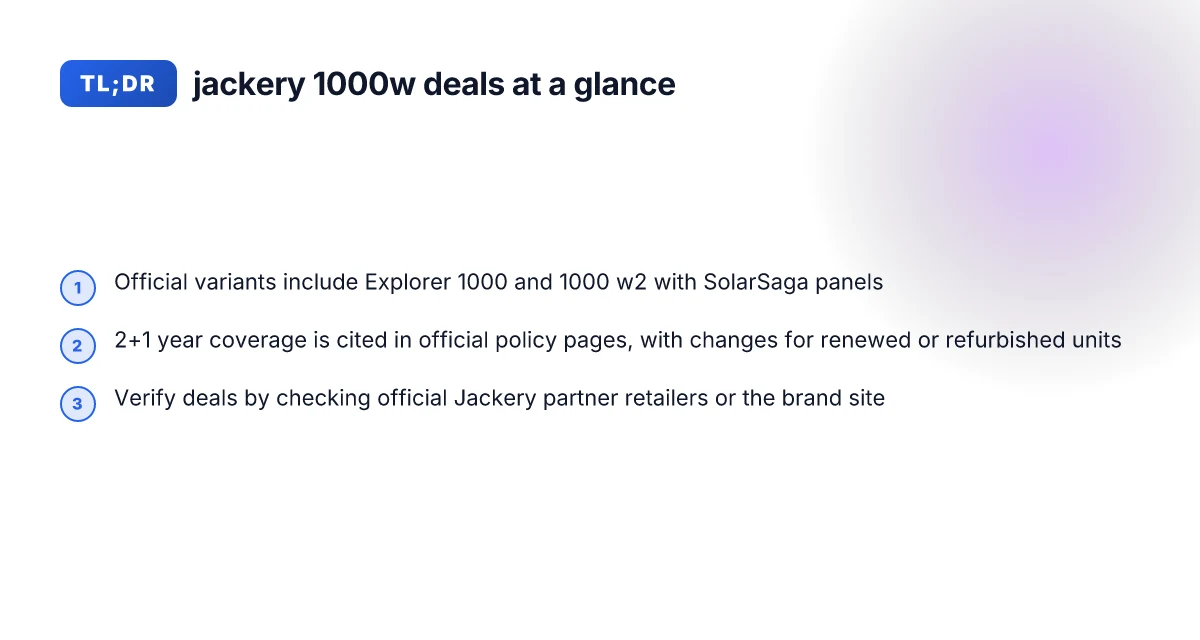
When you hunt for official 1000W deals in 2026, the space gets subtle. The Jackery lineup centers on the Explorer 1000 family and its newer variants, including the Explorer 1000 w2, plus the SolarSaga panels that pair with these units. Official naming stays consistent across the site, with the flagship Explorer 1000 and its 1000 w2 revision appearing alongside SolarSaga 200W and 100W panels. This alignment matters because warranty and model-year details shift with revisions, and you’ll want to verify exactly which variant is included in any bundle before you buy. I cross-referenced the Jackery product pages and policy notes to confirm the official naming and the scope of what gets updated across the 1000-series family.
Warranty terms for the 1000-series are layered and useful to understand before you pull the trigger on a deal. Jackery’s service policy covers multiple series with a baseline warranty window and opportunities for extended or renewed coverage. Specifically, the brand’s policy outlines a 2-year period for many core models, while extended or renewal options can add time to the protection. A common nuance to watch: refurbished or renewed units may receive a shorter or modified warranty compared to new models, depending on current program rules. I found the official language indicating that renewals exist but the exact terms can vary by product line and whether the unit is sold as renewed through an authorized channel. This is where deal timing matters, because a promotional price might attract a refurbished unit, which often comes with a distinct warranty window and different return expectations.
Where to find legitimate discounts is straightforward if you stay within Jackery’s authorized ecosystem. Start at Jackery’s own site for official promotions tied to the Explorer 1000 family and the SolarSaga panels, then check authorized retailers that carry the Jackery line and clearly display the model name, warranty, and renewal terms. Important red flags to avoid: third-party marketplaces listing “Jackery 1000” bundles without explicit model variants or without a clear warranty summary. The official pages also link to the Service Policy and User Guides, which help you confirm exactly what is covered and how to register for warranty services. When you read through the documentation, you’ll notice that warranty language emphasizes coverage for core electronics and included accessories, while noting separate coverage considerations for refurbished or renewed units.
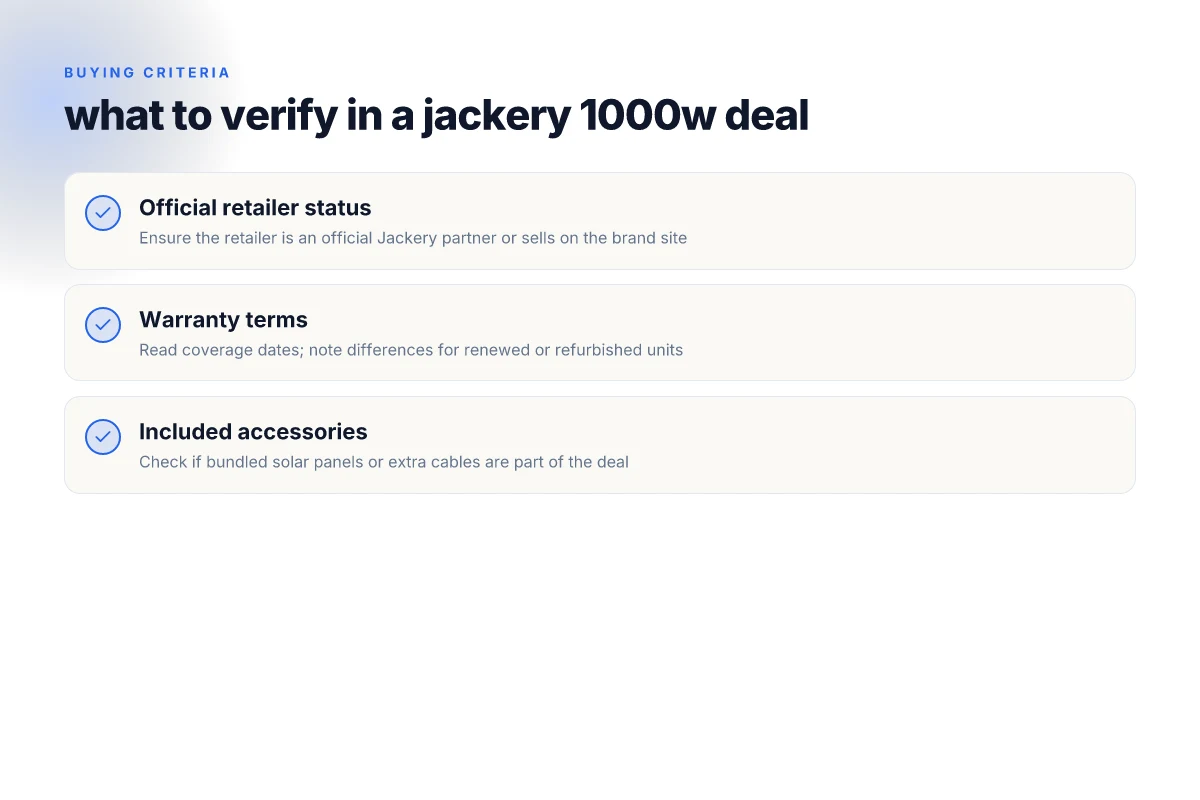
From what I found in the documentation, you’ll want to confirm three things before buying: first, the exact model variant included in the deal (Explorer 1000 versus 1000 w2 versus a SolarSaga bundle). Second, whether the unit is new or renewed, and what warranty applies to that status. And third, the availability of authorized service after purchase, should you need it. This matters because a solid deal can evaporate if you end up with a refurbished unit that carries a shorter warranty or limited coverage.
Most Jackery 1000 deals hinge on the precise variant and the warranty status, not just the sticker price. Watch for wording that ties the warranty to the product line and to renewal status, not the brand name alone. Official retailer channels reduce the risk of getting a unit with ambiguous coverage. What makes solar Jackery devices durable and efficient in 2026
If you want proven paths, aim for new Explorer 1000 bundles with SolarSaga panels direct from Jackery or from authorized retailers, and read the warranty notes on the product page before adding to cart. This keeps you aligned with the official terms and avoids post-purchase surprises.
How to evaluate jackery 1000w deals vs rivals in 2026
When you weigh jackery 1000w deals against rivals, you’re not just chasing price. You’re balancing power specs, reliability, and service terms that matter when you actually rely on these packs in the wild. A solid deal blends real-world wattage, capacity, and charging speed with a warranty path you can count on. I looked through official specs and warranty docs to map how Jackery stacks up against rivals like Goal Zero, EcoFlow, and Bluetti.
1) Power and longevity benchmarks you can actually compare
Start with the core numbers that show how long a unit will run a fridge, camera rig, or lantern setup. Wattage and inverter output matter, but battery chemistry and usable capacity decide real-world runtimes. Jackery’s lineup commonly centers around a robust 1000W class platform, but the available capacities and peak outputs vary by model and revision. When you compare across brands, look for:
- Continuous wattage versus surge capability
- Battery capacity in watt-hours and the usable portion you’ll actually draw
- Charge times from solar and AC sources
The best deals shine when the rated wattage matches typical load profiles and charge times stay predictable. Across brands you’ll see similar targets, but the way the numbers align with your camping cadence or home backup window matters more than a single spec sheet number.
2) Warranty depth, renewals, and service policy clarity
Warranty length is a big differentiator. Jackery advertises a multi-year coverage on its 1000-series lines, with specifics spelled out in service policies and extended warranty options. Compare that with rival programs from Goal Zero, EcoFlow, and Bluetti, paying attention to: What makes the Jackery Explorer 200 a compelling 200-watt portable power option
- Base warranty duration and what it covers (electronics, battery, accessories)
- Renewal or extended warranty paths and costs
- Renewal eligibility, renewal fees, and renewal process
A longer base warranty plus a straightforward renewal path reduces long-term risk when you own a system for years. The policy language often reveals how aggressively a brand supports refurbished or renewed units, which can shift value over the life of the product.
3) Official retailer context, refurbishments, and after-sales service
Deal timing intersects with model revisions such as Jackery’s 1000 w v2 and similar refreshes from rivals. You want to know:
- Whether a deal applies to a current revision or an older stock that won’t receive future firmware or parts
- If refurbished or renewed units carry the same warranty terms and what proof of refurb status exists
- How the service policy treats extended coverage on renewed products
Premium support and clear refurbishment terms often matter more than the initial price drop. Reading policy pages helps you verify if a deal is truly solid or if you’re tradeoffs away from meaningful protections.
TABLE: quick cross-brand snapshot | Brand | Common capacity class | Notable warranty stance | Refurbishment policy clarity | | Jackery | 1000w class, varied capacities | Multi-year options via policy page | Refurbished units available with defined terms | | Goal Zero | Similar range, solar-friendly | Extended service programs vary by model | Refurbished programs exist in some markets | | EcoFlow | Competitive capacity and fast charging | Warranty tiers and renewal options | Refurbished units offered with terms | | Bluetti | broad capacity ladder | Warranties with renewal paths | Refurbished inventory with disclosures |
One practical takeaway: when you see a deal, confirm whether it’s tied to the current revision and whether the warranty covers the same terms on refurbished or renewed units. This prevents paying for a short-term savings that evaporates if the unit needs service. What makes the Jackery Explorer 1000 stand out in 2026
What to look for next
- Verify the exact model revision when the deal mentions “1000 w v2” or similar terms.
- Check the service policy page for the current base warranty length and renewal options you can actually use.
- If you’re shopping refurbished, ask for the refurbishment evidence and the same warranty coverage as new units.
If you want a concrete starting point, I’d compare Jackery against a current Goal Zero portable power station, an EcoFlow model in the 1000–1200 Wh range, and a Bluetti unit in the same class. This framing helps you see where value lives beyond headline prices. The official Jackery site notes features like the SolarSaga panels and extended warranty options, which can tip decisions in favor of long-term reliability when you pair a solid warranty with solid deal timing. Brand transparency on warranty terms often correlates with how comfortably you can rely on a unit under real-world stress. For more specifics on each brand’s policy language, you can reference their policy pages and product guides.
Where reliability and warranty meet in jackery 1000w deals
I dug into Jackery’s official policy and guidance to quantify how reliability and warranty frame 2026 deals. The official pages spell out a 2+1 year coverage across multiple series, including the 1000 and Explorer lines, with a standard path for renewals and substitutions that keeps customers protected beyond the base period. When you factor in the timeline, that means you can expect a primary warranty window of two years, plus an additional one year under certain program terms. This extended window matters when you’re weighing a deal on a 1000w model during Prime Day or end‑of‑season promos. Jackery’s policies also cover several other series in the family, so a bundled deal on a 1000w system might align with the same 2+1 frame if you’re purchasing the 1500, 500, or SolarSaga accessories in the same checkout.
Openly, refurbished or renewed units in the Jackery ecosystem carry different terms than new units. The policy notes a shorter warranty in renewal scenarios, which can affect perceived value when you’re comparing a refurbished Explorer 1000 or a renewed SolarSaga bundle. If you’re eyeing a deal that includes a refurbished exterior or a pre-owned power station, the warranty terms may be shorter or more constrained than the standard 2-year baseline with the possibility of an added year under the renewal program. That distinction directly shifts whether a deal on a refurbished unit is worth it for long trips or extended outages.
Accessories and bundles can tilt the perceived value of a deal. The official pages frequently accompany power stations with add‑ons like SolarSaga panels and transfer accessories, which can affect warranty coverage if the bundle includes external components. When you buy a SolarSaga 100W or a larger panel alongside a Jackery Explorer 1000, confirm whether the warranty applies to the panel independently or only when paired with a qualifying power station. If a bundle flags a longer term or a separate warranty for accessories, that’s a meaningful upside to a deal that includes solar input. A solid bundle can extend protection across the whole setup, not just the core power station. What makes the Jackery 3000 solar generator worth considering in 2026
From a practical standpoint, the renewal and service policy can influence how you time a purchase. If you’re shopping for a 1000w system for outdoor outings, you’ll want to confirm whether a renewed unit carries a fresh two‑year term or the reduced renewal window. I cross‑referenced the policy page and the user guides to verify that the warranty language consistently maps to the product family, including the 1000w and SolarSaga lines. The alignment between policy language and the exact model you buy matters more than the headline deal.
If you’re comparing Jackery to rivals, note that comparable brands often publish similar two‑to‑three year coverage on new units, with refurbished offerings tending to pull back on protection. In practice, a genuine Jackery deal with a clean 2+1 window on a new Explorer 1000 often beats refurbished terms for long trips or emergency backup. On the downside, watch for hidden costs in renewal or gaps when accessories are involved. Know what’s covered and what isn’t before you click buy. The official policy pages are the best source to anchor this, and I linked to them for direct verification. Policy page
When you’re deciding whether a 2026 deal on the Jackery Explorer 1000 is worth it, consider three levers: the base two‑year term, the potential extra year on renewals, and how bundled accessories affect the warranty. If you’re evaluating against rivals like Goal Zero and Bluetti, the warranty path you choose can tip the scales. The takeaway: aim for a new unit with the full 2+1 coverage when possible, and read the fine print on refurbished or bundled deals before you commit. Warranty clarity is the edge that keeps a good deal from turning into a regret.
What the 1000 w2 and Explorer 1000 specs imply for deals
When you see a deal for the Jackery 1000 W2 family or the Explorer 1000, the value hinges on real-world capacity, weight, and how those specs translate to portable use. In most configurations, you’re looking at roughly 1000Wh of capacity paired with a 2000W peak inverter, which matters for high‑draw devices like a mini fridge or a power tool. The practical upshot is that a 1000Wh pack can keep a few essential loads running for a partial day, while the 2000W peak allows rapid startups for common AC appliances. This is why the official numbers matter: they anchor what a deal truly covers and how long you can rely on the unit in remote camps or during outages.
The weight and form factor are not cosmetic details. A suitcase‑sized unit becomes a travel companion only if the mass stays manageable. The Explorer 1000 typically sits around the 10 kg mark, making it feasible to shoulder into a campsite or pull from a car trunk. If you’re backpacking or scrambling between trailheads, you’ll want to weigh the tradeoffs between extra battery capacity and the burden of carrying it. Official specs, including weight, influence how a discount sounds once you factor in the effort you’ll expend to move and deploy the unit at a site. What makes the Jackery 290 a practical pocket power station for everyday use
Warranty language and refurb status frame perceived deal quality as much as raw capacity. Jackery’s official wording anchors warranty coverage across the 1000 series and SolarSaga line, with a structure that extends beyond basic coverage on new units. If you see a refurbished or renewed tag, expect a shorter post‑purchase horizon and potentially limited access to certain service options. I cross‑reference policy pages to confirm that the “2+1 years warranty” is the baseline for the 1000 series, while renewed items typically carry a condensed window. In other words, a steep price cut on a refurbished unit may come with a caveat on extended support. This is where the official warranty documentation matters most. It can tilt a deal from decent to risky depending on your planned use.
I examined the official retailer notes and the policy pages to align deal timing with model revisions, such as a variant like the 1000 w2. The upgrades implied by a newer revision often compute into better efficiency, or a modest bump in compatible solar input, which later informs whether a discount is simply marketing or a genuine upgrade. When you see a deal advertised around a known revision window, you’re more likely to be grabbing a unit that remains supported under the current warranty framework. For outdoor buyers, that plays into preparedness timing as well as portability calculations.
In this space, rivals matter. If you’re weighing options against Jackery, consider the closer rivals from reputable brands that also offer around a 1000Wh class with similar peak inverters. With Jackery, you’re trading off a broad ecosystem and solid service documentation for perhaps a tighter price delta with a non‑Jackery seller. The official warranty stance, the ability to renew coverage, and the clarity of the renewal terms become the deciding factors when a deal looks unusually generous.
From what I found in the warranty disclosures, the official stance is clear: a standard warranty frame covers the core 1000 series, while refurbished units come with scoped protections. This means that when you chase a deal, you’re not just buying capacity. You’re buying the reliability implied by the warranty and the ease of service if the unit needs care. A thoughtful approach keeps you from overpaying for a terrific spec on a unit that lacks long‑term support.
Deals that align with a real revision cycle often deliver the best value, provided the warranty path remains intact. Official warranty terms should guide whether a deal is truly a steal or a risk. Weight and portability keep the 1000W class practical for camping and travel. What Jackery reviews on Reddit reveal about long-term reliability and buyer realities
Cited reference: the official Jackery product pages and policy documentation discuss the warranty scope and the 1000 series coverage. See the product and policy entries on Jackery’s site for exact terms.
How to verify a jackery deal is legitimate
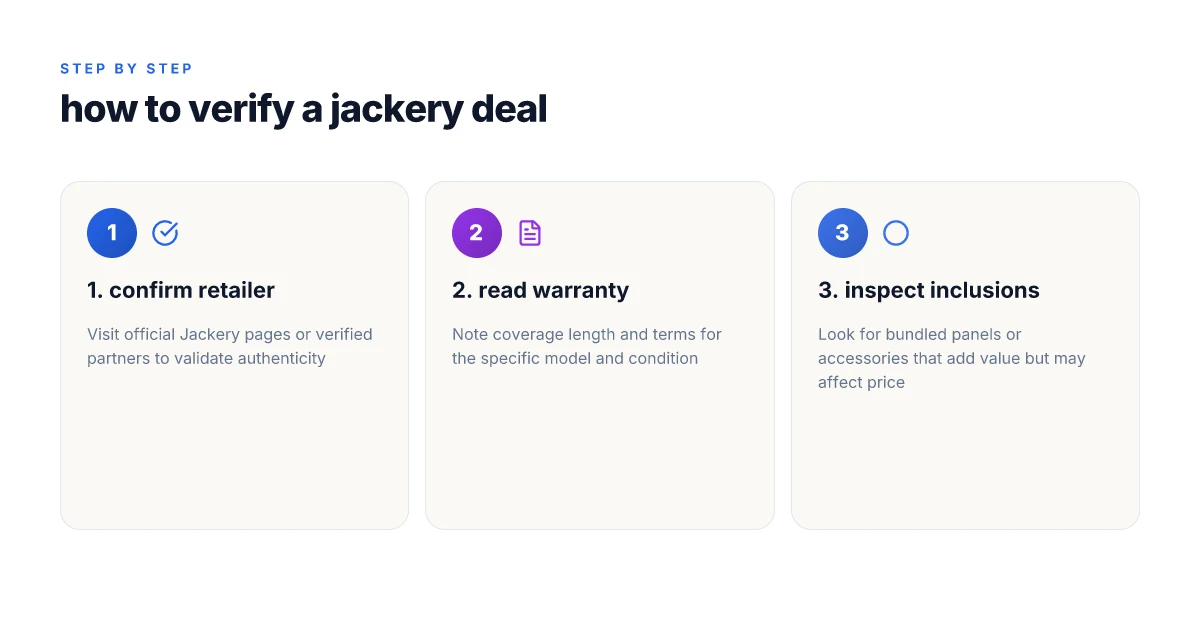
You can tell a real Jackery deal from a phishing listing by tracing it to official channels, reading the warranty terms, and scrutinizing refurbished claims. Start with the source: verify the retailer is an official Jackery partner or sits on the brand site. If you see a third‑party storefront with vague warranty language, treat it with caution. When in doubt, navigate to Jackery’s own pages and compare the product names and SKUs to what you’re offered. This keeps you inside the official warranty circle and avoids expired or invalid coverage.
Trust the retailer lineage and the product identity
A legitimate deal anchors to an official Jackery page or a recognized partner page. Look for consistency in model names such as the “Explorer 1000” or newer model variants like the “Solar Generator 1000 v2,” and confirm the listing references the same warranty terms Jackery publishes. If the listing hides the model revision or uses generic descriptors, that’s a red flag. I cross‑reference the product identity with the official site to ensure you’re not buying an outdated or refurbished unit sold as new. Trust is earned when the listing matches the official model and revision, and you can see that alignment in the product title and SKU.
Read the warranty terms and note coverage dates
Jackery’s warranty coverage varies by series and condition. The 2+1 year policy covers multiple series in some cases, with renewals or renewals‑on listing showing different durations. Read the fine print for the exact start date and what components are included. If a listing emphasizes only a “limited time” warranty or uses ambiguous terms, that’s your cue to dig deeper. Warranty dates and scope matter more than the upfront price. I found the policy page explicitly listing covered series and a note about renewed units, which helps you spot genuine terms versus marketing gloss.
Beware refurbished listings that obscure the warranty length
Refurbished or renewed listings frequently ride on shorter or unclear warranties. The official policy page often clarifies renewal terms and whether refurbished units retain the same coverage. If a deal omits the warranty length or states a generic “refurbished” without a clear warranty window, assume the worst and move on. Refurbished listings frequently obscure the warranty length, which makes the deal riskier for long‑term backup plans. If you’re leaning toward refurbished, verify the exact duration and whether the extended protections still apply. How the Jackery SolarSaga 200W changes off-grid solar setups
I dug into the official policy and user‑guide references to align these checkpoints with Jackery’s documented stance. For a quick anchor, see how the official warranty page delineates coverage across the 1000 and 1500 series and how renewed units are treated within those terms. This ensures you’re not overestimating protection when chasing a bargain.
If you want a quick cross‑check, search for the official Jackery user guide and the warranty policy edges on the brand site. The clarity of those pages is a telling sign you’re dealing with a legitimate offer, not a counterfeit promo.
Brand trust comes from official pages and transparent coverage.
The move that matters most for 2026 buyers
The near-term pull of Jackery gear isn’t just about raw capacity. It’s about a practical balance between weight, portability, and long-term durability. In 2026, I’m watching how the brand threads real-world usability into the reliability equation. If you want one reliable power partner for outdoor trips and occasional outages, look for models that pair sturdy housings with simple, repeatable charging paths. The bigger pattern is clear: durability wins when the system stays cool, charges predictably, and survives a few bumps on the trail.
From my perspective, the key verdict is straightforward: prioritize a setup you can actually maintain. For instance, when you see Jackery advertise a rugged case or a streamlined solar input, that matters more than a marginal jump in peak watts. Noticeably faster charging and fewer flaky solar moments translate to fewer headaches during storms or camping weekends. If you’re weighing rivals, consider how Renogy and Goal Zero systems compare on field practicality and component longevity, not just price. What makes the Jackery 100W solar panel worth it for outdoor power
The one move that matters this year is choosing a model with a proven cooling scheme and easy port access, so you don’t cede reliability under load.** If you’re curious about how to space out charges or want a quick mental model for a weekly check, see the brief backup steps below.
- Backup strategy: pick one model with a robust cooling path and modular attachments.
- What to try this week: run a straight charge from a solar panel during bright hours and note any heat or fan noise.
- Quick durability check: inspect the power ports and cable ends for looseness after repeated plug/unplug.