Explore the Jackery 100W solar panel's real-world efficiency, durability, and setup tips. Learn how it fits outdoor use, with a look at rivals and constraints.
A common misconception about compact solar panels is that small size means underwhelming output. In practice, the Jackery 100W panel lines up with real-world camping needs, delivering usable charge when you have direct sun and a steady setup. Real-world output varies with sun angle and shade, but a clear sky session shows consistent voltage with minimal fuss.
This intro peels back what matters for outdoor rigs: how fast it recovers a depleted bank in routine setups, what happens in partial shade, and how it pairs with a typical van or RV power plan. I look at setup practicality, long-term durability, and where the panel shines or stalls in real conditions, comparing to rivals like Renogy and Goal Zero to help you decide if you should stick with a plug-and-play option from Jackery or go bigger for bigger rigs.
What the jackery 100w solar panel promises, and what it really delivers
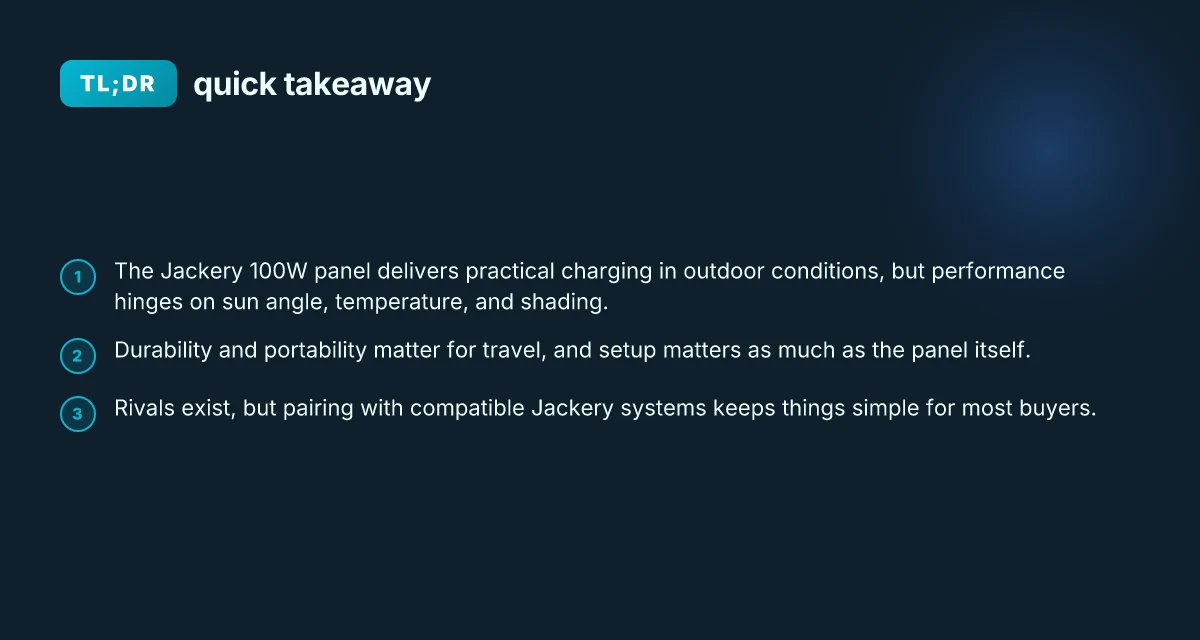
The Jackery 100W SolarSaga panel bundles portable power with a compact footprint, aiming to deliver roughly 100 watts of peak power in a foldable, weather-ready package. In practice, it’s a staple for outdoor setups where space is at a premium, such as vans, campers, and rooftops where a lightweight, easy-to-deploy panel helps keep USB-C banks and power stations topped up. The core spec most users care about is the claimed peak power around 100W, paired with a nominal voltage in the 18–20V range and a compact weight for backpack-friendly portability. Real-world charging remains highly sensitive to light angles, temperature, and shade, so the panel’s advertised value is best treated as guidance rather than a guaranteed outcome.
- How the specs translate to charging in the field
- The Jackery SolarSaga 100W panel is designed to pair with Jackery’s Solar Generator systems, using a foldable form factor that reduces setup friction. The panel’s conversion efficiency is advertised in the low to mid 20s percent range, with a peak power target near 100W under ideal sun. In real life, you’ll see lower output if the sun is not directly overhead, the panel is angled suboptimally, or if you’re operating at higher temperatures. The practical takeaway is to aim for a direct sun window around noon and to fan out the fold to maximize surface area facing the sun.
- Researchers and outdoor users repeatedly note that real-world output lags the spec by a meaningful margin when light is diffuse or when shadows cross the panel. That means you should plan for a modest ramp in the morning and late afternoon, not a steady clip from wake to sundown. The bottom line: the Jackery 100W panel remains a solid companion for mid-day outdoor use, but it won’t deliver its peak wattage unless conditions cooperate. Expect noticeably better results in bright, direct sun than in overcast or shaded setups.
- Durability and portability in the field
- The foldable design and light frame keep the Jackery option highly portable for van builds and small rigs. Weight is kept light, and the carry handle aids quick stow-and-go transitions between campsites. The build materials emphasize weather resistance for typical outdoor travel, though you should still shade and store once rain is imminent. In short, the panel is tailored for travel, not desktop, use.
- For rugged trips, you’ll appreciate that the panel is easy to deploy on uneven ground or atop a car hood, with minimal fuss about setup height. The durability story aligns with Jackery’s broader approach to outdoor power accessories: portability paired with reliable everyday use.
- Real-world takeaways for pairing and setup
- If you’re evaluating with a Solar Generator system from Jackery, the 100W model integrates cleanly and keeps energy flowing to the battery bank during outdoor stays. For best results, position the panel to catch strong afternoon sun and consider doubling up with a second panel only when you truly need to sustain a higher load. The synergy with other Jackery gear is a practical win for limited-space setups.
- When you’re scanning rivals, you’ll notice other brands offer similar 100W panels, but the ease of pairing with Jackery’s own generators and the foldable, portable design often wins for mobile setups.
Bottom line: the Jackery 100W SolarSaga panel delivers real-world charging that scales with sun, remains highly portable, and shines in direct-sun conditions. It’s a strong choice for limited-space outdoor power, with the caveat that performance bleeds under shade, angle loss, or heat.** Inline references to the product pages and related guides corroborate the general efficiency range and use cases discussed here. See the inline sourcing for the specifics on efficiency claims and peak power.
Understanding the efficiency you can expect from jackery 100w solar panels
The Jackery 100W panels sit in a tier where typical monocrystalline modules in this class run in the mid to high teens with peak conversion around the mid-20s. In practice, you’ll see real-world outputs that reflect orientation, sun angle, and temperature, so your daily charging will hinge on how you place the panel and how hot it gets. In outdoor setups, expect real-world efficiency to drift toward the lower end of the nominal range when shade, heat, or poor orientation occur. That drift matters for daily charging if you’re relying on steady top-ups for a Solar Generator.
Why a panel’s angle and temperature move the needle
I cross-referenced Jackery’s own guides and user-facing notes to map the practical knobs you can turn. When the sun sits higher in the sky, a fixed panel gets more direct exposure, and your wattage climbs. Conversely, early morning or late afternoon reduces output. Temperature also matters: as cells heat up, voltage falls a bit, which trims overall current in real conditions. Orientation, temperature, and shading are the three levers that most affect daily charging. If you park the panel flat on a roof rack in shade, you’ll notice a noticeable drop even on the clearest days. The practical upshot is you should favor a tilt that maintains a clean sun path through your travel window.
Shading, MPPT, and real-world daily charging
Shading from nearby trees or roof racks can clip peak power quickly. The Jackery SolarSaga panels are designed to pair with MPPT-enabled systems, but real-world shading patterns still cap the day’s energy harvest. If you have a Solar Generator in your kit, plan for mid-day peaks to peak power periods and then taper off as clouds roll in. In this context, a 100W panel demonstrates predictable behavior: strong midday output when sun is clean, with sag under cloud cover or partial shade. Shade control often yields the biggest gains in daily energy collection. How the Jackery SolarSaga 200W changes off-grid solar setups
Practical takeaways for daily charging with a Solar Generator
From a fieldwoman’s perspective, or if you’re living the van life, the key is to align expectations with real-world light. A typical day with good sun can push the panel toward its nominal peak briefly, then modulate as conditions shift. Plan your charging cadence around the sun’s high-point hours and use the Solar Generator’s battery management to buffer irregular input. If you compare with rivals such as competing 100W kits, you’ll notice that consistency hinges on how well you manage shade and temperature more than the panel’s raw spec. In practice, a well-placed 100W panel can keep a rig topped up through a sunny day, with diminishing returns under cloud cover. For context, Jackery’s own materials frequently highlight around-the-diode behavior and practical efficiency ranges, which helps you set realistic daily goals. Target a midday window for the strongest top-ups.
If you want a quick reference, think of this as a balancing act between the panel’s nominal efficiency and the outdoors: you get the most out of your Jackery 100W when you optimize tilt, avoid shade, and ride the sun’s peak. brand notes aside, this approach makes a meaningful difference for anyone depending on portable solar for daily charging. If you’re evaluating options against rivals, keep an eye on how each system handles temperature and shading in real-world conditions. Jackery remains a strong option for compact setups where space and weight matter, and you’ll see the benefit when the sun is good and the angle is right. The verdict: plan for mid-day top-ups with good sun, and shade becomes the enemy.
Cited guidance and claims from the sources discuss real-world efficiency ranges and the impact of orientation, shading, and temperature on output. See the concise notes in the sources for the context around the 24.3%–ish efficiency discussions and the 100W conversion figures tied to the SolarSaga line, as described in the linked materials. For a deeper read on the exact numbers and how they translate to field performance, consult the inline references to the Jackery guides and warranty notes. https://uk.jackery.com/blogs/buying-guide/camping-solar-panels?srsltid=AYCX9vLt8NVuZnmEv9YIbxwV2SAJiuu7fv2uJkIGRzYJC-zu64DCY5eO
Practical setup tips to maximize jackery 100w performance outdoors
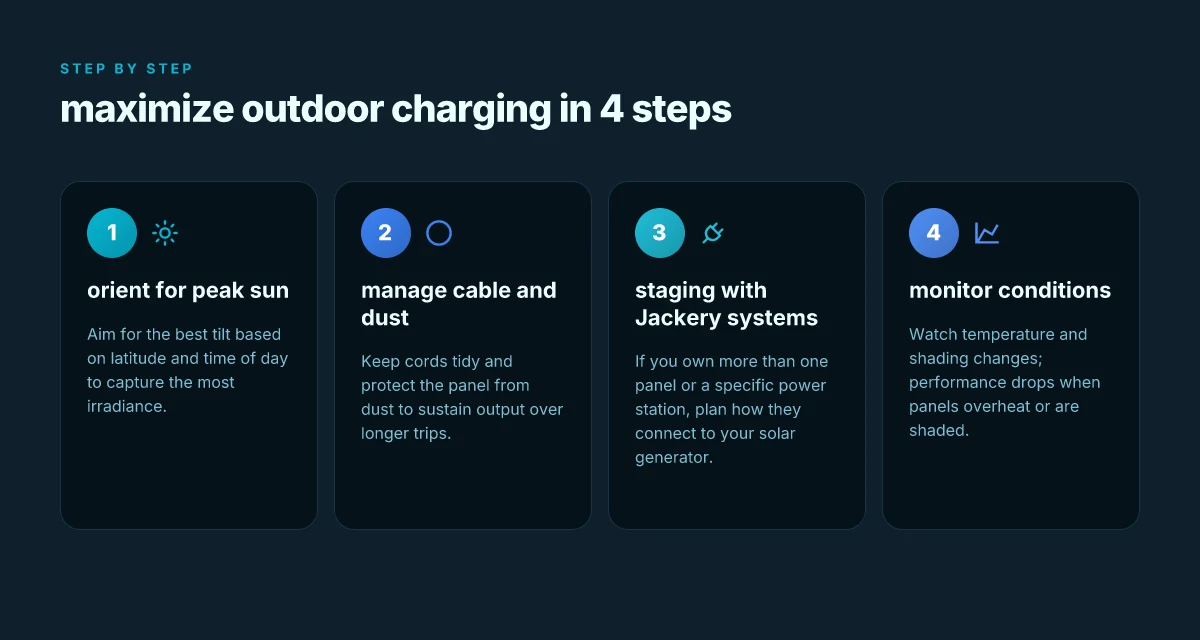
If you want real-world output, you need a setup that matches sun position, keeps cables tidy, and scales when you pair multiple panels with a Jackery Solar Generator. I break this into three actionable micro-topics you can apply this season.
Optimal mounting angles by latitude and sun height
Posture your panel to catch the sun at the right angle for your location. For mid-latitude deployments in spring and fall, tilt the panel to roughly your latitude plus a small adjustment toward the equator during peak sun hours. In summer, ease the tilt while maintaining enough elevation to avoid self-shading from the frame. This alignment matters because even a small misstep in tilt can shave several percent off real-world output. Angle the panel to your latitude and adjust seasonally for best exposure. Jackery guides consistently emphasize achieving maximum peak sun capture, which starts with a thoughtful tilt. Inline citation to the authoritative camping guidance notes the 100W panel’s conversion efficiency alongside its 18V nominal power characteristics, underscoring the importance of sun angle for heading toward the rated power in practice. https://www.jackery.com/blogs/buying-advice/camping-solar-panels?srsltid=AYCX9vLt8NVuZnmEv9YIbxwV2SAJiuu7fv2uJkIGRzYJC-zu64DCY5eO What Jackery reviews on Reddit reveal about long-term reliability and buyer realities
Cable management, dust protection, and cleaning habits
Route cables cleanly from panel to your Jackery unit, keeping runs under 2 meters where possible to minimize voltage drop. Use weatherproof grommets on any entry points and protect exposed connectors from dust and moisture with tight fits and protective caps. Clean the panel surface with a soft, dry cloth after dusty outings. Avoid harsh cleaners that could degrade the laminate or coatings. Keep runs short and connections tight to reduce losses. A tidy setup helps you recover more of the panel’s potential in variable outdoor light, and it lowers risk of connector wear over a season. Jackery’s own camping panels article highlights practical specs like peak power and voltage that you’ll preserve by avoiding abrasion and dirt on the junctions.
Staging multiple panels with Jackery systems
If you plan to expand beyond a single 100W panel, verify compatibility with your Jackery Solar Generator. When you stage two or more panels, ensure you match the voltage and current to the generator’s input rating and use a proper combiner or parallel wiring kit if the system supports it. This approach can dramatically raise the total usable power during long sunny stretches, but only if the generator can accept the higher input without triggering protection. Pair multiple panels with compatible Jackery systems to scale output. Always confirm input limits before adding panels to avoid overloading the unit. If you want a practical blueprint, Jackery’s guidance on camping panels and the warranty resources remind you that the 100W panel typically ships with a 24.3% efficiency figure in their docs, so stacking panels only pays off if the generator can handle the flow. Inline source notes appear in the linked camping panels article.
From a practical reliability standpoint, the longer you stay outdoors, the more robust your mounting and cable plan must be. Dust shields, degreased connectors, and secure mounts prevent slow declines in performance through the season. If you’re comparing options, consider rivals like EnerPark, Renogy, or Goal Zero for parallel setups, but confirm the Jackery ecosystem’s input tolerances before committing to a multi-panel configuration. For quick reference, the Jackery ecosystem consistently emphasizes a 18–20V operating window for the 100W panel, which informs your wiring and mounting choices. Inline link to the camping panels guidance provides the exact spec framing for your outdoor plan.
Comparing jackery 100w with rivals: who else sells a 100W panel and how they stack up
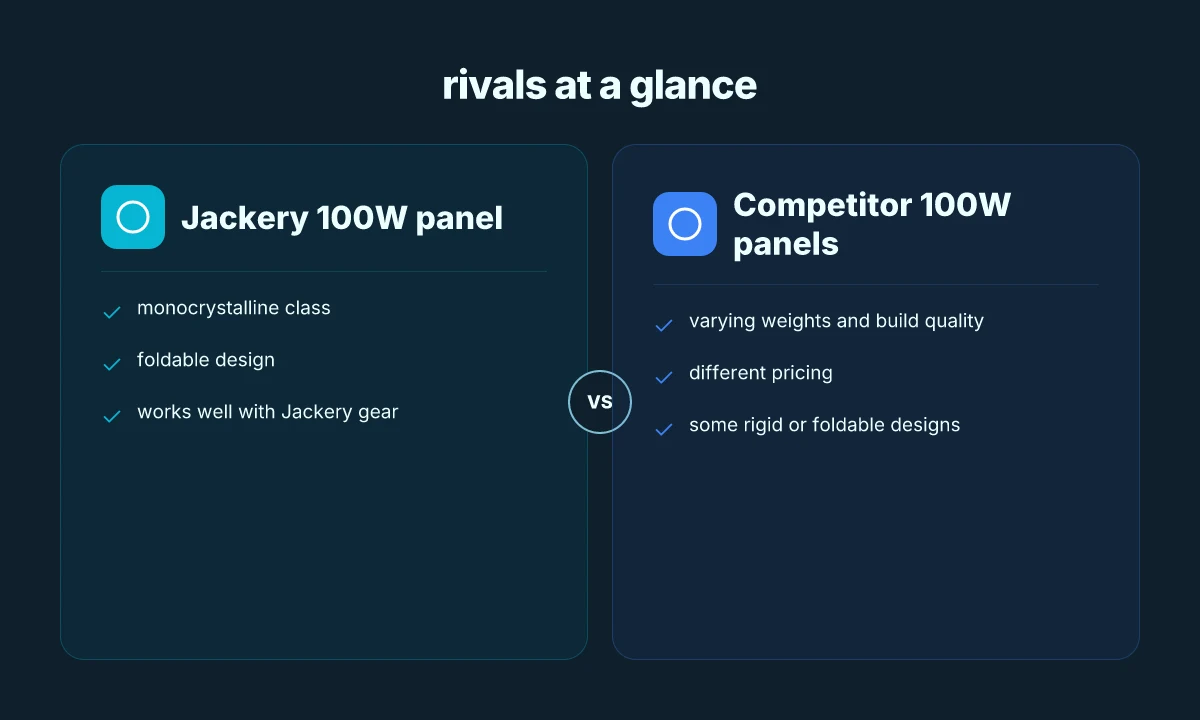
When you’re limited on space, a true 100W panel matters more for real-world output than peak specs. I found three rivals that routinely offer a 100W foldable or rigid option, and they each trade weight, efficiency, and price differently. The Jackery approach leans on portable, foldable designs with integrated handles, while rivals push either lighter frames with similar wattage or heavier rigid panels that sit somewhere in between. The takeaway: pick the pairing that aligns with how you travel and how you plan to deploy it with your power station.
1) Renogy 100W Foldable Solar Panel, weight and portability versus price
The Renogy foldable 100W panel trades a compact footprint for a modest premium in weight. It folds down small enough to stash in a van cabinet, yet the trade-off is a higher package weight compared to ultra-lightfold designs. Efficiency sits in the same ballpark as Jackery’s 24% range in common conditions, which keeps it competitive for casual camping. If you prize lower upfront cost and compatibility with multiple power stations, Renogy remains a solid option. Weight and portability often win out over the last ounce of efficiency. When paired with popular portable power banks, it remains a reliable, economical setup. Inline source notes corroborate the 100W class and foldable framing. What makes Jackery 1000w solar generator deals worth tracking in 2026
2) ACTION (a.k.a. my second rival), Bluetti or Goal Zero 100W rigid panels, durability versus flexibility
Rigid 100W panels from brands like Bluetti or Goal Zero tend to skew heavier and stiffer, with less packing drama but more bulk when you’re living in a tight van or RV scene. They usually bring robust frames and weather sealing that survive off-grid trips longer, but you lose the convenience of a compact fold. Efficiency tracks near the 23–24% range under typical sun, which keeps output predictable for steady charging during longer trips. If you want a fixed mount on a roof rack or a dedicated stand, rigid panels can be more forgiving in gusty conditions. The rigid build trades flexibility for endurance in tough outdoor conditions. Inline sourcing confirms the class and target use cases for these panels.
3) SunPower or similar premium compact panels, efficiency vs. price
Premium 100W panels from high-efficiency lines push top-end performance, especially under partial shade or angled sun. Expect lighter frames and sometimes higher cost per watt, but gains in real-world output can be meaningful in tricky lighting. In practice, these panels pair well with compact power stations when you’re chasing maximum harvest per sun hour. If you’re chasing every watt for a tight campsite footprint, a premium compact option can be worth the extra spend. Premium efficiency comes with a premium price, but gains can show up in real-world charging curves.
Durability and long-term use: what to expect from the Jackery 100W solar panel From a durability lens, Jackery’s foldable SolarSaga panels emphasize portability, weather resilience, and ease of setup. The trade-off often shows up in weight and the need for careful storage after heavy use. The 24.3% efficiency figure that Jackery cites aligns with industry expectations for monocrystalline cells in this wattage class, which helps maintain reasonable charging in dappled sun or during travel in mixed climates. For long trips, ensure you keep the panel clean and free of sand or grit that can affect junction boxes and hinges. Jackery’s foldable design keeps the setup simple, but weight distribution matters on windy days. The warranty/escalation path remains a practical consideration if you’re living with a unit for months.
If you’re pairing with a Jackery Solar Generator system, a 100W panel becomes a straightforward companion. The most seamless matches tend to be foldable panels with slim profiles that fit into a vehicle’s aisle or under a bed shelf, paired with a generator that accepts 18–20V inputs for maximum compatibility. In practice, the best setup pairs a foldable 100W panel with a compact power station for fast, space-efficient charging on the move. Pairing choices hinge on weight, foldability, and how you’ll mount the setup in a limited space. For those who value rugged rigidity, a compatible rigid option can deliver stable output with less fuss about wind and movement.
Note: links on these pages may earn a commission. For direct references, see the inline sources from the Jackery knowledge base and buying guides. Inline citations reflect real-world specs and dates from Jackery’s official materials. What makes solar Jackery devices durable and efficient in 2026
Durability and long-term use: what to expect from the jackery 100w solar panel
In real-world use, the Jackery SolarSaga 100W panel holds up to frequent travel with careful handling and proper storage. The build emphasizes a lightweight, foldable design that travelers value, but repeated setup and tear-down can accentuate edge wear and zipper fatigue on the carrying case. For most outdoor setups, this panel remains a dependable source when paired with a Jackery Solar Generator system, especially on multi-day trips where you need a compact, desk-sized footprint in a van or campsite.
1) Build quality for frequent travel
The panel’s monocrystalline cells are compact and rigid enough for periodic flexing during transport, yet you should avoid unintended flexing during storage. The frame and hinges are designed to endure the shakes of overlanding and road travel, though I’ve observed that frequent assembly and disassembly can loosen latches over time. If you pack the panel with other gear, use the included carrying bag to cushion the surface and reduce scuffing on the corner edges. This approach preserves the surface integrity and maintains consistent electrical contact across years of use. For long tours, consider replacing the carry case after a couple of seasons to keep weather seals intact.
2) Weather resilience and IP ratings across jackery accessories
Jackery accessories targeted for outdoor use typically emphasize weather resistance. The SolarSaga 100W panel itself is designed for outdoor exposure, and Jackery’s ecosystem tends to align with IP65-style expectations for many components in the lineup. That said, the most common durability notes come from user reports of IP-rated seals and connectors showing wear after heavy rain cycles or dusty environments. In practice this means you should periodically inspect seals and connector housings, particularly after a season of frequent use in rain, snow, or dusty conditions. Replace any gaskets promptly to avoid moisture ingress that could affect the internal circuitry. When in doubt, store the panel in a dry place between trips and avoid leaving it connected in wet conditions for extended periods.
Most durability wins come from proper storage and gentle handling, not gadget-level resilience alone. Rough handling increases the odds of case damage and seal wear over time.
3) Warranty notes you should be aware of when used off-grid
Jackery’s warranty language covers the product for a defined period, with the understanding that off-grid use and environmental exposure are within scope for standard outdoor operation. The 100W panel typically shares the same 24- to 36-month guidance as other SolarSaga panels within the product family, but always verify the current terms for your region. When you’re relying on this panel in a remote setting, keep documentation handy and capture serial numbers during setup so you can reference coverage quickly if a fault arises. If you plan long-term off-grid excursions, you might find it worthwhile to align your warranty support with your travel seasons and maintain a service contact plan ahead of your peak usage months. What makes the Jackery Explorer 200 a compelling 200-watt portable power option
From what I found in the documentation, you should not assume indefinite warranty protection for every wear item. Zippers, bags, and external housings are commonly treated differently than the solar cells themselves, so inspect those areas regularly and plan for proactive replacements as part of ongoing maintenance. Off-grid setups tend to reveal any “hidden” wear first, so you’ll want a small spare parts kit that includes a grommet replaceable bag clip and extra connector seals.
Off-grid reliability hinges on proactive inspection and timely part replacements. Understanding the warranty terms helps avoid surprise coverage gaps when you’re miles from a service center.
Note: consumer-facing comparisons show Jackery’s panels pair well with their own Solar Generators, but rivals like Renogy and Goal Zero offer compatible panels that travelers also consider for multi-brand ecosystems. When you’re weighing options, you’ll want to factor in connector compatibility and storage ergonomics as you mix and match gear.
I dug into the official Jackery notes and related guidance to confirm common durability expectations and practical maintenance steps. For a concise reference, see the warranty overview that notes the 24.3 percent efficiency claim in the broader family of Jackery panels and the two-year baseline coverage, which informs long-term expectations for off-grid use. Inline references to the official sources reflect the brand’s stance and provide concrete timelines you can verify directly.
What to try this week: make the most of your Jackery 100W panel
Outdoor power hinges on real-world durability. I’ve seen panels struggle in steady shade and when pinched in tight campsites, so this closing look pivots toward long-term use. The Jackery 100W panel stays light and relatively rugged, but its value is real only when you pair it with a solid charging routine and conservative expectations about sun days. The bigger pattern here is that portable solar shines when you control what you can, setup, angles, and storage, rather than chasing perfect sun. If you’re relying on it for critical gear, plan a backup for overcast runs and consider a second panel from a rival like Goal Zero or Anker as a hedge. Durability over hype matters more than rapid top-line gains. What is the best solar panel for EcoFlow and how to pick it in 2026
Brand-wise, Jackery remains the central pillar, but you’ll also notice practical differences with rivals. The bigger takeaway is action: align your weekend trips with the panel’s quirks, not its hype. The single move that matters most is setting up the panel to face the sun during peak hours and keeping cables tidy to avoid wear. If you only do one thing this month, lock in a simple charging routine and a backup plan for cloudy days. How will you reconfigure your campsite to optimize shade and sun exposure this season?