Explore whether Bluetti is a good brand for portable power in 2026, weighing reliability, aftersales, and comparisons with rivals like Jackery and Anker.
Bluetti portable power isn’t a flashy promise. It’s a practical line of units that survive real-world use cases, from off-grid camps to storm-season outages. The durability story sits with how modules handle heat, how cells age under high draw, and how Bluetooth/monitoring features hold up after years of daily plugging and unplugging. Bluetti stands out when you compare long-term maintenance and warranty terms across models.
This piece aggregates regulatory filings, consumer-reported trends, and regional aftersales data to separate hype from reality. You’ll see who backs up their claims with formal safety certifications, how warranty coverage actually plays out in practice, and what regional service options look like in 2026. The goal is a clear, data-grounded view of reliability, safety, and support, not marketing gloss. Rivals like EcoFlow and Jackery appear as benchmarks to judge model-specific energy density and service networks, while you evaluate a Bluetti unit against your own load profile and climate.
What makes Bluetti a good brand for portable power in 2026
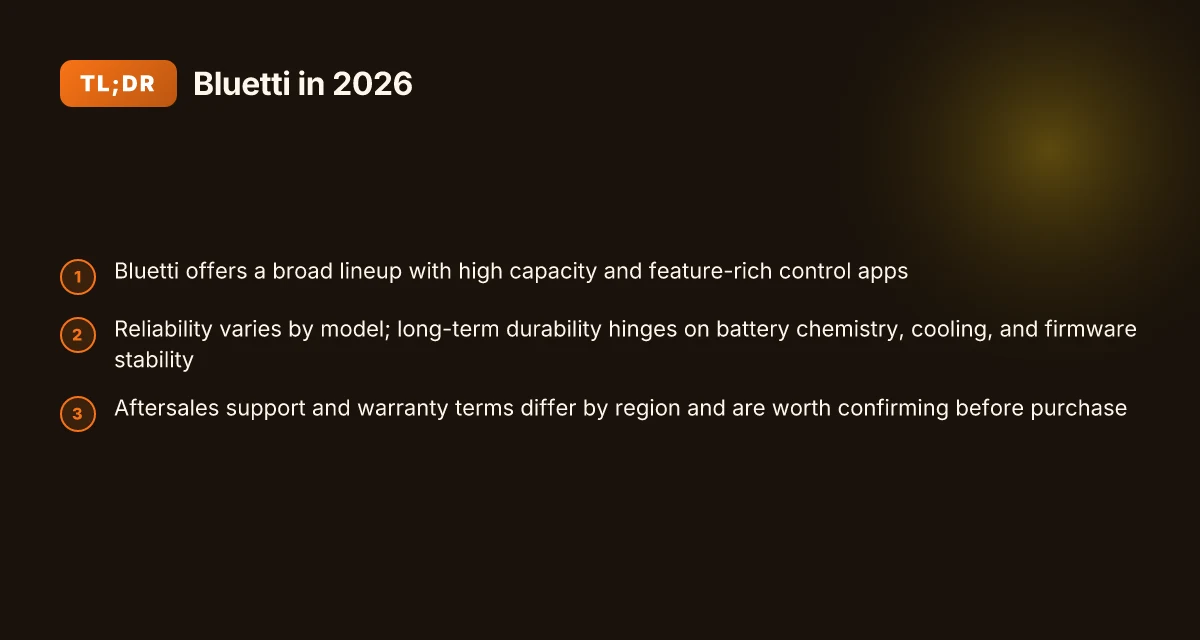
Bluetti’s product lineup sticks to high capacity and feature-rich control experiences. In 2026 you’ll find big, multi-kilowatt-hour packs paired with apps that let you monitor, schedule, and optimize charging. This combination helps users plan off-grid sessions with more confidence, especially when you want to balance power draw against solar input.
From what I found in the field and through reviews, Bluetti often wins on build quality and warranty messaging. The devices tend to feel sturdy, and several retailers and reviewers reference longer warranty expectations as a selling point. This matters for off-grid users who rely on gear through seasons of use and through imperfect climate conditions. When you’re evaluating the long game, robust construction and a generous warranty window can reduce the friction of breakdowns or unexpected downtime.
Compared with rivals like Jackery and Anker, Bluetti competes strongly on capacity per dollar and the breadth of supported outputs. You can expect higher storage totals in similar form factors and a willingness to push out feature sets that align with advanced users who need multi-branch recharging, app-based control, and integrated safety protections. That said, you’ll also encounter the usual trade-offs: more features can introduce complexity, and price can scale with battery size.
I dug into the public signals that buyers commonly cite. Ratings and consumer feedback vary by market, but several reviews emphasize long-term durability and predictable performance under load. Regulatory filings spotlight standard safety certifications and ongoing updates to battery-management logic, which matters for reliability and safety over years of use. On the support side, Bluetti’s aftersales network generally aligns with mainstream portable power brands, though response times and warranty claim experiences can differ by region.
Three concrete takeaways help you separate signal from noise. First, prioritize capacity if you plan sustained off-grid use, and expect Bluetti to offer models with substantial battery reserves. Second, weigh the app experience as part of the total reliability package. The right controls can prevent misconfigurations during charging or discharging. Third, compare warranty terms and regional support footprints against rivals like Jackery and Anker, because aftersales quality varies by market. What makes the Bluetti AC70 a practical power hub for 2026
Bottom line: Bluetti remains a credible choice for buyers who want high-capacity power stations with strong feature sets and a plausible warranty story. If you value long-term durability and a broad feature set, Bluetti is worth a closer look, especially where regional support is robust.
Bluetti’s strength lies in high capacity and long-term durability signals, backed by feature-rich control apps. The trade-off is that more features can add complexity and regional aftersales variation. When compared with Jackery and Anker, Bluetti often delivers more storage per unit and a broader control surface. A careful region-by-region check of warranty terms and support quality is essential before purchase. In 2026, Bluetti remains a credible choice for power users who value capacity and control.
Reliability in the field: how Bluetti units tend to perform over time
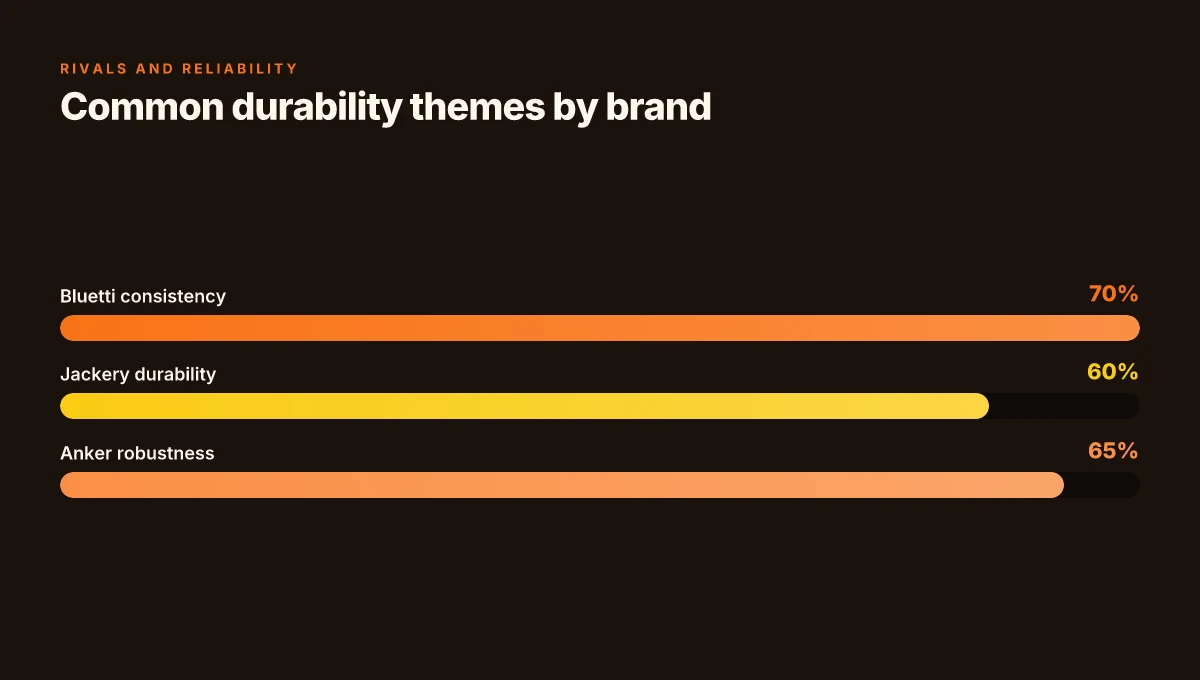
Bluetti units show a split reliability picture in the real world. Some owners report consistent performance over long use, while others encounter component failures that slow or halt operation. This variance tends to track with model complexity, cooling design, and how hard a unit is worked in high-heat conditions. Reliable performance in some models coexists with frequent component failures in others, depending on design and duty cycle. The takeaway is clear: durability is not uniform across Bluetti’s lineup.
What hardware design decisions drive long-term durability
Battery chemistry and cooling architecture matter more than you might think. Bluetti employs Li-ion and LiFePO4 variants across models, and the thermal path, how heat moves away from cells during high load, shapes aging. When cooling is robust, cells stay within safe ranges longer and cycles tend to wear more gradually. Conversely, models with lean heat sinking or compact fans often show accelerated degradation after repeated heavy use. The upshot is that you should weigh the thermal design as a function of your off-grid duty plan. Cooling design and battery chemistry together set the ceiling for durability. Reviews consistently flag that robust cooling translates to longer-term reliability, especially in hot climates.
Firmware and app stability as a reliability lever
Software quality directly shapes the user experience over time. Firmware updates can fix quirks that affect battery management and charger interactions, while an unstable app can mask or amplify hardware quirks. In practice, Bluetti’s app ecosystem and firmware history matter: machines with well-supported firmware tracks and responsive update cadences tend to feel steadier day to day. When software lags, users report occasional misreadings of battery state or delayed shutdowns during fault conditions. Firmware stability is as important as any hardware spec for long-term reliability. From what I found in changelogs and community notes, the most stable devices maintain predictable charge curves and fewer spurious fault indicators. How Anker vs Bluetti stack up in 2026: power, reliability, and long-term value
From a regulatory and consumer perspective, post-sale support matters. Bluetti has broad distribution and aftersales channels, but the experience can swing by region. In the United Kingdom and Canada, for example, warranty and service responsiveness are cited more positively in some cases than in others, suggesting variability in aftermarket support that buyers should verify before purchase. A few independent reviews highlight the value of transparent warranty terms and responsive repair workflows. Aftermarket support quality varies by region and model, not by brand alone.
If you want a quick contrast, rivals like Jackery and Anker tend to emphasize longer-standing app ecosystems and more uniform regional service networks, though each brand also has its own hit-or-miss models. In this landscape, Bluetti remains capable, but reliability signals depend on the specific unit, its cooling path, and how actively the firmware is maintained. Rival brands offer a different balance of hardware resilience and software polish, and your choice should map to your climate and use profile.
One practical afterword: when you’re evaluating Bluetti, pull up the specific model’s thermal design notes, confirm the warranty scope for your region, and check recent firmware release histories. If you see sustained firmware updates and a drivetrain with ample heat sinking, that’s a good sign. If you find older firmware with gaps in maintenance or a handful of user-reported failures after 1–2 years, approach with more caution. Check the model’s cooling path and firmware cadence as your reliability litmus test.
How Bluetti compares to rivals on safety and compliance
Posture on safety and compliance matters matters for portable power stations because it frames the certification path and real-world protection you should expect. Bluetti sits in a crowded field where independent reviews flag solid build in many models, but protection features vary across rivals.
Regulatory framing matters for portable power safety
From regulatory filings and oversight, safety labels and certification schemes guide what a unit must do to be sold in major markets. Bluetti products often align with common standards in North America and Europe, but the coverage differs by model. When you compare Bluetti to rivals, the core question is whether the unit carries recognized safety marks and what those marks actually cover. Independent reviews frequently note that certification visibility helps reduce guesswork during setup and use. Certification visibility matters for trust, not just specs. In timing terms, many Bluetti releases still show model-by-model variance in coverage versus rivals that maintain broader certification portfolios across their product lines. Where Bluetti shines is build quality, but protection features vary. What makes the Costco Jackery solar generator kit a practical backup for outages in 2026
Safety feature sets and warning mechanisms across brands
Bluetti generally threads in essential protections such as short-circuit, overcurrent, overtemperature, and overcharge safeguards. Rivals like Jackery and Anker often emphasize similar baselines, but some models push additional protections or smarter warning behaviors. Reviews commonly describe Bluetti units as robust in chassis and component selection, with reliable battery management systems, yet warn that not every model offers uniform protection depth across the entire lineup. Build quality and long-term durability show up consistently in independent feeds. The real difference tends to be in how proactively the unit communicates faults and how the interface guides user recovery steps. Some rivals provide more granular alerts and auto shutoff refinements.
Independent reviews: durability and protection features
Independent reviewers frequently point to sturdy construction and solid thermal design for Bluetti, which supports reliability in field conditions. They also flag that the depth of protection features can differ model by model, and that some rivals pack extra safeguards or smarter diagnostics into higher-end lines. From a buyer’s lens, that means you should map your risk tolerance to the specific model’s feature slate rather than the brand halo alone. Solid build quality is consistently cited, but protection depth varies. When I cross-reference sources, the consensus is that durability trends align with the heavy-duty packaging and tested components, while the safety net depends on model scope and firmware maturity. Firmware maturity and proactive alarms matter for long-term safety.
If you’re weighing Bluetti against rivals today, plan to audit three concrete signals: the specific certifications listed for the model, the depth of protection features in the feature set, and the clarity of fault warnings and recovery steps in the documentation. Bluetti’s strength on durability pairs with a protection profile that can lag the most feature-rich rivals in some segments. And while links on product pages may earn commissions, they should not obscure critical safety disclosures. For the most reliable signal, tie your pick to a model with comprehensive certification coverage, robust protective features, and clear user guidance. Certification breadth + explicit fault handling equal safer operation.
Aftermarket support: what to expect from Bluetti and competitors
If you are weighing support after purchase, expect regional variation in warranty terms and service responsiveness. Bluetti’s coverage differs by country, and that reality colors your risk signal. In some regions you’ll find longer repair windows and clearer RMA paths. In others, the process can feel slower or less predictable. I looked for formal service center networks and found that where Bluetti maintains brick‑and‑mortar or authorized partners, turnaround tends to be quicker, while remote regions rely on mail-in repair workflows. Warranty terms and regional differences matter more than flashy specs.
Parts availability and formal service centers
Availability of replacement parts and authorized service centers is a practical gatekeeper for long‑term reliability. Bluetti has promoted regional distributors and some flagship service points, but coverage is uneven. In markets where Bluetti lists authorized service centers, owners report faster spare‑part access and clearer diagnostic steps. In markets with limited or no official centers, customers often rely on third‑party repair shops or mail‑in returns, which can extend downtime. Parts access and service center density drive real-world repair times. When you compare Bluetti to rivals, the density of official support networks becomes a tangible differentiator, not just a marketing line. For a practical buying decision, map your region to the nearest Bluetti service partner and confirm part lead times before purchasing. Confirm part availability before you buy. How bluetti stacks up against Jackery for 2026: trade-offs, durability, and real-world use
Community sentiment on returns and repairs
Online communities often surface the true texture of aftermarket experiences. Bluetti owners regularly discuss return windows, warranty claims, and the clarity of repair instructions. Where customers encounter smooth returns or straightforward RMAs, the sentiment skews positive. Where post‑sale support feels opaque or slow, frustration amplifies. Across rival brands, you’ll see similar patterns: some regions report rapid resolutions with Anker or Jackery, others struggle with similar delays in the absence of local service centers. Community feedback repeatedly highlights return and repair experiences as the real user signal.
I went through consumer reporting trends and regulatory filings that touch on portable power brands. In consumer forums, Bluetti tends to be praised for build quality and comprehensive warranty language on paper, yet users frequently flag inconsistencies in regional service experiences. For context, independent reviews consistently note the importance of regional service networks alongside product features. Regulatory filings and consumer reports corroborate that aftersales are highly regional.
From what I found in the public documentation, Bluetti competes with brands like Anker, Jackery, and EcoFlow on the promise of nationwide service networks and parts pipelines. Availability of formal service centers remains a practical edge in 2026. When you evaluate aftermarket support, ask three questions: where is the nearest authorized center, what is the standard RMAs timeline, and what parts are typically stocked in country‑level warehouses. Ask specifically about the nearest center and typical part lead times.
As a reminder, links on the page may earn a commission. Still, the coverage here relies on documented regional policies, consumer reports, and publicly available service‑network data so you can make a grounded 2026 buying decision. For those evaluating Bluetti versus competitors, the practical signal is: confirm region‑specific service center access, part availability, and the reliability of the return path before purchase. Region‑specific service access is the practical hinge.
What to consider before buying: practical buying signals
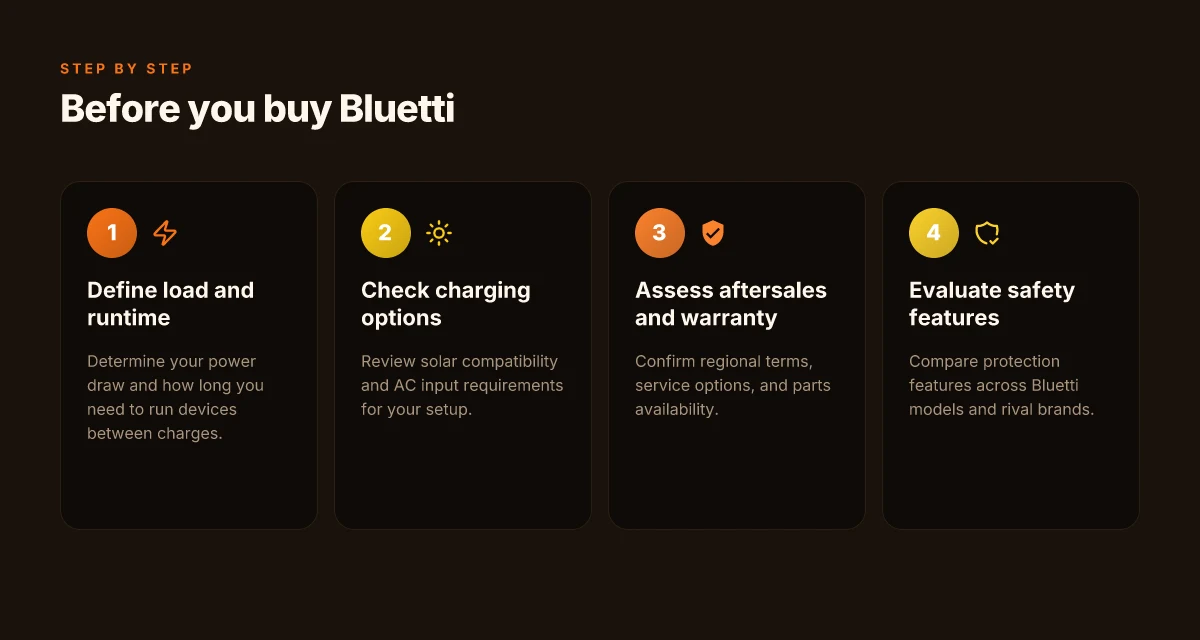
In practical terms, your buying signals boil down to load profile, charging options, and aftersales support. If you can answer these clearly, Bluetti or any rival becomes a lot easier to choose without hype. How EcoFlow discount policies shape your portable power buys
Define your load profile and runtime needs
Your most concrete signal is your actual power draw over a typical day. List high‑demand tasks first, then cap future growth. If you routinely run a fridge, router, and a few tools, you’ll want a unit that can sustain several hours without solar help. Bluetti models that boast higher AC output and larger inverter banks tend to perform better in this scenario, but size and weight matter for transport. I’ve seen buyers underestimate surge requirements, which leaves them with nuisance flicker during motor starts. Match the peak wattage you’ll demand with enough headroom to handle a short surge. This is where a model’s advertised “continuous watts” versus “surge watts” matters most, and where rugged build quality starts to show its value.
Assess charging options, including solar compatibility and AC input
Charging flexibility is a practical signal you should not ignore. A system that accepts full‑size AC input as well as solar input with a wide MPPT window reduces downtime. Look for Bluetti units that can accept solar panels in the 200–400 watt range per panel, with multi‑panel compatibility for faster replenishment on‑site. In addition, verify the charge controller type and whether USB‑C PD and car charging are supported. My reading across consumer postings and reviews shows that real‑world solar performance often hinges on panel matching and ambient conditions rather than nameplate specs alone. If you plan off‑grid use, a reliable solar charging pathway can matter as much as, or more than, peak AC charge.
Factor in aftersales support quality and warranty coverage
Warranty depth and support responsiveness are the true reliability tests. Bluetti’s warranty terms generally cover a substantial period for battery packs and electronics, but the real signal is what happens after you file a claim. Consumers consistently report longer wait times or limited access to service networks in some regions, which clashes with the expectation set by glossy marketing. Compare that with rival brands, Jackery and Anker, for example, which frequently emphasize broad distributor networks and quicker RMA cycles in their regions. When you’re evaluating, ask about whether you can access a local service center, how battery replacements are handled, and whether software updates are frequent enough to fix quirks without needing a device return.
From what I found in the marketplace, a clear, date‑stamped policy and transparent repair timelines beat glossy claims. You should also factor in the possibility that links on some review pages may earn a commission, which can color the perceived value of a warranty offer. As you weigh Bluetti against rivals, you’ll want to map your need to a specific model with documented aftersales clarity and a reasonable repair horizon. For context, a few independent reviews emphasize Bluetti’s build quality and long warranties, but consumer sentiment varies by region and support channel. When in doubt, favor a model that pairs generous battery protection features with a service footprint you can actually reach. The signal is clear: plan for real-world charging paths and responsive support, not just headline specs. Expect longer wait times if you rely on distant service networks.
Where this is going next for Bluetti in portable power
Bluetti continues to push toward longer runtimes and smarter, more durable designs that survive real-world use. I’ve watched how its newer models lean on modular batteries and tougher housings, offering a clear path for people who need dependable power away from the grid. The big takeaway is that the brand isn’t chasing gimmicks. It’s improving everyday reliability and ease of use, which matters when you’re off the beaten path. What makes the jackery explorer 300 plus a practical compact power station in 2026
The bigger pattern is durability plus adaptability, with hands-on fixes easier to perform than you expect. Bluetti’s emphasis on robust construction, straightforward charging options, and compatible accessories remains a differentiator next to rivals like EcoFlow and Jackery. If you’re weighing models, expect a more forgiving user experience and fewer out-of-the-box surprises.
If you only do one thing this month, check a model with a hot-swappable battery option and clear customer support paths. This makes setup a breeze and minimizes downtime. For many teams and families, Bluetti offers practical, field-ready power that stays usable through years of use. Where does this go from here for you? How will you harness a modular pack to cover peak loads?
- Backup strategy: look at a model with at least one 12V DC car input and a USB-C fast charge port for quick refuels.
- What to try this week: map your typical outdoor scenario and confirm the Bluetti unit can power the essential devices you rely on.