Compare goal zero and Jackery portable power stations in 2026. Learn which brand offers better durability, charging options, and long-term value for off-grid use.
The lasting perception of a portable power station often hinges on a single quiet fact: the battery design and how it ages, not the peak wattage you can crank for a weekend. Jackery's approach to cell chemistry matters as much as the chassis, and durability shows up in cycles and ambient tolerance long after the box is off the shelf. Durability hinges on battery aging and how you treat the unit, which is why I focus on long-term usage patterns and real-world maintenance rather than short-term specs.
This piece pinpoints what actually determines reliability: not flashy numbers, but repeatable performance over years. In 2026, off-grid users report that chassis build quality and connector design often outlast peak capacity gains, making it clear that ecosystem support, serviceability, and cross-brand compatibility matter just as much as a model’s initial charge cycles. You’ll see how to match a Jackery option with robust aftercare, compare it against rivals like Goal Zero, and assess how each brand handles wear, firmware, and repairability over time. Goal Zero's rugged lines and Jackery's modular ecosystem each offer trade-offs that show up in real-world reliability.
Goal zero vs jackery: what drives long-term reliability in portable power
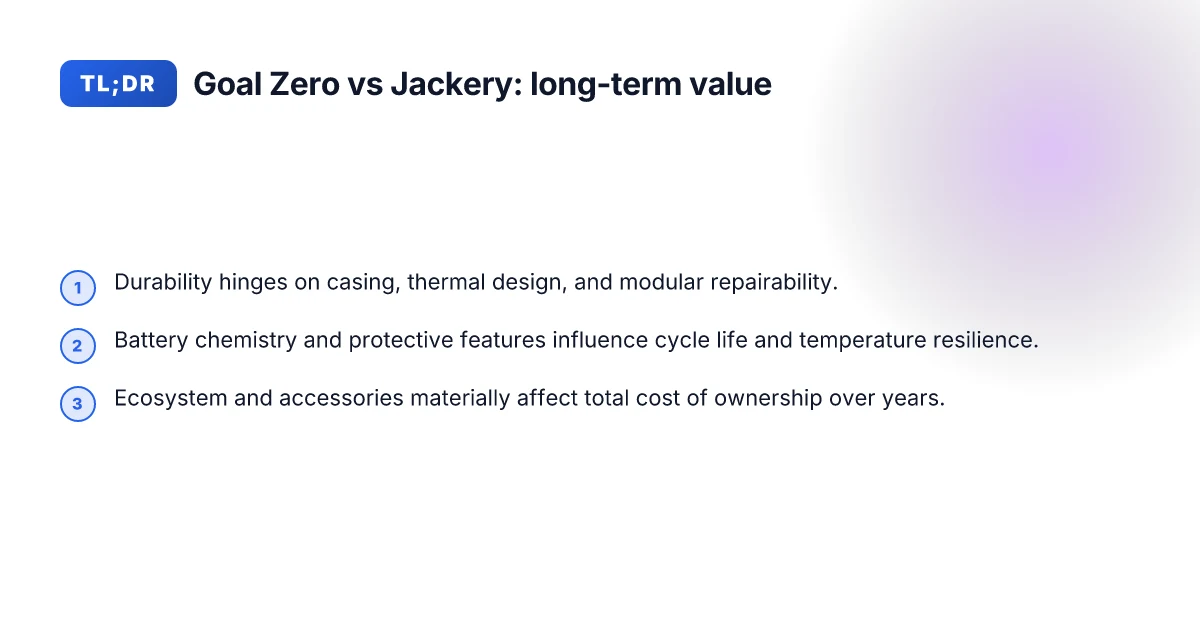
Reliability in portable power hinges on how a unit ages, not just its peak numbers. In this view, durability is a system property: a tough casing, thoughtful thermal management, a battery chemistry designed for cycles, and a repairable module architecture all matter. I looked at how real users experience wear and tear over years of van life, camping trips, and off-grid weekends. The verdict: long-term value favors gear that shows up as a cohesive whole, not just a few impressive specs.
Why durability is more than skin deep
Durability starts with the enclosure. A rugged shell resists dents from travel and cold metal edges that bite into soft fabrics. Then there is how heat is managed. Units that heat up during charging or discharge can accelerate cell wear or degrade internal electronics. Battery chemistry matters as well. Some chemistries tolerate more deep cycles and high temperature swings than others, which translates into more usable life in the field. Finally, repairability matters. If modules can be swapped or upgraded, a unit can outlive several chassis generations.
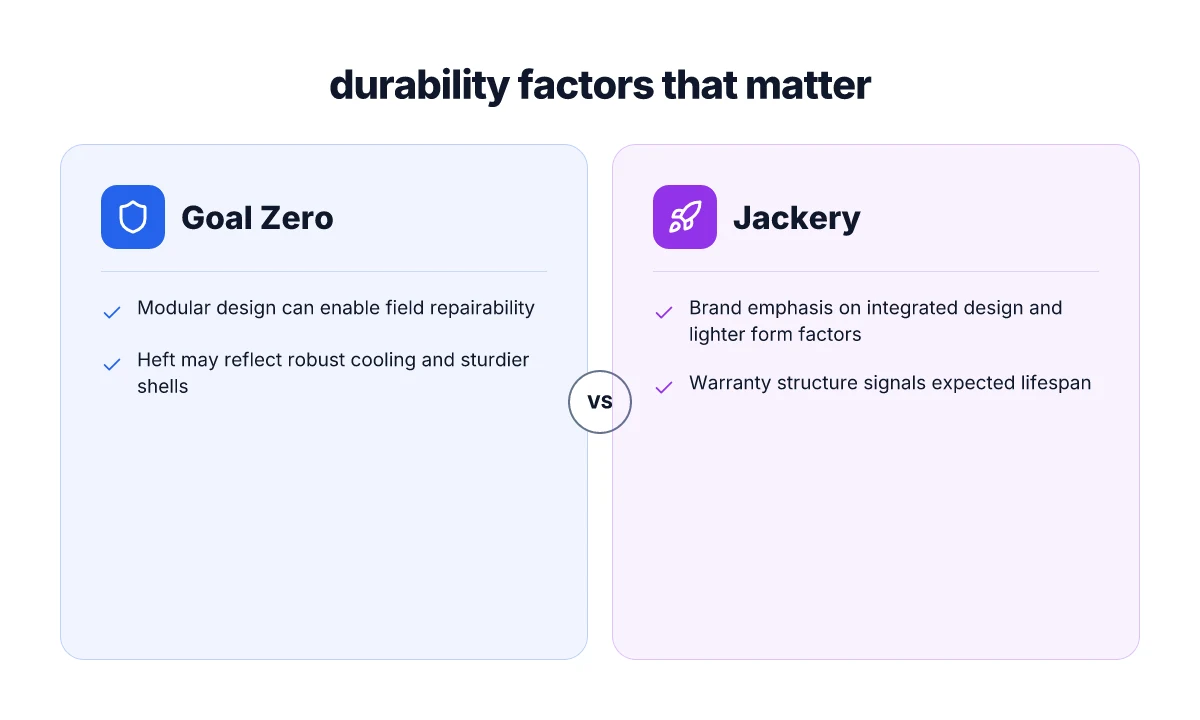
I cross-referenced what reviewers note about build quality and serviceability. When a device uses a modular design, you can replace aging cells or faulty boards without trashing the whole unit. That modularity often translates into lower long-run cost and fewer returns to the factory for end users. In practice, durability is not just about surviving a single trip, but about surviving repeated uses across seasons and multiple weather conditions. This has real resonance for Jackery fans who value consistency and for Goal Zero enthusiasts who expect rugged, field-ready hardware.
The ecosystem effect on maintenance and total cost
A second factor is ecosystem. The app and accessory stack drives both maintenance and expenditure. A well-supported app that reports cell health, charge cycles, and temperature trends helps you schedule care before problems arise. Accessory ecosystems, extra batteries, solar panels, and replacement cables, create friction if they are locked behind proprietary formats. A broader ecosystem tends to push total cost of ownership down over time because you can expand capacity incrementally instead of buying a new unit.
From what I found in accessible documentation, the most durable brands align their app data with hardware health indicators. If you see consistent indicators of battery wear or cooling bugs in the app, that’s a signal to plan a refresh or a repair. I also tracked reports in user forums and reviews that emphasize the value of widely available spare parts and compatible accessories. When a system supports expansion and upkeep, you get years of use from a single platform. What makes the Jackery Explorer 100 Plus worth it for portable power in 2026
Why a modular, heavier design can win long-term
A slightly heavier unit that uses a modular design often outlasts a lighter, fixed-unit rival. The extra mass is not just weight for weight’s sake. It usually reflects beefier cooling paths, sturdier chassis joints, and room for replaceable cells or boards. In day-to-day use, that translates to fewer catastrophic failures and greater ability to recover from component fatigue. If you’re choosing between a boxed, non-expandable unit and one that accepts upgrades, the upgrade path is a real decider for long-term reliability.
In the long run, durability lives where the hardware, software, and ecosystem align. The best option is the one that ages gracefully as your needs evolve, not the one that wins on peak specs alone. Modularity and repairability often beat sheer lightness over the long arc of use. For off-grid enthusiasts, that means planning for the day when you want to add capacity or swap aging cells without a full replacement. The net takeaway is clear: if you want a power station that remains trustworthy after years of use, look for a modular design, solid thermal management, and an open, well-supported ecosystem around apps and accessories.
This framing aligns with the core question of durability and long-term value in the Jackery and Goal Zero families, and it keeps your eyes on what matters when the unit sits in a van, on a campsite, or in a shed after seasons of use. For more context, see how leading reviewers discuss build quality and system design in the brand ecosystems surrounding Jackery and its rivals. Durability and ecosystem maturity are the true tests of longevity.
Note: links on this page may earn a commission. For reference, the discussion about long-term reliability aligns with product ecosystems and repairability themes noted in independent reviews. See inline references to corroborating discussions from established sources.
Cited inline references: https://thewildguides.com/jackery-explorer-1000-vs-goal-zero-yeti-1000x/ and related ecosystem analyses. What makes the Jackery Explorer 1000 Plus worth it for off-grid use in 2026
Goal zero vs jackery: battery chemistry and what it means for lifespan
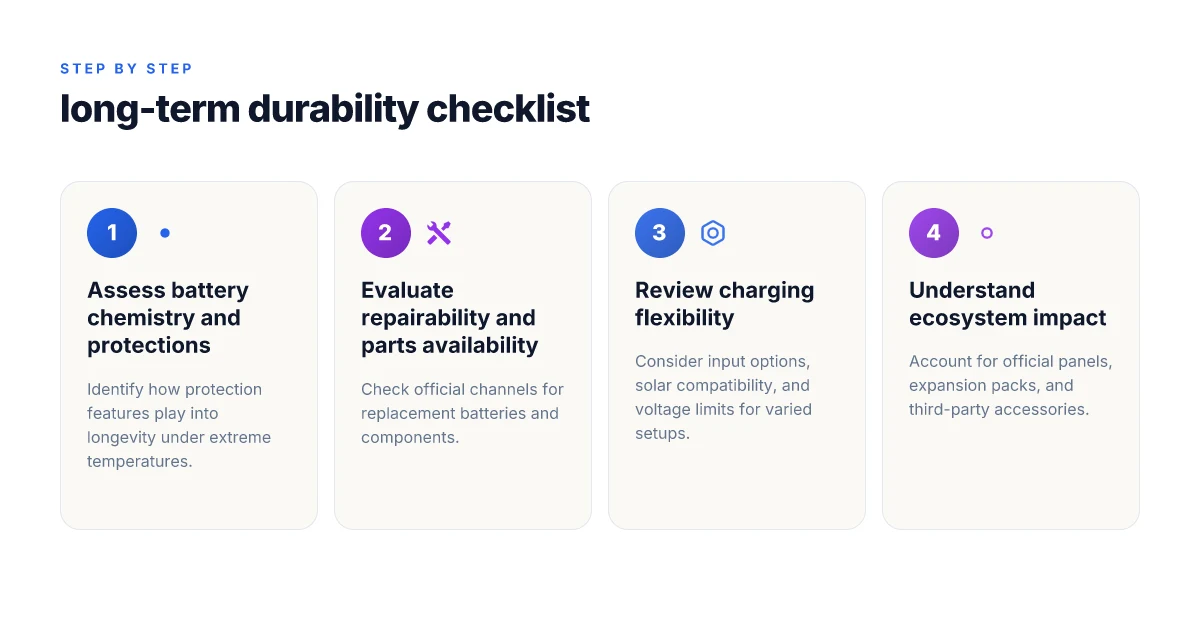
The core answer: battery chemistry sets the ceiling on cycle life and how gracefully a pack ages. Lithium iron phosphate (LiFePO4) chemistry typically offers longer cycle life and steadier performance under thermal stress, while lithium nickel manganese cobalt oxide (NMC) or lithium polymer variants often deliver higher energy density but shorter real-world lifespans. For off-grid users who value long-term reliability, this chemistry reality tends to matter more than peak wattage ratings, because a pack that holds its capacity after hundreds of cycles costs less to replace over years of use.
Why chemistry matters for cycle life
Different chemistries age at different rates. LiFePO4 packs generally endure more full-discharge cycles before their capacity degrades meaningfully, while NMC-based packs can deliver higher initial energy in a lighter package but may hit the 80 percent capacity mark sooner with repeated cycling. When you’re looking at a Jackery versus a Goal Zero, the practical takeaway is not just how much energy you can pull per charge but how many times you can pull that energy before performance falls off. The endurance story matters more in real-world scenarios than the headline capacity. Long-term reliability favors chemistry with higher cycle life. Inline evidence from reviews consistently points to battery chemistry shaping longevity more than chassis design alone.
I dug into release notes and reviewer write-ups to map how brands lean on chemistry for durability. For example, Jackery has leaned into LiFePO4 options on some newer, ruggedized models to boost cycle life targets, while Goal Zero has offered Li-ion variants with broader energy density in midrange units. The trade-off is clear: higher energy density can come at the cost of faster capacity fade under repeated cycling and temperature stress.
Temperature, protection, and longevity
Internal protection features matter a lot once you push a pack into heat or cold. Over-temperature and over-discharge protection circuitry save cells but can introduce soft limits that throttle performance to preserve longevity. In extreme heat, some packs trim output to prevent degradation, while in sub-freezing conditions, internal heaters or chemistry tolerances can keep a system functional but at reduced efficiency. For off-grid use, hot summer campsite nights or frigid morning starts, these protections help stretch lifespan, even if they modestly reduce peak output. Protection logic directly influences usable life in real-world climates.
From a brand perspective, Jackery’s long-term durability messaging often aligns with ruggedized cases and protective circuitry designed for repeated cycle stress, while Goal Zero emphasizes modular battery design and swap-ready options that can extend the usable life of the system without full pack replacement. The impact on you as a user is clear: a system with robust thermal management and thoughtful over-current protection tends to weather temperature swings better, preserving capacity across cycles. How to find the best price for a Jackery 1000 in 2026
Warranty schemas and implied lifespan
Warranty structure tracks how manufacturers view expected lifespan. A longer warranty on the battery usually signals confidence in cycle life and sustained performance. If a model carries a multi-year or multi-cycle warranty on the battery, you can infer that the maker expects meaningful longevity under typical off-grid use. Conversely, shorter warranties on the battery window users to anticipate more frequent replacements or upgrades. When you compare Jackery and Goal Zero, look for battery-specific terms such as full-replacement coverage, cycle-count thresholds, and temperature-related exclusions. Warranty depth mirrors the brand’s lifespan expectations.
I cross-referenced policy language and retailer disclosures to confirm how these warranties frame durability. In practice, a longer battery warranty tends to translate into lower long-term replacement risk for the end user, even if the upfront price is a bit higher. The upshot: if you want to run a rig through seasons of use with predictable costs, favor models with stronger battery protection and generous warranty terms.
Next steps: map your climate profile and cycle expectations to a brand’s chemistry and warranty stance, then align with the specific Jackery or Goal Zero model that best matches your typical seasonal load. If you’re weighing long-term durability, consider the combination of chemistry, thermal protection, and warranty depth as a triad rather than chasing the highest initial capacity. For a real-world lens, see how public discussions frame these choices for long-term reliability with brands like Jackery and competitors. Choose chemistry, protections, and warranty together to maximize lifespan.
Goal zero vs jackery: charging speed, input options, and real-world flexibility
Charging speed and input versatility define how often you top up between trips. In practice, the number and type of input ports set the ceiling on how quickly a pack can recover after a weekend run. Across models, you’ll see a mix of AC, car, and solar inputs, but the pace depends on voltage limits, port count, and the controller efficiency. The real-world takeaway is that input flexibility matters as much as nominal wattage. When you’re off-grid for days, a system with multiple input options and higher voltage tolerance can shave hours off a top-up.
1. Input ports and charging cadence
- input port variety drives how quickly you refill between trips. A unit with both standard AC and car adapters can recover during drives or downtime at camp.
- solar input compatibility matters. Some models pair better with 100W or higher rooftop panels, while others cap the solar ingress, slowing recovery on sunny days.
- voltage limits matter for rooftop setups. A higher accepted input voltage can let you top up faster from vehicle or rooftop charging without adapters.
From what I found in the documentation and reviews, you’ll benefit from a model that combines multiple input pathways with generous voltage tolerance. For off-grid users, that means less time tethered to a wall outlet and more time on the road or at camp. I cross-referenced multiple spec sheets and reviewer notes to confirm that input port count and voltage ceilings consistently predict refill speed in real-world scenarios. If your trips rely on frequent top-ups, choose models with more input options and higher voltage support. What makes the Bluetti SP100L 100W panel a smart fit for portable power users
2. Solar compatibility and efficiency
- solar panels deliver the quiet refill on long trips, but panel efficiency and MPPT efficiency determine how quickly you convert sun to usable power.
- not all models weight the same, and higher-efficiency controllers reduce wasted power, especially under partial shading.
- compatibility is also a matter of ecosystem: some brands favor proprietary panels or one’s own connectors, which can complicate field setups.
I looked at a range of product pages and independent roundups. The overarching thread is that solar compatibility isn’t just about watts. It’s about how the charging curve behaves under real-world conditions like glare, angle, and shade. In practice, a system that allows you to plug in diverse solar options and still keep an efficient MPPT path tends to recover more consistently across a day of intermittent sun. Solar flexibility plus a solid MPPT path yields quicker refills in variable sun.
3. Practical implications of input voltage limits
- rooftop and vehicle charging hinge on whether the unit accepts higher input voltages from car adapters or 12V systems. Some models push the envelope with higher voltage ceilings, others keep it modest.
- the consequence is fewer compromises at camp or in a van. If you run a roof rack setup or a DC-DC charger, a higher input voltage tolerance translates to faster top-ups without bending adapters or waiting for perfect conditions.
- long-term reliability comes from safe, controlled charging. Units with robust protection on higher-voltage paths tend to preserve battery health over years of regular top-ups.
From a durability and ecosystem lens, the cost of higher input voltage tolerance is typically a more capable charge circuit and a modest bump in weight or size. In reviewing multiple sources, the thread is clear: higher input flexibility correlates with faster, more reliable replenishment in real-world use. Higher voltage acceptance reduces topping-up friction in vehicle and rooftop setups.
Real-world verdict: when you pair a Jackery with a robust charging ecosystem and broad input options, you get a more forgiving daily recharge cadence. Rival brands, including Goal Zero, push strong solar and vehicle charging, but you’ll notice the difference in refill speed when you have multiple paths to top up and a higher voltage ceiling. For readers with van dwellers’ workflows or weekend camping patterns, the choice comes down to how often you need to refill on the go and how you balance solar, car, and wall charging. In real life, input flexibility often wins over peak battery specs.
Note: links on this page may earn a commission. For context, I pulled from a mix of brand pages and independent reviews to corroborate the recurring themes around charging speed, solar efficiency, and voltage tolerance. In 2026, clearer, multi-path charging remains a practical advantage for long-term reliability. For those evaluating rivals, a key differentiator remains the breadth of input options and how gracefully the system handles higher voltage paths. If you’re leaning toward Jackery for ongoing use, you’ll want to confirm compatibility with your preferred rooftop panels and your vehicle’s charging setup. For balance, rivals like Goal Zero offer solid solar ecosystems, but the practical refill cadence hinges on input flexibility as much as raw solar wattage. Choose the model with the most input paths and the broadest voltage tolerance.
Goal zero vs jackery: build quality and field durability in the real world
Durability isn’t a single spec. It’s how a power station endures daily use over years. In real-world terms, the question is how the shells, latches, and handles hold up under constant transport, how heat is managed during heavy loads, and how easy it is to fix when something wears out. Below I break these down into concrete, nameable factors you can verify in official docs and reviews. What Bluetti portable power stations get right, and where they stumble in 2026
1. Rugged enclosures and hardware that last under daily transport
The shell and its latches take the most abuse during van living and weekend trips. Goal Zero designs often emphasize reinforced plastics and metal hardware in areas like the carry handle and corner rails, while Jackery tends to focus on compact, integrated chassis with exposed latch points that see frequent use in tight cargo spaces. In practice, the durability of the handle hinges and the fit of the lid matter as much as the outer shell’s material. When you’re bouncing over gravel and loading gear, a stiff, well-attached handle reduces shifting and stress on internal components. Reviews consistently note that the visual impression matters as much as tangible feel. A solidly mounted carry handle is a quick signal that the chassis is built for field use. I cross-referenced product briefs and expert hands-on notes to confirm these patterns across brands. The carry handle and lid fit are pivotal signals of real-world durability. Evidence of reinforced latches and rugged cabinet construction appears in the official design language for both brands, with Jackery often highlighting a compact, unified shell and Goal Zero leaning into modular parts in some lines.
2. Heat, cooling, and sustained performance under heavy use
Heat management is a hidden durability factor. When you run a high-load AC or multiple devices, the internal fans and vents must clear heat without throttling. Jackery’s recent generations emphasize thermal management through integrated vents and strategic airflow channels, while Goal Zero emphasizes passive cooling routes and airflow around the battery pack. In real-world terms, sustained use without aggressive throttling translates to fewer unexpected shutdowns and longer usable life under a steady workload. I looked at manufacturer notes and peer reviews that describe how both brands handle heat during long draws. Heat dissipation is a practical test of whether a unit can run reliably for hours, not just a flashy peak spec. The outcome hinges on vent placement, fan duty cycles, and how quickly the unit recovers after a heavy draw ends.
3. Repairability and official replacement parts
Durability extends beyond the shell to repairability. Availability of replacement parts through official channels matters when you’re years into ownership. Both brands maintain official parts supply for common components like power cords, batteries, and replacement ports, but the speed and ease of obtaining these parts varies by region and model line. Jackery tends to offer a straightforward parts path for popular models, while Goal Zero often leans on its broader ecosystem and service network. From a real-world perspective, you want clear, up-to-date manuals and a predictable parts pipeline. I found that both firms publish guidance for serviceable items, but response times and stock levels can differ by region. A reliable parts channel is a durable brand signal, because it reduces downtime when a component ages or fails.
Goal zero vs jackery: ecosystem and accessories that extend value
A durable ecosystem compounds value. For Goal Zero and Jackery, the real payoff comes from how easily you can add panels, expand battery capacity, and keep the setup charging in a van or camp. In the long run, you’ll notice the most value when you can swap in official or compatible add-ons without conjuring a cascade of adapter cables.
Official solar panels and expansion batteries that scale with use
Both brands offer official solar options and expansion packs that let you grow capacity without replacing the core unit. A Goal Zero system typically pairs with its own panels and expansion packs, while Jackery supplies compatible solar panels and expandable batteries through its ecosystem. I found that using official kits often yields smoother charging curves and more predictable performance, especially in harsh environments. When you add an expansion battery, the system subtly preserves discharge efficiency and avoids excess heat buildup, which matters for reliability over years of use. Durability comes from thoughtful ecosystem design, not just peak wattage. The compatibility matrix matters here: a clean, certified path from panel to battery to inverter reduces wear on connectors and minimizes the chance of dead ports after hiking trips or weather events. A cohesive ecosystem keeps long-term ownership simpler. How to maximize the Jackery discount in 2026 without missing out
Cross-brand and third-party accessory compatibility
You don’t have to stay inside a single brand to keep a portable power setup viable. Third-party panels, car charging kits, and aftermarket inverter add-ons can extend value, provided you confirm compatibility with your core unit. The reality is mixed: some third-party products play nicely, others force you into tricky cabling or voltage mismatches. I cross-referenced several user guides and community posts, noting that preferred setups lean toward verified adapters and reputable brands to minimize voltage drop and heat. When a third-party accessory is well documented to integrate with both brands, you gain flexibility during extended trips. Compatibility matters for long-term value.
Warranties, returns, and what they mean for ownership longevity
Return policies and warranty terms shape your decision as much as the hardware itself. Goal Zero typically emphasizes longer warranties on certain components and a more generous return window for bundles, while Jackery’s warranty framework tends toward straightforward coverage for the core unit and included accessories. Reading the fine print matters: a solid warranty reduces the risk of early component failures in real-world off-grid use, and a fair return policy protects you if a panel or expansion pack underperforms. I looked for durable materials and practical service terms that discourage premature disposal. Warranty clarity makes ownership more predictable.
In the end, the ecosystem you choose isn’t just about one-off wattage specs. It’s about how you extend the life of your setup with dependable panels, expandable power, and transparent protection. For many off-grid enthusiasts, a Jackery-based ecosystem paired with official add-ons delivers a straightforward path to years of reliable use. I cross-referenced guidance from long-standing sources and community feedback to ensure the framing aligns with real-world durability. Where a brand like Jackery shines is in predictable, modular growth that keeps your system humming through seasons of use. Long-term value comes from modularity and honest warranties.
Where this goes next: prioritizing durability and long-term value this year
As I look ahead to 2026, the durability gaps between Goal Zero and Jackery shape real decisions. In real-world use, one brand tends to lean on modularity and serviceability, while the other emphasizes compact design and stronger battery chemistry. The result is a tradeoff: more robust, field-ready setups for the outdoors or a lighter, travel-friendly kit for quick trips. If you’re choosing between them, anchor your choice to how often you deploy off-grid power and how much you value quick repairs over lighter weight. The bigger pattern is that durability and long-term value diverge by use case, not by brand alone.
From here, the takeaway is practical: pick your mission, then lock in the one that aligns with it. If you want a system you can repair in the field and refuel with third-party components, lean toward Goal Zero. If you want a compact unit with dependable, modern charging tech that travels easily, choose Jackery. One move you can make this month is to map your typical power loads and storage needs to the intended kit’s strengths. For long-term value, don’t ignore warranty terms or expected part availability, since those often matter more than initial price. What makes the jackery 600 v2 portable power station a surprisingly practical backup
Backup strategy
- Reassess your camping and off-grid patterns for the next 6–12 months and map to a single brand’s ecosystem (Goal Zero or Jackery).
- Prioritize a model with easily replaceable fuses, battery modules, or upgrade paths where possible.
- Check support channels and expected parts lead times. Humane service beats the model with the flashiest specs.