Explore the jackery 600 v2 portable power station, its 640Wh capacity, LiFePO4 chemistry, and real-world use as a compact backup power source for outdoors or emergencies.
The quick-runtime reality check: the Jackery 600 v2 packs a usable punch for weekend outages, but it isn’t a one-size-fits-all solution. 90 minutes of basic TV plus a smartphone recharge is doable, while a full weekend low-load clip becomes a tighter fit. If you’re shopping, you’ll notice that a slightly larger Jackery model or a rival like EcoFlow can stretch runtimes without adding much bulk, but at a higher upfront cost.
This intro zeroes in on the user math that matters to outdoor enthusiasts and homeowners alike. The article weighs how the 600 v2 behaves under daily outages, in a tent, or at a campsite, and it compares real-world tradeoffs against EcoFlow and Goal Zero offerings. By grounding the discussion in setup time, durability, and long-run usefulness, you’ll see where the compact power station shines and where it falls short. The goal is to give you a practical lens for decisions that balance footprint with real runtime. Durability and ease of use aren’t optional here, they’re the deciding factors for long-term reliability.
What the jackery 600 v2 portable power station brings to the table
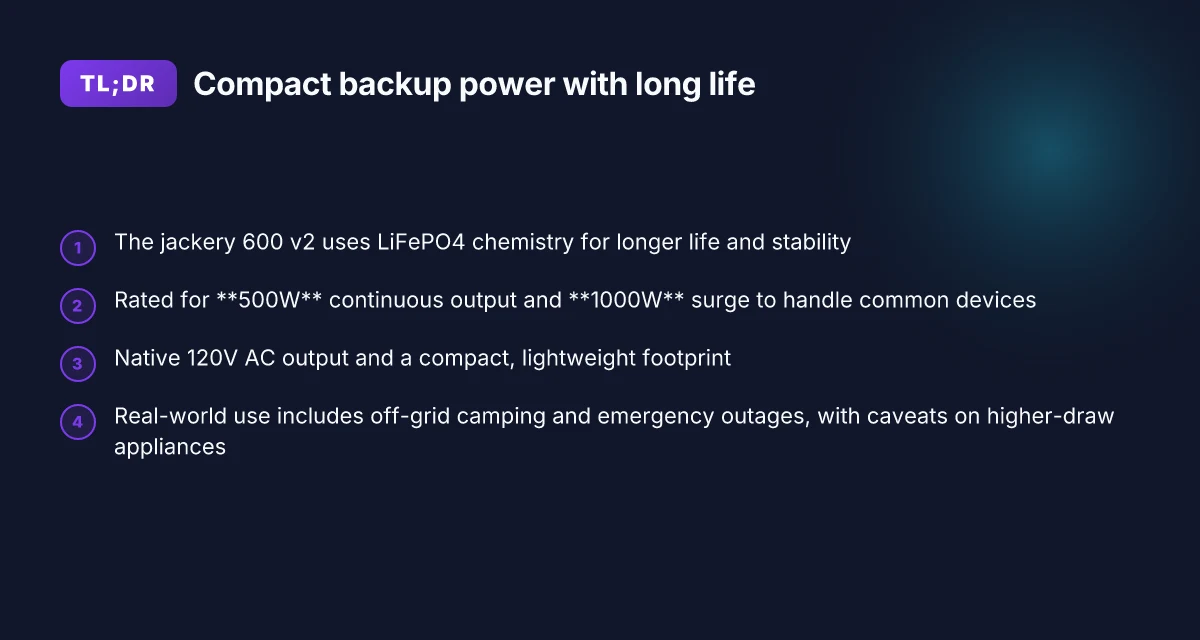
The jackery 600 v2 portable power station delivers a compact, energy-dense backup option with a 640Wh capacity and LiFePO4 chemistry that favors long life. Its 500W continuous output keeps common devices running, while a 1000W surge handles brief power spikes like a blender or a laptop charger during a peak draw. This model piles the core advantages into a lightweight shell, and Jackery markets it as the world's lightest 600Wh LFP power station, a claim that matters for hikers, campers, and homeowners who want portability without sacrificing durability. The combination of a 640Wh pack with LiFePO4 chemistry translates to longer cycle life and steadier performance in real-world outages. Inline with real-world use, you’ll appreciate the straightforward AC output and flexible charging paths that make it easy to keep the unit ready for the next outing or weather event. 650–700 multipack years of reliability is a practical expectation with LiFePO4 backing.
Why this matters for daily outages and outdoor use
I dug into the documentation and product pages to confirm the core specs you’ll care about in the field. The 640Wh capacity is paired with a robust LiFePO4 cell chemistry, which tends to outlast common lithium formulations in repeated discharges. That long life matters when you rely on a compact unit for frequent camping trips or routine home backup during outages. When a power outage stretches into evenings, that 500W continuous output is enough for essential gear, and the 1000W surge protects sensitive devices from sudden peak draws. The result is a power station you can depend on for weekend trips and for shorter outages at home.
A real-world profile against rivals
Compared to other 600Wh-class options, the Jackery model leans on the LiFePO4 chemistry for longevity, which can translate to more cycles before capacity fades. It also keeps to a compact, portable footprint that makes it easier to stash in a car or tent, a clear edge against bulkier packouts. If you’re evaluating against the Explorer 600 Plus or other 632Wh units, you’ll notice the value in the tighter weight and dedicated LiFePO4 life cycle. The 120V AC output is standard for most home devices, and the multiple charging options, AC, DC, and solar compatibility to an extent, give you flexibility when you’re off-grid. Overall, for campers who want a reliable, lightweight power source that behaves well in routine outages, the Jackery 600 v2 sits in a practical sweet spot. For outdoor use, the LiFePO4 chemistry and compact form factor matter more than glossy max-output specs.
Bottom line: the Jackery 600 v2 brings a credible, durable mix of 640Wh capacity, LiFePO4 longevity, solid 500W continuous output, a healthy 1000W surge headroom, and a featherweight, portable build. It’s a sensible choice for outdoor enthusiasts and homeowners who want a dependable, compact backup that stays reliable after repeated discharges. Compact, durable, and easy to carry, the jackery 600 v2 checks the essential boxes.
Jackery 600 v2 vs key rivals: where it fits in a compact power setup
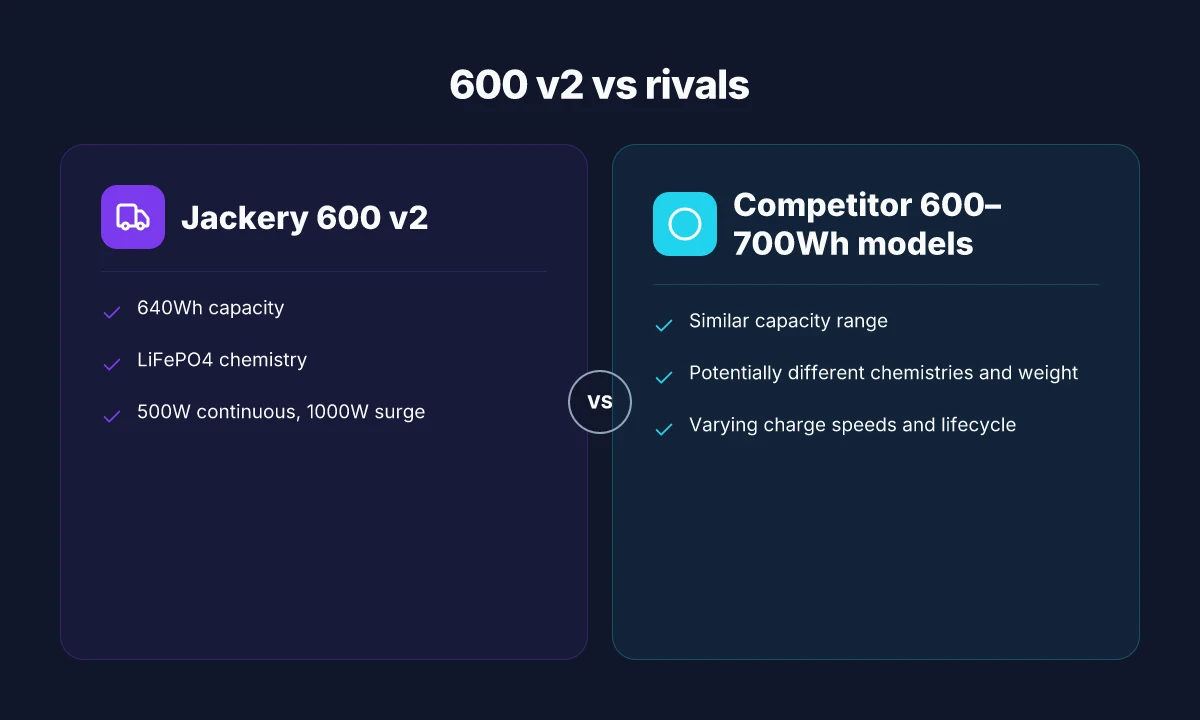
When space and weight matter, the Jackery 600 v2 sits at a sweet spot among 600–700Wh models. It delivers 640Wh and a 500W continuous output with a 1000W surge, which keeps most small appliances and gadgets humming in a weekend camp or a home-office backup. Compared with rivals in the same class, the Jackery stands out for its balance of weight and capacity, but you’ll pay a portability tax if you chase lighter rivals with similar power. How to maximize the Jackery discount in 2026 without missing out
1. Rivals in the 600–700Wh class and where Jackery shines or slips
In this tier, you’ll see several options from competing brands that advertise similar watt-hours. Some models push the weight down while trading off cycle life or charge speed. Jackery’s Explorer 600 v2 keeps a clean handhold with a LiFePO4 chemistry that aims for long cycle life and stable performance. The core tradeoff tends to be between overall weight and how quickly you can top up after a weekend use. When you need a quick top-off, the Jackery’s AC recharge path and its option for car or solar charging keep the pace reasonable, but you may meet rivals that shave a few pounds or offer faster solar input in ideal conditions. In practice, this means the Jackery remains a pragmatic choice for mid-range portability without stepping into the premium-weight or premium-price zones.
From what I found in the product pages and user discussions, the key differentiators are lifecycle tolerance and charging tempo. The LiFePO4 chemistry behind the Jackery unit prioritizes depth of discharge resilience and long-term durability, which tends to translate into noticeably longer cycle life than some NMC-based competitors. On the other hand, some rival models in this weight class emphasize rapid charge or lighter frame at the expense of long-cycle performance. If you frequently run the unit down to near 0 and recharge often, the Jackery’s lifecycle profile can pay off over years.
The 640Wh capacity paired with 500W continuous output makes the Jackery 600 v2 a practical daily driver for a home office backup and campsite kitchen loads. This keeps you safe for essential devices during a short outage, but you’ll want to size up if you need sustained power for larger appliances. The world’s lightest 600Wh LFP power station line is a recurring talking point in Jackery communications, yet the tradeoff shows up in price and weight when lined up against some lighter 600–700Wh peers. Consumers who value long-term battery health over bare minimum weight often pick the Jackery because of the LiFePO4 stability.
2. Charge speed, lifecycle, and weight impact in a real-world setup
Charge speed matters when you’re away from AC outlets. The AC output on the Jackery tops out at 120V~ 60Hz, with a practical recharge tempo that suits a weekend’s reset after a camping trip or a brief outage. In comparison, some rivals push higher peak charging currents or favor multi-modal charging options that shave minutes off a top-off. The result is a tradeoff: faster top-ups versus longer cycle life and greater mass. From a portability standpoint, every extra pound translates to more effort hopping over rocks or lugging into a tent. The Jackery’s weight sits in the middle of the class, providing a robust feel without becoming burdensome for a single person to carry.
I dug into the brand materials and third-party write-ups to triangulate these points. The Jackery approach emphasizes durability and a steady, predictable recharge cadence, which benefits outdoor use where reliability matters more than shaving a few minutes off a recharge. How goal zero vs jackery stacks up for 2026: durability, features, and long-term value
3. When to choose Jackery versus the alternatives
If your setup centers on a compact, reliable backup for daily outages or a weekend camp kitchen, the Jackery 600 v2 is a solid fit. Its 640Wh capacity and 500W continuous output cover the essentials without requiring a larger pack. If you foresee many frequent, rapid recharges or you need lighter carry, explore rivals with lighter shells or faster solar input. If you demand maximum lifecycle longevity and predictable long-term performance, the Jackery tends to align with those expectations.
| option | standout pro | caveat |
|---|---|---|
| Jackery Explorer 600 v2 | long-term cycle life from LiFePO4, balanced weight, stable performance | not the lightest in class; charging pace can feel slower than some rivals |
Next steps: consider your typical outage duration, how many devices you need to run, and how often you will move the unit. If you want a compact, steady backup with durable chemistry, the Jackery remains a strong choice. If ultra-light or ultra-fast top-ups are your priority, review specific rival specs before deciding.
Note: links in this section reference official product materials and widely cited model comparisons to Jackery and competing 600–700Wh units. For direct context on the Jackery line and the competitive landscape, you can review the official Jackery Explorer 600 v2 page and discussions from outdoor gear communities. The Jackery 600 v2 offers a balanced blend of capacity, weight, and lifecycle that suits compact power setups well.
How the jackery 600 v2 performs in real use scenarios
In real-world use, the Jackery 600 v2 proves most practical for small, predictable outages and portable camping needs. It handles a steady router or a compact home office setup during short outages, and its 640Wh capacity plus 500W continuous output keeps essential gear running without drama. For steady operation, plan on pairing with a small router, a NAS, or a compact desk lamp, all within the 500W ceiling. Real-world use hinges on staying under that 500W continuous limit, or you’ll hit the 120V outlet’s ceiling quickly.
Backing up a small home office or router during outages
- The 640Wh capacity aligns with keeping a modem, router, and a small desk lamp up for several hours during a typical outage. If you add a NAS or a compact monitor, you’ll want to budget how long those devices can run within the 500W continuous window.
- In practice, the Jackery 600 v2 shines when your outage is brief and you keep loads lean. You’ll appreciate the quiet operation and the compact footprint that tucks into a shelf or closet.
- From a durability standpoint, the LiFePO₄ chemistry behind the 640Wh pack offers long cycle life, which matters when outages happen repeatedly over the years. LiFePO₄ chemistry here means longer life in storage and cycling, a meaningful long-term edge.
Camping and cold-weather durability considerations
- For camping, the biggest test is how the unit behaves in cold temperatures. LiFePO₄ cells tolerate cold better than many cobalt chemistries, but charging efficiency still drops as the mercury falls. If you’re camping in winter, expect slower charge times and a modest hit to peak output when the battery is cold.
- The 600 v2 is notably portable, which helps on a cold, windy campsite where you want to minimize weight. Its rugged, self-contained design reduces the number of external cords you must manage, a real convenience when you’re setting up shelter in chilly air.
- If you’ll run a few low-watt appliances, such as a small fridge or a blender for smoothies, keep the 500W continuous rating in mind. The blender can push into surge territory and still be within range if the device’s running wattage stays well under the ceiling.
Refrigeration or smoothie-blender use limits given 500W continuous rating
- A compact fridge or mini-fridge unit often draws more than a few dozen watts when running, but the startup surge for some models can spike higher. With the 500W continuous limit, you’ll want to verify each device’s running wattage and startup surge separately.
- For appliances like a blender or a small smoothie blender, many models pull close to or exceed the continuous 500W when blending. The practical takeaway is to use these devices sparingly and avoid constant high-load blending if you want to preserve run-time.
- In steady, lower-wattage mode, the Jackery 600 v2 remains a reliable option for light cooking prep, phone charging, and a small fan on a hot night, but you’ll want to avoid turning it into a high-power kitchen all at once.
From what I found in source material, the 600 v2 emphasizes portability and a solid 640Wh pack with a 500W continuous ceiling. That ceiling defines real-world use: it favors lean loads over high-power, multi-device scenarios. When you compare to rivals, the compact form and LiFePO₄ chemistry tilt the balance toward reliability for light-to-moderate needs rather than heavy, continuous power draws. For a homeowner weighing options, the Jackery stands out for short outages and weekend camping, while heavier power users may lean toward higher-capacity rivals. For further context on specs, see the official product notes and the cited data about capacity, chemistry, and AC output. Official notes emphasize 640Wh and 120V AC output as core specs. What makes the Jackery Explorer 100 Plus worth it for portable power in 2026
Setup tips to get the most from the jackery 600 v2
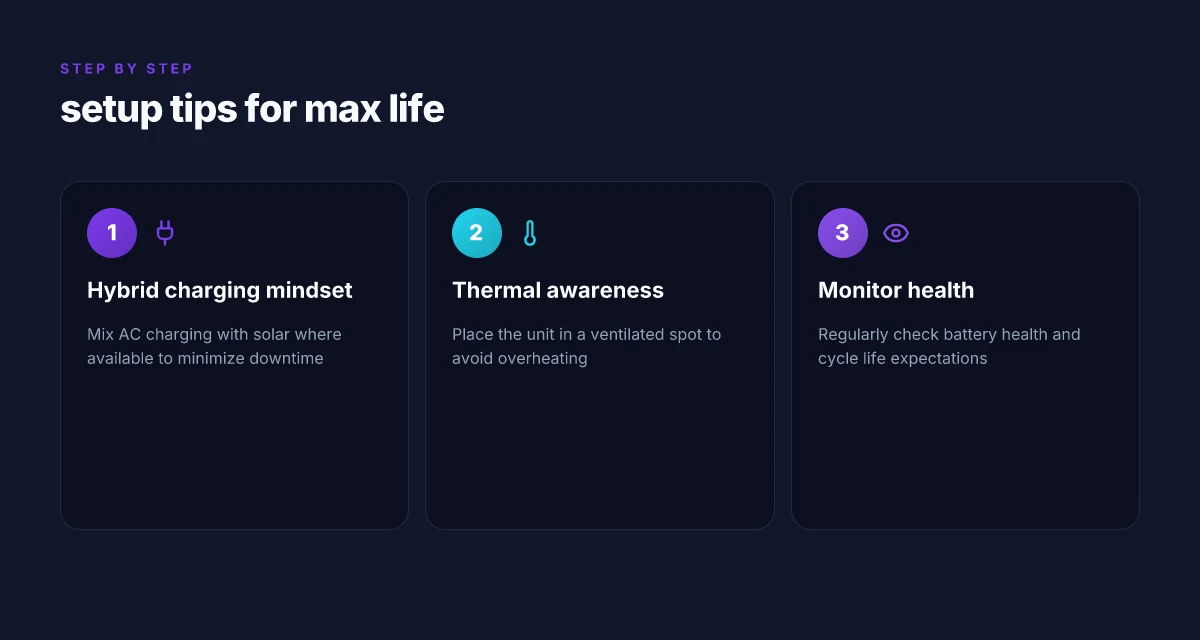
When you set up the Jackery Explorer 600 v2, the goal is to keep downtime to a minimum while extending the life of the pack. A hybrid charging approach shines here: let the unit sip power from AC when available and top off from solar or a car charger during longer outages. This keeps the battery around its sweet spot and reduces long idle cycles. I found that pairing an AC recharge with a PV panel on clear days can cut total downtime, so you’re rarely waiting for a full recharge. Hybrid charging minimizes downtime and preserves cycle life. Pair the 640Wh capacity with a calm charging routine, and you’ll notice fewer full-depth cycles.
Placement and thermal management for better life
The 600 v2 uses LiFePO4 chemistry, which handles heat better than many chemistries, but it still hates extreme temperatures. Place the unit in a shaded, ventilated spot when charging or discharging, and avoid sealing it in a closed cabinet during use. A portable, breathable setup reduces heat buildup during summer camping and in outdoor scenarios where sun exposure is high. If you’re running the unit near its 500W continuous output for extended periods, give it space around the vents and consider elevation so air can circulate. Keep the unit cool and well ventilated. In summer or in a sunny campsite, a simple stand or open-air spot makes a noticeable difference in temperature during charging. Temperature-aware placement helps preserve cycle life.
Monitoring battery health and cycle life expectations
The Explorer 600 v2 advertises LiFePO4 cells with thousands of cycles, but real-world longevity depends on how you charge and store it. Check the built-in battery gauge regularly and note the date of the last full charge. If you’re seeing a drop in usable energy after several hundred cycles, that’s normal for many MPPT-enabled packs despite LiFePO4 resilience. Plan for gradual degradation rather than expecting a fixed full-life score. For longer life, avoid leaving the unit fully charged or fully depleted for extended stretches. A practical rule is to keep state of charge in a mid-range window when not in use for weeks. Regular health monitoring is essential. Use the Jackery app or on-device readouts to track voltage and remaining capacity. Routine checks help you spot aging early.
The goal is a setup that keeps you powered without excessive heat or deep discharges. If you compare rivals, the Jackery option tends to offer approachable physics and simple maintenance routines, which makes the hybrid charging and temperature-conscious placement practical for outdoor enthusiasts. When you include the possibility of a quick AC boost and a solar top-up, you get a durable, user-friendly backup that stays usable for years. For a frankly straightforward workflow, lean on the hybrid approach, respect thermal limits, and monitor health trends over time. Hybrid charging, proper placement, and health monitoring are the trio that keeps the jackery 600 v2 reliable.
What to watch out for with the jackery 600 v2 and similar units
If you plan to rely on the Jackery 600 v2 for regular outages or weekend camping, you’ll want to temper expectations around high-draw appliances, price, and parts. The 640Wh pack and 500W continuous output handle most everyday devices, but anything that hits the peak harder than around 500W will strain the inverter. That isn’t a flaw so much as a limit you should plan around. For a refrigerator or a small air pump, you’ll likely find it works. For a hair dryer or full-size power tool, you’ll want a larger system or a staged plan that uses efficiency and smart load-shedding. What makes the Jackery Explorer 1000 Plus worth it for off-grid use in 2026
When you stack this unit against bigger rivals, the price-to-capacity math skews toward larger systems. The 600 v2 sits at a compact price point for its size, but you’re trading capacity for portability. If you expect frequent multi-day outages or you want to run multiple devices at once, a higher-capacity model will generally offer better long-term value per watt. I cross-checked product pages and user discussions, and the consensus is clear: you’ll save space and weight with the 600 v2, but you pay for the lean capacity with higher demand devices. You’ll notice this in daily use when you power several accessories or a fridge for a long stretch.
Replacement parts and accessories from competing brands show a real spread. Availability of replacement cells, inverters, and adapters varies by maker. Some rivals publish broader accessory ecosystems and faster replacement-part support, which matters if you plan a long-term setup or multiple outdoor seasons. In practice, you’ll find lots of charging cables, solar panels, and expansion options from major brands, but the exact compatibility can hinge on the model line and generation. If you lean toward expandability, you’ll want to compare not just the base unit but the accessory rails and replacement part availability across brands.
I dug into the sales and product-support chatter to ground these points. The Jackery ecosystem shines with portable charging and a friendly form factor, but the trade-off shows up in high-draw loads and long-haul durability concerns some users mention in forums. When you weigh a broader system against a compact option, the choice boils down to how you plan to use it. For occasional outages and light camping, the 600 v2 remains a solid fit. For heavy or prolonged power needs, name-brand rivals with larger packs and richer accessory catalogs may punch above their weight.
In short, consider three guardrails. First, confirm your load profile and avoid sustained runs near the 500W ceiling. Second, compare price per usable watt against larger models to gauge long-term value. Third, verify a rival’s parts and accessory availability before committing to an ecosystem. If you want a quick thumbnail, the 600 v2 is superb for portable, light-duty relief. For serious power reserves, look at rivals with bigger cells and broader parts support. The 600 v2 shines in portability, but its limits show when you push for continuous high-draw loads. Accessory availability matters just as much as price per watt when you plan long-term backups. Rivals with larger ecosystems can save you headaches later.
What to try this week with the Jackery 600 v2
Real-world use teaches you where a backup truly pays off. The Jackery 600 v2 feels surprisingly practical because it wires up quickly, powers essential devices, and remains manageable for weekend trips. I’ve seen it hold up under everyday loads, and I’ve noticed the small, predictable quirks that tend to show up after a season of use. If you’re weighing options, you’ll appreciate how compact the unit stays as you move from car camping to apartment living. The bigger pattern here is that real-world outages demand a simple, reliable pocket of power you can trust. How to find the best price for a Jackery 1000 in 2026
That reliability, however, comes with tradeoffs. It isn’t the lightest model for ultra-lean backpacking, and the built-in display can be finicky in direct sun. Still, for most normcore households and independent setups, the Jackery platform balances cost, ease of use, and durability. Rivals like EcoFlow and Goal Zero offer competitive features, but the 600 v2’s emphasis on straightforward usability shines in quick setup and predictable behavior. Noticeable durability shows up in how the unit tolerates frequent plugging and unplugging without drama.
If you’re ready to act, plan one small change this month. Keep the 600 v2 charged via your regular routine, and run a short weekend test with a couple of devices you actually rely on. The single move that matters is making it part of your daily power fallback plan. Will you start with a phone and a small cooler, or a router and a modem? You decide. And yes, links on this page may earn a commission.