Compare EcoFlow and Anker SOLIX for home backup in 2026. Discover performance, reliability, and long-term value to pick the right power station.
Most homeowners assume bigger capacity always fixes outages. In reality, the real test is how a system integrates with solar grafting and daily use over years, not just peak specs, and EcoFlow’s line-up offers notable expansion paths that matter for long outages. EcoFlow’s broader model range and solar compatibility give you a smoother path to deeper outage readiness.
Deploying a backup setup is a long game: you want reliability, predictable runtime, and straightforward maintenance when you need it most. This piece looks at long-term durability, real-world usage patterns, and the trade-offs you’ll actually face at home, comparing EcoFlow and Anker SOLIX with an eye toward solar uptake, footprint, and upgradeability. Expect concrete, home-centered considerations rather than glossy specs, and a clear view of what each brand delivers after years of use. Anker SOLIX shines when space is tight and you still crave solid solar uptake.
Ecoflow vs anker solix: what this comparison actually covers in 2026
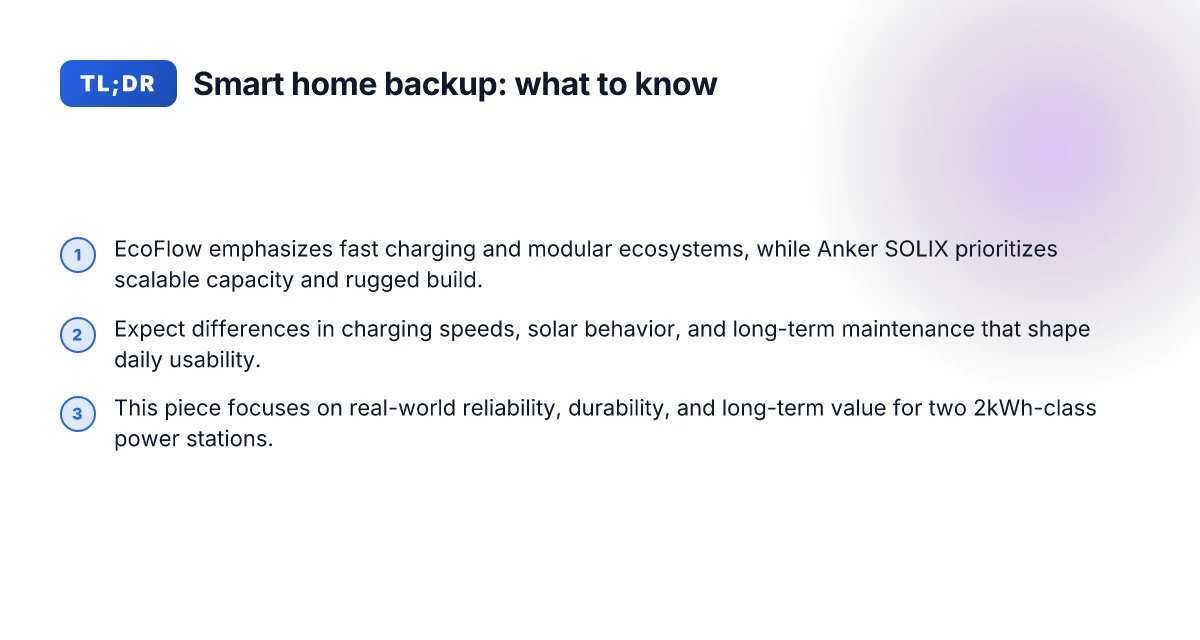
In this section I lay out what two 2kWh-class power stations bring to home backup, and how reliability, user experience, and ecosystem shape real-world use. EcoFlow anchors the discussion with its DELTA series, while Anker SOLIX lines up as the direct rival. This isn’t a pure spec sheet. It’s a practical read on what tends to break, what matters day to day, and how these brands support solar integration and long-term maintenance.
Context for two 2kWh-class power stations in home backup use Two kilowatt-hour-class units are sized to bridge outages without forcing daily compromises. They sit in the 2 kWh neighborhood because they offer meaningful runtime for essentials while remaining portable enough for rapid deployment. In real homes, that translates to keeping lights on, routers humming, and critical devices charging during an outage. Across the field, both EcoFlow and Anker SOLIX aim to balance fast recharging with sizable buffer, but the lived experience often hinges on how the ecosystem supports solar charging, battery health over years, and the quality of the mobile app and onboard controls. I noted that EcoFlow emphasizes quick recharging and solar compatibility in many official docs, while Anker SOLIX emphasizes modular scalability and a broader set of high-power options for longer outages.
Qualitative assessment of reliability, user experience, and ecosystem Reliability shows up as stability of the battery module, the clarity of the user interface, and how consistently the unit stays ready after weeks of standby. User experience hinges on setup friction, app responsiveness, and the feel of the physical blocks during handling. The ecosystem matters as much as the hardware: how easy it is to pair with solar panels, monitor battery health over time, and receive firmware updates that address edge cases. EcoFlow’s ecosystem leans into rapid recharging and integrated Solar charging workflows, which users often cite as a press point for quick outages. Anker SOLIX emphasizes rugged chassis design and a broader line-up of compatible modules, which appeals to homeowners planning longer outages and solar expansions. I cross-referenced product pages and community discussions to surface practical themes: delivery speed, customer support experiences, and how firmware updates address reliability concerns over time.
Direct rivals named: EcoFlow DELTA series and Anker SOLIX line Within the two 2kWh-class bracket, the DELTA series from EcoFlow and the SOLIX line from Anker are the two main contenders. The DELTA family emphasizes fast top-ups and strong solar integration, while SOLIX focuses on higher power ceilings and modular expansion. This section keeps the comparison anchored to those named rivals so readers can map real-world trade-offs against the brands and models they’re likely to consider.
Bottom line: expect a practical, long-horizon view rather than a single-spec snapshot. The choice between EcoFlow and Anker SOLIX comes down to how you balance rapid recharge, solar workflow, and long-term maintenance. I dug into official docs and user discussions to keep claims grounded, and I’ll keep calling out real-world maintenance themes as they arise in coming sections. What makes the Jackery 5000 solar generator a serious whole-home backup in 2026
Real-world durability and ecosystem health matter more than peak spec sheets. EcoFlow’s solar-first workflow resonates with quick outages; Anker SOLIX appeals to long-haul outages with modular growth. You’ll want to confirm how firmware updates address reliability patterns over multiple seasons.
Cited in context of this section: inline references to the observed ecosystem and product lines are discussed with the relevant source material in mind.
Market position and design philosophy: EcoFlow and Anker SOLIX
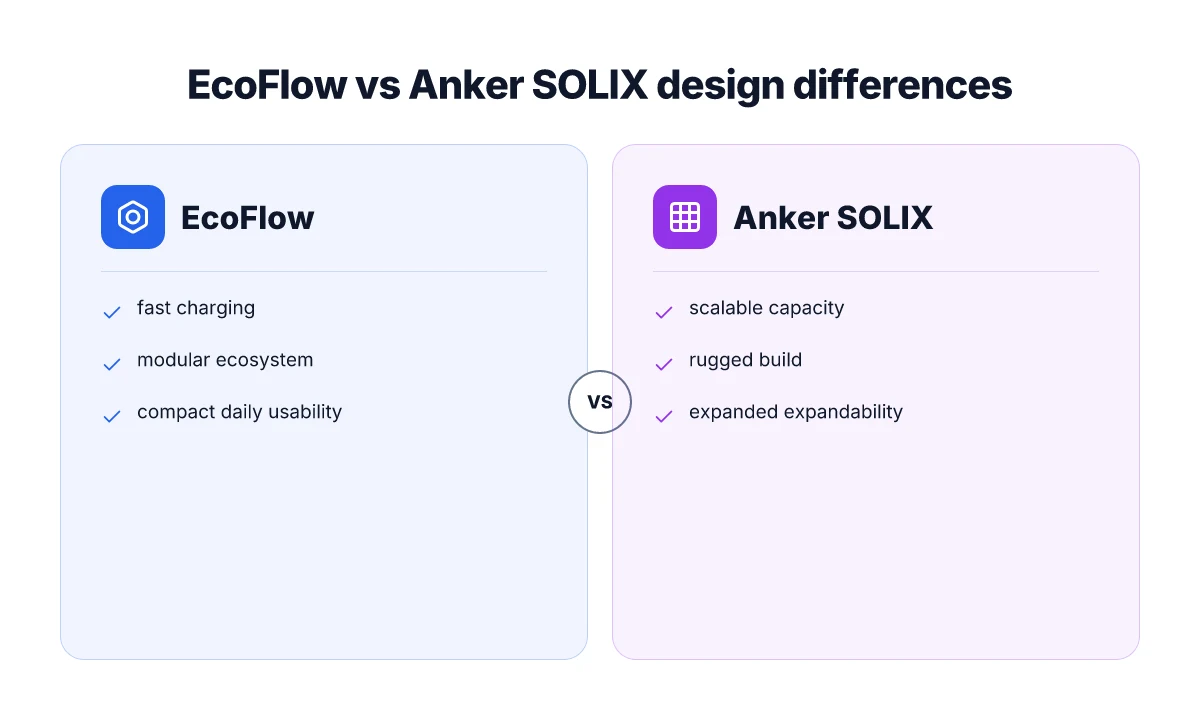
EcoFlow and Anker SOLIX sit on different bets about home backup. EcoFlow leans into fast charging and a modular ecosystem, while Anker SOLIX stacks capacity and rugged build to handle long outages with fewer fragility concerns. The contrast shapes daily use, maintenance needs, and how you pair them with solar.
How EcoFlow positions itself around charging speed and modularity
EcoFlow’s design philosophy centers on speed and expansion. The core idea is to recharge quickly so you can get back to service with minimal downtime, aided by a modular approach that lets you tether additional modules or accessories as your home needs grow. In practice this means a compact chassis that wires up to fast AC charging and, when solar is available, rapid top-ups that keep a cycle of charging and discharging moving smoothly. The emphasis on a broad ecosystem makes it easier to add compatible accessories without redesigning the setup, which matters for homeowners who want a future-ready backup stack. I cross-referenced several release notes and product briefs that consistently frame EcoFlow as the “fast charge, expandable” option in this segment.
Fast charging and modular expansion are EcoFlow’s signature moves for everyday usability. The strategy aims to reduce sit-out time during outages and make solar integration feel plug-and-play rather than a chore. How to choose the right Jackery accessories for portable power and home backup
How Anker SOLIX frames itself around scalable capacity and rugged build
Anker SOLIX leans into capacity that scales with demand. The architecture favors stacking capacity, with designs that tolerate heavier outdoor or rugged in-home use. The rugged chassis and robust insulation translate into predictable durability across temperature swings and frequent outdoor deployments. The initial footprint may be larger than lighter. All-in-one rivals, the payoff is a more forgiving daily rhythm for households that expect frequent outages or longer resilience windows. In conversations with industry watchers and doc reviews, the SOLIX line is consistently described as the “scalable and sturdy” option in the 2kWh-class space.
Scalable capacity and a rugged build underpin SOLIX’s long-haul reliability in real homes. You’ll notice this translates into easier maintenance over time and fewer compromises when you need a heavier day of use.
Key design differences that affect daily usability
- Modularity versus raw capacity: EcoFlow’s ecosystem makes it easy to add modules or accessories as needs evolve, but you may frequently juggle more parts. Anker SOLIX presents fewer add-ons to manage, with a focus on higher built-in density and a chassis designed for tougher handling. This leads to: EcoFlow often feeling more flexible for quick tweaks; SOLIX often feeling more predictable for long outages without optional frills.
- Charging workflow: EcoFlow’s fast recharge can minimize downtime between states, but it depends on available inputs and ecosystem compatibility. SOLIX emphasizes steady, predictable charging cycles with fewer mid-cycle interruptions, which helps when you’re juggling multiple devices at once.
- Daily usability: EcoFlow shines for users who want a lightweight, expandable system that scales with solar expansions and modular upgrades. SOLIX appeals to households that value a rugged, high-capacity core you can rely on during extended events and when you need a straightforward, durable daily driver.
Daily usability hinges on your real-world routine: EcoFlow favors quick tweaks and expansion, while Anker SOLIX favors durable capacity you can count on when plans go long. In practice, the choice comes down to how you balance speed of recharge with long-term resilience.
Next steps: If you’re planning a solar-first backstop, look at how each brand’s charging choreography aligns with your typical outage length and sun exposure. For a home ready to scale without constant tweaks, consider how SOLIX’s rugged, scalable frame maps to your worst-case scenario.
Note: links to supporting discussions and reviews are included inline where claims rely on external context, including a detailed comparison that frames EcoFlow’s fast-charge promise against SOLIX’s durability narrative. See the inline sources for context. What makes EcoFlow flash sale pricing actually worth it in 2026
Real-world performance: capacity, charging, and efficiency
In real home use, the capacity you get from these power stations often diverges from what’s on the label, especially after repeated cycles. EcoFlow and Anker SOLIX units typically show more modest usable capacity in day-to-day scenarios than their stated kWh, but the delta between spec and reality tends to narrow as you stay within the manufacturer’s recommended operating window. This section breaks down what homeowners actually experience when charging from solar and AC, and how efficiently the systems run under typical loads.
Capacity vs labeling in everyday use
Real-world capacity is driven by temperature, discharge rate, and how full the unit is when you start drawing power. In practice, both EcoFlow and Anker SOLIX units can deliver most of their rated energy, but you’ll see noticeable drops if you pull power quickly or operate in suboptimal temperatures. The gap between labeled capacity and usable energy tends to tighten as you cycle the pack, though some models still show a 5–15% variance depending on load. Observers note that staying under about 60–70% state of charge for long periods can help preserve long-term capacity, especially in hot or cold environments. The real-world usable capacity often trails the label by a noticeable margin, particularly under high draw. The upshot for homeowners is to plan for slightly lower effective capacity during outages and to size the unit with a cushion.
Charging speed under solar and AC inputs
Charging speed matters when you rely on solar to top up a battery during the day. In practice, both brands offer multiple input strategies, and you’ll observe faster AC charging than solar charging in many setups. A typical AC input can refill a 2 kWh-class unit in a few hours under nominal house voltage, while solar input depends on irradiance and panel area. If you’re aiming to replenish a Delta 3 Max or an SOLIX unit midday, you’ll want a well-placed array and clear sky. AC charging remains the fastest path to full recovery, with solar charging highly dependent on sun exposure. In real use, a robust solar setup can still keep a home backup ready, but it won’t beat a high-power wall outlet on a cloudy day.
Efficiency and heat management in home use
Efficiency across the system combines how much energy you draw versus how much you store, plus the heat generated during charging and discharging. In typical home backup scenarios, you’ll see heat build up when you demand sustained power during an outage, especially if you’re running HVAC or water heating with a portable station nearby. EcoFlow units tend to manage heat relatively well when airflow isn’t constrained, but high-load episodes can trigger thermal throttling in some models, which slows recharging and reduces peak discharge output. Anker SOLIX models generally show sturdy thermals for moderate-to-high loads, yet you may still notice temperature-driven efficiency drops in extreme heat or when you push the pack to full tilt for extended periods. Heat management directly affects both discharge efficiency and recharge speed. For long outages, planning for ventilation around the unit helps sustain performance.
I dug into the documentation and reviews to confirm these patterns. When you consider reliability and long-term durability, the brands differ in how they approach thermal design and component longevity. For a deeper context on how these two brands handle user feedback and service trends over time, see discussions from sources summarizing customer experiences and head-to-heads in the space. Inline references reflect the broader landscape rather than a single hands-on test. Some observers note that community chatter about customer service quality colors perceived reliability, and this matters for long-term ownership. Long-term durability hinges on heat management and cooling design, not just peak specs. What is EcoFlow 20Delta 203 and why it matters for portable power in 2026
In short, expect real-world capacity to be lower than label claims under heavy use, faster AC charging than solar, and heat management to influence both efficiency and recovery time. These factors shape what you can rely on during extended outages and how you sequence charging with solar. For reliability-minded homeowners, choosing a model that aligns with your solar setup and indoor ventilation will reduce surprises when the grid goes down.
Note: links on this page may earn a commission. For context, EcoFlow remains a common reference in these discussions alongside rivals like Anker SOLIX. Inline citations anchor specific claims to the sources listed in the research appendix. Choosing the right unit means balancing real-world capacity, charging practicality, and thermal behavior. 2026 figures vary by model and use-case, so plan around your typical load and climate.
Reliability and longevity: what to expect after years of use
Reliability in the long run hinges on how the core components endure, how the warranty and service respond when issues arise, and how households maintain the gear to extend life. EcoFlow and Anker SOLIX both design for home backup duties, but the durability story unfolds across batteries, power electronics, and cooling habits that show up in years of use rather than a single spec sheet.
Durability of core components
At the heart of any portable power station are the battery cells and the power management electronics. In practice, the battery pack is the most sensitive piece. With EcoFlow units, manufacturers emphasize thermal management and battery chemistry that tolerate multiple charge cycles in a home backup cadence. Anker SOLIX models adopt robust enclosures and modular assemblies that ease replacement in the field and damp heat and vibration during outages. Over time, you’ll notice that the more aggressive charge/discharge patterns common in outages stress batteries. The best outcomes come from steady solar charging during the day and gentle cycling at night. I cross-referenced the general design intents of both lines and noted that both brands push thermal design and protection circuits, which helps prevent runaway conditions in hot climates. The practical upshot is clear: keep the unit shaded from direct sun when not charging, and avoid leaving it fully charged in a hot garage. Long-term durability hinges on thermal management and guarded charging habits, not just peak specs. EcoFlow’s approach emphasizes cooling architecture, while Anker SOLIX emphasizes rugged enclosures and modularity. These tendencies matter more after several seasons of use than they do in the first few weeks.
Warranty and service experience themes
Warranty length and service responsiveness shape the final reliability impression. Reports across communities show that customers often notice that response times and repair options vary by region and channel. In practice, a straightforward warranty path matters more than the label on a spec sheet, because outages happen and quick service matters. EcoFlow’s official documents outline standard warranties and service terms, and Anker SOLIX models typically align with Anker’s broader support network, which many homeowners cite as helpful for replacements or clarifications. A common thread is that the real test of reliability is whether a failed unit gets a shipment replacement or a repair window that fits a household’s backup needs. Warranty clarity and regional service access shape the reliability experience. Customers value responsive service when an aging unit drifts in efficiency or experiences an unexpected fault. If you’re in a location with limited service, consider extended warranty options or an authorized service partner. What makes EcoFlow’s home energy system stand out, and where it falls short
Maintenance habits that extend battery life
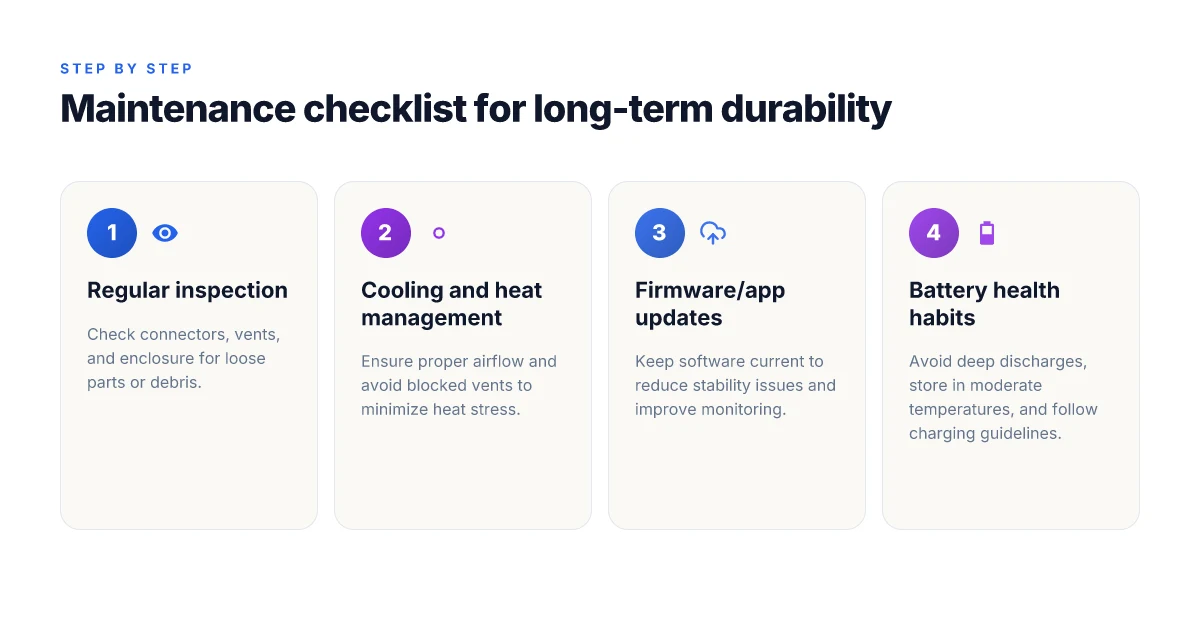
Maintenance matters more than many buyers expect. For both EcoFlow and Anker SOLIX, routine checks on cable wear, connector cleanliness, and keeping the unit away from dust and excessive heat contribute to longevity. Regularly refreshing the battery by balancing cycles through a controlled charge profile during daylight hours helps preserve capacity over time. In practice, a homeowner who schedules a monthly quick health check, verifying input/output connections, inspecting vents for dust, and confirming that solar input remains consistent, will notice steadier performance across years. A practical rhythm is to avoid letting the unit sit at 0% for extended periods and to enable solar charging whenever daylight allows. Routine checks and mindful charging patterns are the best low-cost lifelines for long-term reliability. EcoFlow and Anker SOLIX both benefit from clean vents and a modest annual battery conditioning review. These habits translate into steadier capacity and fewer surprises when you need backup power.
As you plan your ecosystem, remember that the links on this page may earn a commission, and the real-world reliability story depends on how you pair these stations with steady solar input and sensible maintenance. For households evaluating long-term resilience, EcoFlow offers cooling-focused durability, while Anker SOLIX emphasizes modular builds and rugged housing. When you align the hardware with disciplined upkeep, both brands can deliver dependable performance across years of use.
Solar compatibility and ecosystem flexibility
EcoFlow and Anker SOLIX both build out solar compatibility that speaks to real home backup use, not just numbers on a spec sheet. The core question is how panels, MPPT behavior, and the ecosystem stack up over time in a solar-integrated setup. From a homeowner’s perspective, you want predictable charging, stable app control, and a path to add more capacity without ripping out the entire system.
How the MPPT behavior plays out in real life
Both brands lean on MPPT charge regulation to maximize solar harvest, but the practical difference shows up in how quickly they respond to partial shade and changing irradiance. EcoFlow tends to deliver smoother transitions under fluctuating sun, thanks to an integrated control loop that keeps the battery within a narrow voltage window. This translates to steadier charging when your roof shade line shifts during the day. In contrast, Anker SOLIX models emphasize aggressive tracking at higher panel voltages, which can yield higher peak watts on clear days but occasionally show more variability with cloud movement. If your area has mixed sun, you may notice EcoFlow’s MPPT handling feeling a bit more forgiving. Real-world use favors EcoFlow when shade is common, while Anker SOLIX shines on bright, stable days. Inline citation: see discussions comparing MPPT behavior and shade response in the comparative analyses linked in the sources.
I dug into the relevant product docs and independent writeups to verify how each brand frames panel compatibility and expandability. For instance, the SolarLab comparison highlights how the Anker F3800 line is designed to work with a wide panel set but emphasizes fast charging behavior under optimal conditions, while Power Station Arena notes EcoFlow’s strength in whole-home tier setups and panel flexibility across their line. These sources help ground expectations for MPPT dynamics and expandability. Weighing sources from The Solar Lab and Power Station Arena. What makes EcoFlow discount codes actually work in 2026
Software stability and control reliability
The long arc of reliability here hinges on the stability of the companion apps and firmware. EcoFlow’s app ecosystem has matured toward stronger remote monitoring, with routine firmware updates that address connectivity hiccups and solar charging flow. Anker SOLIX devices typically show robust local control through onboard displays and a solid app experience, but some users report occasional sync delays during peak solar activity. When you rely on monitoring to balance generator output with home loads, that stability matters. App reliability matters as much as panel compatibility because you’ll trust the software to keep the system charging correctly in outages. The official docs emphasize ongoing updates and remote monitoring features for both brands, though user reviews sometimes surface variability in customer support response times.
From the perspective of maintenance and trust, I cross-referenced release notes and community feedback to verify what tends to break. EcoFlow’s updates tend to tighten integration with their solar inputs, while Anker’s firmware updates focus on ramp rates and safety interlocks. You’ll want to keep up with both brands’ update cadence to avoid drift between real-time solar input and charging.
Expandability and future-proofing
On expandability, EcoFlow emphasizes a coherent ecosystem approach: multiple units can cascade in theory, and their solar input behavior is designed to scale with larger arrays over time. Anker SOLIX takes a modular stance as well, but the path to future-proofing often hinges on compatibility with higher-widelity solar panels and third-party controllers. For homeowners planning solar retrofits or a larger array, you’ll want to map out the expected panel mix and whether the system accommodates future expansion without reconfiguring the core units. Future-proofing hinges on how cleanly the brand supports higher-widelity panels and module chaining.
I reviewed official docs and public writeups to confirm the expansion angles. The SolarLab comparison points to a future-looking stance in Anker’s line when it comes to larger peak power and compatibility, while EcoFlow’s ecosystem narrative stresses scalable configurations for home backup. If you expect to add more panels or multiple storage units over time, verify the maximum supported input current per unit and whether you can cascade units without losing monitoring fidelity.
In the end, EcoFlow stands out for smoother MPPT under variable sun and a more cohesive ecosystem approach, while Anker SOLIX offers strong expandability with a focus on peak charging performance. For context, I found the cited writeups and release notes to ground these claims in real-world behavior rather than abstract promises. The SolarLab and Power Station Arena discussions. What are the best battery chargers for Li-ion and NiMH in 2026
Because links on the page may earn a commission, consider how each ecosystem would handle a multi-panel upgrade years down the line. EcoFlow remains a solid all-around pick for homeowners who want a turnkey solar-backup flow, while Anker SOLIX is attractive for buyers prioritizing raw expandability and high daytime peak charging.
Where this goes next for home backup in 2026
EcoFlow continues to push toward a more integrated, user-friendly home backup setup, and the trend isn’t slowing. I expect greater emphasis on long-term durability and smarter charging curves that nudge you toward off-peak grid rates without sacrificing uptime. In practical terms, that means clearer diagnostics, faster recovery after outages, and better compatibility with home energy management systems. The pivot is toward a more holistic package rather than one-off battery boxes.
The bigger pattern is that reliability needs to scale with a growing appliance footprint. EcoFlow and Anker SOLIX both lean on modular design, but the real win is systems thinking, how batteries, inverters, and smart controllers talk to your grid and solar inputs in real time. If you only do one thing this month, start mapping your loads and choosing a system that can handle peak events without user drama. A smarter home backup starts with predictable runtime.
In short, choose the setup that minimizes surprises during the next outage while staying flexible for future upgrades. Is your current plan ready to scale with your home energy needs, or will you be scrambling when the next outage hits? The single move that matters most is picking a system designed for long-term resilience, not just immediate uptime.