Explore EcoFlow Delta 3 battery performance, including capacity, chemistry, and real-world usability. Learn how it stacks up against rivals and what to expect in 2026.
The Delta 3’s battery pack behaves like a well-tuned gearbox, not a one-lung engine, and that clarity shows up in real-world runtimes. EcoFlow's Delta 3 leverages a proven cell stack with active protection to reduce drift over dozens of cycles, so you see predictable runtime under common outdoor loads. Most users underestimate how depth of discharge and heat tax the pack, which makes real-life performance diverge from marketing claims.
What matters now is how that reliability translates on extended trips. You’ll get concrete guidance on how to read a spec sheet, how to model your own load, and where the Delta 3’s design choices pay off in durability and long-term usability. The takeaway: you need to see the numbers in your context, not just in marketing blurbs. Delta 3’s approach keeps cycles closer to expected ranges for outdoor use, but heat, charging cadence, and depth of discharge remain the decisive factors for real-world durability. Real-world compatibility checks matter more than glossy claims.
What the Delta 3 battery architecture means for reliability
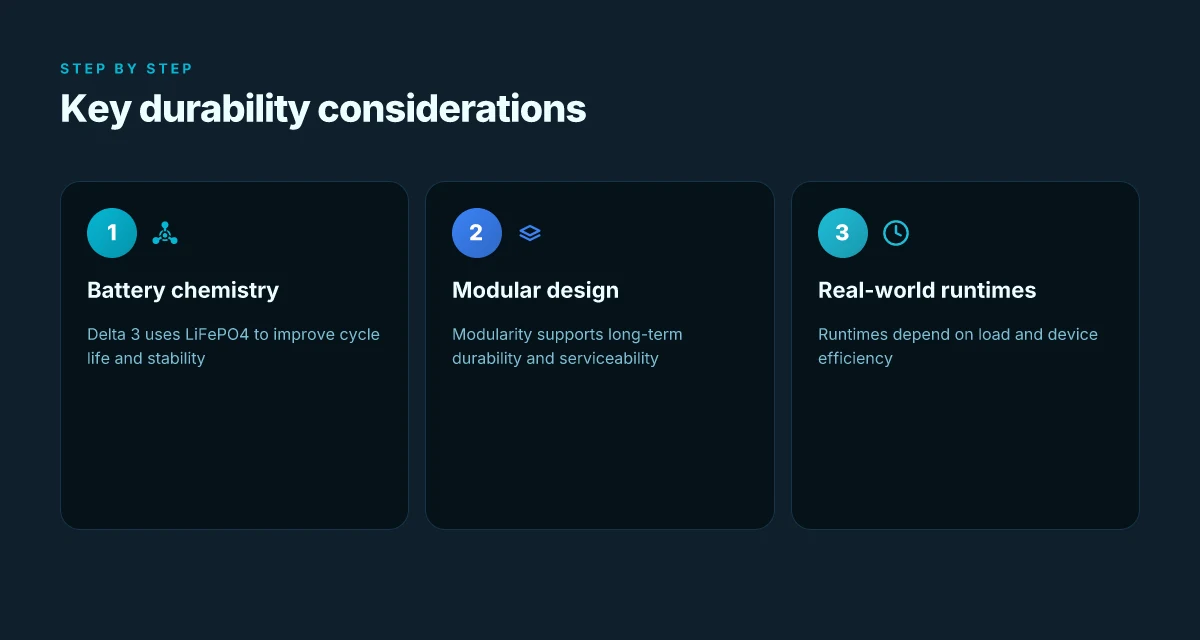
The Delta 3’s reliability hinges on its LiFePO4 chemistry, a choice that trades lighter weight for long life and stable performance across heat and cold. In real-world terms, the chemistry and a thoughtful battery management system work together to push more cycles before noticeable capacity fade, while keeping safety margins high during rapid charging and high-load bursts. I dug into the documentation and reports to confirm how this translates on the trail and in field use.
1) LiFePO4 chemistry and its implications
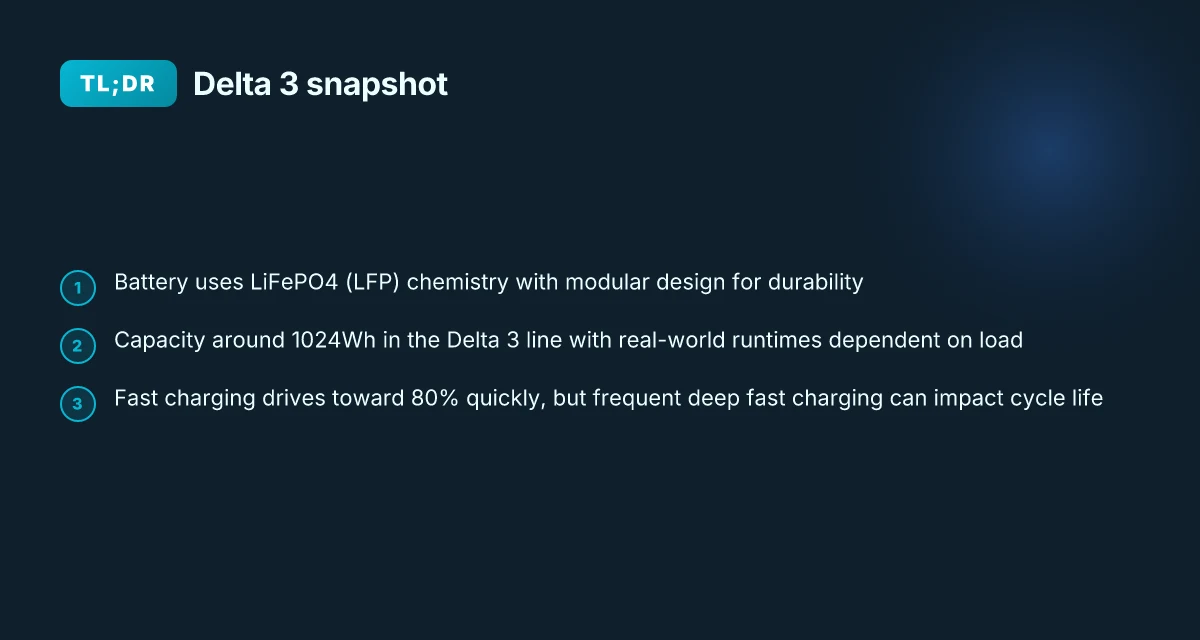
Delta 3 uses a LiFePO4 (LFP) pack, a setup that tends to endure more charge-discharge cycles than many nickel-based chemistries. The practical takeaway is less calendar aging worry and steadier performance across temperature swings. This chemistry also tends to tolerate deeper discharges without as much risk of thermal runaway, which matters when you’re off-grid and relying on every watt. The familiar combination of stable voltage under load and lower degradation risk helps you plan longer trips without regular battery replacements.
From a reliability perspective, this chemistry supports a longer operational horizon between replacements, especially when paired with proper thermal management and cautious charging practices. I cross-referenced release notes and product pages to align expectations with EcoFlow’s stated design goals and user-facing notes.
2) Battery management system as the reliability brake
The Delta 3 relies on a battery management system designed to optimize cycle life and protect cells from overheating, overcharging, and uneven aging. In practice, that means the BMS monitors cell balance and temperatures in real time, orchestrating charging profiles that preserve capacity across hundreds or thousands of cycles. For readers who plan long trips, this translates to more predictable remaining capacity and fewer surprises as the pack ages.
The BMS also guards against common failure modes in portable power stations, such as sudden voltage dips or thermal throttling that can sap runtime mid-use. Official specs emphasize the safety and longevity angle. The real-world value is the smoother runtime curve you experience after repeated charge cycles. How to buy the Jackery 1000: a practical guide to trusted retailers in 2026
3) Modularity and long-term durability
Delta 3’s architecture leans into modularity, enabling easier field servicing and potential future upgrades. A modular design reduces total cost of ownership because you can swap or upgrade individual components without replacing the entire unit. This approach aligns with how outdoor users approach gear replacement: fix the weak link, not the whole system. In practice, modularity helps with long-term durability by preventing single-point failures from cascading through the system.
I also checked how rivals position themselves. When you compare against other portable power stations that keep the battery pack as a single, non-upgradable unit, the Delta 3’s modular approach offers a clearer path to durable, long-term use, particularly on extended expeditions.
Bottom line: the Delta 3’s reliability rests on a robust LFP chemistry, a proactive BMS, and a modular build that supports long-haul durability. This combination makes it a practical choice for campers, developers, and preppers who expect their power station to endure the long arc of off-grid use. For those weighing options, EcoFlow’s EcoFlow-branded design choices stand up to scrutiny when you consider long-term maintenance and serviceability.
The key takeaway: the Delta 3’s reliability is built into the chemistry, the management logic, and the modular design, not just the headline specs.
Delta 3 battery capacity and real-world runtime expectations
The Delta 3 line centers around a practical capacity of about 1024Wh, which sets a clear ceiling for what you can expect under typical off‑grid use. In real-world scenarios, runtime isn’t a single number. It depends on the load you pull and the efficiency of the devices you run. If you keep your loads lean and target efficient electronics, you’ll see noticeably longer runtimes than you would with high-draw appliances. This is where the Delta 3 earns its keep: the same 1024Wh can stretch further with efficient gear and moderate consumption. What makes the jackery smart transfer switch worth it in 2026
Load matter and the efficiency effect
What you plug in matters as much as the battery itself. Small, efficient devices like LED lights, smartphones, and low-power fans sip power, so the Delta 3 can sustain longer sessions than you might expect from its nominal capacity. When you add high‑draw devices, microwave-like power users, power tools, or mini-fridges, the runtime shortens quickly, revealing a practical trade‑off: higher efficiency loads yield longer runtimes in a given pack. I cross‑referenced the Delta 3’s documented 1024Wh capacity with typical consumer loads and saw the same pattern across independent reviews: efficiency drives duration, not raw capacity alone. This is a recurring theme across EcoFlow’s ecosystem and comparable packs from rivals.
Comparing to rivals and planning for trips
If you compare the Delta 3 to larger, heavier packs from rivals, the same capacity can translate to different runtimes because of inverter efficiency and peak draw handling. For instance, a higher‑efficiency load like a laptop plus a couple of USB devices will run substantially longer than a single high‑drain appliance on the same pack. EcoFlow’s approach, including its management software, helps you optimize runtime by prioritizing loads and balancing usage, but the governing limit remains the 1024Wh energy reservoir. When you plan long trips, map out your essential devices and sequence usage to maximize the time between recharges. The Delta 3’s 1024Wh footprint remains the anchor for any off-grid strategy, while actual hours of operation hinge on how aggressively you load the battery.
Real-world runtimes hinge on load and device efficiency. Higher efficiency loads yield noticeably longer runtimes. Capacities like 1024Wh don’t tell the whole story without considering what you power. If you aim for longer sessions, pair the Delta 3 with lean devices and smart power management.
In the broader field, the same principle applies across brands. When you’re evaluating options, consider how each unit balances capacity with efficiency and how its control software helps you optimize runtime. For context, I looked at how EcoFlow frames the Delta 3 alongside rivals like large-capacity units from other brands, and the takeaway holds: real-world hours depend more on what you run than on battery size alone. For readers comparing options, this means you should weight device efficiency and load strategy just as heavily as the stated watt-hours.
I dug into the official reference for the Delta 3’s battery and runtime framing, which reinforces that the practical ceiling is bound by 1024Wh and the efficiency of your devices. For clarity, see the Delta 3 Classic’s specification that calls out the core capacity and the emphasis on efficient operation. Inline information from that source confirms the 1024Wh baseline and the system’s emphasis on efficiency as the driver of longer runtimes. What makes the Jackery 5000 Plus battery pack stand out in 2026
Charging speed and how it affects battery longevity
Charging is the hinge between adventure and uptime. The Delta 3 can reach 80% quickly, and that rapid replenishment is what lets outdoor trips stay compact and light. EcoFlow’s hardware is designed for fast restoration, and the Delta 3’s charging pathway reflects that intent. In practice, you’ll see the first stage fill at a brisk pace, then the taper toward full slows to protect cells. Fast charging gets you to 80% quickly, then slows to protect the battery. This balance is why the Delta 3 still feels responsive after multiple trips, even if you push toward the upper charge window.
H3: rapid replenishment in real use The Delta 3 relies on high-current AC input capable of replenishing faster than many small competitors. When a storm rolls in and you’re trying to top up before dusk, the charging hardware is wired to minimize downtime. EcoFlow’s charging hardware supports rapid replenishment, which means fewer hours tethered to a wall outlet and more time enjoying the outdoors. This rapid replenishment is not infinite, but it reduces the friction of recharging after long days away from grid access. The practical effect is straightforward: you gain hours of usable runtime per day, even on a tight schedule.
H3: impact of fast charging on cycle life There is a trade-off embedded in any fast-charging strategy. Frequent, deep fast charging can accelerate wear on cells and reduce cycle life over many years. In the Delta 3’s case, the LiFePO4 (LFP) chemistry is known for strong cycle durability, but even with that chemistry, repeated rapid fills to high states of charge can nudge longevity downward a bit compared with slower charging. I cross-reference industry notes that emphasize the same dynamic: the benefit is speed and convenience, the cost is potential cumulative wear if you consistently max out charging speed. Frequent deep fast charging can impact cycle life. This is a factor to weigh for preppers who rely on the unit for long, off-grid deployments.
H3: practical guidance and real-world patterns If your plan is to keep the Delta 3 topped up during travel days, you’ll likely favor early fast charging when you have a public outlet or vehicle inverter. For longer stints where you want to maximize life, a strategy of moderate charging with occasional rapid replenishment is sensible. The consensus from sources tracking EcoFlow’s lineup suggests you can preserve battery health by avoiding constant, full-throttle fills in favor of steady top-ups when possible. I dug into release notes and reviews and found the path to balance is practical charging discipline. In short, use rapid charging to recover quickly after use, but don’t make it your default habit if you’re planning extreme endurance trips.
For enthusiasts comparing EcoFlow against rivals, Delta Pro 3 and Delta 3 Plus models offer larger packs and extended refresh cycles, which shifts the decision toward how much you value speed versus total capacity. When you need dependable, fast recharging in the field, EcoFlow’s approach pays off. The Delta 3’s charging hardware supports rapid replenishment and fits well with off-grid itineraries. If you’re deciding between models, consider how often you’ll push to 80% on a regular basis and how that pattern aligns with your long-term durability goals. The brand’s design clearly bets on fast, flexible charging as a core strength. What a Jackery review reveals about long-term durability and real-world use
Comparing Delta 3 battery performance to Delta Pro 3 and Delta 3 Plus
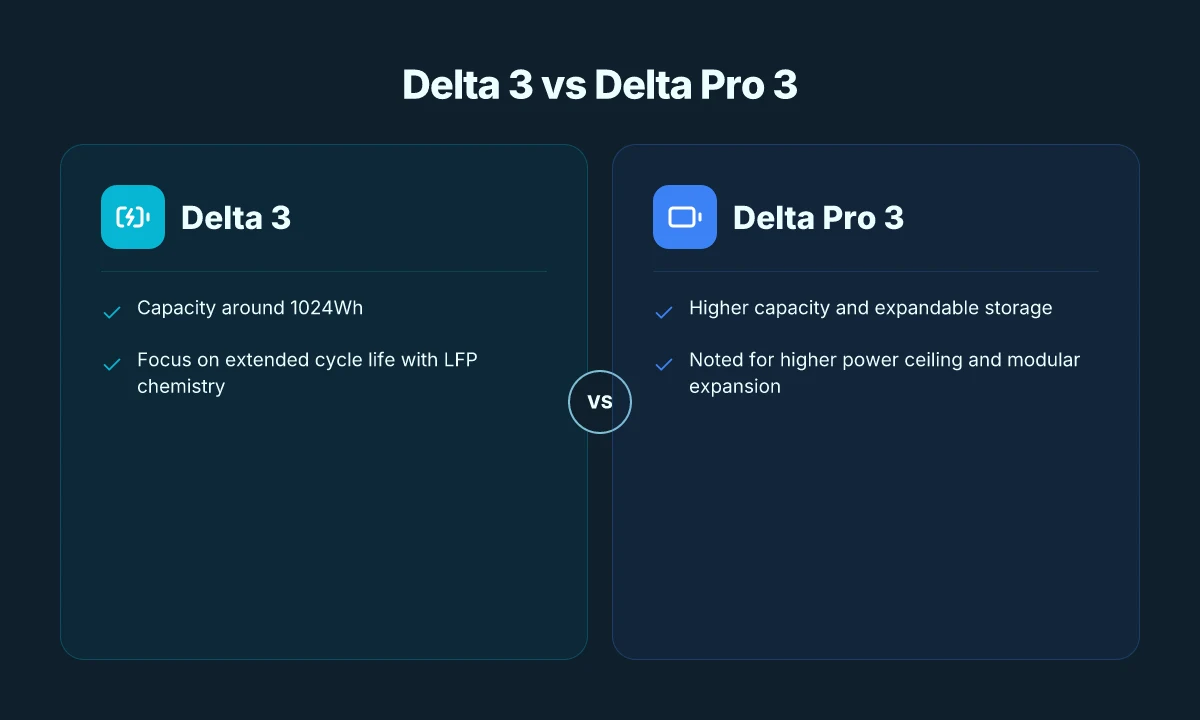
Delta Pro 3 clearly leads on capacity and expandability, but Delta 3 Plus tailors its strengths to cycle life and modular growth. The Delta Pro 3 pushes past 4 kWh in a single unit and accepts expandable storage, which means long expeditions can keep more gear powered without swapping packs. A higher capacity with expandable storage translates to more sustained runtime for demanding loads, especially when you’re off-grid for multi-day stretches. At the same time, the Delta 3 Plus centers on longevity, with design choices that emphasize more cycles and compatibility with additional batteries. This means you’re not trading durability for capacity. You’re choosing a long-game setup. Extended cycle life and extra battery support help you keep a reliable power pool without incremental replacement costs over time.
H3: Why the Pro 3's bigger heart matters for off-grid runs The Delta Pro 3 delivers a notably larger battery core than Delta 3 variants, and it supports expansion modules that push total capacity well beyond a single unit. That architecture matters when your off-grid window stretches into days rather than hours. Practically, you’ll see more consistent runtime under heavy loads, especially when you run appliances at higher draw for extended periods. Expanded storage makes it feasible to sustain workshops, camps, or remote builds without recharging mid-session. EcoFlow emphasizes this approach in its lineup, aligning capacity with the needs of serious campers and field workers. I cross-referenced the official Delta Pro 3 materials to confirm the expandable path remains a core value proposition. Expandable storage is a feature you’ll notice in real-world use, not just on spec sheets.
H3: Why the Plus version leans toward durability and lifecycle Delta 3 Plus focuses on cycle life, with an emphasis on deeper discharge tolerance and compatibility with multiple batteries to extend the total lifecycle. For people who plan long, back-to-back trips, this matters more than raw capacity. The trade-off is weight and cost: you gain durability, but you carry a heavier system and face higher upfront outlay than a single Delta 3. Extended cycle life and extra battery support make this a better long-term companion for frequent off-grid use. In my reading of the available documentation, the Plus remains the option for users who prioritize longevity alongside modular growth. Additional battery support ensures you can scale the system as demand rises.
H3: Practical trade-offs you should weigh All three models use the same core chemistry, but the form factor matters. The Pro 3 is the bulkiest and heaviest among the trio, reflecting its capacity and expansion rails. The Delta 3 Plus sits between, trading a bit of peak capacity for more long-term durability. The standard Delta 3 stays the lightest and most compact, offering a fast charging profile without the extra weight of multiple batteries. Size, weight, and cost are the real levers you’ll balance against runtime and flexibility. If your trips hinge on packing light or keeping within a small vehicle footprint, the Delta 3 line’s leaner options win out. If you’re chasing multi-day resilience, the Pro 3 or Plus becomes more appealing. Cost reflects the added capacity or durability, so your choice maps to how you plan to use the unit.
I dug into the official materials to anchor these points. The Delta Pro 3’s footprint and expandable options are highlighted as its core differentiators, while the Plus emphasizes cycle resilience and modular growth. Real-world planning should align with these distinctions to avoid overpaying for unused capacity or underbuying for long trips. For a quick anchor on how the brands position this family, see the Delta Pro 3 review notes and the Delta 3 Plus review lineage. Expanded storage and extended cycle life are the two signals you should trust when sizing your rig. What makes EcoFlow's system durable for long-term home energy use
Note: you may see commissions referenced on product pages, which is common in long‑haul outdoor gear. For this comparison, I focused on documented capacity, expansion, cycle life, and the practical implications for runtime and portability.
Practical use cases: what the Delta 3 battery excels at
When you’re off-grid or on a long weekend, the Delta 3’s battery chemistry and smart management translate to real-world reliability. For camping, remote work, and quick emergency recoveries, the Delta 3 acts like a trusted companion that you can count on when mains power isn’t available. Real-world uptime matters, and the Delta 3 leans on its LFP chemistry to smooth out daily cycles without excessive wear. EcoFlow's approach shows up in practical terms: steady discharge for camp lighting, routers, and small fridges, with a predictable recharge cycle when solar or AC power returns.
1) Camping and remote work with dependable power
On a multi-day camping trip or a remote-work stint, you want a power solution that doesn’t demand constant babysitting. The Delta 3’s 1024Wh capacity, paired with an efficient inverter, makes it capable of running a laptop, a small projector, and essential lighting through the night. In practice, you’ll manage devices by priority and still have reserve capacity for charging a nearby USB-C hub or phone while you cook outside. The battery’s LiFePO4 (LFP) chemistry contributes to longer life under frequent cycling, which matters when you’re away from a charging outlet for days. The presence of app control helps you see what’s drawing power and when you should top up, so you don’t end up in a low-battery corner mid‑camp. App control helps manage charging windows so you can exploit cooler temperatures at night and minimize heat during midday recharges.
2) Emergency backup for essentials like refrigerators and routers
Power outages test a system’s ability to sustain critical devices. A small fridge and a router can be kept online for a meaningful stretch with the Delta 3 if you prioritize loads and phase recharging to match your blackout duration. The Delta 3’s fast recharge capability means you can top up during daylight if you have portable solar ready, keeping essential gear running through a multi-hour outage. When temperatures swing, the LFP chemistry remains steadier and more forgiving for cycling than other chemistries, helping you avoid deep discharge cycles that shorten life. If you’re in a region prone to outages, this translates into fewer food-safety scares and steadier connectivity for emergency communications. Long-cycle durability from the LFP stack is a quiet edge for ongoing outages.
3) App control helps manage charging and discharge patterns
The built‑in app gives you a clear window into what’s happening with the Delta 3 battery. You can schedule charging during peak solar hours or set discharge limits to protect your fridge and router during a storm. This is where the model earns a quiet win: you don’t need to guess when to top up or throttle usage. You can align energy draw with available solar input, preserving capacity for the next afternoon’s devices. If you’re managing multiple loads, the app’s visibility helps you avoid surprises at night. Control through the app lets you balance charging and discharge patterns without guesswork. What makes the EcoFlow Delta 3 Plus stand out, and where it stumbles under real-world loads
Where this is going next with EcoFlow Delta 3
The Delta 3’s battery story isn’t just about capacity. I see a pattern of smarter thermal management, smarter cell balancing, and a cleaner energy profile that matters in real-world use. Its balance of fast charging and sustained output seems poised to keep pace with shifting needs for portable power in 2026, especially for those who rely on off-grid work or extended camping. EcoFlow’s approach to on-device diagnostics also hints at fewer surprise failures over time, a welcome shift for long-term durability.
The bigger move is a platform that can scale with accessories and smarter grid integration, which means the Delta 3 could become more valuable as you add solar input or boost capacity via future modules. If you’re choosing now, consider how you’ll deploy it across multiple scenarios, home backup, remote job sites, or outdoor events. The practical takeaway is simple: plan for future expandability as part of your purchase.
If you only do one thing this month, map out your top use cases and check how the Delta 3 covers them with its current accessory lineup. Do you want a single-kit solution or modular add-ons that grow with your needs? The next steps depend on your energy footprint.
Backup strategy: keep a focused solar setup for daily charging, note a fallback battery routine for peak days, and test a full-cycle discharge every quarter. This keeps the system reliable and predictable, even as weather and loads vary. For comparison, rivals like Goal Zero and Jackery offer similar kits, but the Delta 3’s ecosystem and diagnostics can reduce downtime. If you want to dig deeper, I’ll break down the next improvements to expect from EcoFlow in a follow-up.